
You are currently browsing the category archive for the ‘Mickey Mouse’ category.
Director: David Hand
Release Date: January 19, 1935
Stars: Mickey Mouse
Rating: ★
Review:
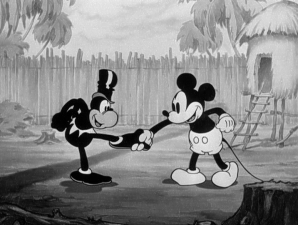 Like in ‘The Castaway‘ (1932), Mickey has been shipwrecked, and he’s washed ashore at a tropical island full of cannibals.
When the cannibals try to cook a young native, Mickey scares them away in order to rescue the poor fellow. He then adopts this young native and they build a fort together, which they finish just in time, before the cannibals return to attack them. These eventually manage to overrun Mickey’s defense, and Mickey and the native flee on a self made ‘ship’.
Even when compared to Disney’s two other embarrassing cartoons about cannibals (the Silly Symphony ‘Cannibal Capers‘ (1930) and ‘Trader Mickey‘ (1932, curiously also directed by David Hand), the depiction of natives in ‘Mickey’s Man Friday’ is backward and humiliating. Mickey’s man Friday uses his feet more than his hands and appears to be more closely related to apes than to man. This is so sickening to watch that this is one of the very rare cartoons of which I feel that they could have remained under the rug, despite the fast and clever ‘invention gags’ featured in this cartoon, which foreshadow comparable gags in ‘The Flintstones’.
Watch ‘Mickey’s Man Friday’ yourself and tell me what you think:
This is Mickey Mouse cartoon No. 72
To the previous Mickey Mouse cartoon: Two-Gun Mickey
To the next Mickey Mouse cartoon: The Band Concert
Director: Burt Gillett
Release Date: September 29, 1934
Stars: Mickey Mouse, Pluto
Rating: ★
Review:
 Mickey Plays Papa’ reuses the concept of Mickey receiving orphans from ‘Mickey’s Orphans‘ from 1931. But this time he has to deal with only one orphan mouse, called Elmer.
The film is particularly noteworthy for its scary opening: while Mickey’s reading a scary novel titled “the cry in the night” in bed, someone’s laying the orphan on his doorstep, whose cries startle Mickey and Pluto. When Mickey and Pluto discover that these cries are caused by a cute little baby, they both try to comfort him. These attempts include a nice Charlie Chaplin imitation by Mickey. This cartoon also contains a gag in which Mickey’s being attacked by numerous kitchen tools, which was copied in ‘Who Framed Roger Rabbit‘ (1988).
But most importantly, the cartoon contains long character-based solo sequences, like Mickey’s trouble with a rubber nipple and Pluto’s antics with a toy bunny and a fishbowl. This type of elongated solo scenes, alternating between the two characters, appear for the first time in this cartoon, but unfortunately they’re not very funny here. Nevertheless, they would become a dominant style element of the Mickey Mouse cartoons of the rest of the 1930s, especially in the Mickey, Donald and Goofy trio outings, luckily often with way more hilarious results.
‘Mickey Plays Papa’ ends when Mickey’s released from the rubber nipple and he finally succeeds in making the baby laugh, by doing a Jimmy Durante imitation with his elongated nose. It would be the last cartoon directed by Burt Gillett before he left Disney in March 1934 for the Van Beuren Studios, only to return in 1937 to direct two other cartoons, the excellent ‘Lonesome Ghosts’ (1937) and ‘The Moth and the Flame’ (1938).
Watch ‘Mickey Plays Papa’ yourself and tell me what you think:
This is Mickey Mouse cartoon No. 69
To the previous Mickey Mouse cartoon: Orphan’s Benefit
To the next Mickey Mouse cartoon: The Dognapper
Director: David Hand
Release Date: June 16, 1934
Stars: Mickey Mouse, Minnie Mouse, the orphan mice
Rating: ★★★
Review:
 Two of the orphan mice used in ‘Giantland‘ (1933) and ‘Gulliver Mickey’ (1934) appear in this cartoon.
It’s unclear whether these two brats are Mickey’s nephews Morty and Ferdy, who were created by Floyd Gottfredson in the Mickey Mouse comic in 1932, as they’re not named in this short. If they are, this film marks their only screen appearance, for, unlike Donald’s nephews, they don’t appear in any other film. Anyway, as in the comic strip, these two brats are full of mischief.
This time they steal Mickey’s anthropomorphized steam roller, while Mickey’s flirting with Minnie. The two kids manage to destroy a bridge, a streetcar, a complete hotel and the steamroller itself, but in the end Mickey’s not mad at them, just laughing.
‘Mickey’s Steamroller’ is a real gag-cartoon. Yet, it is not particularly funny and it has an old-fashioned feel to it, especially after such elaborate entries in the Mickey Mouse series, as ‘Mickey’s Gala Premier‘ and ‘Giantland‘.
Watch ‘Mickey’s Steamroller’ yourself and tell me what you think:
This is Mickey Mouse cartoon No. 67
To the previous Mickey Mouse cartoon: Gulliver Mickey
To the next Mickey Mouse cartoon: Orphan’s Benefit
Director: Burt Gillett
Release Date: March 3, 1934
Stars: Mickey Mouse, Pluto
Rating: ★★★★
Review:
 Playful Pluto consists of several loose gags around Mickey and Pluto in a garden. It contains Mickey’s first encounter with a little whirlwind, which he manages better than his second one in ‘The Little Whirlwind’ from 1941.
But ‘Playful Pluto’ is most notable for the now famous flypaper sequence, in which Pluto gets caught in flypaper. This is an important scene in animation history, because it’s the first time Pluto is seen as a thinking character. Not only that, it is arguably the first believable animation of thought processes. This illusion of thought is achieved solely by pantomime animation.
The flypaper scene elevated its animator, Norm Ferguson, to the eternal hall of animation fame and it showed how laughs could originate in character animation alone. This sequence not only raised the standards of animation of Pluto, but of character animation in general. As to celebrate its success, this scene was remade in color for the Donald Duck short ‘Beach Picnic‘ (1939).
At the same time, this cartoon shows how character-based gags could slow down the pace. This was an unfortunate side-effect, for this high pace had been painstakingly achieved in the Mickey Mouse cartoons during the previous years.
Watch ‘Playful Pluto’ yourself and tell me what you think:
This is Mickey Mouse cartoon No. 65
To the previous Mickey Mouse cartoon: Camping Out
To the next Mickey Mouse cartoon: Gulliver Mickey
Director: Burt Gillett
Release Date: September 30, 1933
Stars: Mickey Mouse, Minnie Mouse
Rating: ★★★
Review:
 Mickey is a jockey in a horse race.
Unfortunately, his horse Thunderbolt gets drunk just before the race starts. So he rides a pantomime horse, with his two black stable boys in it, instead. Remarkably, they win, due to a colony of angry and determined wasps, who chase the two poor black boys to the finish and into the distance, while Mickey receives all the glory.
‘The Steeple Chase’ is one of those ‘adventure type stories’ Mickey began having in 1932, and which were undoubtedly inspired by Floyd Gottfredson’s comic strip. ‘The Steeple Chase’ is a prime example: it shows clear similarities to ‘Mickey Mouse and his horse Tanglefoot‘, which ran about the same time (from June to October 1933). The colonel from ‘The Steeple Chase’ returns in that comic strip as a grumpy judge.
The early scenes firmly state why Mickey should win the race, e.g. when Minnie tells him “you gotta win, Mickey, or you’ll break the colonel’s heart”. Thus we are more involved in the horse race then in Mickey’s boxing game in ‘Mickey’s Mechanical Man‘ from earlier that year. Nevertheless, it remains a fact that Mickey’s actually cheating in both these cartoons, and misusing the two black stable boys while doing so. This makes it rather difficult to sympathize with Mickey. Moreover, the race is hardly as exciting as the one in ‘Barnyard Olympics‘ (1932), and the cartoon is by all means inferior to Gottfredson’s classic comic strip. The best gags come from the numerous ways in which the wasps attack Mickey and his fake horse.
Watch ‘The Steeple Chase’ yourself and tell me what you think:
This is Mickey Mouse cartoon No. 60
To the previous Mickey Mouse cartoon: Puppy Love
To the next Mickey Mouse cartoon: The Pet Store
Director: Wilfred Jackson
Release Date: June 17, 1933
Stars: Mickey Mouse, Minnie Mouse
Rating: ★
Review:
 Mickey has build a robot to fight a gorilla in a boxing match, which is called “the battle of the century: machine vs. beast”.
Mickey’s robot has one disadvantage: he runs wild when he hears Minnie’s car horn. Luckily, this fact helps him in the end: when he’s clobbered by the gorilla (on the tune of Franz Liszt’s second Hungarian rhapsody), he seems almost lost. But then Minnie fetches her car horn, revitalizing the robot. From that point he actually cheats, using multiple boxing gloves, a hammer and hits below the belt.
Despite its clear story and high quality animation, ‘Mickey’s Mechanical Man’ is a very weak short, and a low point in the otherwise outstanding Mickey Mouse year of 1933. The cartoon is surprisingly low on gags and it’s difficult to sympathize with the robot character, as it’s mechanical after all, while the gorilla is a living being. Moreover, Mickey’s motives remain unclear and we’re not invited to care about the match.
The cartoon most interesting feat. are the robot’s jerky movements, which are clearly mechanical and based on wind-up toys, but which become rather frantic and ridiculously elaborate when the robot goes wild. Nevertheless, there are some traces of Stan Laurel’s boxing moves from ‘Any Old Port’ (1932).
‘Mickey’s Mechanical Man’ is reminiscent of the Fleischer Studio’s equally weak ‘The Robot‘ (1932). Both films were inspired by rather hysterical stories about robots taking over jobs, which circulated in the early 1930s, and which struck a chord in an era of vast unemployment.
Watch ‘Mickey’s Mechanical Man’ yourself and tell me what you think:
This is Mickey Mouse cartoon No. 57
To the previous Mickey Mouse cartoon: The Mail Pilot
To the next Mickey Mouse cartoon: Mickey’s Gala Premier
Director: Burt Gillett
Release Date: February 28, 1933
Stars: Mickey Mouse, Minnie Mouse, Pluto
Rating: ★★★½
Review:
 ‘Mickey’s Pal Pluto’ shows how important Pluto had become by 1933.
It’s the first cartoon having the sympathetic mutt in its title, and it’s he, not Mickey or Minnie, who’s the real star of this short, arguably making ‘Mickey’s Pal Pluto’ Pluto’s first own cartoon.
In ‘Mickey’s Pal Pluto’ Pluto saves a few little kittens from drowning. Mickey and Minnie take them home, but there Pluto grows jealous of the intruders, exemplified by a conflict between his devilish and angelic sides, who materialize outside him, and who speak in rhyme. Unfortunately, when Pluto listens to his little devil, this leads to Mickey putting him outside. Nevertheless, when the kittens fall into a well, Pluto rescues the kittens from drowning again, almost drowning himself in the act. In the end he’s rewarded for this unselfish behavior with a roast chicken.
The moral clearly is that being good will be rewarded, as Pluto’s angel character clearly states in the end. So some of the childish sentimentality that had entered the Silly Symphonies in 1933 sneaks in to the Mickey Mouse series, as well.
‘Mickey’s Pal Pluto’ marks the first appearance of Pluto’s imaginary little devil and angel, symbolizing his inner conflict. This cartoon was more or less remade in color in 1941, titled ‘Lend a Paw’. Pluto’s little devil would reappear in ‘Mickey’s Elephant‘ (1936).
Watch ‘Mickey’s Pal Pluto’ yourself and tell me what you think:
This is Mickey Mouse cartoon No. 53
To the previous Mickey Mouse cartoon: The Mad Doctor
To the next Mickey Mouse cartoon: Mickey’s Mellerdrammer
Director: Burt Gillett
Release Date: November 12, 1932
Stars: Mickey Mouse, Minnie Mouse, Pluto
Rating: ★★½
Review:
 The Wayward Canary’ follows the same story line as ‘The Barnyard Broadcast‘ (1931) and ‘Mickey’s Revue‘ (1932). Like in these films, a song-and-dance routine is interrupted by numerous animals causing havoc.
This time, Mickey gives Minnie a canary for a present. It appears to have numerous offspring. These little birds escape and fly all over the house. Before they’re all caught, the complete house is wrecked.
Among the numerous gags there’s a surreal one when Pluto and a cat run through a wringer, which renders them flat. By 1932 such extreme body deformities had become extremely rare in Disney cartoons, and soon they would vanish altogether, as they were not in tune with Disney’s search for the ‘plausible impossible’. It was up to Tex Avery at Warner Brothers to revive gags like these in the late 1930s.
Among Minnie’s household there is a lighter with a swastika on it [update: see animation historian David Gerstein’s comment below for an explanation]. She also has signed portraits of Douglas Fairbanks and Mary Pickford. Together with Charlie Chaplin and D.W. Griffith, these two actors were the co-founders of United Artists, the company Disney had joined in 1932.
These portraits are the first caricatures of real people in a Mickey Mouse film. Although Mickey and Minnie were only slowly shedding their barnyard background, these signed portraits are not too surprising accessories, considering Mickey’s enormous popularity in the early 1930s. Moreover, they suggest that Mickey and Minnie, although being cartoon characters, live in the real world, among other Hollywood stars. This concept would be developed further in the next year, in the superb ‘Mickey’s Gala Premier‘.
Watch ‘The Wayward Canary’ yourself and tell me what you think:
This is Mickey Mouse cartoon No. 48
To the previous Mickey Mouse cartoon: Touchdown Mickey
To the next Mickey Mouse cartoon: The Klondike Kid
Director: David Hand
Release Date: August 20, 1932
Stars: Mickey Mouse, Pluto
Rating: ★
Review:
 Mickey is a trader in Africa. He is captured by a bunch of hungry cannibals, whose king laughs with Goofy’s guffaw*.
The cannibals ruin Mickey’s trade, which consists mostly of musical instruments. When Mickey grabs a saxophone, he launches a long song-and-dance-routine, making the short old-fashioned when compared to contemporary Mickey Mouse cartoons like ‘Barnyard Olympics‘, ‘Mickey in Arabia‘ and ‘Mickey’s Nightmare’.
The cartoon is hampered further by severe and backward caricatures of African natives. They’re shown as extremely dumb, and halfway apes and humans. Among the offensive images are shots of cannibals playing instruments with their feet, and others of cannibals with gigantic duck-like lips. In any case practically all the gags originate in the cannibals’ ignorant use of Mickey’s trade, which make the film a tiresome watch today, despite its jolly atmosphere. The cannibals would also appear in Floyd Gottfredson’s contemporary Mickey Mouse strip, starting at August 17. The strip borrowed several images from the animated cartoon, including the fat king and his cook.
‘Trader Mickey’ was the first short directed by David Hand (1900-1986), who’d become Disney’s third director after Wilfred Jackson and Burt Gillett. Hand had joined the Disney studio as an animator in early 1930, just after the departure of Ub Iwerks. As a director he would create many wonderful shorts, like ‘The Mad Doctor‘ (1932) and ‘Who Killed Cock Robin‘ (1935). Then he advanced to features, directing ‘Snow White and the Seven Dwarfs’ (1937) and ‘Bambi‘ (1942). Hand would leave the Disney studio in July 1944 to set up his own studio in England.
Unfortunately, ‘Trader Mickey’ cannot be regarded a great start of Hand’s directing career. It’s a weak film, based on ingredients from the equally weak ‘Cannibal Capers‘ (1930) and ‘The Delivery Boy‘ (1931). Hand would nevertheless maintain a high standard in all his next films, the only other failures being ‘Mickey’s Man Friday‘ (unfortunately also starring cannibals) and ‘The Robber Kitten‘, both from 1935.
Watch ‘Trader Mickey’ yourself and tell me what you think:
This is Mickey Mouse cartoon No. 45
To the previous Mickey Mouse cartoon: Mickey’s Nightmare
To the next Mickey Mouse cartoon: The Whoopee Party
*Goofy himself had just made his first appearance in ‘Mickey’s Revue‘ from three months earlier and there was not yet an indication that this character was here to stay, or that this laugh was exclusively his.
Director: Wilfred Jackson
Release Date: April 13, 1932
Stars: Clarabelle Cow, Horace Horsecollar, Mickey Mouse, Minnie Mouse, Pete
Rating: ★★★★★
Review:
 As the title implies, there’s a great sports event at the barn.
Mickey is joining a cross country race that involves running, rowing and cycling (which is beautifully animated). His main opponent is a rather unrecognizable Pete, who looks like just a big mean cat without a peg leg.
‘Barnyard Olympics’ was inspired by the upcoming Summer Olympics in Los Angeles in 1932. It’s a brilliant gag cartoon: it’s fast, consistent and exciting, and without doubt one of Mickey’s finest. It immediately starts with an excellent gag when a spectator suddenly discovers he’s being filmed and waves at ‘the camera’.
In a way ‘Barnyard Olympics’ marks Goofy’s debut. He’s not seen at all, but during a boxing match his characteristic laughter, provided by story man Pinto Colvig, can already be heard. In Mickey’s next film, ‘Mickey’s Revue‘, Goofy would appear on the screen himself.
With ‘Barnyard Olympics’ Mickey entered the zenith of his career. His films from 1932-1934 are his best. Almost all portray him as the little, but brave underdog fighting the odds, and importantly, in these films Mickey still is the star himself. After 1934 Mickey became more and more of a straight man, losing screen time to Pluto, Donald and Goofy. Yes, the Mickey Mouse films from the second half of the 1930s are also great, but by then Mickey’s own stardom was in a clear decline. But in ‘Barnyard Olympics’, like the other films from 1932-1934, he’s still in top form as the greatest cartoon star of his era.
Watch ‘Barnyard Olympics’ yourself and tell me what you think:
This is Mickey Mouse cartoon No. 40
To the previous Mickey Mouse cartoon: The Mad Dog
To the next Mickey Mouse cartoon: Mickey’s Revue
Director: Burt Gillett
Release Date: February 27, 1932
Stars: Mickey Mouse, Pete, Pluto
Rating: ★★★½
Review:
 When Mickey is washing Pluto, Pluto accidentally swallows a piece of soap.
He runs into the street where he’s seen as a mad dog. There he confronts Pete (with peg leg), who is a dog catcher and who wants to shoot Pluto…
‘The Mad dog’ is a fast gag cartoon with a clear story from the beginning to the end. By now, the Disney studio could produce amazingly consistent stories. Moreover, effect animation had fully penetrated the Mickey Mouse cartoons. The washing scene, for example, is full of difficult and extraordinarily lifelike animation of splashing water.
Watch ‘The Mad Dog’ yourself and tell me what you think:
This is Mickey Mouse cartoon No. 39
To the previous Mickey Mouse cartoon: The Grocery Boy
To the next Mickey Mouse cartoon: Barnyard Olympics
Director: Wilfred Jackson
Release Date: July 11, 1932
Stars: Mickey Mouse, Minnie Mouse, Pete
Rating: ★★★★
Review:
 ‘Mickey in Arabia’ can be described as ‘Gallopin’ Gaucho‘ in Arabia.
In this short Mickey and Minnie are tourists visiting some mythical Arabian country on a camel. Here they meet Pete, who has both his legs here, and who apparently is some sort of sheik. Pete captures Minnie, which leads to an exciting finale, which consists of continuous series of gags.
Despite its all too familiar story outline, ‘Mickey in Arabia’ is a major step forward in the Mickey Mouse series. It places Mickey outside his familiar barnyard and performance settings, and sends him on an adventure abroad, similar to the ones Mickey was having in Floyd Gottfredson’s comic strip of the same time. Mickey is at his best as the little hero, and he excels here. Gottfredson himself sent Mickey to Arabia, too, but only two years later, at the end of 1934. His comic strip ‘The Sacred Jewel’ borrows a lot of images from this 1932 film.
The adventure notwithstanding, the Disney story men didn’t forget to fill the short with gags, making ‘Mickey in Arabia’ a fast paced and funny short. It also has a great score, which makes excellent use of Albert Ketèlbey’s ‘In a Persian Market’ to create an Arabian atmosphere.
With ‘Mickey in Arabia’, the studio had hit the jackpot storywise, and in the next two years Mickey would play the little hero more often, with delightful results. Indeed, already in the same year, ‘Mickey in Arabia’ would be topped by the even more excellent ‘Touchdown Mickey‘ and ‘The Klondike Kid‘.
Watch ‘Mickey in Arabia’ yourself and tell me what you think:
This is Mickey Mouse cartoon No. 43
To the previous Mickey Mouse cartoon: Musical Farmer
To the next Mickey Mouse cartoon: Mickey’s Nightmare
Director: Wilfred Jackson
Release Date: February 8, 1932
Stars: Mickey Mouse, Minnie Mouse, Pluto
Rating: ★★★½
Review:
 Mickey has to deliver groceries to Minnie. When he arrives, she’s baking a stuffed turkey in the kitchen. Mickey helps her cooking in a musical scene, based on the 12th Street Rag. But then Pluto steals the turkey, an event that leads to a grand finale in which Minnie’s kitchen is completely ruined. Nevertheless, Mickey and Minnie retain their optimistic spirit.
‘The Grocery Boy’, contains many fine gags, the best of which is Mickey throwing a dish in the trash can immediately after he has finished preparing it. The structure of this short is very similar to those of the earlier ‘Mickey Steps Out‘ and ‘Mickey Cuts Up‘ from 1931, being part musical number and part gags leading to ruin. The finale is fast-paced and gag-rich, and saves a film that started a little bit dull.
Watch ‘The Grocery Boy’ yourself and tell me what you think:
This is Mickey Mouse cartoon No. 38
To the previous Mickey Mouse cartoon: The Duck Hunt
To the next Mickey Mouse cartoon: The Mad Dog
Director: Burt Gillett
Release Date: October 28, 1931
Stars: Clarabelle Cow, Horace Horsecollar, Mickey Mouse, Minnie Mouse, Pluto
Rating: ★★★½
Review:
 In ‘The Beach Party’ Mickey, Minnie, Clarabelle Cow, Horace Horsecollar and Pluto go picnicking on the beach. All goes well, until an evil octopus ruins their picnic, and they all have to battle against him.
‘The Beach Party’ is one of four 1931 Mickey Mouse cartoons to feature no musical routine, at all. Clearly, the Disney studio grew more and more confident in telling stories instead of musical numbers. And rightfully so, because ‘The Beach Party’ shows that Disney studio was more capable than any other studio in telling a good gag-filled story leading to a great finale. These were a welcome replacement to the tiring song-and-dance-routines. And so, by 1932, the musical numbers had almost disappeared from the Mickey Mouse cartoons.
Nonetheless, ‘The Beach Party’ knows no dialogue, and most of the movement is rhythmical, and set to a musical beat. The film’s greatest idea is the battle, because the gang’s means to chase the octopus away are entirely based on their eating habits as shown before. Such subtle and sophisticated story telling was unknown outside the Walt Disney studio at that time.
Notice, too, how Pluto and the crab resolve into speed lines when fighting. This effect was still pretty new at the time. The gag with the crab would be reused six years later to much better effects in ‘Hawaiian Holiday’.’The Beach Party’ is no classic, but secretly this film, too, shows Disney’s ambitions.
‘The Beach Party’ is also the first of only two shorts in which Mickey, Minnie, Clarabelle Cow and Horace Horsecollar are presented as four close friends, the other one being ‘Camping Out’ from 1934. Their friendship would become common practice in Floyd Gottfredson’s Mickey Mouse comics, starting with ‘Mickey Mouse and the Ransom Plot’ (July-November 1931).
In these comic strips Clarabelle Cow and Horace Horsecollar would become real personalities, something that never happened in the Mickey Mouse films. Indeed, soon after Mickey changed to color in 1935, Clarabelle Cow and Horace Horsecollar vanished from the screen, apart from an occasional cameo. Unfortunately, the same thing occurred in the Mickey Mouse strips: Horace’s and Clarabelle’s last major adventure with Mickey was ‘Race for Riches’ (July-September 1935), after which they were replaced by Goofy.
Watch ‘The Beach Party’ yourself and tell me what you think:
This is Mickey Mouse cartoon No. 34
To the previous Mickey Mouse cartoon: The Barnyard Broadcast
To the next Mickey Mouse cartoon: Mickey Cuts Up
Director: Burt Gillett
Release Date: September 30, 1931
Stars: Clarabelle Cow, Horace Horsecollar, Mickey Mouse, Minnie Mouse, Pluto
Rating: ★★★
Review:
 Mickey’s got his own radio station at the barn. There, Minnie, Horace Horsecollar and Clarabelle Cow perform some music to broadcast.
All goes well, until a cat and her little kittens cause havoc in the studio. Mickey has a hard time chasing them away, and during his efforts all instruments are destroyed.
‘The Barnyard Broadcast’ reuses the cat from ‘Mickey Steps Out‘ from two months earlier, and it introduces the numerous kittens that would cause Mickey lots of trouble in the subsequent films ‘Mickey’s Orphans‘ (1931) and ‘Mickey’s Revue‘ (1932). After that their role would be taken over by the orphan mice, introduced in ‘Mickey’s Nightmare‘ (1932).
After ‘Mickey Steps Out’, ‘The Barnyard Broadcast’ is another attempt in building a finale in a string of gags. The film is not entirely successful in this and only gains momentum when Mickey chases the cat away with a broom. The technique would be perfected in the subsequent films, ‘The Beach Party‘ and ‘Mickey Cuts Up‘.
Watch ‘The Barnyard Broadcast’ yourself and tell me what you think:
This is Mickey Mouse cartoon No. 33
To the previous Mickey Mouse cartoon: Fishin’ Around
To the next Mickey Mouse cartoon: The Beach Party
Director: Burt Gillett
Release Date: September 1, 1931
Stars: Mickey Mouse, Pluto
Rating: ★
Review:
 Mickey and Pluto go fishing in a no fishing area, but the fish are making fun of them.
Pluto even gets under water, sniffing the bottom of the lake and meeting an enormous fish. This scene reuses quite some animation of Pluto sniffing from Pluto’s debut ‘The Picnic‘ (1930). Then a gamekeeper appears, but Mickey and Pluto escape him. The goat-like gamekeeper would return in Floyd Gottfredson’s Mickey Mouse comic ‘Dr. Oofgay’s Secret Serum’ (July 1934).
Like ‘Traffic Troubles‘, ‘The Moose Hunt‘ and ‘The Beach Party‘ from the same year, ‘Fishin’ Around’ is a genuine gag cartoon. It is the weakest of the lot, however, and can hardly be called a classic. The tricks the fish pull at Pluto and Mickey are amusing, but nothing more than that. Both the fish and Pluto steal a lot of screen time from Mickey, who is blander than ever before in this short.
Nevertheless, the film is a modest example of how the Disney studio tried to improve the quality of its animation. Notice, for example, the reflections and other water effects in this short. By now, they had become standard in Disney cartoons. Moreover, the cartoon starts with some quite convincing animation of Mickey rowing. There’s some clear sense of pulling weight here, even though these cycles are interspersed with less convincing animation.
Watch ‘Fishin’ Around’ yourself and tell me what you think:
This is Mickey Mouse cartoon No. 32
To the previous Mickey Mouse cartoon: Blue Rhythm
To the next Mickey Mouse cartoon: The Barnyard Broadcast
Director: Burt Gillett
Release Date: June 6, 1931
Stars: Mickey Mouse, Minnie Mouse, Pete (cameo), Pluto
Rating: ★★
Review:
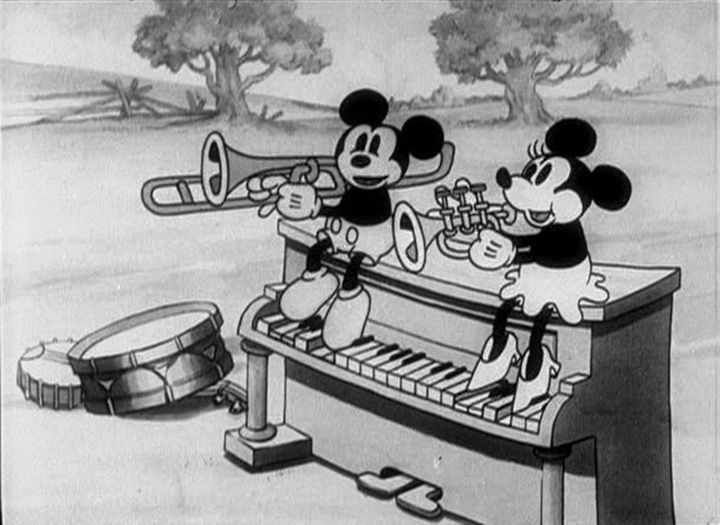 In ‘The Delivery Boy’ we watch Minnie doing the laundry in a pasture, singing the 1905 hit song ‘In the Shade of the Old Apple Tree’.
Mickey surprises her, and they dance the Charleston together to the background music. Mickey is so happy, he boxes a wasp’s nest. The wasp’s nest hits his donkey and his whole delivery, which consists of musical instruments, is spread over the pasture.
Undaunted, Mickey and Minnie start playing the piano, and all the farm animals join in, playing ‘The stars and stripes forever’. The cartoon ends when Pluto retrieves a burning dynamite stick and everything explodes. Nevertheless, Mickey is still able to finish playing John Philip Sousa’s famous march.
‘The Delivery Boy’ is as joyous as it is boring. After three years of song-and-dance routines one grows rather tired of it. Moreover, cartoons like ‘Traffic Troubles‘ and ‘The Moose Hunt‘ had proven that Mickey could do very well without them.
Pluto would cause havoc again in some of the succeeding films, like ‘Mickey Steps Out‘ (1931), ‘Mickey Cuts Up‘ (1931) and ‘The Grocery Boy‘ (1932). In these films the song-and-dance routine would give way to well-build gag-filled finales, of which the one in ‘The Delivery Boy’ is an embryonic version.
Watch ‘The Delivery Boy’ yourself and tell me what you think:
This is Mickey Mouse cartoon No. 29
To the previous Mickey Mouse cartoon: The Moose Hunt
To the next Mickey Mouse cartoon: Mickey Steps Out
Director: Burt Gillett
Release Date: April 30, 1931
Stars: Mickey Mouse, Pluto
Rating: ★★★½
Review:
 In ‘The Moose Hunt’ Mickey and Pluto are hunting moose.
They finally find a moose (or more exactly, the moose finds them). Unfortunately, in front of the moose, Mickey’s gun fails and soon the moose hunts both Mickey and Pluto. The chase ends with Mickey escaping on a flying Pluto.
‘The Moose Hunt’ is Mickey’s third gag only short, after ‘The Fire Fighters‘ (1930) and ‘Traffic Troubles‘ from earlier that year. It’s hardly as good as those earlier entries, though. Its pace is slow, and it contains some awkward gags, like the flying Pluto finale. It also contains a rare gag breaking the fourth dimension: when Mickey accidentally shoots Pluto, he suddenly addresses the audience with a “Is there a doctor in the house?”. Then, when Mickey begs Pluto to speak to him, Pluto actually speaks!
The self-conscious audience gag would remain a rarity at Disney, but it would become a staple gag at Warner Bros. when Tex Avery joined that studio. The two Pluto gags are totally out of character, and have nothing to do with him being a dog. After ‘The Moose Hunt’ we would never see Pluto flying or speaking again (apart from a short ‘Mammy’ at the end of ‘Mickey Steps Out‘), and after watching ‘The Moose Hunt’ it is easily understandable why not.
Luckily, there are other scenes that are more inspired, and in which Pluto behaves like a dog throughout. Indeed, in his very first solo scene, which reuses a little animation from ‘The Chain Gang‘ (1930), Pluto’s character as a little dumb and a little cowardly dog is pretty well established. Pluto’s looks are still unstable, but he’s excellently animated, throughout.
In ‘The Moose Hunt’ Pluto also gets his name (he was called ‘Rover’ in his first appearance in ‘The Picnic‘ from six months earlier). He now clearly is Mickey’s dog, not Minnie’s, like in the earlier film. It’s clear that the Mickey Mouse films could use an extra character, and after this film Pluto would appear in almost all succeeding Mickey Mouse films, stealing more and more screen time from Mickey.
Mickey would go hunting moose again in the way funnier ‘Moose Hunters’ from 1937, which, incidentally, doesn’t star Pluto.
Watch ‘The Moose Hunt’ yourself and tell me what you think:
This is Mickey Mouse cartoon No. 28
To the previous Mickey Mouse cartoon: The Castaway
To the next Mickey Mouse cartoon: The Delivery Boy
Director: Wilfred Jackson
Release Date: March 27, 1931
Stars: Mickey Mouse
Rating: ★★
Review:
 Mickey is a castaway, stranding on a tropical island.
Luckily, a piano is washed ashore as well, so Mickey performs for the jungle animals inhabiting the island. Unfortunately, an obnoxious little tiger disturbs him, and a great ape wants to play the piano, too, wrecking the instrument.
‘The Castaway’ was a short made out of rest material, and it shows: Mickey’s looks are wildly inconsistent, there’s not even a hint of a story, and the whole film feels like a throwback to 1929. Nevertheless, this short contains nice effect animation of waves washing ashore. It also reuses some animation of dancing sea lions from ‘Wild Waves‘ (1929) and of a dancing ape from ‘Jungle Rhythm‘ (1929), the film with which ‘The Castaway’ has most in common, which is no advertisement. In fact, Walt Disney disliked the film, thinking it didn’t look like a Walt Disney picture. And indeed, it hardly does.
The gag in which a lion gets eaten by a crocodile was borrowed from a very early Mickey Mouse comic strip from February 1930, which incidentally was the last panel drawn by Ub Iwerks himself.
‘The Castaway’ is also noteworthy for being the first Disney short to feature music by Frank Churchill, who would score many Disney shorts, and who would become particularly famous for the hit song ‘Who’s Afraid of the Big Bad Wolf’ from ‘Three Little Pigs‘ (1933) and the songs in ‘Snow White and the Seven Dwarfs’ (1937).
Watch ‘The Castaway’ yourself and tell me what you think:
This is Mickey Mouse cartoon No. 27
To the previous Mickey Mouse cartoon: Traffic Troubles
To the next Mickey Mouse cartoon: The Moose Hunt
Director: Burt Gillett
Release Date: October 9, 1930
Stars: Mickey Mouse, Minnie Mouse, Pluto (as Rover)
Rating: ★★★
Review:
 Mickey’s driving to Minnie’s house singing his own theme song. They both are going on a picnic. While Mickey and Minnie are singing and dancing across the field to the tune of ‘In the Good Old Summertime’, hundreds of wild animals take their food away. The picnic ends in rain.
‘The Picnic’ is a rather plotless and unremarkable cartoon. It nevertheless contains a nice surreal gag in which a rabbit pulls away a hole. This kind of surrealism was rare at Disney’s at that time, but later, Tex Avery would reuse this gag many times at Warner Brothers and MGM.
‘The Picnic’ would have been forgettable, did it not mark the debut of Pluto. He is called Rover in this cartoon, and appears to be Minnie’s dog rather than Mickey’s, but he’s Pluto alright. At this point there’s no reason to believe that Disney intended to make the dog a regular character. Floyd Gottfredson’s Mickey Mouse comics of January 1931 cover similar grounds, but feature a very large dog called “Tiny”.
Nevertheless, in April 1931 Pluto would return in ‘The Moose Hunt‘. This time to stay*. In fact Pluto would become a more and more important character in the Mickey Mouse cartoons, at times stealing most of the screen time from Mickey, who would become more and more a ‘straight man’. Eventually, Pluto would be given his own series, in 1937.
Watch ‘The Picnic’ yourself and tell me what you think:
This is Mickey Mouse cartoon No. 23
To the previous Mickey Mouse cartoon: The Gorilla Mystery
To the next Mickey Mouse cartoon: Pioneer Days
* Gottfredson’s Mickey Mouse comics followed three months later, introducing Pluto on July the 8th.


 Dr. Grob's Animation Review