
You are currently browsing the category archive for the ‘Walt Disney films’ category.
Director: David Hand
Release Date: December 19, 1936
Rating: ★★★
Review:
 The success of Oscar-winning ‘Three Orphan Kittens‘ (1935) undoubtedly prompted this sequel, which is both less beautiful, less entertaining and less remarkable than the original short.
The film is aptly titled ‘More Kittens’, which shows its crowd-pleasing character. This time the kittens create havoc in the garden, while dealing with a fly, a tortoise and a teasing blue bird.
The cartoon is remarkable for introducing the good-natured St. Bernard Bolivar, who would become Donald Duck’s dog in the comic strip two years later. He’s not named here, but the likeness is so stunning, not only in design but also in character, that there’s no doubt it’s him. True, there was also a St. Bernard in ‘Alpine Climbers’ (1936), but this dog lacks Bolivar’s character, being more of a cliche St. Bernard instead.
Watch ‘More Kittens’ yourself and tell me what you think:
This is Silly Symphony No. 65
To the previous Silly Symphony: Mother Pluto
To the next Silly Symphony: Woodland Café
Directors: Pinto Colvig, Walt Pfeiffer & Ed Penner
Release Date: April 17, 1937
Stars: Mickey Mouse, Donald Duck, Clarabella Cow, Clara Cluck, Goofy
Rating: ★★★½
Review:
 Mickey is only the straight man while hosting an amateur night at the theater.
We watch Donald trying to recite ‘Twinkle Twinkle Little Star’ while forgetting the words, Clarabella Cow and Clara Cluck performing an operatic song, and Goofy with an automatic one man band that goes haywire.
Donald surprises not only his but also the modern audience by drawing a tommy gun to shoot at the audience(!). However, it’s Goofy’s silly musical machine which draws the biggest laughs in a hilarious sequence, with particularly silly animation.
‘Mickey’s Amateurs’ ends with Donald getting caught in the closing end circle. Self-awareness gags like this were rare at Disney’s (another example is the burning title card in ‘Mickey’s Fire Brigade‘ from 1935), but would become standard repertoire at Warner Bros. and in Tex Avery’s cartoons at MGM.
Watch ‘Modern Inventions’ yourself and tell me what you think:
This is Mickey Mouse cartoon No. 94
To the previous Mickey Mouse cartoon: Moose Hunters
To the next Mickey Mouse cartoon: Modern Inventions
Director: Jack King
Release Date: May 29, 1937
Stars: Donald Duck
Rating: ★★★½
Review:
 After a short stint at Warner Brothers, veteran animator Jack King makes his debut as a director at the Disney studio.
King would remain a director of Donald Duck films until his retirement in 1948, directing only three cartoons without the duck (‘Farmyard Symphony‘ from 1938, and the propaganda shorts ‘Out of the Frying Pan into the Firing Line‘ and ‘Defense against Invasion‘, from 1942 and 1943, respectively).
‘Modern Inventions’ is Donald’s first real solo outing, sharing screen time only with mechanical objects. He visits a ‘museum of modern marvels’ , where he has to deal with a mechanical robot butler (the running gag of the film), a package wrapper, a ‘robot nurse maid’ and an automatic barber chair. Like in ‘The Band Concert‘ Donald shows an ability to produce numerous objects out of nothing, this time hats. He even manages to change his army cap into a baby cap.
‘Modern Inventions’ was the last of three Donald Duck shorts under the Mickey Mouse flag. With his next cartoon, ‘Donald’s Ostrich‘ he would have a series of his own…
Watch ‘Modern Inventions’ yourself and tell me what you think:
This is Mickey Mouse cartoon No. 95
To the previous Mickey Mouse cartoon: Mickey’s Amateurs
To the next Mickey Mouse cartoon: Hawaiian Holiday
Director: Ben Sharpsteen
Release Date: January 9, 1937
Stars: Donald Duck
Rating: ★★★★★
Review:
 After co-starring with Pluto in ‘Donald and Pluto‘ (1936), Donald really comes to his own in ‘Don Donald’. In this cartoon he only shares screen time with a new character, Donna Duck, a predecessor of Daisy with a temper that matches Donald’s own.
In this film, we watch Donald in a Mexican setting featuring a surprisingly Krazy Kat-like palm in the background. He wears a large sombrero and tries to woo Donna, but his donkey spoils his efforts. Donald trades his donkey for a car (the small red car we would become so familiar with). The car makes a deep impression on Donna, and both go for a ride.
The animation of the car ride is a great showcase of animation of speed, while the hilarious sequence in which Donald tries to restart the motor again is a wonderful example of rubbery animation. The film ends marvelously, when Donna produces a unicycle out of her handbag and rides off into the distance. But the whole film is one of sheer delight and one of the classics of the 1930s.
Despite Mickey’s absence, ‘Don Donald’ is still part of the Mickey Mouse series. Only with ‘Donald’s Ostrich‘ from December 1937 Donald would get his own series.
Watch ‘Don Donald’ yourself and tell me what you think:
This is Mickey Mouse cartoon No. 91
To the previous Mickey Mouse cartoon: The Worm Turns
To the next Mickey Mouse cartoon: Magician Mickey
Director: Ben Sharpsteen
Release Date: September 12, 1936
Stars: Donald Duck, Pluto
Rating: ★★½
Review:
 While Donald is plumbing, Pluto accidentally swallows a magnet, attracting all kinds of metallic objects, like his dish, a pendulum, a watch and eventually Donald’s monkey-wrench.
This short features elaborate gags based on character animation, surely building to a grand finale. One can admire the inevitable ‘logic’ of the film, yet the result is only mildly funny, and neither one of Donald’s or Pluto’s best films.
Although advertised as a Mickey Mouse cartoon, in ‘Donald and Pluto’ Mickey Mouse is not present at all. On the contrary, for both Donald and Pluto this is their first cartoon without Mickey (if we disregard the Silly Symphonies ‘Just Dogs‘ from 1932 and ‘The Wise Little Hen‘ from 1934). After getting more and longer sequences of their own within the Mickey Mouse series, this step was inevitable.
Pluto had come a long way, sharing five years and 33 films with Mickey before standing on his own, but Donald received his independence already within two years, after only twelve films with Mickey.
Both Pluto and Donald would get their own series in 1937. They would appear together in five more films, all within Donald’s series: ‘Beach Picnic‘ (1939), ‘Donald’s Dog Laundry‘, ‘Put-Put Troubles‘, ‘Window Cleaners‘ (all 1940) and finally ‘The Eyes Have It’ (1945).
Watch ‘Donald and Pluto’ yourself and tell me what you think:
This is Mickey Mouse cartoon No. 88
To the previous Mickey Mouse cartoon: Mickey’s Circus
To the next Mickey Mouse cartoon: Mickey’s Elephant
Director: David Hand
Release Date: October 10, 1936
Stars: Mickey Mouse, Pluto
Rating: ★★½
Review:
 ‘Mickey’s Elephant’s opens with Mickey receiving a cute young elephant from the Rajah of Ghaboon as a playmate for Pluto. Unfortunately Pluto is not amused, and he thinks ‘Bobo’ is an intruder with intentions to replace him.
‘Mickey’s elephant’ is similar to ‘Mickey’s Pal Pluto‘ (1933) and to ‘Mickey’s Kangaroo‘ (1935), in which Pluto is also jealous of an intruder and which also feature his evil side. Like in ‘Mickey’s Pal Pluto’ Pluto’s evil consciousness has materialized into a little devilish persona, who talks with a strong New York accent and who persuades Pluto to fix Bobo using red pepper. Sneezing along Bobo blows is own new house down, but unfortunately Pluto’s too…
‘Mickey’s Elephant’ is a rare example of a Mickey Mouse film inspired by the Mickey Mouse comic strip. Most of the time the influence was reversed. But in this case Bobo the elephant had made his entrance in Floyd Gottfredson’s strip two years earlier. Bobo is a completely innocent character, and Pluto’s little devil notwithstanding, the cartoon is more cute than funny.
Watch ‘Mickey’s Elephant’ yourself and tell me what you think:
This is Mickey Mouse cartoon No. 89
To the previous Mickey Mouse cartoon: Donald and Pluto
To the next Mickey Mouse cartoon: The Worm Turns
Director: Ben Sharpsteen
Release Date: August 1, 1936
Stars: Donald Duck, Mickey Mouse, the Orphan Mice, the Little Seal
Rating: ★★½
Review:
 In ‘Mickey’s Circus’ we watch Mickey and Donald perform in a circus for a pack of orphan mice.
Most of the time goes to Donald and his trained seals. Only after six minutes Mickey joins in again, struggling with Donald on the slack-rope, while being troubled by the orphan mice.
‘Mickey’s Circus’ was the last cartoon to feature the Orphan Mice (apart from the remake of ‘Orphan’s Benefit from 1941), until their unexpected return in ‘Pluto’s party‘ from 1952. It’s also the first Disney short featuring a cute little seal. Similar seals would reappear in ‘Pluto’s Playmate‘ (1941), ‘Rescue Dog‘ (1947) and ‘Mickey and the Seal‘ (1948).
Watch ‘Mickey’s Circus’ yourself and tell me what you think:
This is Mickey Mouse cartoon No. 87
To the previous Mickey Mouse cartoon: Alpine Climbers
To the next Mickey Mouse cartoon: Donald and Pluto
Director: Ben Sharpsteen
Release Date: June 20, 1936
Stars: Mickey Mouse, Donald Duck, Goofy, Pete
Rating: ★★★½
Review:
 Because Mickey, Donald and Goofy can’t pay the rent, evil sheriff Pete will sell their furniture. The boys decide to move before that’s going to happen…
‘Moving Day’ is the this third of the classic trio cartoons featuring Mickey, Donald and Goofy. In this entry Mickey is hardly visible. Most of the cartoon is taken by his co-stars in two all too elaborate sequences: one featuring Goofy in a surreal struggle with a piano with a will of its own, and another featuring Donald’s trouble with a plunger and a fishbowl.
Despite the great animation, one gets the feeling that in this cartoon the artists were too much obsessed with character and less with gags, making this cartoon a bit slow and tiresome, when compared to the previous trio outings ‘Mickey’s Service Station’ and ‘Mickey’s Fire Brigade‘ from 1935. Luckily, in later trio shorts like ‘Moose Hunters’ or ‘Hawaiian Holiday’, the fast pace was found again.
‘Moving Day’ is the first cartoon to feature Pete in color. It was also the last of only three cartoons in which Art Babbitt animated Goofy. After he had done so much for the character in ‘Mickey’s Service Station’ and ‘On Ice‘, one can say that in ‘Moving Day’ he went a little too far in milking the goof’s scenes. Anyhow, Babbitt went over to feature films, but after these three shorts Goofy’s character was established well enough for others to take over with equally inspired results.
Watch ‘Mickey’s Fire Brigade’ yourself and tell me what you think:
This is Mickey Mouse cartoon No. 85
To the previous Mickey Mouse cartoon: Mickey’s Rival
To the next Mickey Mouse cartoon: Alpine Climbers
Director: David Hand
Release Date: October 26, 1935
Rating: ★★★
Review:
 On a winter night three kittens are thrown in a sack into a garden.
Luckily they can escape the cold by entering the house, which they explore. This sweet cartoon contains elaborate gags with a.o. pepper, a bottle of milk, and a pianola.
‘Three Orphan Kittens’ was penned by Joe Grant and Bill Cottrell, and benefited from Fred Moore’s appealing animation. Indeed, it won an Academy Award. Its success made it one of those rare Silly Symphonies to evoke a sequel (‘More Kittens‘ from 1936). Moreover, it clearly inspired other animation film makers: the milk bottle gag was more or less copied by Fleischer in ‘We did it‘ (1936) which also stars three kittens. And, some of the pianola gags may have inspired Hanna and Barbera in their ‘The Cat Concerto‘ (1947).
At least Hanna and Barbera copied the black maid (of whom we only see her arms and legs) for their own Mammy Two-Shoes in the Tom & Jerry series. The black maid would also return in a few Disney shorts: ‘More Kittens‘ (1936), ‘The Pantry Pirate‘ (1940, starring Pluto), and ‘Figaro and Cleo‘ (1943).
Watch ‘Three Orphan Kittens’ yourself and tell me what you think:
This is Silly Symphony No. 56
To the previous Silly Symphony: Music Land
To the next Silly Symphony: Cock o’ the Walk
Director: John Lounsberry, Wolfgang Reitherman & Art Stevens
Release Date: June 22, 1977
Rating: ★★★★½
Review:
 ‘The Rescuers’ was a joint venture of an old and a new generation of animators at the Disney studio. It is without doubt the best of the three features the studio made in the seventies.
It was Disney’s first feature film since ‘One Hundred and One Dalmatians‘ (1961) in which Wolfgang Reitherman shared the direction duties, and this fact alone arguably improves the end product.
Unlike the earlier features ‘The Aristocats’ (1970) and ‘Robin Hood‘ (1973) it doesn’t contain any reused animation (with a possible exception of animation from ‘Bambi‘ in a minor mood scene). And while ‘The Aristocats’ and ‘Robin Hood’ relied on proven formulas, both being very reminiscent of ‘Jungle Book’ (1967), ‘The Rescuers’ has a fresh story (based on a children’s book by Margery Sharp), and a unique, surprisingly gloomy atmosphere. In Sharp’s book the mice rescue a prisoner, but for the film the Disney story men chose an orphan girl named Penny to be rescued. A masterstroke, for the lovable little girl easily becomes the center of the story, which contains a lot of heart.
However, all the film’s main characters are adorable: the lovely Hungarian mouse Bianca (voiced by Eva Gabor) and her companion, the superstitious yet valiant janitor Bernard are such great characters that they were able to spawn Disney’s first sequel, ‘The Rescuers Down Under’ in 1990. Medusa is a real and wonderful villain. She hasn’t got any special powers and at times she’s portrayed as preposterous, but mostly she’s sly, mean and genuinely scary: a worthy adversary for our heroes to deal with. She was animated by Milt Kahl, the last and arguably best piece of animation he ever did for the studio.
Medusa may steal the show, but even the minor characters like Orville the Albatross, Rufus the cat, Evenrude the damselfly, Snoops and the two Alligators are delightful. They all contribute to a story, which is concise and well-told. It evolves without delays or side-ways, and leads to a great finale in Devil’s Bayou.
‘The Rescuers’ is also the first Disney feature since ‘Bambi’ (1942) not to be a musical, but to use songs to evoke moods only. All these elements contribute to a story which is both thrilling and moving. The film’s opening credits use a song and beautiful oil paintings by Mel Shaw to start the story. Unfortunately, the background paintings in the rest of the movie are more prosaic, mixing moody oil paintings with more graphic backgrounds to an uneven effect. The animation on the other hand is superb throughout.
Unfortunately, ‘The Rescuers’ proved more of a swansong of the old generation of nine old men than the beginning of a new era. The following features were much weaker, and only with ‘The Little Mermaid’ (1989) Disney found a genuinely new and strong voice. Thus stands ‘The Rescuers’ as a beacon of light in the dark ages of animation that were the 1970s and 1980s.
Watch the trailer of’The Rescuers’ and tell me what you think:
Director: Wolfgang Reitherman
Release Date: November 8, 1973
Rating: ★★★
Review:
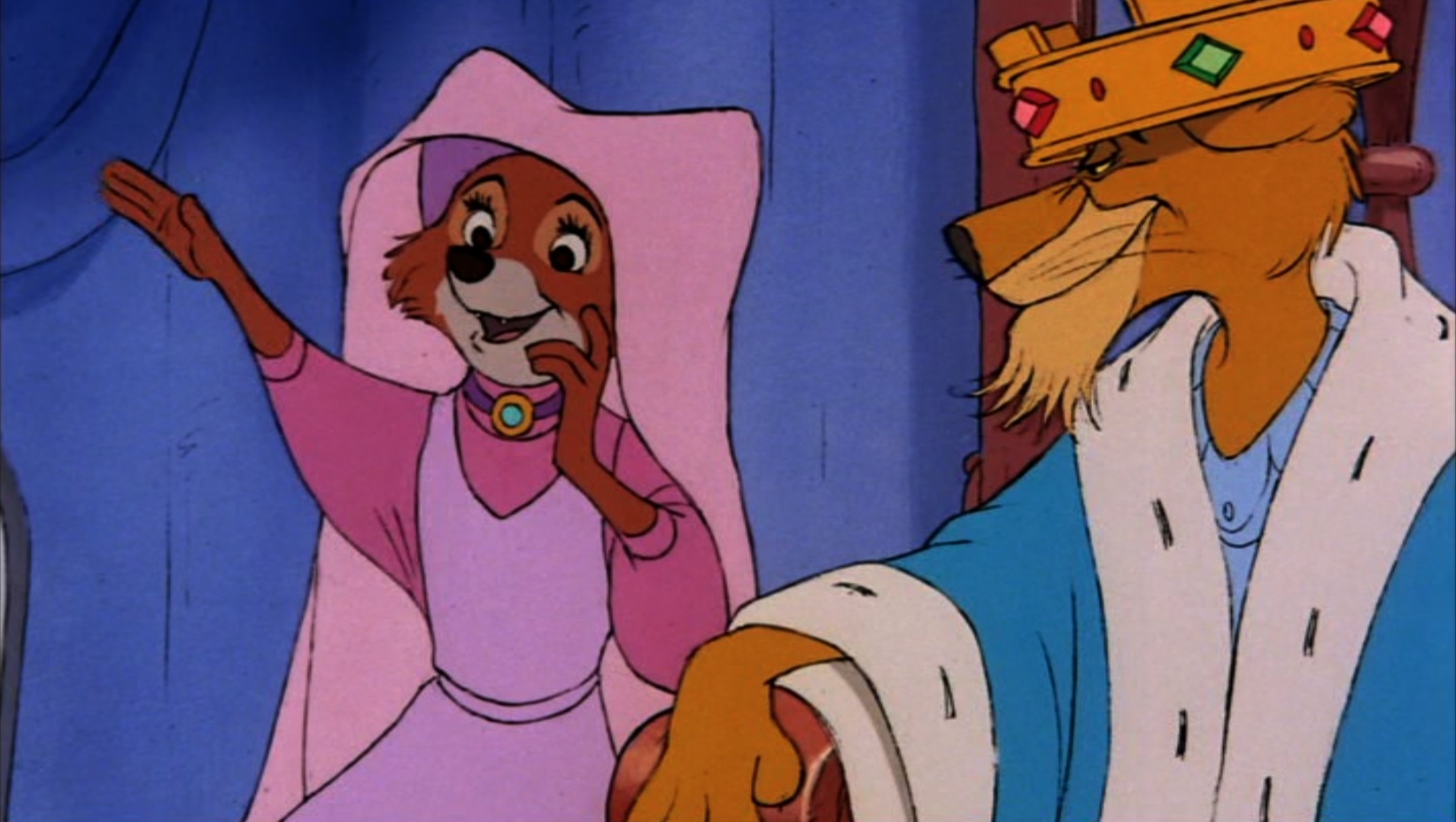
‘Robin Hood’ was Walt Disney studio’s 21st feature. The film’s story and designs lean heavily on the 1938 feature ‘The Adventures of Robin Hood’, starring Errol Flynn.
But by now the characters are portrayed as animals, a relic of an abandoned feature film project about Reynard the fox called ‘Chanticleer’. This great idea doesn’t lead to a great film, however. Despite the fine character designs, the strong voice cast (a nice mix of British and American accents) and the often superb animation, Robin Hood must be placed among the weaker Disney features.
Many of the character designs are so reminiscent of those in ‘Jungle Book’, the film almost feels like a rip-off. There’s a bear, voiced by Phil Harris, the voice of Baloo, there’s a snake with the power of hypnosis and there are some funny vultures. The story evolves at a remarkably slow pace, taking almost half an hour to introduce the characters (first Robin and Little John, then Prince John and Sir Hiss, followed by the Sheriff, and in another scene Maid Marian and Lady Kluck), before some sort of plot sets in.
More than any earlier Disney feature ‘Robin Hood’ seems particularly aimed at children: both great drama and great comedy are absent and danger is never really felt, save for two very short moments. The great finale is anything but that, and King Richard serves as an off-stage deus ex machina, putting an equally welcomed as unsatisfying end to the film.
In a 1973 letter to animator Larry Ruppel, cited in John Canemaker’s book ‘Walt Disney’s Nine Old Men & The Art of Animation’, animator Frank Thomas expressed the film’s shortcomings:
“We obviously decided to keep it on the ‘fun’ side, but I have worried that the audiences would feel it was too flimsy – that we were not being quite serious enough with our characters. For instance, does anyone really fear Prince John? Is Robin ever worried about his ability to achieve something or even how it should be done? Did winning Maid Marian make any difference in Robin’s behavior. In real life it would have.”
The rather tinned music doesn’t help, either. What’s more, the film’s three forgettable songs are all presented within a twelve minutes period of the film (0’46-0’58), with which the film reaches dead waters after the tournament scene, which was less spectacular than it could be in the first place. Even worse, the dance scene blatantly reuses complete dance animation sequences from ‘Snow White and the seven dwarfs’ (1937), ‘Jungle Book’ (1967) and ‘Aristocats’ (1970). All these aspects give the film a cheap feel. It frustrated younger animators like Don Bluth, who thought the film lacked both quality and soul, and it indirectly led to Bluth’s departure in 1979, during the production of ‘The Fox and the Hound‘ (1981).
The film’s best moments are the opening song ‘Oo-De-Lally’, sung by Roger Miller (as Alan-a-Dale), sir Hiss flying around with his head in a balloon and propelling himself like a helicopter, and King John as a whole. This is by all means a marvelous character, perfectly voiced by Peter Ustinov, and animated with gusto. Because of the film’s strong visuals (after all, it’s the only Robin Hood film starring foxes), the film fares better in memory than by actually watching it.
In all, Robin Hood is a timid, rather lifeless and all too safe feature, which makes painfully clear that in the seventies Disney’s glory days lay years behind. Indeed, it would take the studio another fifteen years to crawl out of the uncertain times the studio went through after Walt Disney’s death.
Watch the trailer for ‘Robin Hood’ and tell me what you think:
‘Robin Hood’ is available on Blu-Ray and DVD
Director: Jack Hannah
Release Date: May 30, 1953
Stars: Donald Duck, Huey, Dewey and Louie
Rating: ★★★★
Review:
 Donald and the boys are on a holiday in Latin America. But Huey, Dewey and Louie only have eyes for their comic book.
Donald then fools them by pretending a fountain of youth has made him younger. He even uses an alligator egg to make them believe he turned into an egg again. This leads to an encounter with the mother alligator, whose not amused. In the end we watch Donald and the boys fleeing into the distance.
The backgrounds in this cartoon are extraordinarily colorful. The characters don’t really read well against these backgrounds, but their lushness is overwhelming and an extra highlight besides the gags.
Watch ‘Don’s Fountain of Youth’ yourself and tell me what you think:
This is Donald Duck cartoon No. 99
To the previous Donald Duck cartoon: Trick or Treat
To the next Donald Duck cartoon: The New Neighbor
Director: Charles Nichols
Release Date: April 18, 1953
Stars: Mickey Mouse, Pluto
Rating: ★★★½
Review:
 ‘The Simple Things’ was to be Mickey’s and Pluto’s last theatrical cartoon (Pluto’s own series had stopped two years earlier).
Unfortunately it is a rather uninspired goodbye. The cartoon returns to the elongated situation comedy of the thirties. There are only two plots here, which hardly build up to a finale. First: Pluto’s encounters with a humanized clam and second, Mickey and Pluto’s fight with a hungry seagull. Both parts are executed routinely, without inspiration.
This makes ‘The Simple Things’ a sad ending to a career that started so phenomenally well, changing the course of animation, 25 years earlier. It would take Mickey another thirty years to return to the movie screen in ‘Mickey’s Christmas Carol‘ from 1983. Meanwhile, Mickey & Pluto director Charles Nichols would direct three Donald Duck cartoons, and one special, ‘The Saga of Windwagon Smith‘, before leaving Disney for Hanna-Barbera in 1962.
Watch ‘The Simple Things’ yourself and tell me what you think:
This is Mickey Mouse cartoon No. 125
To the previous Mickey Mouse cartoon: Pluto’s Christmas Tree
To the next Mickey Mouse cartoon: Mickey’s Christmas Carol
Director: Jack Hannah
Release Date: November 21, 1952
Stars: Mickey Mouse, Pluto, Chip ‘n Dale
Rating: ★★★★★
Review:
 Mickey chops Chip ‘n Dale’s tree down to use as a Christmas tree.
By doing so he accidentally brings the two little chipmunks home. Pluto soon discovers the duo, but Mickey only does so in the very end. The cartoon ends with a cameo of Goofy, Donald and Minnie singing Christmas carols in Mickey’s garden.
The cartoon’s overall atmosphere is cute, adorable and full of charm, making ‘Pluto’s Christmas Tree’ one of the most delightful Mickey Mouse cartoons from the post-war period. This short is the second of two Mickey Mouse cartoons directed by Jack Hannah, the other being ‘Squatter’s Rights’ from 1946. These are the only two cartoons to feature Mickey and Chip ‘n Dale. It’s also the third of Mickey’s four Christmas cartoons, the others being ‘Mickey’s Orphans‘ from 1931, ‘Mickey’s Good Deed‘ from 1932 and ‘Mickey’s Christmas Carol‘ from 1983.
Watch ‘Pluto’s Christmas Tree’ yourself and tell me what you think:
This is Mickey Mouse cartoon No. 124
To the previous Mickey Mouse cartoon: Pluto’s Party
To the next Mickey Mouse cartoon: The Simple Things
Director: Milt Schaffer
Release Date: September 19, 1952
Stars: Mickey Mouse, Pluto, The Orphan Mice
Rating: ★
Review:
 Mickey and Pluto celebrate Pluto’s birthday, which includes a huge pink birthday cake and the presence of several little mice.
In fact, this cartoon marks the unexpected return of the orphan mice, which we hadn’t seen on the screen since ‘Mickey’s Circus‘ from 1936. The little mice give Pluto a hard time and they eat all the cake. Luckily Mickey has saved a piece for our canine friend.
‘Pluto’s Party’ is the only Disney film directed by Pluto story man Milt Schaffer. Unfortunately it’s not a success. Mickey’s design is rather angular in this cartoon and the antics by the orphan mice are quite tiresome, not funny. In spite of the bright colors and the fast cutting, the overall mood is timid and listless. Only two Mickey Mouse cartoons would follow, and you can almost feel the series ending in this cartoon.
Watch ‘Pluto’s Party’ yourself and tell me what you think:
This is Mickey Mouse cartoon No. 123
To the previous Mickey Mouse cartoon: R’coon Dawg
To the next Mickey Mouse cartoon: Pluto’s Christmas Tree
Director: Charles Nichols
Release Date: August 10, 1951
Stars: Mickey Mouse, Pluto
Rating: ★★
Review:
 This cartoon starts with a Texan voice-over telling about raccoon hunting. Enter Mickey and Pluto who are exactly doing that.
Pluto’s pursuit is hindered, however, by the raccoon’s clever decoys and sidetracks. In his final trick the raccoon fools Mickey and Pluto by pretending having a baby, using Mickey’s coonskin cap.
Mickey has pretty little screen time in this cartoon, which is essentially Pluto’s. His visualisations of what he’s smelling are the highlights of this gentle if not very remarkable film.
Watch ‘R’Coon Dawg’ yourself and tell me what you think:
This is Mickey Mouse cartoon No. 122
To the previous Mickey Mouse cartoon: Mickey and the Seal
To the next Mickey Mouse cartoon: Pluto’s Party
Director: Wilfred Jackson
Release Date: August 8, 1952
Rating: ★★★½
Review:
 Half a year after ‘Lambert the Sheepish Lion‘, voice actor Sterling Holloway returns as a narrator for a Disney cartoon.
Here he tells the story of a little house on a hill in the country side who is soon surrounded by the city and forgotten. The house’s first neighbors are arrogant and aristocratic wooden houses, which soon burn down. The second neighbors are sloppy brick houses, which are pulled down in the end. Her third neighbors are enormous skyscrapers. When the little house thinks she’s finished, she’s moved to start anew on the countryside.
This sweet little story is based on a children’s book from 1942 by Virginia Lee Burton and uses a slightly different design to remain faithful to her original illustrations. Like ‘Lambert the Sheepish Lion’, the story is very sweet, not funny. Its main attraction are the humanized houses, excavators and such.
However, the story is well-told, thanks to story man Bill Peet. It contains heart and has a strong sense of nostalgia. In fact, conservative nostalgia has rarely been put more convincingly to the screen. The film is strongly anti-urban and anti-progress, and full of longing to the peace and quiet of a bygone era. Its message is expressed at the end of the cartoon, when Holloway tells us that “the best place to find peace and happiness is in a little house on a little hill way up in the country”.
Watch ‘The Little House’ yourself and tell me what you think:
‘The Little House’ is available on the DVD ‘Walt Disney Treasures: Disney Rarities’
Director: Jack Hannah
Release Date: February 8, 1952
Rating: ★★½
Review:
 Disney’s favorite voice, Sterling Holloway, returns for the first time since ‘Peter and the Wolf’ (‘Make Mine Music’, 1946), to lend his voice to a child-delivering stork like he did in ‘Dombo’ (1942).
Holloway tells the story of Lambert, a lion cub who’s accidentally delivered to a mother sheep. Because he’s different, he’s bullied by the other lambs, and he grows into a cowardly lion, until he rescues his mother from the clutches of an evil wolf.
Like the similar ‘Morris, the Midget Moose‘ from two years earlier, the story of ‘Lambert, the Sheepish Lion’ is slow, sickeningly sweet and terribly unfunny. What Lambert eats during his stay among the sheep remains a puzzling mystery. The cartoon’s only delight are the facial expressions on the adult Lambert.
Watch ‘Lambert, the Sheepish Lion’ yourself and tell me what you think:
‘Lambert, the Sheepish Lion’ is available on the DVDs ‘Walt Disney Treasures: Disney Rarities’ and ‘Melody Time’
Director: Jack Hannah
Release Date: November 24, 1950
Stars: Bootle Beetle
Rating: ★★
Review:
 ‘Morris, the Midget Moose’ starts with an eldery bootle beetle who tells two young bootle beetles the short’s story.
The beetle tells us about Morris, a very small moose with normal antlers who befriends Balsam, a moose with small antlers. They’re both outcasts, but together they defeat the reigning moose, the invincible Thunderclap.
This moralistic story is very sweet, but also slow and boring. It reuses a gag from ‘Moose Hunters’ (1937) of moose throwing each other on the ground, affecting the complete landscape, but the gag is executed less elaborately, and with less funny results.
‘Morris, the Midget Moose’ was the only cartoon featuring Bootle Beetle outside Jack Hannah’s Donald Duck series. It was also the little insect’s last appearance on the movie screen.
Watch ‘Morris, the Midget Moose’ yourself and tell me what you think:
‘Morris, the Midget Moose’ is available on the DVD ‘Walt Disney Treasures: Disney Rarities’
Director: Jack Kinney
Release Date: March 3, 1950
Rating: ★★
Review:
 After the Walt Disney studios quit its package features, it started to release ‘specials’ again, one-shot cartoons featuring no recurring character.
These specials were essentially the successors of the Silly Symphonies, and a few were made during World War II. However, most of them were made in the fifties, if not necessarily to advance animation, then certainly to keep animators busy between feature films. Unfortunately, almost none of these shorts match the inventiveness of the Silly Symphonies or were really successful (the Academy Award winning ‘Toot Whistle Plunk and Boom’ (1953) is the prime exception).
For example, ‘The Brave engineer’, the first special from the fifties, looks like it has been a left-over from the compilation feature ‘Melody Time‘ (1948). Like this feature’s sequences ‘The Legend of Johnny Appleseed‘ and ‘Pecos Bill‘, it’s a half sung and half narrated tall-tale based on a poem about a legendary American hero from the 19th century.
This time comedian Jerry Colonna sings and tells the story of Casey Jones, a train engineer, a character who really existed. In the cartoon Casey desperately tries to deliver the western mail on time. On the way he encounters all the cliches featured in westerns involving trains: a damsel on the rails, train robbers and a villain who blows up a bridge. The ride ends in a clash with another train. Unlike the real Casey Jones, who died in the crash, the cartoon Casey survives and delivers the mail on time, almost…
Despite the relatively fast pace and many corny gags, the story never really takes off. The viewer somehow never gets involved in the story and remains uninterested to the end.
Watch ‘The Brave Engineer’ yourself and tell me what you think:
‘The Brave Engineer’ is available on the DVD ‘Walt Disney Treasures: Disney Rarities’


 Dr. Grob's Animation Review