You are currently browsing the category archive for the ‘Walt Disney films’ category.
Director: Jack Hannah
Release Date: December 16, 1949
Stars: Donald Duck, Chip ‘n’ Dale
Rating: ★★★
Review:
 In 1949 Donald Duck had to deal with three small adversaries: Bootle Beetle, the bee and Chip ‘n Dale. Of the three, Chip ‘n Dale were by far the funniest – and it’s no wonder they have become famous where the two insects have not.
‘Toy Tinkers’ is particularly inspired, using Christmas toys as props for a chase inside Donald’s living room, leading to an open war that is far removed from the Christmas spirit. Highlight, however, is the excellent animation of Dale impersonating a gentleman with a top hat and a cane.
Watch ‘Toy Tinkers’ yourself and tell me what you think:
This is Donald Duck cartoon No. 82
To the previous Donald Duck cartoon: Slide, Donald, Slide
To the next Donald Duck cartoon: Lion Around
Director: Jack Hannah
Release Date: November 25, 1949
Stars: Donald Duck, The Bee
Rating: ★★
Review:
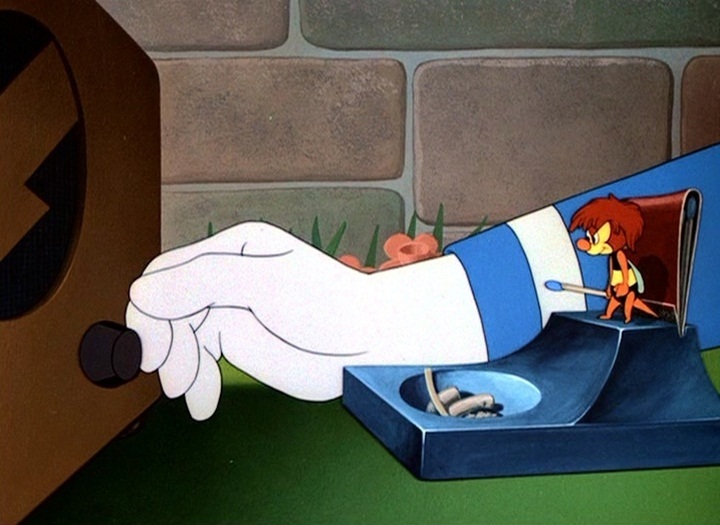 After his move into the Donald Duck series three months earlier in ‘Honey Harvester’, the bee returns. This time as a classical music lover competing with Donald over the radio.
While the bee wants to listen to classical music, Donald wants to listen to a world series baseball match.
The most inspired gags involve Donald and the bee reenacting the match in Donald’s garden. But the bee is hardly a funnier character than Bootle Beetle, and the cartoon never comes off: the violence remains restrained, the bee remains cute. Donald is reduced to a simply annoying character, a bully who is rightly ‘sent to the showers’.
Watch ‘Slide, Donald, Slide’ yourself and tell me what you think:
This is Donald Duck cartoon No. 81
To the previous Donald Duck cartoon: The Greener Yard
To the next Donald Duck cartoon: Toy Tinkers
Director: Jack Hannah
Release Date: October 14, 1949
Stars: Donald Duck, Bootle Beetle
Rating: ★
Review:
 ‘The Greener Yard’ is the third cartoon starring the annoyingly unfunny Bootle Beetle.
In this short there are in fact two Bootle Beetles: an older one and his son, who doesn’t like to eat beans and who longs for greener pastures. But the older Bootle Beetle tells him how the grass always looks greener at the other side, but isn’t. He apparently has learned this lesson in Donald’s garden, where is given a hard time by Donald, his chickens and two bluebirds.
‘The Greener Yard’ is slow, boring and moralistic, and forms a low point in Donald Duck’s canon. Luckily, it was the last Donald Duck short to feature this boring insect. Nevertheless, the elderly Bootle Beetle and his younger counterpart would return to the screen one last time, in ‘Morris, the Midget Moose‘ (1950).
Watch ‘The Greener Yard’ yourself and tell me what you think:
This is Donald Duck cartoon No. 80
To the previous Donald Duck cartoon: All in a Nutshell
To the next Donald Duck cartoon: Slide, Donald, Slide
Director: Jack Hannah
Release Date: June 3, 1949
Stars: Donald Duck, Chip ‘n’ Dale
Rating: ★★★
Review:
 It’s 7 October, and Chip and Dale are storing acorns for the winter. Because they don’t get enough, they steal them from Donald Duck, who, as a forest ranger, has a sackful to plant new oak trees with.
‘Winter Storage’ was Chip and Dale’s fourth film, and only the second in their mature form. In this cartoon they are even better developed than in their previous entry, ‘Three for Breakfast’ (1948), and watching the interplay between the two chipmunks is a sheer delight. Donald’s role, on the other hand, is modest, and only comes alive in the finale, in a very nice fake ice hockey scene.
Watch ‘Winter Storage’ yourself and tell me what you think:
This is Donald Duck cartoon No. 77
To the previous Donald Duck cartoon: Sea Salts
To the next Donald Duck cartoon: Honey Harvester
Director: Jack Hannah
Release Date: April 8, 1949
Stars: Donald Duck, Bootle Beetle
Rating: ★
Review:
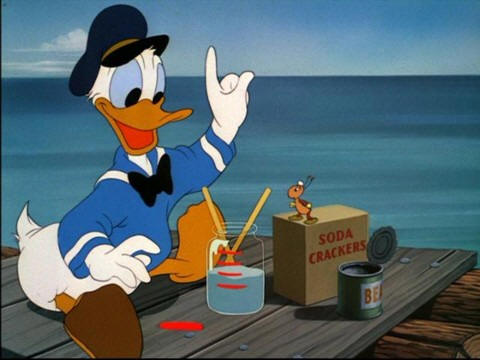 Bootle Beetle, introduced in ‘Bootle Beetle‘ from 1947, returns to tell us about his relationship with ‘the captain’, and old seafaring version of Donald Duck. He relates how he and ‘the captain’ were shipwrecked and stranded on a desert island.
Bootle Beetle never was a funny character, and this cartoon, too, suffers: Bootle beetle is simply too cute. Moreover, his relationship to Donald is never explained, nor the fact why Donald is suddenly a captain. To make things worse, the cartoon is painstakingly slow. For example, it contains a very long gag on a coconut, unfavorably reminiscent of the overlong gags of the earliest character animation-based cartoons of the mid-1930’s, like ‘Mickey Plays Papa‘ (1934) or ‘Moving Day‘ (1936).
Watch ‘Sea Salts’ yourself and tell me what you think:
This is Donald Duck cartoon No. 76
To the previous Donald Duck cartoon: Donald’s Happy Birthday
To the next Donald Duck cartoon: Winter Storage
Director: Burny Mattinson
Release date: December 16, 1983
Stars: Mickey Mouse, Scrooge McDuck, Donald Duck, Daisy Duck, Goofy, Jiminy Cricket, Pete, Willie the Giant
Rating: ★★★½
Review:
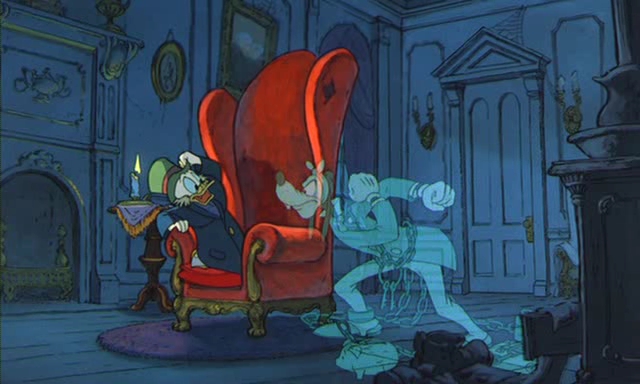 Mickey’s Christmas Carol’ is one of countless cinema versions of Charles Dickens’s classic tale, this time using Disney characters.
Star of the film is Scrooge McDuck, which of course comes natural to the old miser as the character was actually named after Dickens’ main protagonist. Unlike the other characters Scrooge McDuck was mainly a comics hero, created by Carl Barks, and he had appeared on the screen only one time before, in the educational film ‘Scrooge McDuck and Money’ (1967). However, only four years later he would be animated extensively, in the highly successful televison series, Ducktales.
Most people however will remember ‘Mickey’s Christmas Carol’ as Mickey’s return to the screen for the first time since his retirement in 1953. But it also marks the return of Donald (as Scrooge’s nephew Fred) and Goofy (as his former partner Jacob Marley) to the screen after a 22 year absence. The film has an all-star cast in any case, reviving many other classic Disney stars, like Jiminy Cricket (as the ghost of Christmas Past), Daisy (as Scrooge’s former love interest) and Pete (as the ghost of Christmas future). Also featured is Willie the giant from ‘Fun and Fancy Free‘ (1948) as the ghost of Christmas present, and several characters from ‘The Wind in the Willows‘ (1949). Apart from these we can see glimpses of the Big Bad Wolf and the three little pigs, Clarabella Cow, Horace Horsecollar, Huey, Dewey and Louie, Minnie Mouse and some characters from ‘Robin Hood‘.
This all-star cast gives the film a nostalgic feel that fits the story. Indeed, with hindsight, one can see ‘Mickey’s Christmas Carol’ as an early example of the Renaissance that was about to happen, in which the classic cartoon style was revived after ca. twenty dark years.
‘Mickey’s Christmas Carol’ is no ‘Who Framed Roger Rabbit‘, however, and it only looks back, not forward. For example, the rather uninspired score is by Irwin Kostal, who had been composing for Disney since ‘Mary Poppins’ (1964). Moreover, the film’s design, using xerox cells and graphic backgrounds, is firmly rooted in the tradition of the 1960’s and 1970’s.
‘Mickey’s Christmas Carol’ is a nice and entertaining movie, but it would take another five years for the Renaissance hitting Disney in full glory, with inspired and innovative films as ‘Who Framed Roger Rabbit’ (1988) and ‘The Little Mermaid’ (1989).
Watch ‘Mickey’s Christmas Carol’ yourself and tell me what you think:
http://www.dailymotion.com/video/xmq7ql_1983-mickey-s-christmas-carol_shortfilms
This is Mickey Mouse cartoon No. 126
To the previous Mickey Mouse cartoon: The Simple Things
To the next Mickey Mouse cartoon: The Prince and the Pauper
Director: Ward Kimball
Airing date: December 28, 1955
Stars: Walt Disney, Ward Kimball, Wernher von Braun
Rating: ★★★
Review:
 After ‘Man in Space‘ (1955), ‘Man and the Moon’ is the second of three Disneyland broadcasts documenting man’s plans to conquest space.
‘Man of the Moon’ deals with the conquest of the moon, and consists of four parts. The first, largely animated, tells about man’s fascination for the moon, depicting the moon in mythology, in literature, in folklore, in nursery rhymes and in song. This sequence is a highlight of ‘cartoon modern’ style, and is full of director Ward Kimball’s trademark zany humor. It’s also the highlight of the documentary, despite the studio’s efforts to evoke the first mission to the moon in the fourth part. The folklore section is the most bold part featuring a highly stylized man, but even better are the charming animated children’s drawings in the nursery rhyme section. The sequence ends hilariously with a silly tin pan alley song about the moon, in which the writers throw in every obvious rhyme word (June, swoon, spoon, honeymoon, and even Daniel Boone).
After 18 minutes of great animation, the live action sections start, beginning with the second part. This is the shortest of the four, and features Ward Kimball in real person, telling us facts about the moon. The third part is hosted by German rocket scientist Wernher von Braun, who tells about a possible mission to the moon. Surprisingly, Von Braun does not try to land on the moon, but merely wants to fly around it. His plans involve the assembly of a giant wheel-like space station before even one vessel is flown to the moon.
His plans are shown in the fourth part as an “on the spot account of the first expedition to the moon”. Unfortunately, this is not as exciting a finale it possibly was in 1955, despite the dramatic music and the inclusion of an emergency scene in which a small meteor hits one of the fuel tanks. Nevertheless, the special effects are quite good, showing the space station rotating, and smaller reparation vessel leaving the moon rocket. Especially, weightlessness within the moon rocket is shown quite convincingly.
In 1957 Disney even showed more ambitious space plans, in ‘Mars and Beyond’.
Watch ‘Man and the Moon’ yourself and tell me what you think:
Directors: William Beaudine & Wilfred Jackson
Airing date: November 30, 1955
Stars: Walt Disney, Gertie the Dinosaur, Colonel Heeza Liar, Silas Bumpkin, Bobby Bumps, Felix the Cat, Koko the Clown
Rating: ★★★★★
Review:
 Walt Disney himself hosts a Disneyland television episode on the history of animation, from the humble attempts to capture movement in drawing in the caves of Lascaux to his own masterpiece ‘Fantasia’ (1940).
Disney demonstrates some early devices of animation like the thaumatrope, the phenakistoscope, the zoetrope and the praxinoscope, showing that animation in fact predates cinema. One of the highlights of the program is the complete showing of one of Charles-Émile Reynaud’s animated “films” for his own praxinoscope device. The other one is the reenactment of Winsor McCay’s vaudeville show with Gertie the Dinosaur (1914). This part alone makes the episode worthwhile watching, as McCay’s classic work becomes even stronger in its vaudeville context.
More animation from other early studios is shown, like Bray’s Colonel Heeza Liar, Raoul Barré’s Silas Bumpkin, Earl Hurd’s Bobby Bumps and Pat Sullivan’s Felix the Cat.
Disney also plays tribute to his old rival, Max Fleischer, by showing a Koko the Clown cartoon, accompanied by organ playing by his own cartoon composer, Oliver Wallace. The show ends with one of Walt Disney’s major achievements, the Nutcracker Suite from’Fantasia'(1940), which, unfortunately, is shown in black and white.
Watch ‘The Story of Animated Drawing’ yourself and tell me what you think:
‘The Story of Animated Drawing’ is available on the DVD ‘Walt Disney Treasures: Behind the Scenes at the Walt Disney Studio’
Director: Bill Justice
Release date: July 18, 1956
Rating: ★★★★
Review:

Director Bill Justice had co-directed two educational shorts in 1943: ‘The Grain That Built a Hemisphere‘ and ‘The Winged Scourge‘, but ‘Jack and Old Mac’ marks his solo direction debut.
Taking the cartoon modern-style to the max, ‘Jack and Old Mac’ brings jazzy versions of two familiar addition songs: ‘The House That Jack Built’ and ‘Old MacDonald Had A Farm’.
This simple and unpretentious idea leads to one of Disney’s most daring cartoons. The first song only uses characters made out of words and throughout the picture startlingly modern backgrounds are used, which constantly change and which are totally abstract, giving no sense of space whatsoever. The animation, too, is mostly very limited, although some animation is reused from the ‘All the Cats Join In’-sequence from ‘Make Mine Music’ (1946).
George Bruns’s score is strikingly modern for a Disney cartoon, using genuine bebop jazz. In comparison, Louis Prima’s dixieland jazz in ‘Jungle Book’ from eleven years later is much more old-fashioned.
In all, ‘Jack and Old Mac’ is a neglected little masterpiece, and Disney’s modest, but most daring contribution to the cartoon avant-garde.
Justice would direct four more specials: ‘A Cowboy Needs a Horse’ (1956), ‘The Truth about Mother Goose‘ (1957), ‘Noah’s Ark‘ (1959) and ‘A Symposium on Popular Songs‘ (1962), all strikingly modern in design.
Watch ‘Jack and Old Mac’ yourself and tell me what you think:
‘Jack and Old Mac’ is available on the DVD ‘Walt Disney Treasures: Disney Rarities’
Director: Jack Hannah
Release date: April 27, 1956
Stars: Humphrey Bear
Rating: ★★
Review:
 In 1956 Jack Hannah directed two Cinemascope cartoons starring Humphrey the bear and the park ranger, without Donald Duck.
‘Hooked Bear’ is the first one. In this short the park is visited by fishermen. Humphrey, of course, wants to join in, trying to catch some fish, but he is entirely unsuccessful.
Even though Humphrey is a well developed and likable character, ‘Hooked Bear’ does not rank among Hannah’s most inspired cartoons. The short marks only Humphrey’s fifth appearance, but some routine already has sneaked in, and none of the gags ever seem to pay off satisfactorily.
Watch ‘Hooked Bear’ yourself and tell me what you think:
‘Hooked Bear’ is available on the DVD ‘Walt Disney Treasures: Disney Rarities’
Director: Jack Kinney
Release date: October 15, 1954
Rating: ★★
Review:
 In this narrated short a lion deliberately gets himself caught to scare the people in New York. Unfortunately, he’s all but unnoticed there.
‘Social Lion’ was the last of three ‘special cartoons’ Jack Kinney directed in 1954, after his own Goofy series had stopped. It is, unfortunately, not a very successful cartoon. Its narration is trite, its timing poor and its animation, by veteran Norm Ferguson, heterogeneous: the full animation of the lion is awkwardly out of contact with the highly stylized animation of the humans.
Unfortunately, ‘Social Lion’ would be the great animator’s last statement. the Disney studio fired Ferguson in July 1953. He died four years later of a heart-attack, at the premature age of 45.
The cartoon reuses the weird safari song from Kinney’s earlier, way more successful short ‘African Diary’ (1945).
Watch ‘Social Lion’ yourself and tell me what you think:
‘Social Lion’ is available on the DVD ‘Walt Disney Treasures: Disney Rarities’
Director: Jack Kinney
Release date: May 21, 1954
Rating: ★★★★
Review:
 After his own Goofy series had stopped in 1953, Jack Kinney directed six other shorts at the Walt Disney Studio.
‘Pigs is Pigs’ is probably the best of the lot. It’s a story in rhyme and song about a railway station employee who does everything by the rules. At one day he has a dispute with a Scotchman about whether guinea pigs are pigs or not. The guinea pigs remain at the station until the bureaucrats of his company have found out the answer. Unfortunately, the animals multiply by the hour, soon filling the complete station.
The designs and animation of this short are highly stylized, making ‘Pigs is Pigs’ a prime example of ‘cartoon modern’, despite its 1905 setting. The scenes at the railway company are the best, ruthlessly parodying the aimless ways of bureaucracy.
Watch ‘Pigs is Pigs’ yourself and tell me what you think:
‘Pig is Pigs’ is available on the DVD ‘Walt Disney Treasures: Disney Rarities’
Directors: Clyde Geronimi, Wilfred Jackson & Hamilton Luske
Release Date: June 16, 1955
Rating: ★★★★★
Review:
 ‘Lady and the Tramp’ is a mild and friendly film based both on story ideas by Joe Grant that went as far back as 1939, and a short story by novelist Ward Greene. It tells the story of Lady, an upper class female Cocker Spaniel living around the turn of the century.
Lady’s life of luxury seems to be threatened by the coming of a baby, but it is the babysitter, aunt Sarah, who’s her real nemesis. The cat-loving old lady quickly has Lady muzzled, and it’s up to the tramp to rescue her. They spend a night out together, but in the morning, while they’re chasing chickens “together”, Lady gets caught and ends in the city dogpound. There she discovers that the tramp is quite a ladies’ man. It seems their short-lived relationship is over, but then the tramp helps her catching a rat that has sneaked into the house and into the baby’s room…
‘Lady and the Tramp’ was the first animated feature in Cinemascope. The film uses the new technique to great effects, with the action carefully laid out to the broad screen. Its backgrounds are very beautiful, and remarkably lush or, when necessary, highly dramatic. Only in the love scene they become somewhat stylized, showing a Mary Blair influence otherwise absent from the film.
The high quality animation is a delight to watch and stands out in an age of stylized and limited animation, something the 1950s more and more became to be. Like the animals in ‘Bambi‘ (1942), the dogs have a look and feel of real animals, while, at the same time, being full characters one can relate to, with a complete range of human expressions. Even the minor characters, like the dogs in the dogpound, are perfectly animated in that respect. The voices help in this dualism, often being a combination of human and dog-like sounds.
The humans, on the other hand, are hardly seen, and only the strongly caricatured ones, Aunt Sarah, Tony and Joe, have something of a character. It is telling that the most famous and probably most romantic kiss in animation history can be seen in this movie and is a kiss between two dogs. In this scene Lady and the tramp share a meal of spaghetti, accompanied by romantic music by the two Italian restaurant owners. This scene, animated by Frank Thomas, is the undisputed highlight of the film. Honorable mention goes to the very lifelike fight between the tramp and a large rat, a strongly dramatic scene animated by Wolfgang Reitherman, which can compete with the fighting scene in ‘Bambi’ in its impact.
Watch the dining scene from ‘Lady and the Tramp’ yourself and tell me what you think:
Director: Ward Kimball
Airing Date: March 9, 1955
Stars: Walt Disney, Ward Kimball, Wernher von Braun
Rating: ★★★★
Review:
 ‘Man in Space’ is a Disneyland special about man’s conquest of space, which, two years before the launching of Sputnik, was still a dream at that time.
The documentary includes information about rockets, weightlessness and concludes with an exciting account of man’s first space travel, based on the designs by rocket engineer Wernher von Braun. Von Braun is one of three German scientists featured in the program, the others being Willy Ley and Heinz Haber, demonstrating the enormous influence of German scientists on American science. Ley had fled Nazi Germany in 1935, but Haber stayed there till the end of the war, and Von Braun was even responsible for the deadly V2 rocket, a technical tour-de-force, but also the Nazi regime’s most fearful weapon.
‘Man in Space’ is shortly introduced by Walt Disney himself, quickly giving the presentation to director Ward Kimball, who remains the main host of the program. Kimball is clearly in his element here. His own wacky cartoon animation style is featured in a short history of man’s attempts to enter space, and in Haber’s accounts of ‘space medicine’. Indeed, he later called the space series, of which ‘Man in Space’ is the first entry, the creative high point of his career.
Throughout the movie, the use of animation is sparse, however, and the animation itself very limited. Nevertheless, its use is very effective, especially in the visionary concluding part, with its typical fifties science fiction designs.
‘Man in Space’ would be followed by ‘Man and the Moon‘ (1955) and ‘Mars and Beyond’ (1957), taking ideas on space travel even further.
Watch ‘Man in Space’ yourself and tell me what you think:
Director: Jack Hannah
Release Date: January 14, 1955
Stars: Donald Duck
Rating: ★★★★
Review:
 In ‘No Hunting’ Donald is encouraged by an off-screen narrator and by the spirit of his grandfather to join the hunting season.
This leads to a great satirical cartoon, ridiculing hunting and hunters. It even contains a parody on ‘Bambi‘!
‘No hunting’ feels like a Goofy short featuring Donald. Like in the Goofy shorts, most of the humor comes from the contrast between the narrator’s lines and what is shown on the screen. It’s a very enjoyable Cinemascope cartoon, which deserves to be more widely known.
Watch ‘No Hunting’ yourself and tell me what you think:
This is Donald Duck cartoon No. 110
To the previous Donald Duck cartoon: Grand Canyonscope
To the next Donald Duck cartoon: Bearly Asleep
Director: Charles Nichols
Release Date: December 23, 1954
Stars: Donald Duck, the Park Ranger
Rating: ★★★★★
Review:
 By 1954 Donald Duck was Walt Disney’s only cartoon star to survive as, Mickey, Pluto and Goofy all had retired in 1953.
Following Tom & Jerry, who had entered the large screen one month earlier, he was to enjoy the last stage of his cinema career in Cinemascope, being the only Disney cartoon star to do so.
‘Grand Canyonscope’ is the first of Donald’s Cinemascope cartoons, and it uses the new technique to great effects. Donald is an annoying tourist in the Grand Canyon, repeatedly bothering the park ranger from ‘Grin and Bear it‘. The action makes excellent use of the wide screen, and the Grand Canyon is portrayed in beautiful scenic backgrounds, which are the real stars of this extraordinarily beautiful Donald Duck cartoon.
Watch ‘Grand Canyonscope’ yourself and tell me what you think:
This is Donald Duck cartoon No. 109
To the previous Donald Duck cartoon: The Flying Squirrel
To the next Donald Duck cartoon: No Hunting
Director: Jack Hannah
Release Date: August 13, 1954
Stars: Donald Duck, Humphrey the Bear
Rating: ★★★★
Review:
 ‘Grin and Bear it’ was the second of six cartoons featuring the nervous bear Humphrey, Disney’s last cartoon star to hit the cinema screen.
It also introduces the fidgety park ranger, voiced by Bill Thompson (more commonly known as the voice of Droopy and Mr. Smee in ‘Peter Pan’, 1953). The park ranger would star in five cartoons. In this short he orders the bears to mix with the tourists, something they gladly do, because this means getting fed. Humphrey, however, is stuck to Donald, who doesn’t share a crumb with the bear. This leads to Humphrey making more and more desperate attempts to obtain food.
Donald is hardly anything more than a straight man in this short. But it’s an entertaining film, nonetheless, featuring beautiful backgrounds.
Watch ‘Grin and Bear it’ yourself and tell me what you think:
This is Donald Duck cartoon No. 107
To the previous Donald Duck cartoon: Dragon Around
To the next Donald Duck cartoon: The Flying Squirrel
Director: Jack Kinney
Release Date: March 5, 1954
Stars: Donald Duck, Daisy Duck, Huey, Dewey and Louie
Rating: ★★★★
Review:
 In this strange and original cartoon Donald is a bachelor in San Francisco during the 1920s, who falls in love with Daisy, but who flees from the prospect of marriage, after having a horrible nightmare.
Like Mickey in ‘Mickey’s Nightmare‘ (1932), Donald has a rather distorted view of married life. While Mickey was haunted by hundreds of little kids, Donald’s fear is virtual slavery.
This short is narrated by an eloquent voice over (reminiscent of Donald’s dream voice in the cartoon of the same name from 1948), supposedly Donald’s ‘written’ voice. Most of the gags originate in the contrast between what’s being said and what the viewer sees.
‘Donald’s Diary’ is a very atypical Donald Duck cartoon. Maybe because it was not directed by his regular director Jack Hannah, but by Jack Kinney, whose own Goofy series had stopped the previous year. The short uses strong and beautiful 1950s backgrounds, more angular animation, and a very different design of Daisy. Moreover, Huey, Dewey and Louie are not Donald’s nephews here, but Daisy’s little brothers.
‘Donald’s Diary’ was the fourth of five Donald Duck cartoons Jack Kinney directed. In it he reused some animation from his first Donald Duck cartoon, ‘Der Fuehrer’s Face‘ from 1943.
Watch ‘Donald’s Diary’ yourself and tell me what you think:
This is Donald Duck cartoon No. 105
To the previous Donald Duck cartoon: Spare the Rod
To the next Donald Duck cartoon: Dragon Around
Director: Jack Hannah
Release Date: May 21, 1948
Stars: Donald Duck, Daisy Duck
Rating: ★★
Review:
 Donald is a travelling salesman trying to sell brushes, but nobody understands him.
He then discovers Ajax voice pills, which give him a smooth voice. Soon he sells all his brushes, and he dreams of asking Daisy to marry him, but the pills only work for a short while and soon only one is left…
Like ‘Donald’s Dilemma‘ from 1947, ‘Donald’s Dream Voice’ is built on a strong idea around Donald’s voice. Unfortunately, in both cartoons the idea is funnier than the execution. In ‘Donald’s Dream Voice’ much time is wasted on Donald trying to retrieve his last pill.
Watch ‘Donald’s Dream Voice’ yourself and tell me what you think:
This is Donald Duck cartoon No. 69
To the previous Donald Duck cartoon: Daddy Duck
To the next Donald Duck cartoon: The Trial of Donald Duck
Director: Jack Hannah
Release Date: November 28, 1947
Stars: Donald Duck, Chip and Dale
Rating: ★★★★
Review:
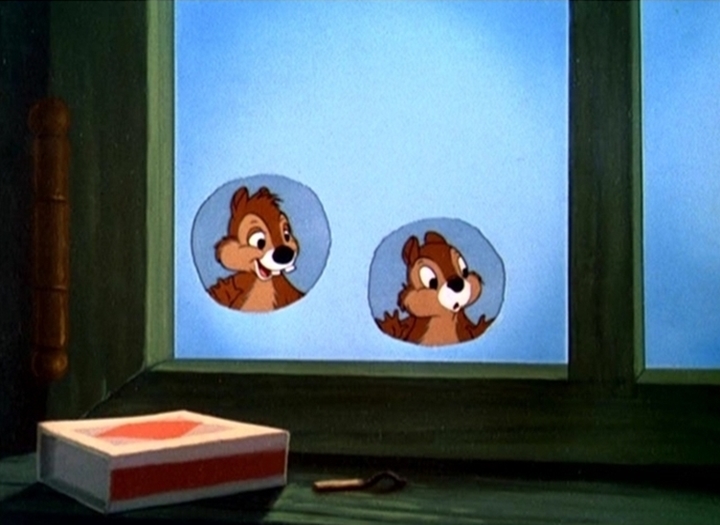 After two early appearances (‘Private Pluto‘ from 1943 and ‘Squatter’s Rights‘ from 1946) ‘Chip ‘n Dale’ marks the true debut of those lovable two little chipmunks, Chip and Dale.
In this cartoon they are named for the first time, and it’s also the first cartoon in which they are two distinct characters, although Dale still lacks his characteristic red nose here. Here they’re teamed against Donald Duck for the first time, their former adversary being Pluto. The short marks the beginning of a series of twenty cartoons, only ending in 1956, at the very end of the era of Disney shorts.
The story of ‘Chip an’ Dale’ provides the blueprint for the series: Donald wants to chop some wood for his winter cottage, and chops down the dead tree in which Chip and Dale live with their storage of nuts. In the subsequent scenes the lively duo tries to prevent Donald from burning up their tree and to get it back. The result is a cartoon of excellent comedy, not only between the chipmunks and Donald, but also between the two little critters themselves.
Watch ‘Chip an’ Dale’ yourself and tell me what you think:
This is Donald Duck cartoon No. 66
To the previous Donald Duck cartoon: Wide Open Spaces
To the next Donald Duck cartoon: Drip Dippy Donald


 Dr. Grob's Animation Review