You are currently browsing the tag archive for the ‘17th century’ tag.
Directors: Tomm Moore & Ross Stewart
Release date: October 30, 2020
Rating: ★★★★★ ♕
Review:
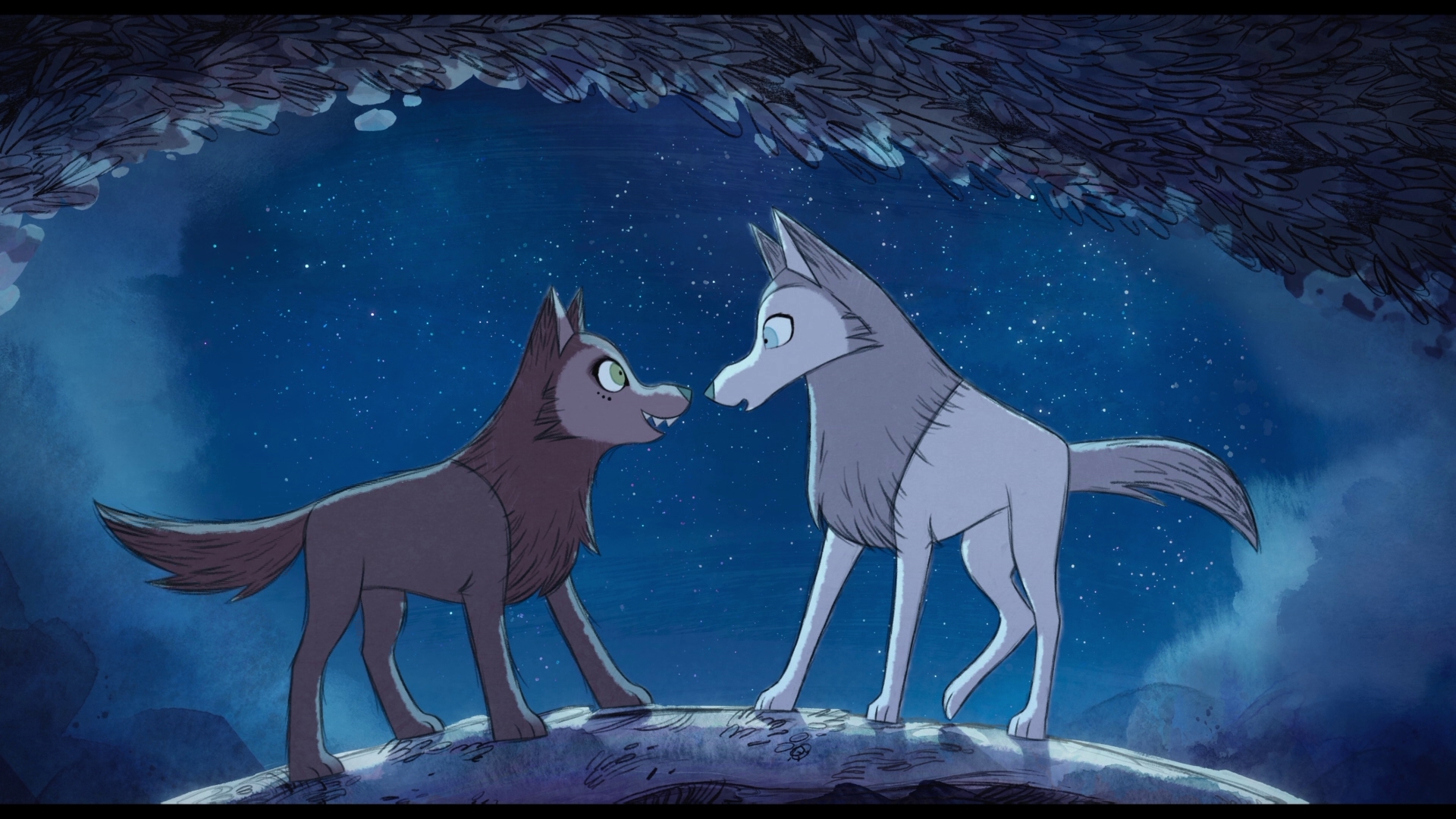
When these films were released, I doubt that many people were aware of that, but Irish studio Cartoon Saloon’s ‘The Secret of Kells’ (2009) and ‘Song of the Sea’ (2014) were part of an Irish folklore trilogy, which was rounded up in 2020 by ‘Wolfwalkers’.
All three films are indeed deeply rooted in Irish culture, and could not have been made elsewhere, but certainly ‘Song of the Sea’ and ‘Wolfwalkers’ also feature universal stories, ‘Song of the Sea’ one of loss and grief, ‘Wolfwalkers’ one of repression.
The idea of ‘Wolfwalkers’ is rooted in the fact that Ireland once used to be a forested country, with wolves roaming around. According to Wikipedia the last wolf in Ireland was killed in 1786, thus the species has long since been extinct on the island. The film goes further back, though, to the town of Kilkenny in 1649-1650, during Oliver Cromwell’s invasion of Ireland (who, without doubt, is the Lord Protector of the film, even though the film makers turn him into a fictional character, resulting in an alternate history ending).
In this town we follow English hunter Goodfellowe, who is deployed by the Lord Protector to hunt down the wolves of the forests surrounding the town, and his feisty daughter, Robyn, who befriends an even livelier mysterious forest girl called Mebh. In an interview on the Kaboom! Animation Festival director Tomm Moore told us they first thought of Robyn as a boy, but a girl fitted better, as she would feel the repressive times even more than a boy would do. And indeed, the film is not necessarily about repression of the Irish, but about repression in general, not in the least of women, with Robyn being forced into a gender role very unsuitable for her (or any other woman of the era, for that matter). It’s painful to see that Robyn’s own father ties the knots to in order to protect her (this story arc is reminiscent of ‘Finding Nemo’ – both films star over-protected fathers stifling their children). This makes ‘Wolfwalkers’ one of at least two great feminist animation films of 2020, the other one being ‘Calamity, une enfance de Martha Jane Cannary’ from France.
Apart from repression the film discusses deep topics like man vs. nature, Christianity vs. paganism, certainty vs. softness, man vs. woman, and single truth fanatism vs. a multi-voiced and more ambivalent reality, all packed in a perfectly told and family friendly adventure fantasy film. ‘Wolfwalkers’ is also vaguely reminiscent of Ghibli’s ‘Princess Mononoke’ from 1997: both films show the problems of man’s handling of nature, without regressing to a mere good and evil. Indeed, the Lord Protector as depicted, is less cruel than I presume the real Oliver Cromwell would have been (no one gets killed in the movie, for example), and his motivations are clearly explained. The film makes clear that the Lord Protector is not necessarily evil, but a fanatic, who is certain that he is on the right path.
As with the previous two Irish folklore films ‘Wolfwalkers’ is an absolutely delight to look at. The film uses very stylized designs and strong color arrangements, both in characters and in the background art. The rigid straightforwardness of the Lord Protector and the city is translated by the straight horizontals and verticals depicting the town, and even of many of its inhabitants. The film makers even show the town as a straight grid when seen in the distance, showing the town with a daringly complete lack of perspective. The grid-like is greatly contrasted by the curves of the forest, which symbolize freedom from the societal straitjackets of the city. The film becomes even more free, when showing the raw animation drawings of running wolves, with the digital pencil lines themselves becoming free from restriction. In this respect, this film is even more beautiful than the two earlier pictures – in fact every frame is a beauty, making this film one of the most beautiful animation films ever made.
The animation is of a high standard anyway: despite all the flat designs there’s a lot of perspective animation and there are even quite a lot of moving backgrounds, especially during the scent and running scenes. The character animation is subtle and often understated. For example, the character difference between Robyn and Mebh is shown by the different movements of the two characters, while Goodfellowe becomes less mobile when the repression ties him further and further.
In all, ‘Wolfwalkers’ is easily the best animation film of 2020, even outcompeting the strong Pixar film ‘Soul’, and must be ranked among the best animation films of all time. Strongly recommended.
Watch the trailer for ‘Wolfwalkers’ yourself and tell me what you think:
‘Wolfwalkers’ is available on the Blu-Ray or DVD set ‘Cartoon Saloon’s Irish Folklore Trilogy’
Directors: Mike Gabriel & Eric Goldberg
Release Date: June 23, 1995
Rating: ★★½
Review:

In the early nineties the Walt Disney studio was on a roll. Since 1989’s ‘The Little Mermaid’ all its features met with both critical acclaim and huge box office successes. Especially, the studio’s previous film, ‘The Lion King’ (1994) rather unexpectedly broke all box office records, being the highest-grossing motion picture of all time until ‘Finding Nemo’ came along in 2003.
Thus, not surprisingly, the expectations were high for Disney’s next feature, ‘Pocahontas’, only to be followed by a huge letdown, even though the feature did rather well at the box office. ‘Pocahontas’ fails in almost every aspect Disney’s previous features succeeded: the film lacks an engaging story, interesting protagonists, a threatening villain, appealing sidekicks, inspired humor or great songs. Of course, being a Disney film, the film’s animation is outstanding, and so is the film’s design, but that’s unfortunately not enough to rescue a film that collapses under its own pretentiousness.
The film is very, very loosely based on the historical John Smith’s accounts of Pocahontas (ca. 1596-1617), and is terribly unhistorical in almost every aspect. Worse, the film is saturated by political correctness to a fault, and can count as a document of historical revisionism. The film tries very, very hard to portray the native Americans as real people, but nevertheless falls into the trap of the ‘noble savage’, reinforcing the myth that native Americans were living in more harmony with nature than Europeans ever did. Of course, the coming of the Europeans was a tragedy to the native Americans, as it started their demise (only a mere handful of the Tsenacommacah, the tribe depicted, still survive today), and it is practically impossible to make a positive film, let alone an uplifting Disney musical, out of such subject matter. In that respect the film was doomed from the outset.
The film starts In London with governor Ratcliffe (1549-1609) wanting to explore the new world to regain status at the court of king James I. We watch Ratcliffe establish Jamestown , and in the finale of the film Ratcliffe is overthrown by his own men, a very unlikely event, by all means (in reality Ratcliffe was killed in an ambush by members of the Pamunkey tribe). While in Virginia Ratcliffe is obsessed with gold only, regarding the native inhabitants as mere pests.
The misunderstanding between the Tsenacommacah and the British almost leads to war, while the love between Pocahontas and John Smith shows that this does not need to be so. The film is one large advertisement for mutual understanding. A welcome message, for sure, but delivered with heavy-handedness and aplomb. In fact, the rather hippie-like message of love conquers all has been stale since 1970, and is in fact rather painful considering the real events following the establishment of the British colony in Virginia.
Additionally, the film suffers from dire dialogue, and an all too obvious emphasis on delivering its message. Most of the movie progresses slowly and sentimentally. What doesn’t help is the uneasy mix between the serious clashes between the human groups, and the fluffy child’s world of the animal sidekicks. Perhaps the film’s best scene is the final one, in which, against all rules of Disney logic, Pocahontas and John Smith part, never to be reunited again…
Part of the movie’s problems are the leads themselves. Admittedly, star animator Glen Keane has animated Pocahontas very well – especially the scenes just prior the first meeting between her and John Smith are outstanding. However, Pocahontas is presented as a brave, mature and independent woman, which contrasts highly with her childish animal friends, and, to be frank, with her rather irresponsible behavior. Moreover, she has very little to do with the historical Pocahontas, who converted to Christianity, while the movie Pocahontas practically converts John Smith to animalism, in a historically very, very unlikely sequence. Even worse, the real Pocahontas later married a planter, and died already at the tender age of 21. These facts are hard to bear when looking at the stout and proud woman Pocahontas is in the Disney film.
Yet, Pocahontas fares much better than her lover John Smith, Unlike Pocahontas, it’s pretty hard to love John Smith, who’s presented as a fearless and almost flawless hero from the outset. John Smith is surprisingly blasé, and pretty vain, too. In fact, in a way Smith has more in common with Gaston from ‘Beauty and the Beast’ than the animators would be willing to admit, and there’s nothing really interesting about him. In fact, Smith remains a remarkably blank character, having a bland design and a weak story arc, typified with the song ‘Savages’, in which Pocahontas teaches him a lesson on the subject of ‘savages’, the worst of the all too clear messages of political correctness in the film. Animator John Pomeroy must have had a hard time breathing some life into this dull character.
More interesting characters are Pocahontas’ friend Nakoma, who, to me, has actually a more appealing character design than Pocahontas herself has, and her father, Chief Powhatan, who arguably is the best designed character in the whole movie. These two Indians are more interesting than all Europeans. Best of these is Thomas, a youngster that is so clumsy he would have died within months in the real world. Governor Ratcliffe is a very unhistorical character, who looks more Spanish than British, and who is foolish enough to try to dig up gold at a random shore. In the 17th century they certainly knew better than that. Ratcliffe is a rather poor excuse for a villain: he’s more vain than scary, and at no point a real threat to anyone, as is proven by the film’s finale. He’s accompanied by a servant called Wiggins, who provides the only convincing comic relief in this all too serious film.
Wiggins certainly is more tolerable than the three animal characters, the overtly cute raccoon Meeko, ditto hummingbird Flit, and Ratcliffe’s pet pug Percy. The three steal considerable screen time, they have their own subplot of enemies befriending each other, and are completely out of tune with the serious subject of clash of civilizations, and threat of war. By the time ‘Pocahontas’ was released, one got the impression that ‘animal sidekicks’ were obligate additions to the rule book of Disney feature film making, a feeling that was corroborated by ‘Mulan’ (1998), in which the animal sidekicks (a dragon and a cricket for God’s sake!) were even more outlandish and superfluous.
Yet, the worst character in the whole movie is Grandmother Willow, a talking tree. Apart from the fact that she’s brought alive by dated computer animation, this is a concept that even in a world full of spirits I will not buy. Grandmother Willow is such an outlandish, unbelievable character, she hampers the whole movie, and makes it very, very difficult indeed, to take the more realistic events seriously. Someone should have vetoed her presence early in the conceptualization of the story.
The soundtrack isn’t of any help either. The songs are by composer Alan Menken, who provided the hit songs for ‘The Little Mermaid’ (1989), ‘Beauty and the Beast’ (1991) and ‘Aladdin’ (1992). Not one of the songs in ‘Pocahontas’, however, reaches these heights. Instead, we are treated by very generic and surprisingly forgettable nineties-musical songs. What certainly doesn’t help are the trite lyrics by Stephen Schwartz, which suffer from the same political correctness as the rest of the movie. The ‘Savages’ song forms the low point of the film in that respect.
No, the film’s unquestionably strongest point is its design, and it’s art director Michael Giaimo and artistic coordinator Don Hansen who should be praised most. More than any other Disney film of the Disney renaissance ‘Pocahontas’ looks back to the stylized designs of the late 1950s. For example, the film starts with a 1607 scene that is very reminiscent of the London scene in ‘The Truth About Mother Goose’ (1957), while in the rest of the film the background art, supervised by Cristy Maltese, is a straight echo of Eyvind Earle’s artwork for ‘Sleeping Beauty’ (1959), including square trees. The human designs, too, are more angular than ever, even to a fault, rendering some of the characters stiff and unappealing, especially some of the Indians, who at times look like technical art school drawings instead of living humans.
In fact, the film is most interesting for its outstanding color design, which with its grand greens, blues and purples is comparable to the best of ‘Fantasia’ (1940) and ‘Sleeping Beauty’, and one must admit that ‘Pocahontas’ certainly is a film worth looking at, if not necessarily one to watch. Indeed, I believe ‘Pocahontas’ will be remembered for its design elements, a clear product of the animation renaissance, especially as an early product of the school that looked back to the cartoon modern age (ca. 1948-1965), as exemplified by several television series from Nickelodeon and Cartoon Network from the second half of the nineties, which were, not surprisingly, often made by former CalArts students of Giaimo.
Watch the trailer for ‘Pocahontas’ yourself and tell me what you think:
‘Pocahontas’ is available on Blu-Ray and DVD


 Dr. Grob's Animation Review