You are currently browsing the tag archive for the ‘Burt Gillett’ tag.
Director: Burt Gillett
Release Date: September 30, 1933
Stars: Mickey Mouse, Minnie Mouse
Rating: ★★★
Review:
 Mickey is a jockey in a horse race.
Unfortunately, his horse Thunderbolt gets drunk just before the race starts. So he rides a pantomime horse, with his two black stable boys in it, instead. Remarkably, they win, due to a colony of angry and determined wasps, who chase the two poor black boys to the finish and into the distance, while Mickey receives all the glory.
‘The Steeple Chase’ is one of those ‘adventure type stories’ Mickey began having in 1932, and which were undoubtedly inspired by Floyd Gottfredson’s comic strip. ‘The Steeple Chase’ is a prime example: it shows clear similarities to ‘Mickey Mouse and his horse Tanglefoot‘, which ran about the same time (from June to October 1933). The colonel from ‘The Steeple Chase’ returns in that comic strip as a grumpy judge.
The early scenes firmly state why Mickey should win the race, e.g. when Minnie tells him “you gotta win, Mickey, or you’ll break the colonel’s heart”. Thus we are more involved in the horse race then in Mickey’s boxing game in ‘Mickey’s Mechanical Man‘ from earlier that year. Nevertheless, it remains a fact that Mickey’s actually cheating in both these cartoons, and misusing the two black stable boys while doing so. This makes it rather difficult to sympathize with Mickey. Moreover, the race is hardly as exciting as the one in ‘Barnyard Olympics‘ (1932), and the cartoon is by all means inferior to Gottfredson’s classic comic strip. The best gags come from the numerous ways in which the wasps attack Mickey and his fake horse.
Watch ‘The Steeple Chase’ yourself and tell me what you think:
This is Mickey Mouse cartoon No. 60
To the previous Mickey Mouse cartoon: Puppy Love
To the next Mickey Mouse cartoon: The Pet Store
Director: Burt Gillett
Release Date: February 28, 1933
Stars: Mickey Mouse, Minnie Mouse, Pluto
Rating: ★★★½
Review:
 ‘Mickey’s Pal Pluto’ shows how important Pluto had become by 1933.
It’s the first cartoon having the sympathetic mutt in its title, and it’s he, not Mickey or Minnie, who’s the real star of this short, arguably making ‘Mickey’s Pal Pluto’ Pluto’s first own cartoon.
In ‘Mickey’s Pal Pluto’ Pluto saves a few little kittens from drowning. Mickey and Minnie take them home, but there Pluto grows jealous of the intruders, exemplified by a conflict between his devilish and angelic sides, who materialize outside him, and who speak in rhyme. Unfortunately, when Pluto listens to his little devil, this leads to Mickey putting him outside. Nevertheless, when the kittens fall into a well, Pluto rescues the kittens from drowning again, almost drowning himself in the act. In the end he’s rewarded for this unselfish behavior with a roast chicken.
The moral clearly is that being good will be rewarded, as Pluto’s angel character clearly states in the end. So some of the childish sentimentality that had entered the Silly Symphonies in 1933 sneaks in to the Mickey Mouse series, as well.
‘Mickey’s Pal Pluto’ marks the first appearance of Pluto’s imaginary little devil and angel, symbolizing his inner conflict. This cartoon was more or less remade in color in 1941, titled ‘Lend a Paw’. Pluto’s little devil would reappear in ‘Mickey’s Elephant‘ (1936).
Watch ‘Mickey’s Pal Pluto’ yourself and tell me what you think:
This is Mickey Mouse cartoon No. 53
To the previous Mickey Mouse cartoon: The Mad Doctor
To the next Mickey Mouse cartoon: Mickey’s Mellerdrammer
Director: Burt Gillett
Release Date: September 10, 1932
Rating: ★★★★★
Review:
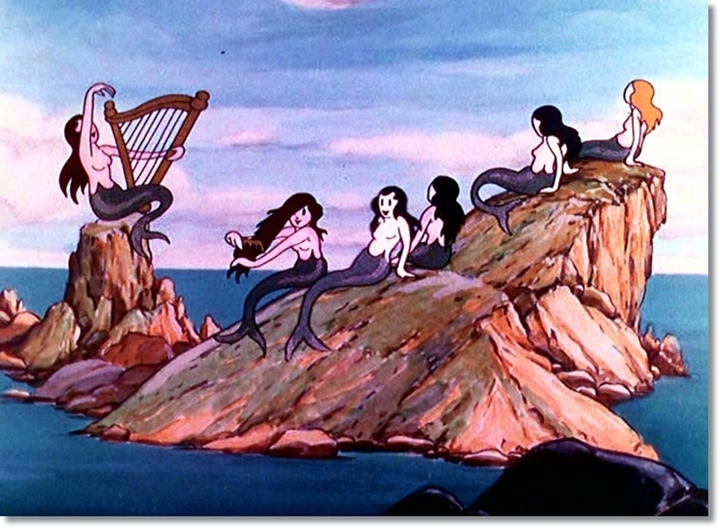
King Neptune is a merry sea giant, who gets angry when a bunch of horny pirates capture one of his topless(!) art deco mermaids. This leads to a war at sea, complete with an aircraft carrier whale and sea creature dive bombers.
‘King Neptune’ introduces a new concept to the Silly Symphonies, that of operetta. No longer the characters act silently to music, now they actually sing in operatic fashion. In the mid-thirties operetta was very popular in Hollywood, and in 1933 the operetta format would spread through the series, and it even shortly invaded Mickey Mouse films, like ‘The Mad Doctor‘, ‘Ye Olden Days‘ and ‘The Mail Pilot‘ (all 1933).
This trend led to curious mini-musicals, like ‘Father Noah’s Ark‘ and ‘The Pied Piper‘ (both 1933). The style reached its apex with ‘The Goddess of Spring’ (1934), in which the singing in all its seriousness became downright ridiculous. The operetta style survived into 1935, after which it disappeared from the Disney cartoons. However, Walt Disney’s first feature, ‘Snow White and the Seven Dwarfs’ (1937), clearly uses the operetta-style, probably because it already had been conceived at the end of 1933.
King Neptune is kind of a stock character. In many ways he’s just Old King Cole from ‘Mother Goose Melodies‘ (1931) in an updated form – rather awkwardly still wearing gloves. This character would resurface as Santa in the next Silly Symphony ‘Santa’s Workshop‘ (1932), as Noah in ‘Father Noah’s Ark‘ (1933), and as King Midas in ‘The Golden Touch’ (1935).
The pirates and mermaids are nowhere near realism, yet they’re designed and animated much better than the hunters in ‘The Fox Hunt‘ (1931), showing that Disney was making fast strides to realistic human designs already at this stage .
‘King Neptune’ is only the second Silly Symphony in color, yet unlike the first, ‘Flowers and Trees‘, it was made with color in mind from the start, and it shows. What a lush, elaborate, colorful and stunningly beautiful short this is! The cartoon simply bursts with color. Nevertheless, at several points the artists were still struggling with the new language of color. For example, one fighting scene on deck is almost rendered in reds only, in another scene the turtles have almost the same color as their background rock, failing to stand out. However, two color Silly Symphonies later, in ‘Santa’s Workshop‘, these problems appeared to have been solved, for that cartoon juxtaposes the most vibrant colors in all its scenes.
Apart from the use of color, ‘King Neptune’ is astounding because of its astonishingly elaborate animation. It’s packed with special effects, and complex and beautiful animation. The opening shots alone, in which King Neptune introduces himself, contain excessive, complex cycles of bubbles and fish. But the short’s highlight is the epic battle, which contains scenes of unprecedented complexity.
More impressive Silly Symphonies were soon to follow, but ‘King Neptune’ itself already is no less than a masterpiece. All previous Silly Symphonies literally pale compared to this one, let alone contemporary cartoons of other studios.
Watch ‘King Neptune’ yourself and tell me what you think:
This is Silly Symphony No. 30
To the previous Silly Symphony: Flowers and Trees
To the next Silly Symphony: Bugs in Love
Director: Burt Gillett
Release Date: November 12, 1932
Stars: Mickey Mouse, Minnie Mouse, Pluto
Rating: ★★½
Review:
 The Wayward Canary’ follows the same story line as ‘The Barnyard Broadcast‘ (1931) and ‘Mickey’s Revue‘ (1932). Like in these films, a song-and-dance routine is interrupted by numerous animals causing havoc.
This time, Mickey gives Minnie a canary for a present. It appears to have numerous offspring. These little birds escape and fly all over the house. Before they’re all caught, the complete house is wrecked.
Among the numerous gags there’s a surreal one when Pluto and a cat run through a wringer, which renders them flat. By 1932 such extreme body deformities had become extremely rare in Disney cartoons, and soon they would vanish altogether, as they were not in tune with Disney’s search for the ‘plausible impossible’. It was up to Tex Avery at Warner Brothers to revive gags like these in the late 1930s.
Among Minnie’s household there is a lighter with a swastika on it [update: see animation historian David Gerstein’s comment below for an explanation]. She also has signed portraits of Douglas Fairbanks and Mary Pickford. Together with Charlie Chaplin and D.W. Griffith, these two actors were the co-founders of United Artists, the company Disney had joined in 1932.
These portraits are the first caricatures of real people in a Mickey Mouse film. Although Mickey and Minnie were only slowly shedding their barnyard background, these signed portraits are not too surprising accessories, considering Mickey’s enormous popularity in the early 1930s. Moreover, they suggest that Mickey and Minnie, although being cartoon characters, live in the real world, among other Hollywood stars. This concept would be developed further in the next year, in the superb ‘Mickey’s Gala Premier‘.
Watch ‘The Wayward Canary’ yourself and tell me what you think:
This is Mickey Mouse cartoon No. 48
To the previous Mickey Mouse cartoon: Touchdown Mickey
To the next Mickey Mouse cartoon: The Klondike Kid
Director: Burt Gillett
Release Date: February 27, 1932
Stars: Mickey Mouse, Pete, Pluto
Rating: ★★★½
Review:
 When Mickey is washing Pluto, Pluto accidentally swallows a piece of soap.
He runs into the street where he’s seen as a mad dog. There he confronts Pete (with peg leg), who is a dog catcher and who wants to shoot Pluto…
‘The Mad dog’ is a fast gag cartoon with a clear story from the beginning to the end. By now, the Disney studio could produce amazingly consistent stories. Moreover, effect animation had fully penetrated the Mickey Mouse cartoons. The washing scene, for example, is full of difficult and extraordinarily lifelike animation of splashing water.
Watch ‘The Mad Dog’ yourself and tell me what you think:
This is Mickey Mouse cartoon No. 39
To the previous Mickey Mouse cartoon: The Grocery Boy
To the next Mickey Mouse cartoon: Barnyard Olympics
Director: Burt Gillett
Release Date: October 28, 1931
Stars: Clarabelle Cow, Horace Horsecollar, Mickey Mouse, Minnie Mouse, Pluto
Rating: ★★★½
Review:
 In ‘The Beach Party’ Mickey, Minnie, Clarabelle Cow, Horace Horsecollar and Pluto go picnicking on the beach. All goes well, until an evil octopus ruins their picnic, and they all have to battle against him.
‘The Beach Party’ is one of four 1931 Mickey Mouse cartoons to feature no musical routine, at all. Clearly, the Disney studio grew more and more confident in telling stories instead of musical numbers. And rightfully so, because ‘The Beach Party’ shows that Disney studio was more capable than any other studio in telling a good gag-filled story leading to a great finale. These were a welcome replacement to the tiring song-and-dance-routines. And so, by 1932, the musical numbers had almost disappeared from the Mickey Mouse cartoons.
Nonetheless, ‘The Beach Party’ knows no dialogue, and most of the movement is rhythmical, and set to a musical beat. The film’s greatest idea is the battle, because the gang’s means to chase the octopus away are entirely based on their eating habits as shown before. Such subtle and sophisticated story telling was unknown outside the Walt Disney studio at that time.
Notice, too, how Pluto and the crab resolve into speed lines when fighting. This effect was still pretty new at the time. The gag with the crab would be reused six years later to much better effects in ‘Hawaiian Holiday’.’The Beach Party’ is no classic, but secretly this film, too, shows Disney’s ambitions.
‘The Beach Party’ is also the first of only two shorts in which Mickey, Minnie, Clarabelle Cow and Horace Horsecollar are presented as four close friends, the other one being ‘Camping Out’ from 1934. Their friendship would become common practice in Floyd Gottfredson’s Mickey Mouse comics, starting with ‘Mickey Mouse and the Ransom Plot’ (July-November 1931).
In these comic strips Clarabelle Cow and Horace Horsecollar would become real personalities, something that never happened in the Mickey Mouse films. Indeed, soon after Mickey changed to color in 1935, Clarabelle Cow and Horace Horsecollar vanished from the screen, apart from an occasional cameo. Unfortunately, the same thing occurred in the Mickey Mouse strips: Horace’s and Clarabelle’s last major adventure with Mickey was ‘Race for Riches’ (July-September 1935), after which they were replaced by Goofy.
Watch ‘The Beach Party’ yourself and tell me what you think:
This is Mickey Mouse cartoon No. 34
To the previous Mickey Mouse cartoon: The Barnyard Broadcast
To the next Mickey Mouse cartoon: Mickey Cuts Up
Director: Burt Gillett
Release Date: September 30, 1931
Stars: Clarabelle Cow, Horace Horsecollar, Mickey Mouse, Minnie Mouse, Pluto
Rating: ★★★
Review:
 Mickey’s got his own radio station at the barn. There, Minnie, Horace Horsecollar and Clarabelle Cow perform some music to broadcast.
All goes well, until a cat and her little kittens cause havoc in the studio. Mickey has a hard time chasing them away, and during his efforts all instruments are destroyed.
‘The Barnyard Broadcast’ reuses the cat from ‘Mickey Steps Out‘ from two months earlier, and it introduces the numerous kittens that would cause Mickey lots of trouble in the subsequent films ‘Mickey’s Orphans‘ (1931) and ‘Mickey’s Revue‘ (1932). After that their role would be taken over by the orphan mice, introduced in ‘Mickey’s Nightmare‘ (1932).
After ‘Mickey Steps Out’, ‘The Barnyard Broadcast’ is another attempt in building a finale in a string of gags. The film is not entirely successful in this and only gains momentum when Mickey chases the cat away with a broom. The technique would be perfected in the subsequent films, ‘The Beach Party‘ and ‘Mickey Cuts Up‘.
Watch ‘The Barnyard Broadcast’ yourself and tell me what you think:
This is Mickey Mouse cartoon No. 33
To the previous Mickey Mouse cartoon: Fishin’ Around
To the next Mickey Mouse cartoon: The Beach Party
Director: Burt Gillett
Release Date: September 1, 1931
Stars: Mickey Mouse, Pluto
Rating: ★
Review:
 Mickey and Pluto go fishing in a no fishing area, but the fish are making fun of them.
Pluto even gets under water, sniffing the bottom of the lake and meeting an enormous fish. This scene reuses quite some animation of Pluto sniffing from Pluto’s debut ‘The Picnic‘ (1930). Then a gamekeeper appears, but Mickey and Pluto escape him. The goat-like gamekeeper would return in Floyd Gottfredson’s Mickey Mouse comic ‘Dr. Oofgay’s Secret Serum’ (July 1934).
Like ‘Traffic Troubles‘, ‘The Moose Hunt‘ and ‘The Beach Party‘ from the same year, ‘Fishin’ Around’ is a genuine gag cartoon. It is the weakest of the lot, however, and can hardly be called a classic. The tricks the fish pull at Pluto and Mickey are amusing, but nothing more than that. Both the fish and Pluto steal a lot of screen time from Mickey, who is blander than ever before in this short.
Nevertheless, the film is a modest example of how the Disney studio tried to improve the quality of its animation. Notice, for example, the reflections and other water effects in this short. By now, they had become standard in Disney cartoons. Moreover, the cartoon starts with some quite convincing animation of Mickey rowing. There’s some clear sense of pulling weight here, even though these cycles are interspersed with less convincing animation.
Watch ‘Fishin’ Around’ yourself and tell me what you think:
This is Mickey Mouse cartoon No. 32
To the previous Mickey Mouse cartoon: Blue Rhythm
To the next Mickey Mouse cartoon: The Barnyard Broadcast
Director: Burt Gillett
Release Date: June 6, 1931
Stars: Mickey Mouse, Minnie Mouse, Pete (cameo), Pluto
Rating: ★★
Review:
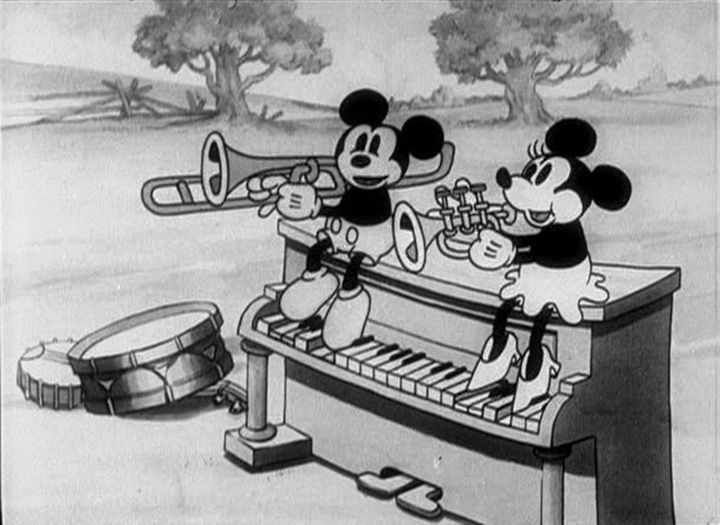 In ‘The Delivery Boy’ we watch Minnie doing the laundry in a pasture, singing the 1905 hit song ‘In the Shade of the Old Apple Tree’.
Mickey surprises her, and they dance the Charleston together to the background music. Mickey is so happy, he boxes a wasp’s nest. The wasp’s nest hits his donkey and his whole delivery, which consists of musical instruments, is spread over the pasture.
Undaunted, Mickey and Minnie start playing the piano, and all the farm animals join in, playing ‘The stars and stripes forever’. The cartoon ends when Pluto retrieves a burning dynamite stick and everything explodes. Nevertheless, Mickey is still able to finish playing John Philip Sousa’s famous march.
‘The Delivery Boy’ is as joyous as it is boring. After three years of song-and-dance routines one grows rather tired of it. Moreover, cartoons like ‘Traffic Troubles‘ and ‘The Moose Hunt‘ had proven that Mickey could do very well without them.
Pluto would cause havoc again in some of the succeeding films, like ‘Mickey Steps Out‘ (1931), ‘Mickey Cuts Up‘ (1931) and ‘The Grocery Boy‘ (1932). In these films the song-and-dance routine would give way to well-build gag-filled finales, of which the one in ‘The Delivery Boy’ is an embryonic version.
Watch ‘The Delivery Boy’ yourself and tell me what you think:
This is Mickey Mouse cartoon No. 29
To the previous Mickey Mouse cartoon: The Moose Hunt
To the next Mickey Mouse cartoon: Mickey Steps Out
Director: Burt Gillett
Release Date: April 30, 1931
Stars: Mickey Mouse, Pluto
Rating: ★★★½
Review:
 In ‘The Moose Hunt’ Mickey and Pluto are hunting moose.
They finally find a moose (or more exactly, the moose finds them). Unfortunately, in front of the moose, Mickey’s gun fails and soon the moose hunts both Mickey and Pluto. The chase ends with Mickey escaping on a flying Pluto.
‘The Moose Hunt’ is Mickey’s third gag only short, after ‘The Fire Fighters‘ (1930) and ‘Traffic Troubles‘ from earlier that year. It’s hardly as good as those earlier entries, though. Its pace is slow, and it contains some awkward gags, like the flying Pluto finale. It also contains a rare gag breaking the fourth dimension: when Mickey accidentally shoots Pluto, he suddenly addresses the audience with a “Is there a doctor in the house?”. Then, when Mickey begs Pluto to speak to him, Pluto actually speaks!
The self-conscious audience gag would remain a rarity at Disney, but it would become a staple gag at Warner Bros. when Tex Avery joined that studio. The two Pluto gags are totally out of character, and have nothing to do with him being a dog. After ‘The Moose Hunt’ we would never see Pluto flying or speaking again (apart from a short ‘Mammy’ at the end of ‘Mickey Steps Out‘), and after watching ‘The Moose Hunt’ it is easily understandable why not.
Luckily, there are other scenes that are more inspired, and in which Pluto behaves like a dog throughout. Indeed, in his very first solo scene, which reuses a little animation from ‘The Chain Gang‘ (1930), Pluto’s character as a little dumb and a little cowardly dog is pretty well established. Pluto’s looks are still unstable, but he’s excellently animated, throughout.
In ‘The Moose Hunt’ Pluto also gets his name (he was called ‘Rover’ in his first appearance in ‘The Picnic‘ from six months earlier). He now clearly is Mickey’s dog, not Minnie’s, like in the earlier film. It’s clear that the Mickey Mouse films could use an extra character, and after this film Pluto would appear in almost all succeeding Mickey Mouse films, stealing more and more screen time from Mickey.
Mickey would go hunting moose again in the way funnier ‘Moose Hunters’ from 1937, which, incidentally, doesn’t star Pluto.
Watch ‘The Moose Hunt’ yourself and tell me what you think:
This is Mickey Mouse cartoon No. 28
To the previous Mickey Mouse cartoon: The Castaway
To the next Mickey Mouse cartoon: The Delivery Boy
Director: Burt Gillett
Release Date: October 9, 1930
Stars: Mickey Mouse, Minnie Mouse, Pluto (as Rover)
Rating: ★★★
Review:
 Mickey’s driving to Minnie’s house singing his own theme song. They both are going on a picnic. While Mickey and Minnie are singing and dancing across the field to the tune of ‘In the Good Old Summertime’, hundreds of wild animals take their food away. The picnic ends in rain.
‘The Picnic’ is a rather plotless and unremarkable cartoon. It nevertheless contains a nice surreal gag in which a rabbit pulls away a hole. This kind of surrealism was rare at Disney’s at that time, but later, Tex Avery would reuse this gag many times at Warner Brothers and MGM.
‘The Picnic’ would have been forgettable, did it not mark the debut of Pluto. He is called Rover in this cartoon, and appears to be Minnie’s dog rather than Mickey’s, but he’s Pluto alright. At this point there’s no reason to believe that Disney intended to make the dog a regular character. Floyd Gottfredson’s Mickey Mouse comics of January 1931 cover similar grounds, but feature a very large dog called “Tiny”.
Nevertheless, in April 1931 Pluto would return in ‘The Moose Hunt‘. This time to stay*. In fact Pluto would become a more and more important character in the Mickey Mouse cartoons, at times stealing most of the screen time from Mickey, who would become more and more a ‘straight man’. Eventually, Pluto would be given his own series, in 1937.
Watch ‘The Picnic’ yourself and tell me what you think:
This is Mickey Mouse cartoon No. 23
To the previous Mickey Mouse cartoon: The Gorilla Mystery
To the next Mickey Mouse cartoon: Pioneer Days
* Gottfredson’s Mickey Mouse comics followed three months later, introducing Pluto on July the 8th.
Director: Burt Gillett
Release Date: July 11, 1930
Stars: Clarabelle Cow, Horace Horsecollar, Mickey Mouse, Minnie Mouse
Rating: ★★★
Review:
 There’s a party at the barn. Mickey and Minnie make some music and Mickey dances with Clarabelle Cow, with a dachshund and with a fat pig, but not with Minnie, who plays the piano.
The short contains no story, but is one of sheer joy. Mickey and Minnie perform folk tunes like ‘Turkey in the Straw’, ‘Pop goes the Weasel’ (in which Mickey repeatedly grabs Minnie’s knickers), and ‘Old Folks at Home’, performed by Mickey on a mouth organ. The cartoon ends when the pig lands on Mickey.
‘The Shindig’ marks Horace Horsecollar’s first appearance as a completely humanized horse. It also contains the first love scene between him and Clarabelle Cow, whose name is written on the shed in which she lives.
In Clarabelle’s first scene, we watch her read Elinor Glyn’s novel ‘Three Weeks’. When she discovers an audience is watching her, she blushes, and quickly hides the book away. No wonder, ‘Three Weeks’ was a scandalous book, an erotic romance from 1907, apparently still controversial in 1930.
The party idea of ‘The Shindig’ was elaborated on in ‘The Whoopee Party‘ (1932), producing a cartoon full of party delight, compared to which ‘The Shindig’ pales.
Watch ‘The Shindig’ yourself and tell me what you think:
This is Mickey Mouse cartoon No. 20
To the previous Mickey Mouse cartoon: The Fire Fighters
To the next Mickey Mouse cartoon: The Chain Gang
Director: Burt Gillett
Release Date: May 23, 1930
Rating: ★★
Review:
 Frolicking fish indeed. Even oysters, starfish and a lobster join in the dance routines, oh so typical of early Silly Symphonies. Nevertheless, this cartoon ends with some kind of story, when an evil octopus follows a small fish, who gets rid of the villain by dropping an anchor on him.
There’s not much to enjoy in ‘Frolicking Fish’ despite its merry premise. However, like ‘Autumn‘ this cartoon contains early and to many rivaling studios undoubtedly ‘unnecessary’ effect animation, this time loads and loads of bubbles.
It has entered animation history, however, by featuring the first example of ‘overlapping action’ in animation. Overlapping action acknowledges that different (body) parts move with different speeds. So one part can already start moving, before another comes to an end, and animation cycles can overlap each other in imperfect ways. This opposed to the then normal type of animation, which was based on poses, which led to straightforward animation cycles. This new type of animation was developed by animator Norm Ferguson, who had been hired by Disney in August 1929. It was a milestone at that time, a piece of animation marveled at by Ferguson’s colleagues, including Walt Disney himself. It led to the development of full animation, which would slowly replace the ‘rubber hose animation’ of the early thirties.
Overlapping Action can be seen in the three fish dancing at 2:07. Compare it to the stiff stop-and-go movements of the fish musicians following this scene, and the difference may become clear.
From ‘Frolicking Fish’ on Norm Ferguson would become one of Disney’s greatest and most influential animators of the 1930s, and he was responsible for another breakthrough piece of animation: ‘Playful Pluto‘ (1934), the first convincing piece of animation of a character thinking. He was a great influence on future Nine Old Man John Lounsberry, whom he trained as an assistant animator. Unfortunately, Ferguson’s star diminished in the 1940s, and by the 1950s his style had become old-fashioned…
Watch ‘Frolicking Fish’ yourself and tell me what you think:
This is Silly Symphony No. 10
To the previous Silly Symphony: Night
To the next Silly Symphony: Arctic Antics
‘Frolicking Fish’ is available on the DVD-set ‘Walt Disney Treasures: More Silly Symphonies’
Director: Burt Gillett
Release Date: March 15, 1930
Rating: ★★★
Review:
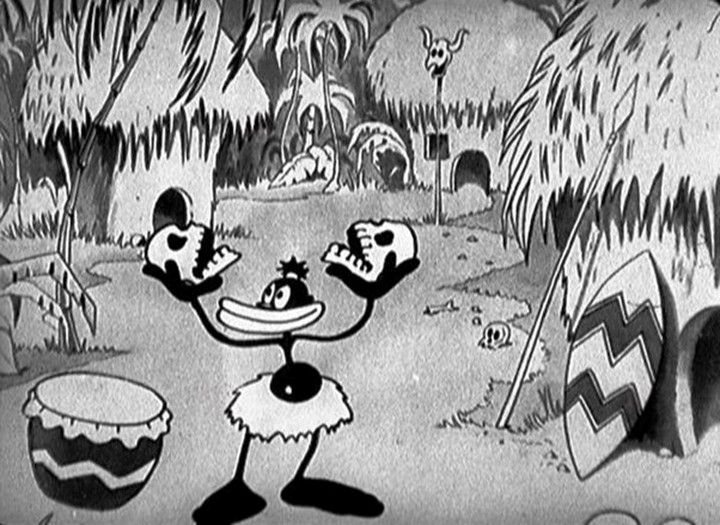 ‘Cannibal Capers’ is a typical early dance routine Silly Symphony. This time we watch dancing cannibals, followed by the antics of one poor cannibal chased by a lion.
The caricatures of the ‘primitive’ blacks are backward and quite extreme in this cartoon: the cannibals have such huge lips, they almost look like ducks(!). Nevertheless, the cartoon is less offensive than a later film like ‘Mickey’s Man Friday‘ (1935), because the cannibals at least look sympathetic (despite the skulls that lie everywhere), and are not compared to apes, like in the latter cartoon.
It also fairs better than the Betty Boop cartoon ‘I’ll Be Glad When You’re Fead You Rascal You‘ (1932), which also features cannibals, but here they’re linked to musicians of Louis Armstrong’s orchestra, making a direct connection between the racist caricatures and real Afro-Americans.
Cannibals were staple characters of cartoons from the thirties, but the caricatures managed to stay well into the fifties, being featured in shorts such as ‘His Mouse Friday‘ (Tom & Jerry, 1951), ‘Spare The Rod’ (Donald Duck, 1954) and ‘Boyhood Daze’ (Merrie Melodies, 1957).
‘Cannibal Capers’ is noteworthy, because it contains the only animation by Floyd Gottfredson that hit the screen: that of the lion running out of the jungle and of a cannibal beating the drum. Around the time this cartoon was released, Gottfredson was asked to take over the Mickey Mouse comic strip (then still written by Walt Disney himself), something he would do until 1975.
Watch ‘Cannibal Capers’ yourself and tell me what you think:
This is Silly Symphony No. 8
To the previous Silly Symphony: Autumn
To the next Silly Symphony: Night
Director: Burt Gillett
Release Date: December 21, 1929
Stars: Mickey Mouse, Minnie Mouse
Rating: ★★★½
Review:
 In his fifteenth cartoon Mickey is a lifeguard and he saves a nearly drowning Minnie.
To comfort his sweetheart Mickey does some playing and dancing. Some animals (pinguins, sea lions, pelicans and a singing walrus) join in. This is a particularly dull sequence, Minnie cheers up, calls Mickey ‘my hero’ and kisses him. Iris out.
In this short, there’s a story at least the first half of the cartoon, making it slightly better than most of the early Mickey Mouse entries. The cartoon starts with some nice scatting by Mickey. Unfortunately, the fledgling lip-synch still accounts for some strange facial expressions on our hero. The drowning and saving part is the most interesting sequence, and contains some nice water animation, as well Mickey defying gravity by swimming through air.
‘Wild Waves’ was the first short directed by Burt Gillett. Gillett had joined Disney in April 1929. He would become the principal Mickey Mouse director of 1930 and 1931, and in 1933 he would gain fame with ‘Three Little Pigs‘. His career at Disney’s would last until 1934, when he left for the ill-fated Van Beuren Studio.
‘Wild Waves’ also was the last Walt Disney short to feature music by Carl Stalling. When Ub Iwerks left Disney in January 1930, Stalling soon followed, believing the studio had no future without this master animator. For his last film Stalling not only provided the score, but also the singing for Mickey and the Walrus. The singing walrus would be reused half a year later, in the Silly Symphony ‘Arctic Antics‘, while the dancing sea lions returned in ‘The Castaway‘ (1931).
Watch ‘Wild Waves’ yourself and tell me what you think:
This is Mickey Mouse cartoon No. 15
To the previous Mickey Mouse cartoon: The Haunted House
To the next Mickey Mouse cartoon: Just Mickey
Director: Burt Gillett
Release Date: November 25, 1933
Stars: Mickey Mouse, The Orphan Mice
Rating: ★★★½
Review:
 Mickey tells the story of Jack and the Beanstalk to his numerous nephews with him in the starring role.
These nephews come out of nowhere, even though they had appeared in ‘Mickey’s Nightmare‘ (1932), where they were, indeed, part of a nightmare. In ‘Giantland’ they’re real alright, and they would star in five other Mickey Mouse cartoons of the 1930s.
In his story Mickey meets the first giant of his career. This giant is very well drawn, with great use of perspective and realistic details, especially in the hands. This must have been the closest the studio could come to the human form in 1933. The cartoon also contains many shadows. Both features are a testimony of Disney’s urge to master more naturalism in his cartoons.
Nevertheless, one can see that the animators were still struggling with such elaborate designs. The giant is not drawn very consistently, and some sequences are more convincing than others. The best and most beautiful scene is when Mickey ends up inside the Giant’s mouth. This is an original scene by all means, and one that could almost only be done in animation.
Notably, the cartoon emphasizes that the story is a fantasy, with Mickey only telling it. Mickey was slowly becoming more settled, and while he’s still the hero of this cartoon, as the years progressed his quieter nature meant that he lost more and more screen time to less timid characters, like Pluto, Donald Duck and Goofy.
Mickey would deal with giants again in ‘Brave Little Tailor’ (1938) and in ‘Fun and Fancy Free’ (1947), a re-telling of the same fairy tale. ‘Gulliver Mickey’ from six months later follows the same story line as ‘Giantland’, but now in reverse, with Mickey himself being the giant, while Floyd Gottfredson retold the story of ‘Giantland’ in his Sunday Mickey Mouse comics from March 11 to April 29, 1934.
Watch ‘Giantland’ yourself and tell me what you think:
This is Mickey Mouse cartoon No. 62
To the previous Mickey Mouse cartoon: The Pet Store
To the next Mickey Mouse cartoon: Shanghaied
Director: Burt Gillett
Release Date: July 1, 1933
Stars: Clarabelle Cow, Horace Horsecollar, Mickey Mouse, Minnie Mouse, Pete, Pluto
Rating: ★★★★★ ♕
Review:
 ‘Mickey’s Gala Premier’ is without doubt one of the greatest of all Mickey Mouse Cartoons.
The short both celebrates the enormous popularity Mickey enjoyed in the early 1930s, and establishes him as one of the leading actors of that period.
We’re witnessing the premiere of a new Mickey Mouse cartoon at the famous Grauman’s Chinese Theater in Hollywood, where Mickey and the gang are welcomed as celebrities (only Goofy is absent, his character was not yet established at that time).
The cartoon that is shown at the premiere is called ‘Galloping Romance’. It is an early and fantastic self-parody. This short only exists within ‘Mickey’s Gala Premier’ and is a ridiculous variation on ‘The Cactus Kid’ (1930), in which Mickey rides a number of silly animals in his pursuit of Pete, including a marimba. This self-consciously silly cartoon is way more old-fashioned than ‘Mickey’s Gala Premier’ itself.
Nevertheless, the crowd, which consists solely of well-known performers of the time, laugh their heads off and, after the show, all try to congratulate Mickey. Mickey’s wet dream appears to be being kissed by Swedish actress Greta Garbo, because it is the cartoon’s climax before it’s being revealed that all has been just a dream.
All the caricatures are the work of Joe Grant, whose work was also quoted by the Disney studio in the short special ‘Parade of the Award Nominees‘ (1932). For ‘Mickey’s Gala Premier’ Disney went directly to Grant, and the film became the story man’s first job for Disney. However, it was only two months after this film that Joe Grant became a full-time employee at the Disney studio. There he would also draw caricatures for ‘Broken Toys’ (1935) and ‘Mickey’s Polo Team’ (1936), but his main contribution would be to the story department.
The self-conscious nature of ‘Mickey’s Gala Premiere’ would remain rare at Disney’s, but it would become one of the key features of the Warner Brother Cartoons, who would produce similar cartoons as ‘You Ought to be in Pictures’ (1940) and ‘What’s Cookin’ Doc?’ (1944). Both cartoons are tributary to ‘Mickey’s Gala Premier’.
The short also sprouted several other cartoons featuring caricatures of contemporary Hollywood stars, among others ub Iwerks’s ‘Soda Squirt‘ (1933), Walter Lantz’s ‘The Merry Old Soul‘ (1933) and ‘Toyland Premiere’ (1934), Disney’s own ‘Mickey’s Polo Team’ (1936) and ‘Mother Goose goes Hollywood’ (1938), and the Warner Brothers cartoons ‘The Coo-Coo Nut Groove’ (1936), ‘Porky’s Road Race’ (1937) and ‘Hollywood Steps Out‘ (1941). Nevertheless, ‘Mickey’s Gala Premier’ was not the first in his kind, for already ten years earlier Felix the Cat made the trip to Hollywood to meet the stars in ‘Felix in Hollywood’ (1923).
Among the stars featured in ‘Mickey’s Gala Premier’ I managed to identify The Keystone Cops, Marie Dressler, Laurel & Hardy, the Marx Brothers, Maurice Chevalier, Eddie Cantor, Jimmy Durante, Harold Lloyd, Edward G. Robinson, Clark Gable, Joe E. Brown, Charlie Chaplin, Buster Keaton, Mae West, Greta Garbo, Bela Lugosi, Frederic March and Boris Karloff.
Also featured is some guy who has a striking resemblance to Prince Charles of Wales and who’s dressed as a king. This is a caricature of Will H. Hays, the president of the Motion Picture Producers and Distributors of America (MPPDA). Hays was Hollywood’s chief censor and the man behind the Hays code, the censorship Hollywood imposed on itself between 1930 and 1968. Interestingly, the censorship only became severe when Hays made place for Joseph Breen in 1934…
Watch ‘Mickey’s Gala Premier’ yourself and tell me what you think:
This is Mickey Mouse cartoon No. 58
To the previous Mickey Mouse cartoon: Mickey’s Mechanical Man
To the next Mickey Mouse cartoon: Puppy Love
Director: Burt Gillett
Release Date: April 8, 1933
Stars: Clarabelle Cow, Goofy, Mickey Mouse, Minnie Mouse
Rating: ★★★★½
Review:
 Mickey and the gang are staged in many different times and places in their cartoons. Yet, this medieval short is the only cartoon in which they are introduced as actors performing their parts.
This idea of Mickey being an actor was first coined in ‘The Wayward Canary’ (1932) and played out to the max in ‘Mickey’s Gala Premier’ (1933). This cartoon nevertheless is played without any awareness of the public.
Minnie is the princess of Lalapazoo, and forced by her father to marry prince Goofy from Pupupadoo. Minnie refuses and is locked up in the high tower. Fortunately, there is minstrel Mickey to save her and to battle the evil prince, chasing him through the window, and marrying the princess himself. This adventure film cliche Disney already had visited in the Oswald cartoon ‘Oh, What A Knight‘, but it is expanded and improved in ‘Ye Olden Days’.
Like ‘Building a Building’ and ‘The Mad Doctor’ from the same year, this cartoon is partly a musical with lots of parts sung. It also contains a very anachronistic guillotine and an elaborately designed horse that shows the aspirations of the studio to master more lifelike designs and animation.
Goofy, who is introduced as Dippy Dawg, is quite miscast here, playing the villain, whom he acts out more sillily than threateningly. It seems that the animators didn’t really know what to do with the character, so far only funny because of his typical voice. So, after this film they dropped him for more than a year.
Watch ‘Ye Olden Days’ yourself and tell me what you think:
This is Mickey Mouse cartoon No. 55
To the previous Mickey Mouse cartoon: Mickey’s Mellerdrammer
To the next Mickey Mouse cartoon: The Mail Pilot
Director: Burt Gillett
Release Date: December 5, 1931
Stars: Mickey Mouse, Minnie Mouse, Pluto
Rating: ★★★★½
Review:
 It’s Christmas and a poor lady drops by Mickey and Minnie’s house to leave a box at their doorstep.
This box contains an endless quantity of little kittens, which are taking over the house within seconds. Soon, the house is near complete destruction. This is partly Mickey’s own fault, because dressed up as Santa he gives the little brats toys like hammers, saws, drills, axes, and even guns and canons.
‘Mickey’s Orphans’ is a real gag cartoon from the outset and the first of several Mickey Mouse shorts in which many brats cause havoc. No musical routine is involved, and as soon as the box of kittens is opened, the gags roll in like they never did before. The kittens even manage to give the ever cheerful Mickey and Minnie a dismayed look, albeit only at the end of the cartoon. The little kittens would cause havoc again in ‘Mickey’s Revue‘ (1932) before being replaced by the little mice in ‘Mickey’s Nightmare‘ later that year. Maybe the idea of giant mice dealing with little kittens was a little too awkward for the makers…
‘Mickey’s Orphans’ is the first of no less than four Mickey Mouse Christmas cartoons, the others being ‘Mickey’s Good Deed‘ (1932), ‘Pluto’s Christmas Tree’ (1952) and ‘Mickey’s Christmas Carol‘ (1983). It was nominated for the very first Academy Award for animated short film, but it understandably lost to the first technicolor short ‘Flowers and Trees‘ (1932), although Walt Disney did get a special Academy Award for the creation of Mickey Mouse.
Watch ‘Mickey’s Orphans’ yourself and tell me what you think:
This is Mickey Mouse cartoon No. 36
To the previous Mickey Mouse cartoon: Mickey Cuts Up
To the next Mickey Mouse cartoon: The Duck Hunt
Director: Burt Gillett
Release Date: November 25, 1931
Stars: Mickey Mouse, Minnie Mouse, Pluto
Rating: ★★★½
Review:
 ‘Mickey Cuts Up’ can be summarized as ‘Mickey Steps Out’ set in a garden.
The first part of the cartoon consists of a quite tiring song-and-dance-routine (with Mickey dancing as a turtle as a minor highlight). Like in ‘Mickey Steps Out’ there’s some whistling with the birds, with Mickey impersonating one. Later the two perform the 1921 hit song ‘Ain’t We Got Fun’ on harmonicas.
Only after five minutes, the second part starts. This hilarious sequence is devoted to Pluto chasing a cat and causing havoc, just like he did in ‘Mickey Steps Out’. The contrast with the first half couldn’t be greater: suddenly the gags come fast and plenty. There’s even an early running gag in which Mickey gets wet in various ways. The second half is of a stunning speed, and a real tour de force in its string of gags leading to other gags, and to the grand finale. This half makes the cartoon a stand out of the era, and one that looks forward to things to come.
Watch ‘Mickey Cuts Up’ yourself and tell me what you think:
This is Mickey Mouse cartoon No. 35
To the previous Mickey Mouse cartoon: The Beach Party
To the next Mickey Mouse cartoon: Mickey’s Orphans


 Dr. Grob's Animation Review