
You are currently browsing the tag archive for the ‘Pluto’ tag.
Director: David Hand
Release Date: August 31, 1935
Stars: Mickey Mouse, Pluto
Rating: ★★★★★
Review:
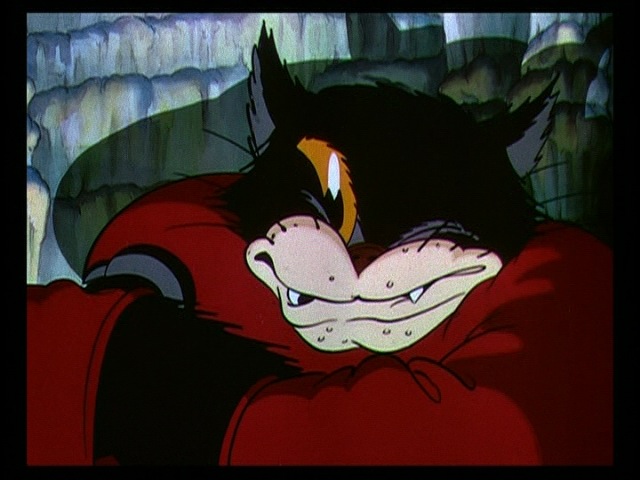 Although this cartoon is part of the Mickey Mouse series, Pluto is its star.
After he has chased a little kitten, he dreams that his Judgement Day has come and that he’s put on trial by a number of cheating cats.
Like most of Disney’s dream-cartoons this one contains wonderful backgrounds, characters and ideas, thanks to story men Joe Grant and Bill Cottrell. The dream sequence is executed in a Silly Symphony-like fashion with lots of rhyme and song and very beautiful animation. The prosecutor, animated by Bill Roberts, is particularly well done: he’s an impressive figure, whose stature anticipates Stromboli from ‘Pinocchio‘ (1940).
Pluto now is a fully developed character who easily carries the complete cartoon on his own. Mickey’s part, on the other hand, is reduced to that of a cameo, something that would occur more and more in the years to come.
Watch ‘Pluto’s Judgement Day’ yourself and tell me what you think:
This is Mickey Mouse cartoon No. 78
To the previous Mickey Mouse cartoon: Mickey’s Fire Brigade
To the next Mickey Mouse cartoon: On Ice
Director: Wilfred Jackson
Release Date: July 13, 1935
Stars: Mickey Mouse, Pluto
Rating: ★★★★
Review:
 ‘Mickey’s Garden’ is Mickey’s second color cartoon (after ‘The Band Concert‘).
It’s also Pluto’s first: he passes the transition into color fluently, getting his typical orange color we’re all familiar with now.
Mickey and Pluto are in the garden trying to kill a number of insects eating Mickey’s crop. When Mickey accidentally sprays himself with bug poison he starts to hallucinate (the transition to the dreamworld is particularly psychedelic: everything, including the background becomes unsteady and wobbly). He dreams that all plants and bugs have grown. This leads to some imaginative scenes. The bugs are not very lifelike, though. The animators even make a weird mistake by giving a particularly evil-looking beetle eight legs instead of six.
Watch ‘Mickey’s Garden’ yourself and tell me what you think:
This is Mickey Mouse cartoon No. 76
To the previous Mickey Mouse cartoon: Mickey’s Kangaroo
To the next Mickey Mouse cartoon: Mickey’s Fire Brigade
Director: Burt Gillett
Release Date: July 1, 1933
Stars: Clarabelle Cow, Horace Horsecollar, Mickey Mouse, Minnie Mouse, Pete, Pluto
Rating: ★★★★★ ♕
Review:
 ‘Mickey’s Gala Premier’ is without doubt one of the greatest of all Mickey Mouse Cartoons.
The short both celebrates the enormous popularity Mickey enjoyed in the early 1930s, and establishes him as one of the leading actors of that period.
We’re witnessing the premiere of a new Mickey Mouse cartoon at the famous Grauman’s Chinese Theater in Hollywood, where Mickey and the gang are welcomed as celebrities (only Goofy is absent, his character was not yet established at that time).
The cartoon that is shown at the premiere is called ‘Galloping Romance’. It is an early and fantastic self-parody. This short only exists within ‘Mickey’s Gala Premier’ and is a ridiculous variation on ‘The Cactus Kid’ (1930), in which Mickey rides a number of silly animals in his pursuit of Pete, including a marimba. This self-consciously silly cartoon is way more old-fashioned than ‘Mickey’s Gala Premier’ itself.
Nevertheless, the crowd, which consists solely of well-known performers of the time, laugh their heads off and, after the show, all try to congratulate Mickey. Mickey’s wet dream appears to be being kissed by Swedish actress Greta Garbo, because it is the cartoon’s climax before it’s being revealed that all has been just a dream.
All the caricatures are the work of Joe Grant, whose work was also quoted by the Disney studio in the short special ‘Parade of the Award Nominees‘ (1932). For ‘Mickey’s Gala Premier’ Disney went directly to Grant, and the film became the story man’s first job for Disney. However, it was only two months after this film that Joe Grant became a full-time employee at the Disney studio. There he would also draw caricatures for ‘Broken Toys’ (1935) and ‘Mickey’s Polo Team’ (1936), but his main contribution would be to the story department.
The self-conscious nature of ‘Mickey’s Gala Premiere’ would remain rare at Disney’s, but it would become one of the key features of the Warner Brother Cartoons, who would produce similar cartoons as ‘You Ought to be in Pictures’ (1940) and ‘What’s Cookin’ Doc?’ (1944). Both cartoons are tributary to ‘Mickey’s Gala Premier’.
The short also sprouted several other cartoons featuring caricatures of contemporary Hollywood stars, among others ub Iwerks’s ‘Soda Squirt‘ (1933), Walter Lantz’s ‘The Merry Old Soul‘ (1933) and ‘Toyland Premiere’ (1934), Disney’s own ‘Mickey’s Polo Team’ (1936) and ‘Mother Goose goes Hollywood’ (1938), and the Warner Brothers cartoons ‘The Coo-Coo Nut Groove’ (1936), ‘Porky’s Road Race’ (1937) and ‘Hollywood Steps Out‘ (1941). Nevertheless, ‘Mickey’s Gala Premier’ was not the first in his kind, for already ten years earlier Felix the Cat made the trip to Hollywood to meet the stars in ‘Felix in Hollywood’ (1923).
Among the stars featured in ‘Mickey’s Gala Premier’ I managed to identify The Keystone Cops, Marie Dressler, Laurel & Hardy, the Marx Brothers, Maurice Chevalier, Eddie Cantor, Jimmy Durante, Harold Lloyd, Edward G. Robinson, Clark Gable, Joe E. Brown, Charlie Chaplin, Buster Keaton, Mae West, Greta Garbo, Bela Lugosi, Frederic March and Boris Karloff.
Also featured is some guy who has a striking resemblance to Prince Charles of Wales and who’s dressed as a king. This is a caricature of Will H. Hays, the president of the Motion Picture Producers and Distributors of America (MPPDA). Hays was Hollywood’s chief censor and the man behind the Hays code, the censorship Hollywood imposed on itself between 1930 and 1968. Interestingly, the censorship only became severe when Hays made place for Joseph Breen in 1934…
Watch ‘Mickey’s Gala Premier’ yourself and tell me what you think:
This is Mickey Mouse cartoon No. 58
To the previous Mickey Mouse cartoon: Mickey’s Mechanical Man
To the next Mickey Mouse cartoon: Puppy Love
Director: David Hand
Release Date: January 21, 1933
Stars: Mickey Mouse, Pluto
Rating: ★★★★★
Review:
 ‘The Mad Doctor’ is Mickey’s third horror cartoon and easily his best (the other two are ‘The Haunted House’ from 1929 and ‘The Gorilla Mystery’ from 1930).
The plot is simple: it’s night, the weather is foul and Pluto is kidnapped by an evil scientist called Dr. XXX, who takes him into his laboratory, which is reminiscent of that of Frankenstein in James Whales’ film of the same name, 1931. Mickey follows Pluto’s tracks into a creepy castle, entering it in a scene which reuses some footage of ‘Egyptian Melodies‘ from 1931. Inside the castle he has to deal with several skeletons, including a ridiculous hybrid of a skeleton and a spider. Soon, he’s captured, too, and about to be killed by a chainsaw. Fortunately, it turns out to be all just a dream…
Besides the horror, this cartoon also features elaborate designs and loads of special effects. Especially beautiful is its shadowing on the characters. It also has a strong musical element, as the mad scientist sings all his lines. Some of the gags are quite surreal and reminiscent of the Fleischer style, like a lock locking itself or the scientist cutting off Pluto’s shadow. The cartoon also features a gag with many doors in one doorpost. This gag would be reused and improved by Tex Avery in ‘The Northwest Hounded Police’ from 1946.
Watch ‘The Mad Doctor’ yourself and tell me what you think:
This is Mickey Mouse cartoon No. 52
To the previous Mickey Mouse cartoon: Building a Building
To the next Mickey Mouse cartoon: Mickey’s Pal Pluto
Director: David Hand
Release Date: January 7, 1933
Stars: Mickey Mouse, Minnie Mouse, Pete ,Pluto
Rating: ★★★★
Review:
 ‘Building a building’ has a grand opening with its close-up of the anthropomorphized excavator.
This fast and gag-rich cartoon can be summarized as ‘Gallopin’ Gaucho‘ at a building site: Mickey is employed as an excavator machinist. When Minnie drops by selling box lunches, Mickey is so struck by love that he ruins the blueprints of foreman Peg Leg Pete three times. Pete is charmed by Minnie, too, and he tries to force her to a kiss. Of course, Mickey comes to the rescue, fleeing with Minnie and leaving Pete behind with the building in complete shambles. Pete just manages to fire Mickey, but Minnie immediately adds him to her business.
‘Building a Building’ reuses several story ideas from the early Oswald cartoon ‘Sky Scrappers‘ (1928). Both feature the hero being an excavator machinist, his love interest bringing box lunches, and Pete trying to abduct the girl. Even the excavator opening shot is a copy of the opening shot of ‘Sky Scrappers’. However, in five years both animation, timing and characterization have much improved. If ‘Sky Scrappers’ was a remarkable achievement for 1928, it was at times still crude. ‘Building a Building’ on the other hand has a refined quality that characterized the Mickey Mouse cartoons of 1933 and beyond.
There’s for example some remarkably flexible animation on Mickey when he rides the elevator. The animators have really put a sense of weight in his body, and exaggerated the effects of the sudden start and stop of the lift on it, with a lovely comic result. The musical score, too, is a delight from beginning to end, becoming particularly silly when Pete’s trousers change into a watering can. Indeed, with ‘Building A Building’ Mickey got his second Academy Award nomination, after ‘Mickey’s Orphans‘ (1931)
‘Building a Building’ is the first of a few 1933 Mickey Mouse cartoons that are introduced and partly played out in Song, following the Silly Symphonies ‘King Neptune‘ and ‘Santa’s Workshop‘ from 1932. Other examples from 1933 are ‘The Mad Doctor‘, ‘Ye Olden Days‘ and ‘The Mail Pilot‘.
Watch ‘Building a Building’ yourself and tell me what you think:
This is Mickey Mouse cartoon No. 51
To the previous Mickey Mouse cartoon: Mickey’s Good Deed
To the next Mickey Mouse cartoon: The Mad Doctor
Director: Burt Gillett
Release Date: December 5, 1931
Stars: Mickey Mouse, Minnie Mouse, Pluto
Rating: ★★★★½
Review:
 It’s Christmas and a poor lady drops by Mickey and Minnie’s house to leave a box at their doorstep.
This box contains an endless quantity of little kittens, which are taking over the house within seconds. Soon, the house is near complete destruction. This is partly Mickey’s own fault, because dressed up as Santa he gives the little brats toys like hammers, saws, drills, axes, and even guns and canons.
‘Mickey’s Orphans’ is a real gag cartoon from the outset and the first of several Mickey Mouse shorts in which many brats cause havoc. No musical routine is involved, and as soon as the box of kittens is opened, the gags roll in like they never did before. The kittens even manage to give the ever cheerful Mickey and Minnie a dismayed look, albeit only at the end of the cartoon. The little kittens would cause havoc again in ‘Mickey’s Revue‘ (1932) before being replaced by the little mice in ‘Mickey’s Nightmare‘ later that year. Maybe the idea of giant mice dealing with little kittens was a little too awkward for the makers…
‘Mickey’s Orphans’ is the first of no less than four Mickey Mouse Christmas cartoons, the others being ‘Mickey’s Good Deed‘ (1932), ‘Pluto’s Christmas Tree’ (1952) and ‘Mickey’s Christmas Carol‘ (1983). It was nominated for the very first Academy Award for animated short film, but it understandably lost to the first technicolor short ‘Flowers and Trees‘ (1932), although Walt Disney did get a special Academy Award for the creation of Mickey Mouse.
Watch ‘Mickey’s Orphans’ yourself and tell me what you think:
This is Mickey Mouse cartoon No. 36
To the previous Mickey Mouse cartoon: Mickey Cuts Up
To the next Mickey Mouse cartoon: The Duck Hunt
Director: Burt Gillett
Release Date: November 25, 1931
Stars: Mickey Mouse, Minnie Mouse, Pluto
Rating: ★★★½
Review:
 ‘Mickey Cuts Up’ can be summarized as ‘Mickey Steps Out’ set in a garden.
The first part of the cartoon consists of a quite tiring song-and-dance-routine (with Mickey dancing as a turtle as a minor highlight). Like in ‘Mickey Steps Out’ there’s some whistling with the birds, with Mickey impersonating one. Later the two perform the 1921 hit song ‘Ain’t We Got Fun’ on harmonicas.
Only after five minutes, the second part starts. This hilarious sequence is devoted to Pluto chasing a cat and causing havoc, just like he did in ‘Mickey Steps Out’. The contrast with the first half couldn’t be greater: suddenly the gags come fast and plenty. There’s even an early running gag in which Mickey gets wet in various ways. The second half is of a stunning speed, and a real tour de force in its string of gags leading to other gags, and to the grand finale. This half makes the cartoon a stand out of the era, and one that looks forward to things to come.
Watch ‘Mickey Cuts Up’ yourself and tell me what you think:
This is Mickey Mouse cartoon No. 35
To the previous Mickey Mouse cartoon: The Beach Party
To the next Mickey Mouse cartoon: Mickey’s Orphans
Director: Burt Gillett
Release Date: July 10, 1931
Stars: Mickey Mouse, Minnie Mouse, Pluto
Rating: ★★★½
Review:
 ‘Mickey Steps Out’ is the first of a few Mickey Mouse cartoons that are half musical numbers half story.
This was a plot structure used in many Mickey Mouse cartoons from 1931 to 1933, with ‘The Pet Store‘ being the last example. This half-baked structure was soon replaced by stories filling the complete cartoons.
In ‘Mickey Steps Out’, Mickey visits Minnie, but Pluto, who should have stayed in, is following him, dragging his dog house along to Minnie’s place. First, Mickey and Minnie perform their usual song-and-dance-routine (this time based on ‘Sweet Georgia Brown’), but when Pluto is chasing a cat, their music is interrupted and followed by a fast sequence of gags of Pluto and the cat ruining the house culminating in a blackface gag.
‘Mickey Steps Out’ arguably contains the first well-constructed finale in Disney history. It’s at least the first of a series of cartoons that end in complete destruction. Pluto would again cause havoc in ‘Mickey Cuts Up’ (1931) and ‘The Grocery Boy’ (1932). Later, destruction would be caused by little kittens (a.o. ‘Mickey’s Orphans‘, 1931) and orphan mice (a.o. ‘Mickey’s Nightmare‘, 1932). ‘Mickey Steps Out’ reuses footage of ‘The Birthday Party’ of Mickey with a fishbowl on his head.
Almost secretly, the film introduces another novelty: the first attempt at a realistically drawn animal: Minnie’s canary is in no sense cartoony, behaving like a real bird. It’s a major advance when compared to the Silly Symphony ‘Birds of a Feather‘ from six months earlier. The canary only plays a small part in the cartoon, but is the testimony of Disney’s ultimate ambitions, even at this stage. It’s these innovations, better story arcs and a strive towards better, more realistic animation that propelled the Disney cartoons forward, leaving their contemporaries far behind.
Watch ‘Mickey Steps Out’ yourself and tell me what you think:
This is Mickey Mouse cartoon No. 30
To the previous Mickey Mouse cartoon: The Delivery Boy
To the next Mickey Mouse cartoon: Blue Rhythm
Director: Ben Sharpsteen
Release Date: January 2, 1937
Stars: Mickey Mouse, Pete, Pluto
Rating: ★★½
Review:
 In the opening shot of ‘The Worm Turns’ we watch Mickey looking like an evil scientist, working on a potion that can give courage and power.
He tries it on a fly caught in a spiderweb, on a mouse (the two different designs of mice in this film, with one being twenty times larger, is quite confusing!) who is the victim of a cat, on the cat, who’s chased by Pluto, and on Pluto, who’s threatened by evil dog catcher Pete.
The animation of the opening sequence is quite stunning, but the whole short fails to get funny. Hanna and Barbera would revisit the same idea in the similar ‘Dr. Jekyll and Mr. Mouse‘ (1947) with much better results.
Watch ‘The Worm Turns’ yourself and tell me what you think:
This is Mickey Mouse cartoon No. 90
To the previous Mickey Mouse cartoon: Mickey’s Elephant
To the next Mickey Mouse cartoon: Don Donald
Director: Burt Gillett
Release Date: July 30, 1932
Stars: Pluto
Rating: ★★★★
Review:
 ‘Just Dogs’ opens with a dog pound, with several dogs howling to the tune of Vernon Dalhart’s 1924 hit ‘The Prisoner’s Song’.
Then a little black dog escapes, and helps Pluto and several other dogs escaping, too. Once outside the little dog repeatedly tries to gain Pluto’s sympathy, to no avail. Not even when it shares a large bone with Pluto. When an annoying little Pekingese warns the other dogs of the bone, trouble starts, but the little dog saves the day with the help of legion of fleas, while Pluto remains busy with an alarm clock. Only then he gains Pluto’s much wanted sympathy.
‘Just Dogs’ is not a particularly funny or beautiful short and its star, Pluto, is most of the time quite unsympathetic, but it does show the advancements in animation Disney was making at the time: we’re not watching ‘just dogs’, we’re watching several recognizable types of dogs, among them a very lifelike St. Bernard.
By now, the Disney animators didn’t need to stick to stereotyped ducks, pigs, cows, horses, or in this case, dogs, but were able to draw and animate real dogs, who looked like dogs, moved like dogs and behaved like dogs. This kind of naturalism is quite unprecedented in earlier films. ‘Just Dogs’ is still a mixed bag: some of the designs are still very primitive, especially during the escape scene, but there are some striking new designs here, not in the least, the small, optimistic black dog, who ‘s the real hero of the short.
The two main protagonists, Pluto and his clever comrade, are two distinct characters, which behave and move differently, a great advancement in character animation. Disney would develop both naturalism and character animation into perfection in the coming seven years.
Two years later the little dog would reappear as Pluto’s rival Terry in Floyd Gottfredson’s Mickey Mouse comics.
Watch ‘Just Dogs’ yourself and tell me what you think:
This is Silly Symphony No. 28
To the previous Silly Symphony: The Bears and the Bees
To the next Silly Symphony: Flowers and Trees


 Dr. Grob's Animation Review