
You are currently browsing the tag archive for the ‘tall tales’ tag.
Director: Marcell Jankovics
Release date: May 3, 1973
Rating: ★★★★
Review:
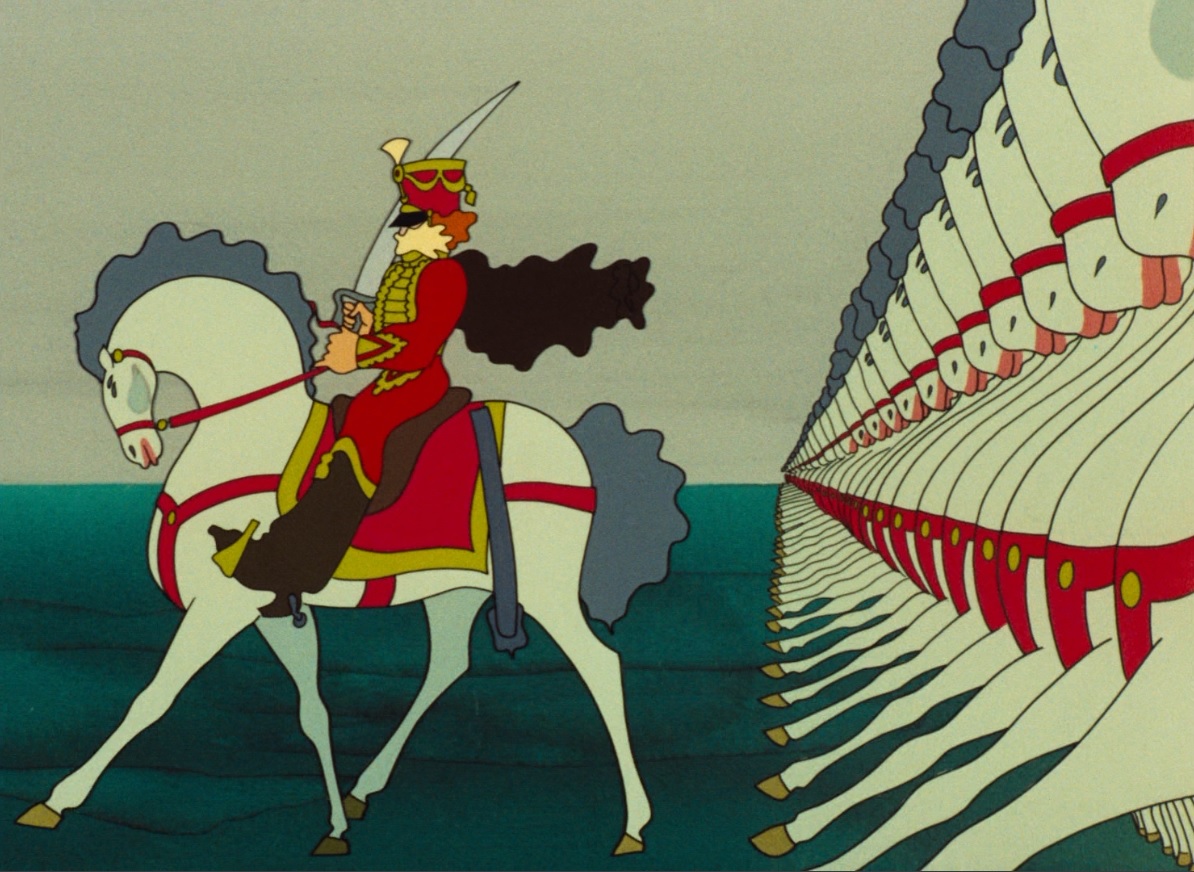
Hungarian director Marcell Jankovics (1941-2021) is most famous for his second animated feature, the mind-blowing masterpiece ‘Fehérlófia’ (Son of the White Mare) from 1981. But his first feature, ‘János Vitéz’ certainly deserves to be equally famous.
‘János Vitéz’ was Hungary’s ever first animated feature ever, but this doesn’t show, at all. The feature is a remarkably mature product that owes nothing to earlier animation films, save George Dunnings’ ‘Yellow Submarine’ from 1968 (and one scene of a devils’ dance, which harks all the way back to Disney’s Silly Symphony ‘The Goddess of Spring’ from 1934). Like Dunning’s film, ‘János Vitéz’ uses very striking visuals in bold colors, and with a genuine contemporary design. In fact, no movie from the seventies looks so enormously ‘seventies’ as this film.
The film was commissioned by the Hungarian government to commemorate the 150st birthday of Hungary’s national poet Sándor Petőfi (1823-1849), whose stature in Hungary is comparable to that of Pushkin in Russia. Petőfi wrote ‘János Vitéz’, a long epic poem in 1844, and despite the strikingly modern visuals, the film follows the poem quite faithfully. János Gyulai-Gaál’s score is unmistaken Hungarian, akin to the music of Zoltán Kodály’s folk opera ‘Háry János’ from 1926 and contributes greatly to the utterly Hungarian character of the movie. There are also a few charming songs, adding to the experience.
The story is pretty nonsensical and more of a tall tale than a classic epic poem. It tells about the hero János Vitéz who is a sheep herder in love with the neighboring Iluska. Unfortunately, Iluska’s stepmother, the witch Mostoha, doesn’t approve of the young lovers’ romance, and makes János Vitéz’ flock of sheep disappear. Banished from his village, János Vitéz first joins a band of robbers, then joins the army, but keeps longing for his beloved Iluska.
The film retains much of Petőfi’s poetic quality: the dialogue is in rhyme, and the images themselves have a lyric quality. For example, the love of Iluska and János Vitéz is shown by associative images, full of flowers and a radiant sun. Moreover, a lot of the story is told through the images, and more by suggestion than by literally showing what’s happening. For example, when János Vitéz is banished this is shown by a street in which every house shuts its shutters when János Vitéz passes by.
The images are as folkloristic as they are psychedelic, and never cease to please or to amaze. The character designs are more of a mixed bag. János Vitéz and Iluska are drawn as rather bland beautiful people, while Mostoha, the robbers and the Turks are very cartoony. These and other characters provide some small gags. Character animation is absent. For example, when János Vitéz mourns for Iluska, this emotion is indicated more than heartfelt. Nevertheless, there is a clever use of metamorphosis and animation cycles, and it’s clear the animation is in service of the graphics and of the story.
In all, ‘János Vitéz’ is a joy to watch from start to end and deserves a much wider audience than it has now.
Watch an excerpt from ‘János Vitéz’ yourself and tell me what you think:
‘János Vitéz’ is available on the Blu-Ray of ‘Son of the White Mare’
Director: Rob Gibbs
Release date: November 1, 2011
Rating: ★★
Review:
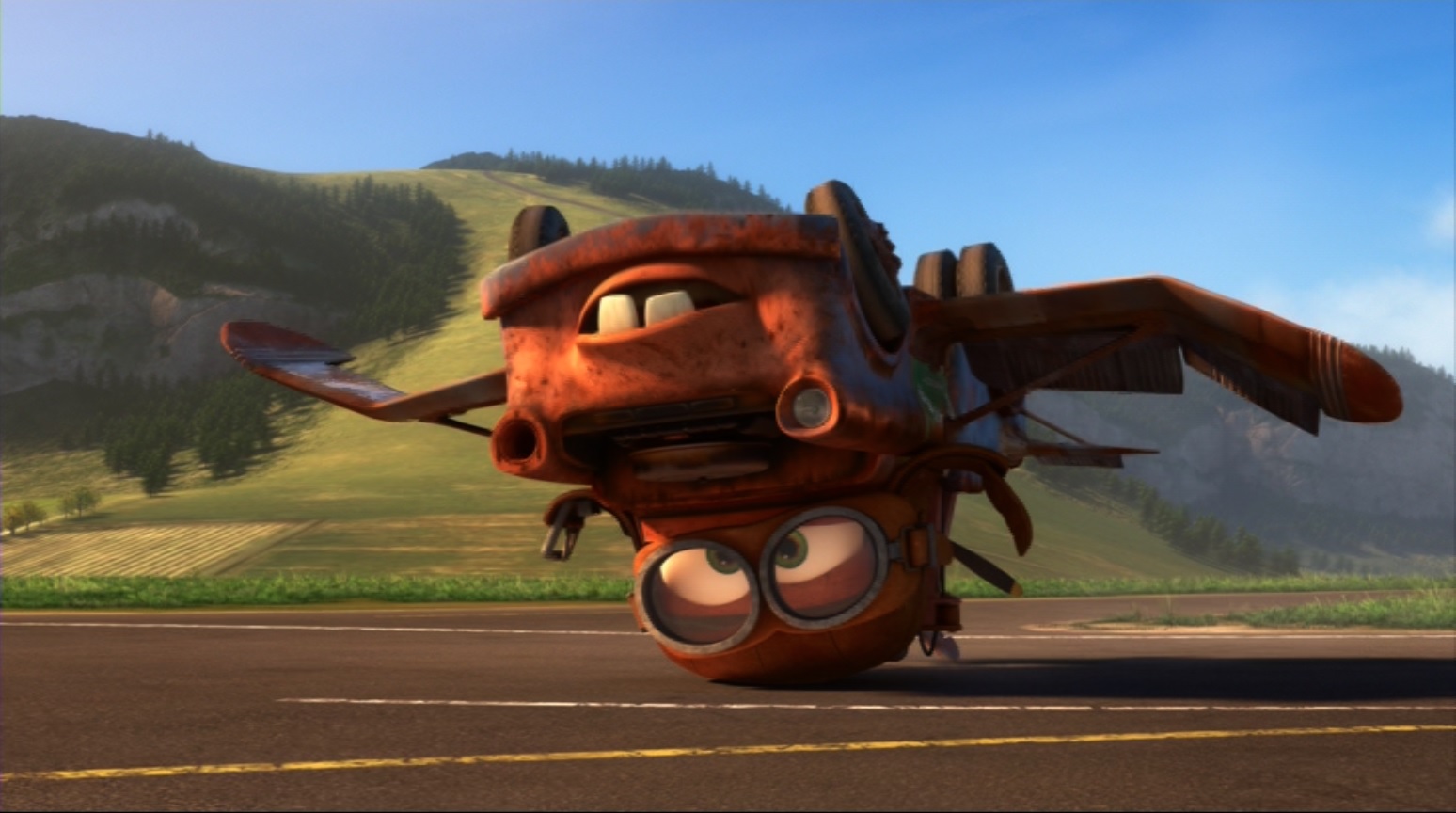
‘Air Mater’ is a late addition to ‘Mater’s Tall Tales’, being aired a year (minus a day) after the ninth episode. In this episode Mater visits a town of planes and takes the air.
Mater’s tall tale is amusing, if very shallow and completely forgettable. Worse, the whole film seems an exercise for the ‘Planes’ feature, released by Disney (not Pixar) in 2013, and feels like an advertisement.
Watch an excerpt from ‘Air Mater’ and tell me what you think:
‘Air Mater’ is available on the Blu-Ray/DVD of ‘Cars 2’ and on the Blu-Ray/DVD ‘Pixar Short Films Collection Volume 2’
Director: ?
Release Date: November 11, 1933
Stars: Willie Whopper
Rating: ★★★★
Review:
 Not satisfied with Flip the Frog, MGM demanded a new cartoon star from Ub Iwerks. So, the studio conceived Willie Whopper, a fat little boy telling tall tales.
Unfortunately, Willie Whopper wasn’t much of a success either, and the series was stopped after only twelve entries. Most famous among the Willie Whopper cartoons probably is ‘Stratos Fear’ in which our hero visits the dentist. When Willie gets too much laughing gas, he inflates and goes up into the air, soon leaving earth, the moon, passing Saturn and into space. When he passes an alien planet, he’s caught by some strange alien scientists.
The alien planet is by all means an odd world, and it anticipates the sheer zaniness of ‘Porky in Wackyland‘ (1938). At one point one of the evil scientists even dresses as a beautiful woman in a scene looking forward all the way to Tim Burton’s feature ‘Mars Attacks!’ (1996). Luckily in the end, it all appears to have been a dream.
‘Stratos Fear’ is an interesting cartoon, because of its early surrealism, but Willie Whopper is not much of a character, being just a bland boy, only reacting on his surroundings, without any internal motivation. The gags, too, are only mildly amusing, as things are just happening on the screen, in a pretty steady flow. Also, despite a certain horror atmosphere, and the erotic beauty, it’s one of those 1933 cartoons already moving towards the infantile world of the second half of the 1930s. The result is noteworthy cartoon, but hardly anything more than that.
Watch ‘Stratos Fear’ yourself and tell me what you think:
‘Stratos Fear’ is available on the DVD ‘Cartoons that Time Forgot – The Ub Iwerks Collection Vol. 2’
Director: Les Clark
Release Date: August 1, 1958
Rating: ★★★
Review:
 ‘Paul Bunyan’ belongs to a group of Disney specials that retell tall tales from the West, following ‘The Legend of Johnny Appleseed‘ and ‘Pecos Bill‘ from ‘Melody Time‘ (1948).
The short is told by three “eye witnesses”, who tell us about the great deeds of the mighty lumberjack Paul Bunyan, who was “63 axe handles high”, and his equally gigantic ox Babe. The best part describes how Bunyan and Babe have reshaped the American landscape: their footsteps turn into the land of 10,000 lakes (in Minnesota), and they themselves build landmarks like the Missouri River, Pikes Peak in Colorado, and the Grand Tetons and Yellowstone Falls in Wyoming.
Eyvind Earle supervised the color schemes, while Tom Oreb designed the characters, like they did for ‘Sleeping Beauty‘ (1959). Their designs are very bold and angular, and the background art, painted by Eyvind Earle and Walt Peregoy, is a delight to watch. Composer George Bruns composed a catchy theme song for the giant hero, which is sung several times throughout the short.
Unfortunately, the short is hampered by a remarkable slowness and a terrible lack of good gags, which make it at 17 minutes too long to remain entertaining. In the end ‘Paul Bunyan’ is more interesting for its looks than for its story.
‘Paul Bunyan’ was the only non-educational short directed by Disney veteran Les Clark, who had been with Disney since the birth of his own studio in 1928.
Watch ‘Paul Bunyan’ yourself and tell me what you think:
‘Paul Bunyan’ is available on the DVD ‘Walt Disney Treasures: Disney Rarities’
Director: Charles Nichols
Release Date: March 16, 1961
Rating: ★★★
Review:

‘The Saga of Windwagon Smith’ was Disney’s last tall tale cartoon after entries like ‘Pecos Bill‘ (from ‘Melody Time‘, 1948) and ‘Paul Bunyan‘ (1958).
Unlike the former, which were rooted in American folklore, this story seems to be an original, although it retains a traditional feel. The story, which is narrated in rhyme, and partly sung by Rex Allen and the Sons of the Pioneers, tells about Windwagon Smith, a sailor who arrives at Westport, a small town in Kansas on a wagon with a sail. He convinces the villagers to make even a larger one to sail the prairies to Santa Fe with. But when it’s ready the villagers get scared and abandon the ‘ship’, except for Molly, the mayor’s daughter, who’s in love with Smith. Together they vanish into a storm.
‘The Saga of Windwagon Smith’ was the last cartoon to be directed by Charles Nichols. It’s also the last of only six shorts directed by him not to feature Pluto. It’s moderately stylized except for Molly, who’s conceived and animated in a charmingly stylized way, seeming to float more than to walk. Nichols left Disney in 1962 for Hanna-Barbera, where he worked on countless television series. In the late 1980s he returned to Disney, where he worked onto his death in 1992, 81 years old.
Watch ‘The Saga of Windwagon Smith’ yourself and tell me what you think:
‘The Saga of Windwagon Smith’ is available on the DVD ‘Walt Disney Treasures: Disney Rarities’


 Dr. Grob's Animation Review