You are currently browsing the tag archive for the ‘Victor Haboush’ tag.
Director: Abe Levitow
Release date: October 24, 1962
Rating: ★★½
Review:
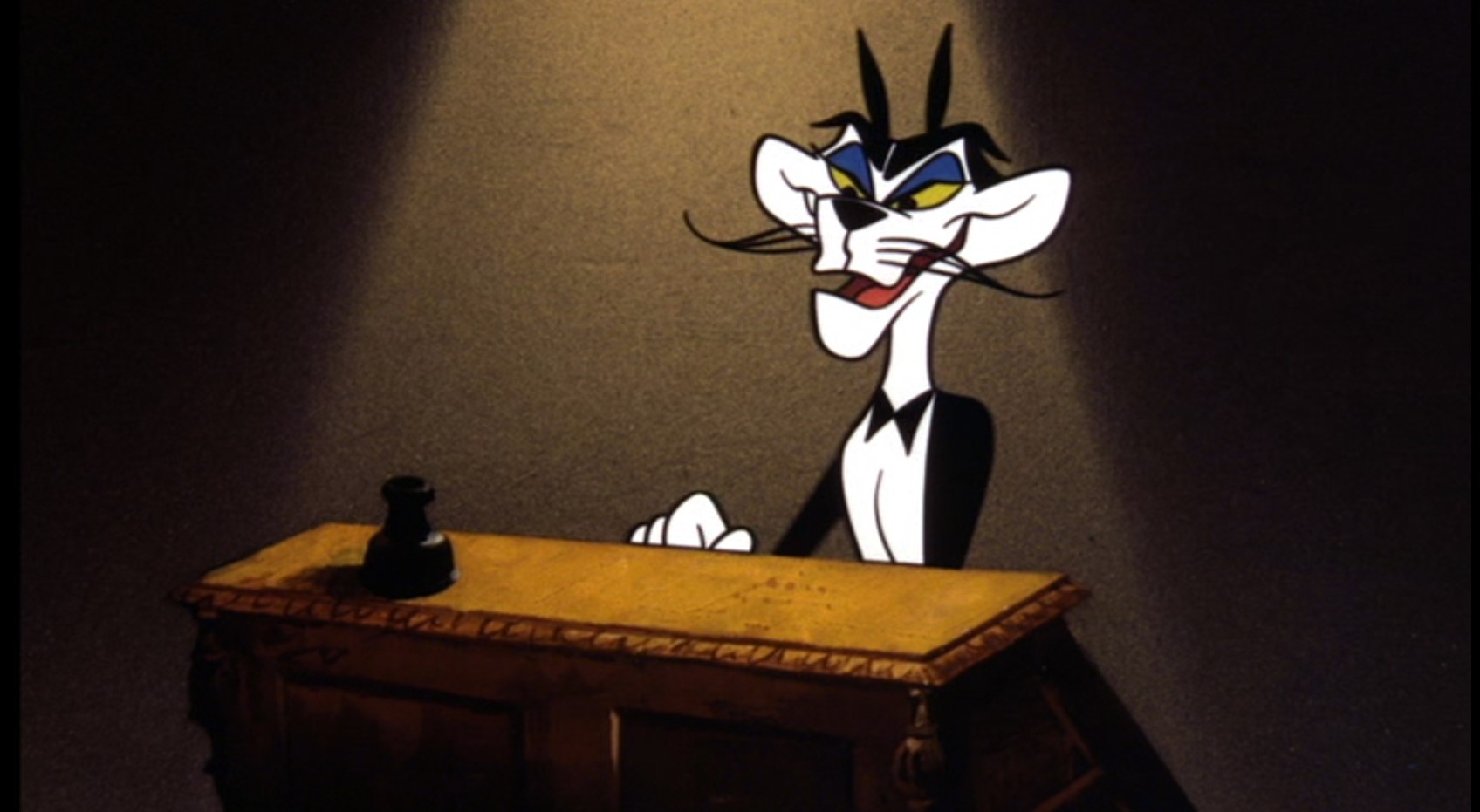
‘Gay Purr-ee’ was the second of only two feature films made by UPA, the first being ‘1001 Arabian Nights’ from 1959 and starring the studio’s only star, Mr. Magoo. In fact, ‘Gay Purr-ee’ was the artistic swansong of the once famed animation studio. Most daring and influential in the 1950s, by the early 1960s UPA had become only a shadow of its former self, as this feature film painfully demonstrates.
In fact, UPA had already entered a stage of decay when Steve Bosustow, one of the founding members of the studio sold his interests to businessman Henry G. Saperstein. Saperstein had no interest in UPA’s “fine-art crap” (as quoted in Adam Abraham’s excellent book on the studio ‘When Magoo Flew’, p. 212) and was only interested in making the cartoons as cheaply as possible. When Saperstein fired Bosustow in 1961, one can say UPA was in fact braindead. It’s thus the more surprising that the studio did make such a costly product as a feature film anyway.
‘Gay Purr-ee’ was distributed for Warner Bros. and the film breathes that studio as much, if not more than the UPA vibe. There’s of course the bad pun in the title, a Warner Bros. trademark. Then the film stars cats, not humans, breaking with a long UPA tradition, but fitting perfectly in the Warner Bros. practice. Moreover, the story was by Chuck Jones and his wife Dorothy. In fact, Jones was moonlighting when he worked for this feature film, and when Warner Bros. found out, he was duly fired because of breach of contract. Jones clearly was responsible for the designs of the three lead characters, if less so for supporting characters like Robespierre and Mme. Rubens-Chatte. To add to the Warner Bros. vibe, the film was directed by Jones’ former animator and co-worker Abe Levitow, and Warner Bros. voice man Mel Blanc voices several characters.
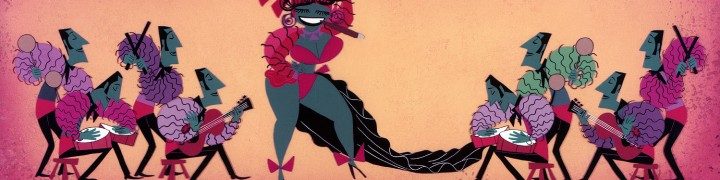
The UPA influence, in fact, is only visible in the gorgeous background art, supervised by Victor Haboush, who had worked on layout and background art for Disney features ‘Peter Pan’, ‘Lady and the Tramp’ and ‘Sleeping Beauty’. The background art of ‘Gay Purr-ee’ is strikingly modern, with bold fauvist color schemes, an unmistakable Van Gogh-influence in the Provencal scenes, and allusions to various other painters in the Parisian ones. In fact, the background art can count as the film’s highlight, for the rest of the movie, unfortunately, is not that good, and the viewer has ample time to marvel at the gorgeous background paintings and pastels.
The film has several problems:
First, the animation doesn’t follow the background layouts. Painted sidewalks are completely ignored, and when Jaune Tom and Robespierre ride the rails, there’s no connection between their walk and the ties they’re supposed to step on.
Second, there’s Dorothy and Chuck Jones’s story: the film takes place in Paris at the end of the 19th century, and tells about a female cat called Mewsette (yes, a pun) who lives in the countryside, but longs to go to Paris. This story is a variation of the age-old trope of a country girl going to the big city only to become ensnared there. Back in 1920 Władysław Starewicz had already made an animation film with this theme called ‘Dans les griffes de l’araignée’ (In the Spider’s Grip). The Joneses add little to this cliché, and the story unfolds in an all too predictable pattern. Moreover, the villain Meowrice’s (yes, another pun) scheme is an all too bizarre one. It would be more logical if he would put poor Mewsette into prostitution, but this was of course off limits in a family film.
Third, there’s the wonky level of anthropomorphism. The cats all walk on fours, and are clearly cats, especially when interacting with men, but at the same time Meowrice is able to write a letter, and there’s a Moulin-rouge-like bar (called Mewlon Rouge, yes, yes) in which cats dance and drink alcohol. The inconsistency is neither explained nor resolved and hampers the overall believability of the film.
Fourth, the characters are not that interesting. Mewsette is more spoiled and naive than sympathetic, Jaune Tom clearly has his heart in the right place, but his only other character trait is that he loves chasing mice. Meowrice is clearly a villain from the very beginning, and his dual character is never played out well. I guess Robespierre was included as comic relief, but he has a particularly weak voice (by Red Buttons) and he is tiresome, not funny. Most interesting and best designed is the opportunistic Mme. Rubens-Chatte, but her role is small and her change of heart all too predictable.
Fifth, Abe Levitow’s all too relaxed direction slows the film down. Excitement or fear are shown, but not felt. Just before the finale there’s a long sequence in which Meowrice describes portraits of Mewsette by several of the leading painters of the era, including Monet, Gauguin and Picasso. This is fun of course, but of no consequence to the narrative, and stalls the story. Then there’s a grand finale on a train, but this, too, is lacking the necessary tension. Never does the viewer fear that things could go wrong.
And finally, sixth, the film contains eight songs by the famed duo of Harold Arlen and Yip Harburg, who have enriched the world with their songs for ‘The Wizard of Oz’ (1939), but none of the songs for ‘Gay Purr-ee’ even remotely approach the quality of the ones for the former musical. Even singer Judy Garland, who sings most of the songs, cannot raise these above the level of forgettable. Even worse, the songs contribute to the slowness of the film, as none of them propels the story forward, but only drag the narrative down. For example, when Jaune Tom sings ‘Little Drops of Rain’ in which he expresses his longing for Mewsette, we watch nice semi-abstract images of sea life, but nothing happens, and the story only resumes after the song.
‘Gay Purr-ee’ still is well animated, and one of the last products of the golden age of studio animation, which came to its end somewhere in the 1960s. It’s thus still worth a watch for anyone interested in the era, but barely a rewarding one, and after viewing what lingers is the background art, and the sad notion that a lot of talent was wasted on a feature film that just was not that good. The UPA animation studio, meanwhile, lasted until 1970, but never regained its artistic heights of the 1950s, or even that of ‘Gay Purr-ee’, for that matter.
Watch the trailer for ‘Gay Purr-ee’ yourself and tell me what you think:
‘Gay Purr-ee’ is available on Blu-Ray and DVD


 Dr. Grob's Animation Review