
You are currently browsing the tag archive for the ‘Wilfred Jackson’ tag.
Director: Wilfred Jackson & Ben Sharpsteen
Release Date: January 23, 1942
Stars: Donald Duck
Rating: ★★★★
Review:
 When the United States were forced into the war themselves, the government asked Disney to make a short to make the American citizens fill in their income tax forms in time. Disney gave them his biggest star of that time, Donald Duck, to play the everyman. The government was not impressed until the taxes came rolling in after the film was screened in cinemas.
In contrast to Disney’s earlier propaganda films for the Canadian government, this film uses entirely new animation, directed by Wilfred Jackson, and produced in the ridiculously short time period of a single month.
The short opens with Donald dancing to the energetic title song, which is sung by Cliff Edwards, the voice of Jiminy Cricket in ‘Pinocchio‘ (1940). The song is played on a slightly anthropomorphised radio. The radio then asks Donald if he wants to do his part for the country and Donald is growing more and more enthusiastic, until the radio reveals he has to pay his income tax. The radio has to persuade Donald once again, who grows enthusiastic again to the strong slogan ‘Taxes to beat the axis’ (with the axis referring to the Axis powers: Germany, Italy and Japan).
The film further explains the public how to fill in a new, simplified form, using an anthropomorphized pen, bottle of ink and blotter. Like the shorts Disney made earlier for the Canadian government (e.g. ‘The Thrifty Pig‘ and ‘7 Wise Dwarfs‘), the second half (directed by Ben Sharpsteen) consists of very limited and highly propagandistic animation with grim images of factories, guns, planes, war ships and tanks, while an intense narrator repeats the intoxicating mantra of ‘taxes to beat the axis’.
When he comes to the propagandist climax, the sentence “to beat to earth the evil destroyer of freedom and piece”, we watch a horrifying towering monster-like machine depicting the Nazi aggressor. This mechanical monster is defeated and makes place for a patriotic end shot with clouds resembling the American flag, tanks and guns rolling and planes flying accompanied by a heroic hymn, while the narrator tells us that “this is our fight”.
It’s important to note that the film goes at lengths to dehumanize the enemy. The average tax payer was not to help to kill people, but to destroy “the enemy”, in this case a vague mechanical monster. Succeeding propaganda films often eschewed the idea that making war is killing people, with the propaganda feature ‘Victory through Air Power’ (1943) being the prime example.
In case of “The New Spirit”, propaganda rarely was so obvious, but it works: after watching the picture I had its slogan in my head for days. Indeed, the film was so successful, that it got a follow-up the next year: ‘The Spirit of ’43‘.
Watch ‘The New Spirit’ yourself and tell me what you think:
Director: Wilfred Jackson
Release Date: June 17, 1933
Stars: Mickey Mouse, Minnie Mouse
Rating: ★
Review:
 Mickey has build a robot to fight a gorilla in a boxing match, which is called “the battle of the century: machine vs. beast”.
Mickey’s robot has one disadvantage: he runs wild when he hears Minnie’s car horn. Luckily, this fact helps him in the end: when he’s clobbered by the gorilla (on the tune of Franz Liszt’s second Hungarian rhapsody), he seems almost lost. But then Minnie fetches her car horn, revitalizing the robot. From that point he actually cheats, using multiple boxing gloves, a hammer and hits below the belt.
Despite its clear story and high quality animation, ‘Mickey’s Mechanical Man’ is a very weak short, and a low point in the otherwise outstanding Mickey Mouse year of 1933. The cartoon is surprisingly low on gags and it’s difficult to sympathize with the robot character, as it’s mechanical after all, while the gorilla is a living being. Moreover, Mickey’s motives remain unclear and we’re not invited to care about the match.
The cartoon most interesting feat. are the robot’s jerky movements, which are clearly mechanical and based on wind-up toys, but which become rather frantic and ridiculously elaborate when the robot goes wild. Nevertheless, there are some traces of Stan Laurel’s boxing moves from ‘Any Old Port’ (1932).
‘Mickey’s Mechanical Man’ is reminiscent of the Fleischer Studio’s equally weak ‘The Robot‘ (1932). Both films were inspired by rather hysterical stories about robots taking over jobs, which circulated in the early 1930s, and which struck a chord in an era of vast unemployment.
Watch ‘Mickey’s Mechanical Man’ yourself and tell me what you think:
This is Mickey Mouse cartoon No. 57
To the previous Mickey Mouse cartoon: The Mail Pilot
To the next Mickey Mouse cartoon: Mickey’s Gala Premier
Director: Wilfred Jackson
Release Date: September 16, 1933
Rating: ★★★★
Review:

‘The Pied Piper’ is a vivid re-telling of the original fairy tale in operetta fashion.
Thus ‘The Pied Pier’, together with ‘King Neptune‘ (1932) and ‘Father Noah’s Ark‘ (1933), belongs to the operetta- like Silly Symphonies. In its score, composed by Leigh Harline, practically all dialogue is sung, making ‘The Pied Piper’ an animated mini-opera.
Its human designs are way more detailed and anatomically correct than in ‘King Neptune’ or ‘Father Noah’s Ark’, making these two films looking old-fashioned, already. Disney was advancing towards the later realism of ‘Snow White and the Seven Dwarfs’ (1937) with a lightning speed…
Unfortunately, at the same time, a sugary approach is unleashed, as well. For example, the rats are not drown, but caught in an imaginary cheese. Likewise, the children, who are depicted as virtual slaves in Hamelin, do not just disappear, but they’re lured into ‘Joyland’, where even the crippled get cured. So, in the end, practically no harm is done to anyone.
And so, like the contemporary ‘Lullaby Land‘, ‘The Pied Piper’ is a strange mixture of ever advancing animation and rather infantile material. A great deal of the remaining Silly Symphonies would share this mixture, and even Disney’s first features, like ‘Snow White and the Seven Dwarfs’ and ‘Bambi‘ (1942) are not immune to it.
The children designs used here would pop up in numerous sugary cartoons from the 1930s, including those from other studios. And, unfortunately, there would be a lot of them…
Watch ‘The Pied Piper’ yourself and tell me what you think:
This is Silly Symphony No. 39
To the previous Silly Symphony: Lullaby Land
To the next Silly Symphony: The Night before Christmas
Director: Wilfred Jackson
Release Date: April 13, 1932
Stars: Clarabelle Cow, Horace Horsecollar, Mickey Mouse, Minnie Mouse, Pete
Rating: ★★★★★
Review:
 As the title implies, there’s a great sports event at the barn.
Mickey is joining a cross country race that involves running, rowing and cycling (which is beautifully animated). His main opponent is a rather unrecognizable Pete, who looks like just a big mean cat without a peg leg.
‘Barnyard Olympics’ was inspired by the upcoming Summer Olympics in Los Angeles in 1932. It’s a brilliant gag cartoon: it’s fast, consistent and exciting, and without doubt one of Mickey’s finest. It immediately starts with an excellent gag when a spectator suddenly discovers he’s being filmed and waves at ‘the camera’.
In a way ‘Barnyard Olympics’ marks Goofy’s debut. He’s not seen at all, but during a boxing match his characteristic laughter, provided by story man Pinto Colvig, can already be heard. In Mickey’s next film, ‘Mickey’s Revue‘, Goofy would appear on the screen himself.
With ‘Barnyard Olympics’ Mickey entered the zenith of his career. His films from 1932-1934 are his best. Almost all portray him as the little, but brave underdog fighting the odds, and importantly, in these films Mickey still is the star himself. After 1934 Mickey became more and more of a straight man, losing screen time to Pluto, Donald and Goofy. Yes, the Mickey Mouse films from the second half of the 1930s are also great, but by then Mickey’s own stardom was in a clear decline. But in ‘Barnyard Olympics’, like the other films from 1932-1934, he’s still in top form as the greatest cartoon star of his era.
Watch ‘Barnyard Olympics’ yourself and tell me what you think:
This is Mickey Mouse cartoon No. 40
To the previous Mickey Mouse cartoon: The Mad Dog
To the next Mickey Mouse cartoon: Mickey’s Revue
Director: Wilfred Jackson
Release Date: July 11, 1932
Stars: Mickey Mouse, Minnie Mouse, Pete
Rating: ★★★★
Review:
 ‘Mickey in Arabia’ can be described as ‘Gallopin’ Gaucho‘ in Arabia.
In this short Mickey and Minnie are tourists visiting some mythical Arabian country on a camel. Here they meet Pete, who has both his legs here, and who apparently is some sort of sheik. Pete captures Minnie, which leads to an exciting finale, which consists of continuous series of gags.
Despite its all too familiar story outline, ‘Mickey in Arabia’ is a major step forward in the Mickey Mouse series. It places Mickey outside his familiar barnyard and performance settings, and sends him on an adventure abroad, similar to the ones Mickey was having in Floyd Gottfredson’s comic strip of the same time. Mickey is at his best as the little hero, and he excels here. Gottfredson himself sent Mickey to Arabia, too, but only two years later, at the end of 1934. His comic strip ‘The Sacred Jewel’ borrows a lot of images from this 1932 film.
The adventure notwithstanding, the Disney story men didn’t forget to fill the short with gags, making ‘Mickey in Arabia’ a fast paced and funny short. It also has a great score, which makes excellent use of Albert Ketèlbey’s ‘In a Persian Market’ to create an Arabian atmosphere.
With ‘Mickey in Arabia’, the studio had hit the jackpot storywise, and in the next two years Mickey would play the little hero more often, with delightful results. Indeed, already in the same year, ‘Mickey in Arabia’ would be topped by the even more excellent ‘Touchdown Mickey‘ and ‘The Klondike Kid‘.
Watch ‘Mickey in Arabia’ yourself and tell me what you think:
This is Mickey Mouse cartoon No. 43
To the previous Mickey Mouse cartoon: Musical Farmer
To the next Mickey Mouse cartoon: Mickey’s Nightmare
Director: Wilfred Jackson
Release Date: February 8, 1932
Stars: Mickey Mouse, Minnie Mouse, Pluto
Rating: ★★★½
Review:
 Mickey has to deliver groceries to Minnie. When he arrives, she’s baking a stuffed turkey in the kitchen. Mickey helps her cooking in a musical scene, based on the 12th Street Rag. But then Pluto steals the turkey, an event that leads to a grand finale in which Minnie’s kitchen is completely ruined. Nevertheless, Mickey and Minnie retain their optimistic spirit.
‘The Grocery Boy’, contains many fine gags, the best of which is Mickey throwing a dish in the trash can immediately after he has finished preparing it. The structure of this short is very similar to those of the earlier ‘Mickey Steps Out‘ and ‘Mickey Cuts Up‘ from 1931, being part musical number and part gags leading to ruin. The finale is fast-paced and gag-rich, and saves a film that started a little bit dull.
Watch ‘The Grocery Boy’ yourself and tell me what you think:
This is Mickey Mouse cartoon No. 38
To the previous Mickey Mouse cartoon: The Duck Hunt
To the next Mickey Mouse cartoon: The Mad Dog
Director: Wilfred Jackson
Release Date: March 27, 1931
Stars: Mickey Mouse
Rating: ★★
Review:
 Mickey is a castaway, stranding on a tropical island.
Luckily, a piano is washed ashore as well, so Mickey performs for the jungle animals inhabiting the island. Unfortunately, an obnoxious little tiger disturbs him, and a great ape wants to play the piano, too, wrecking the instrument.
‘The Castaway’ was a short made out of rest material, and it shows: Mickey’s looks are wildly inconsistent, there’s not even a hint of a story, and the whole film feels like a throwback to 1929. Nevertheless, this short contains nice effect animation of waves washing ashore. It also reuses some animation of dancing sea lions from ‘Wild Waves‘ (1929) and of a dancing ape from ‘Jungle Rhythm‘ (1929), the film with which ‘The Castaway’ has most in common, which is no advertisement. In fact, Walt Disney disliked the film, thinking it didn’t look like a Walt Disney picture. And indeed, it hardly does.
The gag in which a lion gets eaten by a crocodile was borrowed from a very early Mickey Mouse comic strip from February 1930, which incidentally was the last panel drawn by Ub Iwerks himself.
‘The Castaway’ is also noteworthy for being the first Disney short to feature music by Frank Churchill, who would score many Disney shorts, and who would become particularly famous for the hit song ‘Who’s Afraid of the Big Bad Wolf’ from ‘Three Little Pigs‘ (1933) and the songs in ‘Snow White and the Seven Dwarfs’ (1937).
Watch ‘The Castaway’ yourself and tell me what you think:
This is Mickey Mouse cartoon No. 27
To the previous Mickey Mouse cartoon: Traffic Troubles
To the next Mickey Mouse cartoon: The Moose Hunt
Director: Wilfred Jackson
Release Date: November 5, 1937
Rating: ★★★★½
Review:
 ‘The Old Mill’ is a milestone in effect animation.
From the first scene on special effects seem to be the sole raison d’être of the film. The cartoon is literally stuffed with them: dew on a cobweb, ripples in the water, light beams, fireflies, wind, rain and a thunderstorm.
Disney’s famous multiplane camera, with which the feeling of depth could be realized, makes its debut here. Together these effects create an astonishing level of realism, necessary for the upcoming first animated feature, ‘Snow White and the Seven Dwarfs’. In ‘The Old Mill’ even the animal characters are more or less realistic, a rare feat in Disney cartoons until then.
All this realism leads to awe-inspiring images, based on concept art by Danish illustrator Gustaf Tenggren, who had joined the studio in 1936. Unfortunately, the images do not lead to much of a story. The film is more of a series of moods from dusk to dawn. Despite its clever pacing, reaching a climax in the thunderstorm sequence, ‘The Old Mill’ is an overly romantic depiction of nature, and less enjoyable as a cartoon than as a showcase of Disney animation.
Watch ‘The Old Mill’ yourself and tell me what you think:
This is Silly Symphony No. 68
To the previous Silly Symphony: Little Hiawatha
To the next Silly Symphony: Moth and the Flame
Director: Wilfred Jackson
Release Date: March 13, 1937
Rating: ★★★★★
Review:
 ‘Woodland Café’ returns to the origin of the Silly Symphony series: music.
This enjoyable gem depicts a Harlem-like nightclub for bugs, in which blackface grasshoppers perform hot jazz, led by a Cab Calloway-like bandleader. All bugs swing to it as soon as they enter the club.
After a remarkably erotic act played by a spider and a fly the cartoon climaxes in the jazz song ‘Truckin’, recorded by both the Mills Blue Rhythm Band and Duke Ellington in 1935, and celebrating a dance style that was fashionable around ca. 1935-1938. The main feature of trucking is the shoulders which rise and fall as the dancers move towards each other while the fore finger points up and wiggles back and forth like a windshield wiper. At this point in the short even some astonishing effect animation joins in, delivering totally convincing glitter ball effects and beautiful descending fluffy flowers.
Both charming and entertaining, the whole mood of this delightful cartoon is one of sheer joy.
Watch ‘Woodland Café’ yourself and tell me what you think:
This is Silly Symphony No. 66
To the previous Silly Symphony: More Kittens
To the next Silly Symphony: Little Hiawatha
Director: Wilfred Jackson
Release Date: March 28, 1936
Rating: ★★★★
Review:
 ‘Elmer Elephant’ is a beautiful cartoon. It’s full of cute animals, but despite its cuteness it never becomes cloying. Based on an idea by story artist Bianca Majolie, its storyline is very straightforward and really heartfelt, like the best of Disney’s works.
Elmer visits the birthday party of one of his jungle friends, the extremely cute girl tiger Tilly. He appears to be her favorite guest, but all the other animals (including some non-tropical foxes) mock him because of his trunk, singing “your nose is like a rubber hose”. Moreover they bully and taunt him and send him away.
Unhappy, Elmer wanders through the jungle, but then he encounters even stranger-looking animals: an old giraffe and three Jimmy Durante-like pelicans, who comfort him a little. Then, suddenly, there’s a fire in Tillie’s tree hut. Elmer comes to the rescue, and with help of his nose and of his new odd friends he saves Tillie from the anthropomorphized flames. Thus being the hero of the day he wins Tillie’s love, displayed by a kiss.
Elmer Elephant has the looks of a storybook. It’s beautifully animated, with lots of shadows, and it has well-designed characters. Especially the hippo, who has an absurdly low voice, is a wonderful character. It’s both surprising and a shame that no other cartoon has been made with these cute characters in their beautiful jungle forest, although Elmer and Tilly have a cameo appearance in ‘Toby Tortoise Returns‘.
Of course, the idea of a kind elephant being mocked for a handicap would later return in ‘Dumbo’ (1941), making ‘Elmer Elephant’ its immediate predecessor.
Watch ‘Elmer Elephant’ yourself and tell me what you think:
This is Silly Symphony No. 59
To the previous Silly Symphony: Broken Toys
To the next Silly Symphony: Three Little Wolves
Director: Wilfred Jackson
Release Date: October 31, 1936
Rating: ★★★★★ ♕
Review:
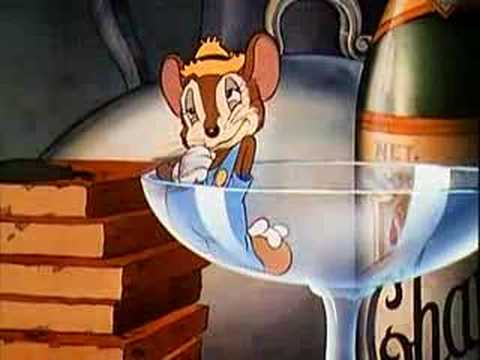 A very beautifully executed rendering of the classic tale, ‘The Country Cousin’ is a gem among the Silly Symphonies.
Its story is lean and economical, its characterization highly effective and its silent acting superb. Particularly noteworthy is the drunken performance of the Country Cousin, animated by Art Babbitt, which belongs to the highlights of animation.
Everyone who wants to know what ‘character animation’ is all about, should go and watch this cartoon. One cannot find a better example of it: the two mice look similar, but are very different in their behavior, attitude, and personality. Moreover, their personalities are played completely in mime, without any help from characteristic voices.
Besides this, ‘The Country Cousin’ contains some very realistic animation of people’s feet walking on the sidewalk. Indeed, the human realism of ‘Snow White and the Seven Dwarfs’ (1937) was not far away anymore.
Thirteen years later, Tex Avery would explore the theme of ‘The Country Cousin’ once again, albeit quite differently and way more ridiculously, in his hilarious short ‘Little Rural Riding Hood’ (1949).
Watch ‘The Country Cousin’ yourself and tell me what you think:
This is Silly Symphony No. 63
To the previous Silly Symphony: Three Blind Mouseketeers
To the next Silly Symphony: Mother Pluto
Director: Wilfred Jackson
Release Date: August 22, 1936
Stars: Max Hare, Toby Tortoise, The Three Little Pigs
Rating: ★★★★★
Review:
 One of the few sequels in Disney’s pre-video era, ‘Toby Tortoise Returns’ features the two stars of ‘The Tortoise and the Hare’ from 1935.
In this cartoon, written by Ward Kimball and featuring his typically zany style of humor, Max Hare (who’s still a bragging bully) and Toby Tortoise combat each other in a boxing match, which – of course – Toby eventually wins, albeit by means of Max’s own trickery.
Apart from Toby Tortoise and Max Hare there are many cameos of other Silly Symphony stars, among them the three little pigs, Dirty Bill (from ‘The Robber Kitten’), Jenny Wren and the Cuckoo from ‘Who Killed Cock Robin?’ and, Elmer Elephant and Tilly Tiger (from ‘Elmer Elephant’), as if all Silly Symphonies were taking place in the same space and time.
This makes ‘Toby Tortoise Returns’ akin to the earlier ‘Mickey’s Polo Team’ from the same year. The whole atmosphere is rather like that of a future Warner Brothers-cartoon, and one can sense the sheer joy the makers had in bringing all these characters together in a cartoon which sole reason of existence seems to be pure fun.
Notice the black bunny and the black turtle that are Max’s and Toby’s helpers, respectively.
Watch ‘Toby Tortoise Returns’ yourself and tell me what you think:
This is Silly Symphony No. 61
To the previous Silly Symphony: Three Little Wolves
To the next Silly Symphony: Three Blind Mouseketeers
Director: Wilfred Jackson
Release Date: May 11, 1935
Rating: ★★★
Review:
 ‘Water Babies’ is sugary cute, contains a lot of repetitive animation and is one of those Silly Symphonies obsessed with babies and their bare behinds (other examples are ‘Lullaby Land’ (1933) and ‘Wynken, Blynken and Nod’ (1938)).
There is not much of a story either: the sexless water babies wake up, make fun and go to bed again (apparently a day only lasts seven minutes in their world).
And yet, this is undoubtedly one of Disney’s most impressive efforts of the era. It feels like a showcase cartoon of the Disney studio, excelling in lush pictures, great effect animation and beautiful theme music by Leigh Harline. Especially the opening scene (dawn) and the last shot (night) are stunningly beautiful. The Disney staff had reached yet another peak, and more was still to come.
‘Water Babies’ itself at least must have been a success, for it was followed by the similar ‘Merbabies’ in 1938, featuring more or less girl characters instead of the boy-like babies in ‘Water Babies’.
Watch ‘Water Babies’ yourself and tell me what you think:
This is Silly Symphony No.52
To the previous Silly Symphony: The Robber Kitten
To the next Silly Symphony: The Cookie Carnival
Director: Wilfred Jackson
Release Date: October 5, 1935
Rating: ★★★★★ ♕
Review:
 In ‘Music Land’ a young violin falls in love with a young saxophone, much to the disapproval of their parents, the queen of ‘The Land of Symphony’ and the king of ‘The Isle of Jazz, respectively, whose realms are separated by the ‘Sea of Discord’.
When the young saxophone is imprisoned, the feud between the two very different nations leads to a war, in which the two young lovers are almost killed… The whole story is told through music, even the characters ‘speak’ with the sounds of the instruments they are. The complete score, by Leigh Harline, is a delight to listen to.
This reading of ‘Romeo and Juliette’ is one of the most inspired of all Silly Symphonies. The very idea of musical instruments ‘speaking’ in their own sound is brilliant. But there is much more. For example, when the saxophone prince is locked up, he’s imprisoned in a metronome and when he writes a letter to his father (a caricature of bandleader Paul Whiteman, ‘the king of jazz’) he does this in staff-notation!
The complete design of the cartoon is delightful. The backgrounds are particularly beautiful, rendering a totally convincing fantasy world, in which the cartoon develops as if it were an age-old story. The concept of a battle between classical music and jazz was a topical one in the 1930s, when jazz was still regarded by many as devilish music and a threat to ‘high culture’. Nevertheless, during the second half of the 1930s jazz gradually became a respected genre, as exemplified by Benny Goodman’s concert in Carnegie Hall in 1938.
Watch ‘Music Land’ yourself and tell me what you think:
This is Silly Symphony No. 55
To the previous Silly Symphony: Who Killed Cock Robin?
To the next Silly Symphony: Three Orphan Kittens
Director: Wilfred Jackson
Release Date: September 1, 1934
Rating: ★★★
Review:
 ‘Peculiar Penguins’ can be summarized as ‘love story in the Antarctic’: a penguin falls in love with a girl, blows it, but saves the day by rescuing her from a terrible shark.
Being one of the weaker entries in the Silly Symphonies, ‘Peculiar Penguins’ nevertheless contains some fine animation, especially in the under water chase, which is literally packed with special effects. Like in ‘Funny Little Bunnies‘, the setting is introduced by a sugary song, accompanying a complex opening shot, with lots of penguins moving and seagulls flying in it.
Ten years later Disney would return to the Antarctic to tell about a particularly peculiar penguin called Pablo in ‘The Three Caballeros‘ (1944).
Watch ‘Peculiar Penguins’ yourself and tell me what you think:
This is Silly Symphony No. 47
To the previous Silly Symphony: The Flying Mouse
To the next Silly Symphony: The Goddess of Spring
Director: Wilfred Jackson
Release Date: July 13, 1935
Stars: Mickey Mouse, Pluto
Rating: ★★★★
Review:
 ‘Mickey’s Garden’ is Mickey’s second color cartoon (after ‘The Band Concert‘).
It’s also Pluto’s first: he passes the transition into color fluently, getting his typical orange color we’re all familiar with now.
Mickey and Pluto are in the garden trying to kill a number of insects eating Mickey’s crop. When Mickey accidentally sprays himself with bug poison he starts to hallucinate (the transition to the dreamworld is particularly psychedelic: everything, including the background becomes unsteady and wobbly). He dreams that all plants and bugs have grown. This leads to some imaginative scenes. The bugs are not very lifelike, though. The animators even make a weird mistake by giving a particularly evil-looking beetle eight legs instead of six.
Watch ‘Mickey’s Garden’ yourself and tell me what you think:
This is Mickey Mouse cartoon No. 76
To the previous Mickey Mouse cartoon: Mickey’s Kangaroo
To the next Mickey Mouse cartoon: Mickey’s Fire Brigade
Director: Wilfred Jackson
Release Date: October 28, 1933
Stars: Mickey Mouse, Minnie Mouse
Rating: ★★★
Review:
 Mickey applies for a job at Tony’s pet store. Then Minnie drops by and together they perform their usual song-and-dance-routine.
‘The Pet Store’ was Mickey’s last cartoon to feature the half song-and-dance routine half story formula, a story structure that by 1933 had become old-fashioned.
This time Minnie’s quite tiresome lalala’s are interrupted by ‘Beppo, the movie monk’, an ape who has read about King Kong (that movie was released the same year) and who wants to imitate him, after he had imitated Stan Laurel. This leads to a nice spoof of King Kong, in which the ape climbs a pile of boxes with Minnie under his arm while being attacked by birds, mimicking the planes in the original feature. In the end Mickey and Minnie are fleeing the pet shop, just before the owner returns, leaving it in complete ruin.
Unfortunately, by 1933 such battle scenes had become as jaded as the song-and-dance routines, and the one in ‘The Pet Store’ is not really different from the ones in ‘The Bird Store‘, ‘King Neptune‘, or ‘Babes in the Woods‘ (all 1932). Nevertheless, the take on ‘King Kong’ is marvelous, and more original than Walter Lantz’s much more literal spoof ‘King Klunk‘ from one month earlier.
Tony is the first elaborate human to enter Mickey’s world, being on par with the human characters in the Silly Symphony ‘The Pied Piper‘ from one month earlier. He would be topped, however, by the giant in Mickey’s next cartoon, ‘Giantland‘. Part of the fun in this cartoon is provided by Tony’s pseudo-Italian labels (like “birda seed” and “biga da sale”), a type of pun that was later borrowed extensively by Chuck Jones in his Pepe le Pew-cartoons.
Watch ‘The Pet Store’ yourself and tell me what you think:
This is Mickey Mouse cartoon No. 61
To the previous Mickey Mouse cartoon: The Steeple Chase
To the next Mickey Mouse cartoon: Giantland
Director: Wilfred Jackson
Release Date: April 8, 1933
Rating: ★★★½
Review:
 The biblical story of Noah has been quite popular with the Disney Studio: it has retold the story three times on film .
‘Father Noah’s Ark’ is its first version, the others are a stop motion film from 1959 (‘Noah’s Ark‘) and a sequence from ‘Fantasia 2000’ featuring Donald Duck.
This cartoon belongs to Disney’s operetta phase (see also ‘King Neptune‘) and tells the age old story as a musical, including some gospel singing. The story is quite straightforward and the short contains only a few mild gags, the best of which are in the building sequence, e.g. the wives using an assembly line of porcupines and some monkeys using a rhinoceros to make planks out of a log.
The designs seem to be halfhearted: Father Noah’s sons look ridiculously cartoony, wearing Mickey Mouse type gloves, for instance. His sons’ wives, on the other hand, are designed in art deco fashion.
The animals, too, are in different stages of naturalism, but the cows portrayed are much more realistic than the ones featured in the Mickey Mouse shorts of the same time. Moreover, when the animals flee into the ark, we see some unprecedentedly realistic giraffes, sealions and lions.
The most stunning naturalism is found in the animation of the sea when the ark is at the mercy of the waves. This is a spectacular scene by any standards. The storm part also features a complex scene of several animals rolling from side to side. There’s a good sense of weight in this sequence, with the elephant moving last.
Watch ‘Father Noah’s Ark’ yourself and tell me what you think:
This is Silly Symphony No. 35
To the previous Silly Symphony: Birds in the Spring
To the next Silly Symphony: Three Little Pigs
Director: Wilfred Jackson
Release Date: September 17, 1932
Stars: Mickey Mouse, Minnie Mouse, Goofy, Clarabelle Cow, Horace Horsecollar
Rating: ★★★
Review:
 After three years of musical cartoons, consistent story lines where reintroduced to the Mickey cartoons with a remarkable success in 1932 (good examples are ‘Barnyard Olympics‘ and ‘Touchdown Mickey’). In this era the musical cartoon ‘The Whoopee Party’ with its total lack of story seems to be quite old-fashioned.
The short contains numerous elements that were used many times earlier: a public dancing, Minnie singing behind the piano and alive inanimate objects (although the latter feature was much more common practice in the Fleischer and Iwerks cartoons of that time – yet no other Disney cartoon celebrates the secret dancing life of inanimate objects as much as ‘The Whoopee Party’ does). The short also contains some nice effect animation of confetti and flying feathers. Despite being anything but new, the sheer fun with which everything is executed, makes this cartoon a delight to watch.
‘The Whoopee Party’ marks Goofy’s second appearance after his debut in ‘Mickey’s Revue‘ earlier that year. It’s in this cartoon he gets the looks he would maintain until Art Babbitt redesigned him for ‘On Ice’ (1935). He’s more than just a silly laugh now; he now has a rudimentary character of being some kind of silly person, and we hear him speak for the first time. Clearly, he now is one of the gang, making sandwiches with Horace and Mickey, and showing to be a character here to stay. Yet, he’s still more weird than likable – and when he made his debut as ‘Dippy Dawg’ in Floyd Gottfredson’s comic strip in January, 1933, he’s introduced as a pest. In fact, Goofy’s character would remain rather vague until 1935. Only with ‘Mickey’s Service Station’ from that year he would become the likable Goof we know today.
It may be interesting to note that Goofy arguably is the first cartoon character built on a funny voice. His success is proof that, although a unique voice is not necessary (Tom and Jerry for instance could do perfectly without one), it certainly helps to build a character. This must have been an inspiration to later voice-based characters like Donald Duck, Porky Pig and Daffy Duck.
Ironically, Goofy himself would eventually lose his voice in the early forties when voice artist Pinto Colvig left Disney for Fleischer.
Watch ‘The Whoopee Party’ yourself and tell me what you think:
This is Mickey Mouse cartoon No. 46
To the previous Mickey Mouse cartoon: Trader Mickey
To the next Mickey Mouse cartoon: Touchdown Mickey
Director: Wilfred Jackson
Release Date: June 22, 1931
Rating: ★★½
Review:
 This Silly Symphony is a quite uninteresting cartoon about beavers.
The film starts with rather dull gags of beavers building a dam to Frank Churchill’s music. By now the dance routines had vanished from the screen, to make place for rhythmical movement. The beavers are portrayed almost as industrial workers, and this first half simply bursts with animation cycles.
Only after four minutes a ‘story’ develops of a little beaver who saves the whole population from a terrible flood. The beavers completely lack personality and even the spirited little one fails to impress. After such elaborate cartoons as ‘Mother Goose Melodies‘ and ‘The China Plate‘ the cartoon’s uniform, dull designs, and tiresome repetitive animation come as a letdown. The result is one of the weaker Silly Symphonies, although it features some quite spectacular animation of the approaching flood.
Watch ‘The Busy Beavers’ yourself and tell me what you think:
This is Silly Symphony No. 19
To the previous Silly Symphony: The China Plate
To the next Silly Symphony: The Cat’s Out


 Dr. Grob's Animation Review