
You are currently browsing the category archive for the ‘Black and White Films’ category.
Directors: Harry Bailey
Release Date: July 14, 1933
Rating: ★★★★
Review:
 ‘Rough on Rats’ is one of the more extraordinary films to come out of the Van Beuren studio.
No other contemporary studio tried as hard as Van Beuren to emulate Disney’s Silly Symphonies. ‘Rough on Rats’ is rather unique in that it even anticipates a Silly Symphony: its subject of three mischievous kittens makes it the direct ancestor of Disney’s Academy Award winning ‘Three Orphan Kittens‘ (1935), and Fleischer’s ‘We Did It‘ (1936).
In this film we watch three kittens wandering through an abandoned grocery store. Then the black kitten gets kidnapped by an outrageously large mean rat. This leads to a battle sequence, reminiscent of the Silly Symphonies ‘The Spider and the Fly‘ (1931), ‘The Bird Store‘ (1932) and ‘Bugs in Love‘ (1932). During this battle the kittens throw almost everything in sight at the vicious creature.
‘Rough on Rats’ is ripe with ambition, and pretty entertaining. Especially Gene Rodemich’s score is enjoyable throughout. Unfortunately, the animation varies between excellent to downright poor, and the designs are erratic, varying greatly between scenes. These shortcomings haunted the Van Beuren studios since its beginning, and it’s depressing to note that by 1933 the animators were still not able to tackle them. Doubtless this was influential to the studio’s lack of success. For example, the ideas in ‘Rough on Rats’ are more interesting than those in most of Warner Bros.’ or Ub Iwerks’s contemporary output, but as the execution is not on par with the ambition, the result is close to failure. And yet one cannot blame the studio trying. Anyhow, it was to Disney-alumnus Burt Gillett to teach the Van Beuren animators the Disney solutions to their problems…
‘Rough on Rats’was the last of the Aesop’s Fables (not including the Cubby the Bear cartoons, which appeared under the same flag). Apparently their outdated 1920’s title card and uninspired series name had the better of them. Nevertheless, one year later they would get a follow-up in the ‘Color Classics’, Van Beuren’s venture into color.
Watch ‘Rough on Rats’ yourself and tell me what you think:
‘Rough on Rats’ is available on the DVD ‘Uncensored Animation from the Van Beuren Studio’
Directors: Harry Bailey & John Foster
Release Date: February 24, 1933
Rating: ★★★
Review:
 ‘Panicky Pup’ is one of those very Silly Symphony-like Aesop’s Fables.
It starts unremarkable enough, with several farm animals making music and dancing to it. At one point the cartoon starts to focus on a pup, but the short really gains momentum when the pup chases a cat into a well. Almost immediately, he’s struck by guilt and the complete surroundings turn into a nightmare haunting him. During this sequence the scenery changes frequently around him, as if the pup is transported through time and space, adding to the surreal atmosphere.
‘Panicky Pup’ mixes Disney and Fleischer influences (comparable cartoons are Disney’s ‘The Cat’s Out‘ (1931) and Fleischer’s ‘Swing You Sinners!‘ (1930)), like no other studio did, with surprising, if uneven results. The cartoon is the direct ancestor of other guilt cartoons like ‘Pluto’s Judgement Day‘ (1936), ‘Pudgy Picks a Fight‘ (1937) and ‘Donald’s Crime’ (1945), showing that Van Beuren had a much more interesting and forward-looking outlook than most reviewers grant the ill-fated studio.
Watch ‘Panicky Pup’ yourself and tell me what you think:
‘Panicky Pup’ is available on the DVD ‘Uncensored Animation from the Van Beuren Studio’
Directors: Harry Bailey & John Foster
Release Date: August 26, 1932
Rating: ★★★
Review:
 ‘Nursery Scandal’ is Van Beuren’s direct answer to Walt Disney’s successful Silly Symphony ‘Mother Goose Melodies‘ (1931), if a rather dingy one.
It’s night and the moon personally awakes some gnomes, who in turn awake Mother Goose. Mother Goose courts a scarecrow, much to the chagrin of the goose and the other nursery rhyme characters. At one point four gnomes start to sing nursery rhymes in a swinging close harmony style, leading to a long song-and-dance sequence in which we watch several nursery rhyme characters dancing, much like ‘Mother Goose Melodies’, but way jazzier. Composer Gene Rodemich is in excellent form in this cartoon, providing a highly enjoyable score. Notice the seemingly naked and very human fairy on top of the nursery rhyme book somewhere in the middle of the cartoon.
Watch ‘Nursery Scandal’ yourself and tell me what you think:
‘Nursery Scandal’ is available on the DVD ‘Uncensored Animation from the Van Beuren Studio’
Director: Dave Fleischer
Release Date: August 4, 1933
Stars: Betty Boop, Cab Calloway
Rating: ★★★★
Review:
 ‘The Old Man of the Mountain’ was the last of three Fleischer cartoons featuring Cab Calloway.
The cartoon is unique in that it uses Calloway’s swing music throughout the picture. The short uses two of Cab Calloway’s hits: the title song, which the Cab had recorded in June 1932; and during the chase scene ‘The Scat Song’, first recorded February 29, 1932.
The complete cartoon perfectly fits the jazzy score, and it’s musically the most perfect of the three Cab Calloway shorts. Unfortunately, this also means it’s devoid of any story, and relatively low on gags. Nevertheless, the sex-inclined atmosphere and the sizzling hot jazz easily make up for it.
The short starts with some live footage of Calloway and his orchestra. Then we cut to a lion warning everybody of the old man of the mountain. Soon, everybody’s fleeing from the old man of the mountain, except Betty. She goes up the mountain to meet him. The old man of the mountain chases her into a cave (somehow, all three Cab Calloway cartoons feature a cave). There the two sing a duet together, the only duet between a jazz singer and a cartoon star I know of. During this scene the old man’s moves are Calloway’s in rotoscope. Then the old man chases her down, until some animals capture the old guy and tie his limbs into a knot. At one point the old man captures Betty’s dress, leaving her in her underwear.
‘The Old Man of the Mountain’ is such a great cartoon one is extra sorry the Fleischers did not make any other cartoon featuring the Cab. One month later they would release ‘I Heard‘ featuring Don Redman, but that was the very last of the Fleischer’s great jazz cartoons. Even worse, by August 1933 Betty Boop’s own heydays were almost over. In 1934 she was bowdlerized by the Hays code, never to perform with hot jazz stars again.
Watch ‘The Old Man of the Mountain’ yourself and tell me what you think:
This is Betty Boop cartoon No. 19
To the previous Betty Boop cartoon: Popeye the Sailor
To the next Betty Boop cartoon: I Heard
‘The Old Man of the Mountain’ is available on the French DVD Box Set ‘Betty Boop Coffret Collector’
Director: Dave Fleischer
Release Date: March 31, 1933
Stars: Betty Boop, Bimbo, Koko the Clown
Rating: ★★★★★♕
Review:
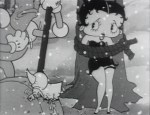 Of all Fleischer cartoons ‘Snow-White’ is probably the most famous. And rightly so, because it brings the Fleischer’s unique brand of surrealism to the max, being simply stuffed with mesmerizing images, unexpected metamorphosis and stream-of-consciousness-like story flows.
The short is also the second of three cartoons featuring the unique voice of Cab Calloway, the others being ‘Minnie the Moocher‘ (1932) and ‘The Old Man of the Mountain‘ from five months later. According to Leslie Cabarga (‘The Fleischer Story’, p.64) the film was animated by one man, Doc Crandall. Indeed he’s the only animator credited on the title card. This may be the cause of the short’s remarkable inner consistency. For the images may make no sense, they do flow into each other in a seamless way, with Betty Boop’s ride into an ice coffin as a particular highlight of absurd logic.
The Fleischer’s ‘Snow-White’ has a winter setting. It starts classical enough with the queen consulting her magic mirror. But then Betty Boop enters the scene, making the knights fall apart and the queen’s head turn into a frying pan, symbolizing her angry jealousy. The queen orders ‘off with her head’, demonstrating the action with her own fingers, and soon Koko and Bimbo (as two knights) prepare for the execution. However, in a very strange string of events they disappear into the hole they’ve dug themselves, while the tree to which Betty is tied sets her free himself.
In another weird string of events Betty Boop ends in an ice coffin at the dwarfs’ door. They drag her into the ‘mystery cave’, followed by the queen, who, using her magic mirror, has turned herself into a witch. Koko and Bimbo also enter the cave. Koko starts singing the St. James Infirmary Blues, one of Calloway’s classic hits, with Cab Calloway’s voice and movements. But when the queen turns him into a ghost, Koko suddenly becomes able to morph into a gold chain and into a bottle, illustrating the lyrics of the song. Later the mirror turns the witch into a dragon, which chases the trio, until Bimbo turns it inside out.
There’s a lot going on in this mind-blowing cartoon, which is over before you know it. Being very, very unlike Disney’s later feature film, ‘Snow-White’ is an undisputed highlight of cartoon surrealism, matched by very few other cartoons (the other one which comes to mind is ‘Porky in Wackyland‘ from 1938). With this short the Fleischers reached the pinnacle of their pre-code cartoon style, before a combination of the Hays code and a tendency to imitate Walt Disney more toned down their unique vision.
Watch ‘Snow-White’ yourself and tell me what you think:
This is Betty Boop cartoon No. 13
To the previous Betty Boop cartoon: Betty Boop’s Penthouse
To the next Betty Boop cartoon: Betty Boop’s Birthday Party
‘Snow-White’ is available on the French DVD Box Set ‘Betty Boop Coffret Collector’
Director: Dave Fleischer
Release Date: November 25, 1932
Stars: Betty Boop, Bimbo, Koko the Clown, Louis Armstrong
Rating: ★★★
Review:
 There are few classic cartoons that will give such a mixed feeling as ‘I’ll Be Glad When You’re Dead You Rascal You’.
There’s much to say for it: the short is one of the wonderful pre-code swing cartoons, featuring no less than the great Louis Armstrong, who appears here in person, not only in the introduction, but also as a floating head, in a remarkable blending of animation and live action.
Unfortunately, ‘I’ll Be Glad When You’re Dead You Rascal You’ is also one of those ignorant cartoons featuring severe caricatures of black people, in their most cliche form: cannibals. Even worse, in this cartoon a direct connection is made between the backward caricatures and the black performers, as one of the cannibals grows into Louis Armstrong’s singing head, and his drummer (probably Tubby Hall) is likened to another big-lipped cannibal. Thus this cartoon is as entertaining as it is offensive.
There’s not much of a story: Betty, Bimbo and Koko are on a safari in dark Africa. There they encounter a tribe of hungry cannibals, who kidnap Betty. Then we cut to Bimbo and Koko on their aimless search for Betty. Soon they’re followed by a cannibal who morphs into a giant floating native head, which turns into that of Louis Armstrong singing the title song. Bimbo and Koko manage to rescue Betty with help of a porcupine. The last shot is for Louis Armstrong and his band. The complete cartoon is rather nonsensical, but Armstrong’s hot jazz make it a great ride, if an uncomfortable one.
Watch ‘I’ll Be Glad When You’re Dead You Rascal You’ yourself and tell me what you think:
This is Betty Boop cartoon No. 7
To the previous Betty Boop cartoon: Betty Boop for President
To the next Betty Boop cartoon: Betty Boop’s Museum
‘I’ll Be Glad When You’re Dead You Rascal You’ is available on the French DVD Box Set ‘Betty Boop Coffret Collector’
Director: Dave Fleischer
Release Date: November 4, 1932
Stars: Betty Boop
Rating: ★★★★
Review:
 ‘Betty Boop for President’ is one of those rare pre-war cartoons using current events as its subject.
The short was released just four days before the 1932 elections. In it Betty Boop runs for president, imitating the then current president and candidate Herbert Hoover and his Democratic challenger Al Smith. Unfortunately for the Fleischers, it was not Al Smith, but Franklin D. Roosevelt who was chosen as the candidate for the Democrats during the Democrat National Convention (June 27-July 2). Apparently, this scene already had been completed before this convention.
Betty’s opponent is one ‘Mr. Nobody’ (a stick wearing a bowler hat). His song demonstrates that nobody cares for the average man. Betty clearly has the upper hand, however, and the next scenes show some of her rather nonsensical suggestions to improve the country. These at least involve loads of knots of ribbons. The cartoon ends with a picture of a glass of beer, indicating that the 18th amendment was a major issue of the elections. Indeed, from March 22 1933 on, low alcohol beer and wine were legalized, and in December of that year, the 18th amendment was repealed by the 21st amendment. The prohibition years were over.
Watch ‘Betty Boop for President’ yourself and tell me what you think:
This is Betty Boop cartoon No. 6
To the previous Betty Boop cartoon: Betty Boop’s Ups and Downs
To the next Betty Boop cartoon: I’ll Be Glad When You’re Dead You Rascal You
‘Betty Boop for President’ is available on the French DVD Box Set ‘Betty Boop Coffret Collector’
Director: Dave Fleischer
Release Date: September 23, 1932
Stars: Betty Boop, Bimbo
Rating: ★★★★★
Review:
 This cartoon features a soundtrack by the Hawaii band ‘The Royal Samoans’, giving the cartoon a lively Hawaii score.
The short starts with Bimbo crashing on an island on a boat, into Betty Boop’s arms. A waterfall throws them into a spot full of singing trees, and later they’re confronted with a bunch of cannibals. Bimbo disguises himself as ‘black’ using mud, and starts singing the Hawaiian war chant. Thus he becomes the natives’ king. The cannibals perform for him, and Betty, too, who dances an extraordinarily sexy hula dance only dressed in a skirt and a flower garland. Unfortunately, the rain washes off Bimbo’s disguise and the two have to flee in a boat.
The movements of the dancing natives and Betty are rotoscoped from the Royal Samoans, rendering them very convincing and lifelike, indeed. Betty Boop’s hula dance is arguably her best scene ever. Apart from this, the cartoon is stuffed with throwaway gags showing the Fleischer’s typical brand of surrealism.
Watch ‘Betty Boop’s Bamboo Isle’ yourself and tell me what you think:
This is Betty Boop cartoon No. 4
To the previous Betty Boop cartoon: Betty Boop , M.D.
To the next Betty Boop cartoon: Betty Boop’s Ups and Downs
‘Betty Boop’s Bamboo Isle’ is available on the French DVD Box Set ‘Betty Boop Coffret Collector’
Director: Dave Fleischer
Release Date: August 19, 1932
Stars: Betty Boop, Bimbo, Koko the Clown
Rating: ★★★½
Review:
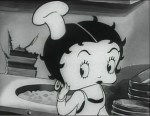 In ‘Betty Boop Bizzy Bee’ Betty works in a mobile canteen, where the complete menu consists of wheat cakes.
After some rather trite gags, a song starts with the recurring line ‘pass me the sugar’. When a fat customer appears with an enormous appetite, the cartoon goes haywire. In the end everything has a belly ache, even the stove, the lunch wagon and the moon.
‘Betty Boop Bizzy Bee’ is one of those Fleischer cartoons in which everything is alive. We watch wheat cakes flipping themselves over in a square dance and plates washing and drying themselves. The ‘story’ makes little sense, it’s just a string of gags in a rather stream-of-consciousness-like fashion. ‘Betty Boop Bizzy Bee’ is very similar to Van Beuren’s ‘Pots and Pans‘ from three months earlier, and may have been inspired by it.
Watch ‘Betty Boop Bizzy Bee’ yourself and tell me what you think:
This is Betty Boop cartoon No. 2
To the previous Betty Boop cartoon: Stopping the Show
To the next Betty Boop cartoon: Betty Boop, M.D.
‘Betty Boop Bizzy Bee’ is available on the French DVD Box Set ‘Betty Boop Coffret Collector’
Director: unknown
Release Date: January 1, 1933
Stars: Flip the Frog
Rating: ★★★★
Review:
 While ‘The Goal Rush‘ anticipated Disney’s ‘Touchdown Mickey‘, ‘Coo Coo the Magician’ clearly follows ‘Mickey in Arabia‘ from six months earlier. The setting and the story are too similar to ignore, making ‘Coo Coo the Magician’ quite a rip-off of Mickey’s wonderful cartoon.
Like Mickey, Flip visits some vague Arabian country with his sweetheart. There they meet the magician. When Flip challenges him, the magician makes his sweetheart disappear. While Flip gets lost in an Egyptian tomb, his girl comes in the clutches of a sultan. Flip comes to the rescue, battling several stereotyped black servants, which the cartoon unfortunately also inherited from Mickey’s cartoon. In the end the couple manages to escape on a magic carpet. There’s a short erotic scene of Flip falling into a harem.
Maybe just because it is a copy of ‘Mickey in Arabia’, ‘Coo Coo the Magician’ is an enjoyable cartoon. The exotic setting clearly inspired the makers to make other gags than usual, making this short standing above the average Flip the Frog cartoon.
Watch ‘Coo Coo the Magician’ yourself and tell me what you think:
This is Flip the Frog cartoon No. 32
To the previous Flip the Frog cartoon: Funny Face
To the next Flip the Frog cartoon: Flip’s Lunch Room
‘Coo Coo the Magician’ is available on the DVD ‘Cartoons That Time Forgot – The Ub Iwerks Collection Vol. 2’
Director: unknown
Release Date: December 24, 1932
Stars: Flip the Frog
Rating: ★★★½
Review:
 By the end of 1932 the Flip the Frog cartoons had turned in genuine gag cartoons, full of action.
‘Funny Face’ starts with a new title card, with an updated Flip the Frog design, showing his more boyish persona he had received the last cartoons, but retaining the bass voice of his earlier incarnation.
In ‘Funny Face’ Flip is typically boyish. He has a date with a girl, but she prefers someone else. So he visits Dr. Skinnum to get a new face. When Flip enters the place, ‘Funny Face’ follows Disney’s ‘King Neptune‘ in the new operetta format, with several masks hanging on a wall singing to him. While Flip gets a new face, his girl is kidnapped by a bully. With his new (human) face, Flip attracts seven girls, who start following him, so he hides in the very house the bully has captured his sweetheart. He rescues her, loses his new face, but gains her love, after all. What becomes of the other seven girls, we’ll never know.
‘Funny Face’ is a strange mix of a gag cartoon and pure melodrama. Its story is erratic, and Flip being a frog among humans becomes more and more problematical, and watching him with a human face is pretty weird to say the least. Notice the strange, rounded backgrounds, however, which are unique to the Iwerks cartoons.
Watch ‘Funny Face’ yourself and tell me what you think:
This is Flip the Frog cartoon No. 31
To the previous Flip the Frog cartoon: Nurse Maid
To the next Flip the Frog cartoon: Coo Coo the Magician
‘Funny Face’ is available on the DVD ‘Cartoons That Time Forgot – The Ub Iwerks Collection Vol. 2’
Director: unknown
Release Date: November 26, 1932
Stars: Flip the Frog
Rating: ★★★
Review:
 ‘Nurse Maid’ is a typical cartoon from the Great Depression era, depicting small jobs and poverty.
The short starts very well with Flip as a newspaper boy facing a lot of bad luck destroying his trade. Broke, he sits down on the street to worry. Luckily a woman offers him a dollar if he minds her big-nosed baby. The rest of the cartoon is devoted to Flip’s troubles with the baby, which start immediately when the baby swallows the coin. Thus Flip conjures an unhealthy plan to retrieve it from the baby’s mouth with a fishing rod (!). While Flip sets out to get one, the baby swallows a potion which makes the little fellow strong…
Like ‘The Goal Rush‘, ‘Nurse Maid’ is as gag rich as it is unfunny. Luckily, Carl Stalling’s music is very inspired, following the action so closely that most of the tunes are reduced to snippets (for example, when during a chase a Scotchman is encountered, Stalling inserts a few bars of a Scottish tune before resuming the chase music). In fact, the cartoon is recommended for Stalling’s music only, which is a marvel to listen to.
Watch ‘Nurse Maid’ yourself and tell me what you think:
This is Flip the Frog cartoon No. 30
To the previous Flip the Frog cartoon: The Music Lesson
To the next Flip the Frog cartoon: Funny Face
‘Nurse Maid’ is available on the DVD ‘Cartoons That Time Forgot – The Ub Iwerks Collection Vol. 2’
Director: unknown
Release Date: October 3, 1932
Stars: Flip the Frog
Rating: ★★★
Review:
 ‘The Goal Rush’ was released only twelve days before the Mickey Mouse cartoon ‘Touchdown Mickey‘ and covers the same ground.
It’s interesting to compare both cartoons, because they’re both lively gag cartoons full of action. Unfortunately, Mickey’s cartoon is better designed, better drawn, better animated, better timed, and better told than Flip’s. So where ‘Touchdown Mickey’ is one of Mickey’s greatest films, and one of the best cartoons of 1932, ‘The Goal Rush’ never really comes off. The gags are often trite, the timing is terribly sloppy and the story meandering.
We watch a football game between Burp University (a bunch of bullies) and Nertz University (Flip and some nerds). Flip’s frog design becomes more and more problematical among the human characters, especially as his love interest is a human girl. The human characters now all have their typical Iwerks designs, except for a very Betty Boop-like farmer girl Flip unveils under a haystack while riding a pig.
There’s a lot going on in this cartoon, but it’s difficult to indicate a good gag. There’s at least a surprising one in which a bandleader shoots a clarinet player who plays off key. The best gag may be the football (pigskin) joining a pig family.
Watch ‘The Goal Rush’ yourself and tell me what you think:
This is Flip the Frog cartoon No. 27
To the previous Flip the Frog cartoon: Circus
To the next Flip the Frog cartoon: Phoney Express
‘The Goal Rush’ is available on the DVD ‘Cartoons That Time Forgot – The Ub Iwerks Collection Vol. 2’
Director: unknown
Release Date: October 29, 1932
Stars: Flip the Frog
Rating: ★★
Review:
 In ‘The Music Lesson’ Flip returns to his schoolboy days from ‘School Days‘, and this short also stars the teacher and dog from the earlier cartoon.
‘The Music lesson’ starts with Flip having to stay inside for one hour to practice his piano lessons. But his human friends signal him from the outside to come outside and swim. Flip tries to sneak out three times, and he succeeds the third time, but at the pond he’s caught by both his piano teacher and a gamekeeper, and in the last scene he’s seen practicing his piano in jail, guarded by the two authority figures.
‘The Music Lesson’ is a genuine attempt at a continuity of gags, but the short is severely hampered by erratic animation and sloppy timing. None of the gags really comes off, and the finale is anything but that. It seems that by the end of 1932 Flip’s short-lived heydays were already over.
Watch ‘The Music Lesson’ yourself and tell me what you think:
This is Flip the Frog cartoon No. 29
To the previous Flip the Frog cartoon: Phoney Express
To the next Flip the Frog cartoon: Nurse Maid
‘The Music Lesson’ is available on the DVD ‘Cartoons That Time Forgot – The Ub Iwerks Collection Vol. 1’
Directors: John Foster & George Stallings
Release Date: December 9, 1932
Stars: Tom and Jerry
Rating: ★★★★½
Review
 ‘Pencil Mania’ arguably is Tom and Jerry’s most inventive short of all.
In this short Jerry has a magic pencil with which he can draw things in mid-air, which immediately come to life. This leads to some surreal gags with a lot of metamorphosis being involved. It’s for example fascinating to watch a saxophone change into a duck.
Unfortunately, as soon as Jerry has drawn three melodrama figures, the short turns to their antics. Nevertheless, the finale is mesmerizing: a complete train disappears into nothing, and Jerry breaks through the paper to make the heroin return to his pencil before Tom can kiss her. Gags like these, breaking the 4th wall, were extremely rare in 1932, making ‘Pencil Mania’ pretty unique. At any rate it’s very enjoyable to watch, even though the train is the only well-drawn thing in the entire short. One can only guess what more able hands could have made out of a story idea like this.
Eight years later Terrytoons would use the same idea in the Gandy Goose cartoon ‘The Magic Pencil’ (1940). No doubt the Terry animators had seen ‘Pencil Mania’, because not only do the two cartoon share a melodrama sequence, the magic also starts with the same gag: that of the Jerry/Gandy Goose drawing an egg, which falls on Tom’s/Sourpuss’s head. Moreover, both Jerry and Gandy Goose turn a door into a car, and like Jerry, Gandy makes the heroin flow back into his pencil.
‘Pencil Mania’ features three songs: Rudy Wiedoeft’s Saxophobia (1919), the 1923 hit ‘Yes, We Have No Bananas’, and ‘You’ve Got Me in the Palm of Your Hand’.
Watch ‘Pencil Mania’ yourself and tell me what you think:
This is Tom & Jerry cartoon No. 18
To the previous Tom & Jerry cartoon: Piano Tooners
To the next Tom & Jerry cartoon: Tight Rope Tricks
‘Pencil Mania’ is available on the DVD ‘The Complete Animated Adventures of Van Beuren Studio’s Tom and Jerry’
Directors: John Foster & George Rufle
Release Date: November 11, 1932
Stars: Tom and Jerry
Rating: ★★★½
Review
 ‘Piano Tooners’ opens with Tom and Jerry performing the 1920 hit song ‘Margie’ in their piano shop, which is simply filled with mice. We also watch them tuning pianos, with the best gag being Jerry flushing a bad note through the toilet.
Suddenly we cut to a concert hall, where one Mlle. Pflop will perform. She appears to be a fat woman, and some of the lesser refined humor in this cartoon stems from watching her getting dressed, in rather risque scenes. At the concert Mll. Pflop sings and plays the piano at the same time, until she hits a flat note. Piano tuners Tom and Jerry come to the rescue, pulling the bad key from the piano as if it were a sore tooth. Tom immediately starts playing ‘Doin’ The New Low-Down’, a song Don Redman would turn into a hit (featuring Cab Calloway and the Mills Brothers) more than a month after the release of ‘Piano Tooners’. Also featured is a maid, who is most probably a caricature, but of whom? She joins in, singing along, but it’s Mlle. Pflop who has the last note.
Like the other Tom and Jerry cartoons, ‘Piano Tooners’ is hopelessly primitive, featuring erratic designs and bad animation. However, the piano tuning gags are entertaining, and it’s hard not to enjoy the short’s weird atmosphere.
Watch ‘Piano Tooners’ yourself and tell me what you think:
This is Tom & Jerry cartoon No. 17
To the previous Tom & Jerry cartoon: A Spanish Twist
To the next Tom & Jerry cartoon: Pencil Mania
‘Piano Tooners’ is available on the DVD ‘The Complete Animated Adventures of Van Beuren Studio’s Tom and Jerry’
Directors: John Foster & George Stallings
Release Date: October 7, 1932
Stars: Tom and Jerry
Rating: ★★
Review
 Somehow Tom and Jerry are shipwrecked and plagued by an evil octopus. Lucky for them they’re washed ashore in Spain, where they immediately go to a Spanish cafe.
At the cafe they encounter two female dancers, and an angry guy who orders them to take part in a bullfight. In the arena Tom and Jerry defeat a battalion of bulls with their bare hands. Then a telegraph arrives to tell them the 18th amendment has been lifted, and immediately Tom and Jerry head home again on their raft…
The 18th amendment, abolishing alcohol, was not lifted until December 5, 1933, more than one year after the release of ‘A Spanish Twist’ , making this cartoon strangely prophetic. Unfortunately, it’s hardly enjoyable otherwise. The Spanish dancers are extremely badly drawn, and the bullfight is anything from entertaining. In fact, ‘A Spanish Twist’ is arguably the worst bullfight cartoon before the equally dull Pink Panther cartoon ‘Toro Pink’ (1979).
Watch ‘A Spanish Twist’ yourself and tell me what you think:
This is Tom & Jerry cartoon No. 16
To the previous Tom & Jerry cartoon: Barnyard Bunk
To the next Tom & Jerry cartoon: Piano Tooners
‘A Spanish Twist’ is available on the DVD ‘The Complete Animated Adventures of Van Beuren Studio’s Tom and Jerry’
Directors: John Foster & George Rufle
Release Date: September 16, 1932
Stars: Tom and Jerry
Rating: ★
Review
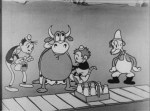 ‘Barnyard Bunk’ opens with a farmer at sleep at a farm, which falls apart. It’s soon clear the farm is destroyed by numerous cheeky mice.
Enter Tom and Jerry playing saxophones. Their music makes a hen laying eggs, a cow producing tons of milk, and two woodpeckers producing a pile of wood. At one point all the lifeless objects of the farm start dancing. In the end the farmer pays the duo for the saxophones, but the moneybag turns out to be filled with mice.
It’s quite shocking to see that in ‘Barnyard Bunk’, a film made well into 1932, still features animation language of the silent era. The short features no dialogue, and the gestures of Tom, Jerry and the farmer are still of the 1920s. The designs of the farmer and the mice do not fare better, and the whole cartoon exudes from archaism. Its only modern feature is the dressed cow, which shows that already by 1932 the Hays code was getting hold of the cartoon industry.
Watch ‘Barnyard Bunk’ yourself and tell me what you think:
This is Tom & Jerry cartoon No. 15
To the previous Tom & Jerry cartoon: Jolly Fish
To the next Tom & Jerry cartoon: A Spanish Twist
‘Barnyard Bunk’ is available on the DVD ‘The Complete Animated Adventures of Van Beuren Studio’s Tom and Jerry’
Director: Dave Fleischer
Release Date: December 16, 1932
Stars: Betty Boop, Bimbo, Koko the Clown
Rating: ★★★½
Review:
 Koko takes Betty on a sightseeing trip to a museum that displays both art and fossils, and where Bimbo is a guard.
Soon Betty is busy feeding a statue called Hunger, and she’s left behind after closing time. Suddenly the statues and fossils come alive, and a horned fossil demands her to sing for them. Betty Boop starts ‘Was That The Human Thing To Do’, a hit from that year, to which the fossils dance. Then the horned (or rather horny) fossil haunts Betty, until the museum suddenly collapses.
‘Betty Boop’s Museum’ is one of the more bizarre Betty Boop shorts of 1932/1933, even though it’s not as good as ‘Betty Boop’s Bamboo Isle‘ or ‘Snow-White‘. The short starts with a spectacular zoom out from Koko’s mouth. There’s also a very short, but nicely animated scene of Koko’s car on roller skates.
Watch ‘Betty Boop’s Museum’ yourself and tell me what you think:
This is Betty Boop cartoon No. 8
To the previous Betty Boop cartoon: I’ll Be Glad When You’re Dead You Rascal You
To the next Betty Boop cartoon: Betty Boop’s Ker-Choo
Betty Boop’s Museum’ is available on the French DVD Box Set ‘Betty Boop Coffret Collector’
Director: Dave Fleischer
Release Date: October 14, 1932
Stars: Betty Boop, Bimbo
Rating: ★★★½
Review:
 ‘Betty Boop’s Ups and Downs’ is one of the most stream-of-consciousness-like cartoons the Fleischer Brothers ever made.
The short starts with Betty Boop moving and putting her old house for sale. As soon as she leaves, the house falls apart, which drops the price immediately, even though the chimney desperately tries to keep the building together. This is a rather weird scene itself, but soon we zoom out to reveal the whole area being on sale, the whole of the United States, and even the complete earth. Suddenly we watch the moon auctioning the earth to the neighboring planets. The earth is sold to a Jewish looking Saturn, who draws gravity from the earth. Suddenly everything starts floating upwards. Imagine, this cartoon started with Betty moving to a new home!
Unfortunately, the studio has difficulties inventing good gags about the world without gravity, and the premise never gets proper treatment. For example, their best gag seems to be Betty Boop’s skirt flying upwards, revealing her panties, which is shown twice. It seems as when their imagination could roam completely freely, the studio got stuck, as the same happened in ‘Crazy Town‘ from earlier that year. When the earth pulls its own magnet back into place, everything falls down again to a jazzy score, and it’s Betty who has the last word in a reprise of her opening song.
Even though it’s not really successful, ‘Betty Boop’s Ups and Downs’ is one of the strangest cartoons ever made, and worth while watching.
Watch ‘Betty Boop’s Ups and Downs’ yourself and tell me what you think:
This is Betty Boop cartoon No. 5
To the previous Betty Boop cartoon: Betty Boop’s Bamboo Isle
To the next Betty Boop cartoon: Betty Boop for President
‘Betty Boop’s Ups and Downs’ is available on the French DVD Box Set ‘Betty Boop Coffret Collector’


 Dr. Grob's Animation Review