
You are currently browsing the category archive for the ‘Black and White Films’ category.
Director: Wilfred Jackson
Release Date: July 28, 1930
Rating: ★★
Review:
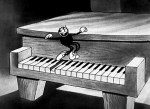
1930 saw a string of Silly Symphonies featuring animals performing endless dance routines. In ‘Midnight in a Toy Shop’, however, the dancing is being done by toys and dolls. Not that it makes a difference…
‘Midnight in a Toy Shop’ introduces the small spider, who would also be the hero of ‘Egyptian Melodies‘. To escape the freezing cold the spider enters a toy shop. First he’s afraid of everything, but when he’s playing the piano, the dolls and toys come to life, dancing to his tunes. This results in a very, very long dance routine, rendering ‘Midnight in a Toy Shop’ a rather dull short. However, in the first scene the spider leads the viewer into the scenery, and we as an audience, explore the toy shop with him. This story idea would be perfected in the intro of ‘Pinocchio‘ (1940), of which the intro of ‘Midnight in a Toy Shop’ is an embryonic version.
‘Midnight in a Toy Shop’ contains a strange mixture of primitive and more advanced designs and animation. It starts with some stunning effect animation of snow, and ends when a candle lights some fireworks, making the spider flee the shop.
Watch ‘Midnight in a Toy Shop’ yourself and tell me what you think:
This is Silly Symphony No. 12
To the previous Silly Symphony: Arctic Antics
To the next Silly Symphony: Monkey Melodies
‘Midnight in a Toy Shop’ is available on the DVD ‘Walt Disney Treasures: More Silly Symphonies’
Director: Ub Iwerks
Release Date: January 31, 1931
Stars: Flip the Frog
Rating: ★
Review:
 In this cartoon Flip the Frog is a blacksmith in a farm-like setting.
Flip replaces a horseshoe of a horse that belongs to a female cat character. This kitten looks exactly like Honey, who was Oswalds’s girlfriend in the 1927-1928 Oswald the Lucky Rabbit cartoons, which Disney and Iwerks had made together. When the horse gets stung by a mosquito he runs off with “Honey” helpless in her carriage. Luckily, Flip saves the day, and wins “Honey”’s kiss.
‘The Village Smitty’ is much more interesting on paper than on the animated screen. Its even pace and its scarcity of gags makes the cartoon virtually endless.
Nevertheless, ‘The Village Smitty’ profits from Carl Stalling’s inspired music. Stalling had left Disney together with Iwerks, thinking that without Iwerks the Disney studio would have no future. After a while he joined Iwerks in his new studio. Stalling would stay with Iwerks until the studio collapsed in 1936. He then moved to Warner Bros., where he would become the most famous cartoon composer of all time.
Watch ‘The Village Smitty’ yourself and tell me what you think:
This is Flip the Frog cartoon No. 8
To the previous Flip the Frog cartoon: The Soup Song
To the next Flip the Frog cartoon: Laughing Gas
‘The Village Smitty’ is available on the DVD ‘Cartoons That Time Forgot – The Ub Iwerks Collection Vol. 1’
Director: Ub Iwerks
Release Date: January 31, 1931
Stars: Flip the Frog
Rating: ★
Review:
 In ‘The Soup Song’ Flip works at a café, although his real occupation there remains rather obscure.
We watch him as a bandleader (imitating Paul Whiteman), as a purser, a cloakroom boy, a waiter and a cook. He dances with a cat on stage (who looks very much like Oswald’s girlfriend, Honey), while a hungry customer eats his cutlery, a gag clearly stolen from the Max Fleischer cartoon ‘Dizzy Dishes’, released five months earlier. In ‘The Soup Song’ the gag is much less well executed however, and it lacks the zany imagination of the Fleischer cartoon. In no sense ‘The Soup Song’ is a classic, and although the animation is good, the cartoon pales even when compared to ‘Dizzy Dishes’, which isn’t all too remarkable itself.
Watch ‘The Soup Song’ yourself and tell me what you think:
This is Flip the Frog cartoon No. 7
To the previous Flip the Frog cartoon: Little Orphan Willie
To the next Flip the Frog cartoon: The Village Smitty
‘The Soup Song’ is available on the DVD ‘Cartoons That Time Forgot – The Ub Iwerks Collection Vol. 1’
Director: Ub Iwerks
Release Date: September 27, 1930
Stars: Flip the Frog
Rating: ★★★
Review:
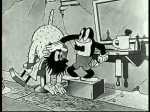 After two films Flip the Frog was redesigned to be a sort of a young man, living in town. Thus in his fourth cartoon Flip is a barber.
This cartoon contains only two scenes: in the first scene we watch Flip polishing his barber pole, which is then stolen and replaced by Flip out of a cat’s tail. In the second scene Flip cuts a hairy dog customer, accompanied by a nail polisher and a shoe polisher. The four of them sing a song together, with which the cartoon ends.
‘The Village Barber’ is typical for the early Ub Iwerks cartoons, in which everything is sparked with life. Even the chair, the razor, and the furnace are autonomous beings, dancing to the musical beat. The Ub Iwerks shorts lack the metamorphosis and spontaneous generation so typical of contemporary Fleischer Talkartoons (e.g. ‘Barnacle Bill‘ and ‘Mysterious Mose‘). Yet, together with the rhythmical Disney-like animation, the abundance of life give the Flip the Frog cartoons a very distinct character. Unfortunately, ‘The Village Barber’ is as low on gags as other Flip the Frog cartoons, and a little boring.
Nevertheless, it’s cartoons like these that ultimately sold the Flip the Frog series to MGM, making it the lion studio’s first venture in cartoon business. Iwerks’s contract with MGM lasted until 1934, when the company exchanged Ub Iwerks for Harman & Ising.
Watch ‘The Village Barber’ yourself and tell me what you think:
This is Flip the Frog cartoon No. 4
To the previous Flip the Frog cartoon: Flying Fists
To the next Flip the Frog cartoon: The Cuckoo Murder Case
‘The Village Barber’ is available on the DVD ‘Cartoons That Time Forgot – The Ub Iwerks Collection Vol. 1’
Director: Ub Iwerks
Release Date: December, 1930
Stars: Flip the Frog
Rating: ★★½
Review:
 Although released after four other cartoons, ‘Puddle Pranks’ is Flip the Frog’s second cartoon. It was made before Pat Powers had sold the series, and it’s the last in which he’s portrayed as a real frog, small in size and acting in nature. Powers was dissatisfied with this version of Flip, and in the subsequent films he would, like Mickey Mouse, be boy-sized and living in towns.
‘Puddle Pranks’ starts with a very Mickey Mouse-like scene, in which Flip drops by his girlfriend’s house to take her for a ride in a grasshopper-chariot. Soon they’re followed by a pelican, which eats the grasshopper(!), and threatens to eat the two frogs. Flip disposes of the pelican, and the two go for a swim. But suddenly, the pelican is back, and they are only rescued because the pelican is eaten by a large fish.
‘Like ‘Fiddlesticks‘, Flip’s first cartoon, ‘Puddle Pranks’ is well animated and joyful, but low on gags and rather boring. The short is almost evenly paced, which makes it rather tiresome to watch.
Watch ‘Puddle Pranks’ yourself and tell me what you think:
This is Flip the Frog cartoon No. 2
To the previous Flip the Frog cartoon: Fiddlesticks
To the next Flip the Frog cartoon: Flying Fists
‘Puddle Pranks’ is available on the DVD ‘Cartoons That Time Forgot – The Ub Iwerks Collection Vol. 1’
Director: Burt Gillett
Release Date: November 20, 1930
Stars: Mickey Mouse, Minnie Mouse
Rating: ★★½
Review:
 In ‘Pioneer Days’ Mickey and Minnie are pioneers travelling in a caravan through the Midwest.
After an all too long sing-and-dance-routine they are attacked by vicious wolf-like Indians. These bring in some spectacular animation: a dance with long shadows around a bonfire, a complex attack scene, and an impressive shot taken from one of the horses circling the encampment, showing a moving background of wagons in perfect perspective.
Most spectacular is the fight between Mickey and a horrible Indian, who has kidnapped Minnie. The fight is shown in close-up, and contains quite some complex movements between the two. It’s scenes like these that show that Disney kept taking the lead in the animation field, ever pressing forward.
Of course, our hero saves the day: when he and Minnie pretend to be the cavalry all the Indians flee.
‘Pioneer Days’ is Mickey’s first of only a few films clearly set in another time period, and thus the precursor of ‘Ye Olden Days‘ and ‘The Nifty Nineties’. The film recycles some footage from ‘The Fire Fighters‘ of two dogs holding a bed to catch falling people.
Watch ‘Pioneer Days’ yourself and tell me what you think:
This is Mickey Mouse cartoon No. 24
To the previous Mickey Mouse cartoon: The Picnic
To the next Mickey Mouse cartoon: The Birthday Party
‘Pioneer Days’ is available on the DVD ‘Walt Disney Treasures: ‘Mickey Mouse in black and white’
Director: Burt Gillett
Release Date: August 18, 1930
Stars: Mickey Mouse, Peg Leg Pete, (Pluto)
Rating: ★★½
Review:
 In ‘Gallopin’ Gaucho‘ Mickey had been depicted as a bandit, but it still comes as a surprise to see him being a prisoner in ‘The Chain Gang’. We’re sure some injustice has been done, and that Mickey is in fact innocent…
Mickey is imprisoned in a mixed prison (one of the inmates is a cow), where Peg Leg Pete is one of the guards. When Pete goes to sleep Mickey brings out his harmonica, like he did in ‘The Shindig‘ one month earlier, and starts playing Vernon Dalhart’s 1924 hit ‘The Prisoner’s Song’.
This leads to an unremarkable sing-and-dance-routine, which abruptly ends in a massive jailbreak. Mickey escapes, but is followed by two bloodhounds, possibly the most elaborately designed dogs hitherto. Animated by Norm Ferguson, these bloodhounds would become the prototype of Pluto later on. Indeed, the animation of the blood hound approaching and sniffing into the camera was reused for Pluto as late as 1939 for ‘The Pointer’. The real Pluto would appear on the screen two months later in ‘The Picnic‘, and even then he still was called ‘Rover’.
The ‘birth’ of Pluto is the single most important feature of this cartoon, although it’s also noteworthy for the presence of gags involving recurring characters (something pretty new at the time), and for the chase scenes, which contain some nice perspective effects.
Watch ‘The Chain Gang’ yourself and tell me what you think:
This is Mickey Mouse cartoon No. 21
To the previous Mickey Mouse cartoon: The Shindig
To the next Mickey Mouse cartoon: The Gorilla Mystery
‘The Chain Gang’ is available on the DVD ‘Walt Disney Treasures: ‘Mickey Mouse in black and white’
Director: Burt Gillett
Release Date: June 20, 1930
Stars: Mickey Mouse, Minnie Mouse, Horace Horsecollar
Rating: ★★★★★
Review:
 In ‘The Fire Fighters’ Mickey is a fire chief who rushes to a burning building, losing almost his complete team on the way.
Together with Horace Horsecollar he rather pitifully tries to extinguish the fire. But he saves the day when he rescues Minnie from the flames.
‘The Fire fighters’ is the first Mickey Mouse cartoons since ‘The Gallopin’ Gaucho‘ to tell a straightforward story. The cartoon is simply packed with gags, which lead to an exciting finale, showing Mickey’s heroic character.
Among Mickey’s team mates is a primitive Horace Horsecollar who is only half anthropomorphized. ‘The Fire Fighters’ is also notable for its use of animals as objects (an ostrich as a pole, a cat as a siren), while objects are very much alive, indeed, most notably the ladder, which is shown sleeping in bed.
The cartoon makes clever use of animation cycles, especially in the scenes depicting the burning building. Some of the gags are quite unique, like Mickey milking a fire hydrant and a ladder that climbs itself down, a gag that has to be seen to be believed.
In all, ‘The Fire Fighters’ is one of the best of the early Mickey Mouse cartoons, and certainly Mickey’s best short of 1930.
Mickey would fighting fire again five years later in the equally inspired ‘Mickey’s Fire Brigade‘ (1935).
Watch ‘The Fire Fighters’ yourself and tell me what you think:
This is Mickey Mouse cartoon No. 19
To the previous Mickey Mouse cartoon: The Cactus Kid
To the next Mickey Mouse cartoon: The Shindig
‘The Fire Fighters’ is available on the DVD ‘Walt Disney Treasures: ‘Mickey Mouse in black and white’
Director: Dave Fleischer
Release Date: September 24, 1930
Stars: Bimbo?
Rating: ★★★★★ ♕
Review:
 ‘Swing You Sinners!’ is an early Talkartoon, and a wildly imaginative one, too.
We watch a thief (probably Bimbo, but his appearance in the early Talkartoons is so inconsistent, one can’t be sure). The thief tries to steal a chicken, but runs into a cop. The thief then flees into a graveyard, where he has a particularly nightmarish experience. First the gate locks itself, then turns into a stone wall, and then the graves start to sing…
Soon all kinds of inanimate objects start to haunt him. And although the soundtrack is very jazzy, ‘Swing You Sinners!’ remains a bad trip throughout. At one time the walls close into him, at another a ghost promises him to give him a ‘permanent shave’.
The animation is extremely rubbery, and even insane. For example, when we watch a chicken do some scatting, both the chicken and the background are very wobbly, to a hallucinating effect. In the end we watch countless ghosts marching, followed by even more ghostly images when the thief starts to descend into hell. The cartoon ends with a giant skull swallowing the thief, a surprisingly grim ending for a cartoon with such swinging music*.
In any case ‘Swing You Sinners!’ is a testimony of the sheer creativity, which was the Max Fleischer Studio in the early 1930s, and should be placed among the greatest cartoons of all time.
Watch ‘Swing You Sinners!’ yourself and tell me what you think:
This is Talkartoon No. 10
To the previous Talkartoon: Barnacle Bill
To the next Talkartoon: Grand Uproar
‘Swing You Sinners’ is available on the French DVD Box Set ‘Betty Boop Coffret Collector’
*It may be interesting to note that this is one of the earliest mentions of swing, predating for example Duke Ellington’s song ‘It Don’t Mean A Thing (If It Ain’t Got That Swing)’ by two years, and being miles ahead of the swing craze of the second half of the 1930s.
Director: Hugh Harman & Rudolf Ising
Release Date: April 19, 1930
Stars: Bosko, Honey
Rating: ★★
Review:
 Harman & Ising’s pilot ‘Bosko the Talk-ink Kid‘ led to a succesful contract with Leon Schlesinger, and in April 1930, the young studio could release their first film for Warner Bros.: ‘Sinkin’ in the Bathtub’.
‘Sinkin’ in the Bathtub’ is the very first of the Looney Tunes, Harman and Ising’s first of three series which name was an all too obvious variation on Walt Disney’s successful Silly Symphonies. In 1931 they would launch the Merrie Melodies, and in 1934, when at MGM, the Happy Harmonies.
Schlesinger had sold the series to Warner Bros. with the prospect of selling their sheet music, and music would be an important part of both the Looney Tunes and Merrie Melodies until the end of the 1930s. Apart from the title song, one can hear ‘Forever Blowing Bubbles’ when Honey turns her bath tub into Bosko’s saxophone, making him blowing bubbles with his instrument.
Animated by Friz Freleng, ‘Sinkin’ in the Bathtub’ features Bosko, the star of ‘Bosko the Talk-ink Kid’, and Warner Bros.’ sole star from 1930 to 1933. Bosko invites his girlfriend Honey for a ride in his anthropomorphized car (which he finds on the toilet(!)). On their journey they experience problems with a cow and a steep hill. The ride ends in a pool.
The cartoon is well-animated and cheerful, but surprisingly boring at the same time, even though it lacks the endless song-and-dance-routines of contemporary Mickey Mouse cartoons. Bosko and his girl behave like Oswald and his girlfriend, and are only different in design, being clearly black stereotypes. They are totally devoid of any personality. In fact, Bosko would never develop one, and eventually it became even unclear what Bosko actually was, as exemplified by the following anecdote from Jack Zander, quoted by Leonard Maltin in ‘Of Mice and Magic’ (page 225):
“One Day a porter at the studio said to young animator Jack Zander, “I want to ask you something about that character you’ve got. I know Mickey Mouse, and Krazy Kat, and Oswald the Rabbit… but Bosko the what?”
Watch ‘Sinkin’ in the Bathtub’ yourself and tell me what you think:
‘Sinkin’ in the Bathtub’ is available on the DVD ‘Looney Tunes Golden Collection Volume Three’ and on the Blu-Ray ‘Looney Tunes Platinum Collection: Volume 2’
Directors: Harry Bailey & John Foster
Release Date: August 31, 1930
Stars: Waffles and Don
Rating: ★
Review:
 ‘Frozen Frolics’ is the third of four cartoons featuring the obscure duo Waffles & Don. In this short they are on their way to the North Pole to steal the pole, which looks like a barber’s pole.
After they lose their sled due to an obstinate rabbit, we suddenly cut to arctic animals dancing, much like Walt Disney’s ‘Arctic Antics‘ from two months earlier. Only after a while we return to the duo, whom we watch being exhausted, and trudging through a snow storm. When Don seems to be dead, Waffles steals his money, and eats his shoe. Luckily, Don is alive after all. But later Waffles doesn’t hesitate to throw his little friend to an angry bear. Don beats him up for that, with which the cartoons ends.
The animation in ‘Frozen Frolics’ is wildly uneven, and more often than not rather out of sync with the music.
Watch ‘Frozen Frolics’ yourself and tell me what you think:
‘Frozen Frolics’ is available on the DVD ‘The Complete Animated Adventures of Van Beuren Studio’s Tom and Jerry’
Directors: Harry Bailey & John Foster
Release Date: January 18, 1931
Stars: Rita Mouse?
Rating: ★★★★
Review:
 ‘Red Riding Hood’ is one of those early 1930s cartoons that have to be seen to be believed.
In this spoof of Red Riding Hood, the ill grandma is visited by a doctor. The doctor’s “jazz tonic’ makes grandma young and handsome, and the wolf starts to fancy her. He plays for her on the harmonium, while ‘grandma’ dances. However, when Red Riding Hood (a Minnie Mouse-copy, see also ‘Circus Capers‘ and ‘The Office Boy‘) enters, the wolf and grandma both flee in the wolf’s car to get married.
Red Riding Hood, meanwhile, warns the wolf’s wife and kids, who hurry to the wedding chapel. They tear the wolf away, leaving grandma crying.
There’s some nice animation on the wolf’s car, but otherwise the animation on this cartoon is wildly inconsistent. However, its story is so weird, it becomes enjoyable.
Watch ‘Red Riding Hood’ yourself and tell me what you think:
‘Red Riding Hood’ is available on the DVD ‘Uncensored Animation from the Van Beuren Studio’
Directors: Harry Bailey & John Foster
Release Date: November 23, 1930
Stars: Milton Mouse, Rita Mouse
Rating: ★★
Review:
 ‘The Office Boy’ is yet another Van Beuren cartoon featuring Milton Mouse and Rita Mouse, Van Beuren’s sloppy copies of Mickey and Minnie Mouse, indirectly showing the mouse’s enormous popularity.
This time Milton is an office boy, where Rita is a secretary. The story involves Milton getting jealous of Rita when the boss flirts with her. So Milton invites the boss’s wife to catch her husband red-handed. In the end we watch Milton and Rita jumping into a painting on a train to sing their end duet.
The designs and animation of Milton and Rita are terrible, but too close for comfort, and some of Mickey’s mannerisms have clearly been copied. As was the case in ‘Circus Capers‘, Milton and Rita are more vulgar than their Disney counterparts, despite the similar looks, and most of the fun of the cartoon lies in the rude behavior of these pseudo-Mickey and Minnie. The cartoon’s best gag, however, is when Rita starts typing frantically even when her boss hasn’t really dictated anything.
But Milton’s and Rita’s days were numbered. In 1931 Disney sued the Van Beuren company, and on April 30, 1931 the federal court prohibited the Van Beuren studio to display any of his Mickey Mouse-lookalikes. The Walt Disney company never asked for money, however. They simply wanted the plagiarism to stop.
Watch ‘The Office Boy’ yourself and tell me what you think:
‘The Office Boy’ is available on the DVD ‘Uncensored Animation from the Van Beuren Studio’
Directors: Harry Bailey & John Foster
Release Date: September 28, 1930
Stars: Milton Mouse, Rita Mouse
Rating: ★★★
Review:
 ‘Circus Capers’ features Milton Mouse and Rita Mouse, Van Beuren’s Mickey and Minnie-like mice, whose resemblance to Disney’s originals is so striking, it’s pure plagiarism.
The Van Beuren Studio comes nowhere near Walt Disney’s high quality standards, however, and ‘Circus Capers’ can be used as a good counter-example to show how good contemporary Mickey Mouse cartoons (e.g. ‘The Shindig‘, ‘The Chain Gang‘ and ‘The Gorilla Mystery‘) actually were.
In ‘Circus Capers’ Milton (pseudo-Mickey) is a clown, while Rita (pseudo-Minnie) is an acrobat riding a horse. An evil circus master shoots Milton away as a human cannonball, meanwhile courting an all too willing Rita. When Milton discovers this, he’s heartbroken, and sings “Laugh Clown Laugh” from the 1928 musical of the same name. However, when the circus master becomes too insistent, Rita flees from him, back to Milton, who gives her the raspberry, making her pass out.
‘Circus Capers’ is hampered by primitive, crude animation, unsteady designs, and odd staging. Its curious story is enjoyable, however, for the real Mickey and Minnie would never behave like Milton and Rita, who seem to be their cruder cousins.
Watch ‘Circus Capers’ yourself and tell me what you think:
‘Circus Capers’ is available on the DVD ‘Uncensored Animation from the Van Beuren Studio’
Directors: Mannie Davis & John Foster
Release Date: August 17, 1930
Rating: ★
Review:
 ‘Laundry Blues’ is one of those cartoons that’s very hard to watch today.
This short features some extreme stereotypes of Chinese people, in animal form, plus one caricature of a (human) Jew. The Jew has his beard washed and ironed, only to fall into the mud with it shortly afterwards.
Apart from the vicious stereotyping, the short suffers from a lack of direction: things are just happening on the screen. The backward racism, the total lack of plot, and the scarcity of gags make ‘Laundry Blues’ endless. It’s everything but a classic, indeed. And yet, the part of the four Chinese ironing was reused in its entirety in ‘Chinese Jinks‘ from 1932.
Watch ‘Laundry Blues’ yourself and tell me what you think:
‘Laundry Blues’ is available on the DVD ‘Uncensored Animation from the Van Beuren Studio’
Director: Harry Bailey
Release Date: December 1, 1929
Stars: Milton Mouse, Rita Mouse
Rating: ★
Review:
 ‘Close Call’ is one of Van Beuren’s earliest sound cartoons, and it shows. Its visual language is still from the silent era, including the use of words on the screen.
The short unashamedly features two clear ripoffs of Walt Disney’s Mickey and Minnie Mouse. We watch them frolicking in a field, when a large cat kidnaps “Minnie” and takes her to a sawmill. “Mickey” comes to the rescue, only to be tied up by the cat to a sawmill, in a classic scene. As luckily as incomprehensibly the North West Mounted Police rides off to rescue the loving couple. They kill the cat (!), and the two mice are married.
The animation on ‘Close Call’ is terribly primitive, and there’s a lot of squeaking, but apart from the final “I do”‘s, there’s no dialogue. Moreover, there’s more drama to the short than humor, making it a tiring watch. The Mickey and Minnie Mouse characters (which off-screen apparently were christened Milton and Rita) would return in several of Van Beuren’s ‘Aesop’s Fables’ cartoons, e.g. ‘Circus Capers‘ and ‘The Office Boy‘ from 1930.
Watch ‘Close Call’ yourself and tell me what you think:
‘Close Call’ is available on the DVD ‘Uncensored Animation from the Van Beuren Studio’
Director: Burt Gillett
Release Date: March 7, 1931
Stars: Mickey Mouse, Minnie Mouse, Peg Leg Pete
Rating: ★★★★★
Review:
 In 1931 Mickey’s cartoons slowly but surely got better. ‘Traffic Troubles’ in particular is a gem, arguably being Mickey’s first great gag cartoon since his first cartoon, ‘Plane Crazy‘ (1928).
In this film Mickey is a cab driver driving an anthropomorphized car, resembling Flip the Frog’s car in ‘The Cuckoo Murder Case’ from five months earlier. His first customer is a fat pig, but he loses his passenger on a road, full of potholes and bumps. Mickey’s horror and surprise when he realizes his customer is gone, is priceless.
Mickey’s second customer is Minnie. When they get a flat tire, Peg Leg Pete makes an odd cameo as ‘Dr. Pep’ who revives Mickey’s car with some kind of potion, with disastrous results. This part leads to a great end scene in which Mickey’s car ends on a cow, rides through a barn, and crashes into a silo.
‘Traffic Troubles’ is a genuine gag cartoon without any songs or dances, but with fast action, plenty of gags building to a grand finale, and spectacular and flexible animation. It also contains a very funny scene in which a police officer asks Mickey many questions while silencing him at the same time. In short, ‘Traffic Trouble’ is arguably the best Mickey Mouse film from 1931, and Mickey’s first really great cartoon since ‘Steamboat Willie‘. But by now the Disney studio was making faster and faster strides, and Mickey’s best cartoons were still to come.
Watch ‘Traffic Troubles’ yourself and tell me what you think:
This is Mickey Mouse cartoon No. 26
To the previous Mickey Mouse cartoon: The Birthday Party
To the next Mickey Mouse cartoon: The Castaway
‘Traffic Troubles’ is available on the DVD ‘Walt Disney Treasures: Mickey Mouse in Black and White Volume Two’
Director: Walt Disney
Release Date: April 5, 1930
Stars: Mickey Mouse, Clarabelle Cow, Horace Horsecollar
Rating: ★★★★
Review:
 While other studios, like Walter Lantz and the Max Fleischer drew inspiration from jazz, and while Warner Bros. could draw from an extensive music catalog, in the early sound days Walt Disney turned to (copyright-free) folk songs and classical music.
After ‘The Opry House‘ (1929) and ‘Just Mickey‘, Mickey’s concert career reaches new heights in ‘The Barnyard concert’. In this highly enjoyable cartoon Mickey conducts a barnyard orchestra in Franz von Suppé’s overture to ‘Dichter und Bauer’. There’s one throwaway gag looking all the way back to his breakthrough cartoon ‘Steamboat Willie‘ (1928),in which Mickey torments some pigs, but most of the cartoon is forward looking.
Indeed ‘The Barnyard Concert’ looks like a blueprint for ‘The Band Concert‘ (1935), in which many of the gags introduced here are improved to perfection. The cartoon features no dialogue, whatsoever, but is full of clever sight gags.
Unfortunately, at this stage the animators still had problems with Mickey’s eyes: in one close-up in particular they are placed awkwardly in Mickey’s face.
Watch ‘The Barnyard Concert’ yourself and tell me what you think:
This is Mickey Mouse cartoon No. 17
To the previous Mickey Mouse cartoon: Just Mickey
To the next Mickey Mouse cartoon: The Cactus Kid
‘The Barnyard Concert’ is available on the DVD ‘Walt Disney Treasures: Mickey Mouse in Black and White Volume Two’
Directors: Mannie Davis & John Foster
Release Date: November 9, 1930
Stars: Waffles and Don
Rating: ★★
Review:
 ‘Gypped in Egypt’ is a cartoon set in Egypt. It predates Disney’s ‘Egyptian Melodies‘, which covers similar grounds, by nine months.
This cartoon was the last of four to feature Waffles and Don. The duo had finally reached distinct personalities in this short: Waffles, the tall cat, is constantly afraid, while Don, the small dog, keeps calm and unimpressed.
In the opening shot we watch the duo traveling through the desert on a camel. When the camel dies, a nightmarish scene starts, featuring a sphinx, pyramids and more camels. This brings our heroes inside an Egyptian tomb, where they encounter dancing skeletons and hieroglyphs. Suddenly, there are skeletons everywhere, and Don plays the piano with one of them. The cartoon ends abruptly with Waffles and Don running from a giant hypnotizing sphinx face.
‘Gypped in Egypt’ features several elements that were reused in Disney’s ‘Egyptian Melodies’: dancing hieroglyphs, nightmarish scenes, and even a corridor scene. However, Van Beuren’s cartoon is much cruder and more disjointed than Disney’s latter cartoon. Its greatest feature is it hallucinating character. Unfortunately, it is not retained throughout the picture, and the whole cartoon suffers from all too sloppy storytelling and ditto timing.
Watch ‘Gypped in Egypt’ yourself and tell me what you think:
‘Gypped in Egypt’ is available on the DVD ‘Aesop’s Fables – Cartoon Classics from the Van Beuren Studio’
Director: John Foster
Release Date: August 3, 1930
Stars: Milton Mouse, Rita Mouse, Waffles
Rating: ★
Review:
 In 1930 practically all American cartoon studios looked at Walt Disney to guide them through the fledgling sound era (the notable exception being Max Fleischer, who went entirely his own path).
None went so far as the Van Beuren studio, which already in 1929 introduced a couple of mice with an all too obvious resemblance to Mickey and Minnie Mouse. Van Beuren’s mice were called Milton and Rita, but I’ve no evidence the studio ever advertized their names on the screen. Why should it? All resemblance to the real Mickey and Minnie clearly was only beneficial to the studio’s output.
‘Hot Tamale’ is one of these films featuring these blatant Mickey and Minnie lookalikes. This time Milton is in Mexico, riding a mechanical horse (why?) to serenade his sweetheart. Rita dances to his music.
There’s still some acting that clearly stems from the silent era, but more disturbingly: Milton looks rather horny and seems more driven by lust than by love. At one point Waffles (who is Pete only but in name) arrives, also craving Rita. Of course, it’s our “hero” who wins her in the end.
In ‘Hot Tamale’ Van Beuren’s pseudo-Mickey and Minnie were nothing like the real thing. But it would become worse. In ‘Circus Capers‘ and ‘The Office Boy‘ both the resemblance and the abject behavior of these Mickey & Minnie-lookalikes was even more striking. It was a question of time before Walt Disney came into action…
Watch ‘Hot Tamale’ yourself and tell me what you think:
‘Hot Tamale’ is available on the DVD ‘Aesop’s Fables – Cartoon Classics from the Van Beuren Studio’


 Dr. Grob's Animation Review