You are currently browsing the category archive for the ‘Black and White Films’ category.
Director: David Hand
Release Date: January 7, 1933
Stars: Mickey Mouse, Minnie Mouse, Pete ,Pluto
Rating: ★★★★
Review:
 ‘Building a building’ has a grand opening with its close-up of the anthropomorphized excavator.
This fast and gag-rich cartoon can be summarized as ‘Gallopin’ Gaucho‘ at a building site: Mickey is employed as an excavator machinist. When Minnie drops by selling box lunches, Mickey is so struck by love that he ruins the blueprints of foreman Peg Leg Pete three times. Pete is charmed by Minnie, too, and he tries to force her to a kiss. Of course, Mickey comes to the rescue, fleeing with Minnie and leaving Pete behind with the building in complete shambles. Pete just manages to fire Mickey, but Minnie immediately adds him to her business.
‘Building a Building’ reuses several story ideas from the early Oswald cartoon ‘Sky Scrappers‘ (1928). Both feature the hero being an excavator machinist, his love interest bringing box lunches, and Pete trying to abduct the girl. Even the excavator opening shot is a copy of the opening shot of ‘Sky Scrappers’. However, in five years both animation, timing and characterization have much improved. If ‘Sky Scrappers’ was a remarkable achievement for 1928, it was at times still crude. ‘Building a Building’ on the other hand has a refined quality that characterized the Mickey Mouse cartoons of 1933 and beyond.
There’s for example some remarkably flexible animation on Mickey when he rides the elevator. The animators have really put a sense of weight in his body, and exaggerated the effects of the sudden start and stop of the lift on it, with a lovely comic result. The musical score, too, is a delight from beginning to end, becoming particularly silly when Pete’s trousers change into a watering can. Indeed, with ‘Building A Building’ Mickey got his second Academy Award nomination, after ‘Mickey’s Orphans‘ (1931)
‘Building a Building’ is the first of a few 1933 Mickey Mouse cartoons that are introduced and partly played out in Song, following the Silly Symphonies ‘King Neptune‘ and ‘Santa’s Workshop‘ from 1932. Other examples from 1933 are ‘The Mad Doctor‘, ‘Ye Olden Days‘ and ‘The Mail Pilot‘.
Watch ‘Building a Building’ yourself and tell me what you think:
This is Mickey Mouse cartoon No. 51
To the previous Mickey Mouse cartoon: Mickey’s Good Deed
To the next Mickey Mouse cartoon: The Mad Doctor
Director: Wilfred Jackson
Release Date: September 17, 1932
Stars: Mickey Mouse, Minnie Mouse, Goofy, Clarabelle Cow, Horace Horsecollar
Rating: ★★★
Review:
 After three years of musical cartoons, consistent story lines where reintroduced to the Mickey cartoons with a remarkable success in 1932 (good examples are ‘Barnyard Olympics‘ and ‘Touchdown Mickey’). In this era the musical cartoon ‘The Whoopee Party’ with its total lack of story seems to be quite old-fashioned.
The short contains numerous elements that were used many times earlier: a public dancing, Minnie singing behind the piano and alive inanimate objects (although the latter feature was much more common practice in the Fleischer and Iwerks cartoons of that time – yet no other Disney cartoon celebrates the secret dancing life of inanimate objects as much as ‘The Whoopee Party’ does). The short also contains some nice effect animation of confetti and flying feathers. Despite being anything but new, the sheer fun with which everything is executed, makes this cartoon a delight to watch.
‘The Whoopee Party’ marks Goofy’s second appearance after his debut in ‘Mickey’s Revue‘ earlier that year. It’s in this cartoon he gets the looks he would maintain until Art Babbitt redesigned him for ‘On Ice’ (1935). He’s more than just a silly laugh now; he now has a rudimentary character of being some kind of silly person, and we hear him speak for the first time. Clearly, he now is one of the gang, making sandwiches with Horace and Mickey, and showing to be a character here to stay. Yet, he’s still more weird than likable – and when he made his debut as ‘Dippy Dawg’ in Floyd Gottfredson’s comic strip in January, 1933, he’s introduced as a pest. In fact, Goofy’s character would remain rather vague until 1935. Only with ‘Mickey’s Service Station’ from that year he would become the likable Goof we know today.
It may be interesting to note that Goofy arguably is the first cartoon character built on a funny voice. His success is proof that, although a unique voice is not necessary (Tom and Jerry for instance could do perfectly without one), it certainly helps to build a character. This must have been an inspiration to later voice-based characters like Donald Duck, Porky Pig and Daffy Duck.
Ironically, Goofy himself would eventually lose his voice in the early forties when voice artist Pinto Colvig left Disney for Fleischer.
Watch ‘The Whoopee Party’ yourself and tell me what you think:
This is Mickey Mouse cartoon No. 46
To the previous Mickey Mouse cartoon: Trader Mickey
To the next Mickey Mouse cartoon: Touchdown Mickey
Director: Burt Gillett
Release Date: December 5, 1931
Stars: Mickey Mouse, Minnie Mouse, Pluto
Rating: ★★★★½
Review:
 It’s Christmas and a poor lady drops by Mickey and Minnie’s house to leave a box at their doorstep.
This box contains an endless quantity of little kittens, which are taking over the house within seconds. Soon, the house is near complete destruction. This is partly Mickey’s own fault, because dressed up as Santa he gives the little brats toys like hammers, saws, drills, axes, and even guns and canons.
‘Mickey’s Orphans’ is a real gag cartoon from the outset and the first of several Mickey Mouse shorts in which many brats cause havoc. No musical routine is involved, and as soon as the box of kittens is opened, the gags roll in like they never did before. The kittens even manage to give the ever cheerful Mickey and Minnie a dismayed look, albeit only at the end of the cartoon. The little kittens would cause havoc again in ‘Mickey’s Revue‘ (1932) before being replaced by the little mice in ‘Mickey’s Nightmare‘ later that year. Maybe the idea of giant mice dealing with little kittens was a little too awkward for the makers…
‘Mickey’s Orphans’ is the first of no less than four Mickey Mouse Christmas cartoons, the others being ‘Mickey’s Good Deed‘ (1932), ‘Pluto’s Christmas Tree’ (1952) and ‘Mickey’s Christmas Carol‘ (1983). It was nominated for the very first Academy Award for animated short film, but it understandably lost to the first technicolor short ‘Flowers and Trees‘ (1932), although Walt Disney did get a special Academy Award for the creation of Mickey Mouse.
Watch ‘Mickey’s Orphans’ yourself and tell me what you think:
This is Mickey Mouse cartoon No. 36
To the previous Mickey Mouse cartoon: Mickey Cuts Up
To the next Mickey Mouse cartoon: The Duck Hunt
Director: Burt Gillett
Release Date: November 25, 1931
Stars: Mickey Mouse, Minnie Mouse, Pluto
Rating: ★★★½
Review:
 ‘Mickey Cuts Up’ can be summarized as ‘Mickey Steps Out’ set in a garden.
The first part of the cartoon consists of a quite tiring song-and-dance-routine (with Mickey dancing as a turtle as a minor highlight). Like in ‘Mickey Steps Out’ there’s some whistling with the birds, with Mickey impersonating one. Later the two perform the 1921 hit song ‘Ain’t We Got Fun’ on harmonicas.
Only after five minutes, the second part starts. This hilarious sequence is devoted to Pluto chasing a cat and causing havoc, just like he did in ‘Mickey Steps Out’. The contrast with the first half couldn’t be greater: suddenly the gags come fast and plenty. There’s even an early running gag in which Mickey gets wet in various ways. The second half is of a stunning speed, and a real tour de force in its string of gags leading to other gags, and to the grand finale. This half makes the cartoon a stand out of the era, and one that looks forward to things to come.
Watch ‘Mickey Cuts Up’ yourself and tell me what you think:
This is Mickey Mouse cartoon No. 35
To the previous Mickey Mouse cartoon: The Beach Party
To the next Mickey Mouse cartoon: Mickey’s Orphans
Director: Burt Gillett
Release Date: July 10, 1931
Stars: Mickey Mouse, Minnie Mouse, Pluto
Rating: ★★★½
Review:
 ‘Mickey Steps Out’ is the first of a few Mickey Mouse cartoons that are half musical numbers half story.
This was a plot structure used in many Mickey Mouse cartoons from 1931 to 1933, with ‘The Pet Store‘ being the last example. This half-baked structure was soon replaced by stories filling the complete cartoons.
In ‘Mickey Steps Out’, Mickey visits Minnie, but Pluto, who should have stayed in, is following him, dragging his dog house along to Minnie’s place. First, Mickey and Minnie perform their usual song-and-dance-routine (this time based on ‘Sweet Georgia Brown’), but when Pluto is chasing a cat, their music is interrupted and followed by a fast sequence of gags of Pluto and the cat ruining the house culminating in a blackface gag.
‘Mickey Steps Out’ arguably contains the first well-constructed finale in Disney history. It’s at least the first of a series of cartoons that end in complete destruction. Pluto would again cause havoc in ‘Mickey Cuts Up’ (1931) and ‘The Grocery Boy’ (1932). Later, destruction would be caused by little kittens (a.o. ‘Mickey’s Orphans‘, 1931) and orphan mice (a.o. ‘Mickey’s Nightmare‘, 1932). ‘Mickey Steps Out’ reuses footage of ‘The Birthday Party’ of Mickey with a fishbowl on his head.
Almost secretly, the film introduces another novelty: the first attempt at a realistically drawn animal: Minnie’s canary is in no sense cartoony, behaving like a real bird. It’s a major advance when compared to the Silly Symphony ‘Birds of a Feather‘ from six months earlier. The canary only plays a small part in the cartoon, but is the testimony of Disney’s ultimate ambitions, even at this stage. It’s these innovations, better story arcs and a strive towards better, more realistic animation that propelled the Disney cartoons forward, leaving their contemporaries far behind.
Watch ‘Mickey Steps Out’ yourself and tell me what you think:
This is Mickey Mouse cartoon No. 30
To the previous Mickey Mouse cartoon: The Delivery Boy
To the next Mickey Mouse cartoon: Blue Rhythm
Director: Burt Gillett
Release Date: January 2, 1931
Stars: Clarabelle Cow, Horace Horsecollar, Mickey Mouse, Minnie Mouse
Rating: ★★½
Review:
 Mickey visits Minnie who has organized a surprise party for his birthday.
Mickey gets a piano for a present and he and Minnie perform a duet on two pianos, singing the 1928 hit ‘I Can’t Give You Anything But Love, Baby’, popularized by e.g. Annette Hanshaw and Louis Armstrong. When Mickey and Minnie dance themselves to the 1917 classic Darktown Strutters’ Ball, their music-stools take over their playing (as did Mickey’s stool in ‘Mickey’s Follies’ from 1929). The cartoon ends with Mickey playing variations on the 12th Street Rag on a stubborn marimba.
This cartoon is actually one long joyful play-and-dance-routine, but its beginning is quite remarkable: when Mickey and Minnie bashfully ask each other whether they’re fine, this may probably be the first funny dialogue in Disney history. At least, it’s a wonderful example of character animation, elegantly establishing the relationship between the two.
Mickey would celebrate his birthday again in ‘Mickey’s Birthday Party’ (1942), which only superficially resembles this earlier short.
Watch ‘The Birthday Party’ yourself and tell me what you think:
This is Mickey Mouse cartoon No. 25
To the previous Mickey Mouse cartoon: Pioneer Days
To the next Mickey Mouse cartoon: Traffic Troubles
Director: Wilfred Jackson
Release Date: June 22, 1931
Rating: ★★½
Review:
 This Silly Symphony is a quite uninteresting cartoon about beavers.
The film starts with rather dull gags of beavers building a dam to Frank Churchill’s music. By now the dance routines had vanished from the screen, to make place for rhythmical movement. The beavers are portrayed almost as industrial workers, and this first half simply bursts with animation cycles.
Only after four minutes a ‘story’ develops of a little beaver who saves the whole population from a terrible flood. The beavers completely lack personality and even the spirited little one fails to impress. After such elaborate cartoons as ‘Mother Goose Melodies‘ and ‘The China Plate‘ the cartoon’s uniform, dull designs, and tiresome repetitive animation come as a letdown. The result is one of the weaker Silly Symphonies, although it features some quite spectacular animation of the approaching flood.
Watch ‘The Busy Beavers’ yourself and tell me what you think:
This is Silly Symphony No. 19
To the previous Silly Symphony: The China Plate
To the next Silly Symphony: The Cat’s Out
Director: Wilfred Jackson
Release Date: May 16, 1931
Rating: ★★★★½
Review:
 Although this cartoon is one of those Silly Symphonies from 1931 using the half dance-routine half story formula, it is one of the most beautiful and most entertaining Silly Symphonies of the era.
The film is inspired by a Western view on a mythical ancient China. The film is without any dialogue and makes effective use of Albert Ketèlbey’s musical piece ‘In a Chinese Temple garden’ to create an oriental atmosphere. It tells a simple story of a little fisherman who saves a girl from drowning, falls in love with her and rescues her from an evil mandarin and a large (Western and fire-breathing) dragon.
After ‘Mother Goose Melodies‘ this is the studio’s second take at the human figure. The result is a mixed bag. The heroin’s movements are still cartoony, for example, and she walks with her knees sideways. Even worse, the long-legged China-man has no hint of realism at all. Moreover, the hero’s size is quite inconsistent, suddenly becoming very small when fighting the evil mandarin. On the other hand, the boy and girl are elegantly drawn, especially their hands. The two easily gain the audience’s sympathy and transcend the stereotypes that occupy most of the film.
Together with ‘Mother Goose Melodies’, ‘The China Plate’ is the most elaborate of the early Silly Symphonies. It’s surprisingly fast-paced and full of action. The complete cartoon is one of sheer delight.
Watch ‘The China Plate’ yourself and tell me what you think:
This is Silly Symphony No. 18
To the previous Silly Symphony: Mother Goose Melodies
To the next Silly Symphony: The Busy Beavers
Director: Burt Gillett
Release Date: September 22, 1930
Stars: Mickey Mouse, Minnie Mouse
Rating: ★★★
Review:
 A gruesome gorilla has escaped. Mickey rings Minnie to warn her about it, but she’s not afraid and she plays Mickey a tune* through the telephone, until the gorilla enters and kidnaps her. Of course Mickey rushes to her house to save her.
This cartoon is interesting for the rather extensive dialogue in the beginning of the cartoon. By now the Disney animators had mastered lip-synch, and neither Mickey nor Minnie show any awkward faces anymore while talking.
Even more interesting is the cartoon’s quite elaborately drawn gorilla, which in several scenes is staged originally to show its huge size. The cartoon is a great improvement on Mickey’s earlier horror cartoon, ‘The Haunted House‘ (1929) and cleverly explores the possibilities of suspense by using some spectacular elements of horror: whispers, shadows, darkness and false alarms. It also contains a classic corridor-with-doors-scene, which may very well be the very first in its genre.
Watch ‘The Gorilla Mystery’ yourself and tell me what you think:
This is Mickey Mouse cartoon No. 22
To the previous Mickey Mouse cartoon: The Chain Gang
To the next Mickey Mouse cartoon: The Picnic
* The tune is “All Alone”, a hit song from 1924, which of course still was copyrighted in 1930. The use of a copyrighted tune marks a change in Disney’s musical policy. Apparently by 1930 he could afford it to pay rights. Disney’s use of well-known pop tunes remained sporadical, however. And Disney soon turned to producing hit songs of his own, most notably ‘Who’s Afraid of the Big Bad Wolf’ from ‘Three Little Pigs‘ (1933).
Director: Walt Disney
Release Date: April 25, 1929
Stars: Mickey Mouse
Rating: ★★★★
Review:
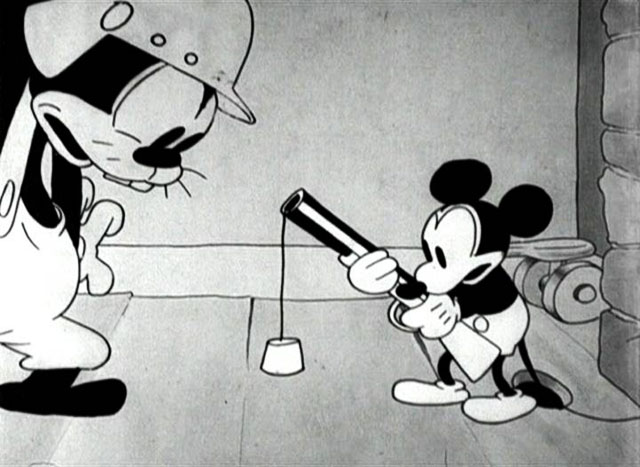 Mickey joins a barnyard army of mice (many of which are Mickey look-a-likes) against an invading army of cats.
We see him naked while he’s treated rather badly by a very rude officer. Mickey’s body is extraordinarily mechanical in this scene: the officer is able to stretch his neck and tongue endlessly, and can even take out Mickey’s heart.
In the next scene another officer shouts “company, forward march!”, making him the first character in a Disney cartoon that actually speaks. Up to this moment characters would only utter single syllable sounds and laughs. Only Minnie could express two syllables with her yoo-hoo, but that was it.
In spite of this step forward, ‘The Barnyard Battle’ remains, in effect, a silent cartoon. The way the inspecting officer asks Mickey to stick out his tongue is a perfect example. The highlight of silent acting, however, is given to Mickey, who, when confronted with a large and mean cat, gives a performance that matches Charlie Chaplin.
Mickey’s size is rather inconsistent in this cartoon. His never as small as in ‘When the Cat’s Away‘, but in some scenes he’s clearly much smaller than usual. The battle has more allusions to the American civil war than to World War I, making it a little more comfortable. Mickey finally defeats the cats by clobbering them with a hammer to Verdi’s anvil chorus from ‘Il Trovatore’. This is probably the first animated scene in which something totally unmusical is done musically. A great cartoon idea, which would be greatly expanded in many cartoons to come.
Watch ‘The Barnyard Battle’ yourself and tell me what you think:
This is Mickey Mouse cartoon No. 7
To the previous Mickey Mouse cartoon: When the Cat’s Away
To the next Mickey Mouse cartoon: The Plow Boy
Director: Walt Disney
Release Date: May 9, 1929
Stars: Mickey Mouse, Minnie Mouse, Horace Horsecollar
Rating: ★★
Review:
 In this weak cartoon (Mickey’s seventh) Mickey and Minnie are farmers.
The most remarkable thing about this cartoon is that it marks the debut of Horace Horsecollar. One might say, it marks the debut of Clarabelle Cow, as well, but the early Mickey Mouse cartoons contain a little too many non-distinct cows to state that clearly, because this cow is not different from the others.
This cartoon is particularly important in the development of Minnie: she now has lost the bra-like circles on her body and she’s singing for the first time. Notice how the animation of the tongue is completely convincing. Although Minnie’s only singing “lalalala” (something she would do in many cartoons to follow), this is an important step in the animation of speech. This was something I guess Disney was eager to master. Indeed, in the next cartoon, ‘The Karnival Kid‘, there’s suddenly a lot of talking and singing.
‘The Plow Boy’ contains a scene where the background moves the wrong way making the cow walk backwards.
Watch ‘The Plow Boy’ yourself and tell me what you think:
This is Mickey Mouse cartoon No. 8
To the previous Mickey Mouse cartoon: The Barnyard Battle
To the next Mickey Mouse cartoon: The Karnival Kid
Director: Walt Disney
Release Date: May 3, 1929
Stars: Mickey Mouse, Minnie Mouse
Rating: ★
Review:
 Awkwardly, in this sixth Mickey Mouse cartoon Mickey and Minnie are portraited as real mice.
They are joined by several look-a-likes in a house party, while the owner, a drunk cat, is gone hunting. There’s still some silent comedy (and no dialogue), but there’s no real story, only an extended musical number. Therefore this cartoon can be regarded as the first of many ‘song-and-dance-routine’-cartoons that would dominate the early 1930s. It even predates the Silly Symphony series, which initial sole raison d’être seems to be song-and-dance-routines.
These cartoons no doubt delighted the audiences at the time. However, I regret their coming, because both story and surreal humor had to give way to the rise of them. ‘When the Cat’s Away’ is a prime example: despite some clever gags, it is easily the dullest of the earliest Mickey Mouse cartoons.
After ‘When the Cat’s Away’ Mickey would never been portrayed as a real mouse again. Like in his first five cartoons, he would just be a boy in the shape of a mouse. The idea of Mickey being a mouse would become negligible compared to the cartoon star he was. Mickey was seen as an actor, not as an animal. This would eventually lead to the awkward situation of Mickey dealing with ‘real’ and very different looking mice in ‘The Worm Turns‘ (1937).
Watch ‘When The Cat’s Away’ yourself and tell me what you think:
This is Mickey Mouse cartoon No. 6
To the previous Mickey Mouse cartoon: The Opry House
To the next Mickey Mouse cartoon: The Barnyard Battle
Director: David Hand
Release Date: November 17, 1934
Stars: Donald Duck, Fifi, Mickey Mouse, Minnie Mouse, Pete
Rating: ★★★★★
Review:
 Mickey and Donald (in his third appearance) are policemen hunting Pete who has ‘dognapped’ Minnie’s dog Fifi. The chase, which includes a lot of gunfight, ends in a sawmill where all three have to cope with a runaway circular saw.
The cartoon is outstanding for its fast pace and high content of gags. Mickey and Donald are staged as a duo, but, like in ‘Orphan’s Benefit’, Donald Duck is given the last shot. ‘The Dognapper’ would remain Mickey’s and Donald’s only genuine duo cartoon, but it set the stage for the famous trio outings of the late thirties in which Mickey, Donald and Goofy would fight the odds together. Goofy, the only missing element, would join Mickey and Donald a few months later, in ‘Mickey’s Service Station’ (1935).
Watch ‘The Dognapper’ yourself and tell me what you think:
This is Mickey Mouse cartoon No. 70
To the previous Mickey Mouse cartoon: Mickey Plays Papa
To the next Mickey Mouse cartoon: Two-Gun Mickey
Director: Walt Disney
Release Date: March 28, 1929
Stars: Mickey Mouse
Rating: ★★★½
Review:
 Unlike its predecessor, ‘The Barn Dance‘, ‘The Opry House’ relies heavily on sound and music.
Mickey is the sole performer in a local theater where he dances and plays music. He even dresses up as a female belly dancer, dancing the hoochie coochie dance.
With its many musical gags, this cartoon is the first step in the development of the ‘concert cartoon’. An orchestra plays George Bizet’s Carmen way out of tune, and Mickey performs the Hungarian Rhapsody by Franz Liszt on the piano. This sequence is particularly important for two reasons: first, Mickey here gains his famous gloves, and second, this is the first time that Liszt’s famous work is featured in an animated cartoon. It would remain a cartoon classic and many years later, Bugs Bunny would perform the same piece on the piano in ‘Rhapsody Rabbit‘ (1946), and Tom and Jerry in ‘The Cat Concerto‘ (1947). Already in this cartoon, Liszt’s piece is the source of several musical gags, as Mickey plays the piano in the most original ways, even clobbering it with his fists, until his stool kicks him.
Watch ‘The Opry House’ yourself and tell me what you think:
This is Mickey Mouse cartoon No. 5
To the previous Mickey Mouse cartoon: The Barn Dance
To the next Mickey Mouse cartoon: When The Cat’s Away
Director: Walt Disney
Release Date: March 15, 1929
Stars: Mickey Mouse, Minnie Mouse, Pete
Rating: ★★★★½
Review:
 In ‘The Barn Dance’, Mickey Mouse’s fourth cartoon, Pete’s rivaling Mickey for the love of Minnie.
The first scene of this cartoon draws its inspiration from the Oswald cartoon ‘Rival Romeos‘, released only eight months earlier. Pete and Mickey both come to Minnie’s house to court her. Pete has the advantage of having a car above Mickey’s chariot, and like Donna Duck would do nine years later in ‘Don Donald‘ (1937), Minnie (wearing a bra, like she did in ‘Gallopin’ Gaucho‘) falls for it. Luckily, the car falls apart even before they’ve taken a ride, so Mickey and Minnie ride together to a barn dance hall.
Unfortunately, Mickey can’t dance: his shoes grow bigger every step, stepping on Minnie’s leg all the time. So after the dance Minnie’s leg is a long mess. She then ties it in a knot and cuts off the excess! These two gags belong to a surreal type typical of the silent era, which Disney would soon abandon.
After Mickey’s failure as a dancer, Minnie only wants to dance with Pete. Mickey solves the problem with help from a balloon, but Pete wrecks Mickey’s plan, regaining Minnie and leaving Mickey crying on the floor. This is a rather odd ending of a marvelous cartoon, which is still firmly rooted in the silent era with its surreal gags, limited use of sound and absence of dialogue.
‘The Barn Dance’ is far less known than the three Mickey Mouse cartoons preceding it, but with its clear storytelling, funny gags and strong acting it’s still a delightful cartoon to watch.
Watch ‘The Barn Dance’ yourself and tell me what you think:
This is Mickey Mouse cartoon No. 4
To the previous Mickey Mouse cartoon: Steamboat Willie
To the next Mickey Mouse cartoon: The Opry House
Director: Walt Disney
Release Date: August 7, 1928
Stars: Mickey Mouse, Minnie Mouse, Pete
Rating: ★★★★★ ♕
Review:

Although Mickey’s first cartoon, ‘Plane Crazy‘, couldn’t arouse any distributor, Disney made another cartoon with his new character, ‘Gallopin’ Gaucho’. It was to be Mickey’s second and last silent cartoon.
If possible, he is even ruder in this short than in ‘Plane Crazy’: according to a poster in the background, he is a sought-after criminal, we watch him smoking and drinking, and dancing a stout tango with Minnie (who’s wearing a bra in this cartoon).
Nevertheless, this cartoon is also the first in which Mickey shows to be a small, but clever and courageous hero. For when Minnie is abducted by Pete (who, in his first appearance in a Mickey Mouse cartoon, has both his legs), Mickey rescues her in a heroic fight. He then earns the kiss he tried to get by force in ‘Plane Crazy’. It was of course this character trait which was greatly expanded upon in later Mickey Mouse cartoons. Mickey’s nemesis, Pete, was in fact a much older character than Mickey – he already figured in some of the Alice cartoons and he was also Oswald’s adversary. His design was initially more dog- or bearlike, but in the Mickey Mouse cartoons it was settled that Pete was some kind of big cat.
Due to the melodrama ‘Gallopin’ Gaucho’ contains less gags than ‘Plane Crazy’, but it’s still a wonderful and fast cartoon with ingenious gags like the scene in which Mickey uses his own tail as a tackle. ‘Gallopin’ Gaucho’ also set out a storyline that was to be copied a couple of times (e.g. ‘The Cactus Kid‘ (1930), ‘Mickey in Arabia‘ (1932),’ The Klondike Kid‘ (1932)), and self-consciously parodied in ‘Gallopin’ Romance’, the film shown in ‘Mickey’s Gala Premier’ (1933). ‘Gallopin’ Gaucho’ itself was a parody of the 1927 Douglas Fairbanks film ‘The Gaucho’.
This cartoon was de facto the first production of Disney’s new fledgling studio (‘Plane Crazy’ was made secretly when Disney was still under Mintz’s contract). Ub Iwerks, who had animated ‘Plane Crazy’ single-handedly, could now be assisted by the young assistant animators Les Clark and the recently hired Wilfred Jackson to work on ‘Gallopin’ Gaucho’. Both men would have long lasting careers at the Disney studio.
Unfortunately, ‘Gallopin’ Gaucho’ didn’t stir the distributors any more than did ‘Plane Crazy’. Disney had to come with something original, if he would get Mickey on the screen. And with something original he came…
A few final trivial remarks
- Mickey has shoes in this cartoon, which he shortly looses while whistling his ostrich in one scene.
- Mickey’s eyes change from the goggly to the familiar ones during the same scene.
- The bird Mickey’s riding might very well be a Rhea, a relative of the ostrich, that lives on the pampas of Argentina, the place where the cartoon takes place.
Watch ‘Gallopin’ Gaucho’ yourself and tell me what you think:
This is Mickey Mouse cartoon No. 2
To the previous Mickey Mouse cartoon: Plane Crazy
To the next Mickey Mouse cartoon: Steamboat Willie
Director: Walt Disney
Release Date: November 18, 1928
Stars: Mickey Mouse, Minnie Mouse, Pete
Rating: ★★★★★ ♕
Review:

In 1928 Walt Disney was at a low point in his career. He had refused to work for Charles Mintz at lower wages, he had lost most of his staff to Mintz, and he had no distributor for his new cartoon star, Mickey Mouse.
Mickey’s first two cartoons, ‘Plane Crazy‘ and ‘Gallopin’ Gaucho‘, were well-made and entertaining films, but they didn’t impress any distributor. The problem was that despite their high quality, they were not really different from other cartoons, like Disney’s former own Oswald the Lucky Rabbit series. Disney had to think of something.
And he did. Mickey’s third cartoon would have the distinction of sound. Sound was an extremely fresh cinematic feature at the time. The breakthrough feature, ‘The Jazz Singer’ had only been released in October 1927, and the first all talking picture, ‘Lights of New York’ was only released in July 1928, the month in which production on ‘Steamboat Willie’ started.
Using sound creatively
Surprisingly, ‘Steamboat Willie’ was not the first cartoon to use synchronized sound. The Fleischer studio, for example, had experimented with the technique as early as 1924, and in October 1928 Paul Terry would release ‘Dinner Time’, which also used a synchronized soundtrack. However, Fleischer’s films failed to reach complete synchronicity, and Paul Terry’s film (which can be watched here) is essentially a silent and remarkably boring cartoon, which just happens to have sound to it.
‘Steamboat Willie’ on the other hand makes perfect use of the novelty of sound. Already in the opening scene we’re treated on something no less than spectacular: we watch and hear Mickey Mouse whistling a joyful tune. After watching several silent cartoons, this sole scene still has a startling effect. But all scenes in ‘Steamboat Willie’ are there to show us the novelty of sound: we watch and hear whistles blowing, cows mooing, chickens cackling, and Minnie shouting “yoo”-hoo”. And thanks to the invention of the click track all sounds are in perfect synchronization with the moving images.
However, the real treat of ‘Steamboat Willie’ comes after 4 minutes, when a goat swallows Minnie’s sheet music and guitar. What seems a disaster turns out to be a delight, for the goat becomes musical, and Mickey and Minnie turn it into some kind of hurdy-gurdy. This gag, in fact, had already been used in the silent Oswald the Lucky Rabbit cartoon ‘Rival Romeos‘ (released in March), but makes much more sense with the added sound. For now the goat-hurdy gurdy provides an intoxicating soundtrack for Mickey to improvise on, incidentally mostly by torturing animals. This musical number, based on ‘Turkey in the Straw’ is a sheer delight, and entertains even today.
The impact of ‘Steamboat Willie’
Needless to say ‘Steamboat Willie’ boosted both Mickey Mouse’s and Walt Disney’s career and it gave a valuable shot to the ailing animation industry. Yet, it also caused a setback, one that can already be seen in this cartoon. In ‘Steamboat Willie’, sound is the sole raison d’être of some of the shots (chickens cackling, a cow mooing). But more important, storyline has given way to an extensive musical number. While the two Mickey Mouse shorts that were made before, ‘Plane Crazy’ and ‘Gallopin’ Gaucho’, had strong, albeit simple stories, Steamboat Willie has almost none. It wasn’t necessary: simply watching Mickey Mouse dancing and playing to the music was marvelous enough for the audiences of that time.
Therefore, in the years after the success of ‘Steamboat Willie’, Disney would favor often tiring sing and dance routines above great story lines. It took the studio almost two years to bring back strong stories to its cartoons (Mickey’s 19th film, ‘The Fire Fighters’ from 1930, is arguably the first).
Conclusion
Nevertheless, ‘Steamboat Willie’ is a great cartoon, and a lot of fun to watch. It is still deeply rooted in the silent era: because lip synchronization had not been developed yet, the characters’ vocabulary remains rather limited. Therefore, it still uses a comic strip-like visual language to express the characters’ feelings. Yet, the musical number is both fresh and catching.
When you’ve seen Steamboat Willie, you’ll be whistling ‘Turkey in the Straw’ for days, with a smile on your face.
Watch ‘Steamboat Willie’ yourself and tell me what you think:
This is Mickey Mouse cartoon No. 3
To the previous Mickey Mouse cartoon: Gallopin’ Gaucho
To the next Mickey Mouse cartoon: The Barn Dance
Director: Walt Disney
Release Date: May 15, 1928
Stars: Mickey Mouse, Minnie Mouse
Rating: ★★★★★ ♕
Review:
 April 1928. Disney has just returned from an ill-fated journey to New York. There he had learned that he had lost his star character Oswald the Lucky Rabbit, and all his crew – all hired away by his distributor, Charles Mintz.
All, save one – only his friend and star animator Ub Iwerks has remained loyal*. And while the rest of the studio is working on the last Disney-produced Oswald cartoons, Iwerks is set to work in a separate office, secretly working on a cartoon, not for Mintz, but for Disney.
Iwerks works at an astonishing speed, and he finishes the animation on the cartoon after two weeks. This is a stunning effort by all standards. But what is even more extraordinary is that the finished product, ‘Plane Crazy’, turns out to be such a fine cartoon!
‘Plane Crazy’ is more consistent than most of the preceding Oswalds. It’s fast, it’s simply packed with gags and very funny. Moreover, it’s full of visual tricks. For example, the film opens with the behind of a cow (!), walking away from the camera. Later there are some great perspective scenes with Mickey’s plane flying under a cow’s udders, and almost crashing into two cars.
The film draws inspiration from the same event as the earlier Oswald cartoon ‘The Ocean Hop‘ (1927): Charles Lindbergh’s flight from New York to Paris on May 20-21 1927, the first non-stop flight across the Atlantic Ocean. A goggle-eyed Mickey Mouse (without shoes or gloves) wants to imitate ‘Lindy’ and builds a plane himself, helped by the other farm animals.
Unfortunately his plane crashes against a tree. Then Mickey transforms a car into a plane, and asks Minnie to fly along. After a breath taking take-off, the plane flies, and up in the air Mickey forces a kiss from Minnie, with disastrous results.
‘Plane Crazy’ is, of course, Mickey’s first cartoon and it hasn’t aged a bit. Yes, it’s a silent cartoon with sound added later. Yes, Mickey looks and behaves rather differently than he would do later, and yes, some of the gags are rather crude. Yet, Plane Crazy is outstanding for its fast-paced gags, its extraordinarily rubbery animation, its awesome use of perspectives and its effective pantomime character animation (its only piece of dialogue is Minnie asking “who, me?”).
The film is a testimony of Ub Iwerks’s extraordinary skill. Not only was he an incredibly fast animator, as this short shows he was also an original artist, with a distinct style and an excellent sense of comic timing.
Unfortunately, in 1928, the distributors didn’t see anything distinctive in Mickey. True, he was not too different from Oswald. Both characters were of more or less the same size (with Mickey being outrageously big for a mouse from the outset). Both characters were kinda likable, had a joyful, adventurous spirit, and were seen courting a love interest. Nevertheless, Disney produced a second cartoon with his new character, ‘Gallopin’ Gaucho‘.
Watch ‘Plane Crazy’ yourself and tell me what you think:
This is Mickey Mouse cartoon No. 1
To the next Mickey Mouse cartoon: Gallopin’ Gaucho
* and, to be fair, animator Johnny Cannon, and the recently hired Les Clark (one of the future Nine Old Men – who was not even approached by Mintz), and some ink and paint girls, and the janitor.
Director: Burt Gillett
Release Date: August 11, 1934
Stars: Clara Cluck, Clarabelle Cow, Donald Duck, Goofy, Horace Horsecollar, Mickey Mouse, the Orphan Mice
Rating: ★★★★★ ♕
Review:
 In ‘Orphan’s Benefit’ Mickey and the gang are giving a theatrical performance for the orphan mice we know from ‘Mickey’s Nightmare’ (1932) and other cartoons.
We watch Donald Duck reciting ‘Little Boy Blue’, Horace Horsecollar, Clarabelle Cow and Goofy as acrobats and Mickey and Clara Cluck giving a recital.
‘Orphan’s Benefit’ marks Donald Duck’s second appearance, after his debut in ‘The Wise Little Hen‘ from two months earlier, and his looks are still a bit awkward: he has black feet (because of his transition from color to black and white), an elongated bill and he is very small compared to the rest of the gang. Nevertheless, ‘Orphan’s Benefit’ marks the real birth of Donald Duck: he’s cast outside the Silly Symphonies along Mickey and his co-stars, and he’s really stealing the show. Moreover, for the first time he’s showing his temper and his typical ‘dance of anger’ (created and animated by Dick Lundy).
Besides Donald Duck this cartoon also introduces Clara Cluck, the opera-singing hen. Her career was way less successful than Donald’s: in total she would star in only seven cartoons, and she retired in 1942. Mickey’s role is reduced to a scarcely visible and embarrassingly unfunny straight man. Therefore Orphan’s Benefit marks as much the start of Donald’s career as the beginning of Mickey’s demise.
‘Orphan’s Benefit’ was the only Disney cartoon to be remade. In 1941 it appeared again, now in color and with new designs (especially of Donald Duck).
Watch ‘Orphan’s Benefit’ yourself and tell me what you think:
This is Mickey Mouse cartoon No. 68
To the previous Mickey Mouse cartoon: Mickey’s Steamroller
To the next Mickey Mouse cartoon: Mickey Plays Papa
Director: Burt Gillett
Release Date: July 30, 1932
Stars: Pluto
Rating: ★★★★
Review:
 ‘Just Dogs’ opens with a dog pound, with several dogs howling to the tune of Vernon Dalhart’s 1924 hit ‘The Prisoner’s Song’.
Then a little black dog escapes, and helps Pluto and several other dogs escaping, too. Once outside the little dog repeatedly tries to gain Pluto’s sympathy, to no avail. Not even when it shares a large bone with Pluto. When an annoying little Pekingese warns the other dogs of the bone, trouble starts, but the little dog saves the day with the help of legion of fleas, while Pluto remains busy with an alarm clock. Only then he gains Pluto’s much wanted sympathy.
‘Just Dogs’ is not a particularly funny or beautiful short and its star, Pluto, is most of the time quite unsympathetic, but it does show the advancements in animation Disney was making at the time: we’re not watching ‘just dogs’, we’re watching several recognizable types of dogs, among them a very lifelike St. Bernard.
By now, the Disney animators didn’t need to stick to stereotyped ducks, pigs, cows, horses, or in this case, dogs, but were able to draw and animate real dogs, who looked like dogs, moved like dogs and behaved like dogs. This kind of naturalism is quite unprecedented in earlier films. ‘Just Dogs’ is still a mixed bag: some of the designs are still very primitive, especially during the escape scene, but there are some striking new designs here, not in the least, the small, optimistic black dog, who ‘s the real hero of the short.
The two main protagonists, Pluto and his clever comrade, are two distinct characters, which behave and move differently, a great advancement in character animation. Disney would develop both naturalism and character animation into perfection in the coming seven years.
Two years later the little dog would reappear as Pluto’s rival Terry in Floyd Gottfredson’s Mickey Mouse comics.
Watch ‘Just Dogs’ yourself and tell me what you think:
This is Silly Symphony No. 28
To the previous Silly Symphony: The Bears and the Bees
To the next Silly Symphony: Flowers and Trees


 Dr. Grob's Animation Review