
You are currently browsing the category archive for the ‘Ireland’ category.
Directors: Tomm Moore & Ross Stewart
Release date: October 30, 2020
Rating: ★★★★★ ♕
Review:
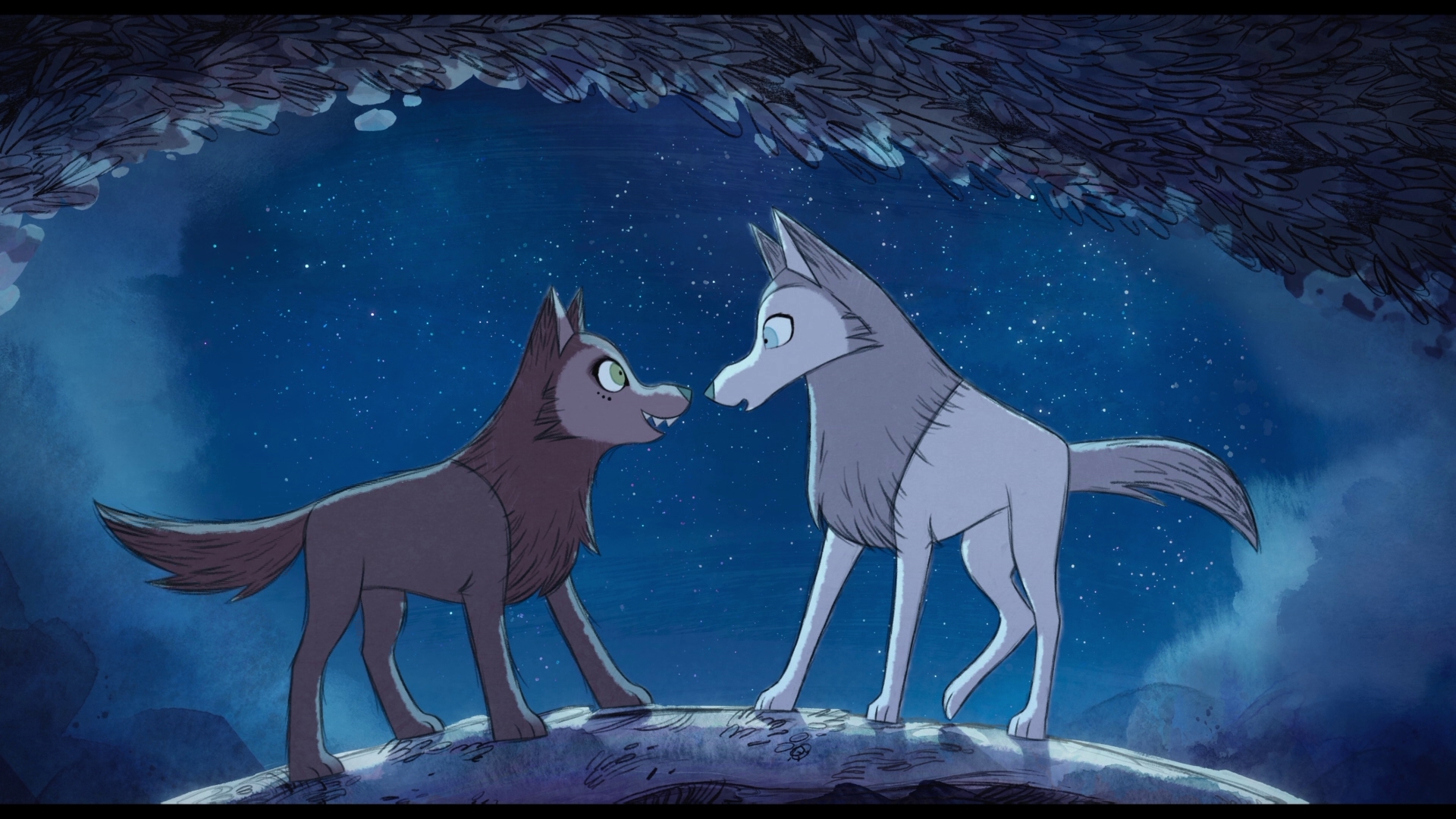
When these films were released, I doubt that many people were aware of that, but Irish studio Cartoon Saloon’s ‘The Secret of Kells’ (2009) and ‘Song of the Sea’ (2014) were part of an Irish folklore trilogy, which was rounded up in 2020 by ‘Wolfwalkers’.
All three films are indeed deeply rooted in Irish culture, and could not have been made elsewhere, but certainly ‘Song of the Sea’ and ‘Wolfwalkers’ also feature universal stories, ‘Song of the Sea’ one of loss and grief, ‘Wolfwalkers’ one of repression.
The idea of ‘Wolfwalkers’ is rooted in the fact that Ireland once used to be a forested country, with wolves roaming around. According to Wikipedia the last wolf in Ireland was killed in 1786, thus the species has long since been extinct on the island. The film goes further back, though, to the town of Kilkenny in 1649-1650, during Oliver Cromwell’s invasion of Ireland (who, without doubt, is the Lord Protector of the film, even though the film makers turn him into a fictional character, resulting in an alternate history ending).
In this town we follow English hunter Goodfellowe, who is deployed by the Lord Protector to hunt down the wolves of the forests surrounding the town, and his feisty daughter, Robyn, who befriends an even livelier mysterious forest girl called Mebh. In an interview on the Kaboom! Animation Festival director Tomm Moore told us they first thought of Robyn as a boy, but a girl fitted better, as she would feel the repressive times even more than a boy would do. And indeed, the film is not necessarily about repression of the Irish, but about repression in general, not in the least of women, with Robyn being forced into a gender role very unsuitable for her (or any other woman of the era, for that matter). It’s painful to see that Robyn’s own father ties the knots to in order to protect her (this story arc is reminiscent of ‘Finding Nemo’ – both films star over-protected fathers stifling their children). This makes ‘Wolfwalkers’ one of at least two great feminist animation films of 2020, the other one being ‘Calamity, une enfance de Martha Jane Cannary’ from France.
Apart from repression the film discusses deep topics like man vs. nature, Christianity vs. paganism, certainty vs. softness, man vs. woman, and single truth fanatism vs. a multi-voiced and more ambivalent reality, all packed in a perfectly told and family friendly adventure fantasy film. ‘Wolfwalkers’ is also vaguely reminiscent of Ghibli’s ‘Princess Mononoke’ from 1997: both films show the problems of man’s handling of nature, without regressing to a mere good and evil. Indeed, the Lord Protector as depicted, is less cruel than I presume the real Oliver Cromwell would have been (no one gets killed in the movie, for example), and his motivations are clearly explained. The film makes clear that the Lord Protector is not necessarily evil, but a fanatic, who is certain that he is on the right path.
As with the previous two Irish folklore films ‘Wolfwalkers’ is an absolutely delight to look at. The film uses very stylized designs and strong color arrangements, both in characters and in the background art. The rigid straightforwardness of the Lord Protector and the city is translated by the straight horizontals and verticals depicting the town, and even of many of its inhabitants. The film makers even show the town as a straight grid when seen in the distance, showing the town with a daringly complete lack of perspective. The grid-like is greatly contrasted by the curves of the forest, which symbolize freedom from the societal straitjackets of the city. The film becomes even more free, when showing the raw animation drawings of running wolves, with the digital pencil lines themselves becoming free from restriction. In this respect, this film is even more beautiful than the two earlier pictures – in fact every frame is a beauty, making this film one of the most beautiful animation films ever made.
The animation is of a high standard anyway: despite all the flat designs there’s a lot of perspective animation and there are even quite a lot of moving backgrounds, especially during the scent and running scenes. The character animation is subtle and often understated. For example, the character difference between Robyn and Mebh is shown by the different movements of the two characters, while Goodfellowe becomes less mobile when the repression ties him further and further.
In all, ‘Wolfwalkers’ is easily the best animation film of 2020, even outcompeting the strong Pixar film ‘Soul’, and must be ranked among the best animation films of all time. Strongly recommended.
Watch the trailer for ‘Wolfwalkers’ yourself and tell me what you think:
‘Wolfwalkers’ is available on the Blu-Ray or DVD set ‘Cartoon Saloon’s Irish Folklore Trilogy’
Director: Nora Twomey
Release date: September 8, 2017
Rating: ★★★★★
Review:

2017 was a good year for the animated feature film: Warner Bros., Dreamworks and the French Polivari and Panique studios gave us great laughs with ‘The Lego Batman Movie’, ‘Captain Underpants: The First Epic Movie’, and ‘ Le grand méchant renard et autres contes…’ (The Big Bad Fox and Other Tales), respectively; Pixar amazed us with the magnificent ‘Coco’, and the Japanese Science Saru studio made quite an impression with the mind-blowing film‘Night Is Short, Walk on Girl’.
However, the most important and most moving animated feature film was the Irish-Canadian-Luxembourgian co-production ‘The Breadwinner’. This was the third feature by the Irish Cartoon Saloon studio, which can be regarded as the most welcome and most original studio additions to the animated feature field of the 21st century, thus far. The Breadwinner’ shares with their previous two films, ‘The Secret of Kells’ (2009) and ‘The ‘Song of the Sea’ (2014) a very charming traditional animation style, and a surprisingly graphic overall design, although the latter is rather toned down in ‘The Breadwinner‘ when compared to the earlier two movies. But unlike the other two, ‘The Breadwinner’ completely lacks the Irish flavor, being set in, of all places, Afghanistan.
Based on the book by Deborah Ellis from 2000 ‘The Breadwinner’ is set in Kabul, the unfortunate country’s capital during the first Islamic Emirate of Afghanistan (better known as the Taliban regime, 1996-2001). By the time the film was made, this extremely oppressive regime was a ghost of the past, at least in Kabul (the Taliban never fully disappeared from the country), but sadly, since August 2021 this misogynist, backward movement is in full charge of the country, once again.
‘The Breadwinner’ makes no mistake how hard it is to live in such a violent, insecure country, where arbitrariness prevails, and where women have no rights, at all, whatsoever. The film follows the eleven-year-old Afghan girl Parvana, who lives with her disabled father, her mother, elder sister Soraya, and a baby brother called Zaki in a tiny house in Kabul. When the father gets arrested and thrown into a prison far outside town, the family quickly get into way more problems than they already had: as women cannot do anything outside without a man, their means to even obtain food completely come to a standstill. At this point Parvana takes an important decision to save her family’s life…
‘The Breadwinner’ is a very believable story, much more subtle than almost anything coming out of the United States. For example, the Afghan people are portrayed as real people, with a rich an ancient culture. Added to the sense of authenticity is the use of Afghan voices (except for the brabbling Zaki), while Mychael and Jeff Danna’s score clearly borrows from the Afghan musical tradition. Thus, the film’s Afghanistan is a convincing one, not a caricature seen through Western eyes. Moreover, although the film makes no mistake about the oppressive and misogynist nature of the Taliban regime, there are many shades of gray between the heroes and villains. Even the villain that causes Parvana’s family’s demise is shown in one last shot as not only evil, but insecure and afraid, too. Moreover, Parvana remains a relatable character, throughout. Despite her courage and adult responsibility, she remains a child, and is shown delighting in childish behavior, especially with her friend Shauzia.
Contrasted with Parvana’s dire circumstances are the images of a story she tells her beloved (her first audience is her baby brother, but she also tells the tale to others, and others even blend in, altering the direction of the story while doing so. These images are rendered in the most colorful, storybook illustration-like, faux cut-out animation, and tell about a boy who goes on a quest to retrieve his village’s seeds from an evil elephant king. This fantastical tale is picked up several times during the movie, and often reflects the events depicted in real life. Especially in the finale, in which the two seem to come together, this dual story telling comes to a harrowing conclusion.
As said, the film’s design is less graphic than that of Cartoon Saloon’s Celtic features. The background art is semi-realistic, with depressing greys, browns and yellows depicting the seemingly treeless town of Kabul. The character design is more graphic, with especially Zaki being an echo of the character designs from the earlier films. Noteworthy is the background art of a rather surreal scene in which Parvana and Shauzia are seen in a field full of abandoned tanks. The traditional animation is a delight, not only the very moving animation of the main characters, but also the cartoony quasi-cut-out animation of Parvana’s story. There’s only a little computer animation present, mostly for crowd scenes.
In all, ‘The Breadwinner’ is one of the best, most adult and most moving animation films to come out of any animation studio, and should be considered a modern classic.
According to director Nora Twomey ‘The Breadwinner’ may be set in Afghanistan but tells a universal story of all children growing up in oppressive countries, everywhere. Yet, we are still waiting for the animated depictions of their stories, while Afghanistan has been the subject of no less than three other animated feature films since then: ‘The Swallows of Kabul’ from 2019 and ‘My Sunny Maad’ and ‘Flee’ from 2021. Surely, the people of say North Korea, Syria, Eritrea, the Central African Republic, or Yemen deserve better.
Watch the trailer for ‘The Breadwinner’ yourself and tell me what you think:
‘The Breadwinner’ is available on Blu-Ray and DVD


 Dr. Grob's Animation Review