
You are currently browsing the category archive for the ‘United Kingdom’ category.
Director: Erica Russell
Release Date: 1989
Rating: ★★★★★
Review:
 ‘Feet of song’ is a non-narrative film about dance and Russell’s solo debut film.
It uses semi-abstract human forms, akin to those by painter Kazimir Malevich. The human forms feel both futuristic and African at the same time, and have a timeless appeal. The images get more and more abstract as the film progresses, but the sense of dance is never lost.
‘Feet of Song’ features African-sounding world music by Charlie Hart, but the music is in service to the beautiful images, not the other way round. Made for Channel 4, ‘Feet of Song’ is a prime testimony of Erica Russel’s unique style, clearly influenced by Oskar Fischinger, but firmly rooted in both her South African roots and dancer background.
Unfortunately, Russell made only two other independent films, ‘Triangle‘ in 1994, and ‘Soma’ in 2001, devoting most of her time to commissioned work (her images for example appear in the Madonna video-clip ‘Dear Jessie’ from 1989).
Watch ‘Feet of Song’ yourself and tell me what you think:
‘Feet of Song’ is available on the DVD inside the book ‘Animation Now!’
Directors: John Halas & Joy Batchelor
Release Date: January 31, 1954
Rating: ★★★★★ ♕
Review:
 Based on George Orwell’s famous fable (published only nine years before), Animal Farm is the first animated feature made in England, it’s one of Europe’s first feature films, and it’s undoubtedly among the masterpieces of feature animation.
The film falls into the tradition of Disney-style semi-realistic cel animation. However, it sets itself apart from the Disney tradition in its grim and political story, its lack of sentimentality and its open depiction of cruelty and violence. Moreover, the backgrounds are bold oil paintings, with visible brush strokes and darker colors than any Disney film had ever shown.
Nevertheless, the realistic and wonderful animation of the animals pays some depths to the Disney tradition (watch the Silly Symphony ‘Farmyard Symphony‘ for example), greatly helped by the presence of ex-Disney animator John Reed. The film even contains one sweet character for comical relief in a little duckling who tries to keep up with the other animals, echoing the turtle in ‘Snow White and the Seven Dwarfs’ (1937). However, when the story turns particularly grim, with the killing of the Trotsky-like pig Snowball by Napoleon’s dog henchmen, we do not see this cute character again.
The assassination of Snowball is the first of several alarming events in which the animals’ revolution is betrayed. The most disturbing of these is Boxer’s ride to a certain death. This scene is the emotional highlight of the film, and it creates strong feelings of outrage and alarm, still. The horror on the face of his friend Benjamin is very well captured, and moves to this day.
Using a voice over and evocative music by Hungarian composer Mátyás Seiber, the film retells Orwell’s story effectively, using only Orwell’s own words. Its only strong deviation from the book is its ending. Where Orwell’s novel ends with the Stalin-like pig Napoleon’s regime installed, the film ends with yet another revolution – some wishful thinking that in the real world never quite came true until the late 1980s, when encouraged by Gorbachev’s perestroika, the people all over Eastern Europe revolted against their communist oppressors.
‘Animal Farm’, which was released within a year after Stalin’s death, is still a moving portrait of the corrupting force of power. Even though its subject, the Soviet Union, has long been a state of the past, the forces depicted in this movie are still active. The world is not free of its Napoleons, yet…
Watch ‘Animal Farm’ yourself and tell me what you think:
Directors: John Halas & Joy Batchelor
Release Date: 1948
Rating: ★★★★
Review:
 ‘Magic Canvas’ is rather pretentiously introduced as “something different (….), new and exciting”.
Luckily, the film is rather original and exciting: using a rather abstract score by Hungarian composer Mátyás Seiber, it consists of associative images with a strong sense of surrealism. It loosely tells the story of man struggling to be free. Even though it has to pay its debts to Disney’s ‘Fantasia’ (1940), ‘The Magic Canvas’ surely is one of the most avant-gardistic films of its time, and a testimony of Halas & Batchelor’s animation ambitions.
Watch ‘Magic Canvas’ yourself and tell me what you think:
‘Magic Canvas’ is available on the DVD inside the book ‘Halas & Batchelor Cartoons’
Director: Peter Lord & David Sproxton
Release Date: 1978
Rating: ★★
Review:
 ‘Confessions of a Foyer Girl’ is the second film in Aardman’s revolutionary ‘Animated Conversations’ series.
Like its predecessor, ‘Down & Out‘, the film uses recorded dialogue. This time we hear two foyer girls chatting in a cinema. The dialogue is hard to understand and the lip-synch is not as good as in ‘Down & out’. Moreover, the animation is associated with seemingly unrelated stock live action footage, which leads to a film, which is both experimental and vague. The result never quite works and the result must be called a failure.
‘Confessions of a Foyer Girl’ is available on the DVD ‘Aardman Classics’
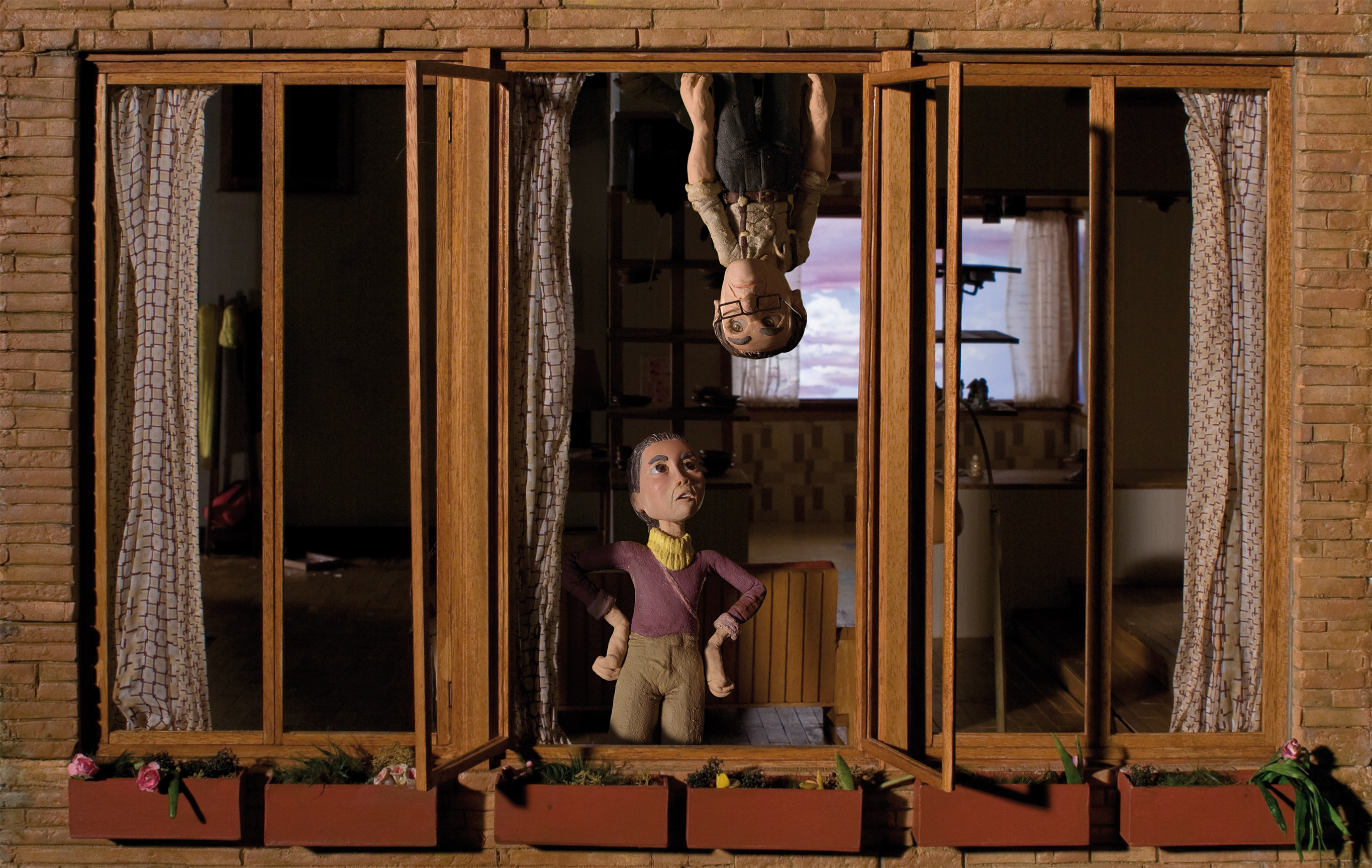
Still from ‘Head over Heels’
‘Head over Heels’ is a film directed by Timothy Reckart, and produced by Fodhla Cronin O’Reilly. It has won this prestigious Eruopean prize at the Cartoon Forum, held in Toulouse, France. Earlier, the film had been nominated for an Academy Award.
‘Head over Heels’ is a stop-motion film about a couple who have grown apart, even though they still live in the same house. In the film, one of them occupies the ceiling, the other the floor. This concept is a masterstroke, and the story is very well executed. The result is a moving picture, which is a well-deserved winner of the Cartoon d’Or 2013.
http://cartoon-media.com/cartoon-d-or/cartoon-d-or-2013/nominees.htm
Director: Peter Lord & David Sproxton
Release Date: 1978
Rating: ★★★★★
Review:
 ‘Down & out’ is the first film in Aardman’s ‘animated conversations’ series and the British studio’s first masterpiece.
The very idea of using dialogue from real life is revolutionary enough, but to use it for clay animation with lip-synch is a masterstroke. Moreover, the animation of the plasticine figures is startling: it lacks the exaggerations of normal animation, but uses small gestures and real movements, like scratching one’s nose or belly, instead. The animation continues realistically even when not supported by the soundtrack. The result is uncannily realistic, making the drama of an old, confused man asking for food and shelter, but being turned down at an Salvation army office, extra tragic.
With this film Aardman single-handedly invented the ‘animated documentary’, a genre which would lead to fantastic films like ‘Ryan’ and ‘Waltz with Bashir’ in the 2000s.
‘Down & Out’ is available on the DVD ‘Aardman Classics’
Directors: Bill Jones, Jeff Simpson & Ben Timlett
Release Date: November 2, 2012
Stars: Graham Chapman
Rating: ★★★
Review:
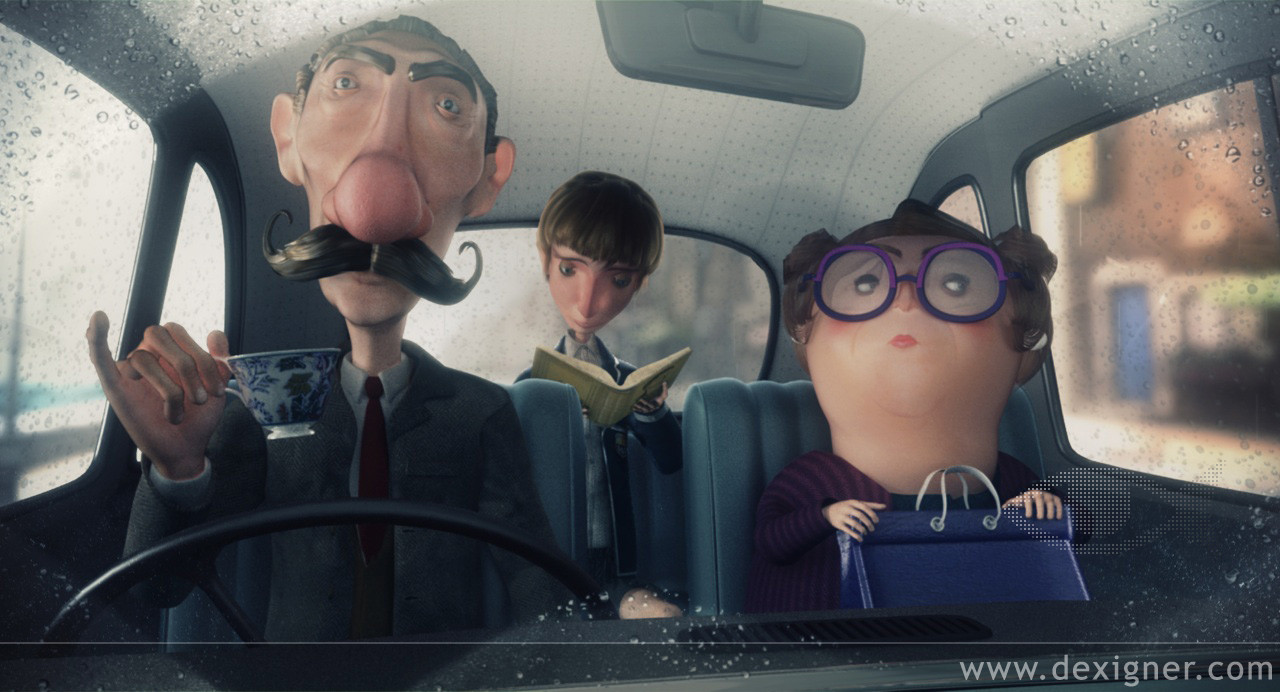 ‘A Liar’s Autobiography: The Untrue Story of Monty Python’s Graham Chapman’ is a film adaptation of Graham Chapman’s own nonsensical autobiography.
At first the film appears to follow Chapman’s book closely, using his own voice over from a audiobook recording. In fact, apart from one song all of Chapman’s vocalizations are by Graham Chapman himself, using various sources. Other former Monty Python members provide some voices, too.
The film adaptation of Chapman’s book is excellent, perfectly blending his dry humor with tongue-in-cheek images. However, the film makers want to make the film a biopic, leaving the book half way and adding some chapters of their own. At this point the film starts to drag. It becomes less humorous and more wandering, with lots of images drenched in sex and alcohol. And so, the film fades out ingloriously, leaving less an impression than it did when it started.
‘A Liar’s Autobiography’ was made by no less than fourteen different animation studios, and the overall array of styles is refreshing and at times mesmerizing. At the same time it can become a bit tiring to watch a changing of style at every scene, and sometimes the design is subpar, or downright ugly. The result is a moderately entertaining film that remains shallow and unmoving, nonetheless.
Watch the trailer of ‘A Liar’s Autobiography: The Untrue Story of Monty Python’s Graham Chapman’ yourself and tell me what you think:


 Dr. Grob's Animation Review