
You are currently browsing the category archive for the ‘★★★’ category.
Director: Joop Geesink?
Release Date: 1943
Rating: ★★★
Review:
 ‘Serenata nocturna‘, Marten Toonder’s and Joop Geesink’s first stop motion film, did raise interest of Philips, and the Dutch electronics company commissioned another short to advertise the Philishave, an electronic razor. This resulted in ‘Phi-garo in het woud’.
in ‘Phi-garo in het woud’ a bearded gnome tries to impress a female elf, but she rejects him. The gnome gets a shave at the local barber, but the elf still rejects him. Then a witch shows him the Philips Philishave, which does the trick.
‘Phi-Garo in het woud’ is less entertaining than ‘Serenata nocturna’, its story less logical, and its designs more generic than in the earlier cartoon. The animation, however, is a little more assured. More commissions were now to follow.
Watch ‘Phi-garo in het woud’ yourself and tell me what you think:
‘Phi-garo in het woud’ is available on the DVD inside the Dutch book ‘De Toonder Animatiefilms’
Director: Seymour Kneitel
Release Date: September 18, 1942
Stars: Superman
Rating: ★★★
Review:
 No sooner were the Fleischer brothers removed from their own studio, or their stars Superman and Popeye were fully put to the war effort.
No other American cartoon stars featured in as many propaganda shorts fighting the foe. Superman stars in five, of which ‘Japoteurs’ is the first.
In this entry three Japanese spies try to steal the world’s largest bomber on its test flight. Of course, Lois flies along, and both she and the plane have to be rescued by Superman.
‘Japoteurs’ is an unfortunate cartoon, which adds to the idea of a fifth column of Japanese within The United States, making every Japanese person suspicious. Indeed, due to this type of paranoia, during the war no less than 110,000 Japanese Americans, including women and children, were put into internment camps.
This is Superman film No. 10
To the previous Superman film: Terror on the Midway
To the next Superman film: Showdown
Director: Dick Lundy
Release Date: July 24, 1942
Stars: Donald Duck
Rating: ★★★
Review:
 Donald is a gold miner, who has to deal with a donkey again (see ‘The Village Smithy‘ from the same year) and a gigantic and nonsensical ore processing machine.
Like contemporary Donald Duck cartoons directed by Dick Lundy, like ‘The Village Smithy’ and ‘Donald’s Garden‘ the cartoon is filled with situation comedy only. This type of comedy reaches its apex in an almost endless scene of Donald being stuck into the head of a pickaxe. Granted, the number of ways Donald can get stuck in it is impressive, but there’s a strong sense of milking the gag, and the result is more tiresome than funny.
Watch ‘Donald’s Gold Mine’ yourself and tell me what you think:
This is Donald Duck cartoon No. 34
To the previous Donald Duck cartoon: Donald’s Garden
To the next Donald Duck cartoon: The Vanishing Private
Director: Dave Fleischer
Release Date: May 15, 1942
Stars: Popeye, Bluto, Olive Oyl
Rating: ★★★
Review:
 In this World War II cartoon Bluto is a soldier who tries to sneak away to date Olive Oyl.
When Popeye passes by Bluto tricks him into his army uniform. Popeye unwillingly has to join a tank squad, which leads to hilarious antics. Only when he has eaten some spinach Popeye directs his tank out of the camp straight to Bluto, who is wooing Olive.
Jack Mercer’s ad libbing during Popeye’s tank ride is fantastic and a highlight of the cartoon, as is the extremely flexible animation on Popeye’s tank. Popeye’s design changes back and forth from the old Fleischer design to the later, more streamlined Famous design, which makes its debut in this cartoon.
Watch ‘Many Tanks’ yourself and tell me what you think:
This Popeye film No. 107
To the previous Popeye film: Olive Oyl and Water Don’t Mix
To the next Popeye film: Baby Wants a Bottleship
Director: Grigori Lomidze
Release Date: 1947
Rating: ★★★
Review:
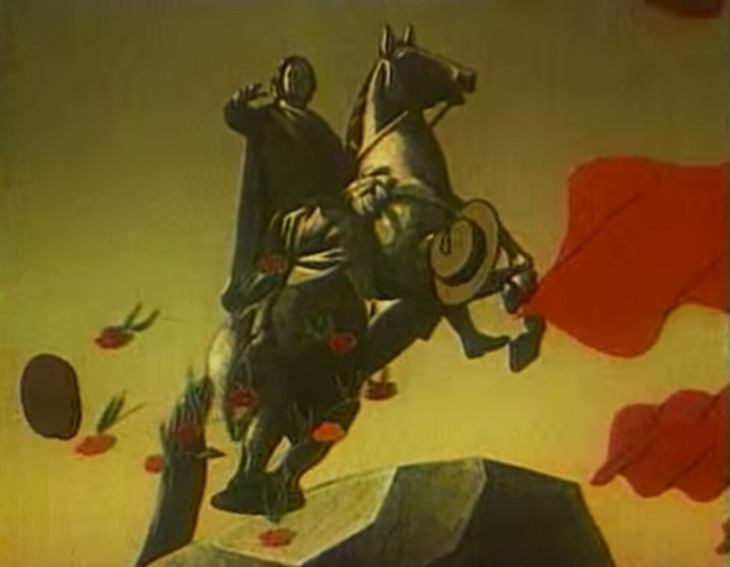 ‘To You, Moscow’ is a long and slow Soviet propaganda film celebrating Moscow’s 800th birthday by depicting its turbulent history.
During the film we watch Moscow’s settlement, the victory of Ivan III over the Tartars (15th century), the revolt against Polish occupation (17th century), the defeat of Napoleon’s army in 1812, the 1905 revolution, the 1917 socialist revolution (‘led by Lenin and Stalin’) and the 1941 defeat of the fascist army to the present day.
The socialist revolution section leads to live-action footage of Moscow, a happy child, flowers, some buildings and street scenes and statues of Lenin and Stalin. The last section, the celebration, shows photographs of heroic inhabitants of the Soviet Union, and not only glorifies Moscow as “our youth, our glory”, “our dear mother” and “our birthday girl”, but also as a “glory to Stalin”.
The different sections are bridged by letters and postcards to comrade Stalin. The sections themselves focus on strives and battles, and are accompanied by alternately realistic and symbolic images. For example, the 1917 revolution is depicted by the czarist double-headed eagle struggling and falling to pieces, while the most impressive part may be that of 1812, with its realistic images of fire.
It may be clear that this film is propaganda at its worst. The film is saved from becoming totally unwatchable by the beautiful animation, the stark images, and the lively patriotic music.
Watch ‘To You, Moscow’ yourself and tell me what you think:
‘To You, Moscow’ is available on the DVD box set ‘Animated Soviet Propaganda’
Director: Alex Lovy
Release Date: July 27, 1942
Rating: ★★★
Review:
 In the deserted ‘Zowie cafe’ a mouse is disturbed a jukebox playing latin music.
In his attempts to stop the machine, the mouse ends in a cocktail and gets drunk. He visions ‘spirits’ coming from the bottles who start a conga beat. A lobster does a Carmen Miranda act, blending Cuban and Brazilian styles, and singing in some kind of mock-Spanish. The mouse happily joins in, until he returns to his home to sleep.
The whole cartoon has a delirious atmosphere, and can be called ‘intoxicating’ without necessarily being really entertaining. The ghosts’ designs, with their red noses and bowler hats, are copied straight from the Mickey Mouse cartoon ‘Lonesome Ghosts’ (1938).
Watch ‘Juke Box Jamboree’ yourself and tell me what you think:
Director: Dave Fleischer
Release Date: March 13, 1942
Stars: Popeye
Rating: ★★★
Review:
 ‘Fleets of Stren’th’ is the third in a series of cartoons in which Popeye has joined the American navy.
In this cartoon Popeye still is a lousy sailor, but when the battle cruiser is under attack, he once again shows what he’s able to do (see also ‘Blunder Below‘). This time the battle cruiser is attacked by a squad of Japanese dive bombers. It takes some time before Popeye is able to eat his spinach, but when he does, he turns into a plane himself, defeating the complete enemy fleet.
In this process we see only one pilot, the other planes are subtly dehumanized. In this way we’ll never think of the fate of the Japanese pilots, at all. This was a clever device used in many war propaganda films of the time.
Watch ‘Fleets of Stren’th’ yourself and tell me what you think:
This Popeye film No. 104
To the previous Popeye film: Blunder Below
To the next Popeye film: Pip-Eye, Pup-eye, Poop-eye and Peep-eye
Director: Alex Lovy
Release Date: August 3, 1942
Rating: ★★★
Review:
 ‘Pigeon Patrol’ is a typical war era cartoon. It tells about Homer Pigeon, a dopey little country pigeon, whose girl Daisy May is impressed by the USA carrier pigeons, who look like American army planes.
Rejected by Daisy May, Homer decides to volunteer, too, but he’s way too small. However when he encounters a crashed carrier, he rescues an important message from an ugly Japanese vulture, beating the enemy saying: “remember Pearl Harbor and Singapore!”. In the end we watch him being decorated and happily married to Daisy May.
‘Pigeon Patrol’ is not too funny, but very propagandistic. It seems to want to emphasize that every man can do his job for the country. The Japanese vulture belongs to the typical stereotyped caricatures of a Japanese in Hollywood cartoons, complete with a suggestion of general Tojo-like glasses.
Two years later, Warner Bros. would tell another tale about a pigeon called Homer in ‘Plane Daffy‘ (1944). Their Homer commits suicide in that film. Walter Lantz’s Homer Pigeon, however, would star one other cartoon, ‘Pigeon Holed’ from 1956.
Watch ‘Pigeon Patrol’ yourself and tell me what you think:
http://www.dailymotion.com/video/x1mnywl_clube-do-pica-pau-correio-aereo_music
Director: Bobe Cannon
Release Date: September 27, 1951
Rating: ★★★
Review:
 ‘Georgie and the Dragon’ is one of those UPA shorts about young people trying to break free, a topic the studio favored (see also ‘Gerald McBoing Boing’ from 1951) and ‘The Oompahs‘ from 1952).
‘Georgie and the Dragon’ is set in Scotland, and tells about the lonesome boy Georgie. His father forbids him to bring pets in the house, but little Georgie befriends a little dragon. When he takes it home it grows larger every minute. Nevertheless Georgie manages to hide the dragon from his parents, even if the dragon’s fire repeatedly damages his father and his surroundings.
‘Georgie and the Dragon’ is a gentle story, but the film is hampered by the tiresome Scottish dialogue and all too present angular backgrounds by Bill Hurtz, against which the fluently animated characters don’t read well.
Watch ‘Georgie and the Dragon’ yourself and tell me what you think:
http://www.dailymotion.com/video/x1q9s48_georgie-and-the-dragon_shortfilms
Director: Jack Kinney
Release Date: April 27, 1951
Stars: Goofy
Rating: ★★★
Review:
 ‘Cold War’ introduces a new name for the Goofy character as the average American, as he had already been portrayed in ‘Goofy Gymnastics‘ (1949) and ‘Hold That Pose‘ (1950).
From now on our hero is known as Mr. George G. Geef, who has a characterless, average voice and who is married to a human wife, of whom we only see her arms and legs. Despite these departures, ‘Cold War’ stills uses the voice over from the sports cartoons, putting the cartoon firmly back into a great tradition. Nevertheless, George G. Geef has little to do with the original Goofy from ‘On Ice‘ (1935), and it’s almost inconceivable that it’s still the same character.
As George Geef Goofy would deal with the troubles of the average American man, like diets, children, and cigarettes. And so, in this first entry of the ‘George Geef’ series within the Goofy series, Mr. Geef catches a cold at work, and is nursed to the max by his over-caring wife…
Watch ‘Cold War’ yourself and tell me what you think:
This is Goofy cartoon No. 29
To the previous Goofy cartoon: Home Made Home
To the next Goofy cartoon: Tomorrow We Diet!
Director: Walter Lantz
Release Date: July 23, 1951
Stars: Woody Woodpecker, Buzz Buzzard, Wally Walrus
Rating: ★★★
Review:

In ‘Sling Shot 6 ⅞’ Woody Woodpecker enters a shooting contest in a Western town.
Woody wins time after time using his slingshot. His main rival is Buzz Buzzard, who ‘plays’ an evil, but extraordinarily dumb Indian who fails to understand the slingshot’s mechanism. When Buzz steals the prize money, Woody destroys the villain with an H-bomb, a nuclear weapon that would be tested the following year.
Despite the animation being surprisingly good at times, ‘Sling Shot 6 ⅞’ is a rather mediocre cartoon, but it is noteworthy for being the first Woody Woodpecker short to feature both Buzz Buzzard and Wally Walrus, who appears as a sheriff.
Watch ‘Sling Shot 6 ⅞’ yourself and tell me what you think:
This is Woody Woodpecker cartoon No. 32
To the previous Woody Woodpecker cartoon: Wicket Wacky
To the next Woody Woodpecker cartoon: Redwood Sap
‘Sling Shot 6 ⅞’ is available on the DVD-set ‘The Woody Woodpecker and Friends Classic Cartoon Collection’
Director: Jack Hannah
Release Date: October 13, 1950
Stars: Donald Duck, the bee
Rating: ★★★
Review:
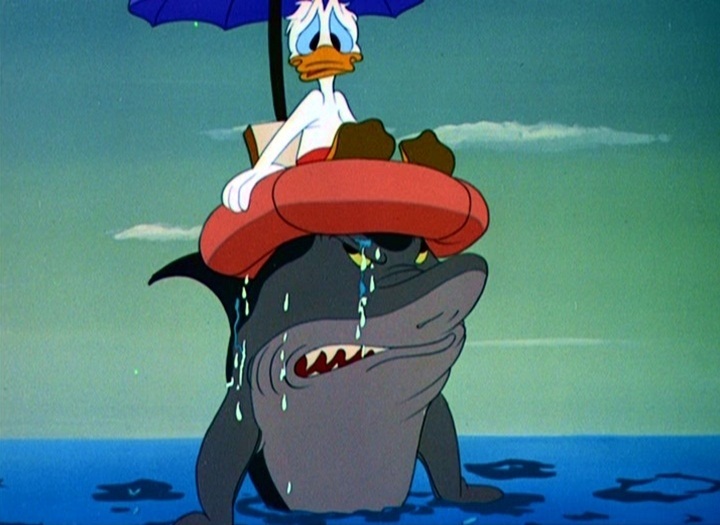 The bee and Donald compete for an empty spot on the beach in an exceptionally violent cartoon.
This short contains some good gags, but because both characters behave very unsympathetically, it is not too enjoyable. The bee, for instance, deliberately feeds Donald to a shoal of hungry sharks, which our poor hero can hardly escape. Even worse, the cartoon ends with Donald swimming into the horizon, with the sharks following after.
The sharks’ design go all the way back to ‘Peculiar Penguins‘ (1934).
Watch ‘Bee at the Beach’ yourself and tell me what you think:
This is Donald Duck cartoon No. 87
To the previous Donald Duck cartoon: Hook, Lion and Sinker
To the next Donald Duck cartoon: Out on a Limb
Director: Robert McKimson
Release Date: December 13, 1949
Stars: Goofy Gophers
Rating: ★★★
Review:
 Robert McKimson reuses the Goofy Gophers from the Art Davis cartoons ‘Goofy Gophers’ (1947) and ‘Two Gophers from Texas’ (1948) to play them against an anonymous dog who wants to be a Shakespearean actor.
The dog finds the gophers in his house, where they start to nag him for no reason. The humor comes from the Shakespeare quotes and the apt practical jokes the Gophers play on the dog, echoing his lines. However, it’s the opening scene that is the most remarkable part of the film: directly after the opening titles we watch the dog being hit by a pie, only to get the ‘That’s All Folks’ caption immediately after it. Then we watch the dog leaving ‘the stage’, cartoons and broad comedy in general to follow his Shakespearean dreams. This scene anticipates a similar scene in ‘Who Framed Roger Rabbit‘ (1988).
It’s a pity that the rest of the cartoon doesn’t live up to this great opening, and that McKimson didn’t use a more familiar or appealing character than this dog, which ultimately fails to impress.
Robert McKimson would return to the Gophers only once, in 1958, with ‘Gopher Broke’.
Watch an excerpt from ‘A Ham in a Role’ yourself and tell me what you think:
‘A Ham in a Role’ is available on the DVD-set ‘Looney Tunes Golden Collection Volume Six’
Director: Jack Hannah
Release Date: March 24, 1950
Stars: Donald Duck, Chip ‘n’ Dale, Daisy Duck, cameos by Goofy, Mickey Mouse and Minnie Mouse
Rating: ★★★
Review:
 Despite its name and title song ‘Crazy over Daisy’ is a surprisingly typical Donald Duck vs. Chip ‘n’ Dale cartoon.
In fact, it hardly features Daisy, at all. And when Daisy finally does show up, she takes the chipmunks in, leaving Donald outside. Yet, we do see Donald being crazy over Daisy, cycling to her on his velocipede… Yes, you read this right: Donald is riding a velocipede, because this cartoon is set in the 1890s. Its opening scene even feels like a copy of the opening scene of the 1941 Mickey Mouse cartoon ‘The Nifty Nineties’, complete with cameos of Goofy, and Mickey and Minnie (in the same car as they drove in the earlier cartoon).
Apart from the typical bicycle, it’s unclear why this cartoon is set in this period. The interplay between Donald and the two chipmunks could have taken place in any era. The most interesting fact about ‘Crazy over Daisy’ is that it contains an animated background scene, rarely seen since the early 1930s.
Watch ‘Crazy over Daisy’ yourself and tell me what you think:
This is Donald Duck cartoon No. 84
To the previous Donald Duck cartoon: Lion Around
To the next Donald Duck cartoon: Trailer Horn
Director: Jack Hannah
Release Date: January 20, 1950
Stars: Donald Duck, Huey, Dewey and Louie, the mountain lion
Rating: ★★★
Review:
 In ‘Lion Around’ Huey, Dewey and Louie use a remarkably lifelike mountain lion costume to fool Donald in order to steal a pie. Unfortunately, Donald discovers the deceit, and then, off course, a real mountain lion shows up.
This story line was already formulaic by 1950, and it doesn’t lead to anything particularly funny. In fact, the highlight is the nephews’ costume itself, with its remarkable ability to stretch. This is some funny animation, unmatched by that of the ‘real’ mountain lion. Nevertheless, the real one would return later that year in ‘Hook, Lion and Sinker‘, and in two Goofy shorts: ‘Lion Down‘ (1951) and ‘Father’s Lion’ (1952).
Watch ‘Lion Around’ yourself and tell me what you think:
This is Donald Duck cartoon No. 83
To the previous Donald Duck cartoon: Toy Tinkers
To the next Donald Duck cartoon: Crazy Over Daisy
Director: Jack Hannah
Release Date: December 16, 1949
Stars: Donald Duck, Chip ‘n’ Dale
Rating: ★★★
Review:
 In 1949 Donald Duck had to deal with three small adversaries: Bootle Beetle, the bee and Chip ‘n Dale. Of the three, Chip ‘n Dale were by far the funniest – and it’s no wonder they have become famous where the two insects have not.
‘Toy Tinkers’ is particularly inspired, using Christmas toys as props for a chase inside Donald’s living room, leading to an open war that is far removed from the Christmas spirit. Highlight, however, is the excellent animation of Dale impersonating a gentleman with a top hat and a cane.
Watch ‘Toy Tinkers’ yourself and tell me what you think:
This is Donald Duck cartoon No. 82
To the previous Donald Duck cartoon: Slide, Donald, Slide
To the next Donald Duck cartoon: Lion Around
Director: Jack Hannah
Release Date: June 3, 1949
Stars: Donald Duck, Chip ‘n’ Dale
Rating: ★★★
Review:
 It’s 7 October, and Chip and Dale are storing acorns for the winter. Because they don’t get enough, they steal them from Donald Duck, who, as a forest ranger, has a sackful to plant new oak trees with.
‘Winter Storage’ was Chip and Dale’s fourth film, and only the second in their mature form. In this cartoon they are even better developed than in their previous entry, ‘Three for Breakfast’ (1948), and watching the interplay between the two chipmunks is a sheer delight. Donald’s role, on the other hand, is modest, and only comes alive in the finale, in a very nice fake ice hockey scene.
Watch ‘Winter Storage’ yourself and tell me what you think:
This is Donald Duck cartoon No. 77
To the previous Donald Duck cartoon: Sea Salts
To the next Donald Duck cartoon: Honey Harvester
Director: Albert Barillé
Airing date: January 29?, 1983
Rating: ★★★
Review:
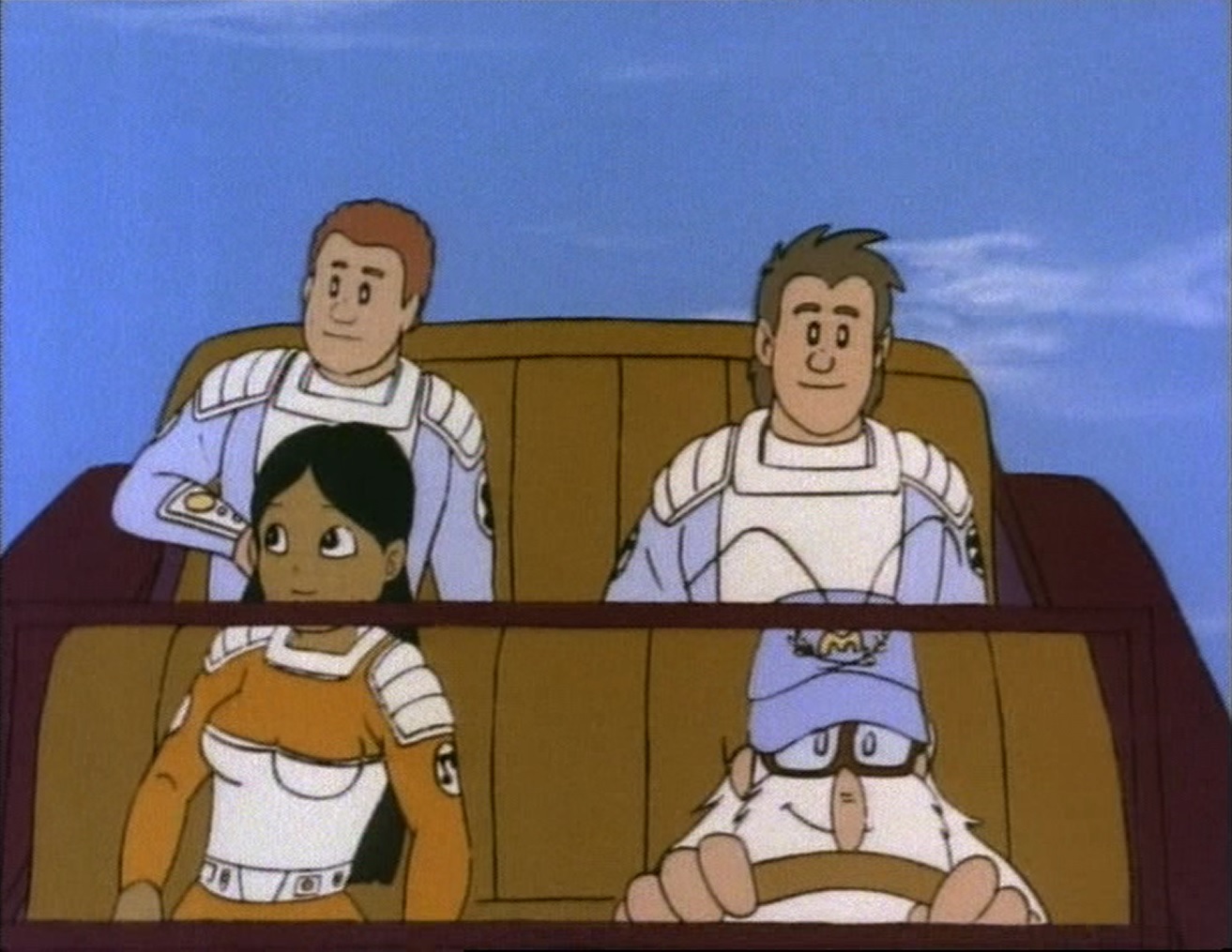 Because they have saved earth from an impending doom in ‘L’imparable menace‘, Pierrot, Psi and Petit Gros are allowed to go on holiday on earth, where they’re received as heroes.
On earth, Maestro’s ancestor (from ‘Le long voyage‘) is their guide, and he takes our heroes to the countryside. Here he tells our heroes the history of earth from the 21st century onward. Barillé’s vision of the earth’s future contains some rather somber views on genetics, war, informatics and the climate.
In the second half of this episode, the old Maestro takes Pierrot and Petit Gros into space, showing a solar ring, a cemetery of spaceships, and even an amusement park called ‘Barillé’s Land’.
Because of its holiday theme, this short moves at a leisurely speed, and it is rather boring compared to the two episodes preceding it. However, even in this relaxed episode, there’s some conflict, when our heroes encounter a saboteur from Cassiopeia.
Inconsistent design have always tortured the Il était une fois… series. And in this episode, in certain scenes the drawings of our heroes are no less than terrible.
Watch ‘Terre!’ yourself and tell me what you think:
This is the 17th episode of ‘Il était une fois… l’espace’ (Once Upon a Time… Space)
To the 16th episode: L’imparable menace (The Unstoppable Menace)
To the 18th episode: L’Atlantide (Atlantis)
Director: Albert Barillé
Airing date: December 18?, 1982
Rating: ★★★
Review:
 This episode starts immediately where ‘La planète déchiquetée‘ has left off: the space vessel ‘Ursus’ has crashed on, luckily, an earth-like planet.
Unfortunately, its captain is ill, and our heroes have difficulties with the second in command, the skeptical and cowardly lieutenant Sanders. While Metro is used for all kinds of reparations, Pierrot and Psi go on two expeditions.
On the first they encounter strange lifeforms, like walking trees, spider-like aliens, green gorillas, and friendly little black people called Ptax. Like the lizards in ‘Les Sauriens‘, the Ptax are telepathic and they help our heroes against the green gorilla creatures.
On the second expedition, our heroes go searching for metal, but what they find is a military ship from Cassiopeia… Aware of the threat, Pierrot and Psi hurry back to the camp, only to learn the captain has died. Only when a riot breaks out between Pierrot and Sanders, Omega comes to the rescue.
The animation is painstakingly slow in this episode, and there’s more urge in the dialogue than in the action. Because of these shortcomings the episode is only half as captivating as it could have been.
Watch ‘Les naufragés de l’espace’ yourself and tell me what you think:
This is the 11th episode of ‘Il était une fois… l’espace’ (Once Upon a Time… Space)
To the 10th episode: La planète déchiquetée (A Planet Blown to Pieces)
To the 12th episode: Les géants (The Giants)
Director: Vladimir Tarasov
Release date: 1978
Rating: ★★★
Review:
 ‘Contact’ is a good-humored short film in which a pipe-smoking, nature-loving hippie encounters a multicolored alien, capable of morphing.
First the man flees in horror, but then the two make contact through music, and in the end we can see them walking into the distance, singing together.
This Soviet film is surprisingly Western-looking and is drawn in a bold seventies style. In contrast with Tarasov’s earlier ‘Forward March, Time!‘ any Soviet association is lacking, and there seems to be some vague message about freedom. Tarasov shows his directing skills and is not afraid to use bold angles and extreme perspectives. The short contains a typical cartoon chase, accompanied by lively jazz music.
In 1979 Tarasov returned with the graphical equally original, but much more propagandistic film ‘Shooting Range’, proving that he was one of the most interesting Russian animators of his generation.
Watch ‘Contact’ yourself and tell me what you think:


 Dr. Grob's Animation Review