
You are currently browsing the category archive for the ‘Aesop’s Fables’ category.
Directors: John Foster & Mannie Davis
Release Date: March 26, 1932
Rating: ★★
Review:
 In ‘The Cat’s Canary’ we watch a cat swallowing a bird. Surprisingly the bird remains alive, and makes the cat produce chirping sounds.
The cat goes to a doctor, to no avail, he then joins a quartet of alley cats serenading a kitten. He joins in chirping. But when he gets hit with a cage, the bird escapes. The bird takes revenge on the cat with help from some fellow birds, including a pelican.
After watching such ambitious films by Van Beuren as ‘The Family Shoe‘, ‘Toy Time‘ and ‘Fly Frolic‘, the Aesop Fable ‘The Cat’s Canary’ feels pretty backward. The designs of the cat are highly inconsistent and primitive, looking back to the Waffles and Don films from 1930. The complete short lacks the Silly Symphony-like quality of the preceding Aesop Fables. Moreover, it’s storytelling is weak and inconsistent: there’s a complete throwaway scene, in which the cat is visited by sympathizing birds, and although the cat is the main protagonist throughout the whole film, he suddenly changes into a villain in the end.
The final scene is clearly inspired by the finale of Disney’s ‘Birds of a Feather‘ (1931), and perhaps ‘The Bird Store‘ (1932), but it adds nothing of its own.
Watch ‘The Cat’s Canary’ yourself and tell me what you think:
‘The Cat’s Canary’ is available on the DVD ‘Aesop’s Fables – Cartoon Classics from the Van Beuren Studio’
Directors: John Foster & Harry Bailey
Release Date: March 5, 1932
Rating: ★★★★½
Review:
 ‘Fly Frolic’ quite shamelessly puts its inspiration from films like Fleischer’s ‘Wise Flies‘ (1930) and Disney’s ‘The Spider and the Fly‘ (1931), visiting exactly the same theme of the spider and the fly.
In Van Beuren’s version, two flies go to the ‘Coffee Pot Cabaret’ for a night out. At one point an old spider enters, scaring the flies to death. He goes into a Cab Calloway routine, singing the bandleader’s 1931 hit ‘Kickin’ The Gong Around’, Calloway’s second song about Minnie the Moocher. Interestingly, this film was released a week before Cab Calloway himself appeared in an animation film in Fleischer’s ‘Minnie the Moocher‘.
After some scatting the spider kidnaps the female fly and takes her to his secret laboratory. At this point the film suddenly changes into a parody of the 1931 horror film ‘Dr. Jekyll and Mr. Hyde’, with the spider changing into a handsome dandy. This doesn’t fool anyone, however, and the hero fly beats him, joined by his fellow flies.
‘Fly Frolic’ is a quite consistent film with a lot of melodrama. The designs are pretty primitive, however, and the spider changes completely from the nightclub scene to the laboratory scene, even before drinking his potion!
Watch ‘Fly Frolic’ yourself and tell me what you think:
‘Fly Frolic’ is available on the DVD ‘Aesop’s Fables – Cartoon Classics from the Van Beuren Studio’
Directors: John Foster & Harry Bailey
Release Date: January 27, 1932
Rating: ★★★½
Review:
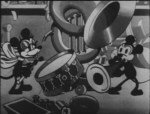 ‘Toy Time’ is another typical Silly Symphony-like short by Van Beuren, trying to beat Disney at his own game.
The cartoon features two mice, Oscar and his girlfriend, who resemble Mickey and Minnie less than Van Beuren’s ill-fated stars Milton and Rita had done (see e.g. ‘Circus Capers‘ and ‘The Office Boy‘).
In fact, the two are portrayed as real mice, having fun in the toy shop at night. This premise comes directly from the Silly Symphony ‘Midnight in a Toy Shop‘, but the Van Beuren studio adds some drama, when a cat appears, and the two mice battle him with help of several toys. Strangely enough the cartoon doesn’t end at that point, but also features a scene in which Oscar serenades his girlfriend on the piano. Only then he earns his sweetheart’s kiss.
Like ‘The Family Shoe‘ (1931), ‘Toy Time’ is highly ambitious. For example, it features a splendid score by Gene Rodemich, and elaborate and quite beautifully painted backgrounds. Unfortunately, the animation is still pretty awkward, and the designs of the two mice primitive and bland. Nevertheless, it shows that the Van Beuren Studio was trying very hard.
Four months later, Warner Bros. would cover similar grounds in ‘It’s Got Me Again!‘, but with much more satisfying results.
Watch ‘Toy Time’ yourself and tell me what you think:
‘Toy Time’ is available on the DVD ‘Aesop’s Fables – Cartoon Classics from the Van Beuren Studio’
Directors: John Foster & Mannie Davis
Release Date: September 14, 1931
Rating: ★★★★★
Review:
 By 1931, Van Beuren’s ‘Aesop’s Fables’ had become the studio’s answer to Walt Disney’s Silly Symphonies, being the first studio clearly trying to copy Disney’s format (Warner Bros’ Looney Tunes and Merrie Melodies were only variations on the Silly Symphonies in name, being very different otherwise).
Given the studio’s animation output up to 1931, ‘The Family Shoe’ is a remarkably consistent and forward-looking product. With its consistent storytelling ‘The Family Shoe’ actually predates Walt Disney’s breakthrough short ‘The Ugly Duckling‘ by three months.
Merging the nursery rhyme of the old woman who lived in a shoe with the fairy tale of Jack and the beanstalk, the film anticipates Mickey’s ‘Giantland’ (1933) by two years, and the cute and childish cartoons of the Hays code era by three years. Also, the opening scenes, with hundreds of brats running around and causing mischief predate similar scenes in Walt Disney’s ‘Mickey’s Orphans‘ (December 1931) and ‘Mickey Nightmare’ (1932).
The cartoon retells the story of Jack and the beanstalk quite faithfully, and the cartoon may be a little low on gags. Yet, there are some typical Van Beuren throwaways present, like the bean planting itself, and the ending, in which the golden eggs transform the old lady into a classy aristocrat overnight.
Van Beuren is often described as merely an also-run studio, but this short shows that at least in 1931 it was more ambitious and more capable than one would expect.
Watch ‘The Family Shoe’ yourself and tell me what you think:
‘The Family Shoe’ is available on the DVD ‘Aesop’s Fables – Cartoon Classics from the Van Beuren Studio’
Directors: Harry Bailey & John Foster
Release Date: July 6, 1930
Stars: Waffles and Don
Rating: ★★★
Review:
 ‘Jungle Jazz’ features that unsung duo, Waffles and Don, introduced three months earlier in ‘The Haunted Ship‘. This time we watch the tall cat and the small dog walking through a jungle.
In this cartoon the duo’s ‘personalities’ are well-established: Waffles is continually scared, while Don remains unimpressed. The film’s highlight is an early scene in which Waffles and Don encounter all kinds of bizarre, psychedelic animals. Waffles and Don hide from these in a cabin, where they find an organ, which Waffles starts to play immediately. This prompts the cartoon’s obligate dance routine, with all kinds of (normal African) animals dancing.
Then, suddenly, they’re surrounded by cannibals! Don even helps them lighting the fire under their cooking pot. But he also somehow manages to scare them away, and the last scene is for four animals forming a barbershop quartet.
‘Jungle Jazz’ is a loosely jointed and erratic short, and it’s a pity the animators didn’t elaborate on the psychedelic animals in the beginning of the cartoon.
Watch ‘Jungle Jazz’ yourself and tell me what you think:
‘Jungle Jazz’ is available on the DVDs ‘Uncensored Animation 2: Cannibals!’ and ‘The Complete Animated Adventures of Van Beuren Studio’s Tom and Jerry’
Directors: Harry Bailey & John Foster
Release Date: July 5, 1931
Rating: ★★★
Review:
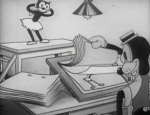 ‘Making ‘Em Move’ is a surprisingly original cartoon, being about animation itself. It’s astonishing that this early cartoon about its own industry comes from the Van Beuren studio, the least developed American animation studio in business those days.
The film is a strange mix of accuracy and nonsense. We watch a fat lady visiting an animated cartoon studio, where several animals are animating ridiculously fast and as if in an assembly line. Among the less accurate scenes are an animator animating a dancing cat who’s dancing right in front of him, and a humanized camera filming the flip-books animators are running in front of it. Meanwhile a jazz band is playing, whose sound is recorded directly on film.
In the second half of the film we watch a public cartoon screening: “Fable Animals present Little Nell’, a crude animation of a classic melodrama with stick figures, predating Tex Avery’s similar ‘Porky’s Preview’ by eleven years(!).
‘Making ’em Move’ is a remarkable cartoon, being about the cartoon industry itself, which remained a rare feat. Unfortunately, the film is neither very educational nor funny. It’s in fact rather directionless, making it to fall short as a classic.
Watch ‘Making ‘Em Move’ yourself and tell me what you think:
‘Making ‘Em Move’ is available on the DVD ‘Aesop’s Fables – Cartoon Classics from the Van Beuren Studio’
Directors: Harry Bailey & John Foster
Release Date: August 31, 1930
Stars: Waffles and Don
Rating: ★
Review:
 ‘Frozen Frolics’ is the third of four cartoons featuring the obscure duo Waffles & Don. In this short they are on their way to the North Pole to steal the pole, which looks like a barber’s pole.
After they lose their sled due to an obstinate rabbit, we suddenly cut to arctic animals dancing, much like Walt Disney’s ‘Arctic Antics‘ from two months earlier. Only after a while we return to the duo, whom we watch being exhausted, and trudging through a snow storm. When Don seems to be dead, Waffles steals his money, and eats his shoe. Luckily, Don is alive after all. But later Waffles doesn’t hesitate to throw his little friend to an angry bear. Don beats him up for that, with which the cartoons ends.
The animation in ‘Frozen Frolics’ is wildly uneven, and more often than not rather out of sync with the music.
Watch ‘Frozen Frolics’ yourself and tell me what you think:
‘Frozen Frolics’ is available on the DVD ‘The Complete Animated Adventures of Van Beuren Studio’s Tom and Jerry’
Directors: Harry Bailey & John Foster
Release Date: January 18, 1931
Stars: Rita Mouse?
Rating: ★★★★
Review:
 ‘Red Riding Hood’ is one of those early 1930s cartoons that have to be seen to be believed.
In this spoof of Red Riding Hood, the ill grandma is visited by a doctor. The doctor’s “jazz tonic’ makes grandma young and handsome, and the wolf starts to fancy her. He plays for her on the harmonium, while ‘grandma’ dances. However, when Red Riding Hood (a Minnie Mouse-copy, see also ‘Circus Capers‘ and ‘The Office Boy‘) enters, the wolf and grandma both flee in the wolf’s car to get married.
Red Riding Hood, meanwhile, warns the wolf’s wife and kids, who hurry to the wedding chapel. They tear the wolf away, leaving grandma crying.
There’s some nice animation on the wolf’s car, but otherwise the animation on this cartoon is wildly inconsistent. However, its story is so weird, it becomes enjoyable.
Watch ‘Red Riding Hood’ yourself and tell me what you think:
‘Red Riding Hood’ is available on the DVD ‘Uncensored Animation from the Van Beuren Studio’
Directors: Harry Bailey & John Foster
Release Date: November 23, 1930
Stars: Milton Mouse, Rita Mouse
Rating: ★★
Review:
 ‘The Office Boy’ is yet another Van Beuren cartoon featuring Milton Mouse and Rita Mouse, Van Beuren’s sloppy copies of Mickey and Minnie Mouse, indirectly showing the mouse’s enormous popularity.
This time Milton is an office boy, where Rita is a secretary. The story involves Milton getting jealous of Rita when the boss flirts with her. So Milton invites the boss’s wife to catch her husband red-handed. In the end we watch Milton and Rita jumping into a painting on a train to sing their end duet.
The designs and animation of Milton and Rita are terrible, but too close for comfort, and some of Mickey’s mannerisms have clearly been copied. As was the case in ‘Circus Capers‘, Milton and Rita are more vulgar than their Disney counterparts, despite the similar looks, and most of the fun of the cartoon lies in the rude behavior of these pseudo-Mickey and Minnie. The cartoon’s best gag, however, is when Rita starts typing frantically even when her boss hasn’t really dictated anything.
But Milton’s and Rita’s days were numbered. In 1931 Disney sued the Van Beuren company, and on April 30, 1931 the federal court prohibited the Van Beuren studio to display any of his Mickey Mouse-lookalikes. The Walt Disney company never asked for money, however. They simply wanted the plagiarism to stop.
Watch ‘The Office Boy’ yourself and tell me what you think:
‘The Office Boy’ is available on the DVD ‘Uncensored Animation from the Van Beuren Studio’
Directors: Harry Bailey & John Foster
Release Date: September 28, 1930
Stars: Milton Mouse, Rita Mouse
Rating: ★★★
Review:
 ‘Circus Capers’ features Milton Mouse and Rita Mouse, Van Beuren’s Mickey and Minnie-like mice, whose resemblance to Disney’s originals is so striking, it’s pure plagiarism.
The Van Beuren Studio comes nowhere near Walt Disney’s high quality standards, however, and ‘Circus Capers’ can be used as a good counter-example to show how good contemporary Mickey Mouse cartoons (e.g. ‘The Shindig‘, ‘The Chain Gang‘ and ‘The Gorilla Mystery‘) actually were.
In ‘Circus Capers’ Milton (pseudo-Mickey) is a clown, while Rita (pseudo-Minnie) is an acrobat riding a horse. An evil circus master shoots Milton away as a human cannonball, meanwhile courting an all too willing Rita. When Milton discovers this, he’s heartbroken, and sings “Laugh Clown Laugh” from the 1928 musical of the same name. However, when the circus master becomes too insistent, Rita flees from him, back to Milton, who gives her the raspberry, making her pass out.
‘Circus Capers’ is hampered by primitive, crude animation, unsteady designs, and odd staging. Its curious story is enjoyable, however, for the real Mickey and Minnie would never behave like Milton and Rita, who seem to be their cruder cousins.
Watch ‘Circus Capers’ yourself and tell me what you think:
‘Circus Capers’ is available on the DVD ‘Uncensored Animation from the Van Beuren Studio’
Directors: Mannie Davis & John Foster
Release Date: August 17, 1930
Rating: ★
Review:
 ‘Laundry Blues’ is one of those cartoons that’s very hard to watch today.
This short features some extreme stereotypes of Chinese people, in animal form, plus one caricature of a (human) Jew. The Jew has his beard washed and ironed, only to fall into the mud with it shortly afterwards.
Apart from the vicious stereotyping, the short suffers from a lack of direction: things are just happening on the screen. The backward racism, the total lack of plot, and the scarcity of gags make ‘Laundry Blues’ endless. It’s everything but a classic, indeed. And yet, the part of the four Chinese ironing was reused in its entirety in ‘Chinese Jinks‘ from 1932.
Watch ‘Laundry Blues’ yourself and tell me what you think:
‘Laundry Blues’ is available on the DVD ‘Uncensored Animation from the Van Beuren Studio’
Director: Harry Bailey
Release Date: December 1, 1929
Stars: Milton Mouse, Rita Mouse
Rating: ★
Review:
 ‘Close Call’ is one of Van Beuren’s earliest sound cartoons, and it shows. Its visual language is still from the silent era, including the use of words on the screen.
The short unashamedly features two clear ripoffs of Walt Disney’s Mickey and Minnie Mouse. We watch them frolicking in a field, when a large cat kidnaps “Minnie” and takes her to a sawmill. “Mickey” comes to the rescue, only to be tied up by the cat to a sawmill, in a classic scene. As luckily as incomprehensibly the North West Mounted Police rides off to rescue the loving couple. They kill the cat (!), and the two mice are married.
The animation on ‘Close Call’ is terribly primitive, and there’s a lot of squeaking, but apart from the final “I do”‘s, there’s no dialogue. Moreover, there’s more drama to the short than humor, making it a tiring watch. The Mickey and Minnie Mouse characters (which off-screen apparently were christened Milton and Rita) would return in several of Van Beuren’s ‘Aesop’s Fables’ cartoons, e.g. ‘Circus Capers‘ and ‘The Office Boy‘ from 1930.
Watch ‘Close Call’ yourself and tell me what you think:
‘Close Call’ is available on the DVD ‘Uncensored Animation from the Van Beuren Studio’
Directors: Mannie Davis & John Foster
Release Date: November 9, 1930
Stars: Waffles and Don
Rating: ★★
Review:
 ‘Gypped in Egypt’ is a cartoon set in Egypt. It predates Disney’s ‘Egyptian Melodies‘, which covers similar grounds, by nine months.
This cartoon was the last of four to feature Waffles and Don. The duo had finally reached distinct personalities in this short: Waffles, the tall cat, is constantly afraid, while Don, the small dog, keeps calm and unimpressed.
In the opening shot we watch the duo traveling through the desert on a camel. When the camel dies, a nightmarish scene starts, featuring a sphinx, pyramids and more camels. This brings our heroes inside an Egyptian tomb, where they encounter dancing skeletons and hieroglyphs. Suddenly, there are skeletons everywhere, and Don plays the piano with one of them. The cartoon ends abruptly with Waffles and Don running from a giant hypnotizing sphinx face.
‘Gypped in Egypt’ features several elements that were reused in Disney’s ‘Egyptian Melodies’: dancing hieroglyphs, nightmarish scenes, and even a corridor scene. However, Van Beuren’s cartoon is much cruder and more disjointed than Disney’s latter cartoon. Its greatest feature is it hallucinating character. Unfortunately, it is not retained throughout the picture, and the whole cartoon suffers from all too sloppy storytelling and ditto timing.
Watch ‘Gypped in Egypt’ yourself and tell me what you think:
‘Gypped in Egypt’ is available on the DVD ‘Aesop’s Fables – Cartoon Classics from the Van Beuren Studio’
Director: John Foster
Release Date: August 3, 1930
Stars: Milton Mouse, Rita Mouse, Waffles
Rating: ★
Review:
 In 1930 practically all American cartoon studios looked at Walt Disney to guide them through the fledgling sound era (the notable exception being Max Fleischer, who went entirely his own path).
None went so far as the Van Beuren studio, which already in 1929 introduced a couple of mice with an all too obvious resemblance to Mickey and Minnie Mouse. Van Beuren’s mice were called Milton and Rita, but I’ve no evidence the studio ever advertized their names on the screen. Why should it? All resemblance to the real Mickey and Minnie clearly was only beneficial to the studio’s output.
‘Hot Tamale’ is one of these films featuring these blatant Mickey and Minnie lookalikes. This time Milton is in Mexico, riding a mechanical horse (why?) to serenade his sweetheart. Rita dances to his music.
There’s still some acting that clearly stems from the silent era, but more disturbingly: Milton looks rather horny and seems more driven by lust than by love. At one point Waffles (who is Pete only but in name) arrives, also craving Rita. Of course, it’s our “hero” who wins her in the end.
In ‘Hot Tamale’ Van Beuren’s pseudo-Mickey and Minnie were nothing like the real thing. But it would become worse. In ‘Circus Capers‘ and ‘The Office Boy‘ both the resemblance and the abject behavior of these Mickey & Minnie-lookalikes was even more striking. It was a question of time before Walt Disney came into action…
Watch ‘Hot Tamale’ yourself and tell me what you think:
‘Hot Tamale’ is available on the DVD ‘Aesop’s Fables – Cartoon Classics from the Van Beuren Studio’
Directors: Mannie Davis & John Foster
Release Date: June 22, 1930
Rating: ★★★
Review:
 ‘A Romeo Robin’ is a rather disjointed Silly Symphony-like cartoon, predating Disney’s Silly Symphony ‘Birds of a Feather’ (1931) by half a year.
Like the latter cartoon, its subject is birds. The short opens with birds whistling, and one yodeling. Then we cut to two birds dancing, while metamorphosing to their deaths in a bizarre scene that should be seen to be believed.
After this mind-blowing scene we’re introduced to an evil one-eyed cat who’s after the birds, and later to a bird who catches a worm to offer to his girlfriend. Together they go for a trip in a plane. When the plane falls down, the evil cat accidentally swallows the plane instead of its inhabitants.
‘A Romeo Robin’ looks like a crude parody of a Silly Symphony. It’s remarkable that at one point some story sets in, even if that remains rather pointless. But then again, around this time even the Silly Symphonies themselves made little sense.
Watch ‘A Romeo Robin’ yourself and tell me what you think:
‘A Romeo Robin’ is available on the DVD ‘Aesop’s Fables – Cartoon Classics from the Van Beuren Studio’
Directors: Mannie Davis & John Foster
Release Date: May 25, 1930
Rating: ★★★
Review:
 This short starts with a scene in which we watch Noah, who is dressed like a sailor, dancing to music a chimp plays on an elephant’s toes.
When Noah’s corns warn him rain is coming, all animals flee into his ark, including a dinosaur. Only the skunks are placed in a separate little boat (a gag more or less repeated in Disney’s ‘Father Noah’s Ark‘ from 1933). On the ship itself it’s suddenly dry and the animals start a very, very Silly Symphony-like dance routine, with dancing storks, monkeys, elephants, hippos, etc. Then they all sing ‘It ain’t gonna rain no mo”. But when the skunks enter the ark, all animals abandon ship. Iris out.
Like ‘The Haunted Ship‘, ‘Noah Knew His Ark’ shows a huge Disney influence. The cartoon is a Silly Symphony but in a name. In this stage Disney’s own cartoons were not really sophisticated themselves, and the Van Beuren Studio at times reaches the same level of animation. However, they bring little of their own, and ‘Noah Knew His Ark’ can hardly be called a classic.
Watch ‘Noah Knew His Ark’ yourself and tell me what you think:
‘Noah Knew His Ark’ is available on the DVD ‘Aesop’s Fables – Cartoon Classics from the Van Beuren Studio’
Director: Mannie Davis & John Foster
Release Date: April 27, 1930
Stars: Waffles and Don
Rating: ★★★½
Review:
 When the Van Beuren studio lost their main character, Farmer Al Falfa to Paul Terry, they had to come up with new stars. Their first attempt was the animal duo Waffles and Don, a tall cat and a small dog who are the precursors of Van Beuren’s Tom and Jerry.
In their first film we watch them flying a plane before lightning strikes them down deep into the ocean. Here they meet an opera-singing walrus (probably inspired by Walt Disney’s ‘Wild Waves‘ (1929), which also features one). Then they enter the shipwreck ‘Davy Jones’, which is full of monsters swooping into the camera, and a skeleton. The skeleton orders Waffles and Don to play the piano and xylophone, which starts the song-and-dance-routine-part of this cartoon.
Most interesting are four drunken tortoises singing ‘Sweet Adeline’ (probably inspired by ‘The Karnival Kid‘ (1929) in which two cats sing exactly the same song). The dance routine ends when Davy Jones himself appears and chases Waffles and Don away. However, the last shot is for the singing turtles.
‘The Haunted Ship’ clearly shows Walt Disney’s influence on other studios. It’s obvious that The Van Beuren studio tried its best to copy Walt Disney’s formulas and standards. Indeed, the cartoon is a great improvement on ‘The Iron Man‘ from three months earlier. There’s song and there’s dance, and music and animation now are closely intertwined. The Van Beuren studio would never reach Walt Disney’s sophistication, but in these early years they were at least able to come somewhere near.
Waffles and Don’s career, however, proved to be short-lived. They only starred in three other 1930 cartoons: ‘Jungle Jazz‘, ‘Frozen Frolics‘ and ‘Gypped in Egypt‘.
Watch ‘The Haunted Ship’ yourself and tell me what you think:
‘The Haunted Ship’ is available on the DVDs ‘Aesop’s Fables – Cartoon Classics from the Van Beuren Studio’ and ‘The Complete Animated Adventures of Van Beuren Studio’s Tom and Jerry’
Director: John Foster
Release Date: January 4, 1930
Stars: Farmer Al Falfa
Rating: ★★½
Review:
 ‘The Iron Man’ was one of the last of Van Beuren’s Aesop’s Fables to feature Farmer Al Falfa, before Paul Terry claimed this character to be his own.
It takes some time for we watch the title’s iron man itself. First we watch a cat with a hurdy-gurdy, then two fighting roosters with ridiculously large feet, and then some remarkable animation of a large tree falling down. This part is essentially silent, with music seemingly added.
Then Farmer Al Falfa receives a package with the iron man in it. Together they perform a bizarre slow dance, to psychedelic effects. It’s clear the Van Beuren studio was still struggling with rhythmical movement, for in this sequence both Al Falfa and the robot seem to float in air. There’s no weight or gravity involved, at all.
Then, when Farmer Al Falfa kicks the robot, it grows millions of miles tall, towering over the earth, before it explodes. This is a mindblowing piece of animated weirdness. However, the pieces fall together to form the robot again, which chases our hero into the distance. Iris out.
‘The Iron Man’ is in no sense a classic film, but it shows the difficulties of the sound age for the silent era studios. The second part also shows some embryonic weirdness that would become staple for the Van Beuren studio films of the early 1930s. Finally, ‘The Iron Man’ is one of the very first cartoons to feature a human-like robot. Other studios would follow years later, like Walter Lantz’s ‘Mechanical Man’ (1932), Max Fleischer’s ‘The Robot‘ (1932) and Walt Disney’s ‘Mickey’s Mechanical Man‘ (1933).
Watch ‘The Iron Man’ yourself and tell me what you think:
‘The Iron Man’ is available on the DVD ‘Aesop’s Fables – Cartoon Classics from the Van Beuren Studio’
Director: John Foster
Release Date: October 11, 1929
Stars: Farmer Al Falfa
Rating: ★
Review:
 Of all American animation studios from the 1930s the Van Beuren Studio must be the least known.
This is no small wonder, for it was not only short-lived, lasting nine years, it was also the weakest studio of the lot, never reaching the heights of Max Fleischer or Walt Disney, and with only a few great cartoons in its entire catalog.
Thanks to Steve Stanchfield and his Thunderbean company, however, quite a sample of this studio’s output has been made available on DVD, so everybody can enjoy them (and incidentally making the Columbia/Screen Gem studio the least known studio – as its films remain utterly unavailable).
Before 1928 Van Beuren’s cartoons were made by Paul Terry, but in November 1928 the success of Disney’s ‘Steamboat Willie‘ prompted Amadee J. Van Beuren to announce that his studio would make the switch to sound, too. This led to a clash with Terry, who left mid-1929, leaving most of the staff and the studio’s main character, the bland Farmer Al Falfa, until Paul Terry reclaimed him in 1930.
The Van Beuren studio was more or less forced into the area of sound, and its crew totally unprepared, lacking experience. Indeed, ‘Summer Time’, Van Beuren’s 16th sound cartoon, is a strange blend of silent film and sound film: words and sound expressions are still visible on the screen, and while there’s music, there’s no rhythmical movement. Moreover, both design and animation are still firmly rooted in the 1920’s and there’s practically no plot, only three unrelated scenes.
The most interesting aspect of this film is Gene Rodemich’s music score, which still sounds fresh. In fact, Rodemich’s scores turned out to be the only constant quality within Van Beuren’s output, being among the best of all 1930s cartoon scores.
The three scenes of ‘Summer Time’ are 1) a frog and a monkey playing some music, waking up an angry owl. 2) A mouse playing in a fat woman’s shadow, attracting other mice, and scaring the woman away, and 3) Farmer Al Falfa being hot and making himself a drink. This story contains a weird scene in which the sun zooms into the camera to visit farmer Al Falfa at his own doorstep. This is the only interesting piece of animation in the entire film.
The cartoon ends with a moral, like many Aesop’s Fable cartoons before it. However, this practice was soon abandoned in 1930.
Watch ‘Summer Time’ yourself and tell me what you think:
‘Summer Time’ is available on the DVD ‘Aesop’s Fables – Cartoon Classics from the Van Beuren Studio’


 Dr. Grob's Animation Review