You are currently browsing the category archive for the ‘Walt Disney films’ category.
Director: Jack Kinney
Release Date: October 9, 1942
Stars: Goofy
Rating: ★★★½
Review:
 ‘The Olympic Champ’ is Goofy’s fourth sports cartoon. Here, Goofy demonstrates the athletic sports of the Olympics: running, hurdles, pole vault jumping, hammer drawing and the decathlon.
Goofy has particular problems with the narrator in this short: he’s almost burned by the eternal flame while the narrator pompously chatters away, and he has to try to balance on a pole, while the narrator is reciting a poem.
‘The Olympic Champ’ is not the best of Goofy’s sports cartoons, but it is enjoyable in its successful blend of blackout gags and great animation.
Watch ‘The Olympic Champ’ yourself and tell me what you think:
This is Goofy cartoon No. 7
To the previous Goofy cartoon: How to Play Baseball
To the next Goofy cartoon: How to Swim
Director: Jack Kinney
Release Date: September 4, 1942
Stars: Goofy
Rating: ★★★
Review:
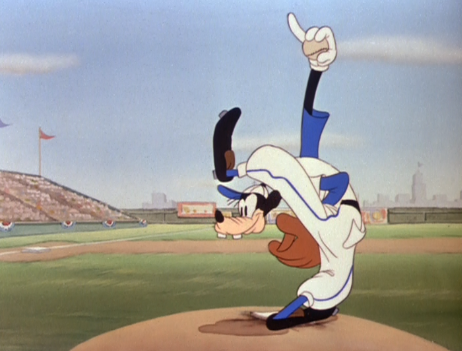 ‘How to Play Baseball’ is the third of Goofy’s sport cartoons, and the first with a title beginning with ‘How to’ (following the ‘How to Ride a Horse’ sequence in ‘The Reluctant Dragon‘ (1941).
The short forms the next and final step in Goofy’s evolution after the duplication of Goofies in the previous cartoon, ‘The Art of Self Defense‘: now multiple Goofies are together the stars of the cartoon. The character remains unique in the cartoon canon in this ability to duplicate himself and remain Goofy throughout, nonetheless.
The short has a highly entertaining way to explain baseball, ending with an exciting finale of the World championship. The gags come fast and plenty, depicting a lot of nonsense. Nevertheless, the cartoon is not only funny, it’s also surprisingly educational.
In the years following ‘How to Play Baseball’ baseball would return to the animated screen in the Woody Woodpecker cartoon ‘The Screwball’ (1943) and in the Bugs Bunny cartoon ‘Baseball Bugs‘ (1944).
Watch ‘How To Play Baseball’ yourself and tell me what you think:
This is Goofy cartoon No. 6
To the previous Goofy cartoon: The Art of Self Defence
To the next Goofy cartoon: The Olympic Champ
Director: Dick Lundy
Release Date: January 29, 1943
Stars: Donald Duck
Rating: ★★★★★
Review:
 In the vibrant opening scene of ‘Donald’s Tire Trouble’ we watch Donald zooming with his car through the mountains with an incredible speed. Then he suddenly gets a flat tire.
In trying to fix it, practically everything goes wrong that can go wrong: Donald has trouble with the jack, the tire patch, the tire itself, and the wheel. Miraculously, he finally manages to fix the one, but then all his tires go flat…
‘Donald’s Tire Trouble’ is without doubt one of the best Donald Duck shorts dealing with Donald’s struggle with inanimate objects, and arguably Dick Lundy’s best Donald Duck cartoon. Instead of milking one gag, like he did in ‘The Village Smithy‘ and ‘Donald’s Garden‘ from 1942, he continuously proceeds from one gag to another, which leads to an impressive string of gags unseen in his earlier cartoons. Moreover, most car drivers will relate to Donald’s frustrations, which will be way more familiar than his problems in the earlier cartoons. The result is an exuberant short, more fit to the World War II era.
Watch ‘Donald’s Tire Trouble’ yourself and tell me what you think:
This is Donald Duck cartoon No. 39
To the previous Donald Duck cartoon: Der Fuehrer’s Face
To the next Donald Duck cartoon: Flying Jalopy
Director: Jack King
Release Date: December 18, 1942
Stars: Donald Duck, Pete
Rating: ★★★★½
Review:
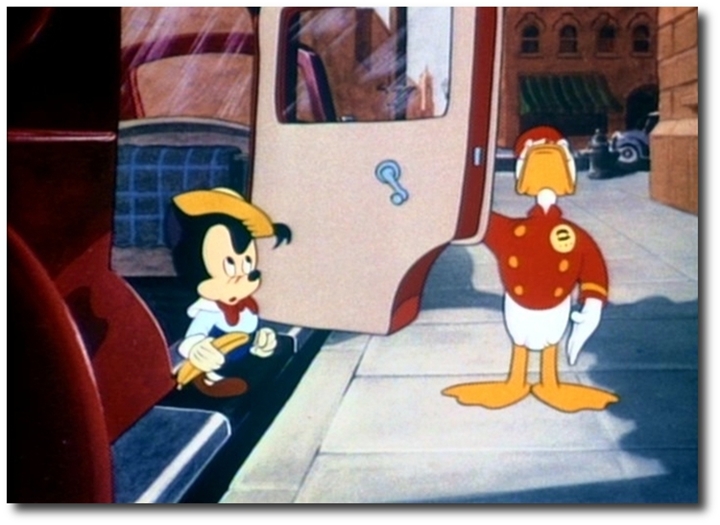 Donald is a bellboy at a chic hotel. He’s hindered in doing his job by Pete’s mischievous son (yes, Pete has got a son in this cartoon).
Pete manages to stay calm, but not Donald. In the end, Donald is fired, but he gets his chance to spank the wicked brat.
‘Bellboy Donald’, penned by Duckmen Carl Barks and Jack Hannah, is one of the better Donald Duck cartoon of the early forties. You won’t find any better interplay between Donald and Pete, with the exception maybe of ‘Trombone Trouble’ (1944).
Moreover, the cartoon contains some remarkably flexible animation of a type rarely seen in a Disney cartoon.
Watch ‘Bellboy Donald’ yourself and tell me what you think:
This is Donald Duck cartoon No. 37
To the previous Donald Duck cartoon: Sky Trooper
To the next Donald Duck cartoon: Der Fuehrer’s Face
Director: Dick Lundy
Release Date: July 12, 1942
Stars: Donald Duck
Rating: ★★
Review:
 In ‘Donald’s Garden’ Donald is a gardener, wearing a straw hat. We watch him having trouble with a water pump and with a gopher, which eats all his vegetables.
‘Donald’s Garden’ is a slow and boring cartoon. It’s hampered by particularly uninspired backgrounds, and it is one of the weaker entries in the Donald Duck series.
It has the same structure as ‘The Village Smithy‘ from earlier that year: it consists of only two situation gags: one with an inanimate object (the pump), and one with an animal (the gopher). Apparently, director Dick Lundy favored these types of gags, for they returned in ‘Donald’s Goldmine’, and in ‘Donald’s Tire Trouble‘, Lundy’s only successful cartoon in terms of situation comedy.
‘Donald’s Garden’ is the first Disney cartoon trying to be funny with gophers. But like the later Pluto shorts ‘Bone Bandit‘ (1948) and ‘Pluto and the Gopher‘ (1950), the studio doesn’t succeed. One may wonder whether gophers are funny, at all.
Watch ‘Donald’s Garden’ yourself and tell me what you think:
This is Donald Duck cartoon No. 33
To the previous Donald Duck cartoon: Donald Gets Drafted
To the next Donald Duck cartoon: Donald’s Gold Mine
Director: Jack King
Release Date: April 10, 1942
Stars: Donald Duck, Huey, Dewey and Louie
Rating: ★★★½
Review:
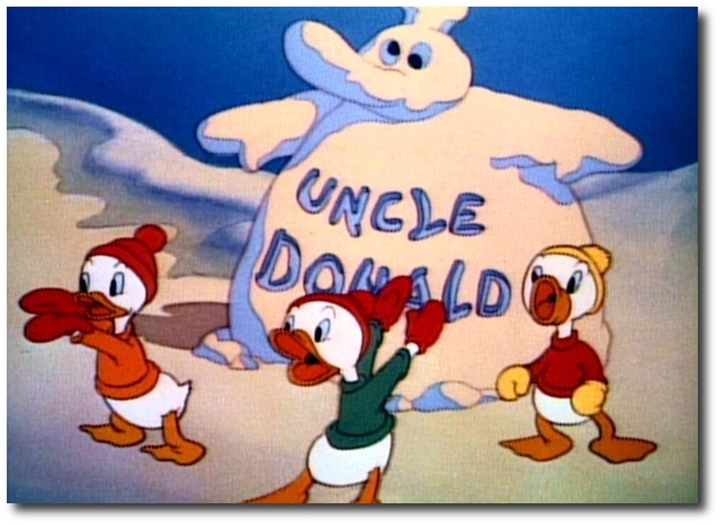 The world is covered in snow, and Donald goes for a sled ride, wearing a ridiculously broad fur overcoat.
He purposely ruins Huey, Dewey and Louie’s snowman by sledding right through it. They seek revenge and build a snowman resembling Donald around a rock. This feud leads to a snow-fight between admiral Donald on a battle ship made out of ice and his three nephews on an ice fort.
‘Donald’s Snow Fight’ is a classic Donald vs. his nephews cartoon, but the complete film is quite slow, due to Jack King’s tame directing. Despite some excellent gags, it doesn’t live up to ‘The Hockey Champ‘ (1939), the other classic winter cartoon featuring Donald and his nephews, or ‘Truant Officer Donald‘ (1941), which also features a battle between Donald and his nephews.
The short’s excellent story is by Carl Barks, who reused its theme two years later in his Donald Duck comic WDC 44-442.
Watch ‘Donald’s Snow Fight’ yourself and tell me what you think:
This is Donald Duck cartoon No. 31
To the previous Donald Duck cartoon: The Village Smithy
To the next Donald Duck cartoon: Donald Gets Drafted
Director: Dick Lundy
Release Date: January 16, 1942
Stars: Donald Duck
Rating: ★
Review:
 In ‘The Village Smithy’ Donald is a blacksmith who has to fix a large cartwheel and to shoe a stubborn female donkey. He succeeds in neither in this remarkably unfunny cartoon, which is one of the weakest within the whole Donald Duck series.
Long situation gags became a common feature of Disney shorts during the rise of the character comedy, in cartoons like ‘Mickey Plays Papa‘ (1934) and ‘Moving Day‘ (1936). Arguably, this time of comedy reaches its nadir in ‘The Village Smithy’. In it only two situations are milked to the length of the complete cartoon, with tiresome results. The wheel scene is the most interesting of the two, if still far from funny, and tributary to the spiral spring scene in ‘Clock Cleaners’ (1937).
The most interesting feature of this otherwise boring cartoon are its backgrounds, which belong to the first oil backgrounds in a Disney short, and which give the film a distinct, gloomy look. Donald, too, has a unique yellowish tan throughout this picture, setting the cartoon apart from all other Donald Duck shorts.
Watch ‘The Village Smithy’ yourself and tell me what you think:
This is Donald Duck cartoon No. 30
To the previous Donald Duck cartoon: Chef Donald
To the next Donald Duck cartoon: Donald’s Snow Fight
Director: Jack King
Release Date: July 30, 1942
Stars: Minnie Mouse, Pluto
Rating: ★★★
Review:
 ‘Out of the Frying Pan into the Firing Line’ is a short propaganda film aimed at American housewives.
In this propaganda short, Minnie is just about to give Pluto some hot bacon grease, when the narrator interrupts, telling housewives of America to save their kitchen fats in order to deliver them at a “neighborhood meat dealer, who is patriotically cooperating”. The fats are apparently used to make glycerine, which is used in ammunition.
This short contains a rare picture of Mickey as a soldier at the front. Otherwise, Mickey was left out of the propaganda, leaving that role to Donald Duck.
‘Out of the Frying Pan into the Firing Line’ is an interesting example of how the American government tried to make every citizen help in the war effort. It shows how World War II entered the life of the average citizen: even kitchen grease could be useful… It offers no one-liner, however, at the likes of the contemporary slogans ‘Save Your Scraps to Bomb the Japs’ or ‘Is Your Trip Really Necessary?”
Watch ‘Out of the Frying Pan into the Firing Line’ yourself and tell me what you think:
Director: Ben Sharpsteen
Release Date: July 21, 1942
Stars: The Three Little Pigs (in a cameo)
Rating: ★★★★
Review:
 Arguably the most ridiculous of all war time propaganda cartoons, ‘Food Will Win the War’ tells us about the successes of American agriculture.
A bombastic narrator makes all kinds of outrageous comparisons to illustrate the farmer’s huge production. Examples are baking all fruits of America into one big pie or frying all America’s meat on four Vesuvius volcanoes. The result is so absurd and its message so out to lunch that the short is actually great fun to watch.
Throughout the cartoon the animation is very limited, almost absent. The limited animation gives the short a poster-like quality. Full animation is limited to four short sequences:
1) a bowling ball bowling down skittles which resemble Hitler, Mussolini and a Japanese general
2) a giant pie thrown at the earth
3) Chickens laying eggs
4) The three little pigs leading an army of pigs.
‘Food Will Win the War’ was the last animated short directed by Ben Sharpsteen. In the 1940s he had moved more and more towards production. He would supervise the production of a.o. ‘Fun and Fancy Free‘ (1947), ‘Cinderella‘ (1950) and ‘Alice in Wonderland‘ (1951) before moving to live action, working on Disney’s True-Life Adventures (1948-1960). He retired in 1962.
Watch ‘Food Will Win the War’ yourself and tell me what you think:
Director: Jack King
Release Date: November 6, 1942
Stars: Donald Duck, Pete
Rating: ★★★½
Review:
 Sky Trooper’ is the third of six shorts dealing with Donald in the army.
The cartoon starts where ‘Donald Gets Drafted‘ ended: with Donald peeling potatoes. And like in the former cartoon Donald Duck wants to fly.
Sergeant Pete gives him a chance, letting him do some ridiculous test and sending him up to be a paratrooper. Unfortunately, Donald doesn’t want to jump and clings to Sergeant Pete. They both end up falling without a parachute but with a huge bomb in their hands. Surprisingly, they survive the fall, because in the end-shot we can see them both peeling potatoes.
‘Sky Trooper’ is surprisingly similar to the Woody Woodpecker cartoon ‘Ace in the Hole’ from five months earlier. However, the cartoon is an improvement on the former two Donald Duck army cartoons. The next ones would even be better…
Watch ‘Sky Trooper’ yourself and tell me what you think:
This is Donald Duck cartoon No. 36
To the previous Donald Duck cartoon: The Vanishing Private
To the next Donald Duck cartoon: Bellboy Donald
Director: Jack King
Release Date: September 25, 1942
Stars: Donald Duck, Pete
Rating: ★★½
Review:
 ‘The Vanishing Private’ is the second of the Donald in the army cartoons. Like the first, ‘Donald Gets Drafted‘ from four months earlier, it features Pete as Donald’s adversary.
In the opening shot we watch Donald singing the theme song from ‘Donald Gets Drafted’ and painting a huge canon in ridiculously bright colors. Sergeant Pete tells him to make the canon hard to see. Donald does so by using invisible paint from an experimental laboratory. He accidentally falls into the bucket of paint himself, making himself invisible and driving Sergeant Pete mad.
‘The Vanishing Private’ suffers because of two reasons:
1) the invisibility makes Donald all too powerful. It’s therefore hard to sympathize with him, and not with poor Pete. This is a problem shared by other invisibility cartoons, like the Tom & Jerry cartoon ‘The Invisible Mouse‘ (1947).
2) The other Donald army cartoons are all about the pains and annoyances of normal army life, which is absolutely part of their fun. But the subject of ‘The Vanishing Pirate’ is so unlikely, one can hardly relate to it.
The result is not a funny cartoon, making ‘The Vanishing Private’ arguably the weakest of Donald’s army cartoons.
Watch ‘The Vanishing Private’ yourself and tell me what you think:
This is Donald Duck cartoon No. 35
To the previous Donald Duck cartoon: Donald’s Goldmine
To the next Donald Duck cartoon: Sky Trooper
Director: Jack King
Release Date: May 1, 1942
Stars: Donald Duck, Pete
Rating: ★★½
Review:
 The attack on Pearl Harbor, December 7, 1941, suddenly smacked The United States into war. The war changed the life of many American citizens, including cartoon stars.
Donald Duck was the fourth of these to support the war effort on the big screen, following Porky Pig, Barney Bear and Popeye, who had joined the army and navy, respectively, in July (‘Meet John Doughboy‘) and November 1941 (‘The Rookie Bear, ‘The Mighty Navy‘). Moreover, Popeye had already engaged the enemy in February in ‘Blunder Below‘. Donald was soon followed by Pluto (May 22), and Woody Woodpecker (June).
In ‘Donald Gets Drafted’, Donald enthusiastically signs up for the army, because he wants to fly, especially after seeing posters of very attractive air hostesses in uniform. His rather naive enthusiasm soon is lowered, when he first has to go through a rather rude medical examination only to end up in the infantry, where he’s bullied by sergeant Pete. Donald doesn’t make a very good soldier, much to Pete’s frustration, and ends up peeling potatoes.
‘Donald Gets Drafted’ is the first of six Donald Duck cartoons devoted to Donald’s career in the army. It introduces Pete as Donald’s sergeant, a role he would fulfill in three other of these war cartoons. The Donald Duck army cartoons are noteworthy for their ambiguous propaganda. Donald is far from a model soldier, and the cartoons makes quite some fun of the army superiors, in the form of Pete. It’s difficult to see them as army advertisements. Moreover, five of the six cartoons are devoted to Donald’s timid life at the training camp. Only in his last war cartoon, ‘Commando Duck’ (1944) would Donald leave American soil to kill some enemies.
With its humor being still quite mild, ‘Donald Gets Drafted’ is not the funniest of Donald’s army cartoons. It is noteworthy, however, for revealing that Donald Duck’s second name is Fauntleroy.
Watch ‘Donald Gets Drafted’ yourself and tell me what you think:
This is Donald Duck cartoon No. 32
To the previous Donald Duck cartoon: Donald’s Snow Fight
To the next Donald Duck cartoon: Donald’s Garden
Director: Clyde Geronimi
Release Date: February 19, 1943
Stars: Mickey Mouse, Pluto
Rating: ★★★★½
Review:
 ‘Pluto and the Armadillo’ is one of the South American films Disney released in the forties after a visit to South America in 1941 (other examples are ‘The Pelican and the Snipe‘ and ‘Contrary Condor’ from 1944).
‘Pluto and the Armadillo’ is actually an outtake from Disney’s first South American ensemble feature ‘Saludos Amigos‘ (1942). This explains its use of a narrator introducing the armadillo and its Brazilian setting.
As the title suggests, this Mickey Mouse cartoon is actually devoted to Pluto. While playing with Mickey during a stop at an airport near a jungle, he mistakes the armadillo for his own ball. As in many other Pluto cartoons (e.g. ‘Pluto’s Playmate‘ from 1941 and ‘Canine Patrol‘ from 1945), Pluto is first suspicious of this new little animal, but then grows in love with it. This standard scenario would have led to a routine Pluto entry, if it were not for the armadillo itself.
The South American mammal is not drawn very lifelike, but looks like a very cute, feminine armed little dog. Her moves are accompanied by metallic and rattling sounds, as if her armor consists of loose mechanical parts, and she walks to an irresistible samba tune, which provides the theme music for the complete cartoon.
Because of her charming presence ‘Pluto and the armadillo’ is very cute and joyful, and a delight to watch, even though it’s not very funny.
Watch ‘Pluto and the Armadillo’ yourself and tell me what you think:
This is Mickey Mouse cartoon No. 117
To the previous Mickey Mouse cartoon: Symphony Hour
To the next Mickey Mouse cartoon: Squatter’s Rights
Director: Clyde Geronimi
Release Date: March 28, 1941
Stars: Mickey Mouse, Pluto
Rating: ★★★★
Review:
 Pluto serves Mickey breakfast on bed, then Mickey gives him a dime to get the morning paper.
Pluto loses the coin almost immediately down into a sewer, but he cleverly retrieves it using chewing gum. When Pluto gets the newspaper, he reads the funnies (a comic strip about… Pluto! – a rare cross reference to a Disney spin-off outside the cinema), before the wind starts to play with it, blowing the paper into the mud, leading to a blackface gag, which is a copy from the Pluto comic he has just read.
‘A Gentleman’s Gentleman’ is officially a Mickey Mouse cartoon, but most of the time is devoted to Pluto. In this cartoon his supreme silent character comedy is simply delightful, making ‘A Gentleman’s Gentleman’ one of the classic Pluto shorts.
Watch ‘A Gentleman’s Gentleman’ yourself and tell me what you think:
This is Mickey Mouse cartoon No. 110
To the previous Mickey Mouse cartoon: The Little Whirlwind
To the next Mickey Mouse cartoon: Canine Caddy
Director: Charles Nichols
Release Date: June 23, 1944
Stars: Pluto
Rating: ★★★★
Review:
 An updated version of Pan from ‘Fantasia’ (1940), now wearing a boiler hat, creates spring.
Pluto enjoys it for a while, e.g. discovering a caterpillar who transforms into a very sexy butterfly. The butterfly is designed as a miniature pin-up girl, who dances to a conga beat. After this encounter, Pluto juggles with a wasps’ nest, angering the wasps who sting him in the form of a Lockheed Lightning and a V2 rocket. These two sequences make ‘Springtime for Pluto’ a typical war era cartoon, even though it’s not about war, at all.
After Pluto gets stung, he’s caught in the rain, and even in a hailstorm. In the end he’s not enjoying spring anymore, and angrily he chases Pan into the distance.
‘Springtime for Pluto’ is the first cartoon directed by Charles Nichols, who would direct all Pluto and Mickey cartoons (save one) from now on until their retirement in 1953. Nichols is famous for his mild-mannered humor, but his debut consists of very enjoyable utter nonsense from the beginning to the end. It’s full of the exuberant spirit of the war time era.
Even the oil backgrounds, painted by Lenard Kester (1917-1997), have more vivid colors than before. These are flatter than in most Disney films, and during the butterfly sequence one can even see the paper texture. They form an early example of a more graphic style of backgrounds within a Disney film, and look forward to the fifties. Perhaps Kester had been inspired by similar experiments by Chuck Jones’ unit at Warner Brothers (e.g. ‘The Dover Boys‘ from 1942). In any case, the result contributes to the surreal atmosphere of the film.
Kester has been credited for backgrounds of only one other Disney cartoon, ‘How To Play Football’ from a few months later. In this short the backgrounds are effective, but unremarkable. Had he been toned down by the studio? Fact is that Kester soon moved on to devote his life to oil painting…
Watch ‘Springtime for Pluto’ yourself and tell me what you think:
This is Pluto cartoon No. 11
To the previous Pluto cartoon: Private Pluto
To the next Pluto cartoon: First Aiders
Director: Clyde Geronimi
Release Date: April 2, 1943
Stars: Pluto, Chip ‘n Dale
Rating: ★★★★
Review:

Pluto has joined the army, and wearing a helmet, he has to protect “the pillbox” (a canon) against saboteurs.
These appear to be two little chipmunks who use the canon to crack acorns. Pluto tries to fight them, but the two critters defeat him in an unexpected ending.
‘Private Pluto’ is the second of two World War II-themed Pluto cartoons (the first being ‘The Army Mascot‘ from 1942). It was also to be the last Pluto cartoon directed by Clyde Geronimi, who promoted to sequence director in Disney’s feature films. Geronimi was succeeded by Charles Nichols, who seemed to be more comfortable with the character and who would direct every Pluto cartoon save one from then on.
‘Private Pluto’ is an important cartoon, because it introduces those famous chipmunks, Chip ‘n Dale. They’re not named yet, nor are they two different characters here, but their mischievous behavior and their hardly comprehensible jabbering are already present, and they’re certainly instantly likeable.
Chip ‘n Dale would eventually become Donald’s adversaries, but Pluto, too, would re-encounter them in three cartoons: ‘Squatters Rights‘ (1946), ‘Food for Feudin’‘ (1950) and ‘Pluto’s Christmas Tree‘ (1952).
‘Private Pluto’ is interesting in its own right, for it shows the line of coastal defense the United States had placed at the Pacific Coast in the years preceding the war. After the attack on Pearl Harbor it had been placed on high alert (thus Pluto’s job), but luckily there was no need ever to use it.
Watch ‘Private Pluto’ yourself and tell me what you think:
This is Pluto cartoon No. 10
To the previous Pluto cartoon: Pluto at the Zoo
To the next Pluto cartoon: Springtime for Pluto
Director: Clyde Geronimi
Release Date: December 27, 1940
Stars: Pluto
Rating: ★★★
Review:
 Surprisingly, in this film Pluto is not Mickey’s dog, but owned by an Afro-American lady, who seems to be the exact copy of Tom & Jerry’s Mammy Two-Shoes, who made her debut in February of that year. However, it was the Disney studio itself who had introduced the Mammy character in ‘Three Orphan Kittens‘ (1935).
In ‘Pantry Pirate’ Mammy puts Pluto outside, but he sneaks into the kitchen trying to steal her roast beef. Hindered by an ironing-board, several tea cups and a bucket of soapy water, he doesn’t succeed, but he does escape Mammy’s wrath by quickly returning to his dog house, pretending to be asleep. Here the cartoon abruptly ends.
‘Pantry Pirate’ is the first of seven Pluto cartoons directed by Clyde Geronimi. It’s also one of his best, with gags leading to more gags in excellent pantomimed and physical situation comedy. This cartoon contains some remarkably flexible animation of Pluto, especially during the ironing-board scene. Pluto’s design, however, seems to be stubbier than usual. The Mammy character would return in ‘Figaro and Cleo‘ (1943).
Watch ‘Pantry Pirate’ yourself and tell me what you think:
This is Pluto cartoon No. 3
To the previous Pluto cartoon: Bone Trouble
To the next Pluto cartoon: Pluto’s Playmate
Director: David Hand
Release Date: August 13, 1942
Rating: ★★★★★ ♕
Review:
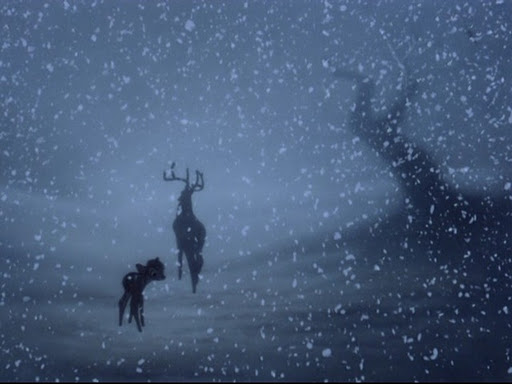 Although it was released after ‘Dumbo‘, ‘Bambi’ is essentially Disney’s fourth feature, and it was also the last in which the studio really pushed the envelope.
‘Bambi’ had been long in the making, with initial work already starting in 1937. In fact, it was initially planned as Disney’s second feature, but soon pushed back in favor of ‘Pinocchio’.
After having made such great and diverse efforts as ‘Snow White’, ‘Pinocchio‘ and ‘Fantasia’, Disney set the stakes even higher in Bambi, reaching a zenith in naturalism. But the film is way more than that: it’s a symphony of nature, utterly romantic in its depiction of forest life. It’s also a coming of age story and a depiction of the circle of life.
‘Bambi’ is full of great scenes, starting with the stunning opening scene, a long and complicated shot, which shows the vastness and depth of the forest using a multiplane camera, and which leads us straight into the story, when we come to follow friend owl in his flight.
The storytelling is very lean, it uses little dialogue and it consists of only a few distinct parts, which all concentrate on Bambi’s experiences. Most of the story is told by images and music only, and there are three pure mood pieces very reminiscent of a Silly Symphony like ‘The Old Mill‘ (1937) and parts of ‘Fantasia’: the April Shower sequence, the autumn sequence and Bambi’s love scene. In these sequences especially, it’s clear that atmosphere prevails above character development, and the studio indulges in beautiful imagery that is still impressive and enchanting today.
The film can be divided into eight sections (the titles are all mine):
1) Birth: which also introduces the lovable little rabbit Thumper;
2) Discovery of the world: including the introduction of the little skunk Flower and a rain scene, set to the beautiful song ‘April shower’;
3) The meadow: where both danger and other deer are introduced, including Bambi’s father and his later love interest, Feline;
4) Autumn: a short transitional mood piece;
5) Winter: which includes the famous skating scene, inspired by Pluto’s difficulties on ice in ‘On ice‘ (1935) and which ends with that harrowing, yet off screen death of Bambi’s mother;
6) Spring: where all our characters have become adolescents and discover the power of love;
7) Man: where man, who never is seen on screen, but whose threatening presence is so much more felt, once again brings danger into the forest, shooting animals (including Bambi) and causing a forest fire, which leads to great dramatic and apocalyptic shots of the burning forest;
and finally
8) Birth again: in which the cycle is completed.
The first five sections take almost two-thirds of the film and are responsible for Bambi’s reputation of being a childish film full of cute animals. This may be partly true, but is does no justice to the complete film, for the last three sections, starting with the death of Bambi’s mother (which essentially ends his childhood) are more artistic, more expressionistic and more dramatic. These scenes belong to the most powerful animated images ever brought to the screen.
But throughout the complete picture the artwork is stunning: the backgrounds, based on designs by Tyrus Wong, are lush and suggestive, the use of color is very clever and often amazing, and the music, which is very important to the narrative and which uses off-screen songs to evoke moods, is rich and effective. Indeed, Bambi’s soundtrack, by composers Frank Churchill and Edward Plumb, ranks among the best scores of any animation film. Backgrounds, design, color, music – all these make the film a mood piece of an astonishing quality.
The animation itself, too, is a highlight. It was supervised by four of the later so-called ‘nine old men’: Eric Larson, Milt Kahl, Frank Thomas and Ollie Johnston, and it’s the first testimony of their legendary status. The animation is amazingly well-done both in its naturalism as in its sense of character. It ranks from pure naturalism in Bambi’s mother exploring the meadow and Bambi preparing to fight to pure character animation. A highlight of the latter is Bambi having to say hello to Feline. Bambi’s behavior in this scene is perfect that of a young bashful boy.
The only deviation from believability is during the Twitterpated sequence: Eric Larson’s animation on friend Owl is zany and cartoony, as is the animation of the lovestruck Flower. The whole sequence is a little bit ridiculous, and out of place with the rest of the film. Luckily as soon as Bambi falls in love with Feline, the last part starts, which in its drama, powerful imagery and stunning effects is the undisputed highlight of the whole movie.
Bambi never ceases to amaze: it is simply beautiful.
Watch the skating scene from ‘Bambi’ yourself and tell me what you think:
Director: Clyde Geronimi
Release Date: November 20, 1942
Stars: Pluto
Rating: ★★★★★
Review:
 With ‘Pluto at the zoo’ director Clyde Geronimi delivers his most successful Pluto short.
In this short Pluto carries a tiny bone when he discovers a huge bone at the Lion’s cave. He decides to steal it, but this causes him lots of trouble with the lion, a kangaroo, a gorilla and several crocodiles.
Pluto’s pantomime is wonderful in this cartoon, and, unlike most of the previous entries directed by Geronimi, there’s an absence of sentimentality, which is nicely replaced by absurdism, with the simply hilarious gorilla sequence as a highlight within the whole series.
Watch ‘Pluto at the Zoo’ yourself and tell me what you think:
This is Pluto cartoon No. 9
To the previous Pluto cartoon: T-Bone for Two
To the next Pluto cartoon: Private Pluto
Director: Clyde Geronimi
Release Date: May 22, 1942
Stars: Pluto
Rating: ★★★
Review:
 ‘The Army Mascot’ is the first of two World War Two cartoons starring Pluto (the other one being ‘Private Pluto‘ from 1943).
Pluto never gets really involved in the war, though, he only joins the army. He was the second Disney character to do so, following Donald Duck, who had been drafted only three weeks earlier, in ‘Donald Gets Drafted‘.
However, Pluto’s reasons to join the army are doubtful, to say the least: only when he sees the enormous portions of meat an army mascot gets, he wants to be one, too. He tries to replace “Gunther Goat”, mascot of the Yoo-hoo Division, but all he gets is cans. In his second attempt he tries to chew tobacco like Gunther can, to impress the soldiers. But Gunther makes Pluto swallow the whole piece, making him sick. This sequence is the highlight of the cartoon, as Pluto’s sickness is animated in the most ridiculous way.
Gunther then tries to finish his rival off by bumping Pluto into the munition depot, but it’s Gunther himself who bumps into the depot, which explodes, blasting the wicked goat up into the air, where he’s caught by a plane and carried away into the distance. Now Pluto takes Gunther’s place, and gets his steak after all.
‘The Army Mascot’ is a rather odd cartoon, where both main characters show unpleasant behavior: Pluto envy and trickery and Gunther haughtiness and wrath. Thus, ‘The Army Mascot’, although war-themed, can hardly be called a patriotic film.
Watch ‘The Army Mascot’ yourself and tell me what you think:
This is Pluto cartoon No. 6
To the previous Pluto cartoon: Pluto Junior
To the next Pluto cartoon: The Sleep Walker


 Dr. Grob's Animation Review