You are currently browsing the category archive for the ‘Merrie Melodies’ category.
Director: Rudolf Ising
Release Date: October 3, 1931
Stars: Foxy
Rating: ★★★½
Review:
 ‘One More Time’ is an aptly titled short, as it marks the third and last cartoon to star Foxy, Warner Bros.’ fox-like Mickey Mouse rip-off.
In this cartoon he’s a police officer, fining a hippo lady for driving too fast, and rescuing his Minnie Mouse-like girlfriend from some thugs. He does so riding a mechanical horse, a relic from the Oswald the Lucky rabbit cartoons (e.g. ‘Ozzie of the Mounted‘, 1927), on which Harman and Ising had worked previously. Strangely enough, Foxy is machine-gunned by one of the gangsters in the end. Perhaps this is why he never returned to the animated screen…
The short has a strong urban setting, uncommon in the Hollywood cartoons of the time, and it features some dazzling perspective animation, but otherwise it’s just another mediocre entry in the early Merrie Melodies canon.
Watch ‘One More Time’ yourself and tell me what you think:
‘One More Time’ is available on the DVD ‘Looney Tunes Golden Collection Volume Six’
Director: Rudolf Ising
Release Date: September 5, 1931
Stars: Foxy
Rating: ★★★
Review:
 ‘Smile, Darn Ya, Smile!’, the second of the Merrie Melodies, is also the second to feature that short-lived early star of Warner Bros., Foxy.
The film is practically a remake of Oswald’s first cartoon, ‘Trolley Troubles’ (1927), on which Harman and Ising had worked themselves: Foxy rides a trolley, inviting his very, very Minnie Mouse-like girlfriend along. Like in the former Oswald film, the ride ends with Foxy losing control of the trolley, which leads to some spectacular perspective animation. Unlike the earlier film, however, ‘Smile, Darn ya, Smile!’ ends rather cornily, when it’s revealed it was all a dream.
The title song is sung several times during the cartoon, e.g. by four hobos. It was revived more than fifty years later in ‘Who Framed Roger Rabbit‘ (1988), when Eddie Valiant enters Toontown.
Watch ‘Smile, Darn Ya, Smile’ yourself and tell me what you think:
‘Smile, Darn Ya, Smile’ is available on the DVD ‘Looney Tunes Golden Collection Volume Six’
Director: Rudolf Ising
Release Date: August, 1931
Stars: Foxy
Rating: ★★★½
Review:
 After twelve Looney Tunes, all starring Bosko, Harman and Ising started a new cartoon series for Warner Bros. with the clearly Silly Symphonies-inspired name ‘Merrie Melodies’.
Unlike the Looney Tunes, the Merrie Melodies would be one-off cartoons, each one promoting a different song from the Warner Bros. song catalog. Indeed, the Merrie Melodies should at least feature one complete chorus of a Warner Bros.-owned tune. This rule continued until the end of the 1930s, and rather hampered the series, for the obligate song sequence would often stop the action of the cartoon.
‘Lady Play Your Mandolin’ is the very first of the Merrie Melodies. It features the title song, which is sung twice during the cartoon. Without explanation, the cartoon features a Mexican cafe setting, which is visited by the hero, Foxy, who was to be Warner Bros.’ answer to Mickey Mouse.
Although not as blatant an imitation as Van Beuren’s Milton Mouse (see ‘Circus Capers‘ and ‘The Office Boy‘), Foxy clearly is Mickey Mouse but with pointed ears and a fluffy tail. Indeed, when watching this cartoon my girlfriend thought it was an early forerunner of Mickey. Foxy never came near Mickey’s popularity, however, and was abandoned after a mere three cartoons.
‘Lady Play Your Mandolin’ is the character’s great testimony. The film is completely plotless, but simply bursts with joy. The short features a lot of flexible animation and everyone moves to Frank Marsales’s peppy music (played by Abe Lyman’s Brunswick Recording Orchestra), including the tables, the cacti, the trees and the cafe itself. There are plenty of gags all around, the most extraordinary one being Foxy’s drunken horse playing its own head as a trombone.
Foxy also started a long Warner Bros. tradition of Al Jolson imitations, when singing the main melody, while his girlfriend (Minnie Mouse but with pointed ears) boop-oop-a-doops. None of the cartoon makes any sense, but its sheer joy makes watching it a highly entertaining experience.
Watch ‘Lady, Play Your Mandolin’ yourself and tell me what you think:
‘Lady, Play Your Mandolin’ is available on the DVD ‘Little Caesar’
Director: Friz Freleng
Release Date: April 21, 1945
Stars: Bugs Bunny, Yosemite Sam
Rating: ★★★★½
Review:
 ‘Hare Trigger’ introduces that tiny yet explosive adversary to Bugs Bunny, Yosemite Sam.
His introduction music is Franz Schubert’s Erlkönig, and train robbery is his profession. However, on the train he encounters Bugs, who gives the short-tempered bandit a hard time.
The cartoon contains a shot of an über-cool Bugs rolling a cigarette, a gag repeated and improved on in ‘Bugs Bunny Rides Again‘ (1948). The short also contains live action footage in the ‘club bar’ wagon. The gun drawing scene is a highlight, as is Yosemite Sam’s death scene, which bugs invokes with ketchup. The cartoon ends brilliantly with a tongue-in-cheek cliffhanger.
According to Freleng he needed a stronger adversary to Bugs than Elmer Fudd ever was, and Yosemite Sam perfectly fitted the job. He was a delightful opponent to Bugs Bunny, and he became Friz Freleng’s favorite bad guy, lasting until 1964, and starring 31 cartoons in total, nearly all with Bugs Bunny. Perhaps Freleng was so fond of the character because he was partly based on Freleng himself.
In any case, he soon took Sam out of his Western origin, making him a.o. a pirate (‘Buccaneer Bunny‘, 1948), a foreign soldier (‘Bunker Hill Bunny‘, 1950) and a sheik (‘Sahara Hare’, 1955). Free from his Western origins Yosemite Sam could be Bugs Bunny in every country and every period of time, and in this respect he anticipates the Little Guy, the Pink Panther’s adversary, who also sprouted from Friz Freleng’s imagination.
Watch ‘Hare Trigger’ yourself and tell me what you think:
http://www.dailymotion.com/video/x2fbv22
This is Bugs Bunny cartoon No. 32
To the previous Bugs Bunny cartoon: Unruly Hare
To the next Bugs Bunny cartoon: Hare Conditioned
Director: Tex Avery
Release Date: July 5, 1941
Stars: Bugs Bunny, Willoughby
Rating: ★★★★★
Review:
 The dumb dog Willoughby was a minor Warner Brothers character, created by Tex Avery, and starring a few cartoons in the early 1940s.
The dog kept changing names, and that’s probably one of the reasons he never got famous. ‘The Heckling Hare’ was his third cartoon, and in it he remains nameless. Tex Avery puts him against his much more famous creation, Bugs Bunny. Penned by Michael Maltese, the result is an inspired cartoon, full of gags.
Willoughby swaps places with Elmer Fudd in hunting rabbits. He’s of course no more successful than Elmer, and Bugs tricks him a lot. The best scene is when Bugs makes the dumb dog making faces, while he puts forward a sign to the audience reading “Silly, isn’t he?”.
However, the cartoon is most famous for its finale: for it ends with a lengthy fall from a cliff by both characters. This scene is obviously cut short in the final version. Producer Leon Schlesinger didn’t like the original ending, which apparently involved no less than two other falls, and ordered the cut. Rumors have it that this was the reason for Tex Avery to leave Warner Bros. This isn’t true. Tex Avery wanted to do a series combining live action animals with animated mouths. Schlesinger wasn’t interested, so Avery ended up doing this series, Christened ‘Speaking of the Animals’ at Paramount. However, this was not a success, and by September 1941 Avery was making cartoons again, now at MGM, where he would direct his greatest shorts.
In his book ‘Chuck Amuck’ Chuck Jones argues that ‘The Heckling Hare’ was the cartoon that re-established Bugs Bunny’s character, after three somewhat misguided cartoons by himself, Tex Avery and Friz Freleng. Bugs Bunny certainly is much more himself and in any of the previous cartoons. In any case, he would meet Willoughby again in the dog’s very last cartoon, ‘Hare Force’ (1944), directed by Friz Freleng, in which the dog is called ‘Sylvester’.
Watch ‘The Heckling Hare’ yourself and tell me what you think:
https://www.dailymotion.com/video/x612jad
This is Bugs Bunny cartoon No. 5
To the previous Bugs Bunny cartoon: Hiawatha’s Rabbit Hunt
To the next Bugs Bunny cartoon: All This and Rabbit Stew
Director: Friz Freleng
Release Date: May 23, 1942
Rating: ★
Review:
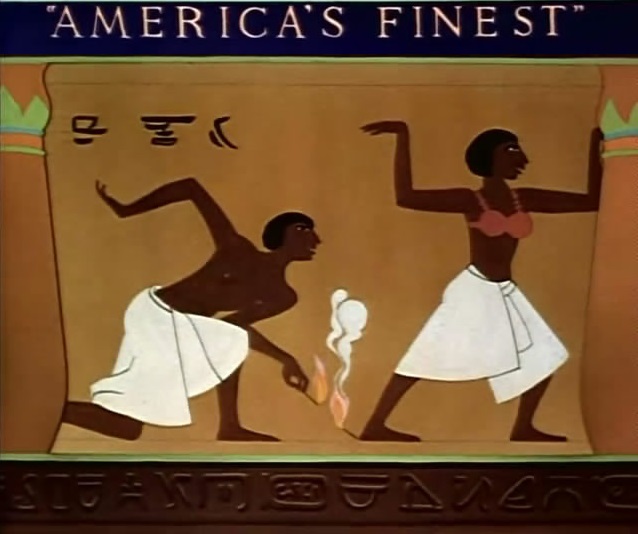 From the early 1930s to the early 1940s Warner Bros. released several cartoons in which books, magazines etc. come to life. Of all these cartoons, ‘Lights Fantastic’ is probably the most extreme and the most dated.
It opens with a real life shot of Times Square in New York, and all sequences after that supposedly take place in neon billboards on this square. This results in little movement, a few gags on Chinese and no laughs.
Present day viewers like me don’t even have a clue how many of these billboards were based on real and familiar ones. I personally could only recognize Mr. Peanut (from Planters). No doubt most of the fun disappeared with the familiarity of the pictured advertising. However, I seriously doubt whether this cartoon has ever been a winner, for its few gags are lame, and don’t build up to a finale, at all.
Watch an excerpt from ‘Lights Fantastic’ yourself and tell me what you think:
Director: Bob Clampett
Release Date: April 11, 1942
Rating: ★★★★★ ♕
Review:

‘Horton Hatches The Egg’ is a unique film within Bob Clampett’s oeuvre, and indeed the complete Warner Bros. canon: it’s the studio’s only book adaptation, it lacks sex and violence, and there is nothing of the zany and extreme animation so typical of Clampett’s unit.
Instead, we’re treated on a surprisingly faithful adaptation of Dr. Seuss’s children’s book to the screen. The cartoon uses most of Dr. Seuss’s rhymes, with adding only a little dialogue of its own, which is easily identifiable because of the lack of rhyme. Dr. Seuss’s designs, too, are wonderfully transferred to the animated screen. Especially Horton and the other forest animals have a distinctive Dr. Seuss character.
The Warner Bros. team departs from Dr. Seuss’s drawings, however, in the human designs. The three hunters are rather bland in Dr. Seuss’s children’s book, but Clampett made them a very funny trio in the cartoon. Moreover, some of the wild Warner Brothers humor has crept into the cartoon, most typically two movie star references, which, unfortunately, date the film a little: Lazy Mayzie imitates Katharine Hepburn, and there’s a fish with Peter Lorre’s features, who, after seeing Horton on a ship, shoots itself, exclaiming “Now I’ve seen everything!”.
Today, a gag like this is regarded inappropriate for children, and it might be this gag that is responsible for the little screen time the cartoon gets today. This is very unfortunate, because this animated adaptation of a Dr. Seuss book is not only the first of all, it is also one of the best, being second only to Chuck Jones’s ‘How The Grinch Stole Christmas‘ from 1966.
Watch ‘Horton Hatches the Egg’ yourself and tell me what you think:
http://www.metatube.com/en/videos/195775/Horton-Hatches-the-Egg-Cartoon-1942/
Director: Bob Clampett
Release Date: September 25, 1943
Stars: Bugs Bunny, Porky Pig, Elmer Fudd, Daffy Duck?
Rating: ★★★★★ ♕
Review:
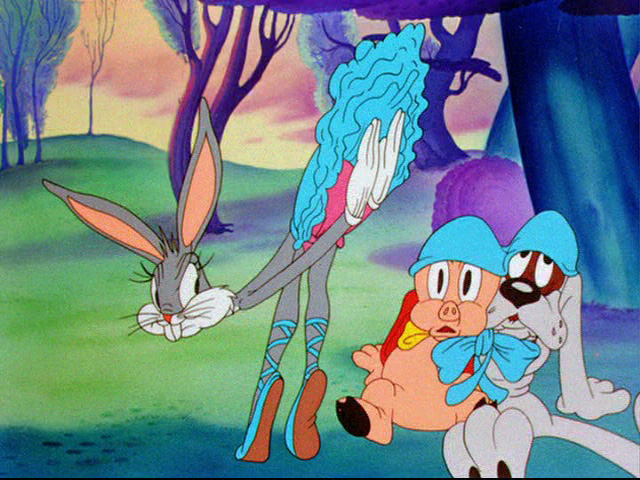 ‘A Corny Concerto’ is a two part spoof on Disney’s most ambitious feature, ‘Fantasia’ (1940), using two waltzes by Johann Strauss jr.
The cartoon features a very Fantasia-like opening, with Elmer Fudd as a clear caricature of Deems Taylor. He announces ‘Tales from the Woods’, which tells about Porky Pig and a dog hunting Bugs Bunny. Porky fills the role of Elmer Fudd in this sequence, and it’s the only cartoon in we can watch him hunting Bugs Bunny. This first part is a classic Bugs Bunny routine, complete with death scene, but now timed to music and acted in pantomime. With its overt mix of high culture and silliness this part is a direct ancestor to Chuck Jones’s later ‘What’s Opera, Doc?‘ (1957).
The second part is a story on ‘The Blue Danube’. It opens with flowers dropping on water, just like in the Nutcracker Suite sequence in Fantasia. This part tells about a little black duck, an infant version of Daffy Duck, trying to join a family of swans, and finally saving them from a vulture by destroying him with TNT. As this story is some kind of inverse of ‘The Ugly Duckling‘ (another acclaimed Disney masterpiece), this could be considered to be a parody within a parody.
Apart from Elmer Fudd’s speeches, the cartoon is completely pantomimed, and full of the wild and zany animation so typical of Bob Clampett’s unit. The backgrounds are lush and colorful, and reminiscent of the the Pastoral Symphony sequence in the original Fantasia. Their designs become overtly ridiculous in ‘The Blue Danube’, with Greek columns placed randomly in the water.
The result is a highly original mix of style and nonsense, and a great testimony of what Leon Schlesinger’s studio could do on a limited budget. In all, the cartoon is an undisputed classic, and very enjoyable, even if you don’t know its topic of parody.
Watch ‘A Corny Concerto’ yourself and tell me what you think:
This is Bugs Bunny cartoon No. 19
To the previous Bugs Bunny cartoon: Wackiki Wabbit
To the next Bugs Bunny cartoon: Falling Hare
This is Porky Pig cartoon No. 102
To the previous Porky Pig cartoon: Porky’s Pig’s Feat
To the next Porky Pig cartoon: Tom Turk and Daffy
Director: Chuck Jones
Release Date: November 17, 1951
Stars: Daffy Duck, Porky Pig
Rating: ★★★★★
Review:
 Following the premise of ‘The Scarlet Pumpernickel’ (1950), Chuck Jones launched a series of cartoons starring Daffy as a misguided hero and Porky as his calm side-kick. ‘Drip-along Daffy’ is the first of this excellent series, with the others being ‘Duck Dodgers in the 24 1/2th Century‘ (1953), ‘My Little Duckaroo’ (1954), ‘Rocket Squad’ (1956), ‘Deduce You Say’ (1956) and ‘Robin Hood Daffy‘ (1958).
In ‘Drip-along Daffy’ Daffy is a typical Western hero, clad in white, riding a well-groomed horse, with an unshaven (!) Porky as ‘comic relief’, riding a donkey. Daffy wants to clean up ‘Lawless Western Town’, which lawlessness is depicted in a series of Tex Averyan gags. However, Daffy finds a heavy adversary in the villain Nasty Canasta…
‘Drip-along Daffy’ is a delightful and gag-rich cartoon, highlight being the strong drink scene, an elaboration on a gag Avery had made in ‘The Shooting of Dan McGoo‘ (1945). Also noteworthy is the high noon scene, in which Jones and his team indulge in numerous camera angles depicting Daffy and Canasta approaching each other. Such original and devoted cinematography had rarely been seen since the Frank Tashlin days.
Nasty Canasta who would return in two more cartoons: ‘My Little Duckaroo’ from 1954 and ‘Barbary Coast Bunny’ from 1956.
Watch ‘Drip-along Daffy’ yourself and tell me what you think:
https://www.dailymotion.com/video/x6em0i8
This is Porky Pig cartoon no. 136
To the previous Porky Pig cartoon: The Wearing of the Grin
To the next Porky Pig cartoon: Dog Collared
This is Daffy Duck cartoon No. 56
To the previous Daffy Duck cartoon: Rabbit Fire
To the next Daffy Duck cartoon: The Prize Pest
‘Drip-along Daffy’ is available on the Blu-Ray ‘Looney Tunes Platinum Collection: Volume 2’ and on the DVD-set ‘Looney Tunes Golden Collection Volume One’
Director: Friz Freleng
Release Date: August 5, 1950
Stars: Daffy Duck, Porky Pig
Rating: ★★
Review:
 1950 was a transitional year for Daffy Duck: director Robert McKimson still retained Daffy’s old loony self in ‘Boobs in the Woods‘, but Chuck Jones introduced a new version of the character, as the anti-hero in ‘The Scarlet Pumpernickel‘.
However, two other shorts from the same year, ‘Golden Yeggs’ and ‘The Ducksters‘, show that the directors were uncertain where to go with the character. In Friz Freleng’s ‘Golden Yeggs’ a goose lays a golden egg (24 karat solid gold) at Porky’s poultry farm, but she blames Daffy for doing it. Daffy plays along, but the news soon attracts a gang of gangsters, led by Rocky, in his debut*. The gangsters kidnap Daffy, forcing him to lay more eggs.
Daffy Duck is quite an empty character in this cartoon, more a victim than in control. He has lost his loony character traits completely, but his later greed and foul play haven’t entered, yet, leaving the character pretty much in limbo. The result is an erratic cartoon, weak in its comedy, and uncertain in its delivery, despite some great gags, like Daffy opening a ‘door’ which consists of a gangster.
Watch ‘Golden Yeggs’ yourself and tell me what you think:
http://www.b99.tv/video/golden-yeggs/
This is Porky Pig cartoon no. 133
To the previous Porky Pig cartoon: An Egg Scramble
To the next Porky Pig cartoon: The Ducksters
This is Daffy Duck cartoon No. 53
To the previous Daffy Duck cartoon: The Bitter Half
To the next Daffy Duck cartoon: The Ducksters
‘Golden Yeggs’ is available on the DVD-set ‘Looney Tunes Golden Collection Volume One’
* The Rocky in ‘Racketeer Rabbit’ (1946) was a different character, being a caricature of Edward G. Robinson)
Director: Friz Freleng
Release Date: April 22, 1950
Stars: Bugs Bunny, Yosemite Sam
Rating: ★★★★★
Review:
 To escape some hunters, Bugs Bunny hides inside a prison, where Sam Schultz (Yosemite Sam) is a prison guard.
What follows is a great series of prison gags, including two morbid ones resulting in Sam hanging on the gallows and being electrified in an electric chair. Throughout the cartoon the warden keeps calling for Schultz, not unlike the Nazi officer in the Ernst Lubitsch feature ‘To Be Or Not To Be’ (1942).
‘Big House Bunny’ is full of excellent gags and Freleng’s timing is superb throughout, making ‘Big House Bunny’ one of those little known masterpieces.
Watch ‘Big House Bunny’ yourself and tell me what you think:
https://www.dailymotion.com/video/x2l293q
‘Big House Bunny’ is available on the DVD set ‘Looney Tunes Golden Collection, Vol. 1’
This is Bugs Bunny cartoon No. 71
To the previous Bugs Bunny cartoon: Homeless Hare
To the next Bugs Bunny cartoon: What’s Up, Doc?
Director: Robert McKimson
Release Date: November 19, 1949
Stars: Sylvester, Hippety Hopper
Rating: ★★
Review:
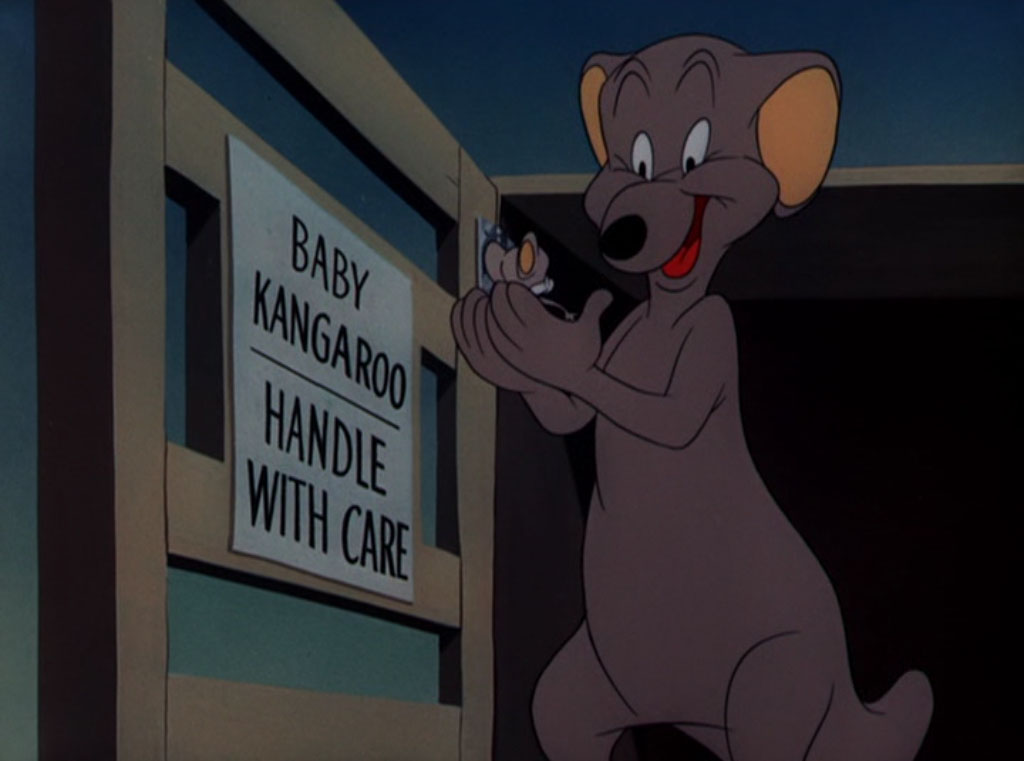 ‘Hippety Hopper’ introduces the kangaroo of the same name, and its only function during its entire career: being mistaken for a mouse.
The cartoon starts gloomily enough, with a misty harbor scene, where a mouse is trying to commit suicide. He’s rescued by Hippety Hopper, however, and together they face the mouse’s terror: Sylvester the cat. The mouse makes Sylvester think he can grow tall, and lets Hippety Hopper beat him out of the house. The best comedy comes from a bulldog who keeps pushing Sylvester back inside.
Hippety Hopper himself is a silent character with a friendly smile and absolutely no personality. He’s easily the least funny recurring star in the Warner Brothers cartoon catalog before the 1960s. Even in this first cartoon his appearance is tiresome. Nevertheless, he would star in twelve other cartoons, lasting even till 1964. The mouse, on the other hand, would disappear after this cartoon. No wonder: he’s designed and animated rather uglily.
Watch ‘Hippety Hopper’ yourself and tell me what you think:
http://www.dailymotion.com/video/x7b04w_merrie-melodies-hippity-hopper-1949_shortfilms
Director: Friz Freleng
Release date: October 13, 1956
Stars: Sylvester, Elmer Fudd
Rating: ★★★
Review:
 ‘Yankee Dood It’ was the last of three propaganda cartoons Friz Freleng directed for the Alfred P. Sloan Foundation, following the earlier ‘By Word of Mouse‘ (1954) and ‘Heir-Conditioned‘ (1955).
This cartoon is an original take on the famous fable of the shoemaker and the elves. Elve company W is missing, and elven king (Elmer Fudd but smaller and wih pointed ears) is wondering where they are. They turn out to be still helping the old shoemaker.
In order to get the elves back, a little elf and the king tell the old shoemaker how companies work, thus telling the short’s propagandistic message. Unfortunately, the shoemaker’s exclamations of ‘Dear Jehosapath’ turn the elves into mice, much to delight of the cat Sylvester (who appears in all three of these shorts).
‘Yankee Dood It’ is a nice, if rather slow propaganda short that only sees advantages of the capitalistic system: lower prices and higher wages. Possible drawbacks like poverty, monopolization, unemployment and pollution are, of course, wisely left out.
Watch ‘Yankee Dood It’ yourself and tell me what you think:
Director: Chuck Jones
Release date: August 8, 1955
Stars: Porky Pig, Sylvester
Rating: ★★★★
Review:
 ‘Jumpin’ Jupiter’ was the last of three cartoons in which director Chuck Jones employed Porky Pig, and Sylvester as his frightened cat.
This time they’re camping out when they’re visited by a bird-like alien. The alien takes their complete camping site to outer space. As in the former cartoons, Porky remains completely unaware of what’s happening, while Sylvester sees it all, much to his horror. In the end we see them drive off into the horizon on a strange, strange planet.
‘Jumpin’ Jupiter’ is a beautiful and well animated cartoon, and arguably the most enjoyable of the Porky-Sylvester pairings. The action is helped by Carl Stalling’s particularly inspired music, which matches the science fiction setting perfectly.
Watch ‘Jumpin’ Jupiter’ yourself and tell me what you think:
https://www.dailymotion.com/video/xk2yb4_porky-pig-jumpin-jupiter_tv
This is Porky Pig cartoon no. 145
To the previous Porky Pig cartoon: My Little Duckaroo
To the next Porky Pig cartoon: Dime to Retire
Director: Robert McKimson
Release Date: December 14, 1957
Stars: Bugs Bunny, Elmer Fudd
Rating: ★★★½
Review:
 ‘Rabbit Romeo’ opens with Elmer Fudd receiveing an enormous package from his uncle Judd Fudd containing a ‘Slobavian rabbit’.
The Slobavian rabbit turns out to be a giant female rabbit called Millicent. Elmer will get $500 if he will guard the rabbit until his uncle arrives. Unfortunately Millicent gets lonely, and expresses that by wrecking things, so Elmer seeks a companion, which of course has to be Bugs Bunny. In the end of the cartoon Bugs gets rid of the all too loving Millicent by putting Elmer into a rabbit suit.
‘Rabbit Romeo’ is a rare combination of storyman Michael Maltese and director Robert McKimson. Maltese’s peppy story makes it one of McKimson’s better latter day shorts. The designs on Bugs and Elmer may be flat and uninspired, the animation on Millicent is great. Moreover, McKimson’s timing is excellent, and he excels in some facial expressions on Bugs Bunny, which belong to the best in any Bugs Bunny short.
Watch ‘Rabbit Romeo’ yourself and tell me what you think:
https://www.dailymotion.com/video/x2jignc?GK_FACEBOOK_OG_HTML5=1
This is Bugs Bunny cartoon No. 134
To the previous Bugs Bunny cartoon: Show Biz Bugs
To the next Bugs Bunny cartoon: Hareless Wolf
Director: Chuck Jones
Release Date: March 8, 1958
Stars: Daffy Duck, Porky Pig
Rating: ★★★★
Review:
 ‘Robin Hood Daffy’ is the last of Chuck Jones’s great series of Daffy and Porky pairings.
Like earlier entries, such as ‘Drip-along Daffy‘ (1951) or ‘Deduce You Say’ (1956), Daffy fails completely in acting out the hero he is supposed to be. In this cartoon Daffy Duck is Robin Hood, but he has a hard time proving that to a skeptical Friar Tuck (Porky Pig). He does so by relentlessly trying to rob a rich nobleman who rides on a remarkably little donkey in a hilariously silly fashion.
This nobleman character is totally unaware of the antics around him and is a late addition to a series of similar odd characters that populated many of Jones’s early films, like the Minah Bird (1941-1947) and the bearded sailor in ‘The Dover Boys‘ (1942). Daffy’s attempts, on the other hand, are more akin to those of the Coyote in the Road Runner series. The best gag is when he tries to swing on a rope, Errol Flynn-style, shouting “Yoicks and away”, only to crash into multiple tree trunks.
Porky is redesigned completely into Chuck Jones’s late design: with ridiculously cute eyelashes, anticipating similar redesigns of Jerry in Jones’s Tom & Jerry cartoons seven years later. The redesign is not a success: Porky looks a little too feminine and too cute for the purposes of the cartoon.
Watch ‘Robin Hood Daffy’ yourself and tell me what you think:
http://www.b99.tv/video/robin-hood-daffy/
This is Porky Pig cartoon no. 150
To the previous Porky Pig cartoon: Boston Quackie
To the next Porky Pig cartoon: China Jones
This is Daffy Duck cartoon No. 83
To the previous Daffy Duck cartoon: Don’t Axe Me
To the next Daffy Duck cartoon: China Jones
‘Robin Hood Daffy’ is available on the DVD-set ‘Looney Tunes Golden Collection Volume Three’
Director: Chuck Jones
Release Date: July 6, 1957
Stars: Bugs Bunny, Elmer Fudd
Rating: ★★★★★ ♕
Review:
 One of the most celebrated animated cartoons of all time, ‘What’s Opera, Doc’ places the typical Elmer Fudd-Bugs Bunny chase routine into the world of Wagnerian opera.
The cartoon’s masterstroke is that it uses all the cliches of the chase, which go all the way back to the first Bugs Bunny Cartoon ‘A Wild Hare‘ (1940), but that they are carried out in the most serious, Wagnerian fashion. The result is ridiculously pompous, mocking Wagnerian opera, as well as playing homage to it. Milt Franklyn’s score quotes music from five Wagner operas: ‘Der fliegende Holländer’, ‘Die Walküre’, ‘Siegfried’, ‘Rienzi’ and ‘Tannhäuser’.
The cartoon’s operatic character is emphasized not only by operatic singing, but also by featuring Wagnerian magic (a magic helmet), a ballet (a staple of French opera, but only employed by Richard Wagner in his very first operas), and a sad ending, a cliche of 19th century opera in general. Michael Maltese provided new lyrics to Wagner’s pilgrim chorus from ‘Tannhäuser’ and made it into a rather Hollywood musical-like love duet between Elmer and Bugs.
The animation is outstanding throughout, especially in the ballet and love duet between Bugs and Elmer. Indeed, for the ballet sequence the animators studied Tatania Riabouchinska and David Lichine from The Original Ballet Russe, and there’s a genuine seriousness about this scene. Yet, the main attraction of the cartoon lies in Maurice Noble’s extreme background layouts and bold color designs. Especially when Elmer gets furious, there is a startling emotional use of colors that has not been seen on the animated screen since ‘Bambi‘ (1942).
The opening sequence, with Elmer casting a mighty shadow is a straight homage to ‘The Night on Bold Mountain’ sequence from ‘Fantasia’ (1940), while the shots of Bugs being dressed as Brünnhilde and riding an oversized horse are retaken from ‘Herr meets Hare’ from 1945 (which, like ‘What’s Opera, doc?” was also penned by Michael Maltese). In this sense the cartoon is as much a homage to animation history as it is to opera.
‘What’s Opera, doc?’ is a brilliant cartoon of pure grandeur and one of Chuck Jones’s all time masterpieces. What’s most striking is that it was made during the normal grind of a commercial animated cartoon studio. The film took much longer than normal to make, which Jones and his unit could only manage to do by cheating on their schedule, stealing time from a much more ordinary short, the Road Runner cartoon ‘Zoom and Bored’ (1957).
Watch ‘What’s Opera, Doc?’ yourself and tell me what you think:
http://www.dailymotion.com/video/x1atzuy
This is Bugs Bunny cartoon No. 131
To the previous Bugs Bunny cartoon: Piker’s Peak
To the next Bugs Bunny cartoon: Bugsy and Mugsy
Director: Chuck Jones
Release Date: December 31, 1955
Rating: ★★★★★ ♕
Review:
 ‘One Froggy Evening’ tells about a construction worker, who discovers a singing frog inside a cornerstone of a building.
He dreams of earning loads of money with the frog, but unfortunately the frog sings for him only, not for anybody else. This leads to the man’s ruin, and in the end he disposes the frog into another building. But in 2056 AD the same thing is about to happen all over again…
‘One Froggy Evening’ is one of the most perfect cartoons ever made (one competitor that comes to mind is ‘The Band Concert’ from 1935): its story, penned by Michael Maltese, is told with the most economical means, without any dialogue. The silent acting is superb, the timing excellent and the handling of the facial expressions gorgeous. The transition of the frog (baptized Michigan J. Frog in the seventies) from lively entertainer to ordinary amphibian is completely convincing, and a great example of the power of animation.
Although the frog was supposedly locked inside the building in 1892, most of the songs it sings are from a later date: ‘Hello! Ma Baby’ was published in 1899, ‘Won’t You Come Over to My House in 1906, ‘I’m Just Wild About Harry’ in 1921, and ‘Please Don’t Talk About Me When I’m Gone’ is even from 1930. Only ‘Come Back to Erin’ and ‘Throw Him Down McCloskey’ are apt, being from 1868 and 1890, respectively. The catchy ‘The Michigan Rag’ was written especially for this cartoon.
‘One Froggy Evening’ feels like a parable. It’s a story of greed, of misfortune, of headstrong belief in a bad idea, and of shattered dreams. It is not hilariously funny, but delightful and simply beautiful. It was Chuck Jones’s personal favorite, and it’s deservedly regarded as an all-time classic. Not that anyone in 1955 thought so, though. The Academy Award went to ‘Speedy Gonzales’, while ‘One Froggy Evening’ didn’t even get an Oscar nomination. Meanwhile, ‘One Froggy Evening’ remains one of the very, very few animated cartoons to inspire a scene in a live action movie, in this case the alien scene in Mel Brooks’s ‘Spaceballs’ (1987).
Watch ‘One Froggy Evening’ yourself and tell me what you think:
Director: Robert McKimson
Release Date: August 31, 1946
Stars: Henery Hawk, Foghorn Leghorn
Rating: ★★★★★
Review:
 Already in his fourth film as a director McKimson introduces his most durable star, Foghorn Leghorn.
The loud-mouthed rooster is coupled with Henery Hawk, in his second appearance since the Chuck Jones cartoon ‘The Squawkin’ Hawk’ (1942). Also featured is the Foghorn Leghorn’s regular opponent, the barnyard dog, and their recurring feud is already laid out in this short. Foghorn Leghorn uses Henery in this feud, making him believe the dog, not he, is a chicken. In the end Henery catches both, and even a horse, exclaiming; “one of them got to be a chicken”.
‘Walky Talky Hawky’ is one of McKimson’s most inspired cartoons. Both Foghorn Leghorn and the barnyard dog are great characters, and the short is full of great, rather Clampettian animation.
Foghorn Leghorn’s vocal mannerisms were inspired by a 1930s radio character called ‘The Sheriff’. Later, mannerisms from another radio character, Senator Claghorn, crept into the rooster’s vocabulary. For a detailed account on the origins of Foghorn Leghorn, see Keith Scott’s excellent post on Cartoon Brew.
Watch ‘Walky Talky Hawky’ yourself and tell me what you think:
Director: Bob Clampett
Release Date: June 9, 1945
Stars: Tweety
Rating: ★★★★★ ♕
Review:
 Two cats, a yellow dopey one and a red one who’s a caricature of Jimmy Durante, fight over a little white kitten.
She tells them that she’ll go out with the first who brings her a little bird. Enter Tweety, who, despite his cute and helpless appearance, finishes with the two cats in no mild manner. On the contrary, ‘A Gruesome Twosome’ is probably the most violent of all classic cartoons. It’s also very beautifully animated, full of wild and zany action, and simply hilarious. The highlights are a dog, who “doesn’t actually belong in the picture” and a very silly pantomime horse costume.
With ‘A Gruesome Twosome’ director Bob Clampett made one of his most extreme cartoons. Its outrageousness splashes from the screen in every scene. Its theme of sex and violence is executed in a much wilder way than Tex Avery would do, let alone any other director of the era. The cartoon’s sheer energy still impresses today. In this way, ‘A Gruesome Twosome’ may be viewed as the ultimate Bob Clampett film.
‘A Gruesome Twosome’ was the last of the three Tweety cartoons Bob Clampett directed (the other two being ‘A Tale of Two Kitties’ from 1942 and ‘Birdy and the Beast’, 1944). The character would reappear in a redesigned, less grotesque and much cuter form in 1947 in ‘Tweety Pie’ to start a much better known career with Sylvester, as directed by Friz Freleng.
Watch ‘A Gruesome Twosome’ yourself and tell me what you think:
http://www.dailymotion.com/video/x1z5zgx_tweety-bird-ep-03-a-gruesome-twosome_fun


 Dr. Grob's Animation Review