You are currently browsing the category archive for the ‘Merrie Melodies’ category.
Director: Friz Freleng
Release Date: December 30, 1944
Stars: Bugs Bunny, Elmer Fudd
Rating: ★★★★★
Review:
 In ‘Stage Door Cartoon’, the forest scene, in which Elmer is “fishing’ for a certain rabbit”, is soon replaced by an urban environment, where Bugs flees into a stage door. From then on, the action takes place in the theater.
The numerous gags involve a great tap dance by Bugs, a spectacular dive by Elmer from a ridiculously high ladder into an “ordinary glass of water” and Elmer watching a Bugs Bunny cartoon. ‘Stage Door Cartoon’ does not make any sense, but it’s full of gags, resulting in one of the funniest of all Bugs Bunny cartoons.
‘Stage Door Cartoon’ also features a Southern Sheriff who looks and sounds like an early version of Yosemite Sam, a Friz Freleng character who would make his debut only four months later.
Watch ‘Stage Door Cartoon’ yourself and tell me what you think:
http://www.dailymotion.com/video/x301jyk
This is Bugs Bunny cartoon No. 29
To the previous Bugs Bunny cartoon: The Old Grey Hare
To the next Bugs Bunny cartoon: Herr Meets Hare
Director: Chuck Jones
Release Date: June 12, 1943
Stars: Hubie and Bertie
Rating: ★★½
Review:
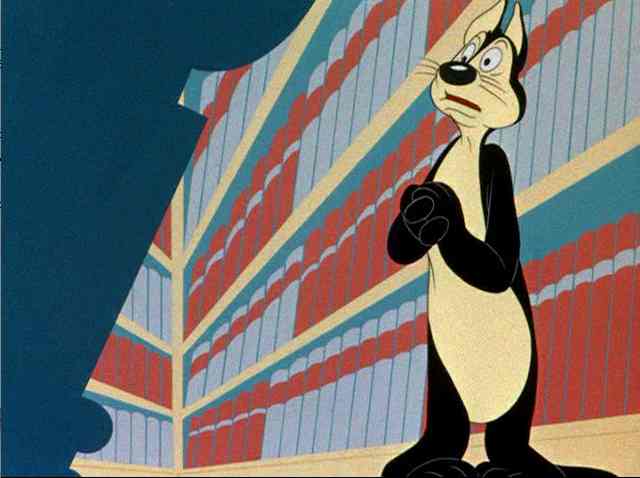 The aristo-cat is the pet of a rich lady. He nags the butler so much that the latter quits. Not knowing how to get food himself, the cat panics, until he learns from a book titled ‘the behavior of cats’ that cats eat mice.
He immediately sets out to get one, but when he encounters one (Hubie) he doesn’t recognize it and he’s scared to death. Hubie and Bertie take advantage of the situation to convince the cat that Rover, a vicious bulldog next door, is a mouse. This leads to several chase routines, until it is revealed that it was all a dream.
‘The Aristo-Cat’ is only moderately funny, and the aristo-cat has a rather ugly voice. But the cartoon’s highly stylized backgrounds are beautiful and an attraction on their own. They are based on layouts by John McGrew, who did some innovative work in a couple of Chuck Jones cartoons from 1942 and 1943, e.g. ‘Conrad the Sailor‘, ‘The Dover Boys‘, and ‘Flop Goes The Weasel’. The backgrounds in ‘The Aristo-Cat’ arguably form the apex of McGrew’s art with their expressionistic angles and patterns, supporting the cat’s agony and fear. In fact, such daring designs would not be seen again before the advent of UPA.
‘The Aristo-Cat’ marks the debut of the mischievous mouse duo Hubie and Bertie. Strangely enough, they were shelved for three years, although Hubie had one solo-outing in 1944 with ‘From hand to Mouse’. The duo returned in 1946 to star five more cartoons: ‘Roughly Squeaking’ (1946), ‘House Hunting Mice’ (1948), ‘The Hypo-Chondri-Cat’ (1950), ‘Cheese Chasers’ (1951) and the greatest of them all, ‘Mouse Wreckers‘ (1949).
Watch ‘The Aristo-Cat’ yourself and tell me what you think:
Director: Chuck Jones
Release Date: February 14, 1942
Stars: Conrad Cat, Daffy Duck
Rating: ★★½
Review:
 ‘Conrad the Sailor’ is the third and last cartoon featuring the early Chuck Jones character Conrad Cat, who also starred ‘Porky’s Cafe’ and ‘The Bird Came C.O.D.’, all from early 1942.
Conrad’s most distinctive trait was his voice, provided by Pinto Colvig, who also voiced Goofy. Indeed, Conrad’s and Goofy’s voices are very similar. However, in ‘Conrad the Sailor’ his voice is rarely heard, as most of the comedy is silent.
In ‘Conrad the Sailor’ Conrad Cat works as a sailor on a battle cruiser (a setting reflecting the war time), where he is nagged by Daffy Duck. Their chase is stopped several times by a small captain who pops up at unexpected moments, a type of gag typical for early Chuck Jones cartoons (see e.g. ‘Inki and the Minah bird’ from 1941 and ‘The Dover Boys‘ from 1942).
‘Conrad the Sailor’ is not a very funny cartoon: neither Conrad nor Daffy behave sympathetically, and the origin of their conflict remains unknown. The Daffy-Conrad-encounters appear to be nothing more than a string of unrelated events. Moreover, Jones’s pacing is still rather slow at times, wearing the comedy down. Conrad’s personality is rather undefined, and after this cartoon he was shelved.
Notwithstanding its weaknesses, the cartoon is noteworthy for its remarkably stylized and surprisingly angled backgrounds, courtesy of lay-out artist John McGrew, who collaborated with Jones on a number of cartoons, before joining the navy himself in 1942. The backgrounds in these cartoons are often the real highlight of the short, and look all the way forward to UPA’s cartoon modern style of the early fifties. McGrew would push the limits even further in ‘The Aristo-Cat‘ (1943).
This is Daffy Duck cartoon No. 12
To the previous Daffy Duck cartoon: The Henpecked Duck
To the next Daffy Duck cartoon: Daffy’s Southern Exposure
‘Conrad the Sailor’ is available on the DVD-set ‘Looney Tunes Golden Collection Volume Four’
Director: Friz Freleng
Release Date: December 18, 1943
Stars: Bugs Bunny
Rating: ★★★★★
Review:
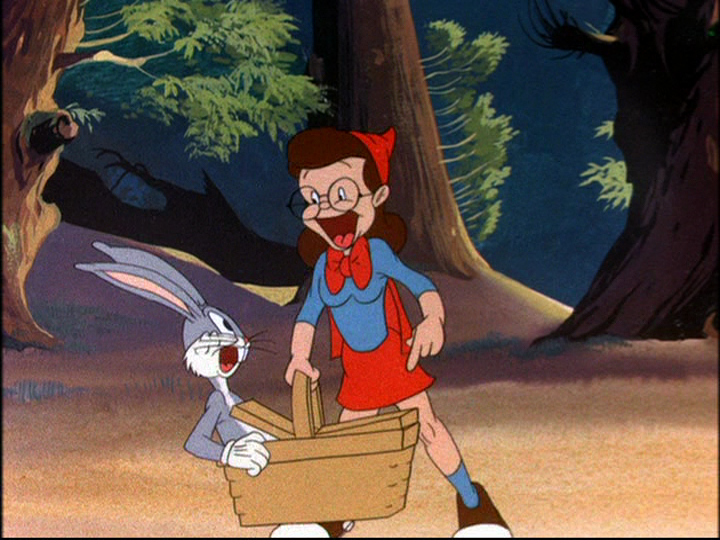 In this wacky take on the classic tale of ‘Little Red Riding Hood’, Red Riding Hood is a bespectacled, loud-voiced teenager taking Bugs in her basket to her Grandma, while singing Cole Porter’s ‘The Five O’Clock Whistle’ in her own idiosyncratic way (voiced by Bea Benadaret).
The wolf sends Red Riding Hood on a long and winding road across a mountain, while he takes a shortcut to grandma’s house, which appears to be just two meters away. The wolf doesn’t need to get rid of grandma, who’s “working swing shift at Lockheed’ (a typical war era reference), but oddly enough he has to get rid of some other wolves waiting in bed.
When Red Riding Hood arrives at grandma’s place, the wolf quickly disposes of the unappealing girl, and gets into a chase routine with Bugs, involving a marvelous door sequence, worked out perfectly in Friz Freleng’s typical timing.
However, at several points they’re interrupted by Red Riding Hood, who insists on asking her familiar questions. In the end, Bugs gets so annoyed that he punishes her instead of the wolf.
‘Little Red Riding Rabbit’ is one of the most successful of all fairy tale-inspired cartoons. It’s loaded with funny gags and one of the early highlights in the Bugs Bunny catalog.
Watch ‘Little Red Riding Rabbit’ yourself and tell me what you think:
http://ulozto.net/live/xRipWpf/bugs-bunny-little-red-riding-rabbit-1944-avi
This is Bugs Bunny cartoon No. 21
To the previous Bugs Bunny cartoon: Falling Hare
To the next Bugs Bunny cartoon: What’s Cookin’, Doc?
Director: Friz Freleng
Release Date: October 10, 1942
Stars: Bugs Bunny, Elmer Fudd
Rating: ★★½
Review:
 ‘The Hare-Brained Hypnotist’ was only the sixth encounter between Elmer Fudd and Bugs Bunny, and only the second by Friz Freleng, but already the routine was ripe for experiment.
In ‘The Hare-Brained Hypnotist’, penned by Michael Maltese, Elmer consults a book on hypnosis to catch Bugs. His hypnosis skill work on a bear, which Elmer makes think it’s a canary. It fails on Bugs however, who in turn manages to hypnotize Elmer, making him think he’s a rabbit. Elmer immediately swaps into a Bugs Bunny routine, leaving Bugs to play the straight guy. But after another hypnosis battle down the rabbit hole, Elmer returns to his former self, fleeing into the distance, while Bugs tells us he’s the B19, referring to the Douglas XB19, a huge experimental bomber plane, which had had its first flight on 27 June 1941.
‘The Hare-Brained Hypnotist’ is not a very funny cartoon. The comedy suffers, because Bugs is forced into the role of the straight guy, a problem the cartoon shares with e.g. ‘Tortoise Beats Hare‘ from 1941. Nevertheless, Elmer’s Bugs Bunnyarisms are quite hilarious, especially in a scene where he makes Bugs eat several carrots at one time.
Watch an excerpt from ‘The Hare-Brained Hypnotist’ yourself and tell me what you think:
http://www.dailymotion.com/video/x2zqdzr
This is Bugs Bunny cartoon No. 13
To the previous Bugs Bunny cartoon: Fresh Hare
To the next Bugs Bunny cartoon: Case of the Missing Hare
Director: Tex Avery
Release Date: March 15, 1941
Stars: Bugs Bunny, Cecil Turtle
Rating: ★★★½
Review:
 ‘Tortoise Beats Hare’ starts with one of the greatest openings of all Warner Brothers cartoons: Bugs walks along the title card, reading it aloud, mispronouncing all the names (Fred a-VEry).
When he reads the title, he gets angry, tears the title card apart and immediately looks up Cecil Turtle to make a bet. Cecil Turtle accepts, but when they’ve started off, he phones all his friends and relations to be his duplicate. This trick make the humble turtle seem to appear everywhere, driving Bugs mad.
‘Tortoise Beats Hare’ is Tex Avery’s first Bugs Bunny cartoon after Bugs Bunny’s debut in ‘A Wild Hare‘ (1940). In it Tex Avery immediately does a surprising experiment to his beloved character by letting him play the role of the straight guy. In ‘Tortoise Beats Hare’ it’s the humble Cecil Turtle who gets all Bugs’s routines, like kissing the rabbit at unexpected moments and addressing the audience with a “we do this kind of stuff to him all through the picture”. As Chuck Jones writes in his book ‘Chuck Amuck’:
‘The Tortoise in fact becomes Bugs, and Bugs becomes Elmer Fudd, outwitted and outacted, thereby losing control both of the tortoise-hare race and of the picture itself’.
This experiment is not a success: watching Bugs Bunny being humiliated gives the viewer an uncomfortable feeling, and outside the Cecil Turtle cartoons it was rarely repeated. Nevertheless, Bugs’ first double take is a delight, and so is the animation on the slow hopping Cecil.
”Tortoise Beats Hare’ was only Bugs Bunny’s third screen appearance, and it shows: his design is still somewhat unsteady, and so is his voice. When Bugs addresses Cecil for the first time, it sounds like we hear many Mel Blanc voices after another.
At MGM Avery would reuse the idea of a guy popping up everywhere driving his opponent mad to greater effect, in two Droopy cartoons, ‘Dumb-Hounded‘ (1943) and ‘The Northwest Hounded Police‘ (1946). In both cartoons Avery skips the explanation how the guy could be everywhere, making the result way funnier.
Meanwhile, Cecil Turtle would return in the Bob Clampett cartoon ‘Tortoise wins by a Hare’ (1942) and in the Friz Freleng cartoon ‘Rabbit Transit’ (1947).
Watch ‘Tortoise Beats Hare’ yourself and tell me what you think:
http://www.dailymotion.com/video/x2ox5qu
This is Bugs Bunny cartoon No. 3
To the previous Bugs Bunny cartoon: Elmer’s Pet Rabbit
To the next Bugs Bunny cartoon: Hiawatha’s Rabbit Hunt
Director: Chuck Jones
Release Date: September 19, 1942
Rating: ★★★★★ ♕
Review:
 ‘The Dover Boys’ or, as it is actually called, ‘The Dover Boys at Pimento University or The Rivals of Roquefort Hall’, is director Chuck Jones’s first masterpiece.
The short introduces his trademark of extreme poses, which in this cartoon are combined with ‘smear animation’ to unique results.
The extreme posing leads to highly stylized animation, which in itself is hilarious in its unnatural depiction of movement. In ‘The Dover Boys’ we watch both movement through poses, especially in the animation on Dan Backslide, as well as non-movement, with Dora descending the stairs as a prime example. Both techniques are important steps away from the classic squash-and-stretch animation, and from ‘believability through full animation’. Indeed, the animation style of ‘The Dover Boys’ looks forward all the way to the fifties, the era in which stylization of design and animation would flourish and dominate the animation industry. Indeed, the short’s prime animator, Bobe Cannon, would play an important role at UPA, the most influential animation film studio of the fifties.
The subject of ‘The Dover Boys’ is a sophisticated parody on melodrama, consisting of an archetypical story of a villain (called Dan Backslide) kidnapping a damsel in distress (dear Dora), taking her to his cottage in the mountains, where she is rescued by the heroes, in this case, the three Dover Boys, Tom, Dick and Larry.
Or is she? In the final scene they knock each other out, and Dora runs off into a distance with an odd bearded character in a bathing suit, who, as a running gag, hops along rather randomly throughout the picture to the music of ‘The Good Old Summertime’. This character is a relative of the equally mysterious Minah Bird from Chuck Jones’ earlier cartoon ‘Inki and the Lion’ (1941).
‘The Dover Boys’ is both innovative and funny. Its humor is as sophisticated as it is silly. In any case, the gags come fast and plenty, with hilarious nonsense as a result. An all time classic.
Watch ‘The Dover Boys’ yourself and tell me what you think:
Director: Friz Freleng
Release Date: April 10, 1937
Rating: ★★★½
Review:
 ‘She Was an Acrobat’s Daughter’ is a cartoon about an evening at the cinema.
It makes very clear that in the 1930s the experience of going to the movies was way more elaborate than nowadays: we watch newsreels, the audience singing to the title song and a feature, ‘The Petrified Florist’, a satire of the Warner Brothers film ‘The Petrified Forest’ (1936), with caricatures of its stars Leslie Howard and Bette Davis. During the cartoon we’re confronted with several movie theater annoyances, like people changing seats, people passing by in the middle of a film, popcorn sellers and bad front row seats.
In this cartoon, Friz Freleng really caught up with the new spirit at Warner Brothers induced by the coming of Tex Avery and Frank Tashlin in 1936. Gone is any resemblance to cuteness or children stars. Instead, there is an annoying duckling asking questions in an irritable voice, and causing havoc in the cinema. There’s no story, just gags, and the film ends rather unexpectedly. But the whole film is a sheer delight, aimed at laughs, and succeeding in it, too. Also featured is an early caricature of Adolf Hitler.
Watch ‘She Was an Acrobat’s Daughter’ yourself and tell me what you think:
http://www.supercartoons.net/cartoon/757/she-was-an-acrobats-daughter.html
Director: Friz Freleng
Release Date: November 11, 1946
Stars: Bugs Bunny
Rating: ★★★★
Review:
 A very deft Bugs Bunny plays Franz Liszt’s second Hungarian rhapsody on a piano. This classical piece was director Friz Freleng’s all-time favorite, and it appears in several of his films.
In ‘Rhapsody Rabbit’ it is played out full. The cartoon consists of spot gags and it has a small story about Bugs having problems with a mouse. This story element is not well-developed and dropped halfway the cartoon, only to return at the end.
The idea of a battle between the pianist and a mouse was perfected by Hanna & Barbera only five months later in their Tom & Jerry cartoon ‘The Cat Concerto‘, which has exactly the same subject, and which uses exactly the same music by Liszt. Unlike Freleng however, the duo swept the Oscar… There seems to be something fishy about this fact, which is analyzed in detail by Thad Komorowski in his excellent blogpost on the issue.
Compared to the latter cartoon, ‘Rhapsody Rabbit’ is less consistent, but more absurd. The gag in which the mouse makes Bugs play an infectious boogie-woogie may be the highlight of the film.
Watch ‘Rhapsody Rabbit’ yourself and tell me what you think:
http://www.220.ro/desene-animate/Rhapsody-Rabbit/RnRu8v7HIK/
This is Bugs Bunny cartoon No. 41
To the previous Bugs Bunny cartoon: The Big Snooze
To the next Bugs Bunny cartoon: Rabbit Transit


 Dr. Grob's Animation Review