You are currently browsing the category archive for the ‘Looney Tunes’ category.
Director: Friz Freleng
Release Date: August 7, 1954
Stars: Tweety & Sylvester
Rating: ★★★★
Review:
 During a chase Sylvester falls down and ceases to be.
He goes straight to hell, where a bulldog-like devil tells him he can return to earth because he has still eight lives left. Unfortunately, back on earth Sylvester loses his lives fast, especially during a chase at a carnival.
‘Satan’s Waitin’ shows some similarities to the Tom & Jerry cartoon ‘Heavenly Puss‘ (1949), including bulldog devils and a heavenly escalator. Nevertheless, it’s one of the most original and most inspired of the Tweety and Sylvester cartoons, on par with the celebrated ‘Birds Anonymous’ from 1957.
Watch ‘Satan’s Waitin’’ yourself and tell me what you think:
http://www.dailymotion.com/video/x1z2hgt_sylvester-the-cat-ep-46-satan-s-waitin_fun
Director: Friz Freleng
Release Date: May 8, 1948
Stars: Bugs Bunny, Yosemite Sam
Rating: ★★★★
Review:
 Already in his third cartoon Yosemite Sam is used outside his original Western setting, and changed into a timeless adversary of Bugs Bunny.
In ‘Buccaneer Bunny’ he’s a 18th century pirate called Seagoin’ Sam. This idea of Sam as a timeless foe was a masterstroke, and in the following years, Sam would be Bugs Bunny’s nemesis in a wide variety of settings, like the American war of independence, the Sahara desert, ancient Rome and the middle ages.
‘Buccaneer Bunny’ is a wonderful start of this series, consisting of wonderful gags, including a beautifully timed multiple door gag. Bugs Bunny also does a great Charles Laughton parody, disguising as captain Bligh, as portrayed by Laughton in ‘Mutiny on the Bounty’ (1935).
Watch ‘Buccaneer Bunny’ yourself and tell me what you think:
https://www.dailymotion.com/video/x5jma78
This is Bugs Bunny cartoon No. 49
To the previous Bugs Bunny cartoon: Rabbit Punch
To the next Bugs Bunny cartoon: Bugs Bunny Rides Again
Director: Robert McKimson
Release Date: July 12, 1947
Stars: Foghorn Leghorn, Henery Hawk, Sylvester
Rating: ★★★½
Review:
 ‘Crowing Pains’ is Foghorn Leghorn’s second cartoon, and it immediately starts where the first (‘Walky Talky Hawky‘, from the previous year) left off: Henery Hawk wants to catch a chicken, and Foghorn Leghorn tricks him by pointing out somebody else as a chicken. This time it’s Sylvester, in an early appearance.
The cartoon is full of Warren Foster-penned nonsense, but the interplay between the four characters (the barnyard dog is also involved) doesn’t develop very well, and seems an early forerunner of the odd pairings of characters of some Warner Brothers cartoons from the 1960s. Unlike those, however, ‘Crowing Pains’ remains an enjoyable cartoon, albeit not among McKimson’s most inspired shorts.
Watch ‘Crowing Pains’ yourself and tell me what you think:
Director: Robert McKimson
Release Date: April 12, 1947
Stars: Daffy Duck
Rating: ★★★
Review:
 Daffy Duck tricks a dog called Leopold with a ‘poisoned bone’ to let him stay at his house during the winter.
Unfortunately, the dog’s owner is an evil scientist (a caricature of Peter Lorre) who happens to be looking for a duck’s wishbone. This leads to a wild chase full of pretty weird gags and off-beat dialogue penned by Warren Foster.
‘Birth of a Nation’ is the second of two Warner Bros. cartoons featuring Peter Lorre as a mad scientist, the other being ‘Hair-Raising Hare’ from 1946. New voice artist Stan Freberg does an excellent job in mimicking and parodying Lorre’s typical voice.
Watch ‘Birth of a Notion’ yourself and tell me what you think:
This is Daffy Duck cartoon No. 36
To the previous Daffy Duck cartoon: The Great Piggy Bank Robbery
To the next Daffy Duck cartoon: Along Came Daffy
‘Birth of a Notion’ is available on the DVD-set ‘Looney Tunes Golden Collection Volume Six’
Director: Robert McKimson
Release Date: July 20, 1957
Stars: Speedy Gonzales
Rating: ★★★★
Review:
 It was Robert McKimson, not Friz Freleng, who directed the first Speedy Gonzales film ‘Cat-Tails for Two’. But it took four years before McKimson revisited this character.
By then Friz Freleng had redesigned McKimson’s creation in ‘Speedy Gonzales’, which had won an Academy Award.
McKimson’s returns to Speedy Gonzales actually results in one of Speedy’s finest films. Here Speedy tries to protect two drunken mice called Pablo and Fernando from a large grey cat. ‘Tabasco Road’ is a very talkative cartoon, but it’s also inspired and charming, especially because of the characters of Pablo and Fernando, who are as intoxicating as they are intoxicated. The best gag, however, is when Speedy’s action appears too fast for the viewer, and Speedy replays it for us in slow motion.
Watch ‘Tabasco Road’ yourself and tell me what you think:
Director: Chuck Jones
Release Date: November 10, 1956
Stars: Road Runner, Wile E. Coyote
Rating: ★★★★
Review:
 This ninth Road Runner cartoon has a deviant opening, in which we watch the coyote baking a chicken out of clay.
Of course he rather has real meat, and his attempts to catch the Road Runner include a spear on a chord, a revolver on a spring, a catapult, a bundle of maces, a half-sewn-through ladder, a wheel of dynamite sticks and a rocket.
The best gag is saved for last, in which the coyote has assembled several rocks above the road. When these fail to fall on the Road Runner, the coyote nervously tries to make them fall until he realizes that he succeeds and they will fall on him. He then brings forth a sign saying “In Heaven’s name, what am I doing?”.
‘There they Go-Go-Go’ contains the most abstract backgrounds ever conceived in a Road Runner cartoon – Maurice Noble really pushes the limits here. Nevertheless they were reused the next year in ‘Scrambled Aches’.
Watch ‘There They Go-Go-Go!’ yourself and tell me what you think:
Director: Friz Freleng
Release Date: January 5, 1957
Rating: ★★★★★
Review:
 ‘Three Little Bops’ retells the story of the three little pigs in a jazz style.
The film features voice actor Stan Freberg as a singing narrator. In the cartoon the three little pigs are jazz musicians who play jump blues (not bebop!). The wolf is a corny jazz cat, who wants to sit in, but whose trumpet playing is too amateurish to entertain. Only in hell the wolf learns that “you gotta get hot to play real cool”.
The film is unique within the Warner Bros. cartoon canon because it features neither voice work by Mel Blanc nor music by Carl Stalling/Milt Franklyn. It even lacks the ‘That’s All Folks!’ ending, showing a ‘The End’, instead. In the cartoon Stan Freberg does all the singing, while the swinging rhythm & blues music is provided by jazz musician Shorty Rogers and his combo. Together with ‘Rhapsody in Rivets‘ (1941), the cartoon is one of the best examples of director Friz Freleng’s perfect sense of musical timing. The result is one of the most entertaining animated cartoons of the late 1950s.
Watch ‘Three Little Bops’ yourself and tell me what you think:
Director: Robert McKimson
Release Date: July 7, 1956
Stars: Daffy Duck
Rating: ★★★
Review:
 ‘Stupor Duck’ is a spoof on the Fleischer’s Superman cartoons, a series that had ended 13 years before, and was earlier parodied by Chuck Jones in ‘Super Rabbit’ (1943), starring Bugs Bunny.
This time Daffy is “Stupor Duck”, who, overhearing a television program, seeks for the non-existent villain Aardvark Ratnick, seeing his deeds in everything. Daffy, for example, rescues a submarine from ‘sinking’. The best part of the cartoon is its opening sequence which perfectly parodies the Fleischer’s opening sequence. The rest of the cartoon is unfortunately hampered by mediocre timing.
Watch ‘Stupor Duck’ yourself and tell me what you think:
http://www.ebaumsworld.com/video/watch/82993447/
This is Daffy Duck cartoon No. 75
To the previous Daffy Duck cartoon: Rocket Squad
To the next Daffy Duck cartoon: A Star Is Bored
‘Stupor Duck’ is available on the DVD-set ‘Looney Tunes Golden Collection Volume Five’
Director: Chuck Jones
Release Date: January 5, 1945
Stars: Pepe le Pew
Rating: ★★★★
Review:
 ‘Odor-able Kitty’, marks the debut of that French-speaking, amorous skunk Pepe le Pew.
In his book ‘Chuck Amuck’ Jones reveals that this character was based on story man Tedd Pierce. In any case, Pierce wrote the story, but how much of himself he had put self-knowingly into this smelly Don Juan remains a mystery.
Oddly enough, in his first cartoon Pepe turns out to be a fraud, being married and having two children. Even his voice changes in the end of the cartoon. But before this surprising finale he’s genuinely Pepe, complete with quasi-French accent, strange hop (including Stalling’s typical theme music), and a love for cats that look like skunks.
Only, in ‘Odor-able Kitty’ this is a male cat, who deliberately disguises himself as a skunk to get a happier life. He has one, until Pepe hops along. In the end, the cat washes himself and returns to his former life as victim of maltreatment, exclaiming “this is the life!”.
Pepe le Pew’s character didn’t really develop after this film, and all his films have more or less the same story as his debut film. Nevertheless Pepe would be one of the most successful of the characters conceived by Chuck Jones, second to the Road Runner and the Coyote, only. He lasted until 1962, starring fourteen more cartoons.
Watch ‘Odor-able Kitty’ yourself and tell me what you think:
http://www.220.ro/desene-animate/12-Odor-Able-Kitty/GcMYA69rME/
Director: Frank Tashlin
Release Date: October 14, 1944
Rating: ★★★★★
Review:
 ‘Plane Daffy’ opens with a military squad of pigeons hopelessly awaiting the return of Homer Pigeon, a dopey character, resembling Bob Clampett’s Bashful Buzzard from ‘Bugs Bunny Gets the Boid’ (1942).
This character has fallen into the clutches of Hatta Mari (an obvious reference to Mata Hari, a Dutch exotic dancer and spy during World War I). Hatta Mari appears to be a seductive pin up pigeon and a spy for the axis powers. After he realizes he has revealed his secret, Homer shoots himself (!).
The squad now seeks another for the job, to which Daffy, ‘the woman hater’, happily volunteers. Finally, after a wild chase, he too has to reveal his secret to the Fuehrer. But it turns out to be “Hitler is a stinker”, to which Adolf exclaims “that’s no secret!”, and Goehring and Goebbels add: “Ja! Everyone knows that!”.
‘Plane Daffy’ is one of the best war cartoons the Warner Bros. studio ever made. It may have been inspired by Walter Lantz’s ‘Pigeon Patrol’, but it’s much faster, wilder and zanier. It uses a voice over in rhyme, and citation-rich dialogue, and it’s full of extremely wild and zany animation.
Watch ‘Plane Daffy’ yourself and tell me what you think:
https://www.dailymotion.com/video/x1ykypg_daffy-duck-ep-31-plane-daffy_fun
This is Daffy Duck cartoon No. 27
To the previous Daffy Duck cartoon: Slightly Daffy
To the next Daffy Duck cartoon: The Stupid Cupid
‘My Favorite Duck’ is available on the DVD-set ‘Looney Tunes Golden Collection Volume Four’
Director: Frank Tashlin
Release Date: November 3, 1944
Rating: ★★★★
Review:
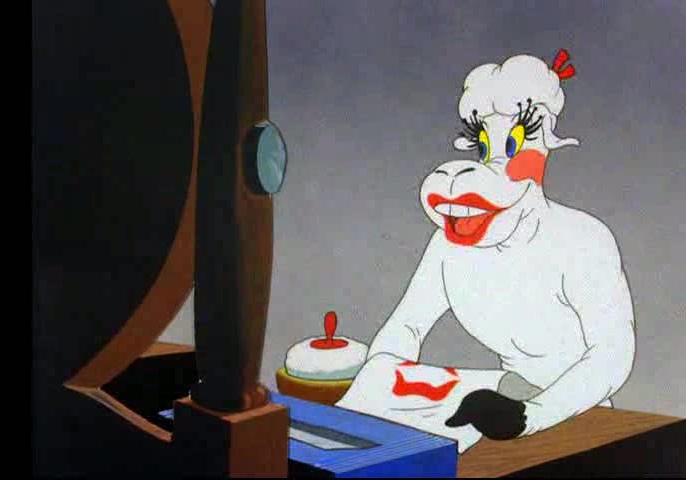 ‘I Got Plenty of Mutton’ opens with a hungry wolf reading in the newspaper that the sheepdog is drafted, leaving the sheep unprotected.
Unfortunately, Killer-Diller, “the wolf destroying ram” is now in charge, giving the wolf a hard time, especially when the wolf dresses up as a sexy female sheep tot lure the ram away. When to get rid of the horny ram, the wolf reveals himself as being a wolf, the ram simply replies “so am I!”.
This cartoon is full of zany silent comedy, with frequent looks into the camera by the poor wolf, anticipating similar looks by Chuck Jones’ Coyote in his Road Runner series.
Watch an excerpt from ‘I Got Plenty of Mutton’ yourself and tell me what you think:
Director: Frank Tashlin
Release Date: December 11, 1943
Rating: ★★★
Review:
 This cartoon opens with “Dicky Bird”, the canary, missing.
Rudolph, the cat who ate the bird (!), pretends the poor fellow has flown out of the window, so his mistress orders another one, which turns out to be considerably harder to catch.
The main body of ‘Puss ‘n Booty’ consists of blackout gags that anticipate the Tweety and Sylvester cartoons by four years.
This short was Warner Bros.’ last cartoon in black and white. Nevertheless, its broad use of blacks, greys and white and the startling camera angles (Frank Tashlin’s trademark) make it as modern as any other cartoon of the era.
Watch ‘Puss ‘n Booty’ yourself and tell me what you think:
Director: Frank Tashlin
Release Date: October 30, 1937
Stars: Porky Pig, Petunia Pig
Rating: ★★★★
Review:
 In this cartoon Porky suddenly has three elder brothers (Peter, Portus, and Percy), while Petunia appears to be his sister.
The siblings inherit their estate from their late uncle Solomon (who’s a caricature of Oliver Hardy). Unfortunately, the evil lawyer Goodwill is after them, changing himself into a Dr. Hyde-like character. Strangely enough he insults somebody in the audience, the “guy in the third row”. This to his own regret, for it’s this guy who saves Porky and his siblings in the end! This type of dimension-defying humor was a novelty at the time and would become a Warner Bros. trademark in the late 1930s and early 1940s.
Watch ‘The Case of the Stuttering Pig’ yourself and tell me what you think:
This is Porky Pig cartoon no. 31
To the previous Porky Pig cartoon: Rover’s Rival
To the next Porky Pig cartoon: Porky’s Double Trouble
Director: Frank Tashlin
Release Date: December 19, 1936
Stars: Porky Pig
Rating: ★★★
Review:
 Porky has a game refuge in Canada, in which he defends rather cute animals against an evil hunter.
The hunter is designed like the lieutenant from ‘Little Beau Porky‘, but we only see him appear after 4’30. Before this his threat is shown by his shadow only, a remarkably inventive device for a cartoon of the 1930s.
Like other early Warner Brothers films, ‘Porky in the North Woods’ looks very primitive, and rather Disney-anno-1932/1933-like. Yet it features an extremely fast sequence of a squirrel running a ridiculously long distance through the woods to get help (and back to fetch and apple). Such short and fast sequences of characters crossing ridiculously long distances would become a trademark of Tashlin’s colleague Tex Avery. Like his first two films, Tashlin’s third short at Warner Bros. features a battle sequence: this time we watch an enormous number of animals being called to arms.
Porky hardly talks in this cartoon – it seems Tashlin tried to avoid his tiresome stutter. Indeed, in 1937, the original voice artist would be replaced by Mel Blanc, who was able to make Porky’s stutter funny.
Watch ‘Porky in the North Woods’ yourself and tell me what you think:
http://www.dailymotion.com/video/x2xp64z
This is Porky Pig cartoon no. 17
To the previous Porky Pig cartoon: The Village Smithy
To the next Porky Pig cartoon: Porky the Wrestler
Director: Frank Tashlin
Release Date: October 24, 1936
Stars: Porky Pig
Rating: ★★★½
Review:
 ‘Little Beau Porky’ is Frank Tashlin’s second film at Warner Bros. It’s a more clearly gag-orientated effort than his debut film ‘Porky’s Poultry Plant‘.
Porky (with his old stutter) is a soldier at the foreign legion, being bullied by his lieutenant. However, in the end he manages to single-handedly save the fort and to overthrow an evil Arab and his gang.
Like in ‘Porky’s Poultry Plant’, both design and animation are primitive. But Tashlin unmistakably shows his cinematic talent, especially in the opening sequence and in the preparation for battle.
Watch ‘Little Beau Porky’ yourself and tell me what you think:
http://www.dailymotion.com/video/x2xp5o3
This is Porky Pig cartoon no. 15
To the previous Porky Pig cartoon: Porky’s Moving Day
To the next Porky Pig cartoon: The Village Smithy
Director: Frank Tashlin
Release Date: August 22, 1936
Stars: Porky Pig
Rating: ★★★★
Review:
 Both director Frank Tashlin and composer Carl Stalling make their Warner Bros. debut in this film in which Porky (with his old ugly voice) has a fowl farm, threatened by a bunch of evil buzzards.
‘Porky’s Poultry Plant’ looks primitive when compared to Disney films of the same time, looking more like a Disney film from 1932-1933. Its story is sweet, and not very funny, but Carl Stalling’s music is fresh, and Tashlin’s staging is already very impressive. Especially the air battle sequence (in which Porky, in a small army plane, fights an air fleet of hawks ) is remarkably stunning, showing unparalleled fast montage and original ‘camera’ shots. Both these techniques would become Tashlin trademarks, and would contribute to a faster, more gag-orientated style at Warner Bros. Tashlin had replaced Jack King, who had returned to Disney, and with his first Warner Bros. cartoon he immediately proves to be a more inventive director than his predecessor.
Watch ‘Porky’s Poultry Plant’ yourself and tell me what you think:
http://www.supercartoons.net/cartoon/822/porky-pig-porkys-poultry-plant.html
This is Porky Pig cartoon no. 12
To the previous Porky Pig cartoon: Porky the Rainmaker
To the next Porky Pig cartoon: Milk and Money
Director: Chuck Jones
Release Date: April 19, 1952
Stars: Bugs Bunny
Rating: ★★★★
Review:
 Six years after ‘Hair-raising Hare’ (1946) Bugs Bunny faces the orange monster in sneakers again.
‘Water, Water Every Hare’ is a horror cartoon featuring almost everything a horror movie should have: an evil scientist, a monster, a mummy and a robot. This story is rather awkwardly framed, however, by a story about the river flooding Bugs’s home and transporting him to and from the castle. Facing the monster Bugs repeats his manicure-tric from the earlier film, although this time he pretends to be a hair dresser. He also makes himself invisible and he makes the monster shrink.
If not as funny as ‘Hair-raising Hare’, ‘Water, Water Every Hare’ is full of clever gags. It moves at a relatively relaxed pace, which only a very confident film maker could use with such effect. In that respect, ‘Water, Water Evey Hare’ shows the mastery director Chuck Jones had achieved. He needn’t be fast and furious to be funny and he knew it.
Watch ‘Water, Water Every Hare’ yourself and tell me what you think:
http://www.metacafe.com/watch/7621186/water_water_every_hare_1952/
‘Water, Water Every Hare’ is available on the DVD set ‘Looney Tunes Golden Collection, Vol. 1’
This is Bugs Bunny cartoon No. 90
To the previous Bugs Bunny cartoon: Foxy Proxy
To the next Bugs Bunny cartoon: Hasty Hare
Director: Friz Freleng
Release Date: May 2, 1953
Stars: Bugs Bunny, Yosemite Sam
Rating: ★★★★
Review:

When his home country looks like a desert and he becomes short of carrots, Bugs migrates to Alabama.
Unfortunately, the ‘Mason Dixie Line’, the border between the North (desert) and the South (beautiful green landscape), is protected by Southerner Sam, who isn’t aware that the civil war has ended ages ago. This preposterous idea leads to great gags involving several impersonations by Bugs, a.o. of Abraham Lincoln.
Watch ‘Southern Fried Rabbit’ yourself and tell me what you think:
http://archive.org/details/SouthernFriedRabbit_35
This is Bugs Bunny cartoon No. 98
To the previous Bugs Bunny cartoon: Upswept Hare
To the next Bugs Bunny cartoon: Hare-Trimmed
‘Southern Fried Rabbit’ is available on the DVD set ‘Looney Tunes Golden Collection Volume Four’
Director: Chuck Jones
Release Date: January 19, 1952
Stars: Bugs Bunny, Wile E. Coyote
Rating: ★★
Review:
 The second appearance of the Coyote after his debut film ‘Fast and Furry-ous‘ (1949) was, surprisingly, not another Road Runner cartoon.
Instead, director Chuck Jones decided to place his still fresh carnivore character against Bugs Bunny, a character increasingly in need of worthy opponents.
in ‘Operation: Rabbit’ Wile E. Coyote gets his name (in the Road Runner cartoons he’s never called that way). Wile E. introduces himself to Bugs as ‘genius’, and suddenly he is a talking character, speaking with an eloquent, vaguely British voice. The experiment is not successful. The coyote’s ability to speak floods the action with a lot of superfluous dialogue, and he almost totally lacks the sympathetic frustration so wonderfully demonstrated in the Road Runner cartoons. Moreover, there’s hardly any chemistry between the two overconfident characters, which leads to remarkably unfunny gags, with only the one involving a flying saucer being able to create a chuckle.
Despite the shortcomings, Jones would make Bugs Bunny and Wile E. Coyote co-star in three more cartoons: ‘To Hare is Human’ (1956), ‘Rabbit’s Feat’ (1960), and ‘Compressed Hare’ (1961). Meanwhile the Coyote would have a much more interesting career in the Road Runner cartoons, with the second one, ‘Beep Beep’, appearing four months after ‘Operation Rabbit’.
Watch ‘Operation: Rabbit’ yourself and tell me what you think:
This is Bugs Bunny cartoon No. 87
To the previous Bugs Bunny cartoon: Big Top Bunny
To the next Bugs Bunny cartoon: 14 Carrot Bunny
Director: Chuck Jones
Release Date: January 3, 1953
Stars: Sam Sheepdog & Ralph Wolf
Rating: ★★★★★
Review:
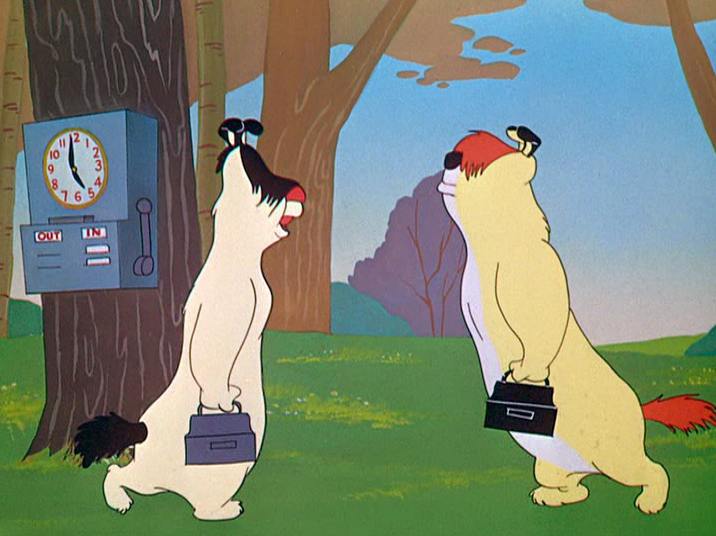 ‘Don’t Give up the Sheep’ is the first cartoon in a series of seven cartoons featuring the excellent duo Sam Sheepdog and Ralph Wolf.
In their first entry Sam Sheepdog is called Ralph, while Ralph remains yet unnamed. Sam goes to work, relieving his colleague Fred in attending the sheep. He has to counter the attacks by Ralph the wolf, who looks like Wile E. Coyote’s scruffy cousin. The cartoon is full of excellent, Road Runner-like blackout cartoons. In his silliest attempt the wolf dresses up as the God Pan to lull the sheepdog to sleep. To no avail, of course.
In this cartoon the backgrounds (by Carlos Manriquez) are becoming more stylized, although they still look like real nature. Sam and Ralph would never become major characters, but their miniseries is a little delight within the Warner Brothers canon.
Watch ‘Don’t Give up the Sheep’ yourself and tell me what you think:
http://www.wimp.com/hilariouscartoon/
‘Don’t Give up the Sheep’ is available on the DVD set ‘Looney Tunes Golden Collection, Vol. 1’


 Dr. Grob's Animation Review