You are currently browsing the category archive for the ‘Looney Tunes’ category.
Director: Chuck Jones
Release Date: August 11, 1945
Stars: Bugs Bunny
Rating: ★★★★
Review:
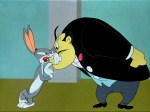 In ‘Hare Conditioned’ Bugs Bunny is working in a display at a department store. But the manager has other plans with him and wants our hero stuffed.
‘Hare Conditioned’ is full of director Chuck Jones’ typical sophisticated humor and extreme posing. For example, at the beginning of the chase scene we can see the manager looking for Bugs in three places. His move from one place to another is done in smears only one frame long, leading to extremely fast takes between the poses. Also, the final chase, involving elevators and stairs, is wonderfully timed. One of the short’s best gags, however, is set to a slower pace, and involves Bugs cross-dressing as a female customer and the manager courting him/her by tickling his/her feet.
Unfortunately, the cartoon ends abruptly with a rather trite ending: when the manager has Bugs Bunny cornered on the roof, Bugs convinces his adversary there’s a monster behind him, with himself posing as the monster, making the manager jump off the roof. But then he looks into the mirror himself…
‘Hare Conditioned’ is one of the great entries in the Bugs Bunny canon. The short clearly establishes Jones’s concept of the rabbit, as the director stated in his book ‘Chuck Amuck’:
“Golden Rule. Bugs must always be provoked. In every film, someone must have designs upon his person: gastronomic, as a trophy, as a good-luck piece (…..), as an unwilling participant in a scientific experiment (laboratory rabbit or outer-space creature). Without such threats Bugs is far too capable a rabbit to evoke the necessary sympathy”.
Indeed, Bugs only comes into action in this cartoon when threatened by death. First he tries to flee his foe, but when this proves impossible he takes control of the situation himself. Only then he does serious harm to his opponent. Nevertheless, Bugs remains calm throughout the cartoon.
Jones kept to his golden rule in the rest of his cartoons, giving Bugs other large or powerful adversaries like a giant red monster in ‘Hair-Rasing Hare’ (1946), a large boxer in ‘Rabbit Punch‘ (1948), or a Martian, capable of blowing up the earth, in ‘Haredevil Hare‘ (1948).
Watch ‘Hare Conditioned’ yourself and tell me what you think:
https://www.dailymotion.com/video/x5y67d2
This is Bugs Bunny cartoon No. 33
To the previous Bugs Bunny cartoon: Hare Trigger
To the next Bugs Bunny cartoon: Hare Tonic
‘Hare Conditioned’ is available on the DVD-set ‘Looney Tunes Golden Collection Volume Two’
Director: Robert McKimson
Release Date: June 28, 1947
Stars: Bugs Bunny, Elmer Fudd
Rating: ★★★★★
Review:
 McKimson’s second Bugs Bunny cartoon is way funnier than his first one, ‘Acrobatty Bunny‘ (1946).
In ‘Easter Yeggs’, Bugs Bunny encounters a lethargic Easter Bunny who makes Bugs replace him, because he has ‘sore feet’. Bugs ends up delivering Easter eggs in some slum, where he’s troubled by an unbelievably annoying little red-haired kid. In his next attempt he encounters Elmer Fudd, who’s only after Easter bunny stew.
Penned by Warren Foster, ‘Easter Yeggs’ is a hilarious cartoon, and without doubt among both Robert McKimson’s and Bugs Bunny’s all time best. Its highlight may be Bugs’ performance as a magician conducting a misguided trick with Elmer’s watch.
Watch ‘Easter Yeggs’ yourself and tell me what you think:
This is Bugs Bunny cartoon No. 44
To the previous Bugs Bunny cartoon: A Hare Grows in Manhattan
To the next Bugs Bunny cartoon: Slick Hare
Director: Robert McKimson
Release date: June 29, 1946
Stars: Bugs Bunny
Rating: ★★
Review:
 ‘Acrobatty Bunny’ is director Robert McKimson’s first Bugs Bunny cartoon. It’s not his best.
When a circus moves in, it disturbs Bugs Bunny’s quiet home life. When he wants to complain, he encounters a lion and the rest of the cartoon consists of his battle with this animal.
Bugs seems in less control than he normally is and their battle is not very funny. McKimson would bring Bugs back to the circus in the more successful ‘Big Top Bunny‘ (1951).
Watch ‘Acrobatty Bunny’ yourself and tell me what you think:
http://ulozto.net/live/x2MQDJj/bugs-bunny-acrobatty-bunny-1946-avi
This is Bugs Bunny cartoon No. 38
To the previous Bugs Bunny cartoon: Hair-Raising Hare
To the next Bugs Bunny cartoon: Racketeer Rabbit
Director: Bob Clampett
Release Date: January 5, 1946
Stars: Daffy Duck
Rating: ★★★★
Review:
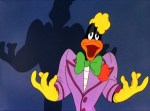 ‘Book Revue’ is the last of the book-covers-come-to life cartoons, a series started by Harman and Ising in 1932, with ‘Three’s a Crowd’.
These cartoons, in which the book titles provide the gags, were mostly plotless, relying on puns and sight gags. ‘Book Revue’ is no exception, but it has the most swinging take on the formula one can wish for.
Set in ‘ye olden book shoppe’, ‘Book Revue’ contains caricatures of some famous (white) jazzmen of the era: Harry James, Frank Sinatra, Tommy Dorsey, Benny Goodman and Gene Krupa. There’s a scene resembling ‘The Swooner Crooner’ (1944), and foreshadowing ‘Little ‘Tinker’ (1948), in which several female characters swoon as soon as Sinatra starts singing. There’s a strong sense of sex here, as in an earlier scene involving ‘Indian strip’, affecting male characters. This places ‘Book Revue’ at the end of the World War II cartoon trends, for these allusions to sex would soon be discarded.
At a certain point Daffy Duck (jumping from a Merrie Melodies and Looney Tunes magazine cover) dresses himself as Danny Kaye (with a blonde wig). He interrupts the swing music to tell about a nonsensical tale of some Russian youth and a girl called Cucaracha. In this sequence Daffy imitates the Russian accent Kaye sometimes would explore. When ‘singing’ cucaracha the background suddenly changes into a startling monochrome red.
This absurd sequence is followed by Daffy singing ‘Carolina in the Morning’. Daffy immediately exchanges the song for some superb scat singing to warn Red Riding Hood for the Wolf. These two sequences form a highlight in Daffy’s career, and a real tour de force from voice actor Mel Blanc. The ‘story’, if there is any, involves Daffy being followed by the wolf from Red Riding Hood. In line with the book-covers-come-to-life tradition several personas from book covers come to help to get rid of the villain, sending the wolf to Dante’s inferno.
The animation of Daffy is extremely flexible in this cartoon, especially when animated by Rod Scribner and Manny Gould, who really push the limits here. At one point Daffy even converts into one big eye – probably the most extreme deformation of a major cartoon star ever put to screen.
‘Book Revue’ makes no sense at all, but it is a cartoon full of sheer joy, and a crowning achievement of the book series.
Watch an excerpt from ‘Book Revue’ yourself and tell me what you think:
This is Daffy Duck cartoon No. 31
To the previous Daffy Duck cartoon: Nasty Quacks
To the next Daffy Duck cartoon: Baby Bottleneck
‘Book Revue’ is available on the DVD-set ‘Looney Tunes Golden Collection Volume Two’ and on the Blu-Ray-set ‘Looney Tunes Platinum Collection: Volume 2’


 Dr. Grob's Animation Review