
You are currently browsing the tag archive for the ‘1931’ tag.
Director: Burt Gillett
Release Date: September 30, 1931
Stars: Clarabelle Cow, Horace Horsecollar, Mickey Mouse, Minnie Mouse, Pluto
Rating: ★★★
Review:
 Mickey’s got his own radio station at the barn. There, Minnie, Horace Horsecollar and Clarabelle Cow perform some music to broadcast.
All goes well, until a cat and her little kittens cause havoc in the studio. Mickey has a hard time chasing them away, and during his efforts all instruments are destroyed.
‘The Barnyard Broadcast’ reuses the cat from ‘Mickey Steps Out‘ from two months earlier, and it introduces the numerous kittens that would cause Mickey lots of trouble in the subsequent films ‘Mickey’s Orphans‘ (1931) and ‘Mickey’s Revue‘ (1932). After that their role would be taken over by the orphan mice, introduced in ‘Mickey’s Nightmare‘ (1932).
After ‘Mickey Steps Out’, ‘The Barnyard Broadcast’ is another attempt in building a finale in a string of gags. The film is not entirely successful in this and only gains momentum when Mickey chases the cat away with a broom. The technique would be perfected in the subsequent films, ‘The Beach Party‘ and ‘Mickey Cuts Up‘.
Watch ‘The Barnyard Broadcast’ yourself and tell me what you think:
This is Mickey Mouse cartoon No. 33
To the previous Mickey Mouse cartoon: Fishin’ Around
To the next Mickey Mouse cartoon: The Beach Party
Director: Burt Gillett
Release Date: September 1, 1931
Stars: Mickey Mouse, Pluto
Rating: ★
Review:
 Mickey and Pluto go fishing in a no fishing area, but the fish are making fun of them.
Pluto even gets under water, sniffing the bottom of the lake and meeting an enormous fish. This scene reuses quite some animation of Pluto sniffing from Pluto’s debut ‘The Picnic‘ (1930). Then a gamekeeper appears, but Mickey and Pluto escape him. The goat-like gamekeeper would return in Floyd Gottfredson’s Mickey Mouse comic ‘Dr. Oofgay’s Secret Serum’ (July 1934).
Like ‘Traffic Troubles‘, ‘The Moose Hunt‘ and ‘The Beach Party‘ from the same year, ‘Fishin’ Around’ is a genuine gag cartoon. It is the weakest of the lot, however, and can hardly be called a classic. The tricks the fish pull at Pluto and Mickey are amusing, but nothing more than that. Both the fish and Pluto steal a lot of screen time from Mickey, who is blander than ever before in this short.
Nevertheless, the film is a modest example of how the Disney studio tried to improve the quality of its animation. Notice, for example, the reflections and other water effects in this short. By now, they had become standard in Disney cartoons. Moreover, the cartoon starts with some quite convincing animation of Mickey rowing. There’s some clear sense of pulling weight here, even though these cycles are interspersed with less convincing animation.
Watch ‘Fishin’ Around’ yourself and tell me what you think:
This is Mickey Mouse cartoon No. 32
To the previous Mickey Mouse cartoon: Blue Rhythm
To the next Mickey Mouse cartoon: The Barnyard Broadcast
Director: Burt Gillett
Release Date: June 6, 1931
Stars: Mickey Mouse, Minnie Mouse, Pete (cameo), Pluto
Rating: ★★
Review:
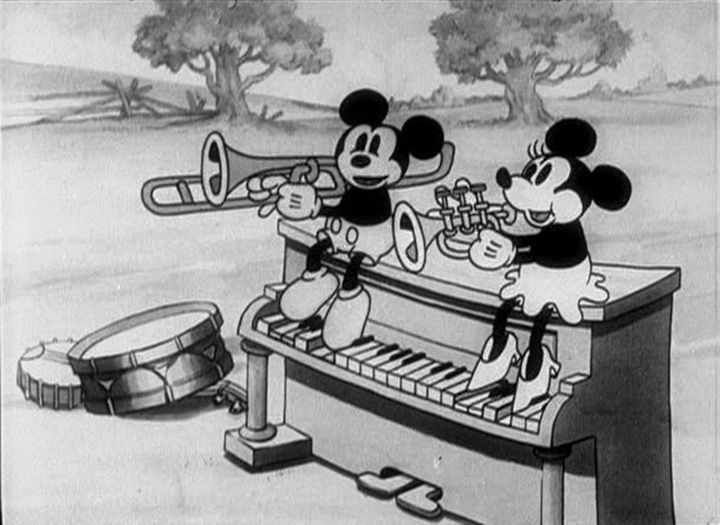 In ‘The Delivery Boy’ we watch Minnie doing the laundry in a pasture, singing the 1905 hit song ‘In the Shade of the Old Apple Tree’.
Mickey surprises her, and they dance the Charleston together to the background music. Mickey is so happy, he boxes a wasp’s nest. The wasp’s nest hits his donkey and his whole delivery, which consists of musical instruments, is spread over the pasture.
Undaunted, Mickey and Minnie start playing the piano, and all the farm animals join in, playing ‘The stars and stripes forever’. The cartoon ends when Pluto retrieves a burning dynamite stick and everything explodes. Nevertheless, Mickey is still able to finish playing John Philip Sousa’s famous march.
‘The Delivery Boy’ is as joyous as it is boring. After three years of song-and-dance routines one grows rather tired of it. Moreover, cartoons like ‘Traffic Troubles‘ and ‘The Moose Hunt‘ had proven that Mickey could do very well without them.
Pluto would cause havoc again in some of the succeeding films, like ‘Mickey Steps Out‘ (1931), ‘Mickey Cuts Up‘ (1931) and ‘The Grocery Boy‘ (1932). In these films the song-and-dance routine would give way to well-build gag-filled finales, of which the one in ‘The Delivery Boy’ is an embryonic version.
Watch ‘The Delivery Boy’ yourself and tell me what you think:
This is Mickey Mouse cartoon No. 29
To the previous Mickey Mouse cartoon: The Moose Hunt
To the next Mickey Mouse cartoon: Mickey Steps Out
Director: Burt Gillett
Release Date: April 30, 1931
Stars: Mickey Mouse, Pluto
Rating: ★★★½
Review:
 In ‘The Moose Hunt’ Mickey and Pluto are hunting moose.
They finally find a moose (or more exactly, the moose finds them). Unfortunately, in front of the moose, Mickey’s gun fails and soon the moose hunts both Mickey and Pluto. The chase ends with Mickey escaping on a flying Pluto.
‘The Moose Hunt’ is Mickey’s third gag only short, after ‘The Fire Fighters‘ (1930) and ‘Traffic Troubles‘ from earlier that year. It’s hardly as good as those earlier entries, though. Its pace is slow, and it contains some awkward gags, like the flying Pluto finale. It also contains a rare gag breaking the fourth dimension: when Mickey accidentally shoots Pluto, he suddenly addresses the audience with a “Is there a doctor in the house?”. Then, when Mickey begs Pluto to speak to him, Pluto actually speaks!
The self-conscious audience gag would remain a rarity at Disney, but it would become a staple gag at Warner Bros. when Tex Avery joined that studio. The two Pluto gags are totally out of character, and have nothing to do with him being a dog. After ‘The Moose Hunt’ we would never see Pluto flying or speaking again (apart from a short ‘Mammy’ at the end of ‘Mickey Steps Out‘), and after watching ‘The Moose Hunt’ it is easily understandable why not.
Luckily, there are other scenes that are more inspired, and in which Pluto behaves like a dog throughout. Indeed, in his very first solo scene, which reuses a little animation from ‘The Chain Gang‘ (1930), Pluto’s character as a little dumb and a little cowardly dog is pretty well established. Pluto’s looks are still unstable, but he’s excellently animated, throughout.
In ‘The Moose Hunt’ Pluto also gets his name (he was called ‘Rover’ in his first appearance in ‘The Picnic‘ from six months earlier). He now clearly is Mickey’s dog, not Minnie’s, like in the earlier film. It’s clear that the Mickey Mouse films could use an extra character, and after this film Pluto would appear in almost all succeeding Mickey Mouse films, stealing more and more screen time from Mickey.
Mickey would go hunting moose again in the way funnier ‘Moose Hunters’ from 1937, which, incidentally, doesn’t star Pluto.
Watch ‘The Moose Hunt’ yourself and tell me what you think:
This is Mickey Mouse cartoon No. 28
To the previous Mickey Mouse cartoon: The Castaway
To the next Mickey Mouse cartoon: The Delivery Boy
Director: Wilfred Jackson
Release Date: March 27, 1931
Stars: Mickey Mouse
Rating: ★★
Review:
 Mickey is a castaway, stranding on a tropical island.
Luckily, a piano is washed ashore as well, so Mickey performs for the jungle animals inhabiting the island. Unfortunately, an obnoxious little tiger disturbs him, and a great ape wants to play the piano, too, wrecking the instrument.
‘The Castaway’ was a short made out of rest material, and it shows: Mickey’s looks are wildly inconsistent, there’s not even a hint of a story, and the whole film feels like a throwback to 1929. Nevertheless, this short contains nice effect animation of waves washing ashore. It also reuses some animation of dancing sea lions from ‘Wild Waves‘ (1929) and of a dancing ape from ‘Jungle Rhythm‘ (1929), the film with which ‘The Castaway’ has most in common, which is no advertisement. In fact, Walt Disney disliked the film, thinking it didn’t look like a Walt Disney picture. And indeed, it hardly does.
The gag in which a lion gets eaten by a crocodile was borrowed from a very early Mickey Mouse comic strip from February 1930, which incidentally was the last panel drawn by Ub Iwerks himself.
‘The Castaway’ is also noteworthy for being the first Disney short to feature music by Frank Churchill, who would score many Disney shorts, and who would become particularly famous for the hit song ‘Who’s Afraid of the Big Bad Wolf’ from ‘Three Little Pigs‘ (1933) and the songs in ‘Snow White and the Seven Dwarfs’ (1937).
Watch ‘The Castaway’ yourself and tell me what you think:
This is Mickey Mouse cartoon No. 27
To the previous Mickey Mouse cartoon: Traffic Troubles
To the next Mickey Mouse cartoon: The Moose Hunt
Director: Burt Gillett
Release Date: December 5, 1931
Stars: Mickey Mouse, Minnie Mouse, Pluto
Rating: ★★★★½
Review:
 It’s Christmas and a poor lady drops by Mickey and Minnie’s house to leave a box at their doorstep.
This box contains an endless quantity of little kittens, which are taking over the house within seconds. Soon, the house is near complete destruction. This is partly Mickey’s own fault, because dressed up as Santa he gives the little brats toys like hammers, saws, drills, axes, and even guns and canons.
‘Mickey’s Orphans’ is a real gag cartoon from the outset and the first of several Mickey Mouse shorts in which many brats cause havoc. No musical routine is involved, and as soon as the box of kittens is opened, the gags roll in like they never did before. The kittens even manage to give the ever cheerful Mickey and Minnie a dismayed look, albeit only at the end of the cartoon. The little kittens would cause havoc again in ‘Mickey’s Revue‘ (1932) before being replaced by the little mice in ‘Mickey’s Nightmare‘ later that year. Maybe the idea of giant mice dealing with little kittens was a little too awkward for the makers…
‘Mickey’s Orphans’ is the first of no less than four Mickey Mouse Christmas cartoons, the others being ‘Mickey’s Good Deed‘ (1932), ‘Pluto’s Christmas Tree’ (1952) and ‘Mickey’s Christmas Carol‘ (1983). It was nominated for the very first Academy Award for animated short film, but it understandably lost to the first technicolor short ‘Flowers and Trees‘ (1932), although Walt Disney did get a special Academy Award for the creation of Mickey Mouse.
Watch ‘Mickey’s Orphans’ yourself and tell me what you think:
This is Mickey Mouse cartoon No. 36
To the previous Mickey Mouse cartoon: Mickey Cuts Up
To the next Mickey Mouse cartoon: The Duck Hunt
Director: Burt Gillett
Release Date: November 25, 1931
Stars: Mickey Mouse, Minnie Mouse, Pluto
Rating: ★★★½
Review:
 ‘Mickey Cuts Up’ can be summarized as ‘Mickey Steps Out’ set in a garden.
The first part of the cartoon consists of a quite tiring song-and-dance-routine (with Mickey dancing as a turtle as a minor highlight). Like in ‘Mickey Steps Out’ there’s some whistling with the birds, with Mickey impersonating one. Later the two perform the 1921 hit song ‘Ain’t We Got Fun’ on harmonicas.
Only after five minutes, the second part starts. This hilarious sequence is devoted to Pluto chasing a cat and causing havoc, just like he did in ‘Mickey Steps Out’. The contrast with the first half couldn’t be greater: suddenly the gags come fast and plenty. There’s even an early running gag in which Mickey gets wet in various ways. The second half is of a stunning speed, and a real tour de force in its string of gags leading to other gags, and to the grand finale. This half makes the cartoon a stand out of the era, and one that looks forward to things to come.
Watch ‘Mickey Cuts Up’ yourself and tell me what you think:
This is Mickey Mouse cartoon No. 35
To the previous Mickey Mouse cartoon: The Beach Party
To the next Mickey Mouse cartoon: Mickey’s Orphans
Director: Burt Gillett
Release Date: July 10, 1931
Stars: Mickey Mouse, Minnie Mouse, Pluto
Rating: ★★★½
Review:
 ‘Mickey Steps Out’ is the first of a few Mickey Mouse cartoons that are half musical numbers half story.
This was a plot structure used in many Mickey Mouse cartoons from 1931 to 1933, with ‘The Pet Store‘ being the last example. This half-baked structure was soon replaced by stories filling the complete cartoons.
In ‘Mickey Steps Out’, Mickey visits Minnie, but Pluto, who should have stayed in, is following him, dragging his dog house along to Minnie’s place. First, Mickey and Minnie perform their usual song-and-dance-routine (this time based on ‘Sweet Georgia Brown’), but when Pluto is chasing a cat, their music is interrupted and followed by a fast sequence of gags of Pluto and the cat ruining the house culminating in a blackface gag.
‘Mickey Steps Out’ arguably contains the first well-constructed finale in Disney history. It’s at least the first of a series of cartoons that end in complete destruction. Pluto would again cause havoc in ‘Mickey Cuts Up’ (1931) and ‘The Grocery Boy’ (1932). Later, destruction would be caused by little kittens (a.o. ‘Mickey’s Orphans‘, 1931) and orphan mice (a.o. ‘Mickey’s Nightmare‘, 1932). ‘Mickey Steps Out’ reuses footage of ‘The Birthday Party’ of Mickey with a fishbowl on his head.
Almost secretly, the film introduces another novelty: the first attempt at a realistically drawn animal: Minnie’s canary is in no sense cartoony, behaving like a real bird. It’s a major advance when compared to the Silly Symphony ‘Birds of a Feather‘ from six months earlier. The canary only plays a small part in the cartoon, but is the testimony of Disney’s ultimate ambitions, even at this stage. It’s these innovations, better story arcs and a strive towards better, more realistic animation that propelled the Disney cartoons forward, leaving their contemporaries far behind.
Watch ‘Mickey Steps Out’ yourself and tell me what you think:
This is Mickey Mouse cartoon No. 30
To the previous Mickey Mouse cartoon: The Delivery Boy
To the next Mickey Mouse cartoon: Blue Rhythm
Director: Burt Gillett
Release Date: January 2, 1931
Stars: Clarabelle Cow, Horace Horsecollar, Mickey Mouse, Minnie Mouse
Rating: ★★½
Review:
 Mickey visits Minnie who has organized a surprise party for his birthday.
Mickey gets a piano for a present and he and Minnie perform a duet on two pianos, singing the 1928 hit ‘I Can’t Give You Anything But Love, Baby’, popularized by e.g. Annette Hanshaw and Louis Armstrong. When Mickey and Minnie dance themselves to the 1917 classic Darktown Strutters’ Ball, their music-stools take over their playing (as did Mickey’s stool in ‘Mickey’s Follies’ from 1929). The cartoon ends with Mickey playing variations on the 12th Street Rag on a stubborn marimba.
This cartoon is actually one long joyful play-and-dance-routine, but its beginning is quite remarkable: when Mickey and Minnie bashfully ask each other whether they’re fine, this may probably be the first funny dialogue in Disney history. At least, it’s a wonderful example of character animation, elegantly establishing the relationship between the two.
Mickey would celebrate his birthday again in ‘Mickey’s Birthday Party’ (1942), which only superficially resembles this earlier short.
Watch ‘The Birthday Party’ yourself and tell me what you think:
This is Mickey Mouse cartoon No. 25
To the previous Mickey Mouse cartoon: Pioneer Days
To the next Mickey Mouse cartoon: Traffic Troubles
Director: Wilfred Jackson
Release Date: June 22, 1931
Rating: ★★½
Review:
 This Silly Symphony is a quite uninteresting cartoon about beavers.
The film starts with rather dull gags of beavers building a dam to Frank Churchill’s music. By now the dance routines had vanished from the screen, to make place for rhythmical movement. The beavers are portrayed almost as industrial workers, and this first half simply bursts with animation cycles.
Only after four minutes a ‘story’ develops of a little beaver who saves the whole population from a terrible flood. The beavers completely lack personality and even the spirited little one fails to impress. After such elaborate cartoons as ‘Mother Goose Melodies‘ and ‘The China Plate‘ the cartoon’s uniform, dull designs, and tiresome repetitive animation come as a letdown. The result is one of the weaker Silly Symphonies, although it features some quite spectacular animation of the approaching flood.
Watch ‘The Busy Beavers’ yourself and tell me what you think:
This is Silly Symphony No. 19
To the previous Silly Symphony: The China Plate
To the next Silly Symphony: The Cat’s Out
Director: Wilfred Jackson
Release Date: May 16, 1931
Rating: ★★★★½
Review:
 Although this cartoon is one of those Silly Symphonies from 1931 using the half dance-routine half story formula, it is one of the most beautiful and most entertaining Silly Symphonies of the era.
The film is inspired by a Western view on a mythical ancient China. The film is without any dialogue and makes effective use of Albert Ketèlbey’s musical piece ‘In a Chinese Temple garden’ to create an oriental atmosphere. It tells a simple story of a little fisherman who saves a girl from drowning, falls in love with her and rescues her from an evil mandarin and a large (Western and fire-breathing) dragon.
After ‘Mother Goose Melodies‘ this is the studio’s second take at the human figure. The result is a mixed bag. The heroin’s movements are still cartoony, for example, and she walks with her knees sideways. Even worse, the long-legged China-man has no hint of realism at all. Moreover, the hero’s size is quite inconsistent, suddenly becoming very small when fighting the evil mandarin. On the other hand, the boy and girl are elegantly drawn, especially their hands. The two easily gain the audience’s sympathy and transcend the stereotypes that occupy most of the film.
Together with ‘Mother Goose Melodies’, ‘The China Plate’ is the most elaborate of the early Silly Symphonies. It’s surprisingly fast-paced and full of action. The complete cartoon is one of sheer delight.
Watch ‘The China Plate’ yourself and tell me what you think:
This is Silly Symphony No. 18
To the previous Silly Symphony: Mother Goose Melodies
To the next Silly Symphony: The Busy Beavers
Director: Wilfred Jackson
Release Date: December 12, 1931
Rating: ★★★★★
Review:
 This is the first of two versions of ‘The Ugly Duckling’ made by Disney.
Unlike the latter, more familiar version, this ugly duckling is a real duck, accidentally born to a chicken. He’s rejected until he saves his chick brothers and sisters from drowning in a long, fast and exciting action scene, involving both a tornado and a waterfall.
Although looking crude and primitive when compared to the 1939 short, this first version of The Ugly Duckling is a milestone in Disney’s storytelling: while the earlier Silly Symphonies contain a lot of repetitive animation and dance routines, The Ugly Duckling is the first Silly Symphony to tell a coherent story from the beginning to the end. Even the Mickey Mouse films of that time are not that consistent. There still is some rhythmic movement, especially at the beginning, but most of the animation is there to tell the story.
The duckling (who repeatedly looks to the audience for sympathy – not unlike Oliver Hardy) is a real character who transforms from an outcast to a hero, and gains its well-earned sympathy at last. Its best scenes are when it feels rejected, not only by his ‘family’, but also by a cow, a dog and a frog. There’s some genuine feeling of loneliness and unhappiness in these scenes, unparalleled in any other animated film of the time.
This short, which is neither about gags nor about moving to music, would be the first testimony of Disney’s ambitions in storytelling.
Watch ‘The Ugly Duckling’ yourself and tell me what you think:
This is Silly Symphony No. 25
To the previous Silly Symphony: The Fox Hunt
To the next Silly Symphony: The Bird Store
Director: Wilfred Jackson
Release Date: August 19, 1931
Rating: ★★★
Review:
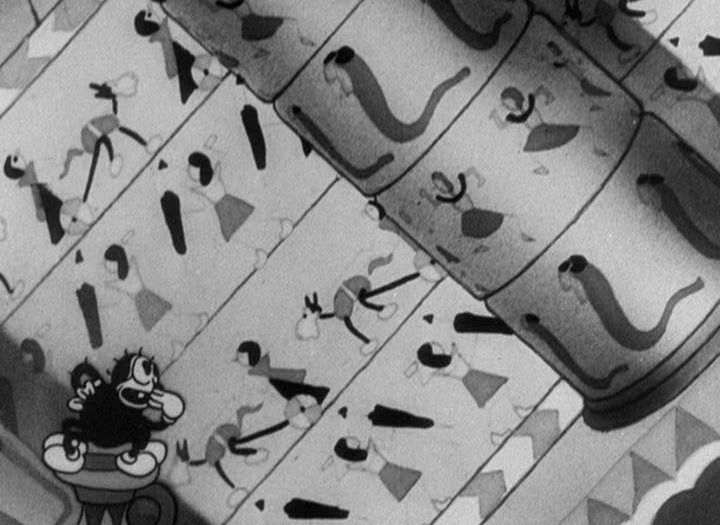
In ‘Egyptian Melodies’ the little six-legged spider from ‘Midnight in a Toy Shop‘ (1930) returns to the animated screen.
The short is one of those early Silly Symphonies that offers quite a dull dance routine only (and no story). Nevertheless, the introduction of the cartoon is well worth watching: when we follow the spider down into the pyramid, we experience some astonishing 3D-effect animation, creating the feeling that the camera wanders with the spider through corridors and staircases.
This unique exercise in perspective would not be repeated in animation until labyrinth computer games were introduced in the 1980s. The Disney Studio itself must have been impressed by this stunning piece of animation, for it was reused two years later in the Mickey Mouse cartoon ‘The Mad Doctor‘ (1933).
Once inside the pyramid, the spider watches four mummies dance, and the drawings on the walls coming to life. These last scenes feature 2-dimensional characters, which can be seen as very early and primitive forerunners of the cartoon modern style of the 1950s. Unfortunately, these scenes are a little bit dull, but they do lead to a great finale. This is one of the earliest nightmare-sequences, in which the montage of images is diffuse and increasingly sped up, in order to suggest the feeling of getting insane. This predates similar sequences in films like ‘Der Fuehrer’s Face‘ (1943) by many years.
The idea for ‘Egyptian Melodies’ may have come from the Van Beuren cartoon ‘Gypped in Egypt‘ (1930), which also features dancing hieroglyphs, nightmarish scenes, and even a corridor scene. Notice that the classic horror film ‘The mummy’ (1932) hadn’t been released, yet, at the time.
This is Silly Symphony No. 21
To the previous Silly Symphony: The Cat’s Out
To the next Silly Symphony: The Clock Store


 Dr. Grob's Animation Review