You are currently browsing the tag archive for the ‘1942’ tag.
Director: Jack King
Release Date: September 25, 1942
Stars: Donald Duck, Pete
Rating: ★★½
Review:
 ‘The Vanishing Private’ is the second of the Donald in the army cartoons. Like the first, ‘Donald Gets Drafted‘ from four months earlier, it features Pete as Donald’s adversary.
In the opening shot we watch Donald singing the theme song from ‘Donald Gets Drafted’ and painting a huge canon in ridiculously bright colors. Sergeant Pete tells him to make the canon hard to see. Donald does so by using invisible paint from an experimental laboratory. He accidentally falls into the bucket of paint himself, making himself invisible and driving Sergeant Pete mad.
‘The Vanishing Private’ suffers because of two reasons:
1) the invisibility makes Donald all too powerful. It’s therefore hard to sympathize with him, and not with poor Pete. This is a problem shared by other invisibility cartoons, like the Tom & Jerry cartoon ‘The Invisible Mouse‘ (1947).
2) The other Donald army cartoons are all about the pains and annoyances of normal army life, which is absolutely part of their fun. But the subject of ‘The Vanishing Pirate’ is so unlikely, one can hardly relate to it.
The result is not a funny cartoon, making ‘The Vanishing Private’ arguably the weakest of Donald’s army cartoons.
Watch ‘The Vanishing Private’ yourself and tell me what you think:
This is Donald Duck cartoon No. 35
To the previous Donald Duck cartoon: Donald’s Goldmine
To the next Donald Duck cartoon: Sky Trooper
Director: Jack King
Release Date: May 1, 1942
Stars: Donald Duck, Pete
Rating: ★★½
Review:
 The attack on Pearl Harbor, December 7, 1941, suddenly smacked The United States into war. The war changed the life of many American citizens, including cartoon stars.
Donald Duck was the fourth of these to support the war effort on the big screen, following Porky Pig, Barney Bear and Popeye, who had joined the army and navy, respectively, in July (‘Meet John Doughboy‘) and November 1941 (‘The Rookie Bear, ‘The Mighty Navy‘). Moreover, Popeye had already engaged the enemy in February in ‘Blunder Below‘. Donald was soon followed by Pluto (May 22), and Woody Woodpecker (June).
In ‘Donald Gets Drafted’, Donald enthusiastically signs up for the army, because he wants to fly, especially after seeing posters of very attractive air hostesses in uniform. His rather naive enthusiasm soon is lowered, when he first has to go through a rather rude medical examination only to end up in the infantry, where he’s bullied by sergeant Pete. Donald doesn’t make a very good soldier, much to Pete’s frustration, and ends up peeling potatoes.
‘Donald Gets Drafted’ is the first of six Donald Duck cartoons devoted to Donald’s career in the army. It introduces Pete as Donald’s sergeant, a role he would fulfill in three other of these war cartoons. The Donald Duck army cartoons are noteworthy for their ambiguous propaganda. Donald is far from a model soldier, and the cartoons makes quite some fun of the army superiors, in the form of Pete. It’s difficult to see them as army advertisements. Moreover, five of the six cartoons are devoted to Donald’s timid life at the training camp. Only in his last war cartoon, ‘Commando Duck’ (1944) would Donald leave American soil to kill some enemies.
With its humor being still quite mild, ‘Donald Gets Drafted’ is not the funniest of Donald’s army cartoons. It is noteworthy, however, for revealing that Donald Duck’s second name is Fauntleroy.
Watch ‘Donald Gets Drafted’ yourself and tell me what you think:
This is Donald Duck cartoon No. 32
To the previous Donald Duck cartoon: Donald’s Snow Fight
To the next Donald Duck cartoon: Donald’s Garden
Director: Leonid Amalrik & Olga Khodataeva
Release Date: 1942
Rating: ★★★★
Review:
 ‘Kino-Circus’ (also called Cinema Circus) is the most inspired of the anti-fascist war propaganda cartoons made in the Soviet Union.
The short is called ‘a cartoon satire in three acts’ and features a Charlie Chaplin-like character, who introduces us to three staged satires, all featuring Adolf Hitler:
In the first, ‘Adolf the dog trainer and his pooches’, Hitler throws a bone at his three dogs, Benito Mussolini, Miklós Horthy and Ion Antonescu, the leaders of his allies Italy, Hungary and Romania, respectively.
In the second, ‘Hitler visits Napoleon’, Hitler asks Napoleon’s tomb for advice, but the deceased drags him into the tomb. It’s the most prophetic of the three, for indeed both Napoleon and Hitler were defeated in Russia.
In the third, ‘Adolf the juggler on powder kegs’, Hitler juggles with several burning torches on a pile of powder-barrels, representing the countries he has occupied. When he accidentally drops one of the torches, the barrels explode. The animation is particularly silly in this sequence and a delight to watch.
After the grim political posters from 1941, ‘Kino-Circus’ is more lighthearted. The film ridicules Hitler more than it makes him threatening. Quite surprising since in1942 Nazi Germany was still a serious threat to the Soviet Union: Leningrad suffered under a long siege, and the Soviet Union had only just begun its counter-attack.
Interestingly, both directors of ‘Kino-Circus’ later became famous for their sweet fairy tale films.
Watch ‘Kino-Circus’ yourself and tell me what you think:
‘Kino-Circus’ is available on the DVD box set ‘Animated Soviet Propaganda’
Director: David Hand
Release Date: August 13, 1942
Rating: ★★★★★ ♕
Review:
 Although it was released after ‘Dumbo‘, ‘Bambi’ is essentially Disney’s fourth feature, and it was also the last in which the studio really pushed the envelope.
‘Bambi’ had been long in the making, with initial work already starting in 1937. In fact, it was initially planned as Disney’s second feature, but soon pushed back in favor of ‘Pinocchio’.
After having made such great and diverse efforts as ‘Snow White’, ‘Pinocchio‘ and ‘Fantasia’, Disney set the stakes even higher in Bambi, reaching a zenith in naturalism. But the film is way more than that: it’s a symphony of nature, utterly romantic in its depiction of forest life. It’s also a coming of age story and a depiction of the circle of life.
‘Bambi’ is full of great scenes, starting with the stunning opening scene, a long and complicated shot, which shows the vastness and depth of the forest using a multiplane camera, and which leads us straight into the story, when we come to follow friend owl in his flight.
The storytelling is very lean, it uses little dialogue and it consists of only a few distinct parts, which all concentrate on Bambi’s experiences. Most of the story is told by images and music only, and there are three pure mood pieces very reminiscent of a Silly Symphony like ‘The Old Mill‘ (1937) and parts of ‘Fantasia’: the April Shower sequence, the autumn sequence and Bambi’s love scene. In these sequences especially, it’s clear that atmosphere prevails above character development, and the studio indulges in beautiful imagery that is still impressive and enchanting today.
The film can be divided into eight sections (the titles are all mine):
1) Birth: which also introduces the lovable little rabbit Thumper;
2) Discovery of the world: including the introduction of the little skunk Flower and a rain scene, set to the beautiful song ‘April shower’;
3) The meadow: where both danger and other deer are introduced, including Bambi’s father and his later love interest, Feline;
4) Autumn: a short transitional mood piece;
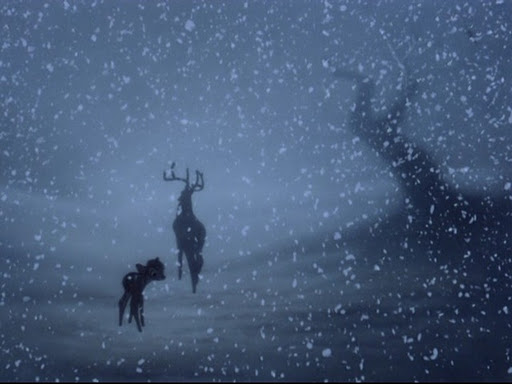
5) Winter: which includes the famous skating scene, inspired by Pluto’s difficulties on ice in ‘On ice‘ (1935) and which ends with that harrowing, yet off screen death of Bambi’s mother;
6) Spring: where all our characters have become adolescents and discover the power of love;
7) Man: where man, who never is seen on screen, but whose threatening presence is so much more felt, once again brings danger into the forest, shooting animals (including Bambi) and causing a forest fire, which leads to great dramatic and apocalyptic shots of the burning forest;
and finally
8) Birth again: in which the cycle is completed.
The first five sections take almost two-thirds of the film and are responsible for Bambi’s reputation of being a childish film full of cute animals. This may be partly true, but is does no justice to the complete film, for the last three sections, starting with the death of Bambi’s mother (which essentially ends his childhood) are more artistic, more expressionistic and more dramatic. These scenes belong to the most powerful animated images ever brought to the screen.
But throughout the complete picture the artwork is stunning: the backgrounds, based on designs by Tyrus Wong, are lush and suggestive, the use of color is very clever and often amazing, and the music, which is very important to the narrative and which uses off-screen songs to evoke moods, is rich and effective. Indeed, Bambi’s soundtrack, by composers Frank Churchill and Edward Plumb, ranks among the best scores of any animation film. Backgrounds, design, color, music – all these make the film a mood piece of an astonishing quality.
The animation itself, too, is a highlight. It was supervised by four of the later so-called ‘nine old men’: Eric Larson, Milt Kahl, Frank Thomas and Ollie Johnston, and it’s the first testimony of their legendary status. The animation is amazingly well-done both in its naturalism as in its sense of character. It ranks from pure naturalism in Bambi’s mother exploring the meadow and Bambi preparing to fight to pure character animation. A highlight of the latter is Bambi having to say hello to Feline. Bambi’s behavior in this scene is perfect that of a young bashful boy.
The only deviation from believability is during the Twitterpated sequence: Eric Larson’s animation on friend Owl is zany and cartoony, as is the animation of the lovestruck Flower. The whole sequence is a little bit ridiculous, and out of place with the rest of the film. Luckily as soon as Bambi falls in love with Feline, the last part starts, which in its drama, powerful imagery and stunning effects is the undisputed highlight of the whole movie.
Bambi never ceases to amaze: it is simply beautiful.
Watch the skating scene from ‘Bambi’ yourself and tell me what you think:
Director: Clyde Geronimi
Release Date: November 20, 1942
Stars: Pluto
Rating: ★★★★★
Review:
 With ‘Pluto at the zoo’ director Clyde Geronimi delivers his most successful Pluto short.
In this short Pluto carries a tiny bone when he discovers a huge bone at the Lion’s cave. He decides to steal it, but this causes him lots of trouble with the lion, a kangaroo, a gorilla and several crocodiles.
Pluto’s pantomime is wonderful in this cartoon, and, unlike most of the previous entries directed by Geronimi, there’s an absence of sentimentality, which is nicely replaced by absurdism, with the simply hilarious gorilla sequence as a highlight within the whole series.
Watch ‘Pluto at the Zoo’ yourself and tell me what you think:
This is Pluto cartoon No. 9
To the previous Pluto cartoon: T-Bone for Two
To the next Pluto cartoon: Private Pluto
Director: Clyde Geronimi
Release Date: May 22, 1942
Stars: Pluto
Rating: ★★★
Review:
 ‘The Army Mascot’ is the first of two World War Two cartoons starring Pluto (the other one being ‘Private Pluto‘ from 1943).
Pluto never gets really involved in the war, though, he only joins the army. He was the second Disney character to do so, following Donald Duck, who had been drafted only three weeks earlier, in ‘Donald Gets Drafted‘.
However, Pluto’s reasons to join the army are doubtful, to say the least: only when he sees the enormous portions of meat an army mascot gets, he wants to be one, too. He tries to replace “Gunther Goat”, mascot of the Yoo-hoo Division, but all he gets is cans. In his second attempt he tries to chew tobacco like Gunther can, to impress the soldiers. But Gunther makes Pluto swallow the whole piece, making him sick. This sequence is the highlight of the cartoon, as Pluto’s sickness is animated in the most ridiculous way.
Gunther then tries to finish his rival off by bumping Pluto into the munition depot, but it’s Gunther himself who bumps into the depot, which explodes, blasting the wicked goat up into the air, where he’s caught by a plane and carried away into the distance. Now Pluto takes Gunther’s place, and gets his steak after all.
‘The Army Mascot’ is a rather odd cartoon, where both main characters show unpleasant behavior: Pluto envy and trickery and Gunther haughtiness and wrath. Thus, ‘The Army Mascot’, although war-themed, can hardly be called a patriotic film.
Watch ‘The Army Mascot’ yourself and tell me what you think:
This is Pluto cartoon No. 6
To the previous Pluto cartoon: Pluto Junior
To the next Pluto cartoon: The Sleep Walker


 Dr. Grob's Animation Review