You are currently browsing the tag archive for the ‘19th century’ tag.
Director: Chris Butler
Release date: April 7, 2019
Rating: ★★★★½
Review:
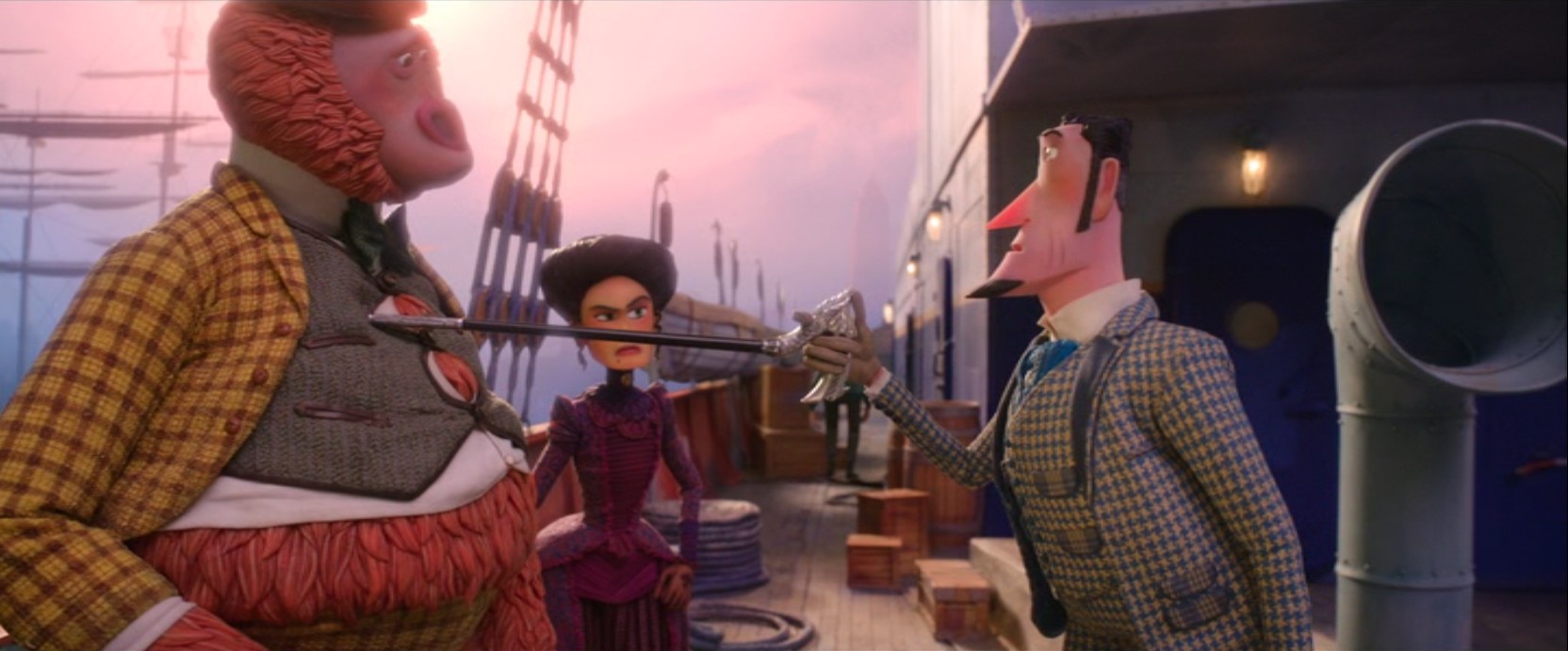
Laika’s ‘Missing Link’ is the second of the three animated yeti features of 2018-2019, the other two being Warner Bros.’ ‘Smallfoot’ from 2018 and Dreamworks’ ‘Abominable’ from 2019. ‘Missing Link’ easily is the best of the three. The stop motion animation is much more interesting than the rather generic computer animation of the other two studios, and the story much less predictable.
The originality already starts with the fact that not yetis but a bigfoot, christened ‘Mr. Link’ from Washington state is the central character of the film. We follow him, his ‘discoverer’ Sir Lionel Frost and Frost’s former love interest and widow of a fellow explorer, Adelina Fortnight, on an unusual quest.
The year is 1886 (we know that because we see the Statue of Liberty being under construction), the year before the European powers would divide Africa between them on the Berlin conference , while in North America the once extremely abundant passenger pigeons were being killed in huge numbers to certain extinction.
This age, in which discovery equaled oppression and slaughter, is exemplified by Sir Lionel Frost’s adversary, Lord Piggot-Dunceby, head of a club of explorers Sir Lionel Frost desperately wants to join, despite the fact all members despise him. This club represents the world of white supremacy and male chauvinism, but Sir Lionel Frost shows he’s made from different material, and the whole film sends a message of love and respect for our fellow creatures, being man or animal, man or woman, or whatever.
‘Missing Link’ does not score high on believability. First, we must accept that Sir Lionel Frost is more interested in discovering than in really studying his findings, despite his few tendencies to do so. Second, we must accept that the giant ape-like Mr. Link can wander through the world unnoticed, simply because he has put on some clothes. Third, we must accept the great lengths to which Lord Piggot-Dunceby goes to thwart Sir Lionel Frost’s plans, not only hiring an assassin, but even completely discarding a huge discovery which could have made him famous if he would steal it from Frost. Fourth, there’s an exciting vertigo scene, which unfortunately throws all plausibility out of the window. In this single scene our heroes should have died multiple times. The film makers don’t even show us how our heroes survive their predicament.
But what the film lacks in believability it makes up in characters and story telling. Both Sir Lionel Frost and Mr. Link are interesting characters, with Mr. Link being instantly likeable, while Adelina Fortnight defies the normal love interest cliches, being much more of an independent woman, steering her own course. There isn’t even a breakup scene in sight, that obligatory staple scene of American animation films of the 2010s.
The characters are much helped by great voice acting. Hugh Jackman (Sir Lionel Frost), Zoe Saldana (Adelina Fortnight), Stephen Fry (Lord Piggot-Dunceby), Timothy Olyphant (the assassin Willard Stenk) and Emma Thompson (whose character I won’t reveal here) all do an excellent voice job, but it’s Zach Galifianakis who stands out as Mr. Link, making him both polite, shy, naïve, enthusiastic, gentle, sweet and open at the same time, without forgetting to make him funny, too.
Being a Laika film, the stop-motion animation is, of course, of the highest quality. Especially the character animation should be mentioned as outstanding, but also impressive are the action scenes, highlight being a long chase scene on a rocking boat.
Understandably for a film showing such wide vistas as the Ocean and the forests of Washington State there’s a large dose of computer animation and computer-generated background art involved, which unfortunately make the film’s looks a little more generic than desired. But the film surprises most in its sunny color palette. ‘Missing Link’ is so much more colorful than all former Laika films, perhaps because it has discarded all horror elements, otherwise so omnipresent in their filmography. Thus, the film has very pleasant looks, and is a joy to watch from start to end (yes, even the end titles are lovely). I certainly hope the studio will retain this direction of more colorful tales and sceneries.
Watch the trailer of ‘Missing Link’ yourself and tell me what you think:
‘Missing Link’ is available on Blu-Ray and DVD
Director: Peter Lord
Release Date: March 28, 2012
Rating: ★★★★
Review:

Aardman’s fifth feature film was, after two computer animated films, a welcome return to the stop-motion the studio is most famous for. It had been seven years since their last stop-motion feature film, ‘Wallace & Gromit: The Curse of the Were-Rabbit’, and meanwhile the studio had exchanged partnership from Dreamworks to Sony Pictures Animation.
Not that that is visible in ‘The Pirates! In an Adventure with Scientists!’ (also known as The Pirates! Band of Misfits’), however, as the film is one hundred percent Aardman. More precisely, even though Nick Park was not involved in this project, his recognizable style now had become the trademark general Aardman style, thus ‘The Pirates! In an Adventure with Scientists!’ explores characters with the same googly eyes and large teeth, if slightly more ‘realistic’ than in the Wallace & Gromit universe.
Unlike Aardman’s earlier features, ‘The Pirates! In an Adventure with Scientists!’ is not an original story, but an adaptation of a children’s novel by British writer Gideon Defoe. I haven’t read the book, so I can’t comment on any differences, but the film certainly is a pretty silly affair, and much of it must have been present in the original writing.
The film takes place in some fantasy take on the 19th century, and stars several historical figures, like Queen Victoria (here depicted as a furious pirate-hating monarch and the villain of the film), Charles Darwin (depicted as a whiny and cowardly character, longing for a girlfriend, and having an all too intelligent chimpanzee as a butler), and, in a small cameo, Jane Austen (the latter’s inclusion is particularly odd, as she died twenty years before Victoria became queen).
The pirates of the title have more in common with Gilbert and Sullivan’s operetta ‘Pirates of Penzance’ (1879)* than with the real thing and are depicted with all the present day cliches imaginable. They’re all dressed in 17th century fashion, belying the 19th century setting, there are wooden legs, flags with skulls, several ‘arrrr’s etc. The modern take on this time period in emphasized by a soundtrack of modern British pop music featuring songs by e.g. Tenpole Tudor, The Clash, The Beat and Supergrass. Thus historicity clearly isn’t the film’s main goal.
On the contrary, the film is self-consciously loony, and chock full of gags and pure nonsense. For example, there’s a pirate festival in which one pirate will be awarded ‘pirate of the year’; one of those pirates makes his entrance from the insides of a giant sperm whale landing on the small harbor; queen Victoria’s dress turns out to be a military killing machine, and so on and so forth.
The story tells about ‘The Pirate Captain’ (he nor his crew do carry names), who dreams of winning ‘the pirate of the year’ award, but who’s actually the laughing stock of the pirate community. In one of his puny attempts to loot a ship he meets Charles Darwin (on his voyage on ‘The Beagle’, which in reality also occurred before Queen Victoria was crowned). Darwin takes interest in the Pirate Captain’s parrot Polly, who’s actually a dodo, and persuades the captain to hand her over for science…
‘The Pirate Captain’, excellently voiced by Hugh Grant, is a round character, dim but enthusiastic, incapable but ambitious, and the story’s focus rests on the tension field between his own ambitions and the love for his crew, mostly personified by pirate ‘Number Two’, who acts as the conscience of the ship. The other six crew members are less well-developed, but allow for a lot of laughs, especially ‘Albino Pirate’ and ‘Surprisingly Curvaceous Pirate’ (an obvious woman with a false orange beard).
In the end the story is less interesting than the general silly atmosphere and the multitude of gags. In fact, the plot is disappointingly generic, containing the obligate break-up scene in which the ambitions of the main protagonist lead to an alienation of his friends (also present in e.g. ‘Up’ from 2009 and ‘Cloudy with a Chance of Meatballs 2’ from 2013), and an equally generic gravity-defying finale, once again bringing back memories to ‘Up’.
The animation is outstanding throughout, and one quickly forgets it’s all done in laboring stop motion. There’s way too much action, and even a breathtaking chase scene (inside Darwin’s London home) to stand still and marvel at the animation itself – it’s simply too fluent, and seemingly effortless – a testimony of the enormous talent present at the British studio. There’s even some traditional animation, when the Pirates’ voyages are depicted on a map of the world. Likewise, there’s hardly time to gape at the sets, which are magnificent in their elaboration and made with so much love and care that one gets immediately submerged into the pirates’ world. I’ve seen the pirate ship at an Aardman exhibition in Groningen, The Netherlands, and that alone is a prop of 3 meters high(!). The captain’s room, too, was something to marvel at – containing a lot of subtle jokes you’ll hardly notice in the movie – if at all. Look for the captain’s log!
In all, ‘The Pirates! In an Adventure with Scientists!’ is great fun, brought to you with bravado and a virtuosity that will leave you breathless.
* the whole concept of Pirate King seems to come from this operetta.
Watch the trailer for ‘The Pirates! In an Adventure with Scientists!’ yourself and tell me what you think:
‘The Pirates! In an Adventure with Scientists!’ is available on Blu-Ray and DVD
Directors: Priit Pärn & Janno Põldma
Release Date: May 6, 1995
Rating: ★★
Review:

‘1895’ is Priit Pärn’s homage to hundred years of cinema. 1895 was the year the Lumière brothers invented the cinématographe, and Pärn, with his colleague Janno Põldma, tells their story in his own unique way. In fact, for 99% of the film we have absolutely no clue what it’s all about.
The film depicts the life of one Jean-Louis, born on November 26, 1863, whose life story takes him all across Europe. Jean-Louis’ biography is told with a voice over and in a rapid succession of short scenes, one more absurd than the other. Sometimes the narration switches to the life of his twin brother, which takes place underground, and which invariably is accompanied by a completely black screen. Little of it makes sense, and often the images are in sharp contrast with the voice over texts.
The film is chock-full of references to famous people of the 19th century, paintings, literature, and, of course, cinema. There’s even a Tom & Jerry parody, which is accompanied by the narrator naming all kinds of French artists. In another scene we can watch Jean-Louis crushing the penguin from Aardman’s ‘The Wrong Trousers‘ (1993).
The film is mostly shot in traditional cel animation, but Pärn and Põldma use a wide range of styles, including rotoscope done in pencil. Unfortunately, the film relies heavily on the narration, and is more absurd than satisfying. In fact, ‘1895’ should be regarded as Pärn’s least successful films, tickling one’s fantasy less than his other works.
‘1895’ is available on the DVD-set ‘Priit Pärn integral 1977-2010’


 Dr. Grob's Animation Review