
You are currently browsing the tag archive for the ‘Abe Levitow’ tag.
Directors: Chuck Jones & Abe Levitow
Release date: December 29, 1962
Rating: ★★★
Review:

‘Martian Through Georgia’ is narrated by Ed Prentiss and tells about a Martian (typically designed as a little green man, if a rather frog-like one).
This Martian is so bored by his own society, his psychiatrist advices him to travel. So the Martian sets out for Earth, where things are very different, indeed. Nevertheless, the Martian finds little happiness on our planet, and in the end goes back home, with renewed love for his home planet (or at least one of its female inhabitants).
‘Martian Through Georgia’ knows a very lame and disappointing ending and is far from funny, but the film’s character designs and animation are of a high quality. Yet, the film’s main attraction are its avant-garde layouts by Maurice Noble and background art by Philip DeGuard. Noble goes completely wild, so the artwork becomes a marvel from start to end. So even if the story fails to inspire, the film’s looks remain entertaining throughout.
Watch excerpts from ‘Martian Through Georgia’ yourself and tell me what you think:
‘Martian Through Georgia’ is available on the DVD-set ‘Looney Tunes Golden Collection Volume Six’
Director: Abe Levitow
Release date: October 24, 1962
Rating: ★★½
Review:
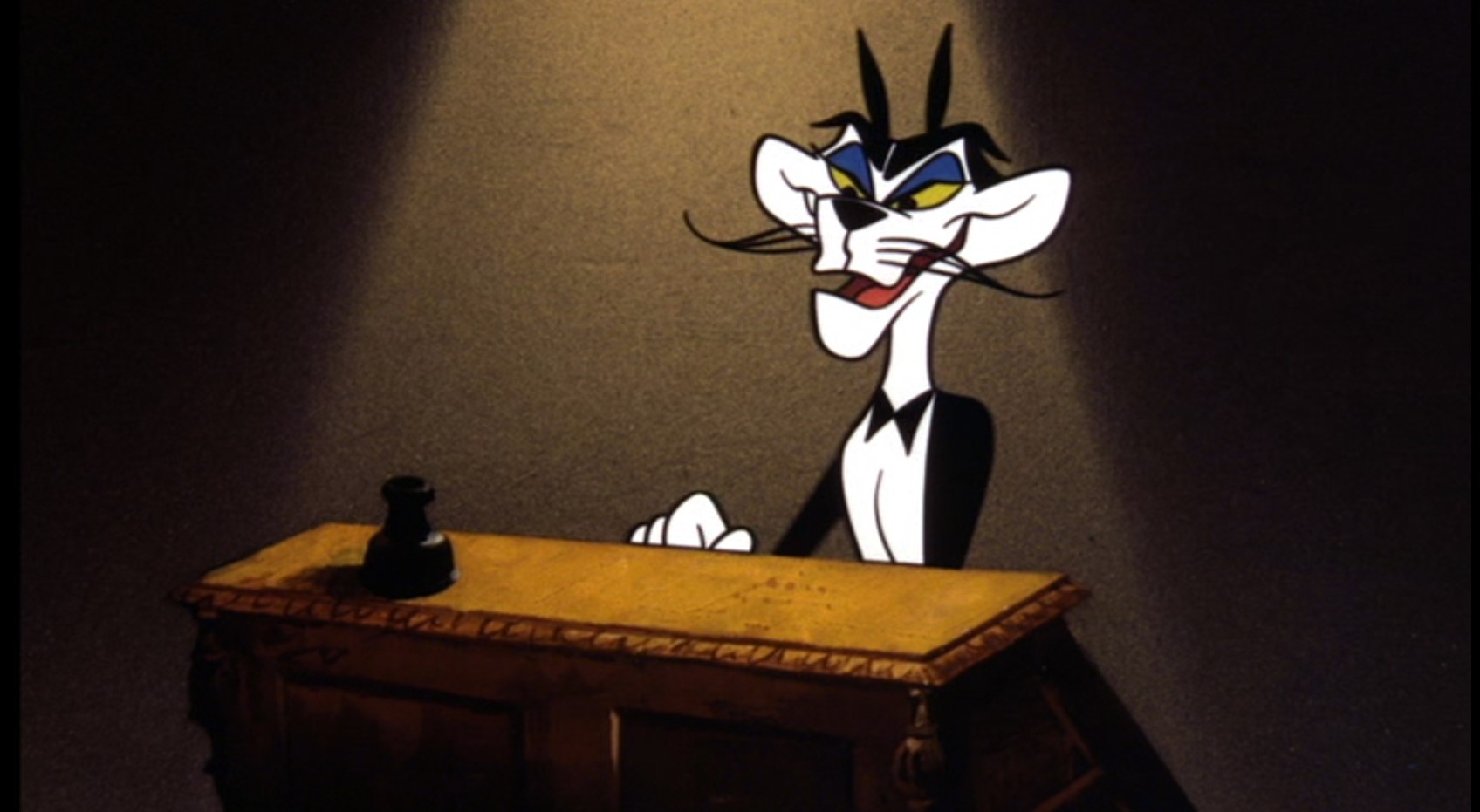
‘Gay Purr-ee’ was the second of only two feature films made by UPA, the first being ‘1001 Arabian Nights’ from 1959 and starring the studio’s only star, Mr. Magoo. In fact, ‘Gay Purr-ee’ was the artistic swansong of the once famed animation studio. Most daring and influential in the 1950s, by the early 1960s UPA had become only a shadow of its former self, as this feature film painfully demonstrates.
In fact, UPA had already entered a stage of decay when Steve Bosustow, one of the founding members of the studio sold his interests to businessman Henry G. Saperstein. Saperstein had no interest in UPA’s “fine-art crap” (as quoted in Adam Abraham’s excellent book on the studio ‘When Magoo Flew’, p. 212) and was only interested in making the cartoons as cheaply as possible. When Saperstein fired Bosustow in 1961, one can say UPA was in fact braindead. It’s thus the more surprising that the studio did make such a costly product as a feature film anyway.
‘Gay Purr-ee’ was distributed for Warner Bros. and the film breathes that studio as much, if not more than the UPA vibe. There’s of course the bad pun in the title, a Warner Bros. trademark. Then the film stars cats, not humans, breaking with a long UPA tradition, but fitting perfectly in the Warner Bros. practice. Moreover, the story was by Chuck Jones and his wife Dorothy. In fact, Jones was moonlighting when he worked for this feature film, and when Warner Bros. found out, he was duly fired because of breach of contract. Jones clearly was responsible for the designs of the three lead characters, if less so for supporting characters like Robespierre and Mme. Rubens-Chatte. To add to the Warner Bros. vibe, the film was directed by Jones’ former animator and co-worker Abe Levitow, and Warner Bros. voice man Mel Blanc voices several characters.
The UPA influence, in fact, is only visible in the gorgeous background art, supervised by Victor Haboush, who had worked on layout and background art for Disney features ‘Peter Pan’, ‘Lady and the Tramp’ and ‘Sleeping Beauty’. The background art of ‘Gay Purr-ee’ is strikingly modern, with bold fauvist color schemes, an unmistakable Van Gogh-influence in the Provencal scenes, and allusions to various other painters in the Parisian ones. In fact, the background art can count as the film’s highlight, for the rest of the movie, unfortunately, is not that good, and the viewer has ample time to marvel at the gorgeous background paintings and pastels.
The film has several problems:
First, the animation doesn’t follow the background layouts. Painted sidewalks are completely ignored, and when Jaune Tom and Robespierre ride the rails, there’s no connection between their walk and the ties they’re supposed to step on.
Second, there’s Dorothy and Chuck Jones’s story: the film takes place in Paris at the end of the 19th century, and tells about a female cat called Mewsette (yes, a pun) who lives in the countryside, but longs to go to Paris. This story is a variation of the age-old trope of a country girl going to the big city only to become ensnared there. Back in 1920 Władysław Starewicz had already made an animation film with this theme called ‘Dans les griffes de l’araignée’ (In the Spider’s Grip). The Joneses add little to this cliché, and the story unfolds in an all too predictable pattern. Moreover, the villain Meowrice’s (yes, another pun) scheme is an all too bizarre one. It would be more logical if he would put poor Mewsette into prostitution, but this was of course off limits in a family film.
Third, there’s the wonky level of anthropomorphism. The cats all walk on fours, and are clearly cats, especially when interacting with men, but at the same time Meowrice is able to write a letter, and there’s a Moulin-rouge-like bar (called Mewlon Rouge, yes, yes) in which cats dance and drink alcohol. The inconsistency is neither explained nor resolved and hampers the overall believability of the film.
Fourth, the characters are not that interesting. Mewsette is more spoiled and naive than sympathetic, Jaune Tom clearly has his heart in the right place, but his only other character trait is that he loves chasing mice. Meowrice is clearly a villain from the very beginning, and his dual character is never played out well. I guess Robespierre was included as comic relief, but he has a particularly weak voice (by Red Buttons) and he is tiresome, not funny. Most interesting and best designed is the opportunistic Mme. Rubens-Chatte, but her role is small and her change of heart all too predictable.
Fifth, Abe Levitow’s all too relaxed direction slows the film down. Excitement or fear are shown, but not felt. Just before the finale there’s a long sequence in which Meowrice describes portraits of Mewsette by several of the leading painters of the era, including Monet, Gauguin and Picasso. This is fun of course, but of no consequence to the narrative, and stalls the story. Then there’s a grand finale on a train, but this, too, is lacking the necessary tension. Never does the viewer fear that things could go wrong.
And finally, sixth, the film contains eight songs by the famed duo of Harold Arlen and Yip Harburg, who have enriched the world with their songs for ‘The Wizard of Oz’ (1939), but none of the songs for ‘Gay Purr-ee’ even remotely approach the quality of the ones for the former musical. Even singer Judy Garland, who sings most of the songs, cannot raise these above the level of forgettable. Even worse, the songs contribute to the slowness of the film, as none of them propels the story forward, but only drag the narrative down. For example, when Jaune Tom sings ‘Little Drops of Rain’ in which he expresses his longing for Mewsette, we watch nice semi-abstract images of sea life, but nothing happens, and the story only resumes after the song.
‘Gay Purr-ee’ still is well animated, and one of the last products of the golden age of studio animation, which came to its end somewhere in the 1960s. It’s thus still worth a watch for anyone interested in the era, but barely a rewarding one, and after viewing what lingers is the background art, and the sad notion that a lot of talent was wasted on a feature film that just was not that good. The UPA animation studio, meanwhile, lasted until 1970, but never regained its artistic heights of the 1950s, or even that of ‘Gay Purr-ee’, for that matter.
Watch the trailer for ‘Gay Purr-ee’ yourself and tell me what you think:
‘Gay Purr-ee’ is available on Blu-Ray and DVD
Directors: Chuck Jones & Abe Levitow
Release Date: January 10, 1959
Stars: Bugs Bunny
Rating: ★★★★½
Review:

‘Baton Bunny’ is the last of Chuck Jones’s great tributes to classical music, following ‘Long-Haired Hare‘ (1949), ‘Rabbit of Seville‘ (1950) and ‘What’s Opera, doc?‘ (1957).
The short also forms the closing chapter on a long tradition of concert cartoons with cartoon stars conducting, which goes all the way back to the Mickey Mouse short ‘The Barnyard Concert‘ from 1930. True, ‘Baton Bunny’ is not the last of such cartoons (it was e.g. followed by MGM’s ‘Carmen Get It (1962) starring Tom & Jerry, and ‘Pink, Plunk, Plink‘ (1966) starring the Pink Panther), but these cartoons are hardly the classics ‘Baton Bunny’ certainly is.
Bugs Bunny is the sole performer in the cartoon – we don’t even see the orchestra members, only their instruments. Bugs Bunny and the orchestra play Franz von Suppés overture ‘Morning, Noon and Night in Vienna’ (1844), which Bugs conducts not only with his hands, but also with his ears and feet. Like earlier conductors Mickey (‘The Band Concert‘, 1935) and Tom (‘Tom & Jerry at the Hollywood Bowl‘, 1950) Bugs has some troubles while conducting: with a fly, echoing Mickey’s problems with a bee in ‘The Band Concert’, and with his collar and cuffs, echoing Mickey’s problems with his over-sized costume. Highlight is Bugs’ reenactment of a Western pursuit featuring a cowboy, an Indian and the cavalry, only using his ears to change into each character.
But throughout the cartoon Bugs is beautifully animated, with strong expressions, and deft hand movements. It’s a sheer pity that in the end, the fly turns out to be Bugs’ only audience. But Bugs is not too proud to bow for the tiny creature that had troubled him so much just before. Apart from the animation and Michael Maltese’s entertaining story, ‘Baton Bunny’ profits from Maurice Noble’s beautiful background art, and great staging. Thus the short is a wonderful testimony of Warner Bros. cartoon art of the late fifties.
Watch ‘Baton Bunny’ yourself and tell me what you think:
https://www.dailymotion.com/video/x6h503w
This is Bugs Bunny cartoon No. 140
To the previous Bugs Bunny cartoon: Pre-hysterical Hare
To the next Bugs Bunny cartoon: Hare-Abian Nights
‘Baton Bunny’ is available on the DVD-box ‘The Looney Tunes Golden Collection Volume 1″
Director: Abe Levitow
Release date: May 5, 1967
Stars: Tom & Jerry
Rating: ★★½
Review:
 In this short, Tom and Jerry are apparently on a cruise somewhere in the Pacific.
When Tom sees people surf, he naturally wants to join in. This leads to a cartoon full of gags, one of which is reused from the Disney classic ‘Hawaiian Holiday'(1937), then thirty years old. It also contains one gag that would have made Hanna and Barbera proud if it had been timed better. Now, most of the action is plain tiresome, resulting in yet another mediocre entry in Chuck Jones’s Tom & Jerry series.
Watch ‘Surf-Bored Cat’ yourself and tell me what you think:
http://www.dailymotion.com/video/x47z2e0
This is Tom & Jerry cartoon No. 159
To the previous Tom & Jerry cartoon: The Mouse from H.U.N.G.E.R.
To the next Tom & Jerry cartoon: Shutter Bugged Cat
Director: Abe Levitow
Release date: April 21, 1967
Stars: Tom & Jerry
Rating: ★★★★
Review:
 As the title implies, this is a parody on the popular secret agent series ‘The Man from U.N.C.L.E.'(which aired from 1964 to 1968).
in this short Jerry is a secret agent who is after a huge stock of cheese, kept in a safe and heavily guarded by the evil ‘Tom Thrush’ (THRUSH was the arch-villain organisation of U.N.C.L.E. In the original series).
Director Abe Levitow and story man Bob Ogle clearly enjoy spoofing the spy cliches. The two are greatly helped by composer Dean Elliott, who provides a very apt sixties spy film musical score. This makes this entry also enjoyable for people who have never watched the original series, but who are familiar with, for example, James Bond.
This short has little to do with Tom & Jerry as originally conceived by Hanna and Barbera, but it is an entertaining cartoon, nonetheless. The film was to be the duo’s last enjoyable theatrical cartoon.
Watch ‘The Mouse from H.U.N.G.E.R.’ yourself and tell me what you think:
https://www.dailymotion.com/video/x3pj4p0
This is Tom & Jerry cartoon No. 158
To the previous Tom & Jerry cartoon: Cannery Rodent
To the next Tom & Jerry cartoon: Surf-Bored Cat
Director: Abe Levitow
Release date: April 7, 1967
Stars: Tom & Jerry
Rating: ★★★★
Review:
 After directing seven terrible cartoons, Abe Lebitow suddenly strikes with ‘Rock ‘n Rodent’.
The story, by Bob Ogle, is inspired, if not anything new (it’s in fact the reverse of the classic Tom & Jerry cartoon ‘Saturday Evening Puss‘ from 1950): when Tom goes to sleep, Jerry rises to play drums with his hep-cat mice friends in the nightclub ‘Le Cellar Smoqué’.
This, of course, keeps Tom awake, and he desperately tries to get rid of the mice, only to succeed in bothering a large bulldog living in the same apartment block.
Unlike the other Tom & Jerry’s by Chuck Jones’s unit, this short has a lively jazzy score penned by a remarkably inspired Carl Brandt. In short, everything seems to come together for once in this cartoon, making this one of the best of the Chuck Jones Tom & Jerry’s.
Watch ‘Rock ‘n’ Rodent’ yourself and tell me what you think:
This is Tom & Jerry cartoon No. 156
To the previous Tom & Jerry cartoon: Guided Mouse-ille
To the next Tom & Jerry cartoon: Cannery Rodent
Director: Abe Levitow
Release date: March 10, 1967
Stars: Tom & Jerry
Rating: ★
Review:
 After ‘O-Solar-Meow‘ Tom and Jerry immediately return to the science fiction setting in ‘Guided Mouse-ille’.
The time is 2565 AD and again, Tom and Jerry fight each other with modern technology, including the robot cat from ‘O Solar Meow’. In the end, our heroes are inexplicably blown to the prehistory, where they continue their chase.
Written by story man John Dunn (as was O-Solar-Meow), ‘Guided Mouse-ille’ is a very bad and terribly unfunny cartoon. Luckily, Tom & Jerry’s next short would be much more fun…
Watch ‘Guided Mouse-ille’ yourself and tell me what you think:
This is Tom & Jerry cartoon No. 155
To the previous Tom & Jerry cartoon: O-Solar-Meow
To the next Tom & Jerry cartoon: Rock ‘n’ Rodent
Director: Abe Levitow
Release date: February 24, 1967
Stars: Tom & Jerry
Rating: ★★
Review:
 In a cartoon that looks forward to ‘2001 A Space Odyssey’ (which would be released the following year), Tom and Jerry inhabit a roulette-like space station.
Here they fight each other using modern technology, including a robot cat. In the end, Tom manages to shoot Jerry to the moon, but luckily for Jerry, it turns out to be made out of cheese.
This cartoon contains nice settings and some original ideas, but none of them are executed well, resulting in yet another mediocre Tom and Jerry cartoon produced by Chuck Jones. Tom & Jerry’s next cartoon, ‘Guided Mouse-ille‘, also has a science fiction setting. Interestingly, both these shorts were penned by story man John Dunn.
Watch ‘O-Solar-Meow’ yourself and tell me what you think:
http://www.dailymotion.com/video/x47z0hx
This is Tom & Jerry cartoon No. 154
To the previous Tom & Jerry cartoon: Cat and Dupli-cat
To the next Tom & Jerry cartoon: Guided Mouse-ille
Directors: William Hanna & Joseph Barbera
Release Date: March 3, 1951
Stars: Tom & Jerry
Rating: ★★★★★
Review:
 Tom’s listening to the radio where a french cook is telling about a fish recipe. Tom immediately tries to cook the goldfish in various ways, but Jerry, who’s the goldfish’s friend, rescues him again and again.
Unlike most Jerry-and-a-friend cartoons, ‘Jerry and the Goldfish’ is not cute, but fast and funny, with great gags coming in plenty, many of which involving deformations of Tom’s body. This makes ‘Jerry and the Goldfish’ easily one of the best Tom & Jerry cartoons using this theme. In 1966 Abe Levitow used the same story theme in the late Tom & Jerry cartoon ‘Fillet Meow‘, unfortunately with appalling results.
Watch an excerpt from ‘Jerry and the Goldfish’ yourself and tell me what you think:
This is Tom & Jerry cartoon No. 56
To the previous Tom & Jerry cartoon: Casanova Cat
To the next Tom & Jerry cartoon: Jerry’s Cousin
Director: Abe Levitow
Release Date: August 4, 1966
Stars: Tom & Jerry
Rating: ★
Review:
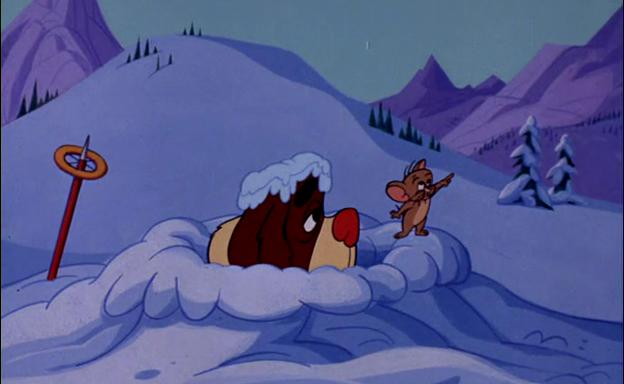 ‘The A-Tom-inable Snowman’ is as abominable as the snowman’s supposed to be: it’s painfully bad and unfunny.
The cartoon has nothing to do with yetis, however. It is set in the alps and involves a helpful St. Bernard. The only surprise is that the titles roll in after 1’22.
Watch ‘The A-Tom-inable Snowman’ yourself and tell me what you think:
This is Tom & Jerry cartoon No. 151
To the previous Tom & Jerry cartoon: Matinee Mouse
To the next Tom & Jerry cartoon: Catty Cornered
Director: Abe Levitow
Release Date: May 5, 1966
Stars: Tom & Jerry
Rating: ★★½
Review:
 In ‘Puss ‘n’ Boats’ Tom is a coastal guard trying to stop Jerry from entering a ship full of cheese. Surprisingly, this is a continuing story containing no black-out gags.
Unfortunately, the designs and animation are both weak, as is the music by first-timer Carl Brandt. The cartoon does contain some clever ideas, but they never get funny.
Watch ‘Puss ‘n’ Boats’ yourself and tell me what you think:
http://tune.pk/video/23936/Tom-And-Jerry-Puss-N-Boats-Episode-147
This is Tom & Jerry cartoon No. 148
To the previous Tom & Jerry cartoon: Love, Love My Mouse
To the next Tom & Jerry cartoon: Fillet Meow
Director: Abe Levitow
Release Date: June 30, 1966
Stars: Tom & Jerry
Rating: ★★
Review:
 In ‘Fillet Meow’ Tom is after a goldfish, who looks a little like Chloe from ‘Pinocchio‘ (1940). Of course Jerry tries to protect the cute little fish.
‘Fillet Meow’ was the third Tom & Jerry cartoon directed by Abe Levitow and by now quality standards had dropped almost to the level of the Gene Deitch Tom & Jerry shorts. The result is rather awful, and nowhere near the quality of the similar ‘Jerry and the Goldfish‘ (1951).
Watch ‘Fillet Meow’ yourself and tell me what you think:
http://onlineplayer.eu/Tom-and-Jerry/filet-meow-148.html
This is Tom & Jerry cartoon No. 149
To the previous Tom & Jerry cartoon: Love, Love My Mouse
To the next Tom & Jerry cartoon: Matinee Mouse
Director: Abe Levitow
Release Date: March 3, 1966
Stars: Tom & Jerry
Rating: ★
Review:
 ‘Jerry-Go-Round’ is staged at a circus: Jerry helps a circus elephant, who in turn protects Jerry from Tom.
This rather dull and unfunny cartoon marks the debut of animator Abe Levitow as a Tom & Jerry director. It is not a success. Levitow was an experienced director: in 1959 he had directed several Warner Brothers cartoons, and at UPA he had directed Mr. Magoo television specials, and the studio’s second feature, Gay-Purree (1962). Yet, this experience is hard to detect in ‘Jerry Go-Round’: both the designs, the timing and the animation are inferior to those in the cartoons directed by Chuck Jones himself.
Watch ‘Jerry-Go-Round’ yourself and tell me what you think:
This is Tom & Jerry cartoon No. 146
To the previous Tom & Jerry cartoon: Jerry, Jerry Quite Contrary
To the next Tom & Jerry cartoon: Love, Love My Mouse


 Dr. Grob's Animation Review