You are currently browsing the tag archive for the ‘Bugs Bunny’ tag.
Director: Chuck Jones
Release Date: June 25, 1949
Stars: Bugs Bunny
Rating: ★★★★★
Review:
 Bugs Bunny is singing nearby a villa, where a huge opera singer, called Giovanni Jones, is practicing.
The singer is heavily disturbed by Bugs’s performance and without arguing destroys our hero’s banjo, his harp and his tuba. Only then Bugs is prompted into war, which he reserves for the opera singer’s concert at the Hollywood Bowl.
What follows are great blackout gags featuring a string of opera tunes, with Bugs as ‘Leopold’ as a major highlight. This impersonation is an obvious reference to star conductor Leopold Stokowski, famous for conducting ‘Fantasia’ (1940). Bugs destroys the conductor’s baton, to direct with his hands only, like Stokowski does. From now on he controls the singer almost like a puppeteer. Bugs finally destroys his opponent by making him sing a ridiculously long high note, which tears the complete bowl down.
With cartoons like ‘Long-Haired Hare’ director Chuck Jones really came into his own: it shows Jones’ attitude to Bugs Bunny, who, in Jones’s cartoons, is only a misschief when provoked. Giovanni Jones is one of Bugs Bunny’s particularly large adversaries, following The Crusher (‘Rabbit Punch‘, 1948), and the warehouse manager in ‘Hare Conditioned‘ (1945).
‘Long-Haired Hare’ also shows Jones’ love for high culture, like opera. For instance, we can clearly detect a painting by Roussau le douanier decorating the opera singer’s villa. Jones’s love for opera would lead to two of his most famous and best cartoons, ‘The Rabbit of Seville‘ (1950) and ‘What’s Opera, doc?‘ (1958), which also feature Bugs Bunny.
In 1950, the Hollywood Bowl would be visited by cartoon characters again, when Tom & Jerry both tried to conduct in ‘Tom and Jerry in the Hollywood Bowl‘.
Watch ‘Long-Haired Hare’ yourself and tell me what you think:
http://www.dailymotion.com/video/x2fdnv1
This is Bugs Bunny cartoon No. 61
To the previous Bugs Bunny cartoon: Bowery Bugs
To the next Bugs Bunny cartoon: Knights Must Fall
Director: Friz Freleng
Release Date: April 30, 1949
Stars: Bugs Bunny, Yosemite Sam
Rating: ★★★★★ ♕
Review:
 Bugs is presenting a vaudeville show in some western town.
Yosemite Sam especially visits his show to see the high diving Fearless Freep. Unfortunately, Freep is delayed by a storm and can’t come to perform. The disappointed Sam urges Bugs to take Freep’s place.
What follows is a masterful series of gags, which all end with Sam falling from the ridiculously high platform. At one point Freleng doesn’t even bother to point out how Bugs makes Sam take the plunge once again. As if it’s a natural law, Sam will fall anyway. Bugs, on the other hand, defies the law of the gravity. But you know, he tells us at the end, he never studied law…
Penned by storyman Tedd Pierce, this wonderfully hilarious cartoon takes a single idea from Freleng’s earlier ‘Stage Door Cartoon‘ (1944) and milks it brilliantly to a superb finale. Freleng’s timing rarely was so effective as in this cartoon, and it must rank among his all time best.
Watch ‘High Diving Hare’ yourself and tell me what you think:
http://www.dailymotion.com/video/x2bdtkf_bugs-bunny-ep-73-high-diving-hare_fun
‘High Diving Hare’ is available on the DVD set ‘Looney Tunes Golden Collection, Vol. 1’
This is Bugs Bunny cartoon No. 59
To the previous Bugs Bunny cartoon: Rebel Rabbit
To the next Bugs Bunny cartoon: Bowery Bugs
Director: Chuck Jones
Release Date: December 14, 1948
Stars: Bugs Bunny
Rating: ★★½
Review:
 Bugs misses a turn at Albuquerque and ends up in Scotland.
When he mistakes a Scotchman’s bagpipes for a monster attacking an old lady, he ends up playing golf against the angered Scotchman. Of course, Bugs wins the game, which consists of several blackout gags, and he even manages to defeat the kilted guy at playing the pipes.
The Scotchman looks like a cross between Elmer Fudd and Yosemite Sam, but who hasn’t got anything near the personality of either of the two. Therefore the interplay between our hero and the villain never really come to live, despite some nice facial expressions on Bugs’ adversary.
Peter Alvarado’s backgrounds do not help: they are too vivid to ignore, but have none of the beauty of either Jones early 1940s cartoons or his cartoons from the 1950s. Instead they express a strange mix of realistic and more stylized patterns. The result is a rather mediocre entry in the Bugs Bunny catalog.
Watch ‘My Bunny Lies over the Sea’ yourself and tell me what you think:
‘My Bunny Lies over the Sea’ is available on the DVD set ‘Looney Tunes Golden Collection, Vol. 1’
This is Bugs Bunny cartoon No. 55
To the previous Bugs Bunny cartoon: A Lad in his Lamp
To the next Bugs Bunny cartoon: Hare Do
Director: Friz Freleng
Release Date: February 2, 1946
Stars: Bugs Bunny
Rating: ★★★★★
Review:
 It seems an almost certain loss for the age-old Tea-Totallers, who get plastered by the tough team of the Gas-House Gorillas…
Bugs Bunny, who’s watching the game, wearing an innocent straw head, boasts that he can beat the Gas-House Gorillas single-handed, so he gets himself a game. Playing in every position he manages to win the ball game in this wild and hilariously funny cartoon, which is noteworthy for its great dialogue, excellent animation, and superb timing. Especially when Bugs Bunny starts batting, the gags role in in a remarkably fast tempo.
Highlight among the many gags may be Bugs’s constant jabbering. Some of it was copied by Jones in ‘Rabbit Punch‘ (1948). ‘Baseball Bugs’ reuses several gags from the Woody Woodpecker cartoon ‘The Screwball’ (1942), but with much better results, making it a classic, where ‘The Screwball’ was not. If the short has one flaw, it’s that it’s over before you know it, with the end coming all too soon.
Notice the advert for ‘Michael Maltese, Ace Dick’ in Bugs Bunny’s first scene.
Watch ‘Baseball Bugs’ yourself and tell me what you think:
https://www.dailymotion.com/video/x6tj0co
‘Baseball Bugs’ is available on the DVD set ‘Looney Tunes Golden Collection, Vol. 1’
This is Bugs Bunny cartoon No. 35
To the previous Bugs Bunny cartoon: Hare Tonic
To the next Bugs Bunny cartoon: Hare Remover
Director: Chuck Jones
Release Date: April 10, 1948
Stars: Bugs Bunny, The Crusher
Rating: ★★★½
Review:
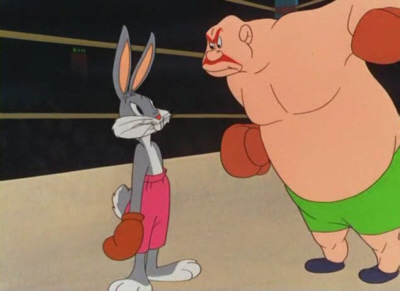 When Bugs jeers at the champion of a boxing game, he’s suddenly ‘invited’ to be in it.
The boxing game soon changes into a wrestling match with blackout gags, in which we only see round 37, 49, 73, 98 and 110. These blackout gags foreshadow the complete Road Runner series. In the last one the champ uses a train in order to ride over Bugs, but then the film abruptly breaks, a revival of a gag Jones used in ‘My Favorite Duck‘ (1942).
‘Rabbit Punch’ is one of the earliest cartoons in what we can call Chuck Jones’ mature style, which consolidated in 1949. Like in his earlier Bugs Bunny cartoons ‘Case of the Missing Hare‘ (1942) and ‘Hare Conditioned‘ (1945), Jones uses his sense of grace and deftness to portray a particularly large, human opponent to Bugs. And like in those cartoons he does that with stunning ‘camera angles’ and a cinematic approach. Bugs is pretty suave in this cartoon, acting out complete terror in the final scene, only to appear in full control, after all.
Watch ‘Rabbit Punch’ yourself and tell me what you think:
http://www.dailymotion.com/video/x2fby3f
This is Bugs Bunny cartoon No. 48
To the previous Bugs Bunny cartoon: A Feather in his Hare
To the next Bugs Bunny cartoon: Buccaneer Bunny
Director:Friz Freleng
Release Date: June 12, 1948
Stars: Bugs Bunny, Yosemite Sam
Rating: ★★★★★ ♕
Review:
 Bugs Bunny dares to resist Yosemite Sam in this Western entry, which is both delightfully classic and totally absurd.
For example, when Yosemite Sam exclaims that ‘The town is not big enough for the two of us’, Bugs responds by building an enormous block of skyscrapers in a few seconds! Its finale, too, is hilarious. When Bugs tries to board an unwilling Sam on a train leaving town, they discover this train’s going to Miami and is full of dames in bathing suits. Then they both want to board it! Needless to say our hero wins the day.
‘Bugs Bunny Rides Again’ is a brilliantly hilarious cartoon full of great and flexible animation, and undoubtedly one of Bugs Bunny’s finest entries. The short reuses some footage of a dancing Bugs from ‘Stage Door Cartoon‘ (1944).
Watch ‘Bugs Bunny Rides Again’ yourself and tell me what you think:
http://ulozto.net/live/xvYBg55/bugs-bunny-bugs-bunny-rides-again-1948-avi
This is Bugs Bunny cartoon No. 50
To the previous Bugs Bunny cartoon: Buccaneer Bunny
To the next Bugs Bunny cartoon: Haredevil Hare
Director: Friz Freleng
Release Date: November 1, 1947
Stars: Bugs Bunny, Elmer Fudd
Rating: ★★★★★
Review:
 In ‘Slick Hare’ Elmer works as a waiter in a restaurant full of celebrities.
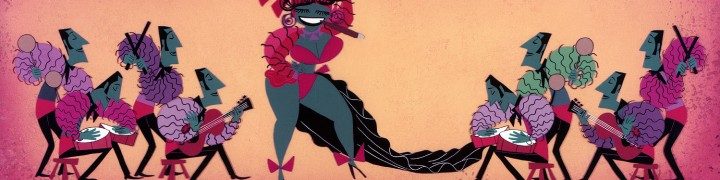
Humphrey Bogart (voiced by Dave Barry) is one of the costumers, and he tells Elmer to bring him a rabbit or else… By chance, Elmer discovers Bugs in his kitchen and what follows is a wild chase involving more celebrities, like The Marx Brothers and Carmen Miranda.
‘Slick Hare’ is a hilarious cartoon. Highlights are a well-timed pie throwing sequence and a a great dance routine by Bugs on an irresistible samba, animated with gusto by Gerry Chiniquy. The cartoon contains some more caricatures of Hollywood stars, like Leopold Stokowski, Frank Sinatra and at the end, Bogart’s wife, Lauren Bacall.
Watch ‘Slick Hare’ yourself and tell me what you think:
This is Bugs Bunny cartoon No. 45
To the previous Bugs Bunny cartoon: Easter Yeggs
To the next Bugs Bunny cartoon: Gorilla My Dreams
Director: Bob Clampett
Release Date: October 5, 1946
Stars: Bugs Bunny, Elmer Fudd
Rating: ★★★★½
Review:
 ‘The Big Snooze’ (a pun on the Bacall-Bogart vehicle ‘The Big Sleep’) opens with Elmer quitting after a short chase routine involving a tree trunk on a cliff.
He tears his contract with Warner apart and decides to enter a career of fishing only ‘and no more wabbits!’. When he rests at the riverside, Bugs enters his serene dream to create a nightmare. This involves e.g. nightmare paint, rendering Elmer in Adam’s costume, making a girl out of him, followed by wolves and a great fall, which typically ends the nightmare. At the end Elmer returns to the scene, reassembling the contract and ready for another routine with the tree.
‘The Big Snooze’ is one of those great cartoons that play with their characters as being real stars (others being the Mickey Mouse cartoon ‘Mickey’s Gala Premier’ (1933), the Donald Duck cartoon ‘The Autograph Hound‘ (1939) and ‘You Ought to Be in Pictures’ (1940, starring Porky and Daffy).
The opening scene was taken from Tex Avery’s ‘All This and Rabbit Stew’ (1941), with Elmer replacing the original black caricature. The rest of the film has a disjointed feel, and features weird cuts and odd cinematographic choices. For example, when Elmer tears up the contract, this is shown in five different shots, following each other in rapid succession: 1) a medium shot of Elmer tearing up the contract, 2) a close-up of only his hands tearing, 3) a close-up of the paper snippets flying into the air above Elmer’s head, who’s hardly seen in this shot, 4) a very strange perspective shot of Elmer smashing the contract into the camera, and 5) a close-up of his boots stamping on what remains of the paper.
Another noteworthy scene is when Bugs Bunny is ‘multiplying’: in this scene Elmer is the only traditionally looking character, placed on a black canvas, overrun by rabbits, only drawn in red, yellow and pink outlines and mixing with the green outlines of some plants. This short scene is a startling piece of early cartoon modernism, and looks forward to the work of the UPA studio in the 1950s. On the other hand, the gag in which Bugs pulls away a hole harks all the way back to the Mickey Mouse cartoon ‘The Picnic‘ (1930).
Bugs sings excerpts from three songs in this short: ‘Beautiful Dreamer’, ‘Someone’s Rocking My Dreamboat’ and ‘September in the Rain’.
The Big Snooze’ was to be Bob Clampett’s last cartoon at Warner Bros. He was fired before he could finish it, and the short was completed by Art Davis, who succeeded him as a director. The film’s look and feel is still that of the war era, while contemporary cartoons by Chuck Jones and Friz Freleng show the studio was heading into other directions, with milder humor and more sophisticated designs. In contrast, in ‘The Big Snooze’ Clampett’s animation style is extremely flexible, as usual for him, and his backgrounds are as vague as ever.
‘The Big Snooze’ is a hilarious cartoon that marks the end of an era, where the wildest and the zaniest gags were possible. Only Tex Avery at MGM would continue the extreme style. Bob Clampett left Warner Bros. in May 1945 to join the Screen Gems studio. He was succeeded by Art Davis, who would direct some great cartoons until his unit was closed down in 1949.
In the years following Clampett’s leave, his zany style was continued for a while by his master animator Robert McKimson, who had been promoted to director only a few months earlier. However, McKimson soon toned down both animation and humor, and he would never achieve the same level of originality as Bob Clampett did during his Warner Bros. days.
Watch ‘The Big Snooze’ yourself and tell me what you think:
https://www.dailymotion.com/video/x6n3yac
This is Bugs Bunny cartoon No. 40
To the previous Bugs Bunny cartoon: Racketeer Rabbit
To the next Bugs Bunny cartoon: Rhapsody Rabbit
‘The Big Snooze’ is available on the DVD-set ‘Looney Tunes Golden Collection Volume Two’
Director: Chuck Jones
Release Date: August 11, 1945
Stars: Bugs Bunny
Rating: ★★★★
Review:
 In ‘Hare Conditioned’ Bugs Bunny is working in a display at a department store. But the manager has other plans with him and wants our hero stuffed.
‘Hare Conditioned’ is full of director Chuck Jones’ typical sophisticated humor and extreme posing. For example, at the beginning of the chase scene we can see the manager looking for Bugs in three places. His move from one place to another is done in smears only one frame long, leading to extremely fast takes between the poses. Also, the final chase, involving elevators and stairs, is wonderfully timed. One of the short’s best gags, however, is set to a slower pace, and involves Bugs cross-dressing as a female customer and the manager courting him/her by tickling his/her feet.
Unfortunately, the cartoon ends abruptly with a rather trite ending: when the manager has Bugs Bunny cornered on the roof, Bugs convinces his adversary there’s a monster behind him, with himself posing as the monster, making the manager jump off the roof. But then he looks into the mirror himself…
‘Hare Conditioned’ is one of the great entries in the Bugs Bunny canon. The short clearly establishes Jones’s concept of the rabbit, as the director stated in his book ‘Chuck Amuck’:
“Golden Rule. Bugs must always be provoked. In every film, someone must have designs upon his person: gastronomic, as a trophy, as a good-luck piece (…..), as an unwilling participant in a scientific experiment (laboratory rabbit or outer-space creature). Without such threats Bugs is far too capable a rabbit to evoke the necessary sympathy”.
Indeed, Bugs only comes into action in this cartoon when threatened by death. First he tries to flee his foe, but when this proves impossible he takes control of the situation himself. Only then he does serious harm to his opponent. Nevertheless, Bugs remains calm throughout the cartoon.
Jones kept to his golden rule in the rest of his cartoons, giving Bugs other large or powerful adversaries like a giant red monster in ‘Hair-Rasing Hare’ (1946), a large boxer in ‘Rabbit Punch‘ (1948), or a Martian, capable of blowing up the earth, in ‘Haredevil Hare‘ (1948).
Watch ‘Hare Conditioned’ yourself and tell me what you think:
https://www.dailymotion.com/video/x5y67d2
This is Bugs Bunny cartoon No. 33
To the previous Bugs Bunny cartoon: Hare Trigger
To the next Bugs Bunny cartoon: Hare Tonic
‘Hare Conditioned’ is available on the DVD-set ‘Looney Tunes Golden Collection Volume Two’
Director: Robert McKimson
Release Date: June 28, 1947
Stars: Bugs Bunny, Elmer Fudd
Rating: ★★★★★
Review:
 McKimson’s second Bugs Bunny cartoon is way funnier than his first one, ‘Acrobatty Bunny‘ (1946).
In ‘Easter Yeggs’, Bugs Bunny encounters a lethargic Easter Bunny who makes Bugs replace him, because he has ‘sore feet’. Bugs ends up delivering Easter eggs in some slum, where he’s troubled by an unbelievably annoying little red-haired kid. In his next attempt he encounters Elmer Fudd, who’s only after Easter bunny stew.
Penned by Warren Foster, ‘Easter Yeggs’ is a hilarious cartoon, and without doubt among both Robert McKimson’s and Bugs Bunny’s all time best. Its highlight may be Bugs’ performance as a magician conducting a misguided trick with Elmer’s watch.
Watch ‘Easter Yeggs’ yourself and tell me what you think:
This is Bugs Bunny cartoon No. 44
To the previous Bugs Bunny cartoon: A Hare Grows in Manhattan
To the next Bugs Bunny cartoon: Slick Hare
Director: Friz Freleng
Release Date: May 22, 1947
Stars: Bugs Bunny
Rating: ★★★
Review:
 ‘A Hare Grows in Manhattan’ starts with a great premise: Bugs is a Hollywood star who has it made.
He is visited by one “Lola Beverley” (only a voice over) who asks him to tell of his humble origin. Next we watch a youthful Bugs in East-side, New York encountering a group of tough street dogs led by a rather dumb bulldog wearing a bowler hat.
Unfortunately, this section remains an ordinary chase sequence, which does not differ from an ordinary Bugs Bunny cartoon. Three years later, McKimson would reuse the idea of Bugs reminiscing his origins in ‘What’s Up Doc?‘, with much better results.
‘A Hare Grows in Manhattan’ contains a ‘little piggy’ gag which was to be repeated by Tweety in ‘Who Framed Roger Rabbit‘ (1988).
Watch ‘A Hare Grows in Manhattan’ yourself and tell me what you think:
http://www.dailymotion.com/video/x2zql38
This is Bugs Bunny cartoon No. 43
To the previous Bugs Bunny cartoon: Rabbit Transit
To the next Bugs Bunny cartoon: Easter Yeggs
Director: Robert McKimson
Release date: June 29, 1946
Stars: Bugs Bunny
Rating: ★★
Review:
 ‘Acrobatty Bunny’ is director Robert McKimson’s first Bugs Bunny cartoon. It’s not his best.
When a circus moves in, it disturbs Bugs Bunny’s quiet home life. When he wants to complain, he encounters a lion and the rest of the cartoon consists of his battle with this animal.
Bugs seems in less control than he normally is and their battle is not very funny. McKimson would bring Bugs back to the circus in the more successful ‘Big Top Bunny‘ (1951).
Watch ‘Acrobatty Bunny’ yourself and tell me what you think:
http://ulozto.net/live/x2MQDJj/bugs-bunny-acrobatty-bunny-1946-avi
This is Bugs Bunny cartoon No. 38
To the previous Bugs Bunny cartoon: Hair-Raising Hare
To the next Bugs Bunny cartoon: Racketeer Rabbit
Director: Frank Tashlin
Release Date: March 23, 1946
Stars: Bugs Bunny, Elmer Fudd
Rating: ★★
Review:
 In ‘Hare Remover’ Elmer Fudd is an unlikely evil scientist developing a potion to change animals into monsters.
He tries it on a dog, but it only makes it eat grass. Because he has run out of test animals, he has to find a rabbit to try the potion on. Enter Bugs Bunny. What follows is a plot in which both characters think they’ve turned the other into a monster, which happens to be a totally confused bear.
‘Hare Remover’ was to be Frank Tashlin’s last Warner Brothers cartoon and the second of only two Bugs Bunny cartoons directed by him. Unfortunately, it’s not a grand finale.
Despite some great gags and a clever story, the director seems at loss with the two personalities. Elmer, who has a slightly altered design, having suddenly received buck-teeth, is awkward enough as a scientist. But watching Bugs being aghast that he really has made his foe into a monster, and trying to revive Elmer’s former self by making a chemical drink of his own, is just out of character.
In September 1944 Frank Tashlin would leave Warner Brothers, to direct puppet films for the Joan Sutherland studio. Then he left animation all together to work at feature films, first as a gag writer and screen writer, then as a director, in 1951.
Robert McKimson would succeed Frank Tashlin as a director. When Bob Clampett left Warner Brothers, too, in May 1945, the studio had entered a new era. The wild days were over.
Watch ‘Hare Remover’ yourself and tell me what you think:
http://www.dailymotion.com/video/x2uvj6k
This is Bugs Bunny cartoon No. 36
To the previous Bugs Bunny cartoon: Baseball Bugs
To the next Bugs Bunny cartoon: Hair-Raising Hare
Director: Friz Freleng
Release Date: December 30, 1944
Stars: Bugs Bunny, Elmer Fudd
Rating: ★★★★★
Review:
 In ‘Stage Door Cartoon’, the forest scene, in which Elmer is “fishing’ for a certain rabbit”, is soon replaced by an urban environment, where Bugs flees into a stage door. From then on, the action takes place in the theater.
The numerous gags involve a great tap dance by Bugs, a spectacular dive by Elmer from a ridiculously high ladder into an “ordinary glass of water” and Elmer watching a Bugs Bunny cartoon. ‘Stage Door Cartoon’ does not make any sense, but it’s full of gags, resulting in one of the funniest of all Bugs Bunny cartoons.
‘Stage Door Cartoon’ also features a Southern Sheriff who looks and sounds like an early version of Yosemite Sam, a Friz Freleng character who would make his debut only four months later.
Watch ‘Stage Door Cartoon’ yourself and tell me what you think:
http://www.dailymotion.com/video/x301jyk
This is Bugs Bunny cartoon No. 29
To the previous Bugs Bunny cartoon: The Old Grey Hare
To the next Bugs Bunny cartoon: Herr Meets Hare
Director: Friz Freleng
Release Date: December 18, 1943
Stars: Bugs Bunny
Rating: ★★★★★
Review:
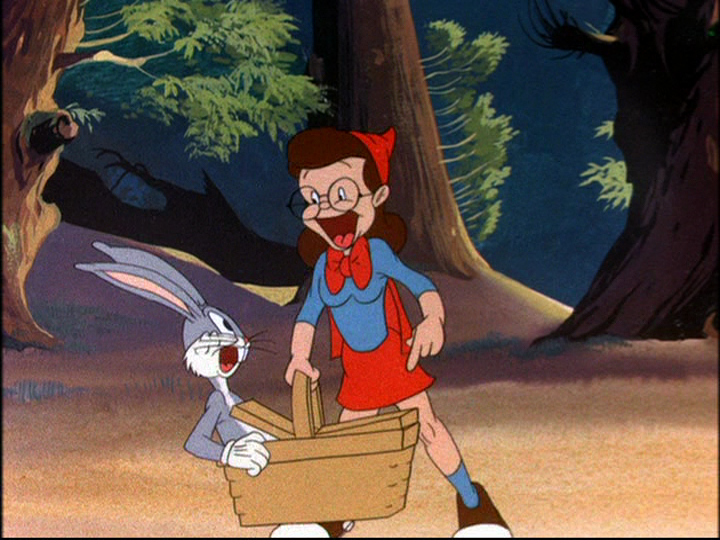 In this wacky take on the classic tale of ‘Little Red Riding Hood’, Red Riding Hood is a bespectacled, loud-voiced teenager taking Bugs in her basket to her Grandma, while singing Cole Porter’s ‘The Five O’Clock Whistle’ in her own idiosyncratic way (voiced by Bea Benadaret).
The wolf sends Red Riding Hood on a long and winding road across a mountain, while he takes a shortcut to grandma’s house, which appears to be just two meters away. The wolf doesn’t need to get rid of grandma, who’s “working swing shift at Lockheed’ (a typical war era reference), but oddly enough he has to get rid of some other wolves waiting in bed.
When Red Riding Hood arrives at grandma’s place, the wolf quickly disposes of the unappealing girl, and gets into a chase routine with Bugs, involving a marvelous door sequence, worked out perfectly in Friz Freleng’s typical timing.
However, at several points they’re interrupted by Red Riding Hood, who insists on asking her familiar questions. In the end, Bugs gets so annoyed that he punishes her instead of the wolf.
‘Little Red Riding Rabbit’ is one of the most successful of all fairy tale-inspired cartoons. It’s loaded with funny gags and one of the early highlights in the Bugs Bunny catalog.
Watch ‘Little Red Riding Rabbit’ yourself and tell me what you think:
http://ulozto.net/live/xRipWpf/bugs-bunny-little-red-riding-rabbit-1944-avi
This is Bugs Bunny cartoon No. 21
To the previous Bugs Bunny cartoon: Falling Hare
To the next Bugs Bunny cartoon: What’s Cookin’, Doc?
Director: Friz Freleng
Release Date: October 10, 1942
Stars: Bugs Bunny, Elmer Fudd
Rating: ★★½
Review:
 ‘The Hare-Brained Hypnotist’ was only the sixth encounter between Elmer Fudd and Bugs Bunny, and only the second by Friz Freleng, but already the routine was ripe for experiment.
In ‘The Hare-Brained Hypnotist’, penned by Michael Maltese, Elmer consults a book on hypnosis to catch Bugs. His hypnosis skill work on a bear, which Elmer makes think it’s a canary. It fails on Bugs however, who in turn manages to hypnotize Elmer, making him think he’s a rabbit. Elmer immediately swaps into a Bugs Bunny routine, leaving Bugs to play the straight guy. But after another hypnosis battle down the rabbit hole, Elmer returns to his former self, fleeing into the distance, while Bugs tells us he’s the B19, referring to the Douglas XB19, a huge experimental bomber plane, which had had its first flight on 27 June 1941.
‘The Hare-Brained Hypnotist’ is not a very funny cartoon. The comedy suffers, because Bugs is forced into the role of the straight guy, a problem the cartoon shares with e.g. ‘Tortoise Beats Hare‘ from 1941. Nevertheless, Elmer’s Bugs Bunnyarisms are quite hilarious, especially in a scene where he makes Bugs eat several carrots at one time.
Watch an excerpt from ‘The Hare-Brained Hypnotist’ yourself and tell me what you think:
http://www.dailymotion.com/video/x2zqdzr
This is Bugs Bunny cartoon No. 13
To the previous Bugs Bunny cartoon: Fresh Hare
To the next Bugs Bunny cartoon: Case of the Missing Hare
Director: Tex Avery
Release Date: March 15, 1941
Stars: Bugs Bunny, Cecil Turtle
Rating: ★★★½
Review:
 ‘Tortoise Beats Hare’ starts with one of the greatest openings of all Warner Brothers cartoons: Bugs walks along the title card, reading it aloud, mispronouncing all the names (Fred a-VEry).
When he reads the title, he gets angry, tears the title card apart and immediately looks up Cecil Turtle to make a bet. Cecil Turtle accepts, but when they’ve started off, he phones all his friends and relations to be his duplicate. This trick make the humble turtle seem to appear everywhere, driving Bugs mad.
‘Tortoise Beats Hare’ is Tex Avery’s first Bugs Bunny cartoon after Bugs Bunny’s debut in ‘A Wild Hare‘ (1940). In it Tex Avery immediately does a surprising experiment to his beloved character by letting him play the role of the straight guy. In ‘Tortoise Beats Hare’ it’s the humble Cecil Turtle who gets all Bugs’s routines, like kissing the rabbit at unexpected moments and addressing the audience with a “we do this kind of stuff to him all through the picture”. As Chuck Jones writes in his book ‘Chuck Amuck’:
‘The Tortoise in fact becomes Bugs, and Bugs becomes Elmer Fudd, outwitted and outacted, thereby losing control both of the tortoise-hare race and of the picture itself’.
This experiment is not a success: watching Bugs Bunny being humiliated gives the viewer an uncomfortable feeling, and outside the Cecil Turtle cartoons it was rarely repeated. Nevertheless, Bugs’ first double take is a delight, and so is the animation on the slow hopping Cecil.
”Tortoise Beats Hare’ was only Bugs Bunny’s third screen appearance, and it shows: his design is still somewhat unsteady, and so is his voice. When Bugs addresses Cecil for the first time, it sounds like we hear many Mel Blanc voices after another.
At MGM Avery would reuse the idea of a guy popping up everywhere driving his opponent mad to greater effect, in two Droopy cartoons, ‘Dumb-Hounded‘ (1943) and ‘The Northwest Hounded Police‘ (1946). In both cartoons Avery skips the explanation how the guy could be everywhere, making the result way funnier.
Meanwhile, Cecil Turtle would return in the Bob Clampett cartoon ‘Tortoise wins by a Hare’ (1942) and in the Friz Freleng cartoon ‘Rabbit Transit’ (1947).
Watch ‘Tortoise Beats Hare’ yourself and tell me what you think:
http://www.dailymotion.com/video/x2ox5qu
This is Bugs Bunny cartoon No. 3
To the previous Bugs Bunny cartoon: Elmer’s Pet Rabbit
To the next Bugs Bunny cartoon: Hiawatha’s Rabbit Hunt
Director: Wilfred Jackson
Release Date: February 23, 1935
Stars: Clarabelle Cow, Donald Duck, Horace Horsecollar, Mickey Mouse
Rating: ★★★★★ ♕
Review:
 Almost three years after ‘Flowers and Trees’ Mickey finally made the step to color, and it’s probably because of this that ‘The Band Concert’ has such a Silly Symphony-like feel to it.
In 1935 the concept of a concert cartoon was already an old one (Mickey’s first was the ‘Barnyard Concert’ from 1930), but it finds the peak of perfection in this one.
Likewise, the use of Gioachino Rossini’s ‘overture Wilhelm Tell’ and ‘Turkey in the Straw’ in cartoons was far from new, but who would have thought that the two tunes would fit together so perfectly? The overture is played inside-out culminating in the storm sequence which brings forth a tornado. That’s how it feels, Mickey is not only conducting the storm music but even the real storm itself!
Notwithstanding the cartoon being a Mickey Mouse showcase, it’s Donald Duck who is stealing the show, like he did in the two previous Mickey Mouse cartoons he appeared in: ‘Orphan’s Benefit‘ and ‘The Dognapper‘. Being the only character in the cartoon born in color, Donald makes the transition from black-and-white to color naturally. Mickey and the other characters, on the other hand, still have a strong black-and-white feeling in their design and are less fitting in the bright world of color.
During Mickey’s concert, Donald produces an unending supply of flutes out of nothing, playing ‘Turkey in the Straw’ right through Rossini’s music (this ability of bringing forth material from out of nowhere was a capability that Donald would soon lose, but it would become a trademark of Bugs Bunny several years later). It’s a bitter irony that it’s this tune, ‘Turkey in the Straw’, which signals Mickey’s demise, because it was the same tune that made Mickey a star in the first place.
Nevertheless, ‘The Band Concert’ is without doubt Mickey’s best concert cartoon, arguably his best cartoon since ‘Steamboat Willie‘ and certainly one of the most perfect animated cartoons ever made.
Watch ‘The Band Concert’ yourself and tell me what you think:
This is Mickey Mouse cartoon No. 73
To the previous Mickey Mouse cartoon: Mickey’s Man Friday
To the next Mickey Mouse cartoon: Mickey’s Service Station
Director: Friz Freleng
Release Date: November 11, 1946
Stars: Bugs Bunny
Rating: ★★★★
Review:
 A very deft Bugs Bunny plays Franz Liszt’s second Hungarian rhapsody on a piano. This classical piece was director Friz Freleng’s all-time favorite, and it appears in several of his films.
In ‘Rhapsody Rabbit’ it is played out full. The cartoon consists of spot gags and it has a small story about Bugs having problems with a mouse. This story element is not well-developed and dropped halfway the cartoon, only to return at the end.
The idea of a battle between the pianist and a mouse was perfected by Hanna & Barbera only five months later in their Tom & Jerry cartoon ‘The Cat Concerto‘, which has exactly the same subject, and which uses exactly the same music by Liszt. Unlike Freleng however, the duo swept the Oscar… There seems to be something fishy about this fact, which is analyzed in detail by Thad Komorowski in his excellent blogpost on the issue.
Compared to the latter cartoon, ‘Rhapsody Rabbit’ is less consistent, but more absurd. The gag in which the mouse makes Bugs play an infectious boogie-woogie may be the highlight of the film.
Watch ‘Rhapsody Rabbit’ yourself and tell me what you think:
http://www.220.ro/desene-animate/Rhapsody-Rabbit/RnRu8v7HIK/
This is Bugs Bunny cartoon No. 41
To the previous Bugs Bunny cartoon: The Big Snooze
To the next Bugs Bunny cartoon: Rabbit Transit


 Dr. Grob's Animation Review