You are currently browsing the tag archive for the ‘Canada’ tag.
Director: Norman McLaren
Release date: 1961
Rating: ★★★½
Review:

‘New York Lightboard’ is a direct-on-film animation film that was never meant for the cinema. Instead, it was a commercial film commissioned by the Canadian Governmental Tourism Office to be projected in an endless loop on a big screen on Times Square in New York City.
The film is both in black and white and silent, but McLaren makes the commercial a very playful one, with letters bouncing and playing with each other, and metamorphosis running wild (we watch. e.g. the letters Canada change into a fish, which turns into a bird, which becomes a smiling sun, etc.).
Most of the film is pretty abstract, but there’s also some fine animation of swimming fish, a galloping horse, a man in a canoe and of Hamlet and Laertes fighting. Apart from the words Canada and ‘Dial PL 7-4917’ (for more information), the most recurring elements are animated fireworks.
The whole film seems a little too playful and too experimental for a general audience, but it certainly must have drawn attention. There’s also a short equally silent documentary called ‘New York Lightboard Record’ in which we watch the film on a screen on Times Square, and some of the responses of the audience watching it.
Watch ‘New York Lightboard’ & ‘New York Lightboard Record’ yourself and tell me what you think:
‘New York Lightboard’ and ‘New York Lightboard Record’ are available on the DVD-box ‘Norman McLaren – The Master’s Edition’
Director: Trey Parker
Release date: June 30, 1999
Rating: ★★★★★ ♕
Review:
The South Park television series was only midway in its third season when its first (and only!) theatrical feature film was released. Thus, the film contains many of the quirks so typical of the earliest seasons but long since forgotten, like Kenny’s obligatory death, Kyle performing the act of ‘kick the baby’ with his little brother Ike or Stan compulsory vomiting on meeting Wendy.
Also prominent are characters that years ago have disappeared from the sitcom like Chef and Mr. Hat. Moreover, Cartman’s personality as a complete and pretty evil ass is not yet defined here, and although he’s already a jerk, he’s just one of the gang here.
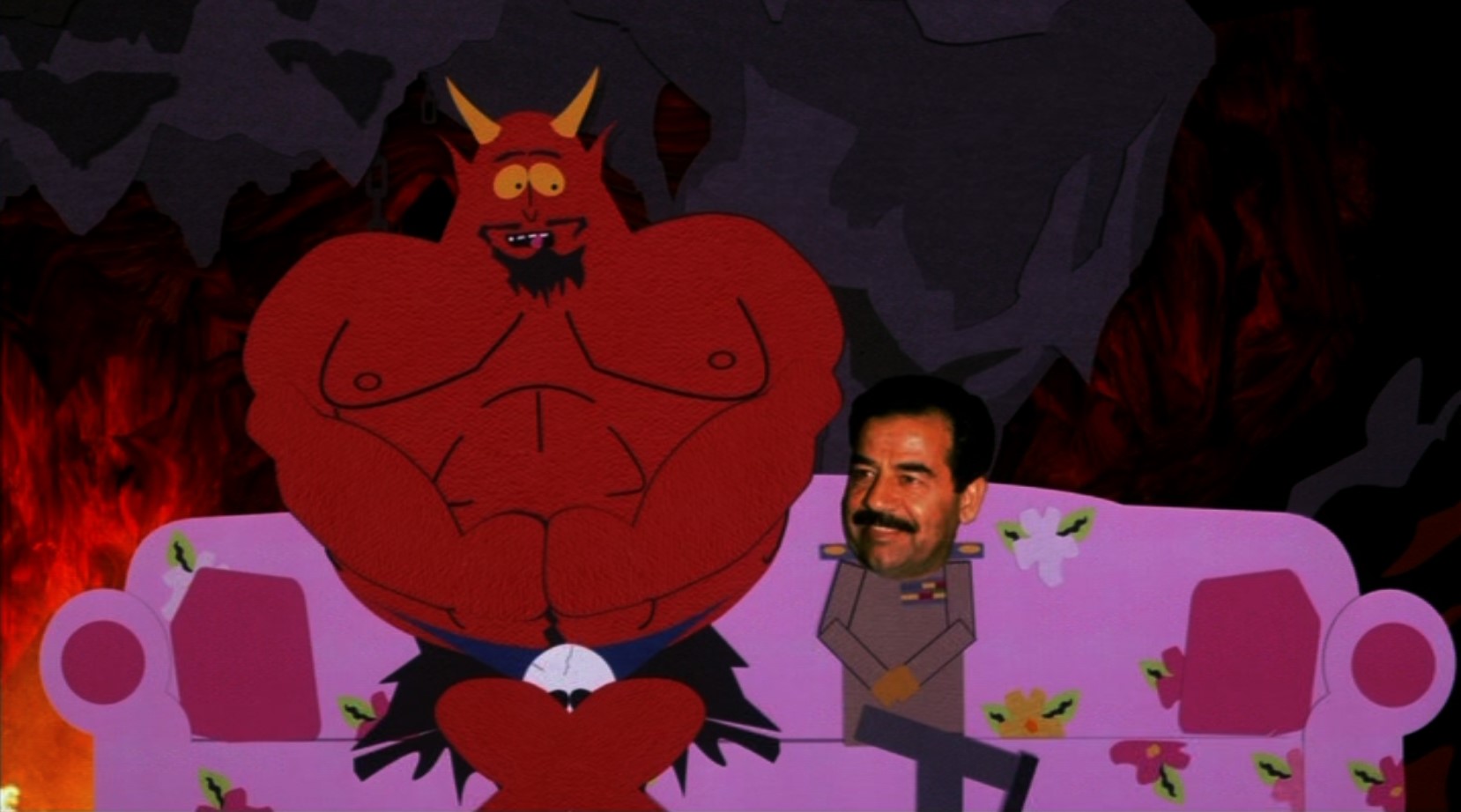
The animation, too, retains much more of its cut-out origins than later seasons, although in the feature film the all too primitive animation is juxtaposed to a swirling 3D computer animation, especially in the hell scenes, which gives the film extra grandeur, but which would become more of a style element in later seasons of the series.
The South Park series always was at its best in social commentary, and it that respect, ‘South Park: Bigger, Longer & Uncut’ delivers big time. The film painfully clearly shows America’s obsession to prevent their children to experience anything subversive, except gun violence (incidentally by now the major death cause of American youth). It’s best not to reveal the plot, but it’s enough to know that when the kids go see the new Philip and Terrance movie ‘Asses on Fire’, things quickly go out of hand.
The film also introduces the idea that Terrance and Philip are Canadian, and that all Canadians have disjointed heads and square hands, so the difference between the designs of the main characters and that of their favorite television show turns out not be one of style, but one of ‘nature’. This ridiculous idea is played out well, and was continued in the television series, too.
Kenny dies, of course, but for the first time we see what happens to him after his death, and quite a bit of the action takes place in hell, where Satan and Saddam Hussein get involved in the plot. Now, the Iraqi dictator was very much alive back then, and the film is a testimony of the US’ frustration they didn’t remove the villain from the office in the first Gulf War (1990-1991).
Because of Hussein Iraq was included in George Bush jr.’s nonsensical ‘Axis of evil’ (together with its arch enemy Iran), which ultimately lead to the misguided and very questionable invasion of Iraq in 2003. In ‘South Park: Bigger, Longer & Uncut’ Saddam Hussein is shown as being even more evil than Satan himself, dominating the prince of darkness in a toxic relationship. Of course, the inclusion of Saddam Hussein ages the film more than necessary, as do other references to real people, like Brian Boitano (whom I as a non-American had never heard of).
Yet, the biggest surprise of ‘South Park: Bigger, Longer & Uncut’ is not its high level of satire, nor its excellent plot, nor the introduction of elements that would become more familiar later on in the series. No, the biggest surprise of the film is that it is in fact, a musical, and a very good one at that, too. The film literally bursts with songs (there are fourteen of them), all ranging from good to excellent.
It seems Trey Parker knew exactly how to write a musical song: yes, practically all his songs are parodies of musical tropes, but his own creatures have such beautiful and memorable melodies they perfectly stand on their own. Absolutely top are ‘What would Brian Boitano do?’ and Satan’s Jesus Christ Superstar-like ‘Up there’. And then there’s a great musical moment when the Les misérables-like song ‘La résistance’ suddenly gets intermixed by four other songs, including a new one sung by soldiers, and the outstanding ‘Blame Canada’. This latter song, which was introduced much earlier in the film, is the undisputed highlight of the feature and was nominated for an academy award for best original song (which it unjustly lost to the bland ‘You’ll Be in My Heart’ Phil Collins composed for Disney’s ‘Tarzan’).
In fact, ‘South Park: Bigger, Longer & Uncut’ is so good at being a musical that it can easily be counted among the best animated musicals ever. Main composer Trey Parker, at least got on a new career as a musical writer. No, there were no other South Park movies to come, but not only did more and more songs creep into the South Park series itself, but Parker made another musical with the bizarre puppet movie ‘Team America: World Police’ (2004) and even hit Broadway with the stage musical ‘The Book of Mormon’ (2011).
In all, South Park: Bigger, Longer & Uncut’ is great satire, it’s a great musical, and it’s a great proof that feature films based on television series could (and should) be an improvement on the original series.
Watch the trailer for ‘South Park: Bigger, Longer & Uncut’ yourself and tell me what you think:
‘South Park: Bigger, Longer & Uncut’ is available on Blu-Ray and DVD
Directors: Amanda Forbis & Wendy Tilby
Release date: June 1, 2011
Rating: ★★★
Review:
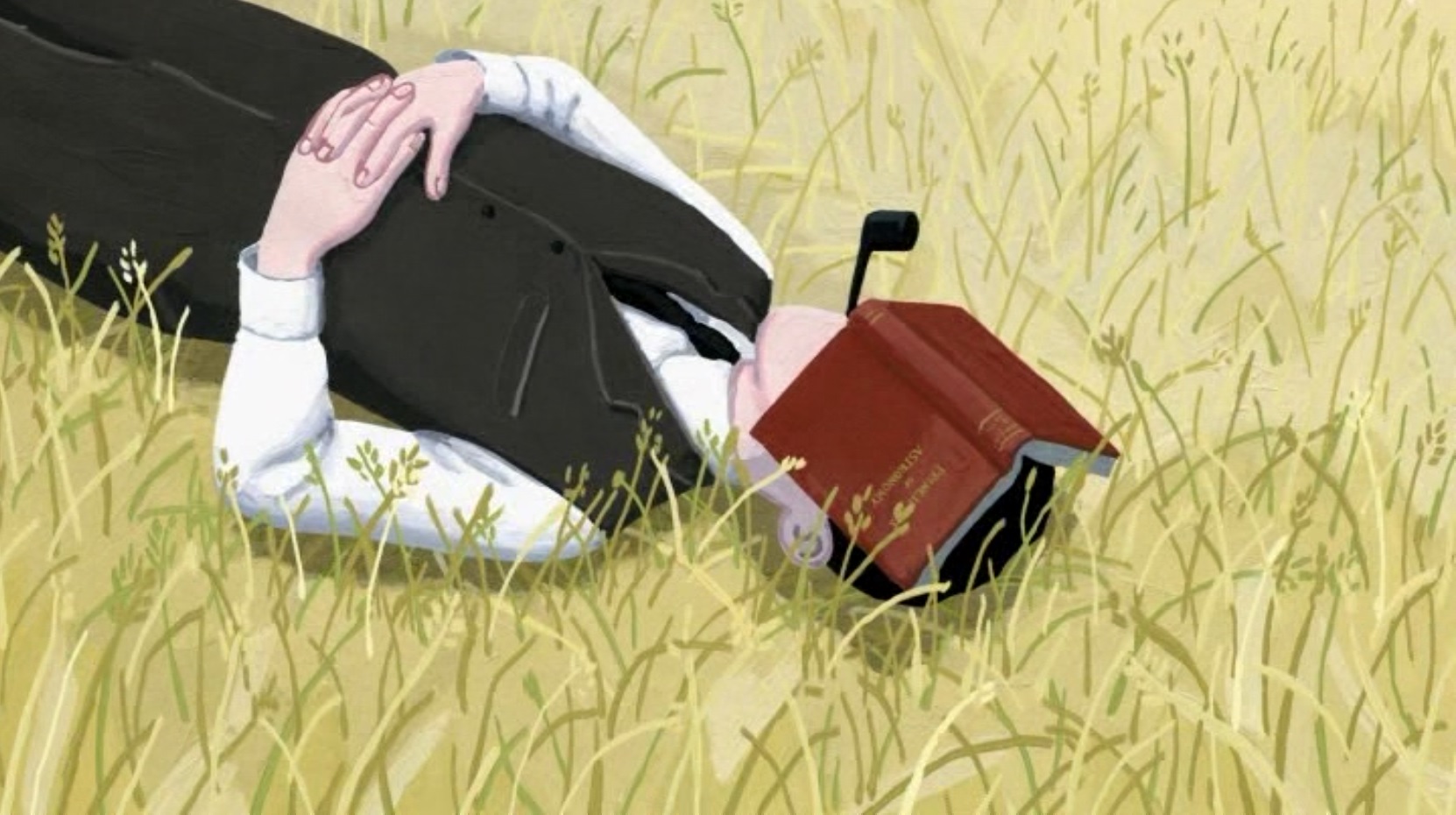
In this short Amanda Forbis and Wendy Tilby tell about a young Englishman migrating to Alberta, Canada in 1909, where he ends in a small hut on the countryside. The young man’s letters to his father and mother paint a rosier picture than his actual circumstances deserve.
For their short Forbis and Tilby use a very attractive form of painted animation, mixed with a little traditional animation. They tell their story using “interviews” with people who knew him and with intertitles, which often rather puzzling tell us about comets.
The film is told rather tongue-in-cheek, but the story is ultimately tragic, and the film could be seen as a meditation on loneliness and failure. But it’s to the viewer to connect the loose snippets of information together in his head, for Forbis and Tilby don’t tell their story straightforward, but associatively and free flowing. The soundtrack is great, using very fitting original songs, as well as old recordings and an instrumental rendering of Gilbert & Sullivan’s big hit ‘I Am the Very Model of a Modern Major-General’.
Watch ‘Wild Life’ yourself and tell me what you think:
‘Wild Life’ is available on the The Animation Show of Shows Box Set 9
Director: Frédéric Back
Release Date: June 1993
Rating: ★★★★★ ♕
Review:
 Following the extraordinary success of ‘The Man Who Planted Trees’, which inspired several tree planting projects, Frédéric Back turned his attention to Canada’s majestic St. Lawrence river in ‘The Mighty River’.
Clocking almost half an hour, this is Back’s last and most impressive film. Told by Donald Sutherland, the film is both an ode to this impressive river, showing nature’s grandeur and spectacular sights, and a tale of the river’s sad history, which with the arriving of the Europeans turns a dark page. Soon, the story is one of slaughter, exploitation, destruction, pollution, and greed.
The film’s pessimistic and environmentalist message at times contrasts greatly with the extraordinarily beautiful and highly virtuoso images, not only of the river itself, or of the abundance of creatures the river inhabits, but also of mankind living around the stream.
Back’s style ranges from highly naturalistic to impressionistic, pointillistic, and even Van Gogh-like. His animation style is in constant motion, taking the spectator from one image to another in an organic string of continuity, as if the film itself flows like a river. Metamorphosis and swooping camera movements add to the flowing nature of the film.
Despite the extraordinary beauty of the more peaceful images, Back shows us many pictures of death and destruction: images of the slaughtering of once abundant species, of decimation of the surrounding forests and of the emptying of life in the nearby Ocean bay. These images give the film a sad and disturbing outlook, and there’s makes no mistake that Black blames sheer greed for these atrocities.
Yet, by altering the images of woe with images of wonder, Back keeps his film from becoming a depressing work of agitprop. Still, his message is crystal clear: man has exploited this mighty river long enough, and now it’s time to give its nature rest and time to heal. And even then the once countless flocks of great auk and passenger pigeons will never return, as man has driven them to extinction.
In all, ‘The Mighty River’ is an impressive piece of work, a film that will leave no viewer unmoved, and a crowning achievement on Back’s already impressive oeuvre.
Watch ‘Le fleuve aux grandes eaux’ yourself and tell me what you think:
‘Le fleuve aux grandes eaux’ is available on the DVD-box ‘L’intégrale de Frédéric Back’
Director: Frank Tashlin
Release Date: December 19, 1936
Stars: Porky Pig
Rating: ★★★
Review:
 Porky has a game refuge in Canada, in which he defends rather cute animals against an evil hunter.
The hunter is designed like the lieutenant from ‘Little Beau Porky‘, but we only see him appear after 4’30. Before this his threat is shown by his shadow only, a remarkably inventive device for a cartoon of the 1930s.
Like other early Warner Brothers films, ‘Porky in the North Woods’ looks very primitive, and rather Disney-anno-1932/1933-like. Yet it features an extremely fast sequence of a squirrel running a ridiculously long distance through the woods to get help (and back to fetch and apple). Such short and fast sequences of characters crossing ridiculously long distances would become a trademark of Tashlin’s colleague Tex Avery. Like his first two films, Tashlin’s third short at Warner Bros. features a battle sequence: this time we watch an enormous number of animals being called to arms.
Porky hardly talks in this cartoon – it seems Tashlin tried to avoid his tiresome stutter. Indeed, in 1937, the original voice artist would be replaced by Mel Blanc, who was able to make Porky’s stutter funny.
Watch ‘Porky in the North Woods’ yourself and tell me what you think:
http://www.dailymotion.com/video/x2xp64z
This is Porky Pig cartoon no. 17
To the previous Porky Pig cartoon: The Village Smithy
To the next Porky Pig cartoon: Porky the Wrestler
Directors: Dick Lyford & Ford Beebe
Release Date: December 12, 1941
Stars: The Seven Dwarfs
Rating: ★★★½
Review:
 ‘7 Wise Dwarfs’ is Walt Disney’s second propaganda film for the Canadian government, and it uses the same two-part formula as the first (‘The Thrifty Pig‘), this time reusing animation from Walt Disney’s most famous film of all: ‘Snow White and the Seven Dwarfs’ (1937).
The first part of ‘7 Wise Dwarfs’ reuses animation of the seven dwarfs singing the mining song and ‘Hi-ho’, but with altered lyrics and backgrounds. There is some new animation of the Dwarfs entering and leaving the bank to buy war bonds. The second part is almost the same as that of ‘The Thrifty Pig’, ending with the same powerful image of planes gunning the words ‘Invest in Victory’. The Seven Dwarfs would return in ‘The Winged Scourge‘ (1943), which features a lot of new animation on them.
Watch ‘7 Wise Dwarfs’ yourself and tell me what you think:
Director: Ford Beebe
Release Date: 1941
Stars: The Three Little Pigs
Rating: ★★★★½
Review:
 Before The United States were dragged into the war by Japan’s attack on Pearl harbor, December 7, 1941, Walt Disney Studio already had made four propaganda shorts for the Canadian government.
Canada, had declared war on Nazi Germany on September 10, 1939, a week after the United Kingdom, following Germany’s invasion of Poland, September 1.
‘The Thrifty Pig’ is the first of Disney’s four propaganda films commissioned by the Canadian government to persuade their citizens to buy war bonds to invest in the war effort. The other three being ‘7 Wise Dwarfs‘ (1941), ‘Donald’s Decision‘ (1942) and ‘All Together‘ (1942). It’s also Disney’s first propaganda cartoon.
‘The Thrifty pig’ consists of two parts, The first part cleverly reuses animation from Walt Disney’s most famous short, ‘Three Little Pigs‘ (1933), but in this shortened version the wolf wears a Nazi costume, the bricks are made of war bonds and the union jack is waving at the wise pig’s house. The only new animation is when the wolf’s blows reveal war bonds beneath the plaster and when the wise pig says “these bricks not only stop his blowing, they will also get him going”.
The second part is more overtly propagandistic and uses limited animation of war machines and slogans to persuade the public to buy “more and more war certificates”. The end shot, where a plane shoots the words ‘Invest in Victory’ on the screen’ is the most powerful image of the complete film.
This two part formula would be reused in all succeeding propaganda films that had to persuade the public to invest in the governmental war industry. Apart from the Canadian commissions, we see this structure in ‘The New Spirit‘ (1942) and ‘The Spirit of ’43‘ (1943), which had to persuade American citizens to pay their income taxes in time.
Watch ‘The Thrifty Pig’ yourself and tell me what you think:


 Dr. Grob's Animation Review