You are currently browsing the tag archive for the ‘Donald Duck’ tag.
Directors: Pinto Colvig, Walt Pfeiffer & Ed Penner
Release Date: April 17, 1937
Stars: Mickey Mouse, Donald Duck, Clarabella Cow, Clara Cluck, Goofy
Rating: ★★★½
Review:
 Mickey is only the straight man while hosting an amateur night at the theater.
We watch Donald trying to recite ‘Twinkle Twinkle Little Star’ while forgetting the words, Clarabella Cow and Clara Cluck performing an operatic song, and Goofy with an automatic one man band that goes haywire.
Donald surprises not only his but also the modern audience by drawing a tommy gun to shoot at the audience(!). However, it’s Goofy’s silly musical machine which draws the biggest laughs in a hilarious sequence, with particularly silly animation.
‘Mickey’s Amateurs’ ends with Donald getting caught in the closing end circle. Self-awareness gags like this were rare at Disney’s (another example is the burning title card in ‘Mickey’s Fire Brigade‘ from 1935), but would become standard repertoire at Warner Bros. and in Tex Avery’s cartoons at MGM.
Watch ‘Modern Inventions’ yourself and tell me what you think:
This is Mickey Mouse cartoon No. 94
To the previous Mickey Mouse cartoon: Moose Hunters
To the next Mickey Mouse cartoon: Modern Inventions
Director: Jack King
Release Date: May 29, 1937
Stars: Donald Duck
Rating: ★★★½
Review:
 After a short stint at Warner Brothers, veteran animator Jack King makes his debut as a director at the Disney studio.
King would remain a director of Donald Duck films until his retirement in 1948, directing only three cartoons without the duck (‘Farmyard Symphony‘ from 1938, and the propaganda shorts ‘Out of the Frying Pan into the Firing Line‘ and ‘Defense against Invasion‘, from 1942 and 1943, respectively).
‘Modern Inventions’ is Donald’s first real solo outing, sharing screen time only with mechanical objects. He visits a ‘museum of modern marvels’ , where he has to deal with a mechanical robot butler (the running gag of the film), a package wrapper, a ‘robot nurse maid’ and an automatic barber chair. Like in ‘The Band Concert‘ Donald shows an ability to produce numerous objects out of nothing, this time hats. He even manages to change his army cap into a baby cap.
‘Modern Inventions’ was the last of three Donald Duck shorts under the Mickey Mouse flag. With his next cartoon, ‘Donald’s Ostrich‘ he would have a series of his own…
Watch ‘Modern Inventions’ yourself and tell me what you think:
This is Mickey Mouse cartoon No. 95
To the previous Mickey Mouse cartoon: Mickey’s Amateurs
To the next Mickey Mouse cartoon: Hawaiian Holiday
Director: Ben Sharpsteen
Release Date: January 9, 1937
Stars: Donald Duck
Rating: ★★★★★
Review:
 After co-starring with Pluto in ‘Donald and Pluto‘ (1936), Donald really comes to his own in ‘Don Donald’. In this cartoon he only shares screen time with a new character, Donna Duck, a predecessor of Daisy with a temper that matches Donald’s own.
In this film, we watch Donald in a Mexican setting featuring a surprisingly Krazy Kat-like palm in the background. He wears a large sombrero and tries to woo Donna, but his donkey spoils his efforts. Donald trades his donkey for a car (the small red car we would become so familiar with). The car makes a deep impression on Donna, and both go for a ride.
The animation of the car ride is a great showcase of animation of speed, while the hilarious sequence in which Donald tries to restart the motor again is a wonderful example of rubbery animation. The film ends marvelously, when Donna produces a unicycle out of her handbag and rides off into the distance. But the whole film is one of sheer delight and one of the classics of the 1930s.
Despite Mickey’s absence, ‘Don Donald’ is still part of the Mickey Mouse series. Only with ‘Donald’s Ostrich‘ from December 1937 Donald would get his own series.
Watch ‘Don Donald’ yourself and tell me what you think:
This is Mickey Mouse cartoon No. 91
To the previous Mickey Mouse cartoon: The Worm Turns
To the next Mickey Mouse cartoon: Magician Mickey
Director: Ben Sharpsteen
Release Date: September 12, 1936
Stars: Donald Duck, Pluto
Rating: ★★½
Review:
 While Donald is plumbing, Pluto accidentally swallows a magnet, attracting all kinds of metallic objects, like his dish, a pendulum, a watch and eventually Donald’s monkey-wrench.
This short features elaborate gags based on character animation, surely building to a grand finale. One can admire the inevitable ‘logic’ of the film, yet the result is only mildly funny, and neither one of Donald’s or Pluto’s best films.
Although advertised as a Mickey Mouse cartoon, in ‘Donald and Pluto’ Mickey Mouse is not present at all. On the contrary, for both Donald and Pluto this is their first cartoon without Mickey (if we disregard the Silly Symphonies ‘Just Dogs‘ from 1932 and ‘The Wise Little Hen‘ from 1934). After getting more and longer sequences of their own within the Mickey Mouse series, this step was inevitable.
Pluto had come a long way, sharing five years and 33 films with Mickey before standing on his own, but Donald received his independence already within two years, after only twelve films with Mickey.
Both Pluto and Donald would get their own series in 1937. They would appear together in five more films, all within Donald’s series: ‘Beach Picnic‘ (1939), ‘Donald’s Dog Laundry‘, ‘Put-Put Troubles‘, ‘Window Cleaners‘ (all 1940) and finally ‘The Eyes Have It’ (1945).
Watch ‘Donald and Pluto’ yourself and tell me what you think:
This is Mickey Mouse cartoon No. 88
To the previous Mickey Mouse cartoon: Mickey’s Circus
To the next Mickey Mouse cartoon: Mickey’s Elephant
Director: Ben Sharpsteen
Release Date: August 1, 1936
Stars: Donald Duck, Mickey Mouse, the Orphan Mice, the Little Seal
Rating: ★★½
Review:
 In ‘Mickey’s Circus’ we watch Mickey and Donald perform in a circus for a pack of orphan mice.
Most of the time goes to Donald and his trained seals. Only after six minutes Mickey joins in again, struggling with Donald on the slack-rope, while being troubled by the orphan mice.
‘Mickey’s Circus’ was the last cartoon to feature the Orphan Mice (apart from the remake of ‘Orphan’s Benefit from 1941), until their unexpected return in ‘Pluto’s party‘ from 1952. It’s also the first Disney short featuring a cute little seal. Similar seals would reappear in ‘Pluto’s Playmate‘ (1941), ‘Rescue Dog‘ (1947) and ‘Mickey and the Seal‘ (1948).
Watch ‘Mickey’s Circus’ yourself and tell me what you think:
This is Mickey Mouse cartoon No. 87
To the previous Mickey Mouse cartoon: Alpine Climbers
To the next Mickey Mouse cartoon: Donald and Pluto
Director: Ben Sharpsteen
Release Date: June 20, 1936
Stars: Mickey Mouse, Donald Duck, Goofy, Pete
Rating: ★★★½
Review:
 Because Mickey, Donald and Goofy can’t pay the rent, evil sheriff Pete will sell their furniture. The boys decide to move before that’s going to happen…
‘Moving Day’ is the this third of the classic trio cartoons featuring Mickey, Donald and Goofy. In this entry Mickey is hardly visible. Most of the cartoon is taken by his co-stars in two all too elaborate sequences: one featuring Goofy in a surreal struggle with a piano with a will of its own, and another featuring Donald’s trouble with a plunger and a fishbowl.
Despite the great animation, one gets the feeling that in this cartoon the artists were too much obsessed with character and less with gags, making this cartoon a bit slow and tiresome, when compared to the previous trio outings ‘Mickey’s Service Station’ and ‘Mickey’s Fire Brigade‘ from 1935. Luckily, in later trio shorts like ‘Moose Hunters’ or ‘Hawaiian Holiday’, the fast pace was found again.
‘Moving Day’ is the first cartoon to feature Pete in color. It was also the last of only three cartoons in which Art Babbitt animated Goofy. After he had done so much for the character in ‘Mickey’s Service Station’ and ‘On Ice‘, one can say that in ‘Moving Day’ he went a little too far in milking the goof’s scenes. Anyhow, Babbitt went over to feature films, but after these three shorts Goofy’s character was established well enough for others to take over with equally inspired results.
Watch ‘Mickey’s Fire Brigade’ yourself and tell me what you think:
This is Mickey Mouse cartoon No. 85
To the previous Mickey Mouse cartoon: Mickey’s Rival
To the next Mickey Mouse cartoon: Alpine Climbers
Director: Jack Hannah
Release Date: May 30, 1953
Stars: Donald Duck, Huey, Dewey and Louie
Rating: ★★★★
Review:
 Donald and the boys are on a holiday in Latin America. But Huey, Dewey and Louie only have eyes for their comic book.
Donald then fools them by pretending a fountain of youth has made him younger. He even uses an alligator egg to make them believe he turned into an egg again. This leads to an encounter with the mother alligator, whose not amused. In the end we watch Donald and the boys fleeing into the distance.
The backgrounds in this cartoon are extraordinarily colorful. The characters don’t really read well against these backgrounds, but their lushness is overwhelming and an extra highlight besides the gags.
Watch ‘Don’s Fountain of Youth’ yourself and tell me what you think:
This is Donald Duck cartoon No. 99
To the previous Donald Duck cartoon: Trick or Treat
To the next Donald Duck cartoon: The New Neighbor
Director: ?
Release Date: May 27, 1948
Stars: Donald Duck, Joe Carioca, The Aracuan Bird
Rating: ★★★★
Review:
 Sung by Ethel Smith and the Dinning Sisters, ‘Blame it on the Samba’ looks like a lost sequence from ‘The Three Caballeros‘ (1944)
The short, the sixth segment from ‘Melody Time‘, reunites Donald Duck, Joe Carioca and the Aracuan bird. The latter serves as the cartoon’s surreal character, who can cross the three dimensions, not unlike the Do-Do in ‘Porky in Wacky Land’ (1938). It’s this feature that makes ‘Blame It On The Samba’ so enjoyable.
Again, the Mary Blair-inspired backgrounds are highly stylized, even almost abstract, and extremely colorful. It also features some live action footage of Ethel Smith dancing and playing the organ and a pair of conga’s. Unfortunately, the music seems to be more about samba than being it, and it never becomes really hot.
Nevertheless, ‘Blame It On The Samba’ is a welcome diversion after Melody Time’s three tiresome episodes ‘The Legend of Johnny Appleseed‘, ‘Little Toot‘ and ‘Trees‘.
Watch ‘Blame it on the Samba’ yourself and tell me what you think:
Directors: Jack Kinney, Hamilton Luske & Bill Roberts
Release Date: September 27, 1947
Stars: Jiminy Cricket, Mickey Mouse, Donald Duck, Goofy, Edgar Bergen, Luana Patton
Rating: ★★★★
Review:
 Fun and Fancy Free’ was the fourth of six package features Disney released in the 1940s.
It consists of two unrelated stories, which were both originally conceived as feature films in 1940/1941. The two stories, ‘Bongo’ and ‘Mickey and the Beanstalk’ are loosely linked by Jiminy Cricket, who sings the happy-go-lucky theme song.
He plays a record to a sad doll and a gloomy bear which features Dinah Shore telling the story of Bongo in rhyme and song. This cute, if unassuming and forgettable little film (after a story by Sinclair Lewis) tells about Bongo the circus bear, who breaks free from the circus, falls in love with a cute female bear called Lulubelle, and combats a large brutal bear called Lumpjack.
Immediately after this story has ended, we follow Jiminy Cricket to a live action setting: a private party with a little girl (Luana Patton), Edgar Bergen and his two ventriloquist sidekicks, the cynical Charlie and the dumb, but gentle Mortimer.
Bergen tells a version of ‘Jack and the Beanstalk’, starring ‘famished farmers’ Mickey, Donald and Goofy in their last classic trio outing. This part had a long genesis, the early drafts of this film go back to 1940. Apparently Pinto Colvig had returned to the Disney studio, because Goofy has his voice back after having been silenced for eight years. Pinto Colvig would do Goofy’s voice in two subsequent shorts, ‘Foul Hunting‘ (1947) and ‘The Big Wash‘ (1948), before leaving again, leaving Goofy voiceless, once more. This sequence is also the last theatrical film in which Walt Disney does Mickey’s voice. Halfway the production Jimmy MacDonald took over.
This second episode of ‘Fun and Fancy Free’ is a delight, if a little bit slow. Its humor derives mostly from Charlie’s sarcastic interruptions. Nevertheless, the animation of the growing beanstalk and of Willie the giant is stunning.
Willie would be the last giant Mickey defeated, after having done with giants in ‘Giantland‘ (1933) and ‘Brave Little Tailor’ (1938). Unlike the other giants, Willie is an instantly likeable character, and he was revived as the ghost of Christmas Present in ‘Mickey’s Christmas Carol‘ (1983).
‘Fun and Fancy Free’ is a lighthearted film. Like Disney’s other package features, it is not too bad, but it is certainly not among the ranks of masterpieces.
Watch the opening scene of ‘Fun and Fancy Free’ yourself and tell me what you think:
Director: Jack Hannah
Release Date: November 1, 1946
Stars: Donald Duck, Goofy
Rating: ★★½
Review:
 ‘Frank Duck Brings ‘Em Back Alive’ is the fourth of five cartoons starring both Donald and Goofy. The coupling never was really successful, and ‘Frank Duck Brings ‘Em Back Alive’ is no exception.
In this short Goofy is staged as some Tarzan-like wild man wearing sneakers. Donald Duck is himself as hunter ‘Frank Duck’, trying to capture the wild man. Their endless chase ends when they encounter a lion. The wild man escapes with Donald’s boat, leaving Donald leaping from tree to tree, followed by the lion. Iris out.
The comedy of ‘Frank Duck Brings ‘Em Back Alive’ does not work well, because Goofy is not really himself here. Maybe director Jack Hannah was inspired by the anonymous Goofies that crowded the Goofy films of the era, including some he directed himself. In any case, when the anonymous Goofy suddenly is reduced to one, something apparently goes wrong. Then we probably expect to watch the real Goofy again, something which does not happen in this cartoon. Instead, we watch a Goofy acting silly, but also outsmarting his hunter, just like Daffy Duck does at Warner Brothers. It just doesn’t feel right. It’s so out of character, it ruins the comedy.
‘Frank Duck Brings ‘Em Back Alive’ contains a very late occasion of Donald’s typical dance of anger, made famous by animator Dick Lundy in Donald’s second screen appearance, ‘Orphan’s Benefit‘ (1934). Donald showed this behavior often in his early career, but it had become rare by the 1940s.
Watch ‘Frank Duck Brings ‘Em Back Alive’ yourself and tell me what you think:
Director: Jack Hannah
Release Date: September 20, 1946
Stars: Donald Duck
Rating: ★★★★
Review:
 In ‘Lightouse Keeping’ Donald works at a lighthouse. He nags a pelican by aiming the light on it. What follows is a fast and funny duel between the two birds in switching on/off the light.
This is a hilarious cartoon from the first scene, in which we watch Donald trying to read in the ever-circling lighthouse light, to the last one, where the feud has gotten so fanatical, the two birds even continue it after sunrise.
With his third Donald Duck short Jack Hannah really hit his stride. It’s faster and better timed than his first three shorts, ‘Donald’s Off Day’ (1944), ‘The Eyes Have It’ and ‘No Sail’ (1945). Maybe he was inspired by his work on a Goofy cartoon, ‘A Knight For A Day‘ earlier that year? In any case, while directing both Goofy and Donald (1946-1947), he made some of his best Donald Duck shorts: apart from ‘Lighthouse Keeping’, the 1947 shorts ‘Straight Shooters’, ‘Clown of the Jungle‘ and ‘Chip an’ Dale‘.
Watch an excerpt from ‘Lighthouse Keeping’ yourself and tell me what you think:
This is Donald Duck cartoon No. 59
To the previous Donald Duck cartoon: Dumb Bell of the Yukon
To the next Donald Duck cartoon: Straight Shooters
Director: Jack King
Release Date: January 7, 1943
Stars: Donald Duck
Rating: ★★★★★ ♕
Review:
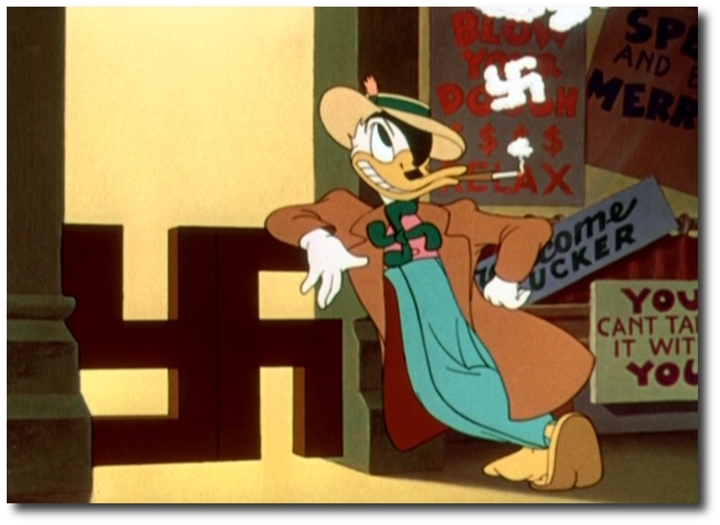 ‘The Spirit of ’43’ is the follow-up to ‘The New Spirit’ from the previous year. The second half is exactly the same, but the first half is even better than the first half of its predecessor, making a clever use of strong symbolic imaginary.
Donald just got paid and he’s divided between his two selves: the thrifty (a Scottish forerunner of Uncle Scrooge) and the spendthrift. These two characters struggle for Donald, in which they both fall down: the spendthrift into a tavern with a swastika-shaped swing-door and the thrifty into a wall, which, together with the stars his fall produces, resembles the American flag. This makes the decision for Donald easier, will he “spend for the axis or save for taxes”? He knocks his spendthrift side into the tavern, crushing the swastika door changing it into a V for victory. At this point the second half starts (see ‘The New Spirit‘ for a description of this part).
‘The Spirit of ’43’ is propaganda, and quite obviously so. But the film is both inventive and effective in its delivery of its message, and therefore surprisingly enjoyable.
Watch ‘The Spirit of ’43’ yourself and tell me what you think:
Director: Wilfred Jackson & Ben Sharpsteen
Release Date: January 23, 1942
Stars: Donald Duck
Rating: ★★★★
Review:
 When the United States were forced into the war themselves, the government asked Disney to make a short to make the American citizens fill in their income tax forms in time. Disney gave them his biggest star of that time, Donald Duck, to play the everyman. The government was not impressed until the taxes came rolling in after the film was screened in cinemas.
In contrast to Disney’s earlier propaganda films for the Canadian government, this film uses entirely new animation, directed by Wilfred Jackson, and produced in the ridiculously short time period of a single month.
The short opens with Donald dancing to the energetic title song, which is sung by Cliff Edwards, the voice of Jiminy Cricket in ‘Pinocchio‘ (1940). The song is played on a slightly anthropomorphised radio. The radio then asks Donald if he wants to do his part for the country and Donald is growing more and more enthusiastic, until the radio reveals he has to pay his income tax. The radio has to persuade Donald once again, who grows enthusiastic again to the strong slogan ‘Taxes to beat the axis’ (with the axis referring to the Axis powers: Germany, Italy and Japan).
The film further explains the public how to fill in a new, simplified form, using an anthropomorphized pen, bottle of ink and blotter. Like the shorts Disney made earlier for the Canadian government (e.g. ‘The Thrifty Pig‘ and ‘7 Wise Dwarfs‘), the second half (directed by Ben Sharpsteen) consists of very limited and highly propagandistic animation with grim images of factories, guns, planes, war ships and tanks, while an intense narrator repeats the intoxicating mantra of ‘taxes to beat the axis’.
When he comes to the propagandist climax, the sentence “to beat to earth the evil destroyer of freedom and piece”, we watch a horrifying towering monster-like machine depicting the Nazi aggressor. This mechanical monster is defeated and makes place for a patriotic end shot with clouds resembling the American flag, tanks and guns rolling and planes flying accompanied by a heroic hymn, while the narrator tells us that “this is our fight”.
It’s important to note that the film goes at lengths to dehumanize the enemy. The average tax payer was not to help to kill people, but to destroy “the enemy”, in this case a vague mechanical monster. Succeeding propaganda films often eschewed the idea that making war is killing people, with the propaganda feature ‘Victory through Air Power’ (1943) being the prime example.
In case of “The New Spirit”, propaganda rarely was so obvious, but it works: after watching the picture I had its slogan in my head for days. Indeed, the film was so successful, that it got a follow-up the next year: ‘The Spirit of ’43‘.
Watch ‘The New Spirit’ yourself and tell me what you think:
Director: Fred Beebe
Release Date: January 13, 1942
Stars: Clarabella Cow, Donald Duck, Figaro, Geppetto, Goofy, Horace Horsecollar, Huey, Dewey and Louie, Mickey Mouse, Pinocchio, Pluto, The Seven Dwarfs
Rating: ★★★½
Review:
 ‘All Together’ is the last and the shortest of the four propaganda films Disney made for the Canadian government.
In the first half we only see some Disney stars parading on patriotic march music in front of the Canadian parliament building in Ottawa. This short scene reuses animation from ‘Pinocchio‘ (Pinocchio, Geppetto and Figaro), ‘Good Scouts‘ (Donald and his nephews), ‘Bone Trouble‘ (Pluto), ‘The Band Concert‘ (Mickey and the gang), ‘Mickey’s Amateurs‘ (Goofy) and ‘Snow White and the Seven Dwarfs’ (the seven dwarfs, who are clearly singing and whistling, although their voices are not heard). ‘All Together’ is the only propaganda short to feature Pinocchio stars.
The second half uses powerful imaginary to persuade the public to buy war certificates. Of the new images, the most striking is the one of coins marching with bayonets.
‘All Together’ is image only. It doesn’t feature any kind of story, making it the least interesting of the four Canadian propaganda films.
Watch ‘All Together’ yourself and tell me what you think:
Director: Ford Beebe
Release Date: January 11, 1942
Stars: Donald Duck
Rating: ★★★
Review:
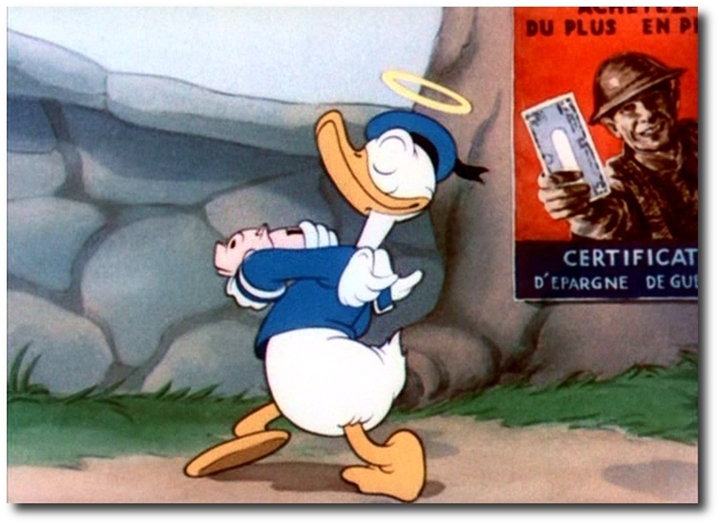 ‘Donald’s Decision is Walt Disney’s third short to persuade the Canadian public to buy war certificates.
This film has the same two-part formula as ‘The Thrifty Pig‘ and ‘7 Wise Dwarfs‘ from 1941. The first half combines reused footage from two Donald Duck shorts from 1938: ‘Self Control‘ and ‘Donald’s Better Self‘, but with altered voices. The second half resembles that of ‘The Thrifty Pig‘ and ‘7 Wise Dwarfs‘.
The result is less convincing than in the earlier two cartoons, probably because the source material is weaker. Neither ‘Self Control’ nor ‘Donald’s Better Self’ belong to Donald Duck’s best. Besides, Donald only reluctantly does his part, in great contrast to the optimistic pigs and dwarfs from the earlier shorts. Indeed, when Disney had to convince the American public for government purposes, the studio came up with completely new animation for its biggest star (in ‘The New Spirit‘ and ‘The Spirit of ’43‘).
Watch ‘Donald’s Decision’ yourself and tell me what you think:
Director: Dick Lundy
Release Date: January 29, 1943
Stars: Donald Duck
Rating: ★★★★★
Review:
 In the vibrant opening scene of ‘Donald’s Tire Trouble’ we watch Donald zooming with his car through the mountains with an incredible speed. Then he suddenly gets a flat tire.
In trying to fix it, practically everything goes wrong that can go wrong: Donald has trouble with the jack, the tire patch, the tire itself, and the wheel. Miraculously, he finally manages to fix the one, but then all his tires go flat…
‘Donald’s Tire Trouble’ is without doubt one of the best Donald Duck shorts dealing with Donald’s struggle with inanimate objects, and arguably Dick Lundy’s best Donald Duck cartoon. Instead of milking one gag, like he did in ‘The Village Smithy‘ and ‘Donald’s Garden‘ from 1942, he continuously proceeds from one gag to another, which leads to an impressive string of gags unseen in his earlier cartoons. Moreover, most car drivers will relate to Donald’s frustrations, which will be way more familiar than his problems in the earlier cartoons. The result is an exuberant short, more fit to the World War II era.
Watch ‘Donald’s Tire Trouble’ yourself and tell me what you think:
This is Donald Duck cartoon No. 39
To the previous Donald Duck cartoon: Der Fuehrer’s Face
To the next Donald Duck cartoon: Flying Jalopy
Director: Jack King
Release Date: December 18, 1942
Stars: Donald Duck, Pete
Rating: ★★★★½
Review:
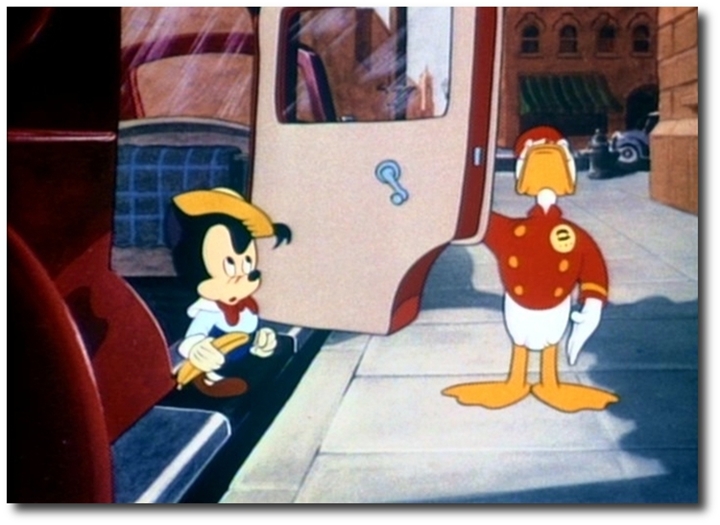 Donald is a bellboy at a chic hotel. He’s hindered in doing his job by Pete’s mischievous son (yes, Pete has got a son in this cartoon).
Pete manages to stay calm, but not Donald. In the end, Donald is fired, but he gets his chance to spank the wicked brat.
‘Bellboy Donald’, penned by Duckmen Carl Barks and Jack Hannah, is one of the better Donald Duck cartoon of the early forties. You won’t find any better interplay between Donald and Pete, with the exception maybe of ‘Trombone Trouble’ (1944).
Moreover, the cartoon contains some remarkably flexible animation of a type rarely seen in a Disney cartoon.
Watch ‘Bellboy Donald’ yourself and tell me what you think:
This is Donald Duck cartoon No. 37
To the previous Donald Duck cartoon: Sky Trooper
To the next Donald Duck cartoon: Der Fuehrer’s Face
Director: Dick Lundy
Release Date: July 12, 1942
Stars: Donald Duck
Rating: ★★
Review:
 In ‘Donald’s Garden’ Donald is a gardener, wearing a straw hat. We watch him having trouble with a water pump and with a gopher, which eats all his vegetables.
‘Donald’s Garden’ is a slow and boring cartoon. It’s hampered by particularly uninspired backgrounds, and it is one of the weaker entries in the Donald Duck series.
It has the same structure as ‘The Village Smithy‘ from earlier that year: it consists of only two situation gags: one with an inanimate object (the pump), and one with an animal (the gopher). Apparently, director Dick Lundy favored these types of gags, for they returned in ‘Donald’s Goldmine’, and in ‘Donald’s Tire Trouble‘, Lundy’s only successful cartoon in terms of situation comedy.
‘Donald’s Garden’ is the first Disney cartoon trying to be funny with gophers. But like the later Pluto shorts ‘Bone Bandit‘ (1948) and ‘Pluto and the Gopher‘ (1950), the studio doesn’t succeed. One may wonder whether gophers are funny, at all.
Watch ‘Donald’s Garden’ yourself and tell me what you think:
This is Donald Duck cartoon No. 33
To the previous Donald Duck cartoon: Donald Gets Drafted
To the next Donald Duck cartoon: Donald’s Gold Mine
Director: Jack King
Release Date: April 10, 1942
Stars: Donald Duck, Huey, Dewey and Louie
Rating: ★★★½
Review:
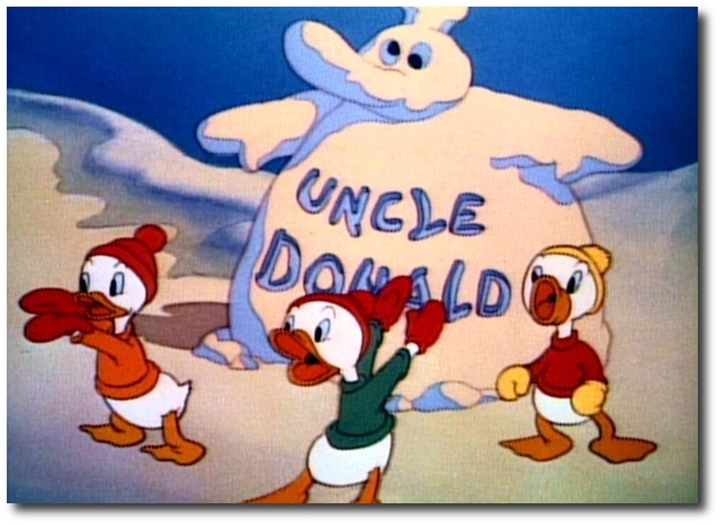 The world is covered in snow, and Donald goes for a sled ride, wearing a ridiculously broad fur overcoat.
He purposely ruins Huey, Dewey and Louie’s snowman by sledding right through it. They seek revenge and build a snowman resembling Donald around a rock. This feud leads to a snow-fight between admiral Donald on a battle ship made out of ice and his three nephews on an ice fort.
‘Donald’s Snow Fight’ is a classic Donald vs. his nephews cartoon, but the complete film is quite slow, due to Jack King’s tame directing. Despite some excellent gags, it doesn’t live up to ‘The Hockey Champ‘ (1939), the other classic winter cartoon featuring Donald and his nephews, or ‘Truant Officer Donald‘ (1941), which also features a battle between Donald and his nephews.
The short’s excellent story is by Carl Barks, who reused its theme two years later in his Donald Duck comic WDC 44-442.
Watch ‘Donald’s Snow Fight’ yourself and tell me what you think:
This is Donald Duck cartoon No. 31
To the previous Donald Duck cartoon: The Village Smithy
To the next Donald Duck cartoon: Donald Gets Drafted
Director: Dick Lundy
Release Date: January 16, 1942
Stars: Donald Duck
Rating: ★
Review:
 In ‘The Village Smithy’ Donald is a blacksmith who has to fix a large cartwheel and to shoe a stubborn female donkey. He succeeds in neither in this remarkably unfunny cartoon, which is one of the weakest within the whole Donald Duck series.
Long situation gags became a common feature of Disney shorts during the rise of the character comedy, in cartoons like ‘Mickey Plays Papa‘ (1934) and ‘Moving Day‘ (1936). Arguably, this time of comedy reaches its nadir in ‘The Village Smithy’. In it only two situations are milked to the length of the complete cartoon, with tiresome results. The wheel scene is the most interesting of the two, if still far from funny, and tributary to the spiral spring scene in ‘Clock Cleaners’ (1937).
The most interesting feature of this otherwise boring cartoon are its backgrounds, which belong to the first oil backgrounds in a Disney short, and which give the film a distinct, gloomy look. Donald, too, has a unique yellowish tan throughout this picture, setting the cartoon apart from all other Donald Duck shorts.
Watch ‘The Village Smithy’ yourself and tell me what you think:
This is Donald Duck cartoon No. 30
To the previous Donald Duck cartoon: Chef Donald
To the next Donald Duck cartoon: Donald’s Snow Fight


 Dr. Grob's Animation Review