
You are currently browsing the tag archive for the ‘Egypt’ tag.
Director: Eiichi Yamamoto
Release date: September 15, 1970
Rating: ★★½
Review:

The most important development in animation of the late 1960s and 1970s was the coming of animated feature films aimed at adults, instead of children/families. Heralding the new era was George Dunning’s 1968 film ‘Yellow Submarine’, but the two most important film makers pioneering in this new field were Ralph Bakshi in America (with e.g., ‘Fritz the Cat’ from 1972 and ‘Heavy Traffic’ from 1973) and Osamu Tezuka in Japan.
The three adult oriented anime films Tezuka made at his own Mushi Productions studio are called the Animerama trilogy and consist of ‘A Thousand and One Nights’ (1969), ‘Cleopatra’ (1970) and ‘Belladonna of Sadness’ (1973). The three show that Tezuka, like Bakshi, confuses adult oriented with a rather juvenile focus on sex and violence, making the films adult in content indeed, but otherwise rather immature and even exploitative products.
More than its adult orientation, ‘Cleopatra’ stands out for its highly eclectic style. The film tackles a variety of designs and animation styles, none weirder than the opening sequence, which takes place in the future year of 2001, and which starts live action actors with animated faces, an experiment luckily not repeated, for the results are pretty ridiculous, especially because there’s absolutely no lip synchronization, at all.
The film’s plot revolves around an alien planet called Pasatorine, which has a secret plan to wipe out mankind called ‘Cleopatra’. In order to find out the plans a trio of humans, naturally, goes back into time by “psycho-teleportation”, taking the souls of ancient characters in Cleopatra’s time.
Thus, the three main protagonists change identity: Jirov becomes Ionius, a powerful slave, Maria becomes Libya, an Egyptian city girl, and Hal turns into Lupa, a close companion of Cleopatra, who turns out to be a leopard, much to Hal’s chagrin. His character is the most annoying of the film, for the leopard is sex crazed and tries to get laid all the time, despite its animal features.
After ten minutes we’re in Egypt where Tezaku depicts the Roman conquest of the ancient kingdom in a very silly style, accompanied by some attractive space funk music. When we first see Libya, the adult orientation immediately becomes clear, for she’s bare breasted the whole time. The Egyptian plot is bizarre, too, with an ugly freckled girl changing into the sex goddess of Cleopatra with the sole reason to seduce Caesar and to kill him. Adding to the weirdness is the coloring, for Libya is rendered bright red, while Caesar is depicted as a green man.
Stylistically, the film is all over the place, anyhow, altering tiresome silliness and cheap rotoscoping with quite some beautiful graphic imagery, like the stylized fighting of the Romans and the Egyptian conspirators. The animation, too, is a mixed bag, from non-animation and cheating jump takes from pose to pose, without any animation in between, to far more interesting animation done in watercolors. The animation of the horse ride, and the struggle between Ionius and an Egyptian warrior are actually quite good, and even the first two sex scenes are interesting in their semi-abstract and even poetical stylization, while the third is depicted as a broken-down film. At one point the imagery reminds one of UPA or the Zagreb school, and at another point there’s even a cut-out sequence featuring variations on classic paintings.
What the film completely lacks, is character animation. Emotions are just indicated, not felt, and there’s only broad caricature, not character development. The potentially dramatic story is further hampered by random gags, often strange and out of place. Likewise, the story is sloppy and meandering, with the film makers having difficulty on whom to focus. For great chunks of screen time, the three protagonists from the opening sequence aren’t anywhere to be seen, and after the events in ancient Egypt have ended tragically (in that respect the film does follow Cleopatra’s real life), the film ends abruptly, leaving the viewer wondering why the whole ‘psycho-teleportic’ excursion, and thus most of the movie, was needed in the first place.
It must be said: ‘Cleopatra’ is not a good movie. It is more of an experiment than a success, more of a product of its time than a timeless movie, and rather a curio than an essential watch. It is a product of a more experimental era, but after watching the film, one can hardly wonder why this short age of adult oriented experimentalism stopped.
Watch the trailer for ‘Cleopatra’ yourself and tell me what you think:
‘Cleopatra’ has been released on Blu-Ray
Director: Bob Clampett
Release Date: November 5, 1938
Stars: Porky Pig
Rating: ★★★½
Review:
 This cartoon starts with the call for morning prayer in a dream Egypt, which has more in common with 1001 Arabian nights than with the real state during the 1930’s.
We watch three Arabs rolling dice, a sexy veiled woman, who turns out to be hideously ugly, and the antics a fakir. Then we cut to some tourists taking a tour on a multi-bumped camel into a desert.
Porky Pig is a little too late to join them, and follows the group on his own camel, called Humpty Dumpty. Unfortunately, once they’re in the desert, the burning sun hits the camel with desert madness. In a wonderful scene, the camel loses grip and starts to hallucinate. The hallucinating effect is greatly added by twirling background images. In this scene the acting of the camel is no less than superb. The sheer manic power of this acting is unprecedented in any animated cartoon, and a subtle milestone of animation.
Unfortunately, the complete cartoon is more strange than funny. Notice the multi-door gag, which is halfway between the ones in ‘The Mad Doctor‘ (1932) and ‘The Northwest Hounded Police‘ (1946).
Watch ‘Porky in Egypt’ yourself and tell me what you think:
http://www.dailymotion.com/video/x43hhxr
This is Porky Pig cartoon no. 48
To the previous Porky Pig cartoon: Porky’s Naughty Nephew
To the next Porky Pig cartoon: The Daffy Doc
‘Porky in Egypt’ is available on the Blu-Ray set ‘Looney Tunes Platinum Collection: Volume 2’, and on the DVD-sets ‘Looney Tunes Golden Collection Volume Three’ and ‘Porky Pig 101’
Directors: Mannie Davis & John Foster
Release Date: November 9, 1930
Stars: Waffles and Don
Rating: ★★
Review:
 ‘Gypped in Egypt’ is a cartoon set in Egypt. It predates Disney’s ‘Egyptian Melodies‘, which covers similar grounds, by nine months.
This cartoon was the last of four to feature Waffles and Don. The duo had finally reached distinct personalities in this short: Waffles, the tall cat, is constantly afraid, while Don, the small dog, keeps calm and unimpressed.
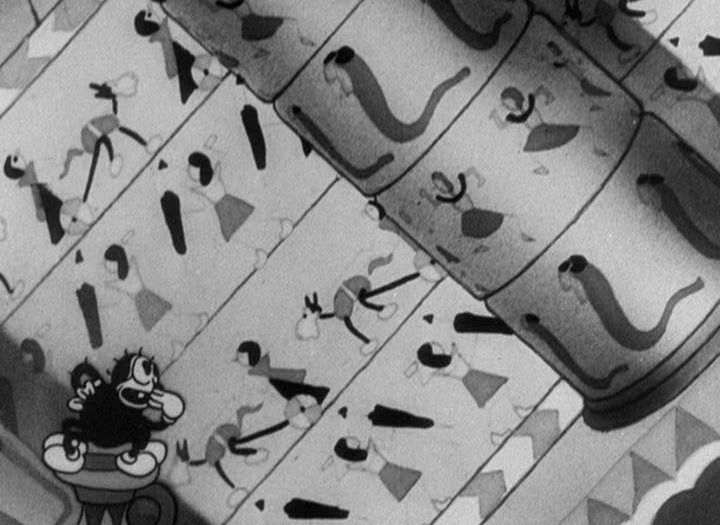
In the opening shot we watch the duo traveling through the desert on a camel. When the camel dies, a nightmarish scene starts, featuring a sphinx, pyramids and more camels. This brings our heroes inside an Egyptian tomb, where they encounter dancing skeletons and hieroglyphs. Suddenly, there are skeletons everywhere, and Don plays the piano with one of them. The cartoon ends abruptly with Waffles and Don running from a giant hypnotizing sphinx face.
‘Gypped in Egypt’ features several elements that were reused in Disney’s ‘Egyptian Melodies’: dancing hieroglyphs, nightmarish scenes, and even a corridor scene. However, Van Beuren’s cartoon is much cruder and more disjointed than Disney’s latter cartoon. Its greatest feature is it hallucinating character. Unfortunately, it is not retained throughout the picture, and the whole cartoon suffers from all too sloppy storytelling and ditto timing.
Watch ‘Gypped in Egypt’ yourself and tell me what you think:
‘Gypped in Egypt’ is available on the DVD ‘Aesop’s Fables – Cartoon Classics from the Van Beuren Studio’
Director: Wilfred Jackson
Release Date: August 19, 1931
Rating: ★★★
Review:
In ‘Egyptian Melodies’ the little six-legged spider from ‘Midnight in a Toy Shop‘ (1930) returns to the animated screen.
The short is one of those early Silly Symphonies that offers quite a dull dance routine only (and no story). Nevertheless, the introduction of the cartoon is well worth watching: when we follow the spider down into the pyramid, we experience some astonishing 3D-effect animation, creating the feeling that the camera wanders with the spider through corridors and staircases.
This unique exercise in perspective would not be repeated in animation until labyrinth computer games were introduced in the 1980s. The Disney Studio itself must have been impressed by this stunning piece of animation, for it was reused two years later in the Mickey Mouse cartoon ‘The Mad Doctor‘ (1933).
Once inside the pyramid, the spider watches four mummies dance, and the drawings on the walls coming to life. These last scenes feature 2-dimensional characters, which can be seen as very early and primitive forerunners of the cartoon modern style of the 1950s. Unfortunately, these scenes are a little bit dull, but they do lead to a great finale. This is one of the earliest nightmare-sequences, in which the montage of images is diffuse and increasingly sped up, in order to suggest the feeling of getting insane. This predates similar sequences in films like ‘Der Fuehrer’s Face‘ (1943) by many years.
The idea for ‘Egyptian Melodies’ may have come from the Van Beuren cartoon ‘Gypped in Egypt‘ (1930), which also features dancing hieroglyphs, nightmarish scenes, and even a corridor scene. Notice that the classic horror film ‘The mummy’ (1932) hadn’t been released, yet, at the time.
This is Silly Symphony No. 21
To the previous Silly Symphony: The Cat’s Out
To the next Silly Symphony: The Clock Store


 Dr. Grob's Animation Review