
You are currently browsing the tag archive for the ‘God’ tag.
Director: Nina Paley
Release date: June 11, 2018
Rating: ★★★
Review:

Seder-Masochism is the second feature animation film by independent animation artist Nina Paley (born 1968), who created quite a stir with the lovely ‘Sita Sings the Blues’ (2008) in which she blended events in her personal life with the story of the Ramayana, but from a woman’s view.
Apparently, Paley was criticized for using a myth from another culture for her feminist message, with attackers typically focusing on Paley’s supposed lack of understanding of Hindu religion, an irrelevant argument, as the misogyny that Paley attacked is plainly visible in the source text (especially in the last book). Moreover, the Ramayana is hardly unique in its treatment of women as second rate citizens, which can be found in practically all ancient texts.
To underline this message, for her second feature Paley dived into her own heretical religious culture, that of Jewism. The result is a more vicious and more pamphlet-like feature than ‘Sita Sings the Blues’, mostly because the personal note is hardly present, only in an interview of Paley with her father, recorded years prior, about his stance towards Judaism, and that of the Pesach (or Passover) in particular. In these scenes Paley is shown as a sacrificial goat and her father as God himself.
The Pesach, and the story from the book of Exodus behind it, forms the central element of ‘Seder-Masochism’. The ‘Seder’ in the title apparently is a ritual feast at the beginning of the Jewish Pesach celebration, and contains some questionable elements, like rejoicing over the Egyptian victims of the ten plagues and of the closing of the Red Sea.
Surprisingly, Paley juxtaposes the story of Exodus with the idea that initially human culture was matriarchal and devoted to mother goddesses, a theory popular with feminists, but unsupported by archeological evidence. Paley even goes so far as suggesting the golden calf from the Exodus story was a return to such a mother goddess, and thus to times of more equality between and women. Indeed, Paley seems to blame Moses, or monotheism in general for the misogynist patriarchy that dominates most of human culture in its historical existence. This is pure fantasy and can be easily debunked. But of course, ‘Seder-Masochism’ is no documentary, but Paley’s personal take on monotheism and its approach to women.
Yet, Paley’s clear atheist approach to the biblical story is more vicious than anything in ‘Sita Sings the Blues’, which makes the film less approachable and less a classic than Paley’s first movie. Especially when Paley turns to real life footage of religion-inspired violence the film becomes pure agit-prop. Nevertheless, the scene in which Moses returns from Mount Sinai, commanding a stop to the women’s temporal liberation and forcing them back into their niqab-like clothing remains a painful one, and rightfully evokes anger about religious societies who limit the freedom of women.
Even with its strong message, Paley’s way of storytelling remains highly attractive. Paley’s dry sense of humor permeates much of the film, and her visual style is charming throughout, her command of minimal, but effective animation one of the highest degrees. I especially like the poetic intro in which a female goddess flows through space, and sprouts plants, animals, and eventually men on a soundtrack of the most beautiful Bulgarian female chant. Paley’s dance animation of ancient female statues is also a masterstroke, and an attraction in its own right (Paley offers them as singular GIFs).
Moreover, Paley very skillfully mixes the interview excerpts, an enormous variety of existing music and even a 1950s record in which a man tells about the Seder celebration. In contrast with ‘Sita Sings the Blues’, in which only records by 1920s singer Annette Hanshaw were used, ‘Seder-Masochism’ plunders the Western pop music tradition, often to a very striking effect. Notice, for example the single sample of ‘Helter Skelter’ from The Beatles during the sixth plague, and the earlier mentioned scene in which Moses returns uses Led Zeppelin’s ‘Your Time Is Gonna Come’ to a painful effect. But the film’s highlight in this respect must be the use of 10cc’s ‘The Things We Do for Love’ which accompanies images of Jews gleefully chopping off foreskins, beheading little goats and killing men and women.
The bitter irony of this sequence is topped by the ‘This Land Is Mine’ sequence, which Paley finished first, and which can be watched as a separate video clip. In this utterly bleak section, we watch several nations fight over the land of Israel, killing one another in greater and greater numbers, with Death itself ultimately being triumphant. With Israel raging the war in Gaza today, with its tens of thousands of innocent Palestine victims, this bleak sequence remains as topical as ever.
The ‘This Land Is Mine’ sequence was also one of the last pieces of animation Paley did in Macromedia Flash, before moving over to Moho. But the most surprising piece of animation in the film is not done on either platform but done with embroidery, in a process Paley calls ‘embroidermation’. This is a lovely piece of stop-motion that Paley rightfully saves for the end, just before the ‘This Land Is Mine’ finale.
In all, ‘Seder-Masochism’ is a beautiful, if rather angry film with a strong feminist message. It cannot stand the comparison with ‘Sita Sings the Blues’, which remains the more balanced work, but as author feature films like this remain utterly rare in the animation field, I strongly recommend watching this feature nonetheless. At least it will make you think about the position of women in society. Paley offers her film for free online, and the movie can be downloaded from her site.
Watch the trailer for ‘Seder-Masochism’ yourself and tell me what you think:
‘Seder-Masochism’ can be downloaded for free from Nina Paley’s website
Directors: Stefan Fjeldmark & Karsten Kiilerich
Release Date: 1996
Rating: ★★★★★ ♕
Review:

‘When Life Departs’ is a cute little Danish film in which eight children share their thoughts on death.
Their musings include ideas on the soul, on heaven, on hell, on God and reincarnation. These are illustrated with very simple, but very charming color pencil drawings on monochrome backgrounds. The drawing deliberately have a childlike, pseudo-clumsy quality, but the animation is, in fact, of a very high degree. Especially the depiction of the children talking is very well done. Despite the simplicity of the drawings these scenes betray a wide range of emotions and involuntary gestures in a short time span.
One stunning scene is one child’s view of heaven, illustrated by an ever in-zooming background animation, as if one flies through the endless heavenly landscapes. At times the pleasant animation helps to keep the subject light. Nevertheless, the story of a boy who has lost his baby brother remains poignant and infinitely sad.
Watch ‘When Life Departs’ yourself and tell met what you think:
‘When Life Departs’ is available on The Animation Show of Shows Box Set 3
Director: Raymie Muzquiz
Airing Date: April 20, 1996
Stars: Duckman
Rating: ★★
Review:

In ‘The One with Lisa Kudrow in a Small Role’ Duckman wants to be alone, so he sends his son Ajax out on the street. Ajax gets abducted by hillbilly aliens from the planet Betamax, and revered as a prophet by the backward planet. But everything goes wrong when Ajax plays them the tape his father gave him, and the planet takes the word of ‘Dod’ literally.
‘The One with Lisa Kudrow in a Small Role’ is violently anti-religion, connecting dogmatism with violence and destruction. The satire is rather blunt and in your face, and therefore actually fails to hit its mark. Meanwhile this is one of those many Duckman episodes tiringly playing with Duckman’s complete ignorance of his own offspring. The result is rather exhausting.
Most enjoyable are Ajax’s semi-profound remarks and the rather Dr. Seuss-like background art of planet Betamax.
Watch ‘The One with Lisa Kudrow in a Small Role’ yourself and tell me what you think:
This is Duckman episode no. 35
To the previous Duckman episode: The Once and Future Duck
To the next Duckman episode: Aged Heat
‘The One with Lisa Kudrow in a Small Role’ is available on the DVD-box ‘Duckman – The Complete Series’
Director: Phil Mulloy
Release Date: 1995
Rating: ★★½
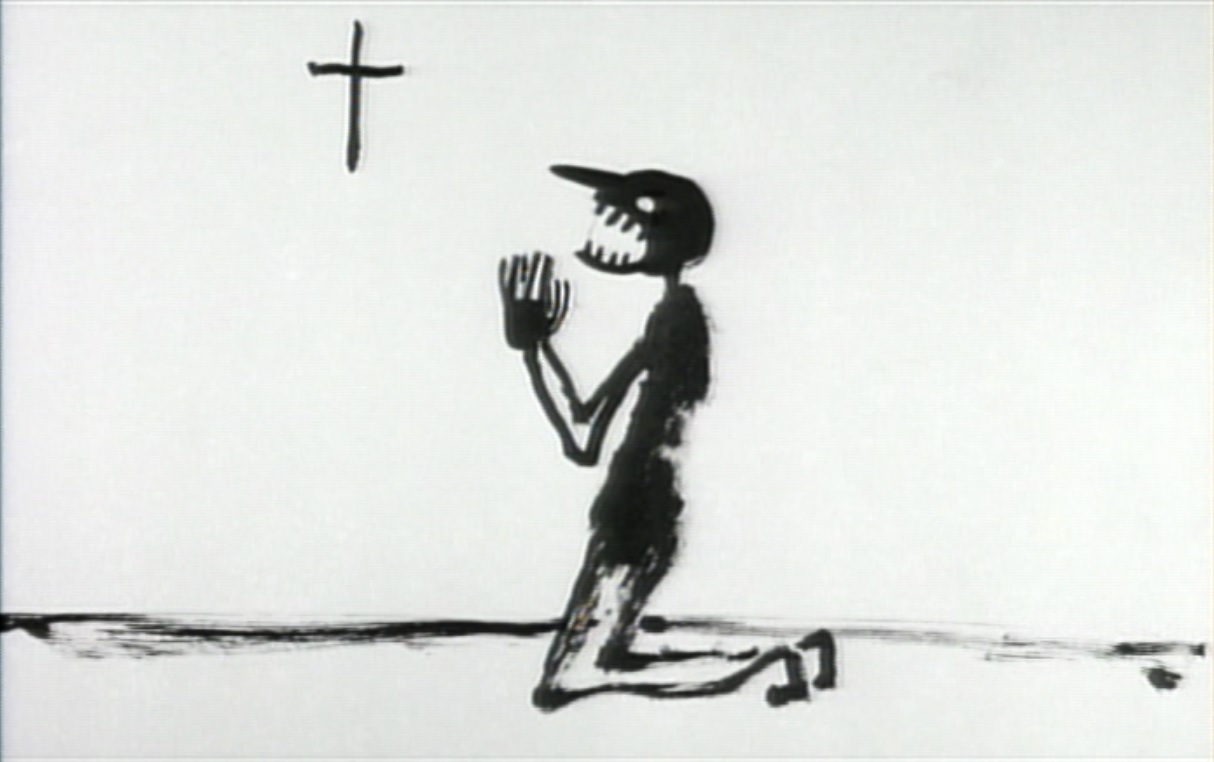
‘Thou Shalt Not Commit Blasphemy’ is Phil Mulloy’s personal take on the Noah story. The result is a rather puzzling film with an unclear message.
The story tells about a man who steals a cross from a church and replaces it with a toy boat. He’s caught by his fellow villagers, and condemned to death by being burnt at a stake. But God intervenes, causing a flood, only rescuing the man and his family.
Unlike most of the Ten Commandments films ‘Thou Shalt Not Commit Blasphemy’ does not feature a voice over, but contains a little dialogue instead, in sped-up voice tracks. Like ‘Thou Shalt Not Adore False Gods‘ and ‘Thou Shalt Not Bear False Witness‘ this short features an active and visible God. But Mulloy’s depiction of God is pretty blasphemous by all means…
‘Thou Shalt Not Commit Blasphemy’ is available on the BFI DVD ‘Phil Mulloy – Extreme Animation’
Director: Phil Mulloy
Release Date: 1995
Rating: ★★½
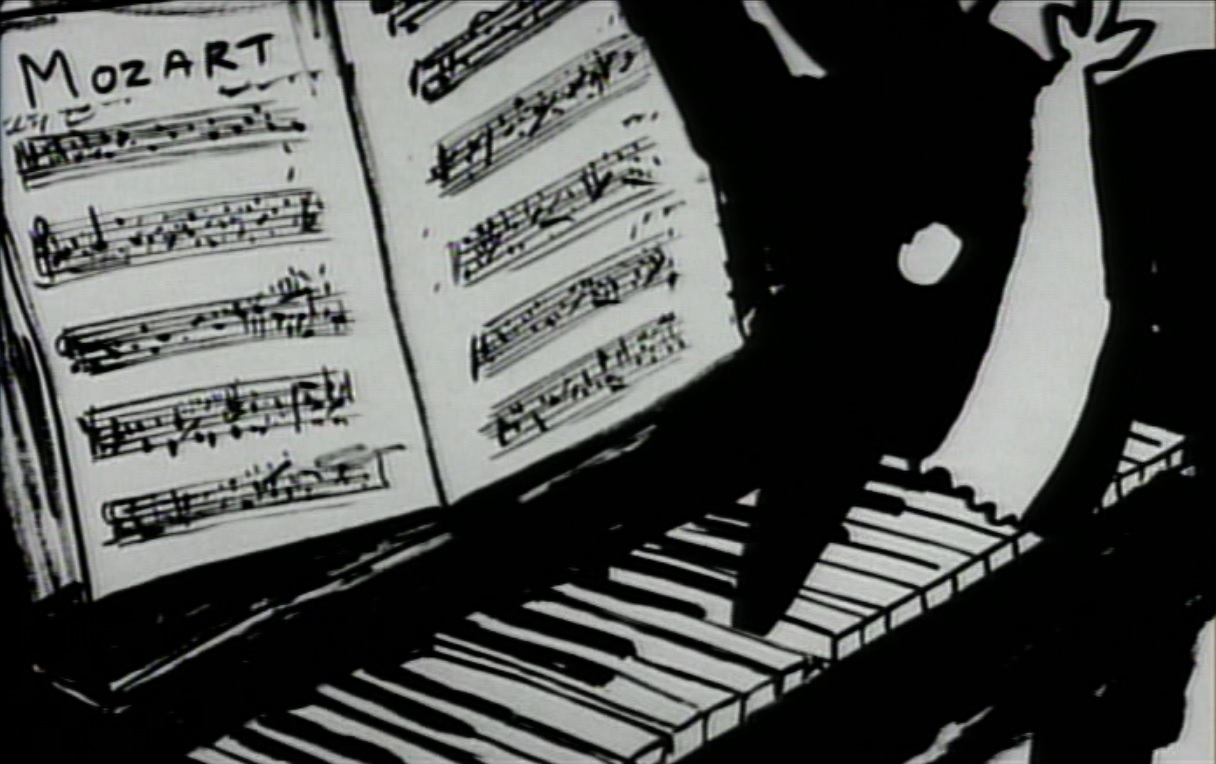
‘Thou Shalt Not Adore False Gods’ is number one of Phil Mulloy’s Ten Commandments films, even though it was not the first one made. This episode has a particularly bizarre story that makes little sense.
The short features one of Mulloy’s standard cowboys, who’s robbed by a burglar, and tied to chair in front of his piano. No-one ever releases him, but over the years he learns to play the piano with his nose.
Unlike most of the Ten Commandment films this short contains neither a voice over nor dialogue, apart from a few short cries. God himself is visible in this cartoon, being portrayed as a selfish and vain creature.
‘Thou Shalt Not Adore False Gods’ is available on the BFI DVD ‘Phil Mulloy – Extreme Animation’


 Dr. Grob's Animation Review