
You are currently browsing the tag archive for the ‘Mickey Mouse’ tag.
Director: Walt Disney
Release Date: November 15, 1929
Stars: Mickey Mouse
Rating: ★
Review:
 ‘Jungle Rhythm’ opens with Mickey playing the harmonica while riding an elephant, the design of which is still rooted in the silent era.
Mickey shoots a vulture, but misses and is soon threatened by a bear and a lion. Luckily at that moment a monkey and a parrot start playing a tune on his harmonica, and a long dance routine can begin…
First we watch Mickey dancing with the lion and the bear, then two monkeys. Then Mickey plays the saxophone with two ostriches dancing. Mickey plays the whiskers of a little leopard like a harp, while a lion dances the hula, and he even returns to ‘Turkey in the Straw’, the tune that made him famous in his first sound cartoon ‘Steamboat Willie‘ (1928). After playing’Yankee Doodle’ on five tigers, a number of apes and a lion, the crowd applauds, and the cartoon ends.
‘Jungle Rhythms’ is easily one of the most boring entries among the early Mickey Mouse shorts: there’s no plot, no dialogue, no song, and the dance routines resemble the worst in contemporary Silly Symphonies. In fact, to me, ‘Jungle Rhythm’, together with ‘When The Cat’s Away‘ and ‘The Castaway‘ (1931), forms the worst trio of all Mickey Mouse cartoons. Luckily, weak cartoons like these remained a rarity within the series.
Watch ‘Jungle Rhythm’ yourself and tell me what you think:
This is Mickey Mouse cartoon No. 13
To the previous Mickey Mouse cartoon: The Jazz Fool
To the next Mickey Mouse cartoon: The Haunted House
Director: Walt Disney
Release Date: October 15, 1929
Stars: Mickey Mouse, Horse Horsecollar
Rating: ★★★★
Review:
 ‘The Jazz Fool’ opens with Mickey playing the organ on a tilt car, which says ‘Mickey’s Big Road Show’, followed by a crowd of animals.
When settled down, Mickey produces a piano out of nowhere, and performs a mildly jazzy stride tune on it. We also watch Horace Horsecollar without his usual yoke performing some drumming to Mickey’s organ tune.
This is Mickey’s second piano concerto cartoon (after ‘The Opry House‘ from seven months earlier), and thus contains some new gags involving piano playing. Mickey severely mistreats the instrument, even spanking it, so, unsurprisingly, the piano takes revenge in the end. The music can hardly be called jazz, however, even though it contains some nice stride piano. It would take two years before Mickey would turn to real jazz, in ‘Blue Rhythm‘ (1931).
As one may have noticed ‘The Jazz Fool’ is one of those early plotless Mickey Mouse shorts. However, there’s plenty of action, and Mickey’s piano performance is still entertaining today. Nevertheless, Mickey would turn to the violin in his next concert cartoon ‘Just Mickey‘ (1930).
Watch ‘The Jazz Fool’ yourself and tell me what you think:
This is Mickey Mouse cartoon No. 12
To the previous Mickey Mouse cartoon: Mickey’s Choo-Choo
To the next Mickey Mouse cartoon: Jungle Rhythm
Director: Walt Disney
Release Date: October 1, 1929
Stars: Mickey Mouse, Minnie Mouse
Rating: ★★★
Review:
 In ‘Mickey’s Choo-Choo’ Mickey drives an outrageously flexible anthropomorphized locomotive, which is an early ancestor of Casey Junior from ‘Dumbo‘ (1941).
He sings ‘I’m working on the railroad‘ and even plays the spaghetti he’s eating, treating it like a harp. Minnie comes along, playing the violin. At this point the cartoon harks back to Mickey’s success cartoon ‘Steamboat Willie‘ (1928), with Mickey playing music on some ducks and a dog.
After this sequence, Minnie rides Mickey’s train to the tune of Yankee Doodle, but on a very steep hill the wagon gets loose and falls backwards with Minnie on it. This sequence contains some wonderful rollercoaster-like perspective gags, reminiscent of the early Oswald the Lucky Rabbit cartoon ‘Trolley Troubles’ (1927).
‘Mickey’s Choo-Choo’ is remarkably fast and full of action. Moreover, it’s the first Disney cartoon to feature real dialogue. However, there’s hardly any plot and Mickey’s and Minnie’s designs are extraordinarily inconsistent, ranging from very sophisticated (with an extra facial line) to downright poor. The result is unfortunately only an average entry in the Mickey Mouse canon.
Watch ‘Mickey’s Choo-Choo’ yourself and tell me what you think:
This is Mickey Mouse cartoon No. 11
To the previous Mickey Mouse cartoon: Mickey’s Follies
To the next Mickey Mouse cartoon: The Jazz Fool
Director: Charles Nichols
Release Date: May 18, 1951
Stars: Mickey Mouse, Pluto, Milton
Rating: ★★★★★
Review:
 In ‘Plutopia’ Mickey and Pluto reach a cabin in the mountains called Utopia.
The place turns out to be dog-unfriendly however: Pluto has to stay outside and even worse, has to be muzzled. Frustrated, Pluto falls asleep. He dreams he’s in Plutopia where Milton (one of the cats from ‘Puss-Cafe‘, and here the cabin’s cat) is his willing servant, serving him food every time Pluto bites him in his tail.
The dream sequence is a delight to watch: its backgrounds consists of no more than changing monochromes featuring ‘scribbled’ outlines of doors, stairs e.g. With this sequence Pluto enters the ‘cartoon modern’ era. Unfortunately, it would be his only cartoon featuring such modern designs.
‘Plutopia’ is the last of only three Pluto cartoons featuring Mickey Mouse (the other two being ‘Pluto’s Purchase’ from 1948 and ‘Pueblo Pluto‘ from 1949). Normally cartoons featuring Mickey would appear under his own name. Indeed, after ‘Plutopia’ the Pluto series had only one entry left, but Pluto would return in Mickey’s last four cartoons.
Remarkably, ‘Plutopia’ features animation by two of the greatest animators of Mickey and Pluto in the 1930s: Fred Moore and Norm Ferguson. Both animators had been eclipsed by Disney’s Nine Old Men, and ‘Plutopia’ is one of the last films they worked on before their premature deaths in 1952 and 1957, respectively.
Watch ‘Plutopia’ yourself and tell me what you think:
This is Pluto cartoon No. 42
To the previous Pluto cartoon: Cold Storage
To the next Pluto cartoon: Cold Turkey
Director: Burny Mattinson
Release date: December 16, 1983
Stars: Mickey Mouse, Scrooge McDuck, Donald Duck, Daisy Duck, Goofy, Jiminy Cricket, Pete, Willie the Giant
Rating: ★★★½
Review:
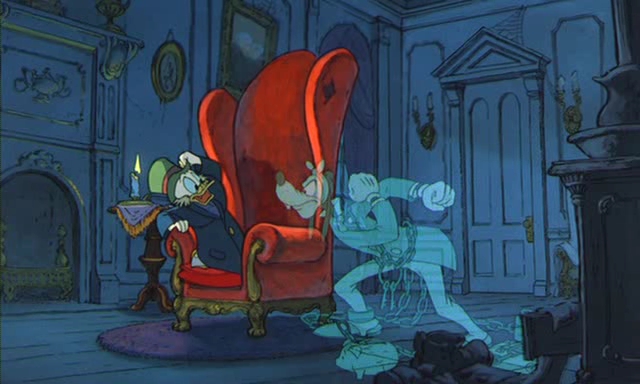 Mickey’s Christmas Carol’ is one of countless cinema versions of Charles Dickens’s classic tale, this time using Disney characters.
Star of the film is Scrooge McDuck, which of course comes natural to the old miser as the character was actually named after Dickens’ main protagonist. Unlike the other characters Scrooge McDuck was mainly a comics hero, created by Carl Barks, and he had appeared on the screen only one time before, in the educational film ‘Scrooge McDuck and Money’ (1967). However, only four years later he would be animated extensively, in the highly successful televison series, Ducktales.
Most people however will remember ‘Mickey’s Christmas Carol’ as Mickey’s return to the screen for the first time since his retirement in 1953. But it also marks the return of Donald (as Scrooge’s nephew Fred) and Goofy (as his former partner Jacob Marley) to the screen after a 22 year absence. The film has an all-star cast in any case, reviving many other classic Disney stars, like Jiminy Cricket (as the ghost of Christmas Past), Daisy (as Scrooge’s former love interest) and Pete (as the ghost of Christmas future). Also featured is Willie the giant from ‘Fun and Fancy Free‘ (1948) as the ghost of Christmas present, and several characters from ‘The Wind in the Willows‘ (1949). Apart from these we can see glimpses of the Big Bad Wolf and the three little pigs, Clarabella Cow, Horace Horsecollar, Huey, Dewey and Louie, Minnie Mouse and some characters from ‘Robin Hood‘.
This all-star cast gives the film a nostalgic feel that fits the story. Indeed, with hindsight, one can see ‘Mickey’s Christmas Carol’ as an early example of the Renaissance that was about to happen, in which the classic cartoon style was revived after ca. twenty dark years.
‘Mickey’s Christmas Carol’ is no ‘Who Framed Roger Rabbit‘, however, and it only looks back, not forward. For example, the rather uninspired score is by Irwin Kostal, who had been composing for Disney since ‘Mary Poppins’ (1964). Moreover, the film’s design, using xerox cells and graphic backgrounds, is firmly rooted in the tradition of the 1960’s and 1970’s.
‘Mickey’s Christmas Carol’ is a nice and entertaining movie, but it would take another five years for the Renaissance hitting Disney in full glory, with inspired and innovative films as ‘Who Framed Roger Rabbit’ (1988) and ‘The Little Mermaid’ (1989).
Watch ‘Mickey’s Christmas Carol’ yourself and tell me what you think:
http://www.dailymotion.com/video/xmq7ql_1983-mickey-s-christmas-carol_shortfilms
This is Mickey Mouse cartoon No. 126
To the previous Mickey Mouse cartoon: The Simple Things
To the next Mickey Mouse cartoon: The Prince and the Pauper
Directors: Pinto Colvig, Walt Pfeiffer & Ed Penner
Release Date: April 17, 1937
Stars: Mickey Mouse, Donald Duck, Clarabella Cow, Clara Cluck, Goofy
Rating: ★★★½
Review:
 Mickey is only the straight man while hosting an amateur night at the theater.
We watch Donald trying to recite ‘Twinkle Twinkle Little Star’ while forgetting the words, Clarabella Cow and Clara Cluck performing an operatic song, and Goofy with an automatic one man band that goes haywire.
Donald surprises not only his but also the modern audience by drawing a tommy gun to shoot at the audience(!). However, it’s Goofy’s silly musical machine which draws the biggest laughs in a hilarious sequence, with particularly silly animation.
‘Mickey’s Amateurs’ ends with Donald getting caught in the closing end circle. Self-awareness gags like this were rare at Disney’s (another example is the burning title card in ‘Mickey’s Fire Brigade‘ from 1935), but would become standard repertoire at Warner Bros. and in Tex Avery’s cartoons at MGM.
Watch ‘Modern Inventions’ yourself and tell me what you think:
This is Mickey Mouse cartoon No. 94
To the previous Mickey Mouse cartoon: Moose Hunters
To the next Mickey Mouse cartoon: Modern Inventions
Director: David Hand
Release Date: October 10, 1936
Stars: Mickey Mouse, Pluto
Rating: ★★½
Review:
 ‘Mickey’s Elephant’s opens with Mickey receiving a cute young elephant from the Rajah of Ghaboon as a playmate for Pluto. Unfortunately Pluto is not amused, and he thinks ‘Bobo’ is an intruder with intentions to replace him.
‘Mickey’s elephant’ is similar to ‘Mickey’s Pal Pluto‘ (1933) and to ‘Mickey’s Kangaroo‘ (1935), in which Pluto is also jealous of an intruder and which also feature his evil side. Like in ‘Mickey’s Pal Pluto’ Pluto’s evil consciousness has materialized into a little devilish persona, who talks with a strong New York accent and who persuades Pluto to fix Bobo using red pepper. Sneezing along Bobo blows is own new house down, but unfortunately Pluto’s too…
‘Mickey’s Elephant’ is a rare example of a Mickey Mouse film inspired by the Mickey Mouse comic strip. Most of the time the influence was reversed. But in this case Bobo the elephant had made his entrance in Floyd Gottfredson’s strip two years earlier. Bobo is a completely innocent character, and Pluto’s little devil notwithstanding, the cartoon is more cute than funny.
Watch ‘Mickey’s Elephant’ yourself and tell me what you think:
This is Mickey Mouse cartoon No. 89
To the previous Mickey Mouse cartoon: Donald and Pluto
To the next Mickey Mouse cartoon: The Worm Turns
Director: Ben Sharpsteen
Release Date: August 1, 1936
Stars: Donald Duck, Mickey Mouse, the Orphan Mice, the Little Seal
Rating: ★★½
Review:
 In ‘Mickey’s Circus’ we watch Mickey and Donald perform in a circus for a pack of orphan mice.
Most of the time goes to Donald and his trained seals. Only after six minutes Mickey joins in again, struggling with Donald on the slack-rope, while being troubled by the orphan mice.
‘Mickey’s Circus’ was the last cartoon to feature the Orphan Mice (apart from the remake of ‘Orphan’s Benefit from 1941), until their unexpected return in ‘Pluto’s party‘ from 1952. It’s also the first Disney short featuring a cute little seal. Similar seals would reappear in ‘Pluto’s Playmate‘ (1941), ‘Rescue Dog‘ (1947) and ‘Mickey and the Seal‘ (1948).
Watch ‘Mickey’s Circus’ yourself and tell me what you think:
This is Mickey Mouse cartoon No. 87
To the previous Mickey Mouse cartoon: Alpine Climbers
To the next Mickey Mouse cartoon: Donald and Pluto
Director: Ben Sharpsteen
Release Date: June 20, 1936
Stars: Mickey Mouse, Donald Duck, Goofy, Pete
Rating: ★★★½
Review:
 Because Mickey, Donald and Goofy can’t pay the rent, evil sheriff Pete will sell their furniture. The boys decide to move before that’s going to happen…
‘Moving Day’ is the this third of the classic trio cartoons featuring Mickey, Donald and Goofy. In this entry Mickey is hardly visible. Most of the cartoon is taken by his co-stars in two all too elaborate sequences: one featuring Goofy in a surreal struggle with a piano with a will of its own, and another featuring Donald’s trouble with a plunger and a fishbowl.
Despite the great animation, one gets the feeling that in this cartoon the artists were too much obsessed with character and less with gags, making this cartoon a bit slow and tiresome, when compared to the previous trio outings ‘Mickey’s Service Station’ and ‘Mickey’s Fire Brigade‘ from 1935. Luckily, in later trio shorts like ‘Moose Hunters’ or ‘Hawaiian Holiday’, the fast pace was found again.
‘Moving Day’ is the first cartoon to feature Pete in color. It was also the last of only three cartoons in which Art Babbitt animated Goofy. After he had done so much for the character in ‘Mickey’s Service Station’ and ‘On Ice‘, one can say that in ‘Moving Day’ he went a little too far in milking the goof’s scenes. Anyhow, Babbitt went over to feature films, but after these three shorts Goofy’s character was established well enough for others to take over with equally inspired results.
Watch ‘Mickey’s Fire Brigade’ yourself and tell me what you think:
This is Mickey Mouse cartoon No. 85
To the previous Mickey Mouse cartoon: Mickey’s Rival
To the next Mickey Mouse cartoon: Alpine Climbers
Director: Charles Nichols
Release Date: April 18, 1953
Stars: Mickey Mouse, Pluto
Rating: ★★★½
Review:
 ‘The Simple Things’ was to be Mickey’s and Pluto’s last theatrical cartoon (Pluto’s own series had stopped two years earlier).
Unfortunately it is a rather uninspired goodbye. The cartoon returns to the elongated situation comedy of the thirties. There are only two plots here, which hardly build up to a finale. First: Pluto’s encounters with a humanized clam and second, Mickey and Pluto’s fight with a hungry seagull. Both parts are executed routinely, without inspiration.
This makes ‘The Simple Things’ a sad ending to a career that started so phenomenally well, changing the course of animation, 25 years earlier. It would take Mickey another thirty years to return to the movie screen in ‘Mickey’s Christmas Carol‘ from 1983. Meanwhile, Mickey & Pluto director Charles Nichols would direct three Donald Duck cartoons, and one special, ‘The Saga of Windwagon Smith‘, before leaving Disney for Hanna-Barbera in 1962.
Watch ‘The Simple Things’ yourself and tell me what you think:
This is Mickey Mouse cartoon No. 125
To the previous Mickey Mouse cartoon: Pluto’s Christmas Tree
To the next Mickey Mouse cartoon: Mickey’s Christmas Carol
Director: Jack Hannah
Release Date: November 21, 1952
Stars: Mickey Mouse, Pluto, Chip ‘n Dale
Rating: ★★★★★
Review:
 Mickey chops Chip ‘n Dale’s tree down to use as a Christmas tree.
By doing so he accidentally brings the two little chipmunks home. Pluto soon discovers the duo, but Mickey only does so in the very end. The cartoon ends with a cameo of Goofy, Donald and Minnie singing Christmas carols in Mickey’s garden.
The cartoon’s overall atmosphere is cute, adorable and full of charm, making ‘Pluto’s Christmas Tree’ one of the most delightful Mickey Mouse cartoons from the post-war period. This short is the second of two Mickey Mouse cartoons directed by Jack Hannah, the other being ‘Squatter’s Rights’ from 1946. These are the only two cartoons to feature Mickey and Chip ‘n Dale. It’s also the third of Mickey’s four Christmas cartoons, the others being ‘Mickey’s Orphans‘ from 1931, ‘Mickey’s Good Deed‘ from 1932 and ‘Mickey’s Christmas Carol‘ from 1983.
Watch ‘Pluto’s Christmas Tree’ yourself and tell me what you think:
This is Mickey Mouse cartoon No. 124
To the previous Mickey Mouse cartoon: Pluto’s Party
To the next Mickey Mouse cartoon: The Simple Things
Director: Milt Schaffer
Release Date: September 19, 1952
Stars: Mickey Mouse, Pluto, The Orphan Mice
Rating: ★
Review:
 Mickey and Pluto celebrate Pluto’s birthday, which includes a huge pink birthday cake and the presence of several little mice.
In fact, this cartoon marks the unexpected return of the orphan mice, which we hadn’t seen on the screen since ‘Mickey’s Circus‘ from 1936. The little mice give Pluto a hard time and they eat all the cake. Luckily Mickey has saved a piece for our canine friend.
‘Pluto’s Party’ is the only Disney film directed by Pluto story man Milt Schaffer. Unfortunately it’s not a success. Mickey’s design is rather angular in this cartoon and the antics by the orphan mice are quite tiresome, not funny. In spite of the bright colors and the fast cutting, the overall mood is timid and listless. Only two Mickey Mouse cartoons would follow, and you can almost feel the series ending in this cartoon.
Watch ‘Pluto’s Party’ yourself and tell me what you think:
This is Mickey Mouse cartoon No. 123
To the previous Mickey Mouse cartoon: R’coon Dawg
To the next Mickey Mouse cartoon: Pluto’s Christmas Tree
Director: Charles Nichols
Release Date: August 10, 1951
Stars: Mickey Mouse, Pluto
Rating: ★★
Review:
 This cartoon starts with a Texan voice-over telling about raccoon hunting. Enter Mickey and Pluto who are exactly doing that.
Pluto’s pursuit is hindered, however, by the raccoon’s clever decoys and sidetracks. In his final trick the raccoon fools Mickey and Pluto by pretending having a baby, using Mickey’s coonskin cap.
Mickey has pretty little screen time in this cartoon, which is essentially Pluto’s. His visualisations of what he’s smelling are the highlights of this gentle if not very remarkable film.
Watch ‘R’Coon Dawg’ yourself and tell me what you think:
This is Mickey Mouse cartoon No. 122
To the previous Mickey Mouse cartoon: Mickey and the Seal
To the next Mickey Mouse cartoon: Pluto’s Party
Director: Charles Nichols
Release Date: January 14, 1949
Stars: Mickey Mouse, Pluto
Rating: ★
Review:
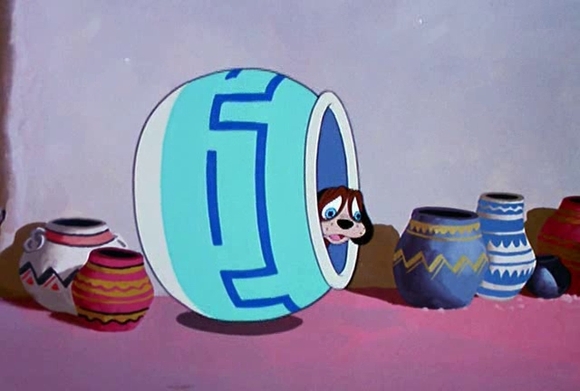 In Pueblo Pluto” Mickey’s a tourist visiting a Pueblo village with Pluto.
Here, Pluto meets the small dog with the droopy eyes from ‘The Purloined Pup’ (1946), who tries to steal Pluto’s buffalo bone. When Pluto finally has his bone secured, he discovers he’s trapped inside a circle of cacti. Of course, it’s the little dog who saves him in this all too typical story.
Like the other Pluto-befriends-a-little-animal-cartoons, this short is as cute as it is dull. Its most interesting feature are the rather stylized backgrounds by Brice Mack, who has used a particularly large amount of pink.
Watch ‘Pueblo Pluto’ yourself and tell me what you think:
This is Pluto cartoon No. 28
To the previous Pluto cartoon: Pluto’s Fledgling
To the next Pluto cartoon: Pluto’s Surprise Package
Director: Charles Nichols
Release Date: December 12, 1948
Stars: Mickey Mouse, Pluto, the little seal
Rating: ★★★½
Review:
 After visiting the seals at the zoo, Mickey accidentally brings a little seal home in his basket.
‘Mickey and the seal’ is the third cartoon to feature the little seal (the other two are ‘Pluto’s Playmate‘ from 1941 and ‘Rescue Dog‘ from 1947). And like the earlier entries featuring this cute animal, ‘Mickey and the Seal’ is charming, but not very funny.
Nevertheless, it contains a lovely scene of Mickey and the seal in bath, which is a prime example of great silent comedy. Its finale, too, arguably is the funniest of all postwar Mickey Mouse cartoons. The bath scene renders a shot of Mickey completely naked (except for his gloves).
Watch ‘Mickey and the Seal’ yourself and tell me what you think:
This is Mickey Mouse cartoon No. 121
To the previous Mickey Mouse cartoon: Mickey Down Under
To the next Mickey Mouse cartoon: R’coon Dawg
Director: Charles Nichols
Release Date: March 19, 1948
Stars: Mickey Mouse, Pluto
Rating: ★
Review:
 ‘Mickey Down Under’ features Mickey and Pluto in some Australian banana plantation.
Pluto has troubles with a boomerang, while Mickey encounters an ostrich. Even though the animation of Pluto is inspired, ‘Mickey Down Under’ is a boring cartoon, and one of the weakest entries in the Mickey Mouse series. Apart from the boomerang, the setting can hardly be called Australian. On the contrary, the cartoon depicts some flora and fauna not indigenous to Australia: toucans, bananas and ostriches. The title music is that of a Pluto cartoon.
Watch ‘Mickey Down Under’ yourself and tell me what you think:
This is Mickey Mouse cartoon No. 120
To the previous Mickey Mouse cartoon: Mickey’s Delayed Date
To the next Mickey Mouse cartoon: Mickey and the Seal
Director: Charles Nichols
Release Date: October 3, 1947
Stars: Mickey Mouse, Minnie Mouse, Pluto
Rating: ★★★★★
Review:
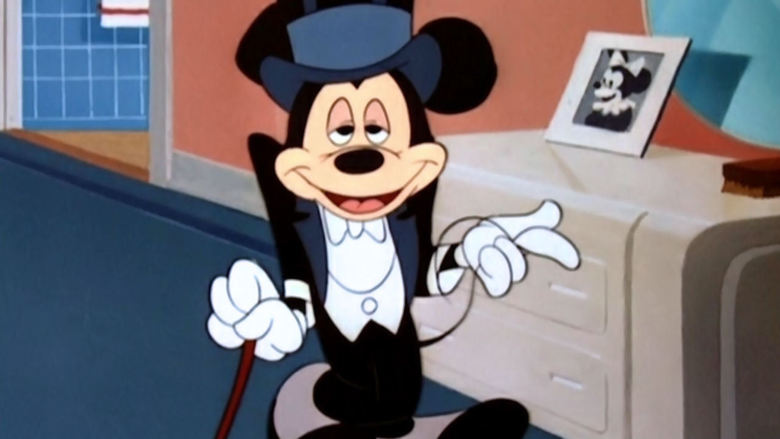 For the first time in five years (actually, since ‘Symphony Hour’) Mickey receives considerable screen time in his own cartoon, even though he has to share it once again with his dog, Pluto.
In the opening scene ‘Mickey’s Delayed Date’ we watch Mickey snoring at home, when the phone rings. It’s Minnie: she has been waiting an hour for him to come at a date with her for a dance. As soon as she has threatened him on the phone to break up if he doesn’t show up within fifteen minutes, Mickey rushes to the dance hall. Unfortunately he loses the tickets, which are brought by Pluto just in time.
Much screen time of ‘Mickey’s Delayed Date’ is devoted to Pluto in a rather long scene with a humanized tall hat. Nevertheless, it’s nice to watch Mickey in fine comic shape again, although he is less flexible here than in Riley Thomson’s shorts of the early forties. This short contains a shot of an almost naked Mickey (even without gloves).
‘Mickey’s Delayed Date’ was the first Mickey Mouse cartoon directed by Pluto-director Charles Nichols. He would direct five of the eight post-war Mickey Mouse cartoons.
Watch ‘Mickey’s Delayed Date’ yourself and tell me what you think:
This is Mickey Mouse cartoon No. 119
To the previous Mickey Mouse cartoon: Squatter’s Rights
To the next Mickey Mouse cartoon: Mickey Down Under
Directors: Jack Kinney, Hamilton Luske & Bill Roberts
Release Date: September 27, 1947
Stars: Jiminy Cricket, Mickey Mouse, Donald Duck, Goofy, Edgar Bergen, Luana Patton
Rating: ★★★★
Review:
 Fun and Fancy Free’ was the fourth of six package features Disney released in the 1940s.
It consists of two unrelated stories, which were both originally conceived as feature films in 1940/1941. The two stories, ‘Bongo’ and ‘Mickey and the Beanstalk’ are loosely linked by Jiminy Cricket, who sings the happy-go-lucky theme song.
He plays a record to a sad doll and a gloomy bear which features Dinah Shore telling the story of Bongo in rhyme and song. This cute, if unassuming and forgettable little film (after a story by Sinclair Lewis) tells about Bongo the circus bear, who breaks free from the circus, falls in love with a cute female bear called Lulubelle, and combats a large brutal bear called Lumpjack.
Immediately after this story has ended, we follow Jiminy Cricket to a live action setting: a private party with a little girl (Luana Patton), Edgar Bergen and his two ventriloquist sidekicks, the cynical Charlie and the dumb, but gentle Mortimer.
Bergen tells a version of ‘Jack and the Beanstalk’, starring ‘famished farmers’ Mickey, Donald and Goofy in their last classic trio outing. This part had a long genesis, the early drafts of this film go back to 1940. Apparently Pinto Colvig had returned to the Disney studio, because Goofy has his voice back after having been silenced for eight years. Pinto Colvig would do Goofy’s voice in two subsequent shorts, ‘Foul Hunting‘ (1947) and ‘The Big Wash‘ (1948), before leaving again, leaving Goofy voiceless, once more. This sequence is also the last theatrical film in which Walt Disney does Mickey’s voice. Halfway the production Jimmy MacDonald took over.
This second episode of ‘Fun and Fancy Free’ is a delight, if a little bit slow. Its humor derives mostly from Charlie’s sarcastic interruptions. Nevertheless, the animation of the growing beanstalk and of Willie the giant is stunning.
Willie would be the last giant Mickey defeated, after having done with giants in ‘Giantland‘ (1933) and ‘Brave Little Tailor’ (1938). Unlike the other giants, Willie is an instantly likeable character, and he was revived as the ghost of Christmas Present in ‘Mickey’s Christmas Carol‘ (1983).
‘Fun and Fancy Free’ is a lighthearted film. Like Disney’s other package features, it is not too bad, but it is certainly not among the ranks of masterpieces.
Watch the opening scene of ‘Fun and Fancy Free’ yourself and tell me what you think:
Director: Jack Hannah
Release Date: June 7, 1946
Stars: Mickey Mouse, Pluto, Chip and Dale
Rating: ★★★½
Review:
 ‘Squatter’s Rights’ is director Jack Hannah’s first of many cartoons starring Chip and Dale, who were introduced by Clyde Geronimi in ‘Private Pluto‘ in 1943. The two chipmunks are still interchangeable here. They would get real personalities in their next cartoon ‘Chip an’ Dale‘ (1947).
In this cartoon Chip and Dale live in a winter cottage, which is visited by Mickey and Pluto. Pluto soon discovers the jabbering duo, but Mickey never does. In the end Chip and Dale make Pluto and Mickey think Pluto’s been shot. In the final shot we can see Mickey running into the distance, carrying Pluto to a hospital, and leaving the cottage to the two little chipmunks.
‘Squatter’s ‘Rights’ is the first of only eight post-war Mickey Mouse cartoons. Mickey had had a short renaissance under director Riley Thompson in the early 1940s, but by 1946 he was once again reduced to a side character, at best co-starring with Pluto. ‘Squatter’s Rights’ is typical, with most of the screen time devoted to Pluto, Chip and Dale.
Jack Hannah would direct only one other Mickey Mouse cartoon: ‘Pluto’s Christmas Tree‘ (1952), which also features Chip ‘n Dale. Hannah’s appointed character was Donald Duck, whom he led through the last stage of his cinematic career. In this he would develop Chip n’ Dale into Donald Duck’s main adversaries.
Watch ‘Squatter’s Rights’ yourself and tell me what you think:
This is Mickey Mouse cartoon No. 118
To the previous Mickey Mouse cartoon: Pluto and the Armadillo
To the next Mickey Mouse cartoon: Mickey’s Delayed Date
Director: Fred Beebe
Release Date: January 13, 1942
Stars: Clarabella Cow, Donald Duck, Figaro, Geppetto, Goofy, Horace Horsecollar, Huey, Dewey and Louie, Mickey Mouse, Pinocchio, Pluto, The Seven Dwarfs
Rating: ★★★½
Review:
 ‘All Together’ is the last and the shortest of the four propaganda films Disney made for the Canadian government.
In the first half we only see some Disney stars parading on patriotic march music in front of the Canadian parliament building in Ottawa. This short scene reuses animation from ‘Pinocchio‘ (Pinocchio, Geppetto and Figaro), ‘Good Scouts‘ (Donald and his nephews), ‘Bone Trouble‘ (Pluto), ‘The Band Concert‘ (Mickey and the gang), ‘Mickey’s Amateurs‘ (Goofy) and ‘Snow White and the Seven Dwarfs’ (the seven dwarfs, who are clearly singing and whistling, although their voices are not heard). ‘All Together’ is the only propaganda short to feature Pinocchio stars.
The second half uses powerful imaginary to persuade the public to buy war certificates. Of the new images, the most striking is the one of coins marching with bayonets.
‘All Together’ is image only. It doesn’t feature any kind of story, making it the least interesting of the four Canadian propaganda films.
Watch ‘All Together’ yourself and tell me what you think:


 Dr. Grob's Animation Review