You are currently browsing the tag archive for the ‘Mickey Mouse’ tag.
Director: Burt Gillett
Release Date: June 6, 1931
Stars: Mickey Mouse, Minnie Mouse, Pete (cameo), Pluto
Rating: ★★
Review:
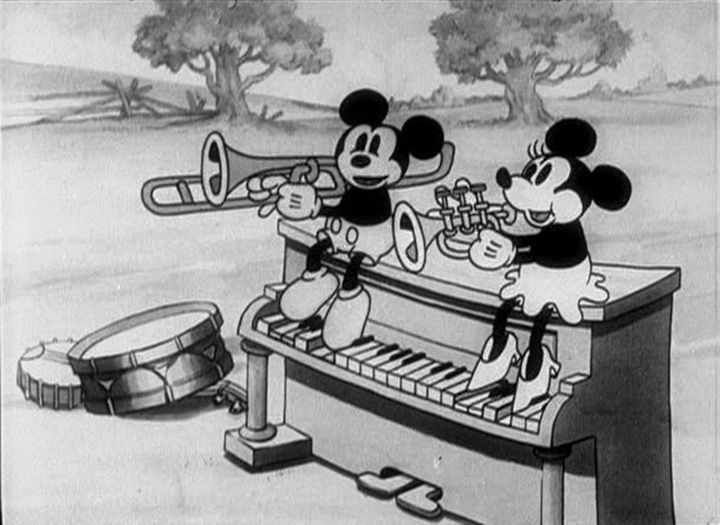 In ‘The Delivery Boy’ we watch Minnie doing the laundry in a pasture, singing the 1905 hit song ‘In the Shade of the Old Apple Tree’.
Mickey surprises her, and they dance the Charleston together to the background music. Mickey is so happy, he boxes a wasp’s nest. The wasp’s nest hits his donkey and his whole delivery, which consists of musical instruments, is spread over the pasture.
Undaunted, Mickey and Minnie start playing the piano, and all the farm animals join in, playing ‘The stars and stripes forever’. The cartoon ends when Pluto retrieves a burning dynamite stick and everything explodes. Nevertheless, Mickey is still able to finish playing John Philip Sousa’s famous march.
‘The Delivery Boy’ is as joyous as it is boring. After three years of song-and-dance routines one grows rather tired of it. Moreover, cartoons like ‘Traffic Troubles‘ and ‘The Moose Hunt‘ had proven that Mickey could do very well without them.
Pluto would cause havoc again in some of the succeeding films, like ‘Mickey Steps Out‘ (1931), ‘Mickey Cuts Up‘ (1931) and ‘The Grocery Boy‘ (1932). In these films the song-and-dance routine would give way to well-build gag-filled finales, of which the one in ‘The Delivery Boy’ is an embryonic version.
Watch ‘The Delivery Boy’ yourself and tell me what you think:
This is Mickey Mouse cartoon No. 29
To the previous Mickey Mouse cartoon: The Moose Hunt
To the next Mickey Mouse cartoon: Mickey Steps Out
Director: Burt Gillett
Release Date: April 30, 1931
Stars: Mickey Mouse, Pluto
Rating: ★★★½
Review:
 In ‘The Moose Hunt’ Mickey and Pluto are hunting moose.
They finally find a moose (or more exactly, the moose finds them). Unfortunately, in front of the moose, Mickey’s gun fails and soon the moose hunts both Mickey and Pluto. The chase ends with Mickey escaping on a flying Pluto.
‘The Moose Hunt’ is Mickey’s third gag only short, after ‘The Fire Fighters‘ (1930) and ‘Traffic Troubles‘ from earlier that year. It’s hardly as good as those earlier entries, though. Its pace is slow, and it contains some awkward gags, like the flying Pluto finale. It also contains a rare gag breaking the fourth dimension: when Mickey accidentally shoots Pluto, he suddenly addresses the audience with a “Is there a doctor in the house?”. Then, when Mickey begs Pluto to speak to him, Pluto actually speaks!
The self-conscious audience gag would remain a rarity at Disney, but it would become a staple gag at Warner Bros. when Tex Avery joined that studio. The two Pluto gags are totally out of character, and have nothing to do with him being a dog. After ‘The Moose Hunt’ we would never see Pluto flying or speaking again (apart from a short ‘Mammy’ at the end of ‘Mickey Steps Out‘), and after watching ‘The Moose Hunt’ it is easily understandable why not.
Luckily, there are other scenes that are more inspired, and in which Pluto behaves like a dog throughout. Indeed, in his very first solo scene, which reuses a little animation from ‘The Chain Gang‘ (1930), Pluto’s character as a little dumb and a little cowardly dog is pretty well established. Pluto’s looks are still unstable, but he’s excellently animated, throughout.
In ‘The Moose Hunt’ Pluto also gets his name (he was called ‘Rover’ in his first appearance in ‘The Picnic‘ from six months earlier). He now clearly is Mickey’s dog, not Minnie’s, like in the earlier film. It’s clear that the Mickey Mouse films could use an extra character, and after this film Pluto would appear in almost all succeeding Mickey Mouse films, stealing more and more screen time from Mickey.
Mickey would go hunting moose again in the way funnier ‘Moose Hunters’ from 1937, which, incidentally, doesn’t star Pluto.
Watch ‘The Moose Hunt’ yourself and tell me what you think:
This is Mickey Mouse cartoon No. 28
To the previous Mickey Mouse cartoon: The Castaway
To the next Mickey Mouse cartoon: The Delivery Boy
Director: Wilfred Jackson
Release Date: March 27, 1931
Stars: Mickey Mouse
Rating: ★★
Review:
 Mickey is a castaway, stranding on a tropical island.
Luckily, a piano is washed ashore as well, so Mickey performs for the jungle animals inhabiting the island. Unfortunately, an obnoxious little tiger disturbs him, and a great ape wants to play the piano, too, wrecking the instrument.
‘The Castaway’ was a short made out of rest material, and it shows: Mickey’s looks are wildly inconsistent, there’s not even a hint of a story, and the whole film feels like a throwback to 1929. Nevertheless, this short contains nice effect animation of waves washing ashore. It also reuses some animation of dancing sea lions from ‘Wild Waves‘ (1929) and of a dancing ape from ‘Jungle Rhythm‘ (1929), the film with which ‘The Castaway’ has most in common, which is no advertisement. In fact, Walt Disney disliked the film, thinking it didn’t look like a Walt Disney picture. And indeed, it hardly does.
The gag in which a lion gets eaten by a crocodile was borrowed from a very early Mickey Mouse comic strip from February 1930, which incidentally was the last panel drawn by Ub Iwerks himself.
‘The Castaway’ is also noteworthy for being the first Disney short to feature music by Frank Churchill, who would score many Disney shorts, and who would become particularly famous for the hit song ‘Who’s Afraid of the Big Bad Wolf’ from ‘Three Little Pigs‘ (1933) and the songs in ‘Snow White and the Seven Dwarfs’ (1937).
Watch ‘The Castaway’ yourself and tell me what you think:
This is Mickey Mouse cartoon No. 27
To the previous Mickey Mouse cartoon: Traffic Troubles
To the next Mickey Mouse cartoon: The Moose Hunt
Director: Burt Gillett
Release Date: October 9, 1930
Stars: Mickey Mouse, Minnie Mouse, Pluto (as Rover)
Rating: ★★★
Review:
 Mickey’s driving to Minnie’s house singing his own theme song. They both are going on a picnic. While Mickey and Minnie are singing and dancing across the field to the tune of ‘In the Good Old Summertime’, hundreds of wild animals take their food away. The picnic ends in rain.
‘The Picnic’ is a rather plotless and unremarkable cartoon. It nevertheless contains a nice surreal gag in which a rabbit pulls away a hole. This kind of surrealism was rare at Disney’s at that time, but later, Tex Avery would reuse this gag many times at Warner Brothers and MGM.
‘The Picnic’ would have been forgettable, did it not mark the debut of Pluto. He is called Rover in this cartoon, and appears to be Minnie’s dog rather than Mickey’s, but he’s Pluto alright. At this point there’s no reason to believe that Disney intended to make the dog a regular character. Floyd Gottfredson’s Mickey Mouse comics of January 1931 cover similar grounds, but feature a very large dog called “Tiny”.
Nevertheless, in April 1931 Pluto would return in ‘The Moose Hunt‘. This time to stay*. In fact Pluto would become a more and more important character in the Mickey Mouse cartoons, at times stealing most of the screen time from Mickey, who would become more and more a ‘straight man’. Eventually, Pluto would be given his own series, in 1937.
Watch ‘The Picnic’ yourself and tell me what you think:
This is Mickey Mouse cartoon No. 23
To the previous Mickey Mouse cartoon: The Gorilla Mystery
To the next Mickey Mouse cartoon: Pioneer Days
* Gottfredson’s Mickey Mouse comics followed three months later, introducing Pluto on July the 8th.
Director: Burt Gillett
Release Date: July 11, 1930
Stars: Clarabelle Cow, Horace Horsecollar, Mickey Mouse, Minnie Mouse
Rating: ★★★
Review:
 There’s a party at the barn. Mickey and Minnie make some music and Mickey dances with Clarabelle Cow, with a dachshund and with a fat pig, but not with Minnie, who plays the piano.
The short contains no story, but is one of sheer joy. Mickey and Minnie perform folk tunes like ‘Turkey in the Straw’, ‘Pop goes the Weasel’ (in which Mickey repeatedly grabs Minnie’s knickers), and ‘Old Folks at Home’, performed by Mickey on a mouth organ. The cartoon ends when the pig lands on Mickey.
‘The Shindig’ marks Horace Horsecollar’s first appearance as a completely humanized horse. It also contains the first love scene between him and Clarabelle Cow, whose name is written on the shed in which she lives.
In Clarabelle’s first scene, we watch her read Elinor Glyn’s novel ‘Three Weeks’. When she discovers an audience is watching her, she blushes, and quickly hides the book away. No wonder, ‘Three Weeks’ was a scandalous book, an erotic romance from 1907, apparently still controversial in 1930.
The party idea of ‘The Shindig’ was elaborated on in ‘The Whoopee Party‘ (1932), producing a cartoon full of party delight, compared to which ‘The Shindig’ pales.
Watch ‘The Shindig’ yourself and tell me what you think:
This is Mickey Mouse cartoon No. 20
To the previous Mickey Mouse cartoon: The Fire Fighters
To the next Mickey Mouse cartoon: The Chain Gang
Director: Walt Disney
Release Date: May 10, 1930
Stars: Horace Horsecollar, Mickey Mouse, Minnie Mouse, Pete
Rating: ★★★★
Review:
 ‘The Cactus Kid’ can be summarized as ‘Gallopin’ Gaucho in Mexico’. Mickey visits a Mexican canteen where Minnie’s a waitress. They make music together until Pete enters and kidnaps Minnie.
When Mickey pulls her nose, we hear Minnie speaking Spanish. The Mexican atmosphere is further enhanced by the use of music from Emmanuel Chabrier’s España, although the chase scene is accompanied by Jacques Offenbach’s (French) can-can.
Pete’s seen with a peg leg for the first time in this cartoon, although he already had a peg leg in several Oswald the Lucky Rabbit cartoons. We also hear him really speak for the first time. Actually, there’s an unprecedented amount of dialogue in this cartoon. Nevertheless, Mickey’s lips still look awkward when he speaks. Fortunately, this problem would soon be solved in the following cartoons.
Horace Horsecollar is recognizable, too, with his characteristic yoke and bowler hat. But he’s still only a partly humanized horse, here, and Mickey rides him. Only in ‘The Shindig‘ from two months later Horace Horsecollar would be fully anthropomorphized.
‘The Cactus Kid’ happened to be the last cartoon Walt Disney directed himself until his unfortunate come-back with ‘The Golden Touch’ five years later. The film was parodied as ‘Galloping Romance’, the cartoon showed in ‘Mickey’s Gala Premier‘ from 1932.
Watch ‘The Cactus Kid’ yourself and tell me what you think:
This is Mickey Mouse cartoon No. 18
To the previous Mickey Mouse cartoon: The Barnyard Concert
To the next Mickey Mouse cartoon: The Fire Fighters
Director: Walt Disney
Release Date: March 6, 1930
Stars: Mickey Mouse
Rating: ★★★★
Review:
 This is a very aptly titled short: we only see Mickey, there are no other stars or characters.
Mickey is the sole performer in his fourth concert cartoon (after ‘The Opry House‘, ‘Mickey’s Follies‘ and ‘The Jazz Fool‘, all from 1929). This time he’s playing the violin, presenting his reading of the fifth Hungarian dance by Johannes Brahms, Träumerei by Robert Schumann (which makes him cry) and, as an encore, the finale from ‘Overture William Tell‘ by Gioachino Rossini.
The whole setting is such that we’ve got the feeling we’re part of the audience ourselves, and that the man with the mocking laugh is among us. Later, the Warner Bros. studio would expand upon this idea of cartoon figures and audience interplay.
‘Just Mickey’ contains some good facial expression animation of Mickey, besides some great shadow effects during his rendering of ‘Träumerei‘. Moreover, the hand movements in this short are remarkably convincing. It is an early showcase of Walt Disney’s ambition to improve the art of animation. Being the first Mickey Mouse cartoon after Ub Iwerks’s departure in January 1930, it shows the studio could do very well without him…
Watch ‘Just Mickey’ yourself and tell me what you think:
This is Mickey Mouse cartoon No. 16
To the previous Mickey Mouse cartoon: Wild Waves
To the next Mickey Mouse cartoon: The Barnyard Concert
Director: Burt Gillett
Release Date: December 21, 1929
Stars: Mickey Mouse, Minnie Mouse
Rating: ★★★½
Review:
 In his fifteenth cartoon Mickey is a lifeguard and he saves a nearly drowning Minnie.
To comfort his sweetheart Mickey does some playing and dancing. Some animals (pinguins, sea lions, pelicans and a singing walrus) join in. This is a particularly dull sequence, Minnie cheers up, calls Mickey ‘my hero’ and kisses him. Iris out.
In this short, there’s a story at least the first half of the cartoon, making it slightly better than most of the early Mickey Mouse entries. The cartoon starts with some nice scatting by Mickey. Unfortunately, the fledgling lip-synch still accounts for some strange facial expressions on our hero. The drowning and saving part is the most interesting sequence, and contains some nice water animation, as well Mickey defying gravity by swimming through air.
‘Wild Waves’ was the first short directed by Burt Gillett. Gillett had joined Disney in April 1929. He would become the principal Mickey Mouse director of 1930 and 1931, and in 1933 he would gain fame with ‘Three Little Pigs‘. His career at Disney’s would last until 1934, when he left for the ill-fated Van Beuren Studio.
‘Wild Waves’ also was the last Walt Disney short to feature music by Carl Stalling. When Ub Iwerks left Disney in January 1930, Stalling soon followed, believing the studio had no future without this master animator. For his last film Stalling not only provided the score, but also the singing for Mickey and the Walrus. The singing walrus would be reused half a year later, in the Silly Symphony ‘Arctic Antics‘, while the dancing sea lions returned in ‘The Castaway‘ (1931).
Watch ‘Wild Waves’ yourself and tell me what you think:
This is Mickey Mouse cartoon No. 15
To the previous Mickey Mouse cartoon: The Haunted House
To the next Mickey Mouse cartoon: Just Mickey
Director: Walt Disney
Release Date: December 2, 1929
Stars: Mickey Mouse
Rating: ★★½
Review:
 ‘The Haunted House’ is Mickey’s first horror cartoon.
In this short he hides from a rain storm in a house, which appears to be haunted by skeletons. A cloaked skeleton orders Mickey to play on a harmonium, while all the skeletons dance.
This sequence reuses some footage of four skeletons dancing from ‘The Skeleton Dance‘. Unfortunately, the new animation on dancing and playing skeletons is hardly as good, and the dancing sequence feels more primitive than ‘The Skeleton Dance’. However, the opening shot is beautiful, with the house flexing in the wind. There’s also some good animation on the cloaked skeleton, and a beautifully lit scene when Mickey strikes a match.
Mickey’s role in this short is very limited, and his only function seems to be being the carrier of the audience’s fear. Indeed, he looks repeatedly into the camera for sympathy, dragging us into the haunted house with him.
The early scenes of this cartoon manage to evoke a genuine feel of horror, but in the end this short resembles the boring song-and-dance-routines of both the early Mickey Mouse and Silly Symphony series too much to be a stand out.
Mickey would return to the horror genre in ‘The Gorilla Mystery‘ (1930) and ‘The Mad Doctor‘ (1933), with much better results.
Watch ‘The Haunted House’ yourself and tell me what you think:
This is Mickey Mouse cartoon No. 14
To the previous Mickey Mouse cartoon: Jungle Rhythm
To the next Mickey Mouse cartoon: Wild Waves
Director: Walt Disney
Release Date: July 25, 1927
Stars: Lois Hardwick (Alice)
Rating: ★★★
Review:
 ‘Alice the Whaler’ was one of the last of the Alice Comedies. It was only followed by two other titles, before Alice was replaced by Oswald the Lucky Rabbit. It features Lois Hardwick as Alice, who had replaced Margie Gay at the end of 1926.
‘Alice the Whaler’ is a cartoon that consists of rather unrelated gags. This time Alice and the gang are on a ship, looking for whales. In this cartoon both Disney’s character designs as the flexible animation have matured. Gone are the goggly eyes, and even one character (a cat cook) is wearing Mickey Mouse-type gloves. Also starring is a small mouse that peels potatoes just the way Mickey would do a year later in ‘Steamboat Willie‘.
Alice has almost disappeared from the screen, by now: she’s visible in four shots only, two total shots of the ships and two close ups that contain no animation whatsoever. Indeed, in his next series, Walt Disney would abandon live action altogether, relying on animation only, which by now already was the best in the business.
Watch ‘Alice the Whaler’ yourself and tell me what you think:
‘Alice the Whaler’ is available on the DVD ‘Walt Disney Treasures: Disney Rarities’
Director: David Hand
Release Date: November 14, 1936
Stars: Pluto
Rating: ★★★
Review:
 Pluto unwillingly starts a career as a mother to a number of chicks.
When he finally has learned to love them, their real mother returns and together with her husband, a violent rooster, tries to chase Pluto away.
Although introduced as such, ‘Mother Pluto’ is not really a Silly Symphony. It lacks both the obligate music and the fairy tale character typical of the series. It’s actually Pluto’s first solo outing. It seems that at the time Disney didn’t dare to introduce new series besides the Mickey Mouse cartoons and the Silly Symphonies. But with Mickey giving way more and more to his co-stars Goofy, Donald and Pluto, this step would soon be made.
At the end of 1937 Pluto would become the first Mickey Mouse co-star to start his own series with ‘Pluto’s Quin-Puplets’, immediately followed by Donald with ‘Donald’s Ostrich’. Goofy followed one-and-a-half year later, in 1939, with ‘Goofy and Wilbur’. These three stars would be heading most of the Disney shorts of the 1940s and 1950s when the Silly Symphony series had been dropped and the number of Mickey Mouse shorts diminished.
Watch ‘Mother Pluto’ yourself and tell me what you think:
This is Silly Symphony No. 64
To the previous Silly Symphony: The Country Cousin
To the next Silly Symphony: More Kittens
Director: Ben Sharpsteen
Release Date: September 28, 1935
Stars: Donald Duck, Goofy, Mickey Mouse, Minnie Mouse, Pluto
Rating: ★★★½
Review:
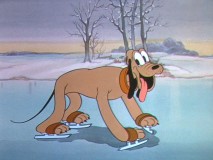 On Ice is the first of Disney’s ‘ensemble cartoons’.
Everyone is in it: Mickey, Minnie (in her color debut), Donald, Goofy, Pluto and even, albeit very briefly, Horace Horsecollar and Clarabelle Cow. ‘On Ice’ introduces two story ideas that would be used again much later: Pluto’s problems on ice in ‘Bambi’ (1942) and the idea of skating near a waterfall in the ‘Once upon a Wintertime’ sequence of ‘Melody Time’ (1948), although this latter idea first appears in the Popeye cartoon ‘Season’s Greetinks!‘ from 1933.
Apart from this, ‘On Ice’ has been very important in the development of Goofy. He’s been completely restyled, has more body to his looks and a much more distinct personality. All these important improvements on the character are attributed to Art Babbitt, one of the greatest animators of all time. Goofy sings ‘The world owes me a living’ from ‘The grasshopper and the ants’ (1934). The song naturally becomes his theme song. No wonder, for the grasshopper and Goofy share the same voice: that of Pinto Colvig. Also of note is Goofy’s original fishing style, using chew to catch fish.
Watch ‘On Ice’ yourself and tell me what you think:
This is Mickey Mouse cartoon No. 79
To the previous Mickey Mouse cartoon: Pluto’s Judgement Day
To the next Mickey Mouse cartoon: Mickey’s Polo Team
Director: David Hand
Release Date: August 31, 1935
Stars: Mickey Mouse, Pluto
Rating: ★★★★★
Review:
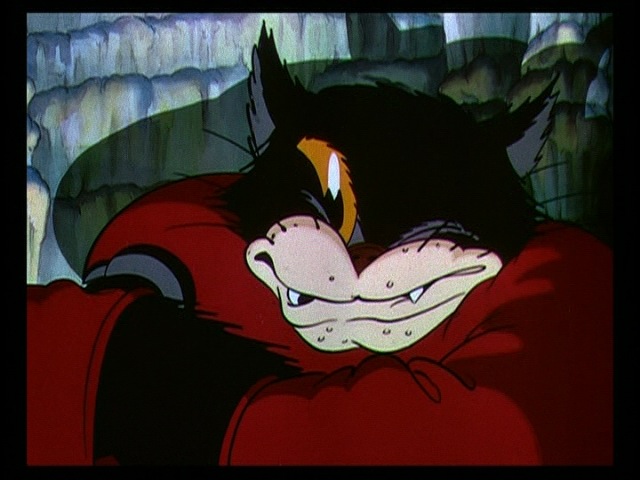 Although this cartoon is part of the Mickey Mouse series, Pluto is its star.
After he has chased a little kitten, he dreams that his Judgement Day has come and that he’s put on trial by a number of cheating cats.
Like most of Disney’s dream-cartoons this one contains wonderful backgrounds, characters and ideas, thanks to story men Joe Grant and Bill Cottrell. The dream sequence is executed in a Silly Symphony-like fashion with lots of rhyme and song and very beautiful animation. The prosecutor, animated by Bill Roberts, is particularly well done: he’s an impressive figure, whose stature anticipates Stromboli from ‘Pinocchio‘ (1940).
Pluto now is a fully developed character who easily carries the complete cartoon on his own. Mickey’s part, on the other hand, is reduced to that of a cameo, something that would occur more and more in the years to come.
Watch ‘Pluto’s Judgement Day’ yourself and tell me what you think:
This is Mickey Mouse cartoon No. 78
To the previous Mickey Mouse cartoon: Mickey’s Fire Brigade
To the next Mickey Mouse cartoon: On Ice
Director: Ben Sharpsteen
Release Date: August 3, 1935
Stars: Clarabelle Cow, Donald Duck, Goofy, Mickey Mouse
Rating: ★★★★★
Review:
 ‘Mickey’s Fire Brigade’ is the second of the classic trio cartoons featuring Mickey, Donald and Goofy, and the first of its kind in color.
When one compares this cartoon to the similar ‘The Fire Fighters’ from 1930, one can see what stunning progress the Disney studio had made in a mere five years: the backgrounds, the camera angles, the character animation, the effect animation: everything has improved considerably.
What’s more, its gags are faster, more clever and better constructed, and they build up to a wonderful finale. Among the numerous brilliant ideas are a burning title card, water splashing against ‘the camera’ and a bathing Clarabelle Cow who is not amused when saved by our heroes.
This cartoon is both Goofy’s first color appearance as the last time he’s seen in the design he got in ‘The Whoopee Party’ about three years before. In this film he’s got a particularly goofy cuckoo theme song, while some of the anthropomorphized flames play ‘who’s afraid of the big bad wolf’ from ‘Three Little Pigs‘ on the piano.
Watch ‘Mickey’s Fire Brigade’ yourself and tell me what you think:
This is Mickey Mouse cartoon No. 77
To the previous Mickey Mouse cartoon: Mickey’s Garden
To the next Mickey Mouse cartoon: Pluto’s Judgement Day
Director: Wilfred Jackson
Release Date: July 13, 1935
Stars: Mickey Mouse, Pluto
Rating: ★★★★
Review:
 ‘Mickey’s Garden’ is Mickey’s second color cartoon (after ‘The Band Concert‘).
It’s also Pluto’s first: he passes the transition into color fluently, getting his typical orange color we’re all familiar with now.
Mickey and Pluto are in the garden trying to kill a number of insects eating Mickey’s crop. When Mickey accidentally sprays himself with bug poison he starts to hallucinate (the transition to the dreamworld is particularly psychedelic: everything, including the background becomes unsteady and wobbly). He dreams that all plants and bugs have grown. This leads to some imaginative scenes. The bugs are not very lifelike, though. The animators even make a weird mistake by giving a particularly evil-looking beetle eight legs instead of six.
Watch ‘Mickey’s Garden’ yourself and tell me what you think:
This is Mickey Mouse cartoon No. 76
To the previous Mickey Mouse cartoon: Mickey’s Kangaroo
To the next Mickey Mouse cartoon: Mickey’s Fire Brigade
Director: Burt Gillett
Release Date: November 25, 1933
Stars: Mickey Mouse, The Orphan Mice
Rating: ★★★½
Review:
 Mickey tells the story of Jack and the Beanstalk to his numerous nephews with him in the starring role.
These nephews come out of nowhere, even though they had appeared in ‘Mickey’s Nightmare‘ (1932), where they were, indeed, part of a nightmare. In ‘Giantland’ they’re real alright, and they would star in five other Mickey Mouse cartoons of the 1930s.
In his story Mickey meets the first giant of his career. This giant is very well drawn, with great use of perspective and realistic details, especially in the hands. This must have been the closest the studio could come to the human form in 1933. The cartoon also contains many shadows. Both features are a testimony of Disney’s urge to master more naturalism in his cartoons.
Nevertheless, one can see that the animators were still struggling with such elaborate designs. The giant is not drawn very consistently, and some sequences are more convincing than others. The best and most beautiful scene is when Mickey ends up inside the Giant’s mouth. This is an original scene by all means, and one that could almost only be done in animation.
Notably, the cartoon emphasizes that the story is a fantasy, with Mickey only telling it. Mickey was slowly becoming more settled, and while he’s still the hero of this cartoon, as the years progressed his quieter nature meant that he lost more and more screen time to less timid characters, like Pluto, Donald Duck and Goofy.
Mickey would deal with giants again in ‘Brave Little Tailor’ (1938) and in ‘Fun and Fancy Free’ (1947), a re-telling of the same fairy tale. ‘Gulliver Mickey’ from six months later follows the same story line as ‘Giantland’, but now in reverse, with Mickey himself being the giant, while Floyd Gottfredson retold the story of ‘Giantland’ in his Sunday Mickey Mouse comics from March 11 to April 29, 1934.
Watch ‘Giantland’ yourself and tell me what you think:
This is Mickey Mouse cartoon No. 62
To the previous Mickey Mouse cartoon: The Pet Store
To the next Mickey Mouse cartoon: Shanghaied
Director: Wilfred Jackson
Release Date: October 28, 1933
Stars: Mickey Mouse, Minnie Mouse
Rating: ★★★
Review:
 Mickey applies for a job at Tony’s pet store. Then Minnie drops by and together they perform their usual song-and-dance-routine.
‘The Pet Store’ was Mickey’s last cartoon to feature the half song-and-dance routine half story formula, a story structure that by 1933 had become old-fashioned.
This time Minnie’s quite tiresome lalala’s are interrupted by ‘Beppo, the movie monk’, an ape who has read about King Kong (that movie was released the same year) and who wants to imitate him, after he had imitated Stan Laurel. This leads to a nice spoof of King Kong, in which the ape climbs a pile of boxes with Minnie under his arm while being attacked by birds, mimicking the planes in the original feature. In the end Mickey and Minnie are fleeing the pet shop, just before the owner returns, leaving it in complete ruin.
Unfortunately, by 1933 such battle scenes had become as jaded as the song-and-dance routines, and the one in ‘The Pet Store’ is not really different from the ones in ‘The Bird Store‘, ‘King Neptune‘, or ‘Babes in the Woods‘ (all 1932). Nevertheless, the take on ‘King Kong’ is marvelous, and more original than Walter Lantz’s much more literal spoof ‘King Klunk‘ from one month earlier.
Tony is the first elaborate human to enter Mickey’s world, being on par with the human characters in the Silly Symphony ‘The Pied Piper‘ from one month earlier. He would be topped, however, by the giant in Mickey’s next cartoon, ‘Giantland‘. Part of the fun in this cartoon is provided by Tony’s pseudo-Italian labels (like “birda seed” and “biga da sale”), a type of pun that was later borrowed extensively by Chuck Jones in his Pepe le Pew-cartoons.
Watch ‘The Pet Store’ yourself and tell me what you think:
This is Mickey Mouse cartoon No. 61
To the previous Mickey Mouse cartoon: The Steeple Chase
To the next Mickey Mouse cartoon: Giantland
Director: Burt Gillett
Release Date: July 1, 1933
Stars: Clarabelle Cow, Horace Horsecollar, Mickey Mouse, Minnie Mouse, Pete, Pluto
Rating: ★★★★★ ♕
Review:
 ‘Mickey’s Gala Premier’ is without doubt one of the greatest of all Mickey Mouse Cartoons.
The short both celebrates the enormous popularity Mickey enjoyed in the early 1930s, and establishes him as one of the leading actors of that period.
We’re witnessing the premiere of a new Mickey Mouse cartoon at the famous Grauman’s Chinese Theater in Hollywood, where Mickey and the gang are welcomed as celebrities (only Goofy is absent, his character was not yet established at that time).
The cartoon that is shown at the premiere is called ‘Galloping Romance’. It is an early and fantastic self-parody. This short only exists within ‘Mickey’s Gala Premier’ and is a ridiculous variation on ‘The Cactus Kid’ (1930), in which Mickey rides a number of silly animals in his pursuit of Pete, including a marimba. This self-consciously silly cartoon is way more old-fashioned than ‘Mickey’s Gala Premier’ itself.
Nevertheless, the crowd, which consists solely of well-known performers of the time, laugh their heads off and, after the show, all try to congratulate Mickey. Mickey’s wet dream appears to be being kissed by Swedish actress Greta Garbo, because it is the cartoon’s climax before it’s being revealed that all has been just a dream.
All the caricatures are the work of Joe Grant, whose work was also quoted by the Disney studio in the short special ‘Parade of the Award Nominees‘ (1932). For ‘Mickey’s Gala Premier’ Disney went directly to Grant, and the film became the story man’s first job for Disney. However, it was only two months after this film that Joe Grant became a full-time employee at the Disney studio. There he would also draw caricatures for ‘Broken Toys’ (1935) and ‘Mickey’s Polo Team’ (1936), but his main contribution would be to the story department.
The self-conscious nature of ‘Mickey’s Gala Premiere’ would remain rare at Disney’s, but it would become one of the key features of the Warner Brother Cartoons, who would produce similar cartoons as ‘You Ought to be in Pictures’ (1940) and ‘What’s Cookin’ Doc?’ (1944). Both cartoons are tributary to ‘Mickey’s Gala Premier’.
The short also sprouted several other cartoons featuring caricatures of contemporary Hollywood stars, among others ub Iwerks’s ‘Soda Squirt‘ (1933), Walter Lantz’s ‘The Merry Old Soul‘ (1933) and ‘Toyland Premiere’ (1934), Disney’s own ‘Mickey’s Polo Team’ (1936) and ‘Mother Goose goes Hollywood’ (1938), and the Warner Brothers cartoons ‘The Coo-Coo Nut Groove’ (1936), ‘Porky’s Road Race’ (1937) and ‘Hollywood Steps Out‘ (1941). Nevertheless, ‘Mickey’s Gala Premier’ was not the first in his kind, for already ten years earlier Felix the Cat made the trip to Hollywood to meet the stars in ‘Felix in Hollywood’ (1923).
Among the stars featured in ‘Mickey’s Gala Premier’ I managed to identify The Keystone Cops, Marie Dressler, Laurel & Hardy, the Marx Brothers, Maurice Chevalier, Eddie Cantor, Jimmy Durante, Harold Lloyd, Edward G. Robinson, Clark Gable, Joe E. Brown, Charlie Chaplin, Buster Keaton, Mae West, Greta Garbo, Bela Lugosi, Frederic March and Boris Karloff.
Also featured is some guy who has a striking resemblance to Prince Charles of Wales and who’s dressed as a king. This is a caricature of Will H. Hays, the president of the Motion Picture Producers and Distributors of America (MPPDA). Hays was Hollywood’s chief censor and the man behind the Hays code, the censorship Hollywood imposed on itself between 1930 and 1968. Interestingly, the censorship only became severe when Hays made place for Joseph Breen in 1934…
Watch ‘Mickey’s Gala Premier’ yourself and tell me what you think:
This is Mickey Mouse cartoon No. 58
To the previous Mickey Mouse cartoon: Mickey’s Mechanical Man
To the next Mickey Mouse cartoon: Puppy Love
Director: Burt Gillett
Release Date: April 8, 1933
Stars: Clarabelle Cow, Goofy, Mickey Mouse, Minnie Mouse
Rating: ★★★★½
Review:
 Mickey and the gang are staged in many different times and places in their cartoons. Yet, this medieval short is the only cartoon in which they are introduced as actors performing their parts.
This idea of Mickey being an actor was first coined in ‘The Wayward Canary’ (1932) and played out to the max in ‘Mickey’s Gala Premier’ (1933). This cartoon nevertheless is played without any awareness of the public.
Minnie is the princess of Lalapazoo, and forced by her father to marry prince Goofy from Pupupadoo. Minnie refuses and is locked up in the high tower. Fortunately, there is minstrel Mickey to save her and to battle the evil prince, chasing him through the window, and marrying the princess himself. This adventure film cliche Disney already had visited in the Oswald cartoon ‘Oh, What A Knight‘, but it is expanded and improved in ‘Ye Olden Days’.
Like ‘Building a Building’ and ‘The Mad Doctor’ from the same year, this cartoon is partly a musical with lots of parts sung. It also contains a very anachronistic guillotine and an elaborately designed horse that shows the aspirations of the studio to master more lifelike designs and animation.
Goofy, who is introduced as Dippy Dawg, is quite miscast here, playing the villain, whom he acts out more sillily than threateningly. It seems that the animators didn’t really know what to do with the character, so far only funny because of his typical voice. So, after this film they dropped him for more than a year.
Watch ‘Ye Olden Days’ yourself and tell me what you think:
This is Mickey Mouse cartoon No. 55
To the previous Mickey Mouse cartoon: Mickey’s Mellerdrammer
To the next Mickey Mouse cartoon: The Mail Pilot
Director: David Hand
Release Date: January 21, 1933
Stars: Mickey Mouse, Pluto
Rating: ★★★★★
Review:
 ‘The Mad Doctor’ is Mickey’s third horror cartoon and easily his best (the other two are ‘The Haunted House’ from 1929 and ‘The Gorilla Mystery’ from 1930).
The plot is simple: it’s night, the weather is foul and Pluto is kidnapped by an evil scientist called Dr. XXX, who takes him into his laboratory, which is reminiscent of that of Frankenstein in James Whales’ film of the same name, 1931. Mickey follows Pluto’s tracks into a creepy castle, entering it in a scene which reuses some footage of ‘Egyptian Melodies‘ from 1931. Inside the castle he has to deal with several skeletons, including a ridiculous hybrid of a skeleton and a spider. Soon, he’s captured, too, and about to be killed by a chainsaw. Fortunately, it turns out to be all just a dream…
Besides the horror, this cartoon also features elaborate designs and loads of special effects. Especially beautiful is its shadowing on the characters. It also has a strong musical element, as the mad scientist sings all his lines. Some of the gags are quite surreal and reminiscent of the Fleischer style, like a lock locking itself or the scientist cutting off Pluto’s shadow. The cartoon also features a gag with many doors in one doorpost. This gag would be reused and improved by Tex Avery in ‘The Northwest Hounded Police’ from 1946.
Watch ‘The Mad Doctor’ yourself and tell me what you think:
This is Mickey Mouse cartoon No. 52
To the previous Mickey Mouse cartoon: Building a Building
To the next Mickey Mouse cartoon: Mickey’s Pal Pluto


 Dr. Grob's Animation Review