
You are currently browsing the tag archive for the ‘Nina Paley’ tag.
Director: Nina Paley
Release date: June 11, 2018
Rating: ★★★
Review:

Seder-Masochism is the second feature animation film by independent animation artist Nina Paley (born 1968), who created quite a stir with the lovely ‘Sita Sings the Blues’ (2008) in which she blended events in her personal life with the story of the Ramayana, but from a woman’s view.
Apparently, Paley was criticized for using a myth from another culture for her feminist message, with attackers typically focusing on Paley’s supposed lack of understanding of Hindu religion, an irrelevant argument, as the misogyny that Paley attacked is plainly visible in the source text (especially in the last book). Moreover, the Ramayana is hardly unique in its treatment of women as second rate citizens, which can be found in practically all ancient texts.
To underline this message, for her second feature Paley dived into her own heretical religious culture, that of Jewism. The result is a more vicious and more pamphlet-like feature than ‘Sita Sings the Blues’, mostly because the personal note is hardly present, only in an interview of Paley with her father, recorded years prior, about his stance towards Judaism, and that of the Pesach (or Passover) in particular. In these scenes Paley is shown as a sacrificial goat and her father as God himself.
The Pesach, and the story from the book of Exodus behind it, forms the central element of ‘Seder-Masochism’. The ‘Seder’ in the title apparently is a ritual feast at the beginning of the Jewish Pesach celebration, and contains some questionable elements, like rejoicing over the Egyptian victims of the ten plagues and of the closing of the Red Sea.
Surprisingly, Paley juxtaposes the story of Exodus with the idea that initially human culture was matriarchal and devoted to mother goddesses, a theory popular with feminists, but unsupported by archeological evidence. Paley even goes so far as suggesting the golden calf from the Exodus story was a return to such a mother goddess, and thus to times of more equality between and women. Indeed, Paley seems to blame Moses, or monotheism in general for the misogynist patriarchy that dominates most of human culture in its historical existence. This is pure fantasy and can be easily debunked. But of course, ‘Seder-Masochism’ is no documentary, but Paley’s personal take on monotheism and its approach to women.
Yet, Paley’s clear atheist approach to the biblical story is more vicious than anything in ‘Sita Sings the Blues’, which makes the film less approachable and less a classic than Paley’s first movie. Especially when Paley turns to real life footage of religion-inspired violence the film becomes pure agit-prop. Nevertheless, the scene in which Moses returns from Mount Sinai, commanding a stop to the women’s temporal liberation and forcing them back into their niqab-like clothing remains a painful one, and rightfully evokes anger about religious societies who limit the freedom of women.
Even with its strong message, Paley’s way of storytelling remains highly attractive. Paley’s dry sense of humor permeates much of the film, and her visual style is charming throughout, her command of minimal, but effective animation one of the highest degrees. I especially like the poetic intro in which a female goddess flows through space, and sprouts plants, animals, and eventually men on a soundtrack of the most beautiful Bulgarian female chant. Paley’s dance animation of ancient female statues is also a masterstroke, and an attraction in its own right (Paley offers them as singular GIFs).
Moreover, Paley very skillfully mixes the interview excerpts, an enormous variety of existing music and even a 1950s record in which a man tells about the Seder celebration. In contrast with ‘Sita Sings the Blues’, in which only records by 1920s singer Annette Hanshaw were used, ‘Seder-Masochism’ plunders the Western pop music tradition, often to a very striking effect. Notice, for example the single sample of ‘Helter Skelter’ from The Beatles during the sixth plague, and the earlier mentioned scene in which Moses returns uses Led Zeppelin’s ‘Your Time Is Gonna Come’ to a painful effect. But the film’s highlight in this respect must be the use of 10cc’s ‘The Things We Do for Love’ which accompanies images of Jews gleefully chopping off foreskins, beheading little goats and killing men and women.
The bitter irony of this sequence is topped by the ‘This Land Is Mine’ sequence, which Paley finished first, and which can be watched as a separate video clip. In this utterly bleak section, we watch several nations fight over the land of Israel, killing one another in greater and greater numbers, with Death itself ultimately being triumphant. With Israel raging the war in Gaza today, with its tens of thousands of innocent Palestine victims, this bleak sequence remains as topical as ever.
The ‘This Land Is Mine’ sequence was also one of the last pieces of animation Paley did in Macromedia Flash, before moving over to Moho. But the most surprising piece of animation in the film is not done on either platform but done with embroidery, in a process Paley calls ‘embroidermation’. This is a lovely piece of stop-motion that Paley rightfully saves for the end, just before the ‘This Land Is Mine’ finale.
In all, ‘Seder-Masochism’ is a beautiful, if rather angry film with a strong feminist message. It cannot stand the comparison with ‘Sita Sings the Blues’, which remains the more balanced work, but as author feature films like this remain utterly rare in the animation field, I strongly recommend watching this feature nonetheless. At least it will make you think about the position of women in society. Paley offers her film for free online, and the movie can be downloaded from her site.
Watch the trailer for ‘Seder-Masochism’ yourself and tell me what you think:
‘Seder-Masochism’ can be downloaded for free from Nina Paley’s website
Director: Nina Paley
Release date: February 11, 2008
Rating: ★★★★★
Review:
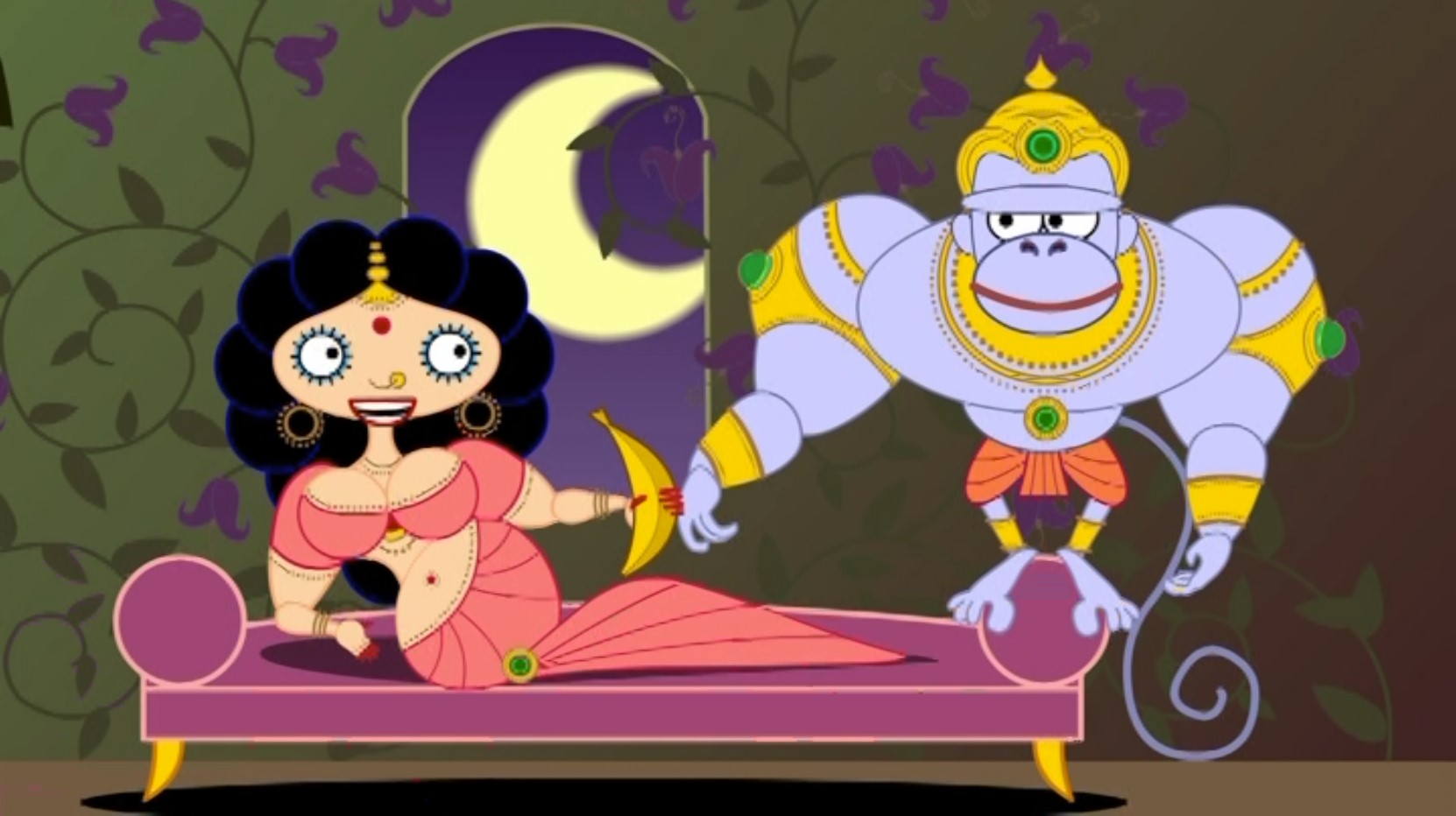
Unlike the European and Japanese animation field, the American animation studio system is unkind to author films. Walt Disney’s ‘Lilo & Stitch’ (Chris Sanders, 2002) probably comes closest, apart from several feature films based on animated television series. Thankfully, some individual artists have filled this gap, most notably Bill Plympton, releasing no less than seven features. Other notable artists are Don Hertzfeldt (‘It’s Such a Beautiful Day’ from 2012), and Nina Paley. Amazingly, all these artists mostly work totally alone, which makes their accomplishments even more stunning.
Nina Paley ‘Sita Sings the Blues’ for example, is written, directed and produced by Paley alone, which took her five to six years, and which could only be finished with help from crowd-funding, being one of the first animated projects to use this type of fund raising.
‘Sita Sings the Blues’ retells the Indian epic ‘The Ramayana’, but it’s also a personal film, in which Paley links her own situation to that of Sita, the perfect wife to the hero Rama. The most incongruous element are the eleven songs by 1920s jazz singer Annette Hanshaw, an artist sadly almost forgotten, whom Paley had discovered prior to the film making. The linking of these sweet and gentle tin pan alley songs to the Ramayana is as odd as it is effective, and the pairing certainly contributes to the uniqueness of the film.
The film uses several different animation styles: Nina Paley’s own personal story is told in a traditional scribbly animation style, with sets based on photographic material. These parts are the least attractive of the lot, even though Paley shows to be a very able animator in this classic cartoon style. The Ramayana is retold by three Indians (Aseem Chhabra, Bhavana Nagulapally and Manish Acharya) who are depicted as traditional shadow puppets of Hanuman, Sita, and Rama, respectively. The story they are telling together is shown in tongue-in-cheek cut-out animation.
The ‘official’ story is also told in cut-out animation, using very attractive recreations of traditional Indian paintings. But the best parts to look at are the songs, which are done in a most attractive cartoon modern design. In these song parts Paley reuses a lot of animation cycles, but actually she makes excellent use of the flash medium, and she makes the most of her limited animation.
Apart from these five alternating styles, there’s also a short sequence using rotoscope and a much more pop-art influenced videoclip-like filming style. All these are apparently done in Macromedia flash.
As said, ‘Sita Sings the Blues’ retells the Ramayana, reducing the huge epic to its barest elements. For example, Lakshmana is hardly mentioned, and the monkey king Sugriva not at all. Moreover, unlike the traditional poem, the focus is on Sita, not Rama, and Paley highlights the questionable parts from the original poem (one at the end of the Yuddha Kanda, and another in the Uttara Kanda), in which Rama treats Sita very unfairly indeed, just like Paley’s own partner does in real life. This makes ‘Sita Sings the Blues’ a feminist film, which sheds a welcome critical light on the traditional depiction and treatment of women, then and now.
As the story is told by three people, who remember the story differently and interpret it in different ways, this leads to some very funny moments. But Paley adds some humor, too, in the ‘official’ story part, for example when the female rakshasa (a sort of demon) Shurpanakha tells her brother Ravana about the beauty of Sita, comparing all her body parts with lotuses.
As said, the Annette Hanshaw songs boast the most attractive designs, and like traditional opera arias, they shed an emotional light on the events. However, Paley cleverly propels the story forward even during these sequences. Yet, as the songs are featured in their entirety, typically lasting ca. 3 minutes, they also drag the film down. As there are eleven of them, one tends to grow a little weary of them as the film progresses. Nevertheless, ‘Sita Sings the Blues’ does a great job in restoring interest in this almost forgotten singer. Unfortunately, the Hanshaw songs were not free from copyright, causing Paley a lot of trouble, and eventually causing her to release the film completely free from copyright.
The Annette Hanshaw songs are juxtaposed to some Indian pop music, mostly by artist Masaladosa. Particularly strong is the angry song which follows the scene in which Paley gets dumped by email. The complete soundtrack is as attractive as the film’s visual designs, and the two complement each other very well.
In all, ‘Sita Sings the Blues’ is not without its flaws, but as it is made by a single woman, it’s no less than a tour-de-force, and the result is a very interesting personal film, which makes one think. Moreover, the film shows the great power and endless possibilities of animation, and single-handedly puts Paley into the pantheon of the medium’s greats. In 2018 Paley made yet another feature called ‘Seder-Masochism’, which unfortunately has attracted much less attention.
Watch the trailer for ‘Sita Sings the Blues’ yourself and tell me what you think:
‘Sita Sings the Blues’ is available on DVD


 Dr. Grob's Animation Review