
You are currently browsing the tag archive for the ‘oppression’ tag.
Director: Jan Lenica
Release date: 1961
Rating: ★★★★
Review:
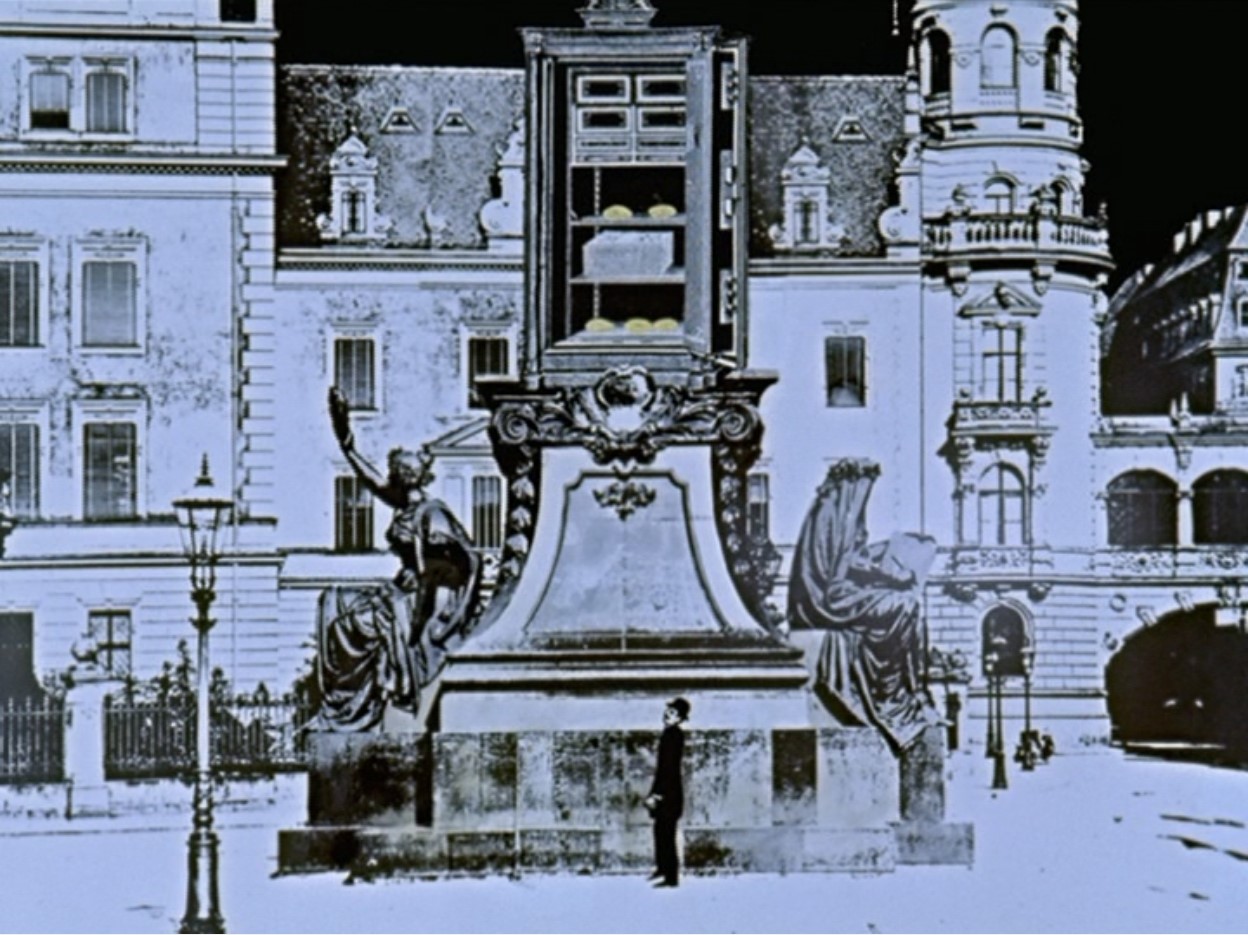
In ‘Labirynt’ a man flies into a seemingly abandoned city, only to find it to be a dangerous place, terrorized by strange creatures and machines, alike.
This is one of those rare animation films from Eastern Europe depicting what it’s like to live in an oppressive communist state. The film is highly surreal, featuring strange creatures, often mixes of animal and human parts, but I am still surprised the film got past the censors. For example, at one moment the man is captured by a bearded machine-man and thoroughly examined. At one key scene we watch is thoughts roaming freely inside his head, only to get barred by a strange contraption. The end, too, in which the man tries to escape the paranoid city is telling enough.
Jan Lenica’s world is based on partly colored old photographs and engravings. His animation is emblematic, but at one point we surely feel the man’s fear, as he tries to flee from his oppressors. The surrealist atmosphere is enhanced by Jan Radlicz’s sound design and by Włodzimierz Kotoński’s score.
Watch ‘Labirynt’ yourself and tell me what you think:
‘Labirynt’ is available on the DVD-set ‘Anthology of Polish Animated Film’
Director: Denis Do
Release date: June 11, 2018
Rating: ★★★½
Review:
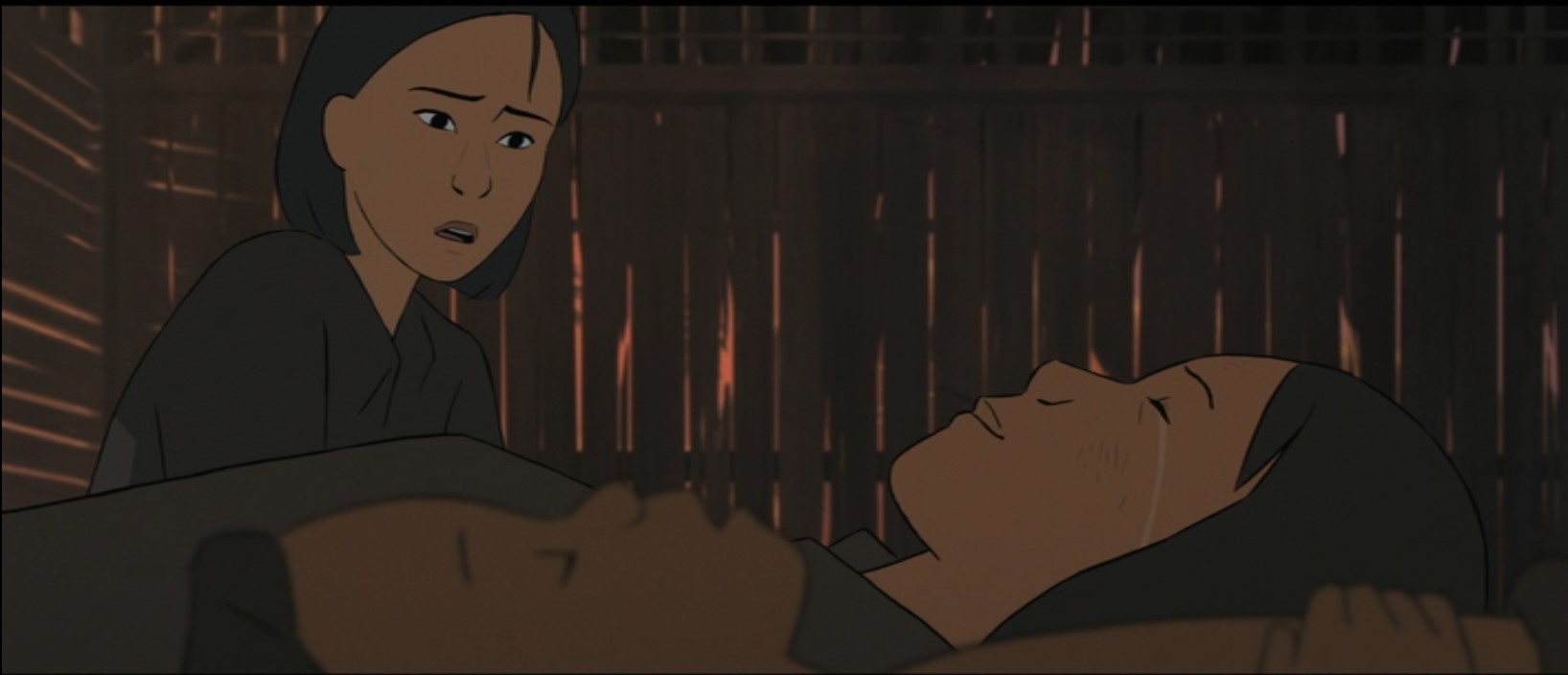
‘Funan’ is a film by Denis Do, a French film maker of Cambodian descent, and the film is partly based on the memories of his own mother.
‘Funan’ means ‘the new people’ in the Khmer language, and this is an apt description of the radical ideology of the Khmer Rouge, an extreme communist movement that took power in Cambodia from 1975 to 1979, only to plunge the nation in one of the severest mass killings in human history, with the ultimate goal to rise as a ‘new nation’ of autarkic, non-intellectual people.
‘Funan’ thus tells about Cambodia’s darkest years, and does so by following one family from Phnom Penh, which almost immediately falls apart, and which succumbs one by one to various aspects of the terror, be it brutal murder, forced labor, famine or rape. We especially follow a couple, Chou and Khuon, and their son Sovanh, who gets separated from his parents near the start of the film.
Luckily, the film eschews gross images, keeping the watch tolerable, but strangely enough, this also means one feels the hardship and sorrow less than one should. The film’s rather episodic nature certainly doesn’t help, and one has a little trouble relating to these people, perhaps because they aren’t introduced very well (the happy bliss of pre-Khmer rouge existence is shown all too shortly), and because the film is told in a plethora of very short scenes, instead of a few well-chosen longer ones. Especially Sovanh’s story is too fragmentary to follow, and his experiences are only hinted at, although it’s clear that the young boy sees a lot of cruelty and death.
The 2D animation is fair, with the human character designs rooted in the French ligne claire tradition, while the background is painted and lineless. Both coloring and lighting are clearly digitally done, and to be frank, rather uninteresting.
I suspect the film could be more daring and more idiosyncratic in its designs and storytelling, especially when compared to Elsa Duhamel’s similar, but far more interesting short ‘Bach-Hong’, which tells of the coming of the communists to Saigon, Vietnam. Duhamel cleverly sticks to a single story, illustrating the regime’s cruelty by one, ostensibly minor detail in the nation’s history.
Do, on the other hand, seems to want to tell everything, and indeed he succeeds in painting a picture of these black years, but I suspect he had better chosen less scenes, and less characters, for now, unfortunately, the film remains at an emotional distance, and that can hardly be the film maker’s purpose. Yet, I am glad personal films like this are being made, for films like ‘Funan’ save tragedies like that of Cambodia from oblivion, and remind us that peace and safety aren’t guaranteed, at all.
Watch the trailer for ‘Funan’ yourself and tell me what you think:
‘Funan’ is available on Blu-Ray and DVD
Director: Nora Twomey
Release date: September 8, 2017
Rating: ★★★★★
Review:

2017 was a good year for the animated feature film: Warner Bros., Dreamworks and the French Polivari and Panique studios gave us great laughs with ‘The Lego Batman Movie’, ‘Captain Underpants: The First Epic Movie’, and ‘ Le grand méchant renard et autres contes…’ (The Big Bad Fox and Other Tales), respectively; Pixar amazed us with the magnificent ‘Coco’, and the Japanese Science Saru studio made quite an impression with the mind-blowing film‘Night Is Short, Walk on Girl’.
However, the most important and most moving animated feature film was the Irish-Canadian-Luxembourgian co-production ‘The Breadwinner’. This was the third feature by the Irish Cartoon Saloon studio, which can be regarded as the most welcome and most original studio additions to the animated feature field of the 21st century, thus far. The Breadwinner’ shares with their previous two films, ‘The Secret of Kells’ (2009) and ‘The ‘Song of the Sea’ (2014) a very charming traditional animation style, and a surprisingly graphic overall design, although the latter is rather toned down in ‘The Breadwinner‘ when compared to the earlier two movies. But unlike the other two, ‘The Breadwinner’ completely lacks the Irish flavor, being set in, of all places, Afghanistan.
Based on the book by Deborah Ellis from 2000 ‘The Breadwinner’ is set in Kabul, the unfortunate country’s capital during the first Islamic Emirate of Afghanistan (better known as the Taliban regime, 1996-2001). By the time the film was made, this extremely oppressive regime was a ghost of the past, at least in Kabul (the Taliban never fully disappeared from the country), but sadly, since August 2021 this misogynist, backward movement is in full charge of the country, once again.
‘The Breadwinner’ makes no mistake how hard it is to live in such a violent, insecure country, where arbitrariness prevails, and where women have no rights, at all, whatsoever. The film follows the eleven-year-old Afghan girl Parvana, who lives with her disabled father, her mother, elder sister Soraya, and a baby brother called Zaki in a tiny house in Kabul. When the father gets arrested and thrown into a prison far outside town, the family quickly get into way more problems than they already had: as women cannot do anything outside without a man, their means to even obtain food completely come to a standstill. At this point Parvana takes an important decision to save her family’s life…
‘The Breadwinner’ is a very believable story, much more subtle than almost anything coming out of the United States. For example, the Afghan people are portrayed as real people, with a rich an ancient culture. Added to the sense of authenticity is the use of Afghan voices (except for the brabbling Zaki), while Mychael and Jeff Danna’s score clearly borrows from the Afghan musical tradition. Thus, the film’s Afghanistan is a convincing one, not a caricature seen through Western eyes. Moreover, although the film makes no mistake about the oppressive and misogynist nature of the Taliban regime, there are many shades of gray between the heroes and villains. Even the villain that causes Parvana’s family’s demise is shown in one last shot as not only evil, but insecure and afraid, too. Moreover, Parvana remains a relatable character, throughout. Despite her courage and adult responsibility, she remains a child, and is shown delighting in childish behavior, especially with her friend Shauzia.
Contrasted with Parvana’s dire circumstances are the images of a story she tells her beloved (her first audience is her baby brother, but she also tells the tale to others, and others even blend in, altering the direction of the story while doing so. These images are rendered in the most colorful, storybook illustration-like, faux cut-out animation, and tell about a boy who goes on a quest to retrieve his village’s seeds from an evil elephant king. This fantastical tale is picked up several times during the movie, and often reflects the events depicted in real life. Especially in the finale, in which the two seem to come together, this dual story telling comes to a harrowing conclusion.
As said, the film’s design is less graphic than that of Cartoon Saloon’s Celtic features. The background art is semi-realistic, with depressing greys, browns and yellows depicting the seemingly treeless town of Kabul. The character design is more graphic, with especially Zaki being an echo of the character designs from the earlier films. Noteworthy is the background art of a rather surreal scene in which Parvana and Shauzia are seen in a field full of abandoned tanks. The traditional animation is a delight, not only the very moving animation of the main characters, but also the cartoony quasi-cut-out animation of Parvana’s story. There’s only a little computer animation present, mostly for crowd scenes.
In all, ‘The Breadwinner’ is one of the best, most adult and most moving animation films to come out of any animation studio, and should be considered a modern classic.
According to director Nora Twomey ‘The Breadwinner’ may be set in Afghanistan but tells a universal story of all children growing up in oppressive countries, everywhere. Yet, we are still waiting for the animated depictions of their stories, while Afghanistan has been the subject of no less than three other animated feature films since then: ‘The Swallows of Kabul’ from 2019 and ‘My Sunny Maad’ and ‘Flee’ from 2021. Surely, the people of say North Korea, Syria, Eritrea, the Central African Republic, or Yemen deserve better.
Watch the trailer for ‘The Breadwinner’ yourself and tell me what you think:
‘The Breadwinner’ is available on Blu-Ray and DVD
Director: Priit Pärn
Release Date: 1987
Rating: ★★★★★
Review:
 Made directly after ‘Time Out’, ‘Breakfast on the Grass’ is one of Priit Pärn’s most powerful films.
It’s also one of his most difficult, and its message is at times hard to decipher. Pärn doesn’t tell straightforward stories, and much remains unexplained. Most importantly, it’s one of the few films showing insight in Eastern European life under the communist oppression. Its atmosphere is gloomy, its graphic style crude and scratchy, its humor dark, and its surrealism disturbing.
In ‘Breakfast on the Grass’ we follow four people, two men and two women, who struggle in their daily life. The first, Anna, strongly feels she’s an outcast in the society. She’s not really part of the system, and misses out on its benefits, as exemplified by her search for rare apples. The second, Georg, imagines himself a playboy, but reality is harder. In pursuit of a suit, with which he can fulfill his playboy dreams he has to go through a grind of corruption. Everyone wants something rare in exchange for offered service. Berta has lost her face as soon she became a mother. She only regains it when she finds the attention of a man. And finally, Eduard shrinks when he needs a paper signed from a very high official. Luckily he gets help from a female friend…
Also starring in these stories is an anonymous artist, who is constantly followed by a flock of crows or dragged around by two state officials. A clearer statement of oppression is hard to find in any Soviet film.
In the end, the four people succeed in their aim, and together they go to a park, where they form a life tableau of Edouard’s Manet’s painting ‘Déjeuner sur l’herbe‘ (1863) which lends its name to the film’s title. This hopeful statement of beauty, freedom and art is as quickly dismantled, however, and the final shot is for the artist, whose arm is smacked by a steam roller…
Like few other films ‘Breakfast on the Grass’ shows what life is like in an oppressed state, where food is scarce, where bureaucracy and corruption run freely, and where the role you play is more important than your personal preferences. Even though the Glasnost was in full flight in 1987, it’s a wonder such a dark accusation was possible in the Soviet Union, of which Estonia was then still part.
Watch ‘Breakfast on the Grass’ yourself and tell me what you think:
Director: Âle Abreu
Release Date: September 20, 2013
Rating: ★★★★½
Review:
 It seems that with their growing economies the BRIC countries enter a new creative era, in which costly projects like animated features are now possible. Especially Brazil is a surprising new country from which unique and distinct animation films sprout.
In 2013 the Holland Animation Film Festival had shown the ambitious ‘Uma História de Amor e Fúria‘, this year it’s the charming film ‘O menino e o mundo’ (The Boy and the World). Surprisingly, given the extremely different animation styles, the two features have more in common than one would expect.
According to its director Âle Abreu* the idea of ‘O menino e o mundo’ was conceived when the little boy character suddenly appeared in his notes when studying Latin American protest music of the last hundred years. The film tells about this little boy growing up in the countryside, near the jungle, who goes to seek his father, who has left for the city to work. On his trip he discovers the real world that is Brazil, far from his idyllic place in the hills. He meets cotton pickers, people in the cotton industry, and even discovers how cotton is shipped to some futuristic cities (vaguely resembling the US) to be made into clothes, which are shipped back to Brazil to be sold at ridiculous prices.
I say Brazil, but Abreu insists that this story is the story of practically every Latin American country, or even every third world country emerging from a dark dictatorial past and now getting caught up in the World Economy. Indeed, the film’s world may be one great fantasy, with vehicles like animals, towns like mountains, and great futuristic cities in the sky. Yet, what happens in this world is instantly recognizable to people all over the world,
Meanwhile, the film clearly shows the grand effects of the global economy on the lives of ordinary and poor people. Without reservation Abreu shows us cotton pickers being fired because they are old and sick, workers working ridiculously long hours in hot industries to produce cotton, only to be replaced by a machine in the end. We watch poor people living in favelas (slums), while advertisements on the streets and on television produce images of a happy life they’ll never be able to reach. We watch people who demand more freedom being oppressed by military police, in a particular powerful sequence in which a colorful bird of freedom is crushed by a black bird of oppression, etc.
It’s this focus on social injustice that ‘O menino e o mundo’ shares with ‘Uma História de Amor e Fúria’. Unlike the latter film, however, Abreu’s film never becomes too heavy-handed, because we keep on seeing this world through the eyes of a child. To achieve this, Abreu uses a wonderfully naive style resembling children’s drawings and pastel crayons. All images are drenched in imagination and wonder, even those of the city and the oppressive forces, whose tanks look like large elephants. When the boy approaches the city, more and more magazine clippings are added to the colorful images. Abreu says he wanted to tell a tale about freedom, so he wanted to have freedom during the making of this film, too. He says: “A director should listen to the voice of his film, and listen to where the film wants to go“.
The result is an absolutely gorgeously looking film, simply bursting in color and fantasy. The animation, too, is superb, especially when considering that most of it was done in Photoshop. According to Abreu the drawings were then printed, filmed, and imported in After Effects for compositing. Moreover, the whole film was made with a very small crew. Nevertheless, the makers have reached a high quality by any standards.
To tell his story Abreu uses no dialogue. Yes, we hear people speak, but in a language that is constructed of Portuguese words spoken out backwards. Indeed, the voice actors had to act and sing in this backward language. However, in no way comprehensible dialogue is missed, for Abreu is perfectly capable of storytelling by images alone. Added to the mix is the cheerful score by Ruben Feffer and Gustavo Kurlat, which is a perfect match to the colorful images. According to Abreu, even the sounds of nature are made by musical means, like hand claps for rain.
‘O menino e o mundo’ is a magical film of sheer delight, deserving to be shown everywhere in the world. And unlike American films, it doesn’t shun the big questions our world needs to answer. For this bravery alone, it deserves a large audience.
Watch the trailer for ‘O menino e o mundo’ and tell me what you think:
* Quotations from Abreu are taken from his introduction and Q&A at the screening of his film at the Holland Animation Film Festival, March 20, 2014.


 Dr. Grob's Animation Review