
You are currently browsing the tag archive for the ‘Pluto’ tag.
Director: Charles Nichols
Release Date: December 12, 1948
Stars: Mickey Mouse, Pluto, the little seal
Rating: ★★★½
Review:
 After visiting the seals at the zoo, Mickey accidentally brings a little seal home in his basket.
‘Mickey and the seal’ is the third cartoon to feature the little seal (the other two are ‘Pluto’s Playmate‘ from 1941 and ‘Rescue Dog‘ from 1947). And like the earlier entries featuring this cute animal, ‘Mickey and the Seal’ is charming, but not very funny.
Nevertheless, it contains a lovely scene of Mickey and the seal in bath, which is a prime example of great silent comedy. Its finale, too, arguably is the funniest of all postwar Mickey Mouse cartoons. The bath scene renders a shot of Mickey completely naked (except for his gloves).
Watch ‘Mickey and the Seal’ yourself and tell me what you think:
This is Mickey Mouse cartoon No. 121
To the previous Mickey Mouse cartoon: Mickey Down Under
To the next Mickey Mouse cartoon: R’coon Dawg
Director: Charles Nichols
Release Date: March 19, 1948
Stars: Mickey Mouse, Pluto
Rating: ★
Review:
 ‘Mickey Down Under’ features Mickey and Pluto in some Australian banana plantation.
Pluto has troubles with a boomerang, while Mickey encounters an ostrich. Even though the animation of Pluto is inspired, ‘Mickey Down Under’ is a boring cartoon, and one of the weakest entries in the Mickey Mouse series. Apart from the boomerang, the setting can hardly be called Australian. On the contrary, the cartoon depicts some flora and fauna not indigenous to Australia: toucans, bananas and ostriches. The title music is that of a Pluto cartoon.
Watch ‘Mickey Down Under’ yourself and tell me what you think:
This is Mickey Mouse cartoon No. 120
To the previous Mickey Mouse cartoon: Mickey’s Delayed Date
To the next Mickey Mouse cartoon: Mickey and the Seal
Director: Charles Nichols
Release Date: October 3, 1947
Stars: Mickey Mouse, Minnie Mouse, Pluto
Rating: ★★★★★
Review:
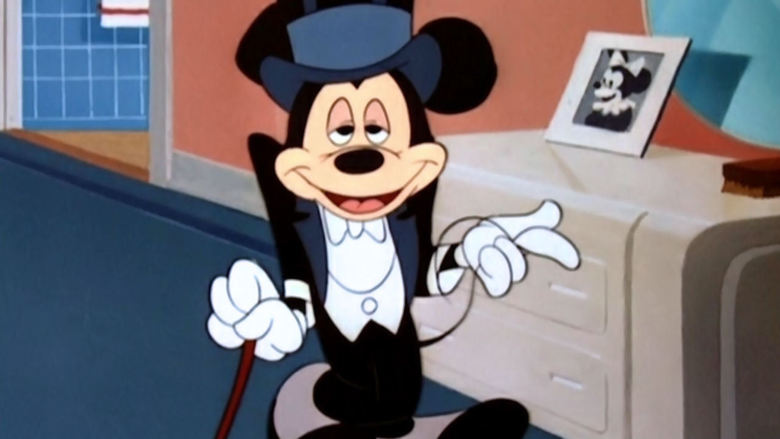 For the first time in five years (actually, since ‘Symphony Hour’) Mickey receives considerable screen time in his own cartoon, even though he has to share it once again with his dog, Pluto.
In the opening scene ‘Mickey’s Delayed Date’ we watch Mickey snoring at home, when the phone rings. It’s Minnie: she has been waiting an hour for him to come at a date with her for a dance. As soon as she has threatened him on the phone to break up if he doesn’t show up within fifteen minutes, Mickey rushes to the dance hall. Unfortunately he loses the tickets, which are brought by Pluto just in time.
Much screen time of ‘Mickey’s Delayed Date’ is devoted to Pluto in a rather long scene with a humanized tall hat. Nevertheless, it’s nice to watch Mickey in fine comic shape again, although he is less flexible here than in Riley Thomson’s shorts of the early forties. This short contains a shot of an almost naked Mickey (even without gloves).
‘Mickey’s Delayed Date’ was the first Mickey Mouse cartoon directed by Pluto-director Charles Nichols. He would direct five of the eight post-war Mickey Mouse cartoons.
Watch ‘Mickey’s Delayed Date’ yourself and tell me what you think:
This is Mickey Mouse cartoon No. 119
To the previous Mickey Mouse cartoon: Squatter’s Rights
To the next Mickey Mouse cartoon: Mickey Down Under
Director: Charles Nichols
Release Date: April 30, 1948
Stars: Pluto
Rating: ★
Review:
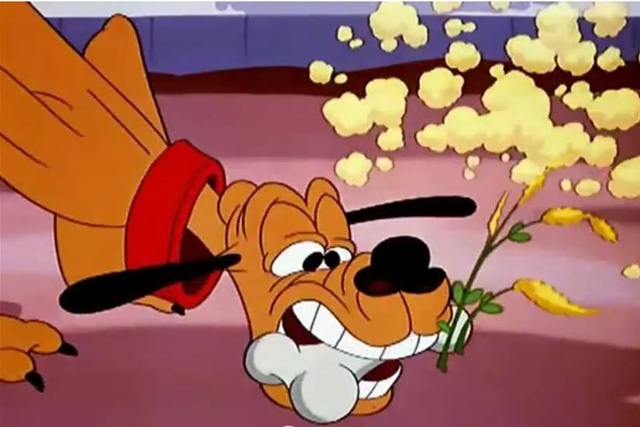 While looking for some bones he has buried, Pluto encounters a gopher who makes him sneeze, using mimosa ,all through this boring picture.
‘Bone Bandit’ is one of Pluto’s most forgettable entries, even though Pluto does not become friends with a little animal for once.
Pluto would encounter another gopher in ‘Pluto and the Gopher‘ (1950), which is only marginally better. Gophers apparently just aren’t funny, a fact also proven by ‘Donald’s Garden‘ (1942) and the Woody Woodpecker cartoon ‘Wicket Wacky‘ (1951).
Watch ‘Bone Bandit’ yourself and tell me what you think:
This is Pluto cartoon No. 24
To the previous Pluto cartoon: Pluto’s Blue Note
To the next Pluto cartoon: Pluto’s Purchase
Director: Charles Nichols
Release Date: December 26, 1947
Stars: Pluto
Rating: ★★★½
Review:
 In ‘Pluto’s Blue Note’ Pluto tries to sing along with some birds, a bee and a grasshopper, but to no avail.
When he discovers that he can use his tail as a needle to play records with, he uses these not only to impress these animals, but also five female dogs, who fall for ‘his’ crooning, Frank Sinatra-like voice. In this short Pluto performs a very silly dance, which is only topped in outrageous animation by his facial expressions while play-backing the crooning voice.
‘Pluto’s Blue Note’ certainly is one of the more inspired Pluto cartoons of the late forties, and its story a welcome deviation from the Pluto-befriends-a-little-animal formula.
Watch ‘Pluto’s Blue Note’ yourself and tell me what you think:
This is Pluto cartoon No. 23
To the previous Pluto cartoon: Mail Dog
To the next Pluto cartoon: Bone Bandit
Director: Charles Nichols
Release Date: November 14, 1947
Stars: Pluto
Rating: ★
Review:
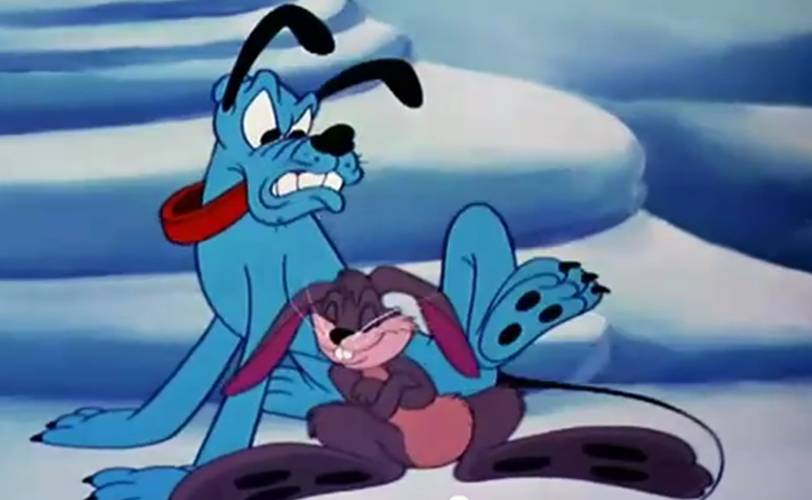 ‘Mail Dog’ is another arctic short featuring Pluto (see ‘Rescue Dog‘ from eight months earlier).
This time Pluto is a mail dog in Alaska. While delivering the mail he encounters a totem pole and a chilly rabbit. When he chases it, he accidentally delivers the mail in time, too.
This short follows the typical Pluto story, where Pluto befriends a little animal he dislikes at first. Unfortunately, there’s absolutely nothing special about this particular entry, making it one of Pluto’s most forgettable cartoons.
Watch ‘Mail Dog’ yourself and tell me what you think:
This is Pluto cartoon No. 22
To the previous Pluto cartoon: Rescue Dog
To the next Pluto cartoon: Pluto’s Blue Note
Director: Charles Nichols
Release Date: March 21, 1947
Stars: Pluto
Rating: ★★
Review:
 Pluto somehow is a rescue dog in the arctic, where he encounters the little seal from ‘Pluto’s Playmate‘ (1941).
In a story all too similar to this earlier entry, Pluto tries to get rid of it, but when the seal rescues him from almost drowning, they become friends.
This is one of the more forgettable Pluto shorts in which Pluto befriends a little animal. Its story is told quite slowly. However, it contains some broad and funny animation of Pluto. The seal would return the following year in ‘Mickey and the Seal‘.
Watch ‘Rescue Dog’ yourself and tell me what you think:
This is Pluto cartoon No. 21
To the previous Pluto cartoon: Pluto’s Housewarming
To the next Pluto cartoon: Mail Dog
Director: Charles Nichols
Release Date: August 13, 1948
Stars: Pluto, Figaro
Rating: ★★★★
Review:
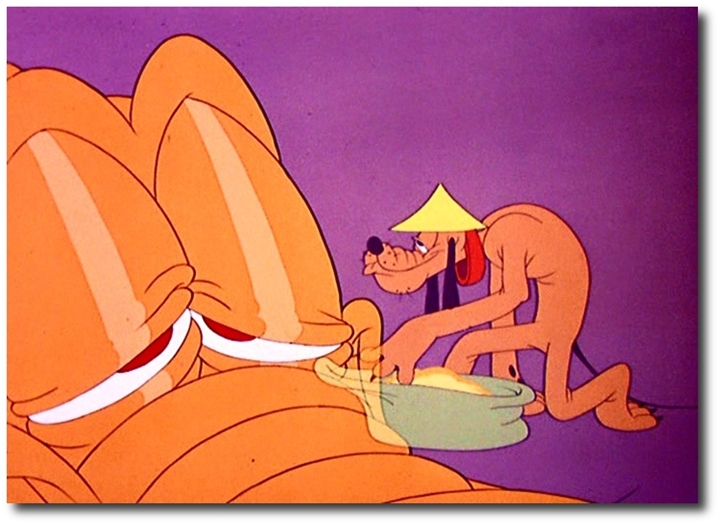
In ‘Cat Nap Pluto’ Pluto’s returning home in the morning from a very rough night, but he’s kept out of sleep by a very rise-and-shiny Figaro.
‘Cat Nap Pluto’ is an entertaining short. The funniest gags in this cartoon involve a very, very sleepy miniature Pluto sandman, who puts Pluto to sleep several times. Nevertheless, the cartoon pales when compared to the Tom & Jerry short ‘Sleepy Time Tom‘ (1951), which covers similar grounds.
‘Cat Nap Pluto’ is the second of three cartoons co-starring Pluto and Figaro, the other ones being ‘First Aiders’ from 1944 and ‘Pluto’s Sweater‘ from the next year.
Watch ‘Cat Nap Pluto’ yourself and tell me what you think:
This is Pluto cartoon No. 26
To the previous Pluto cartoon: Pluto’s Purchase
To the next Pluto cartoon: Pluto’s Fledgling
‘Cat Nap Pluto’ is available on the DVD-set ‘The Complete Pluto Volume Two’
Director: Charles Nichols
Release Date: February 2, 1947
Stars: Pluto, Butch, The Little Turtle
Rating: ★★★
Review:
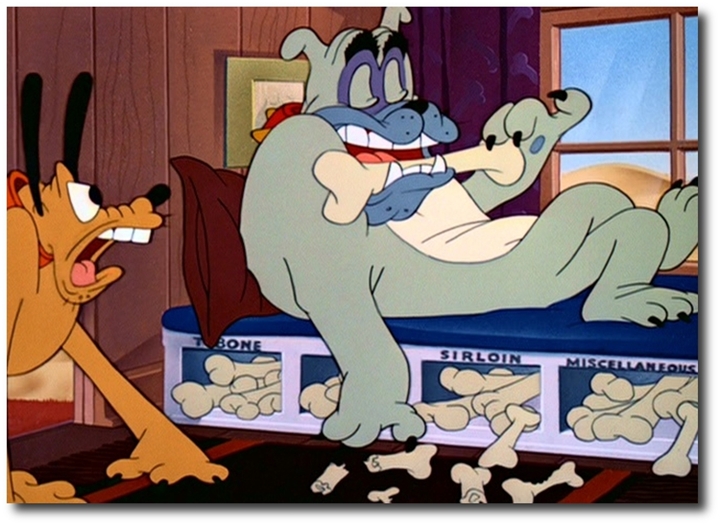 In ‘Pluto’s Housewarming’ Pluto’s got a new and very fancy home at the beach, but even before he moves in, it’s occupied by the little turtle from ‘Canine Patrol‘ (1945).
Pluto manages to dispose of the little fellow, but then bulldog Butch squats his house. Butch chases Pluto away, but he himself is chased away by the little turtle. In return, Pluto allows the little fellow to live in his mansion, too.
‘Pluto’s Housewarming’ is one of those numerous Pluto cartoons from the forties in which Pluto befriends a little animal, which he doesn’t like at first. The addition of Butch, however, brings in a new dimension. Nevertheless, this is cartoon is still rather cute than funny.
The little turtle would reappear in the equally cute and unfunny ‘Pluto’s Surprise Package‘ from 1949.
Watch ‘Pluto’s Housewarming’ yourself and tell me what you think:
This is Pluto cartoon No. 20
To the previous Pluto cartoon: The Purloined Pup
To the next Pluto cartoon: Rescue Dog
Director: Jack Hannah
Release Date: June 7, 1946
Stars: Mickey Mouse, Pluto, Chip and Dale
Rating: ★★★½
Review:
 ‘Squatter’s Rights’ is director Jack Hannah’s first of many cartoons starring Chip and Dale, who were introduced by Clyde Geronimi in ‘Private Pluto‘ in 1943. The two chipmunks are still interchangeable here. They would get real personalities in their next cartoon ‘Chip an’ Dale‘ (1947).
In this cartoon Chip and Dale live in a winter cottage, which is visited by Mickey and Pluto. Pluto soon discovers the jabbering duo, but Mickey never does. In the end Chip and Dale make Pluto and Mickey think Pluto’s been shot. In the final shot we can see Mickey running into the distance, carrying Pluto to a hospital, and leaving the cottage to the two little chipmunks.
‘Squatter’s ‘Rights’ is the first of only eight post-war Mickey Mouse cartoons. Mickey had had a short renaissance under director Riley Thompson in the early 1940s, but by 1946 he was once again reduced to a side character, at best co-starring with Pluto. ‘Squatter’s Rights’ is typical, with most of the screen time devoted to Pluto, Chip and Dale.
Jack Hannah would direct only one other Mickey Mouse cartoon: ‘Pluto’s Christmas Tree‘ (1952), which also features Chip ‘n Dale. Hannah’s appointed character was Donald Duck, whom he led through the last stage of his cinematic career. In this he would develop Chip n’ Dale into Donald Duck’s main adversaries.
Watch ‘Squatter’s Rights’ yourself and tell me what you think:
This is Mickey Mouse cartoon No. 118
To the previous Mickey Mouse cartoon: Pluto and the Armadillo
To the next Mickey Mouse cartoon: Mickey’s Delayed Date
Director: Charles Nichols
Release Date: May 10, 1946
Stars: Pluto, Dinah
Rating: ★★★★
Review:
 ‘In Dutch’ is one of those rare cartoons set in Holland.
In ‘in Dutch’ Pluto is a milk-bringing dog in a very awkward, almost fairy tale-like picture of The Netherlands. He and his love, Dinah the dachshund, accidentally ring the alarm bell in their love play, and they get expelled from the village.
However, our couple saves the day, when Dinah stops a leak in the dyke and Pluto warns the villagers, albeit in an unorthodox way. This story idea is a nice take on the children’s book ‘Hans Brinker, or the Silver Skates’ (1865) by Mary Mapes Dodge. The result is a charming little story in an exotic setting.
Like Mapes Dodge, the animators had probably never visited The Netherlands themselves, for the country is erroneously depicted as surrounded by a huge dyke, behind which the sea is splashing. Further couleur locale is provided by numerous windmills, tulips and wooden shoes. The people in the cartoon speak with a weird accent, which is supposed to sound like Dutch, but which is more reminiscent of German.
Nevertheless, it’s hard to blame the makers for the cliches, for even the George Pal’s cartoon about Holland, ‘Tulips Shall Grow’ (1942), is crowded with windmills, tulips and wooden shoes. And George Pal had lived in The Netherlands for several years…
Watch ‘In Dutch’ yourself and tell me what you think:
This is Pluto cartoon No. 18
To the previous Pluto cartoon: Pluto’s Kid Brother
To the next Pluto cartoon: The Purloined Pup
Director: Charles Nichols
Release Date: April 12, 1946
Stars: Pluto, Butch
Rating: ★★★½
Review:

Pluto’s family life has been treated mysteriously in his films.
Mostly, he is on his own, but in ‘Pluto’s Quin-Puplet’s (1937) he had five children, and in ‘Pluto Junior‘ (1942) only one. In ‘Pluto’s kid Brother’, without any explanation, Pluto suddenly has a smaller brother.
The little brat is full of mischief, causing trouble with a rooster, a mean red cat and even teaming up with Butch the Bulldog to get some sausages from the butcher’s shop. But Butch is not the type to share, and in the end Pluto has to save his brother, while Butch is caught by the dog catcher. However, there’s not too much moral to this story, for Pluto, too, fancies the loot: the sausages his little brother has stolen.
‘Pluto’s Kid Brother’ uses the same story idea as the 1936 Betty Boop cartoon ‘You’re Not Build That Way’ starring Pudgy, but with better results. ‘Pluto’s Kid Brother’ is a great improvement on ‘You’re Not Build That Way’: it’s better animated, less cloying, and more entertaining. The result is a nice cartoon, if by no means among Pluto’s best. It remains unknown whether the makers even knew the Betty Boop cartoon, at all.
The red alley cat would reappear in the Figaro cartoon ‘Bath Day’, six months later. Pluto’s little brother, on the other hand, would disappear again into nothingness, never to return to the screen.
Watch ‘Pluto’s Kid Brother’ yourself and tell me what you think:
This is Pluto cartoon No. 17
To the previous Pluto cartoon: Canine Patrol
To the next Pluto cartoon: In Dutch
Director: Fred Beebe
Release Date: January 13, 1942
Stars: Clarabella Cow, Donald Duck, Figaro, Geppetto, Goofy, Horace Horsecollar, Huey, Dewey and Louie, Mickey Mouse, Pinocchio, Pluto, The Seven Dwarfs
Rating: ★★★½
Review:
 ‘All Together’ is the last and the shortest of the four propaganda films Disney made for the Canadian government.
In the first half we only see some Disney stars parading on patriotic march music in front of the Canadian parliament building in Ottawa. This short scene reuses animation from ‘Pinocchio‘ (Pinocchio, Geppetto and Figaro), ‘Good Scouts‘ (Donald and his nephews), ‘Bone Trouble‘ (Pluto), ‘The Band Concert‘ (Mickey and the gang), ‘Mickey’s Amateurs‘ (Goofy) and ‘Snow White and the Seven Dwarfs’ (the seven dwarfs, who are clearly singing and whistling, although their voices are not heard). ‘All Together’ is the only propaganda short to feature Pinocchio stars.
The second half uses powerful imaginary to persuade the public to buy war certificates. Of the new images, the most striking is the one of coins marching with bayonets.
‘All Together’ is image only. It doesn’t feature any kind of story, making it the least interesting of the four Canadian propaganda films.
Watch ‘All Together’ yourself and tell me what you think:
Director: Jack Kinney
Release Date: July 30, 1943
Stars: Goofy, Pluto (cameo)
Rating: ★★★★★
Review:
 ‘Victory Vehicles’ is the only entirely war-themed Goofy short (although the end of ‘How to be a Sailor’ (1944) refers to the war, too). It’s no army cartoon, however. Instead, the cartoon parodies propagandistic shorts of the time, using a patriotic voice over and dealing with the (real) problem of rubber shortage.
‘Victory Vehicles’ introduces various silly inventions that should replace the car as a form of transportation. The solution finally settles on the pogo-stick: “the answer to a nation’s needs”.
‘Victory Vehicles’ is a very enjoyable cartoon in its silly satire. It’s also a nice window to the shortage problems of World War II America. The film contains a very catchy theme song called ‘Hop on your Pogo Stick’, and a short cameo by Pluto.
‘Victory Vehicles’ is an important landmark in the Goofy series, because it marks Goofy’s graduation from single character to the prototypical everyman. In this short various types of Goofies can be seen, including women and children. They are provided with different voice overs, emphasizing that every Goofy we see is a different one.
Of all evolutions of a cartoon star, this is the most remarkable one. The thirties Goof, with his all too recognizable character traits has been transformed into an everyman who could be anybody, and, at the same time, still be Goofy.
Other directors would return to the original Goofy in cartoons like ‘Foul Hunting‘ (Jack Hannah, 1947) and ‘The Big Wash‘ (Clyde Geronimi, 1948), but Jack Kinney would stick to the everyman Goofy, making the most hilarious cartoons with this character.
This is Goofy cartoon No. 10
To the previous Goofy cartoon: How to Fish
To the next Goofy cartoon: How to be a Sailor
Director: Jack King
Release Date: July 30, 1942
Stars: Minnie Mouse, Pluto
Rating: ★★★
Review:
 ‘Out of the Frying Pan into the Firing Line’ is a short propaganda film aimed at American housewives.
In this propaganda short, Minnie is just about to give Pluto some hot bacon grease, when the narrator interrupts, telling housewives of America to save their kitchen fats in order to deliver them at a “neighborhood meat dealer, who is patriotically cooperating”. The fats are apparently used to make glycerine, which is used in ammunition.
This short contains a rare picture of Mickey as a soldier at the front. Otherwise, Mickey was left out of the propaganda, leaving that role to Donald Duck.
‘Out of the Frying Pan into the Firing Line’ is an interesting example of how the American government tried to make every citizen help in the war effort. It shows how World War II entered the life of the average citizen: even kitchen grease could be useful… It offers no one-liner, however, at the likes of the contemporary slogans ‘Save Your Scraps to Bomb the Japs’ or ‘Is Your Trip Really Necessary?”
Watch ‘Out of the Frying Pan into the Firing Line’ yourself and tell me what you think:
Director: Clyde Geronimi
Release Date: February 19, 1943
Stars: Mickey Mouse, Pluto
Rating: ★★★★½
Review:
 ‘Pluto and the Armadillo’ is one of the South American films Disney released in the forties after a visit to South America in 1941 (other examples are ‘The Pelican and the Snipe‘ and ‘Contrary Condor’ from 1944).
‘Pluto and the Armadillo’ is actually an outtake from Disney’s first South American ensemble feature ‘Saludos Amigos‘ (1942). This explains its use of a narrator introducing the armadillo and its Brazilian setting.
As the title suggests, this Mickey Mouse cartoon is actually devoted to Pluto. While playing with Mickey during a stop at an airport near a jungle, he mistakes the armadillo for his own ball. As in many other Pluto cartoons (e.g. ‘Pluto’s Playmate‘ from 1941 and ‘Canine Patrol‘ from 1945), Pluto is first suspicious of this new little animal, but then grows in love with it. This standard scenario would have led to a routine Pluto entry, if it were not for the armadillo itself.
The South American mammal is not drawn very lifelike, but looks like a very cute, feminine armed little dog. Her moves are accompanied by metallic and rattling sounds, as if her armor consists of loose mechanical parts, and she walks to an irresistible samba tune, which provides the theme music for the complete cartoon.
Because of her charming presence ‘Pluto and the armadillo’ is very cute and joyful, and a delight to watch, even though it’s not very funny.
Watch ‘Pluto and the Armadillo’ yourself and tell me what you think:
This is Mickey Mouse cartoon No. 117
To the previous Mickey Mouse cartoon: Symphony Hour
To the next Mickey Mouse cartoon: Squatter’s Rights
Director: Clyde Geronimi
Release Date: March 28, 1941
Stars: Mickey Mouse, Pluto
Rating: ★★★★
Review:
 Pluto serves Mickey breakfast on bed, then Mickey gives him a dime to get the morning paper.
Pluto loses the coin almost immediately down into a sewer, but he cleverly retrieves it using chewing gum. When Pluto gets the newspaper, he reads the funnies (a comic strip about… Pluto! – a rare cross reference to a Disney spin-off outside the cinema), before the wind starts to play with it, blowing the paper into the mud, leading to a blackface gag, which is a copy from the Pluto comic he has just read.
‘A Gentleman’s Gentleman’ is officially a Mickey Mouse cartoon, but most of the time is devoted to Pluto. In this cartoon his supreme silent character comedy is simply delightful, making ‘A Gentleman’s Gentleman’ one of the classic Pluto shorts.
Watch ‘A Gentleman’s Gentleman’ yourself and tell me what you think:
This is Mickey Mouse cartoon No. 110
To the previous Mickey Mouse cartoon: The Little Whirlwind
To the next Mickey Mouse cartoon: Canine Caddy
Director: Charles Nichols
Release Date: June 23, 1944
Stars: Pluto
Rating: ★★★★
Review:
 An updated version of Pan from ‘Fantasia’ (1940), now wearing a boiler hat, creates spring.
Pluto enjoys it for a while, e.g. discovering a caterpillar who transforms into a very sexy butterfly. The butterfly is designed as a miniature pin-up girl, who dances to a conga beat. After this encounter, Pluto juggles with a wasps’ nest, angering the wasps who sting him in the form of a Lockheed Lightning and a V2 rocket. These two sequences make ‘Springtime for Pluto’ a typical war era cartoon, even though it’s not about war, at all.
After Pluto gets stung, he’s caught in the rain, and even in a hailstorm. In the end he’s not enjoying spring anymore, and angrily he chases Pan into the distance.
‘Springtime for Pluto’ is the first cartoon directed by Charles Nichols, who would direct all Pluto and Mickey cartoons (save one) from now on until their retirement in 1953. Nichols is famous for his mild-mannered humor, but his debut consists of very enjoyable utter nonsense from the beginning to the end. It’s full of the exuberant spirit of the war time era.
Even the oil backgrounds, painted by Lenard Kester (1917-1997), have more vivid colors than before. These are flatter than in most Disney films, and during the butterfly sequence one can even see the paper texture. They form an early example of a more graphic style of backgrounds within a Disney film, and look forward to the fifties. Perhaps Kester had been inspired by similar experiments by Chuck Jones’ unit at Warner Brothers (e.g. ‘The Dover Boys‘ from 1942). In any case, the result contributes to the surreal atmosphere of the film.
Kester has been credited for backgrounds of only one other Disney cartoon, ‘How To Play Football’ from a few months later. In this short the backgrounds are effective, but unremarkable. Had he been toned down by the studio? Fact is that Kester soon moved on to devote his life to oil painting…
Watch ‘Springtime for Pluto’ yourself and tell me what you think:
This is Pluto cartoon No. 11
To the previous Pluto cartoon: Private Pluto
To the next Pluto cartoon: First Aiders
Director: Clyde Geronimi
Release Date: April 2, 1943
Stars: Pluto, Chip ‘n Dale
Rating: ★★★★
Review:

Pluto has joined the army, and wearing a helmet, he has to protect “the pillbox” (a canon) against saboteurs.
These appear to be two little chipmunks who use the canon to crack acorns. Pluto tries to fight them, but the two critters defeat him in an unexpected ending.
‘Private Pluto’ is the second of two World War II-themed Pluto cartoons (the first being ‘The Army Mascot‘ from 1942). It was also to be the last Pluto cartoon directed by Clyde Geronimi, who promoted to sequence director in Disney’s feature films. Geronimi was succeeded by Charles Nichols, who seemed to be more comfortable with the character and who would direct every Pluto cartoon save one from then on.
‘Private Pluto’ is an important cartoon, because it introduces those famous chipmunks, Chip ‘n Dale. They’re not named yet, nor are they two different characters here, but their mischievous behavior and their hardly comprehensible jabbering are already present, and they’re certainly instantly likeable.
Chip ‘n Dale would eventually become Donald’s adversaries, but Pluto, too, would re-encounter them in three cartoons: ‘Squatters Rights‘ (1946), ‘Food for Feudin’‘ (1950) and ‘Pluto’s Christmas Tree‘ (1952).
‘Private Pluto’ is interesting in its own right, for it shows the line of coastal defense the United States had placed at the Pacific Coast in the years preceding the war. After the attack on Pearl Harbor it had been placed on high alert (thus Pluto’s job), but luckily there was no need ever to use it.
Watch ‘Private Pluto’ yourself and tell me what you think:
This is Pluto cartoon No. 10
To the previous Pluto cartoon: Pluto at the Zoo
To the next Pluto cartoon: Springtime for Pluto
Director: Clyde Geronimi
Release Date: December 27, 1940
Stars: Pluto
Rating: ★★★
Review:
 Surprisingly, in this film Pluto is not Mickey’s dog, but owned by an Afro-American lady, who seems to be the exact copy of Tom & Jerry’s Mammy Two-Shoes, who made her debut in February of that year. However, it was the Disney studio itself who had introduced the Mammy character in ‘Three Orphan Kittens‘ (1935).
In ‘Pantry Pirate’ Mammy puts Pluto outside, but he sneaks into the kitchen trying to steal her roast beef. Hindered by an ironing-board, several tea cups and a bucket of soapy water, he doesn’t succeed, but he does escape Mammy’s wrath by quickly returning to his dog house, pretending to be asleep. Here the cartoon abruptly ends.
‘Pantry Pirate’ is the first of seven Pluto cartoons directed by Clyde Geronimi. It’s also one of his best, with gags leading to more gags in excellent pantomimed and physical situation comedy. This cartoon contains some remarkably flexible animation of Pluto, especially during the ironing-board scene. Pluto’s design, however, seems to be stubbier than usual. The Mammy character would return in ‘Figaro and Cleo‘ (1943).
Watch ‘Pantry Pirate’ yourself and tell me what you think:
This is Pluto cartoon No. 3
To the previous Pluto cartoon: Bone Trouble
To the next Pluto cartoon: Pluto’s Playmate


 Dr. Grob's Animation Review