
You are currently browsing the tag archive for the ‘propaganda’ tag.
Director: Chuck Jones
Release Date: 1957
Stars: Ralph Phillips
Rating: ★★
Review:
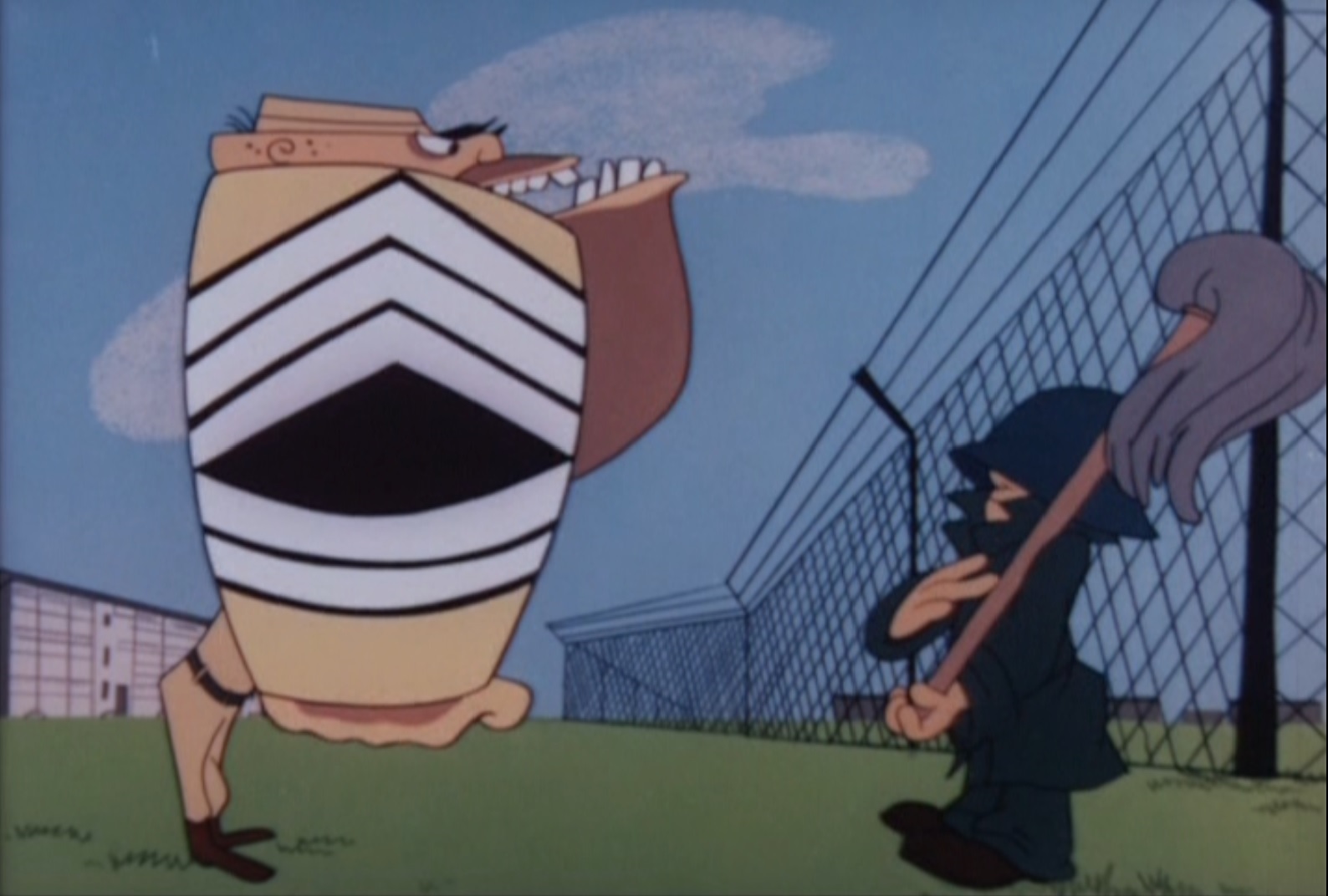 ‘Drafty, isn’t it’ is the second of two propagandistic advertisement shorts Chuck Jones made for the US Army in the late 1950s.
Like its predecessor, ‘90 Days of Wondering‘ (1956), it stars a young adult form of dreamer boy Ralph Phillips. In this short Ralph Phillips has nightmares about all his ideas of adventure being blocked by a giant shadow of a soldier beckoning him. Then he’s visited by an army pixie who elists some fictions and facts about the army. The cliches, of course, are the most hilarious. This short also contains a very Tex Avery-like running gag in which he pixie repeatedly has to put Ralph’s dog to sleep by singing it a fast lullaby.
‘Drafty, Isn’t It?’ is a well-made and beautiful film, and it would have been more enjoyable were it not so sickeningly propagandistic.
Watch ‘Drafty, Isn’t It?’ yourself and tell me what you think:
Director: Chuck Jones
Release Date: 1956
Stars: Ralph Phillips
Rating: ★★★
Review:
 ’90 Days of Wondering’ is a rather propagandistic advertising film to persuade ex-soldiers to reenlist.
Despite its rather questionable message, the film is beautifully designed and animated. Especially striking is its dazzling opening sequence in which we see a young man (an adult version of dreamer boy Ralph Phillips from ‘From A to Z-Z-Z-Z’ from 1954) being extremely happy to leave the army and rushing home. This opening sequence has a speed and gusto that recalls the Warner Brother shorts from the 1940s. It contrasts with the slow pace of the scenes following after, where the young man soon discovers he is out of tune with is hometown. Soon he is visited by two small characters explaining him why he should reenlist…
In 1957 ’90 Days of Wondering’ was followed by yet another propaganda film for the army called ‘Drafty, isn’t it?‘. It also stars the adult version of Ralph Phillips.
Watch ‘90 Days of Wondering’ yourself and tell me what you think:
Director: Clyde Geronimi
Release Date: December 17, 1943
Rating: ★★★★★
Review:
 This Disney short is an original take on the classic fable. It has a clear war message, even though there’s no direct visible link to World War II.
The villain, Foxy Loxy, uses a psychology book, from which he quotes, to lure the inhabitants of a poultry farm into his cave. The inhabitants of the poultry farm are clear representations of contemporary American society, including the upper class (turkeys), female middle class (chicken), male working class (ducks) and the youth (chickens and roosters, whom we see dancing to hot jazz in a short scene).
Foxy Loxy chooses a simpleton called Chicken Little as his main object, making him believe the sky is falling and encouraging him to spread the rumor. Originally, Foxy Loxy was to read from Adolf Hitler’s book ‘Mein Kampf’. It is not likely that the quotes are really from ‘Mein Kampf’, but they do contain surprisingly true lessons in how to manipulate the masses and how to undermine the present authority.
The film’s clear war message is not to fall for rumors and not to join mass hysteria. The film’s ending is as grim as there ever was one in a classic cartoon. In fact, the vision of a graveyard full of chicken bones is only topped by the similar ending in ‘Education for Death’ from the same year.
‘Chicken Little’ remains a little known Disney film, but its message is surprisingly fresh, and is probably even more valid today in an era in which propaganda and false rumors roam the internet and social media than it was during World War II.
‘Chicken Little’ was to be the last short directed by Clyde Geronimi before his dull comeback in ‘The big wash’ (1948). The Disney studio revisited the fable in 2005 in the feature film ‘Chicken Little’, which has ca. nothing in common with this far more interesting and disturbing short.
Watch ‘Chicken Little’ yourself and tell me what you think:
Director: Bill Roberts
Release Date: August 27, 1943
Rating: ★★★★★
Review:
 ‘Reason and Emotion’ is a rather odd propaganda short, telling us about Reason and Emotion, who are depicted as two little characters living inside our heads.
The short ‘demonstrates’ where uncontrolled emotion can lead to: a man gets slapped in the face by a woman, while the woman eats too much. This makes ‘Reason and Emotion’ one of the first cartoons about weight and diets.
Then the short shows how reason is destroyed by Adolf Hitler (in an extraordinarily vicious, but wonderfully animated caricature), who uses fear, sympathy, pride and hate to indoctrinate the Nazi mind. This is one of the propaganda shorts, which treat the Germans as victims of their Nazi leaders (see also ‘Education for Death‘ from the same year). This contrary to the Japanese, who, in WWII animated propaganda films, were all treated as despicable, mean and low. The film also warns against panic and falling for false rumors.
Emotion is depicted as a rough, dumb, but fun-loving caveman, while Reason is a bespectacled thin and rather boring character. One cannot resist to love the Emotion-type, especially in its female form, as depicted in the woman’s head. This female character is animated with gusto by Ollie Johnston.
Watch ‘Reason and Emotion’ yourself and tell me what you think:
Director: Ivan Ivanov-Vano
Release Date: 1972
Rating: ★★½
Review:
 ‘Ave Maria’ is a very grim anti-Vietnam film, made in the Soviet Union.
It combines paintings of the Virgin Mary with images of war. Its darkest moment is when a soldier in a gas mask kills a Vietnamese child. The film ends with live action footage of people protesting against the Vietnam war. Clever montage suggests that the protesters are being repressed.
Despite its disturbing character the film is too blatantly propagandastic and too directionless to be a classic. It also uses little animation.
Watch ‘Ave Maria’ yourself and tell me what you think:
‘Ave Maria’ is available on the DVD box set ‘Animated Soviet Propaganda’
Director: Vladimir Tarasov
Release Date: 1977
Rating: ★★★½
Review:
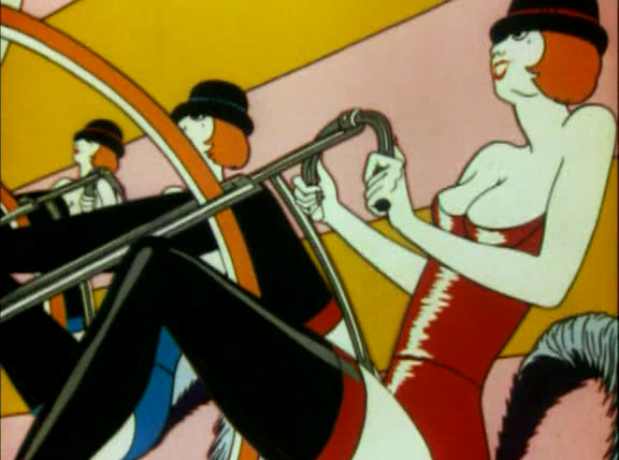 ‘Forward March Time!’ is a bold setting of a poem by soviet futurist poet Vladimir Mayakovsky (1892-1930).
The film illustrates the meandering poem with associative images of the 1905 revolution, the 1917 revolution, World War II and even a futuristic battle in space.
Using a combination of typical seventies designs (besides communist paintings) and rock music (besides an excerpt from Mahler’s fifth symphony), the film is both a markedly modern and interesting piece of soviet propaganda, if a bit too long. It shows Tarasov’s unique style, which he explored further in the much more lighthearted short ‘Contact‘.
Watch ‘Forward March, Time!’ yourself and tell me what you think:
‘Forward March, Time!’ is available on the DVD box set ‘Animated Soviet Propaganda’
Director: Ivan Aksenchuk
Release Date: 1972
Rating: ★★½
Review:
 ‘Plus Electrification’ is a commissioned film for the State Commission for the Electrification.The film propagates the electrification of the Soviet Union.
Accompanied by a folky song glorifying electricity, we watch electricity pylons march through the countryside and Soviet electricity pylons shaking hands with Czech and Polish electricity pylons.
Its use of old-fashioned communist imagery, black-and white live action footage and ridiculously heroic music makes the film extremely dated. Despite the colorful images and even a look into the future, one can hardly comprehend that this film was made in the 1970s, not the 1940s.
Watch ‘Plus Electrification’ yourself and tell me what you think:
‘Plus Electrification’ is available on the DVD box set ‘Animated Soviet Propaganda’
Director: Vladimir Pekar
Release Date: 1971
Rating: ★★
Review:
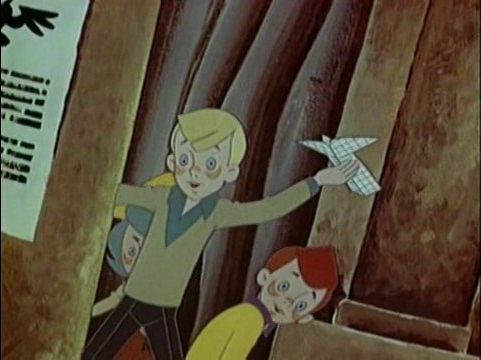 It seems that in the early 1970s Soviet Propaganda took a rather retrograde course, being more overtly propagandistic and using images that went all the way back to the 1920s.
Films with a peaceful message, like ‘Proud Little Ship‘ (1966) or ‘We Can Do It‘ (1970) were interchanged for self-important glorifications of the Soviet Union, and its ‘heroic’ history. This period produced some of the most terrible propaganda films ever made. ‘The Adventures of the Young Pioneers’ is a prime example.
The film plays during World War Two, Russia’s Great War. When their village is occupied by some goofy Nazi Germans, three communist children decide to withstand their occupants. They are betrayed by a collaborator, however, and captured when raising a red flag. Luckily, they are saved by the red army.
This children’s film uses ugly designs and very old-fashioned looking caricatures of Nazis, while the children and especially the red army are drawn quite heroically. The result is as unappealing and unfunny as it is sickeningly propagandistic.
Watch ‘The Adventures of the Young Pioneers’ yourself and tell me what you think:
http://www.fandor.com/films/the_adventures_of_the_young_pioneers
‘The Adventures of the Young Pioneers’ is available on the DVD box set ‘Animated Soviet Propaganda’
Director: Lev Atamanov
Release Date: 1970
Rating: ★★★★★
Review:
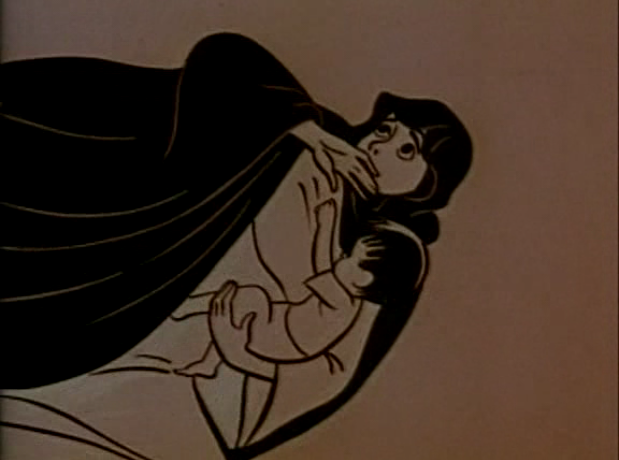 From a fascistic egg sprouts a military bird.
The young bird is fed by a capitalist and a general (who both are clearly American) with money and weapons. It grows into a huge black war-bird, which flies over the whole world, threatening loving couples in London, Paris, Moscow and Japan, and an old man, two mothers and several children in an unclear place. When the war-bird starts to attack, one mother turns Asian, Muslim and black, in order to illustrate that war can affect everybody everywhere. Eventually, however, the war-bird is overthrown by a multitude of peace doves, created by workers, writers, children, artists, musicians and pacifists.
‘We Can Do It’ is a beautiful and strikingly pacifistic film and undoubtedly one of the best propaganda films ever created in the Soviet Union. The film clearly is designed for international audiences, with its final message (the title) depicted not only in Russian, but also in German, English, Spanish and French.
Despite its anti-American sentiment, its pacifistic theme is timeless and universal. The film tells its clear message without any dialogue or voice over. Moreover, its designs are stunning and very effective, especially that of the war-bird.
Watch ‘We Can Do It’ yourself and tell me what you think:
‘We Can Do It’ is available on the DVD box set ‘Animated Soviet Propaganda’
Director: Inessa Kovalevskaya
Release Date: 1971
Rating: ★
Review:
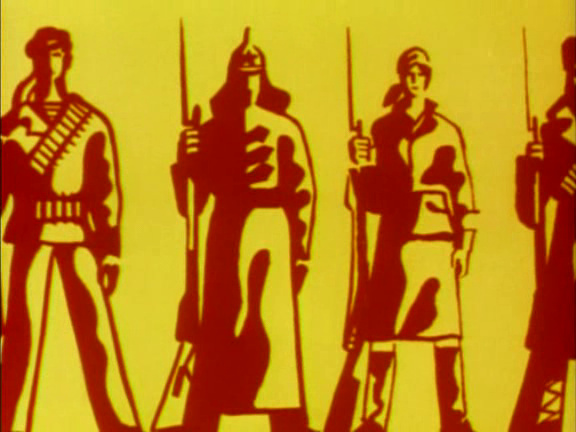 One could see ‘Songs of the Years of Fire’ as the Soviet answer to ‘Fantasia’.
This propaganda film features songs from the Russian civil war (1917-1922). These songs are accompanied by revolutionary and shamelessly patriotic images of the brave soviet army, to which the film is dedicated.
The resulting film is as graphically interesting as it is boring and sickening. It’s hard to believe such blatant propaganda could be made as late as 1971.
‘Songs of the Years of Fire’ is available on the DVD box set ‘Animated Soviet Propaganda’
Director: Perch Sarkisyan
Release Date: 1965
Rating: ★★★
Review:
 ‘A Hot Stone’ is a Soviet propaganda film from the 1960s based on a children’s book by Arkady Gaidar from 1941.
In it a boy stumbles on an old stone in the woods, which has the ability to give someone a new life again. The boy wants to help an old and lonely man with it, but the man sees no need for it as he has led a happy life. Enter the propaganda, in which the old man tells about the revolution and the civil war. This part is not much of a story. but it’s full of symbolic images, like people breaking their chains, and a giant worker slashing the double headed eagle of the czarist empire with a giant hammer.
‘A Hot Stone’ is a slow and boring film, but it’s also beautifully designed, in an original graphic style, which makes use of bold ink strokes.
Watch ‘A Hot Stone’ yourself and tell me what you think:
‘A Hot Stone’ is available on the DVD box set ‘Animated Soviet Propaganda’
Director: Victor Gromov
Release Date: 1949
Rating: ★★
Review:
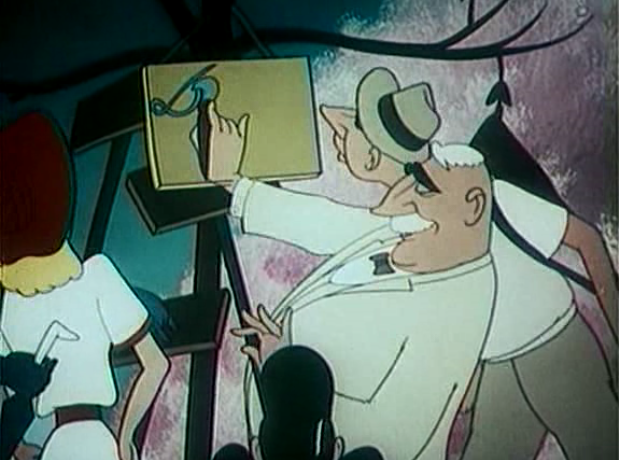 Mr. Wolf is a Russian propaganda film. The film is an oddball in director Gromov’s small animation output. His other seven films are fantastic fairy tales and children’s films
The film tells about Mr. Wolf, a rich American, who is fed up with weapons and war. He retreats with his unwilling family to a peaceful island. But then oil is discovered on the island. Immediately, Mr. Wolf and his family are overpowered by greed, and the American only too gladly drops his pacifism.
‘Mr Wolf’ is based on a comedy by Evgeny Petrov. Although drowned in caricature, this blatant propaganda film is hardly funny: its animation is elaborate, but painstakingly slow, and too excessive. Moreover, it is not too clear what the message is. Are all Westerners blinded by greed? Is pacifism senseless in a world of war? Are oil and peace at odds with eachother? I’ve no idea.
Watch ‘Mr. Wolf’ yourself and tell me what you think:
‘Mr. Wolf’ is available on the DVD box set ‘Animated Soviet Propaganda’
Director: Clyde Geronimi
Release Date: January 15, 1943
Rating: ★★★★★ ♕
Review:
 Both propaganda shorts Disney released in January 1943, ‘Der Fuehrer’s Face‘ and ‘Education for Death’, were the most powerful propaganda the studio ever released. However, the two couldn’t be more different: while ‘Der Fuehrer’s Face’ is an outrageously funny satire, ‘Education for Death’ is, some funny scenes notwithstanding, the most unsettling short the studio ever released. Its general tone is black, grim and its purpose is to shock, not to entertain.
Based on a book by Gregor Ziemer, ‘Education for Death’ tells us how Hans, a typical German boy, is indoctrinated by the rulers of the Third Reich. The short is conceived in a quasi-documentary style. The narrator makes us believe that the scenes we’re watching, are happening right before our eyes, and unlike any other cartoon of the period, the Germans speak real German, which is translated by the narrator.
Moreover, most of the human designs are quite realistic, with Hans’s mother, animated by Milt Kahl, being the acme in human naturalism by the studio thus far. On the other hand, all scenes are heavily dramatized, using colors like red and black, vast shadows, and extreme camera angles, which depict every Nazi as a towering and threatening figure.
In the beginning we are still allowed to laugh at a ridiculous version of Sleeping Beauty, in which Hitler, dressed like a ‘handsome knight’ rescues a fat, Valkyrie-like Germany from an evil witch (said to be democracy). But after the school scene, the short turns decidedly black, with images of book burning, a bible being replaced by ‘Mein Kampf’ and Jesus by a Nazi sword. In the final scene, Hans has grown into a grim soldier, who, wearing chains, blinders and a muzzle, marches to his own death. No matter how blatant this propaganda short is, this is one of the most disturbing endings of an animated film ever put on screen.
Watch ‘Education for Death’ yourself and tell me what you think:
‘Education for Death’ is available on the DVD-set ‘Walt Disney Treasures: On the Frontlines’
Director: Jack King
Release Date: January 7, 1943
Stars: Donald Duck
Rating: ★★★★★ ♕
Review:
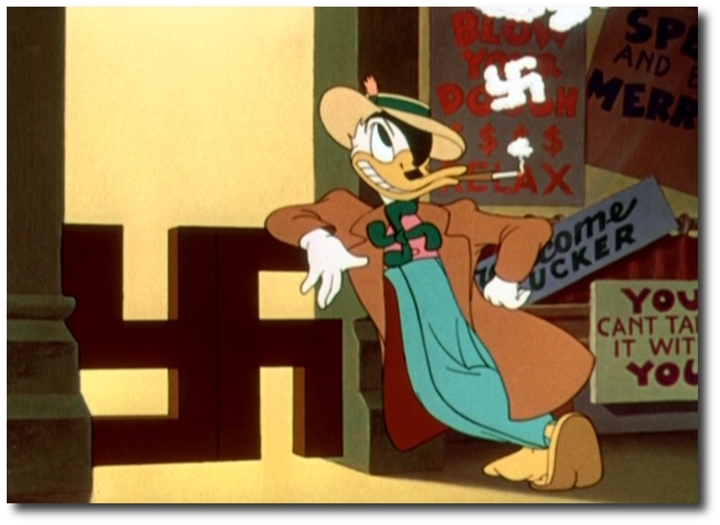 ‘The Spirit of ’43’ is the follow-up to ‘The New Spirit’ from the previous year. The second half is exactly the same, but the first half is even better than the first half of its predecessor, making a clever use of strong symbolic imaginary.
Donald just got paid and he’s divided between his two selves: the thrifty (a Scottish forerunner of Uncle Scrooge) and the spendthrift. These two characters struggle for Donald, in which they both fall down: the spendthrift into a tavern with a swastika-shaped swing-door and the thrifty into a wall, which, together with the stars his fall produces, resembles the American flag. This makes the decision for Donald easier, will he “spend for the axis or save for taxes”? He knocks his spendthrift side into the tavern, crushing the swastika door changing it into a V for victory. At this point the second half starts (see ‘The New Spirit‘ for a description of this part).
‘The Spirit of ’43’ is propaganda, and quite obviously so. But the film is both inventive and effective in its delivery of its message, and therefore surprisingly enjoyable.
Watch ‘The Spirit of ’43’ yourself and tell me what you think:
Director: Bill Justice & Bill Roberts
Release Date: January 4, 1943
Rating: ★★½
Review:
 ‘The Grain that Built a Hemisphere’ is a war time educational short about corn in quite a propagandistic fashion.
The Disney studios made it “under the auspices of the Office of the Coordinator of Inter-American Affairs”, which means that it belongs to the ca. ten films Disney made in the context of America’s ‘good-neighbor policy’ .
‘The Grain that Built a Hemisphere’ is the most propagandistic of the lot. Its tone is set right away when the narrator pompously boosts that “corn is the symbol of a spirit that links the Americas in a common bond of union and solidarity”.
Luckily, the main part of the film is quite insightful, explaining about the origin of corn, and what products it can produce. We learn how inbreeding is used to produce bigger plants and how it can be used as food for livestock (this section reuses footage from ‘Farmyard Symphony‘ from 1938) and as a source for oils, starch, glucose and sugar. And maybe, in the near future, for plastics for all kinds of war machines? Thus ends this educational film as a typical war propaganda short, after all…
Watch ‘The Grain that Built a Hemisphere’ yourself and tell me what you think:
Director: Wilfred Jackson & Ben Sharpsteen
Release Date: January 23, 1942
Stars: Donald Duck
Rating: ★★★★
Review:
 When the United States were forced into the war themselves, the government asked Disney to make a short to make the American citizens fill in their income tax forms in time. Disney gave them his biggest star of that time, Donald Duck, to play the everyman. The government was not impressed until the taxes came rolling in after the film was screened in cinemas.
In contrast to Disney’s earlier propaganda films for the Canadian government, this film uses entirely new animation, directed by Wilfred Jackson, and produced in the ridiculously short time period of a single month.
The short opens with Donald dancing to the energetic title song, which is sung by Cliff Edwards, the voice of Jiminy Cricket in ‘Pinocchio‘ (1940). The song is played on a slightly anthropomorphised radio. The radio then asks Donald if he wants to do his part for the country and Donald is growing more and more enthusiastic, until the radio reveals he has to pay his income tax. The radio has to persuade Donald once again, who grows enthusiastic again to the strong slogan ‘Taxes to beat the axis’ (with the axis referring to the Axis powers: Germany, Italy and Japan).
The film further explains the public how to fill in a new, simplified form, using an anthropomorphized pen, bottle of ink and blotter. Like the shorts Disney made earlier for the Canadian government (e.g. ‘The Thrifty Pig‘ and ‘7 Wise Dwarfs‘), the second half (directed by Ben Sharpsteen) consists of very limited and highly propagandistic animation with grim images of factories, guns, planes, war ships and tanks, while an intense narrator repeats the intoxicating mantra of ‘taxes to beat the axis’.
When he comes to the propagandist climax, the sentence “to beat to earth the evil destroyer of freedom and piece”, we watch a horrifying towering monster-like machine depicting the Nazi aggressor. This mechanical monster is defeated and makes place for a patriotic end shot with clouds resembling the American flag, tanks and guns rolling and planes flying accompanied by a heroic hymn, while the narrator tells us that “this is our fight”.
It’s important to note that the film goes at lengths to dehumanize the enemy. The average tax payer was not to help to kill people, but to destroy “the enemy”, in this case a vague mechanical monster. Succeeding propaganda films often eschewed the idea that making war is killing people, with the propaganda feature ‘Victory through Air Power’ (1943) being the prime example.
In case of “The New Spirit”, propaganda rarely was so obvious, but it works: after watching the picture I had its slogan in my head for days. Indeed, the film was so successful, that it got a follow-up the next year: ‘The Spirit of ’43‘.
Watch ‘The New Spirit’ yourself and tell me what you think:
Director: Fred Beebe
Release Date: January 13, 1942
Stars: Clarabella Cow, Donald Duck, Figaro, Geppetto, Goofy, Horace Horsecollar, Huey, Dewey and Louie, Mickey Mouse, Pinocchio, Pluto, The Seven Dwarfs
Rating: ★★★½
Review:
 ‘All Together’ is the last and the shortest of the four propaganda films Disney made for the Canadian government.
In the first half we only see some Disney stars parading on patriotic march music in front of the Canadian parliament building in Ottawa. This short scene reuses animation from ‘Pinocchio‘ (Pinocchio, Geppetto and Figaro), ‘Good Scouts‘ (Donald and his nephews), ‘Bone Trouble‘ (Pluto), ‘The Band Concert‘ (Mickey and the gang), ‘Mickey’s Amateurs‘ (Goofy) and ‘Snow White and the Seven Dwarfs’ (the seven dwarfs, who are clearly singing and whistling, although their voices are not heard). ‘All Together’ is the only propaganda short to feature Pinocchio stars.
The second half uses powerful imaginary to persuade the public to buy war certificates. Of the new images, the most striking is the one of coins marching with bayonets.
‘All Together’ is image only. It doesn’t feature any kind of story, making it the least interesting of the four Canadian propaganda films.
Watch ‘All Together’ yourself and tell me what you think:
Director: Ford Beebe
Release Date: January 11, 1942
Stars: Donald Duck
Rating: ★★★
Review:
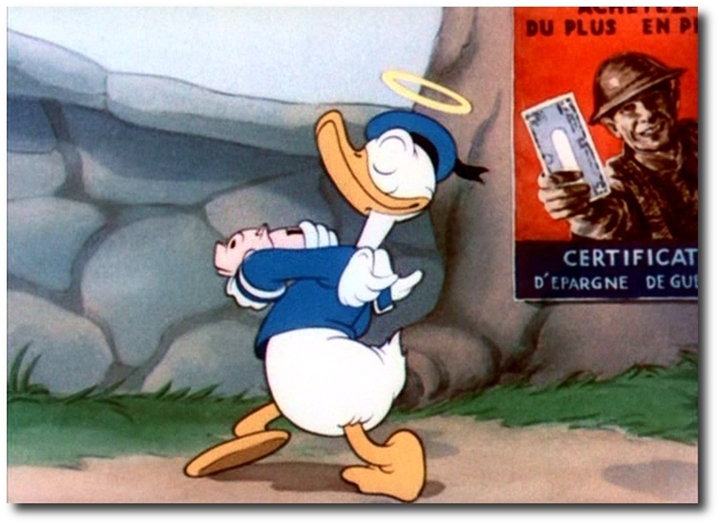 ‘Donald’s Decision is Walt Disney’s third short to persuade the Canadian public to buy war certificates.
This film has the same two-part formula as ‘The Thrifty Pig‘ and ‘7 Wise Dwarfs‘ from 1941. The first half combines reused footage from two Donald Duck shorts from 1938: ‘Self Control‘ and ‘Donald’s Better Self‘, but with altered voices. The second half resembles that of ‘The Thrifty Pig‘ and ‘7 Wise Dwarfs‘.
The result is less convincing than in the earlier two cartoons, probably because the source material is weaker. Neither ‘Self Control’ nor ‘Donald’s Better Self’ belong to Donald Duck’s best. Besides, Donald only reluctantly does his part, in great contrast to the optimistic pigs and dwarfs from the earlier shorts. Indeed, when Disney had to convince the American public for government purposes, the studio came up with completely new animation for its biggest star (in ‘The New Spirit‘ and ‘The Spirit of ’43‘).
Watch ‘Donald’s Decision’ yourself and tell me what you think:
Directors: Dick Lyford & Ford Beebe
Release Date: December 12, 1941
Stars: The Seven Dwarfs
Rating: ★★★½
Review:
 ‘7 Wise Dwarfs’ is Walt Disney’s second propaganda film for the Canadian government, and it uses the same two-part formula as the first (‘The Thrifty Pig‘), this time reusing animation from Walt Disney’s most famous film of all: ‘Snow White and the Seven Dwarfs’ (1937).
The first part of ‘7 Wise Dwarfs’ reuses animation of the seven dwarfs singing the mining song and ‘Hi-ho’, but with altered lyrics and backgrounds. There is some new animation of the Dwarfs entering and leaving the bank to buy war bonds. The second part is almost the same as that of ‘The Thrifty Pig’, ending with the same powerful image of planes gunning the words ‘Invest in Victory’. The Seven Dwarfs would return in ‘The Winged Scourge‘ (1943), which features a lot of new animation on them.
Watch ‘7 Wise Dwarfs’ yourself and tell me what you think:
Director: Ford Beebe
Release Date: 1941
Stars: The Three Little Pigs
Rating: ★★★★½
Review:
 Before The United States were dragged into the war by Japan’s attack on Pearl harbor, December 7, 1941, Walt Disney Studio already had made four propaganda shorts for the Canadian government.
Canada, had declared war on Nazi Germany on September 10, 1939, a week after the United Kingdom, following Germany’s invasion of Poland, September 1.
‘The Thrifty Pig’ is the first of Disney’s four propaganda films commissioned by the Canadian government to persuade their citizens to buy war bonds to invest in the war effort. The other three being ‘7 Wise Dwarfs‘ (1941), ‘Donald’s Decision‘ (1942) and ‘All Together‘ (1942). It’s also Disney’s first propaganda cartoon.
‘The Thrifty pig’ consists of two parts, The first part cleverly reuses animation from Walt Disney’s most famous short, ‘Three Little Pigs‘ (1933), but in this shortened version the wolf wears a Nazi costume, the bricks are made of war bonds and the union jack is waving at the wise pig’s house. The only new animation is when the wolf’s blows reveal war bonds beneath the plaster and when the wise pig says “these bricks not only stop his blowing, they will also get him going”.
The second part is more overtly propagandistic and uses limited animation of war machines and slogans to persuade the public to buy “more and more war certificates”. The end shot, where a plane shoots the words ‘Invest in Victory’ on the screen’ is the most powerful image of the complete film.
This two part formula would be reused in all succeeding propaganda films that had to persuade the public to invest in the governmental war industry. Apart from the Canadian commissions, we see this structure in ‘The New Spirit‘ (1942) and ‘The Spirit of ’43‘ (1943), which had to persuade American citizens to pay their income taxes in time.
Watch ‘The Thrifty Pig’ yourself and tell me what you think:


 Dr. Grob's Animation Review