
You are currently browsing the tag archive for the ‘sacrifice’ tag.
Director: Makoto Shinkai
Release date: July 19, 2019
Rating: ★★
Review:
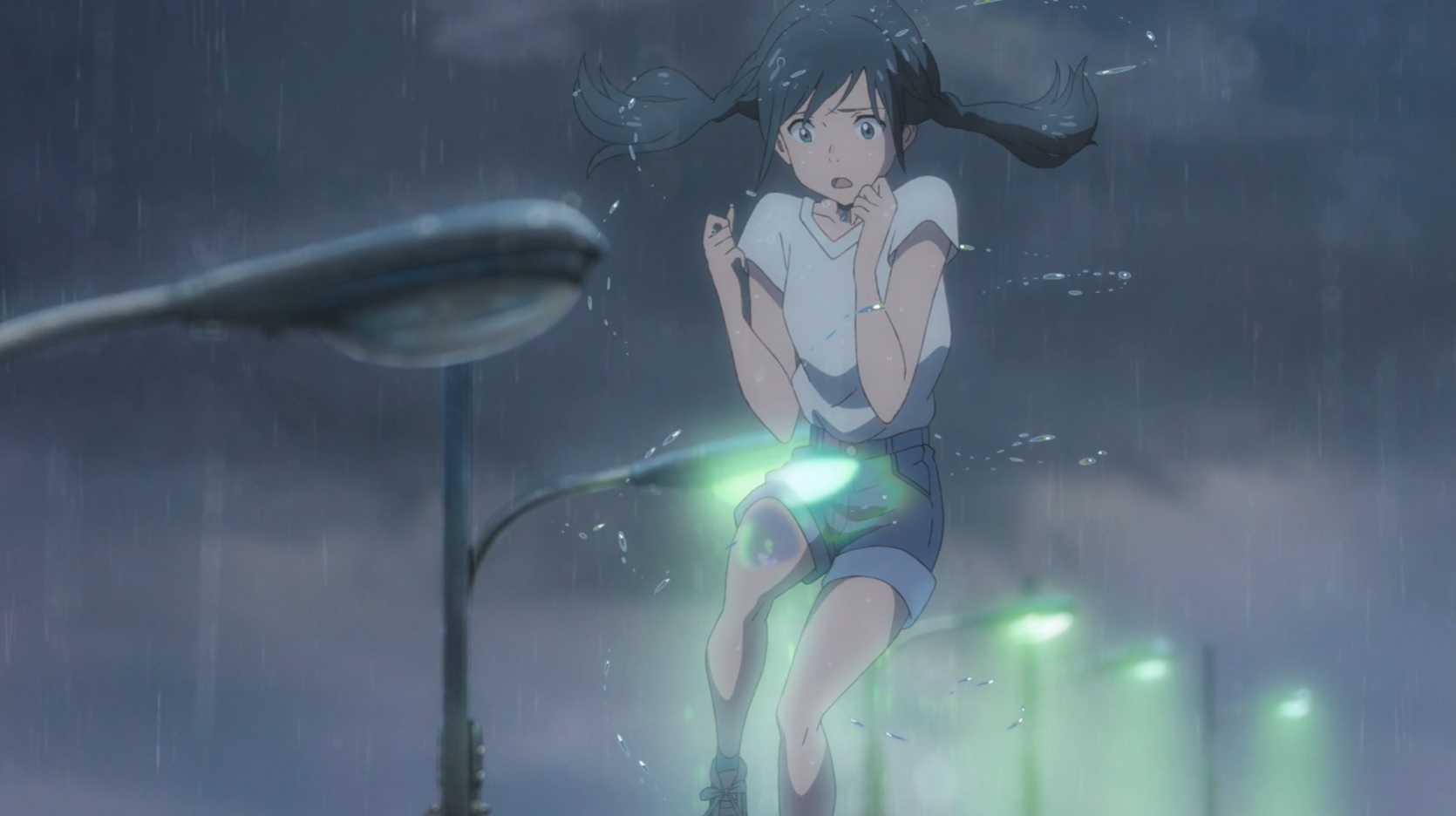
In 2016 Makoto Shinkai rightfully scored a huge hit with his feature film ‘Your Name’. This film’s successor, ‘Weathering with You’ from 2019, unfortunately isn’t half as good.
Like ‘Your Name’ the film is well made, sporting intricate background art, beautiful lighting and fine animation, if not particularly outstanding. But the story, with its high level of spiritualism and its bizarre ending, leaves much to be desired, not in the least because it overstretches its own believability. This already starts with the film’s premise: that Tokyo has been shrouded in rain for months, without any chance of the sun. In this depressing environment there is Hina, a girl who is able to pray for the sun, if only briefly and only locally…
But Hina is not the main protagonist of the film and even remains pretty enigmatic throughout. This is reserved for Hodaka, an sixteen years old boy who has run from home and tries to find his luck in Tokyo, only to discover that this is quite hard without having the legal age to work or a proper identity card. Hodaka is the narrator of the story, and we largely watch the events through his eyes.
Perhaps because the story tells about teenagers the emotions run free in this film, and these are at times quite overblown. One almost rejoices when reality finally checks in with the youngsters’ fantasy life.
Much happens during the course of the film, but little of it makes sense, least of all the aftermath, in which Tokyo is flooded after all. I can’t make head or tail of Shinkai’s tale or his message, and I was for most of the time quite bored. This of course left ample time to admire the background art, but these beautiful sceneries can’t save a film that succumbs under its own pretentions.
Watch the trailer of ‘Weathering with You’ yourself and tell me what you think:
‘Weathering with You’ is available on Blu-Ray and DVD
Director: Oh Sung-Yoon
Release date: July 28, 2011
Rating: ★★★
Review:

I once grabbed a copy of this film from a Tesco’s in Northern Ireland because it looked visually interesting. But I must be one of the very few people who have seen this movie: the film remains totally obscure: I’ve never encountered this feature on any animation festival, review site or such, and it’s not even getting 1000 viewers on the IMDb. This film certainly deserves better, as we shall see below.
‘Daisy, a Hen into the Wild’ turns out to be a Korean film: it was made by Lotte Entertainment and Myung Films, both based in South Korea, and indeed the film’s visuals are a strange mix of Western and Eastern tropes. Especially the character designs are a mixed bag, with some animals looking very Disneyesque (e.g., the little Duckling), others genuinely Asian (e.g., the barnyard ducks and the otter mayor). Most ridiculous is the heroic gander Wilson, who’s a strange combination of a duck and a handsome anime hero, with a waving hairdo.
Nevertheless, ‘Daisy a Hen into the Wild’ is a very attractive film to look at. The coloring is bold and glowing, with bright oranges and greens popping from the screen. Moreover, all characters have an airbrushed coloring, rendering them soft and rich in color. Even better is the background art, which consist of soft, poetical story book-like painting, unlike anything you’ll encounter in either American or Japanese cinema. In fact, the background painting style reminded me most of Jimmy Murakami’s films based on Raymond Briggs’s stories. Some of this background art is extraordinarily beautiful and a real feast to the eye. The animation is of a high level, too, if not too outstanding, often strangely blending naturalism with both Disneyesque character animation and Japanese anime animation styles. There’s a splash of functional computer animation, most interesting when showing moving sceneries.
The story is very surprising, too, and unlike any American animation film. The story takes place within one year, and tells about Daisy, one of countless hens in a battery cage. Daisy’s clearly pining away in this depressing environment. At the start of the movie, she looks sickly and sad, and yearning for the outside world, especially that of some prime fowl that can walk the barnyard freely. At one point she plays dead to escape. The escape succeeds, but if you’d think this would be a film on freedom, you’re mistaken.
It soon becomes clear the loud and naïve Daisy is ill-suited for the outside world. The barnyard fowl expels her and there’s a one-eyed weasel roaming about. Luckily, the gander Wilson helps her, as does the otter, mayor of a large pond, even though the waterfowl despise the newcomer, too. Then things take an unexpected dramatic turn, and the Daisy’s tale becomes one of motherhood, selflessness and even sacrifice.
It’s best not to reveal too much, for this film’s story takes surprising directions up to a final twist unheard of in any animation film from the Western world. For example, Daisy faces some real limits to her possibilities in the outside world, so unlike the limitless American Dream so often depicted in American animated cinema. Even if she wanted to, she can’t be everything she wants to be, and part of the film is about making brave decisions, nonetheless. The only cliché part all too familiar to Western eyes is that of an outsider winning an important competition.
The story is surprisingly serious, and the film contains very little comic relief (only in the form of the otter and some of the barnyard fowl). The Korean makers don’t shun the cruelty of nature and show that every creature has its own very good reasons for what it does, even if it’s killing other species. And they’re able to do so in a moving tale with an attractive visual design.
In all, ‘Daisy, a Hen into the Wild’ is an original and unconventional film that deserves to be seen more. The movie shows that South Korea can have a strong own voice in the animation world, independent of either Western or Japanese animation traditions, or least blending these to a unique style of its own.
Watch the trailer for ‘Daisy, a Hen into the Wild’ yourself and tell me what you think:
‘Daisy, a Hen into the Wild’ is available on DVD


 Dr. Grob's Animation Review