
You are currently browsing the tag archive for the ‘soldiers’ tag.
Director: Marcell Jankovics
Release date: May 3, 1973
Rating: ★★★★
Review:
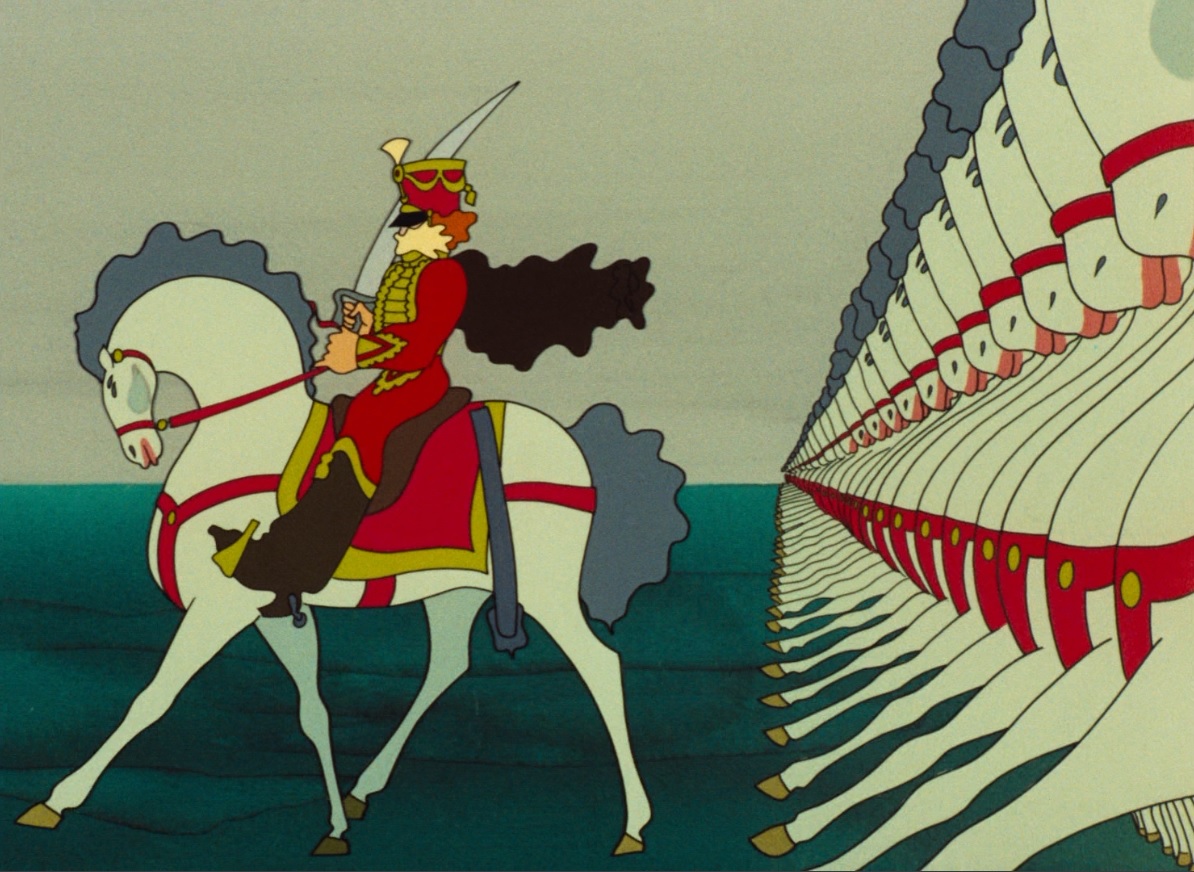
Hungarian director Marcell Jankovics (1941-2021) is most famous for his second animated feature, the mind-blowing masterpiece ‘Fehérlófia’ (Son of the White Mare) from 1981. But his first feature, ‘János Vitéz’ certainly deserves to be equally famous.
‘János Vitéz’ was Hungary’s ever first animated feature ever, but this doesn’t show, at all. The feature is a remarkably mature product that owes nothing to earlier animation films, save George Dunnings’ ‘Yellow Submarine’ from 1968 (and one scene of a devils’ dance, which harks all the way back to Disney’s Silly Symphony ‘The Goddess of Spring’ from 1934). Like Dunning’s film, ‘János Vitéz’ uses very striking visuals in bold colors, and with a genuine contemporary design. In fact, no movie from the seventies looks so enormously ‘seventies’ as this film.
The film was commissioned by the Hungarian government to commemorate the 150st birthday of Hungary’s national poet Sándor Petőfi (1823-1849), whose stature in Hungary is comparable to that of Pushkin in Russia. Petőfi wrote ‘János Vitéz’, a long epic poem in 1844, and despite the strikingly modern visuals, the film follows the poem quite faithfully. János Gyulai-Gaál’s score is unmistaken Hungarian, akin to the music of Zoltán Kodály’s folk opera ‘Háry János’ from 1926 and contributes greatly to the utterly Hungarian character of the movie. There are also a few charming songs, adding to the experience.
The story is pretty nonsensical and more of a tall tale than a classic epic poem. It tells about the hero János Vitéz who is a sheep herder in love with the neighboring Iluska. Unfortunately, Iluska’s stepmother, the witch Mostoha, doesn’t approve of the young lovers’ romance, and makes János Vitéz’ flock of sheep disappear. Banished from his village, János Vitéz first joins a band of robbers, then joins the army, but keeps longing for his beloved Iluska.
The film retains much of Petőfi’s poetic quality: the dialogue is in rhyme, and the images themselves have a lyric quality. For example, the love of Iluska and János Vitéz is shown by associative images, full of flowers and a radiant sun. Moreover, a lot of the story is told through the images, and more by suggestion than by literally showing what’s happening. For example, when János Vitéz is banished this is shown by a street in which every house shuts its shutters when János Vitéz passes by.
The images are as folkloristic as they are psychedelic, and never cease to please or to amaze. The character designs are more of a mixed bag. János Vitéz and Iluska are drawn as rather bland beautiful people, while Mostoha, the robbers and the Turks are very cartoony. These and other characters provide some small gags. Character animation is absent. For example, when János Vitéz mourns for Iluska, this emotion is indicated more than heartfelt. Nevertheless, there is a clever use of metamorphosis and animation cycles, and it’s clear the animation is in service of the graphics and of the story.
In all, ‘János Vitéz’ is a joy to watch from start to end and deserves a much wider audience than it has now.
Watch an excerpt from ‘János Vitéz’ yourself and tell me what you think:
‘János Vitéz’ is available on the Blu-Ray of ‘Son of the White Mare’
Directors: Włodzimierz Haupe & Halina Bielińska
Release Date: 1958
Rating: ★★★½
Review:
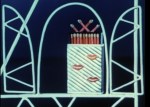
‘The Changing of the Guard’ is a stop motion film that tells a story with the simplest of means.
The background consists of highly graphical wiry outlines of buildings set in an empty stage. The ‘actors’ are matchboxes. We watch them marching, while one of them, a night guard, falls in love with a female matchbox in a window (the matchbox is recognizable as a woman, because of the three lips painted on its front). When the two meet at night, they catch flame, which devours the complete regiment. So, the next day the civilians put up a ‘no smoking’ sign.
Haupe’s and Bielińska’s stop motion is very primitive, yet effective, and their minimalist approach shows how little one needs to tell a communicating and resonating story. Admittedly, their story is not too interesting, verging on the brink of a farce, but the elegant designs and effective animation make it a short fun to watch.
Watch ‘Zmiana warty’ yourself and tell me what you think:
‘Zmiana warty’ is available on the DVD-set ‘Anthology of Polish Animated Film’
Director: Walter Lantz
Release Date: December 1, 1941
Stars: Woody Woodpecker
Rating: ★★★½
Review:
 ‘$21 a Day (Once a Month)’ is the first of the Swing Symphonies, a wartime cartoon series of fifteen based on swing music.
‘$21 a Day (Once a Month)’ reflects the war era perfectly, even though it appeared five days before the attack on Pearl Harbor. The cartoon celebrates the draft that had been installed in 1941. The short’s original twist, however, is that the title song (by Felix Bernard and Ray Klages) is sung by toy animals, toy dolls, toy soldiers etc.
The designs are a mixed bag, some harking back to the early 1930s. Some animals are clearly stuffed, while others look like any other cartoon animal. Unfortunately, this first Swing Symphony hardly really swings. Darrel Calker’s arrangement features a lot of close harmony, but no jazz solos. Only after five minutes some boogie-woogie piano kicks in. Woody Woodpecker has a cameo, making some marching toy soldiers walk differently.
‘$21 a Day (Once a Month)’ is a joyful cartoon, but there were much better Swing Symphonies to follow.
Watch ‘$21 a Day (Once a Month)’ yourself and tell me what you think:
https://www.dailymotion.com/video/xx4w26
‘$21 a Day (Once a Month)’ is available on the DVD set ‘The Woody Woodpecker and Friends Classic Cartoon Collection’


 Dr. Grob's Animation Review