
You are currently browsing the tag archive for the ‘WWII’ tag.
Director: Jack King
Release Date: November 6, 1942
Stars: Donald Duck, Pete
Rating: ★★★½
Review:
 Sky Trooper’ is the third of six shorts dealing with Donald in the army.
The cartoon starts where ‘Donald Gets Drafted‘ ended: with Donald peeling potatoes. And like in the former cartoon Donald Duck wants to fly.
Sergeant Pete gives him a chance, letting him do some ridiculous test and sending him up to be a paratrooper. Unfortunately, Donald doesn’t want to jump and clings to Sergeant Pete. They both end up falling without a parachute but with a huge bomb in their hands. Surprisingly, they survive the fall, because in the end-shot we can see them both peeling potatoes.
‘Sky Trooper’ is surprisingly similar to the Woody Woodpecker cartoon ‘Ace in the Hole’ from five months earlier. However, the cartoon is an improvement on the former two Donald Duck army cartoons. The next ones would even be better…
Watch ‘Sky Trooper’ yourself and tell me what you think:
This is Donald Duck cartoon No. 36
To the previous Donald Duck cartoon: The Vanishing Private
To the next Donald Duck cartoon: Bellboy Donald
Director: Jack King
Release Date: September 25, 1942
Stars: Donald Duck, Pete
Rating: ★★½
Review:
 ‘The Vanishing Private’ is the second of the Donald in the army cartoons. Like the first, ‘Donald Gets Drafted‘ from four months earlier, it features Pete as Donald’s adversary.
In the opening shot we watch Donald singing the theme song from ‘Donald Gets Drafted’ and painting a huge canon in ridiculously bright colors. Sergeant Pete tells him to make the canon hard to see. Donald does so by using invisible paint from an experimental laboratory. He accidentally falls into the bucket of paint himself, making himself invisible and driving Sergeant Pete mad.
‘The Vanishing Private’ suffers because of two reasons:
1) the invisibility makes Donald all too powerful. It’s therefore hard to sympathize with him, and not with poor Pete. This is a problem shared by other invisibility cartoons, like the Tom & Jerry cartoon ‘The Invisible Mouse‘ (1947).
2) The other Donald army cartoons are all about the pains and annoyances of normal army life, which is absolutely part of their fun. But the subject of ‘The Vanishing Pirate’ is so unlikely, one can hardly relate to it.
The result is not a funny cartoon, making ‘The Vanishing Private’ arguably the weakest of Donald’s army cartoons.
Watch ‘The Vanishing Private’ yourself and tell me what you think:
This is Donald Duck cartoon No. 35
To the previous Donald Duck cartoon: Donald’s Goldmine
To the next Donald Duck cartoon: Sky Trooper
Director: Jack King
Release Date: May 1, 1942
Stars: Donald Duck, Pete
Rating: ★★½
Review:
 The attack on Pearl Harbor, December 7, 1941, suddenly smacked The United States into war. The war changed the life of many American citizens, including cartoon stars.
Donald Duck was the fourth of these to support the war effort on the big screen, following Porky Pig, Barney Bear and Popeye, who had joined the army and navy, respectively, in July (‘Meet John Doughboy‘) and November 1941 (‘The Rookie Bear, ‘The Mighty Navy‘). Moreover, Popeye had already engaged the enemy in February in ‘Blunder Below‘. Donald was soon followed by Pluto (May 22), and Woody Woodpecker (June).
In ‘Donald Gets Drafted’, Donald enthusiastically signs up for the army, because he wants to fly, especially after seeing posters of very attractive air hostesses in uniform. His rather naive enthusiasm soon is lowered, when he first has to go through a rather rude medical examination only to end up in the infantry, where he’s bullied by sergeant Pete. Donald doesn’t make a very good soldier, much to Pete’s frustration, and ends up peeling potatoes.
‘Donald Gets Drafted’ is the first of six Donald Duck cartoons devoted to Donald’s career in the army. It introduces Pete as Donald’s sergeant, a role he would fulfill in three other of these war cartoons. The Donald Duck army cartoons are noteworthy for their ambiguous propaganda. Donald is far from a model soldier, and the cartoons makes quite some fun of the army superiors, in the form of Pete. It’s difficult to see them as army advertisements. Moreover, five of the six cartoons are devoted to Donald’s timid life at the training camp. Only in his last war cartoon, ‘Commando Duck’ (1944) would Donald leave American soil to kill some enemies.
With its humor being still quite mild, ‘Donald Gets Drafted’ is not the funniest of Donald’s army cartoons. It is noteworthy, however, for revealing that Donald Duck’s second name is Fauntleroy.
Watch ‘Donald Gets Drafted’ yourself and tell me what you think:
This is Donald Duck cartoon No. 32
To the previous Donald Duck cartoon: Donald’s Snow Fight
To the next Donald Duck cartoon: Donald’s Garden
Director: Leonid Amalrik & Olga Khodataeva
Release Date: 1942
Rating: ★★★★
Review:
 ‘Kino-Circus’ (also called Cinema Circus) is the most inspired of the anti-fascist war propaganda cartoons made in the Soviet Union.
The short is called ‘a cartoon satire in three acts’ and features a Charlie Chaplin-like character, who introduces us to three staged satires, all featuring Adolf Hitler:
In the first, ‘Adolf the dog trainer and his pooches’, Hitler throws a bone at his three dogs, Benito Mussolini, Miklós Horthy and Ion Antonescu, the leaders of his allies Italy, Hungary and Romania, respectively.
In the second, ‘Hitler visits Napoleon’, Hitler asks Napoleon’s tomb for advice, but the deceased drags him into the tomb. It’s the most prophetic of the three, for indeed both Napoleon and Hitler were defeated in Russia.
In the third, ‘Adolf the juggler on powder kegs’, Hitler juggles with several burning torches on a pile of powder-barrels, representing the countries he has occupied. When he accidentally drops one of the torches, the barrels explode. The animation is particularly silly in this sequence and a delight to watch.
After the grim political posters from 1941, ‘Kino-Circus’ is more lighthearted. The film ridicules Hitler more than it makes him threatening. Quite surprising since in1942 Nazi Germany was still a serious threat to the Soviet Union: Leningrad suffered under a long siege, and the Soviet Union had only just begun its counter-attack.
Interestingly, both directors of ‘Kino-Circus’ later became famous for their sweet fairy tale films.
Watch ‘Kino-Circus’ yourself and tell me what you think:
‘Kino-Circus’ is available on the DVD box set ‘Animated Soviet Propaganda’
Director: Panteleimon Sasonov
Release Date: 1941
Rating: ★★½
Review:
 ‘The Vultures’, like ‘4 newsreels‘ and ‘Fascist Boots on our Homeland‘ is a so-called political poster. Like the other two films from 1941 it is soviet propaganda at its most aggressive.
‘The Vultures’ is the least interesting of the set. Its opening shot is its best part: opening with two eyes in the dark, just like ‘The Skeleton Dance‘ (1929). These eyes appear to belong to a fascist vulture. he and the other fascist vultures (battle planes) are chased away and destroyed by the Soviet airfleet in a rather silly and playful-looking air battle, accompanied by heroic march music.
About the director of ‘The Vultures’, Panteleimon Sasonov (1895-1950), little can be found. Giannalberto Bendazzi tells us in his excellent book ‘Cartoons – one hundred years of cinema animation’ that he made an animation film called ‘The Tale of the Pope and Baldo his Servant’ in 1939.
Watch ‘The Vultures’ yourself and tell me what you think:
‘The Vultures’ is available on the DVD box set ‘Animated Soviet Propaganda’
Directors: Valentina Brumberg, Zinaida Brumberg, Aleksandr Ivanov, Olga Khodataeva and Ivan Ivanov-Vano
Release Date: 1941
Rating: ★★★
Review:
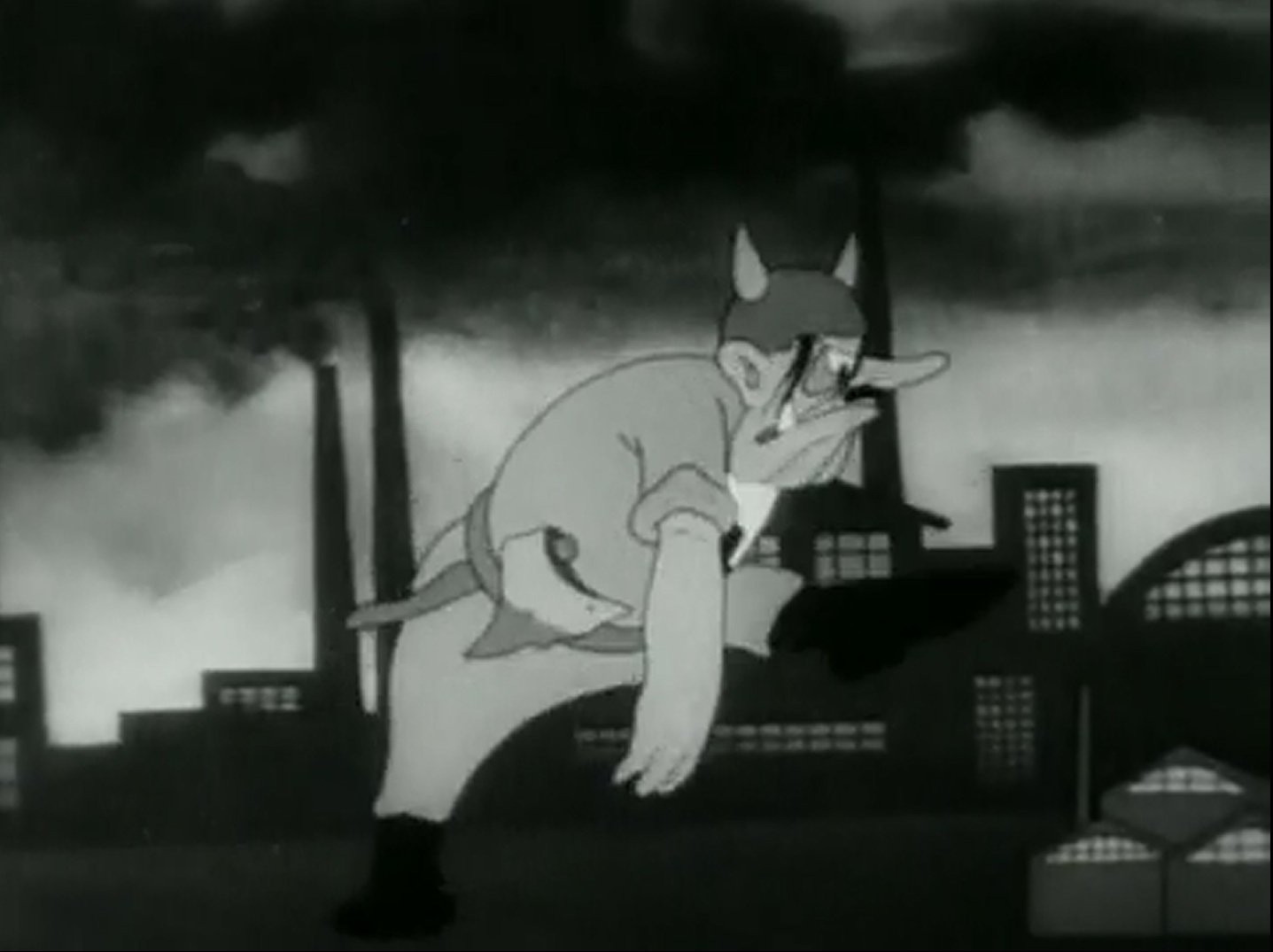 The Soviet propaganda film ‘4 Newsreels’ consists of four so-called ‘political posters’, which are as blatant as propaganda can get.
The first, ‘What Hitler wants’, shows us an extremely ugly and vicious caricature of Hitler marching towards the Soviet Union until he is pierced by the Soviet bayonet.
In the second, ‘Beat the fascist pirates’, sea serpent-like German submarines are defeated by the Soviet fleet.
The third, ‘Strike the Enemy on the front and at home’, is typical for the paranoid society Stalinist Russia was, warning against treacherous fascist spies, foreign agents and saboteurs: “Be vigilant! Remember, our enemy is cunning!”.
The fourth, ‘A mighty handshake’, tells us about the union between England and the Soviet Union against Nazi Germany, showing two mighty giant soldiers shaking hands and crushing a tiny rat-like Hitler in doing so.
Obviously, Germany’s invasion of the Soviet Union left no room for subtleties.
‘4 Newsreels’ was directed by five veterans of animated Soviet propaganda. All had made animated films since the 1920s. Of the five, Ivan Ivanov-Vano (1900-1987) would become the most successful, directing animated films up to the 1970s. Luckily, he and Olga Khodataeva would be able to show a gentler side in numerous animated fairy tale films for children.
Watch ‘4 Newsreels’ yourself and tell me what you think:
‘4 Newsreels’ is available on the DVD box set ‘Animated Soviet Propaganda’
Director: Charles Nichols
Release Date: June 23, 1944
Stars: Pluto
Rating: ★★★★
Review:
 An updated version of Pan from ‘Fantasia’ (1940), now wearing a boiler hat, creates spring.
Pluto enjoys it for a while, e.g. discovering a caterpillar who transforms into a very sexy butterfly. The butterfly is designed as a miniature pin-up girl, who dances to a conga beat. After this encounter, Pluto juggles with a wasps’ nest, angering the wasps who sting him in the form of a Lockheed Lightning and a V2 rocket. These two sequences make ‘Springtime for Pluto’ a typical war era cartoon, even though it’s not about war, at all.
After Pluto gets stung, he’s caught in the rain, and even in a hailstorm. In the end he’s not enjoying spring anymore, and angrily he chases Pan into the distance.
‘Springtime for Pluto’ is the first cartoon directed by Charles Nichols, who would direct all Pluto and Mickey cartoons (save one) from now on until their retirement in 1953. Nichols is famous for his mild-mannered humor, but his debut consists of very enjoyable utter nonsense from the beginning to the end. It’s full of the exuberant spirit of the war time era.
Even the oil backgrounds, painted by Lenard Kester (1917-1997), have more vivid colors than before. These are flatter than in most Disney films, and during the butterfly sequence one can even see the paper texture. They form an early example of a more graphic style of backgrounds within a Disney film, and look forward to the fifties. Perhaps Kester had been inspired by similar experiments by Chuck Jones’ unit at Warner Brothers (e.g. ‘The Dover Boys‘ from 1942). In any case, the result contributes to the surreal atmosphere of the film.
Kester has been credited for backgrounds of only one other Disney cartoon, ‘How To Play Football’ from a few months later. In this short the backgrounds are effective, but unremarkable. Had he been toned down by the studio? Fact is that Kester soon moved on to devote his life to oil painting…
Watch ‘Springtime for Pluto’ yourself and tell me what you think:
This is Pluto cartoon No. 11
To the previous Pluto cartoon: Private Pluto
To the next Pluto cartoon: First Aiders
Director: Clyde Geronimi
Release Date: April 2, 1943
Stars: Pluto, Chip ‘n Dale
Rating: ★★★★
Review:

Pluto has joined the army, and wearing a helmet, he has to protect “the pillbox” (a canon) against saboteurs.
These appear to be two little chipmunks who use the canon to crack acorns. Pluto tries to fight them, but the two critters defeat him in an unexpected ending.
‘Private Pluto’ is the second of two World War II-themed Pluto cartoons (the first being ‘The Army Mascot‘ from 1942). It was also to be the last Pluto cartoon directed by Clyde Geronimi, who promoted to sequence director in Disney’s feature films. Geronimi was succeeded by Charles Nichols, who seemed to be more comfortable with the character and who would direct every Pluto cartoon save one from then on.
‘Private Pluto’ is an important cartoon, because it introduces those famous chipmunks, Chip ‘n Dale. They’re not named yet, nor are they two different characters here, but their mischievous behavior and their hardly comprehensible jabbering are already present, and they’re certainly instantly likeable.
Chip ‘n Dale would eventually become Donald’s adversaries, but Pluto, too, would re-encounter them in three cartoons: ‘Squatters Rights‘ (1946), ‘Food for Feudin’‘ (1950) and ‘Pluto’s Christmas Tree‘ (1952).
‘Private Pluto’ is interesting in its own right, for it shows the line of coastal defense the United States had placed at the Pacific Coast in the years preceding the war. After the attack on Pearl Harbor it had been placed on high alert (thus Pluto’s job), but luckily there was no need ever to use it.
Watch ‘Private Pluto’ yourself and tell me what you think:
This is Pluto cartoon No. 10
To the previous Pluto cartoon: Pluto at the Zoo
To the next Pluto cartoon: Springtime for Pluto
Director: Clyde Geronimi
Release Date: May 22, 1942
Stars: Pluto
Rating: ★★★
Review:
 ‘The Army Mascot’ is the first of two World War Two cartoons starring Pluto (the other one being ‘Private Pluto‘ from 1943).
Pluto never gets really involved in the war, though, he only joins the army. He was the second Disney character to do so, following Donald Duck, who had been drafted only three weeks earlier, in ‘Donald Gets Drafted‘.
However, Pluto’s reasons to join the army are doubtful, to say the least: only when he sees the enormous portions of meat an army mascot gets, he wants to be one, too. He tries to replace “Gunther Goat”, mascot of the Yoo-hoo Division, but all he gets is cans. In his second attempt he tries to chew tobacco like Gunther can, to impress the soldiers. But Gunther makes Pluto swallow the whole piece, making him sick. This sequence is the highlight of the cartoon, as Pluto’s sickness is animated in the most ridiculous way.
Gunther then tries to finish his rival off by bumping Pluto into the munition depot, but it’s Gunther himself who bumps into the depot, which explodes, blasting the wicked goat up into the air, where he’s caught by a plane and carried away into the distance. Now Pluto takes Gunther’s place, and gets his steak after all.
‘The Army Mascot’ is a rather odd cartoon, where both main characters show unpleasant behavior: Pluto envy and trickery and Gunther haughtiness and wrath. Thus, ‘The Army Mascot’, although war-themed, can hardly be called a patriotic film.
Watch ‘The Army Mascot’ yourself and tell me what you think:
This is Pluto cartoon No. 6
To the previous Pluto cartoon: Pluto Junior
To the next Pluto cartoon: The Sleep Walker
Director: Vyacheslav Kotyonochkin
Release Date: 1967
Rating: ★★★
Review:
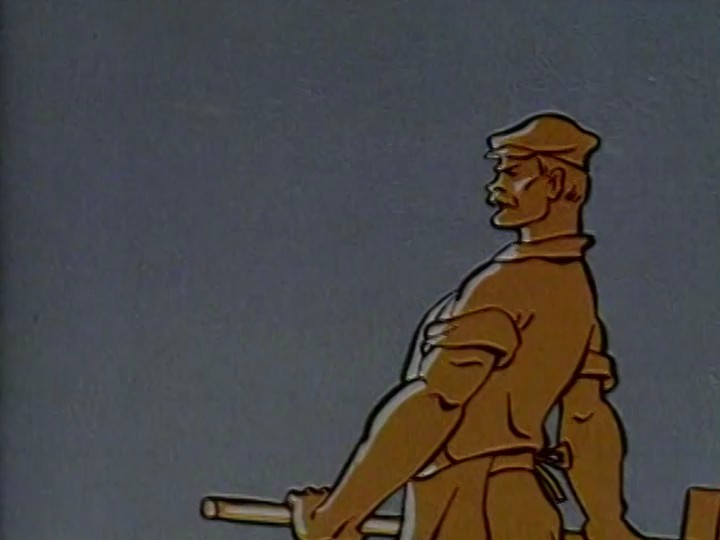 ‘Prophets and Lessons’ is a Soviet propaganda film. It tells us how every time the Western world predicted the Soviet Union to fail, but that these predictions never came true.
Its chapters are all conceived in the same order: first we see animated capitalist predict something, then we see a giant Soviet blacksmith strike his mighty hammer and finally we see live action footage of the Soviet Union’s successes.
The separate chapters are the Soviet revolution, the civil war, the five year plans, the Second World War, the reconstruction after the war and the Soviet space program. The action is silent, and the imagery rather outdated (more like that of the 1920s than of the 1960s).
‘Prophets and Lessons’ is one of the most obviously propagandistic animation films ever made in the Soviet Union. Its overtly propagandistic message, its repetitive character, and its outdated symbolism make it rather tiresome to watch.
Surprisingly, two years later, the director of this humorless film, Vyacheslav Kotyonochkin, would launch a successful series of comic cartoons, called ‘Ну, Погоди!’ (‘Just Wait!’), featuring a very cartoony wolf.
Watch ‘Prophets and Lessons’ yourself and tell me what you think:
‘Prophets and Lessons’ is available on the DVD box set ‘Animated Soviet Propaganda’


 Dr. Grob's Animation Review