You are currently browsing the tag archive for the ‘Yuri Norstein’ tag.
Director: Anatoly Karanovitch
Release date: 1963
Rating: ★★★★
Review:
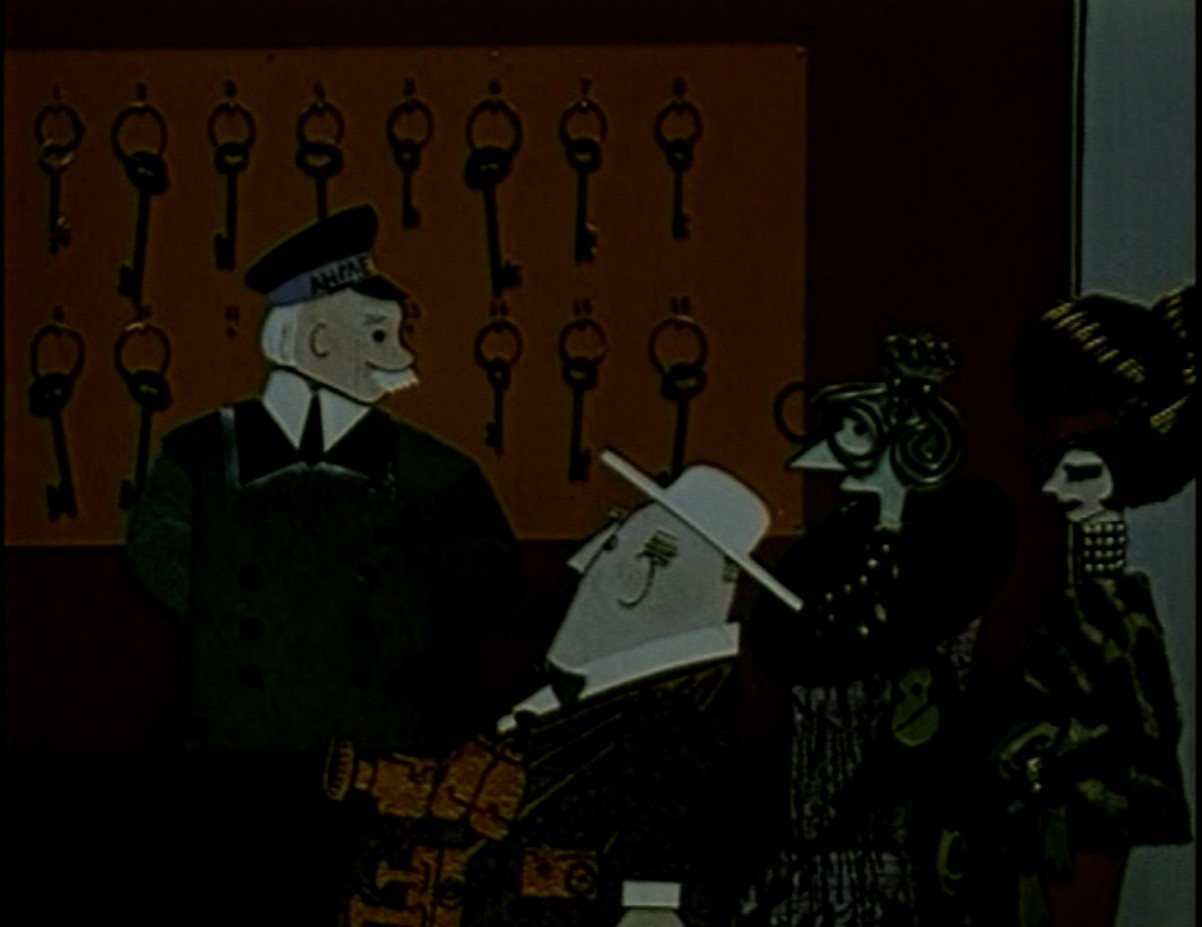
After Fyodor Khitruk gave Soviet animation a huge update with ‘Story of One Crime’, the animated Soviet propaganda shorts also became more modern and interesting to look at. A good example is ‘Mister Twister’ from 1963.
Based on the poem of the same name by Samuel Marshak (1887-1964) ‘Mister Twister’ is a story in rhyme about Mr. Cook (alias ‘Mister Twister’), an American millionaire who visits the Soviet Union on request of his daughter Susie. When he arrives in Leningrad, he refuses to sleep in the appointed hotel, because a black man sleeps there, too. The doorman of the hotel calls all his colleagues from other hotels to tell the millionaire they’re full. After a tiring day of searching and a night in the doorman’s office, the millionaire and his family are completely humbled. Now, Mr. Cook will rent a room, even though he will be surrounded by colored people, all visiting Leningrad because an international conference.
This cartoon uses both cel animation and cut-out techniques and is conceived as a children’s book coming alive. The animation (e.g. by a young Yuri Norstein) is crude and emblematic, but shows modern influences in its unnatural depictions of movement.
‘Mister Twister’ is one of no less than three animated Soviet propaganda films from 1963 aimed at American capitalism. Despite the rather poor animation, it’s the best of the three, because of the charmingly little story, and because its anti-racist message, which is of a much more lasting quality than say the glory of communism.
Watch ‘Mister Twister’ yourself and tell me what you think:
‘Mister Twister’ is available on the DVD set ‘Animated Soviet Propaganda’
Director: Yuri Norstein
Release date: 1973
Rating: ★★★★
Review:
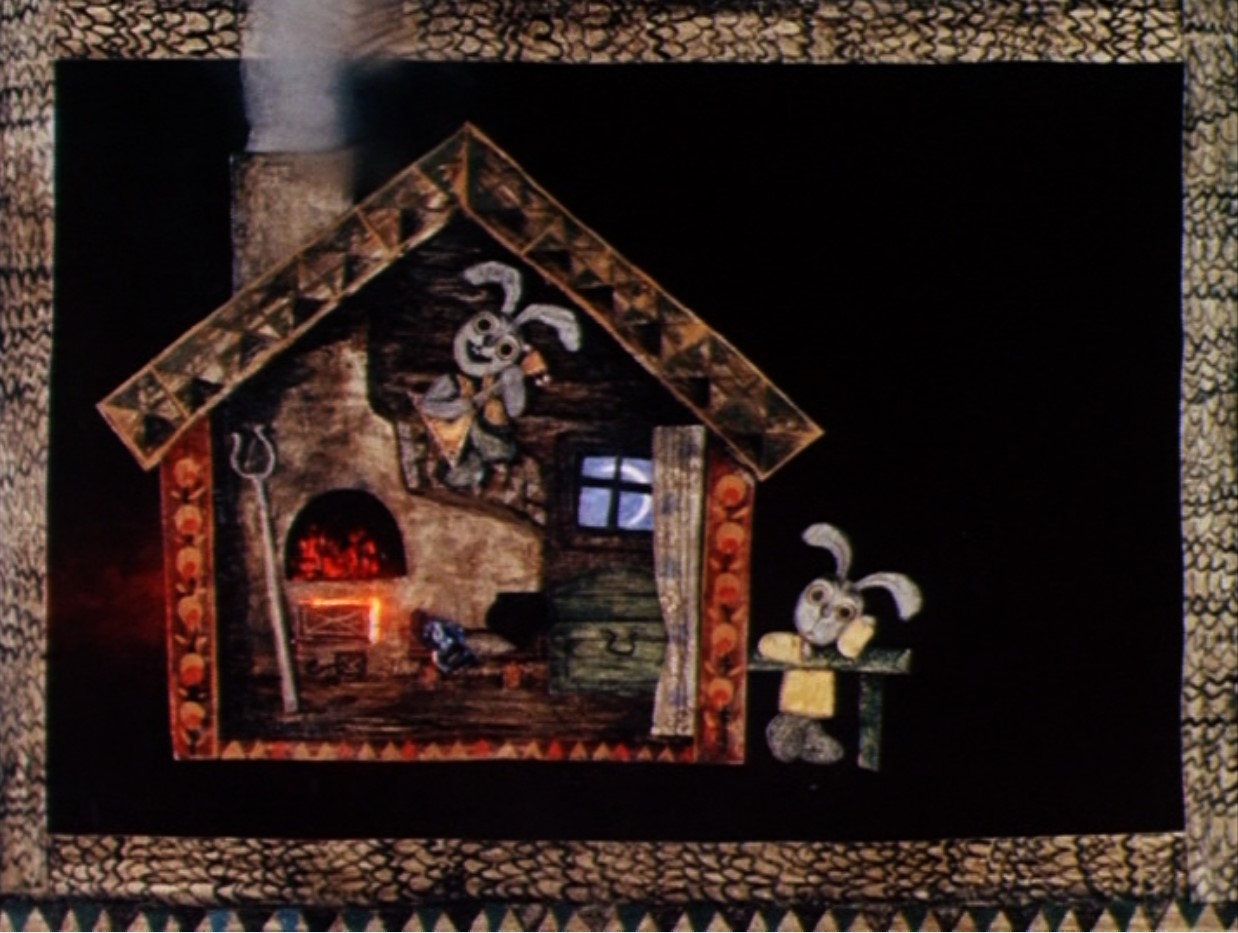
In ‘Fox and Rabbit’ (actually Fox and Hare) Norstein retells a Russian folktale in which a fox chases a rabbit out of his own house. A wolf, a bear and a bull all three promise the rabbit to help him regain his house, but when threatened by the fox they run off. Only a small rooster at least tries it.
The story is told by a voice-over, and is illustrated in a very charming semi-folkloristic style, which striking and colorful supposedly wooden frames framing the action, as if were looking at paintings. M. Meyerovich’s, rather Stravinsky-like music only adds to the folkloristic character. Norstein’s cut-out animation, meanwhile, is of the highest order, and full of little subtleties, signifying the different characters.
‘Fox and Rabbit’ may be less famous than the later ‘Hedgehog in the fog’ (1975) or ‘Tale of Tales‘ (1979), the film already shows Norstein’s extraordinary talent and charming animation style. Fyodor Khitruk thought highly of the film, and was completely surprised that such commonplace material (Soyuzmultfilm had made fable films for several decades) turned into such an original, idiosyncratic film.
Watch ‘Fox and Rabbit’ yourself and tell me what you think:
‘Fox and Rabbit’ is available on the DVD ‘Masters of Russian Animation Volume 2’
Directors: Ivan Ivanov-Vano & Yuri Norstein
Release date: 1971
Rating: ★★★
Review:
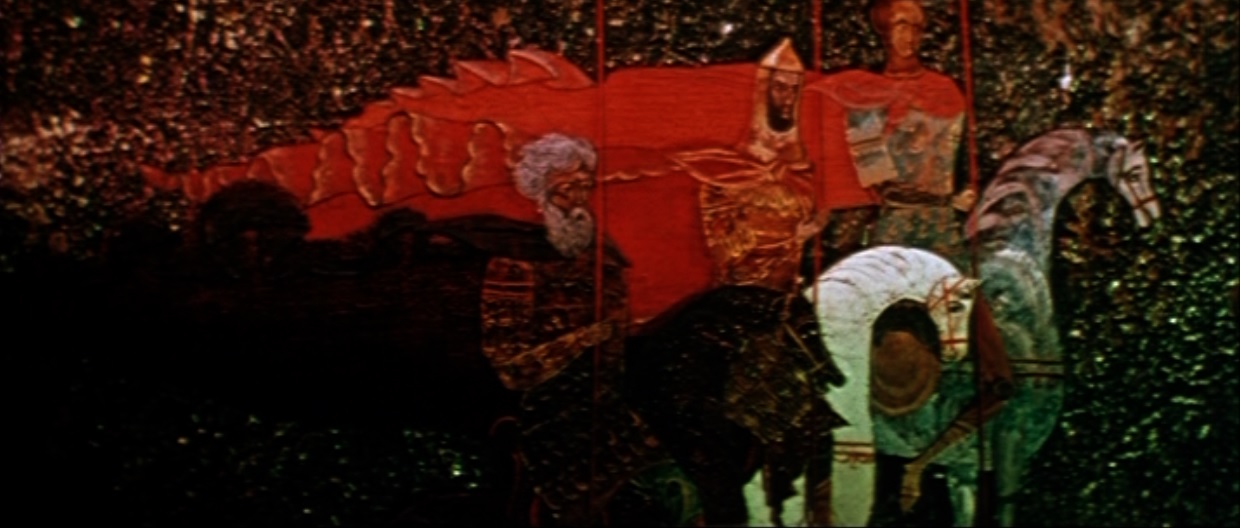
Veteran director Ivan Ivanov-Vano and young and up-and-coming talent Yuri Norstein co-direct the rather enigmatic ‘The Battle of Kerzhenets’.
Set to music by Nikolai Rimsky-Korsakov (excerpts from his opera ‘the Invisible City of Kitezh’), the film tells of a legendary epic battle of a Russian army against an invading army of Mongols, and of its aftermath. The film consists of three parts: in the first we watch the soldiers saying goodbye to their wives and children, the second depicts the battle itself, and the third part shows how life continues, with images of farmers sowing and harvesting and of children playing.
The short stops quite abruptly, and it’s quite unclear what the duo wanted to tell with their film. Nevertheless, the film is a marvel to watch. As the directors state themselves in the opening of the film, the visuals are based on Russian icons and frescos of the 14th to 16th century, and these give the short its unique style.
The cut-out animation is fair, and more emblematic than realistic, but the real treat lies in the way the two directors filmed their short. For a film about a battle, the filming is remarkably poetic: the images often flow into each other by the use of dissolves into black and back, and there’s a lot of soft focus on the images, creating a magical distance. In fact, the images are mesmerizing throughout the picture, and clearly look forward to Norstein’s individual poetic style.
Watch ‘The Battle of Kerzhenets’ yourself and tell me what you think:
‘The Battle of Kerzhenets’ is available on the DVD ‘Masters of Russian Animation Volume 2’
Director: Ivan Ivanov-Vano
Release date: 1969
Rating: ★★½
Review:

‘Seasons’ is a very poetic stop-motion film set to music by Pyotr Ilyich Tchaikovsky.
The film tells about two lovers through the seasons, although we see mostly images of autumn (the two riding together through a forest) and winter (a lengthy sleigh ride), with summer being reduced to a reminiscence of happier times, and spring hardly identifiable, at all.
The film is directed by Ivan Ivanov-Vano, but co-directed by Yuri Norstein, and already contains several elements of the later director’s mature style: the stop-motion is close to cut-out animation, there are plenty multi-plane effects, and the filming of the images has a soft, poetic edge to it. The designs are extraordinary beautiful, especially that of the crystalline forest, but as practically nothing happens during the entire film, the result is as enchanting as it is boring.
Watch ‘Seasons’ yourself and tell me what you think:
‘Seasons’ is available on the DVD ‘Masters of Russian Animation Volume 2’
Director: Yuri Norstein
Release Date: 1979
Rating: ★★½
Review:
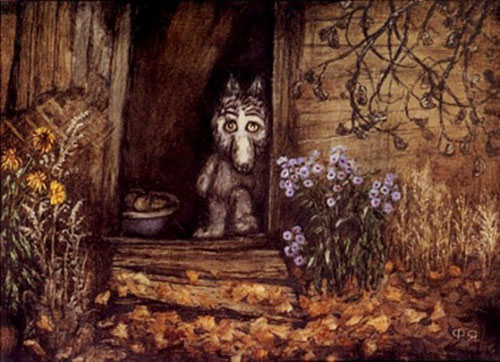 In ‘Tale of Tales’ we’re watching a wolf cub trying to survive his loneliness in an old house, relying on his memories.
These images are altered with images of a river scene with a.o. a fisherman, his wife and his children, and a giant Picasso-like minotaur skipping rope. Two other recurring images are that of dancing wives losing their men to war, and that of a little boy eating apples in the snow.
‘Tale of Tale’s is regarded as Yuri Norstein’s masterpiece and as one of the best animation films of all time. This does not mean it is the most accessible of all films, on the contrary. ‘Tale of Tales’ is a poetic film, but a confusing one. The nostalgic images seem unrelated, and are shown in a non-linear fashion. In fact, it is very difficult to render a ‘tale’ out of the images, which are intrinsically very strong, especially those of the melancholy wolf cub and of the iconic river scene.
Most of the film is made of muddy images in sepia-tones, rendering a dreamy atmosphere. Many images return, bridged by the wolf cub character, who, alone, seems to live in the present, outside of the images of a childhood long past. There’s some vague sense of a happy childhood being shattered by war and being lost in time.
The film uses no dialogue, and even the music is timid in its evocation of mood. Some of the cut-out animation is superb, however, and the overall imagery one of great virtuosity. The end result is as beautiful as it is overlong and frustratingly incomprehensible.
Watch ‘Tale of Tales’ yourself and tell me what you think:


 Dr. Grob's Animation Review