
You are currently browsing the category archive for the ‘Bray Productions films’ category.
Director: Unknown
Release date: May 7, 1920
Stars: Judge Rummy
Rating: ★★★★
Review:
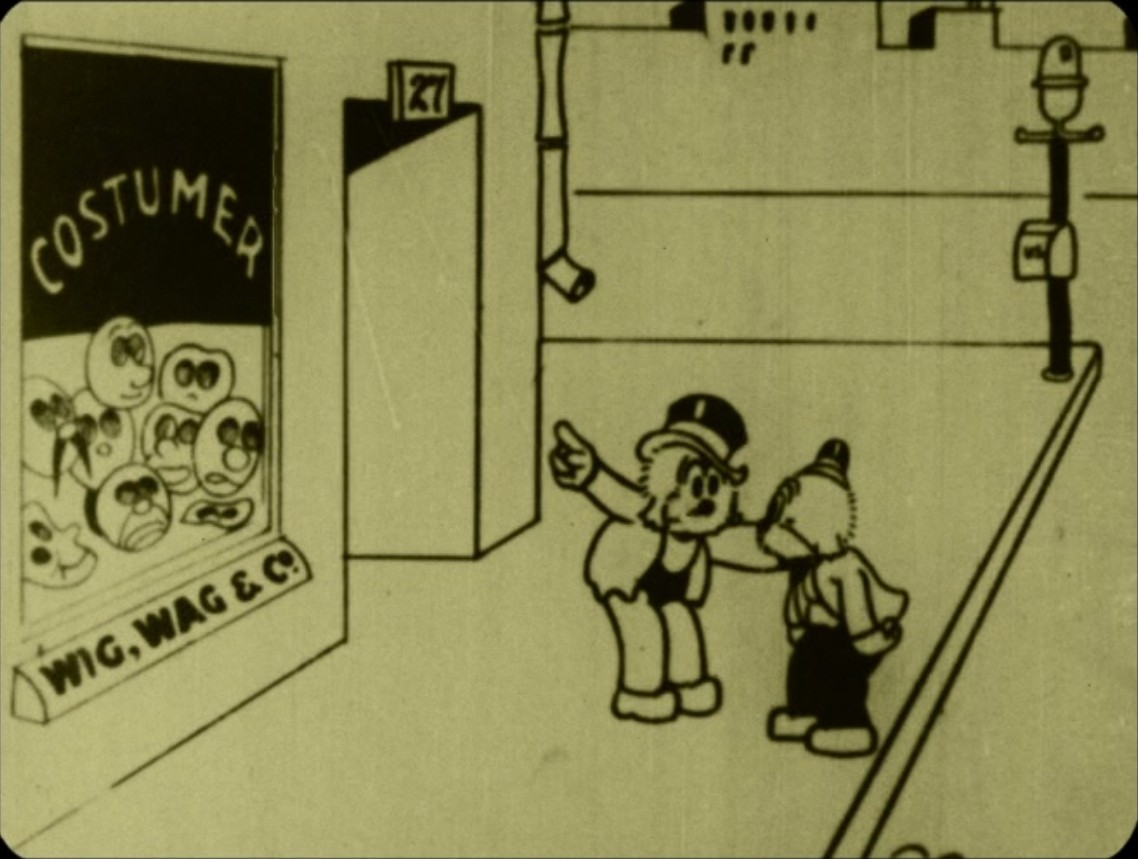
Tad Dorgan’s Judge Rummy was a comic strip that run from 1910 to 1922. Between 1918 and 1922 it was also an animated cartoon series, directed by the likes of Jack King, Burt Gillett and Grim Natwick, who would all become animation legends, and, surprisingly, Gregory La Cava, later director of live action comedies like ‘My Man Godfrey’ (1936) and ‘Stage Door’ (1937).
I’ve no idea who’s responsible for ‘A Fitting Gift’ but the animator has a very pleasant animation style, with unexpected touches of metamorphosis, original staging, and surprising movements.
In this short Judge Rummy wants to buy a gift for a girl he admires. His friend Silk Hat Harry suggest a corset, but Judge Rummy is too bashful to enter, so Silk Hat Harry suggests the two dress as women themselves, but then Judge Rummy’s wife appears. The gags themselves in this cartoon, one including a homosexual stereotype, are pretty trite, but as said, the execution is much fun, making this short a pleasant watch.
Watch ‘A Fitting Gift’ yourself and tell me what you think:
‘A Fitting Gift’ is available on the Blu-Ray-DVD combo ‘Cartoon Roots: The Bray Studios Animation Pioneers’
Director: Walter Lantz
Release date: March 9, 1920
Stars: Jerry on the Job
Rating: ★★★
Review:

Jerry is on a job at a train station, where his boss is plagued by a mosquito. Jerry knows just the way to get rid of the little pest, or does he?
‘The Tale of the Wag’ is a nice little cartoon based on one simple idea. The animation is full of surprising details, like Jerry using his crest as an arm to scratch himself, or Jerry shaking hands with the thought balloon that contains his idea. These little touches rescue an otherwise rather run of the mill short.
Watch ‘The Tale of a Wag’ yourself and tell me what you think:
‘The Tale of a Wag’ is available on the Blu-Ray-DVD combo ‘Cartoon Roots: The Bray Studios Animation Pioneers’
Director: Vernon Stallings
Release date: March 3, 1920
Stars: Krazy Kat
Rating: ★
Review:

Compared to other cartoonists working at the Bray studio, the work of Vernon Stallings is certainly subpar. His Krazy Kat cartoons are crude and simple, and lack the sophisticated animation of an Earl Hurd or the inventiveness of Walter Lantz.
‘The Best Mouse Loses’ is a very short cartoon in which Ignatz Mouse goes into a ringed boxing match. Arbiter Krazy Kat lets him win, much to Ignaz’s chagrin. Both the premise and the execution of this cartoon are poor, and the animation is only interesting because of some strange body elongations not seen elsewhere.
Watch ‘The Best Mouse Loses’ yourself and tell me what you think:
‘The Best Mouse Loses’ is available on the Blu-Ray-DVD combo ‘Cartoon Roots: The Bray Studios Animation Pioneers’
Director: Wallace Carlson
Release date: September 6, 1919
Stars: Dreamy Dud, Wallace Carlson, John Randolph Bray
Rating: ★★★★
Review:

Young Wallace Carlson parodies his own work in a short funny film starring himself.
If anything the film shows that animating a cartoon is a lot of work. Most telling is the scene in which Carlson photographs a huge pile of animation drawings. The intertitle ’48 hrs later… ‘ says it all.
The cartoon itself, ‘Dreamy Dud’, which Carlson plays to an unimpressed John Randolph Bray , is not half as funny as the live action sequences, and only demonstrates that Carlson belongs to the lesser gods of animation. His animation style is crude and formulaic, with little sense of timing.
Watch ‘How Animated Cartoons Are Made’ yourself and tell me what you think:
‘How Animated Cartoons Are Made’ is available on the Blu-Ray-DVD combo ‘Cartoon Roots: The Bray Studios Animation Pioneers’
Director: Earl Hurd
Release date: April 23, 1919
Stars: Bobby Bumps and Fido
Rating: ★★★
Review:

‘Bobby Bumps’ Pup Gets the Flea-Enza’ is a funny take on the devastating Spanish Flu epidemic of 1918-1920. In this cartoon Bobby Bumps and Fido both think Fido’s got the influenza, while he only got a flea (depicted as a black devilish little man).
The humor is mild, but Earl Hurd once again demonstrates to be one of the best animators of the era. Every shot and move look smooth and elegant. The best gag may be the visit to the horse doctor.
‘Bobby Bumps’ Pup Gets the Flea-Enza’ is available on the Blu-Ray-DVD combo ‘Cartoon Roots: The Bray Studios Animation Pioneers’
Director: Max Fleischer
Release date: October 14, 1919
Stars: Max Fleischer, Koko the Clown
Rating: ★★★
Review:

Max en Dave Fleischer were two true animation pioneers. In 1915 they invented the rotoscope, which they patented that year. With rotoscope they could capture live action movement as drawings on paper. Their first rotoscope tests featured Dave Fleischer in a clown suit, and these were the origin of Koko the Clown, star of ‘Out of the Inkwell’ series.
The two brothers started to make these shorts for J.R. Bray from 1919 on, but they only became a real series in 1920, and Koko got his name much later, in 1923. ‘The Tantalizing Fly’ is but the second ‘Out of the Inkwell’ short, yet it already shows the merit of rotoscope and the brothers’ imaginative way of storytelling.
In ‘The Tantalizing Fly’ Max Fleischer is hindered by a fly while drawing Koko. He tries to swat it, but hits Koko instead. Then it’s Koko’s turn. He tries to lure the fly by drawing a bald sitting man, but only manages in hitting the man instead of the fly.
The idea of an animator drawing a character is as old as animation itself, and clocking less than four minutes ‘The Tantalizing Fly’ is frustratingly short, leaving room for just a few gags, but Fleischer’s mix of animation, rotoscope and live action is fun to watch, and shows that the two brothers were among the most interesting animation film makers of their time.
Watch ‘The Tantalizing Fly’ yourself and tell me what you think:
‘The Tantalizing Fly’ is available on the Blu-Ray ‘Cartoon Roots: The Bray Studios Animation Pioneers’ and on the DVD-set ‘Popeye the Sailor 1933-1938’
Director: Earl Hurd
Release date: December 4, 1918
Stars: Bobby Bumps and Fido
Rating: ★★★½
Review:

In ‘Bobby Bumps Puts a Beanery on the Bum’ Bobby Bumps and Fido answer to an ad ‘boy wanted in to help in kitchen’ from the ‘Quick Lunch Beanery’.
What follows is a rather aimless string of gags, most remarkable of which is one in which Fido makes a cat eat its words by rolling up the cat’s speech balloon and shovel it down its throat. The cartoon ends all too abruptly, when Bobby pours ink over the cook who chased him out of the beanery.
More interesting than anything of this, however, is the opening scene in which a hand draws Bobby Bumps lying down in perfect perspective. Bobby Bumps helps the hand coloring him, only then follows Fido and the scenery. The Bobby Bumps cartoons were drawn elegantly anyhow, making them stand out of the 1910s crowd, and even though ‘Bobby Bumps puts a Beanery on the Bum’ isn’t the best entry in the series, in this respect it’s now exception.
Watch ‘Bobby Bumps Puts a Beanery on the Bum’ yourself and tell me what you think:
‘Bobby Bumps Puts a Beanery on the Bum’ is available on the DVD-set ‘Popeye the Sailor 1933-1938’
Director: Earl Hurd
Release Date: January 24, 1919
Stars: Bobby Bumps & Fido
Rating: ★★★
Review:

‘Bobby Bumps’ Last Smoke’ starts with Earl Hurd’s hand drawing Bobby Bumps, tickling him on the way. Then finished he gives the boy a cigarette, and immediately the scenery sets in.
Bobby starts smoking enthusiastically, but soon gets dizzy and throws the cigarette away. The cigarette smoke transfers him and Fido to a sultan’s palace in a 1001 Arabian night version of Turkey. The duo rescue a lady from the Sultan’s dungeons, with Bobby knocking out all the guards, and some lions, with the lady’s former ball and chain. He earns the damsel’s kiss in reward, which turns out to be Fido licking him.
Now, one would suspect that ‘Bobby Bumps’ Last Smoke’ is a typical anti-smoking cartoon, with Bobby giving up smoking after this trippy experience. But no, the one thing he’ll never do again isn’t smoking, but “insulting a sultan”. And so, with this pun, the short ends.
‘Bobby Bumps’ Last Smoke’ boasts elaborate human designs and intricate background art, but as with most animated cartoons from the 1910s, the animation is limited and jumpy.
‘Bobby Bumps’ Last Smoke’ is available on the Blu-Ray/DVD-combo ‘Cartoon Roots: Bobby Bumps and Fido’
Directors: Max & Dave Fleischer
Release Date: July 6, 1920
Stars: Ko-Ko the Clown
Rating: ★★★½
Review:

‘The Clown’s Little Brother’ is one of the Fleischer brothers’ earliest films, when they were still working at Bray Studio.
The film stars Max Fleischer as the artist drawing Ko-Ko the clown, who’s only known as ‘the inkwell clown’ in this cartoon. Interestingly, as soon as Max tries to draw the character, his pen fails and Ko-Ko jumps out of the glass in which Max washes his pen. Immediately thereafter Max gets his mail, which strangely enough contains a live kitten. The Inkwell Clown gets a letter, too, stating that his kid brother arrives in another mail package. But Ko-Ko’s kid brother turns out to be a cheeky brat and Max leaves.
Undeterred, Ko-Ko tries to entertain the little kid with his antics, but the boy easily outperforms the clown, not in the least because he’s 100% animated, while Ko-Ko is partly rotoscoped. Thus the kid’s movements are wilder, less realistic and more impossible than Ko-Ko’s. At one point Ko-Ko falls off the piece of paper, and on the kitten, who plays with the poor cartoon character. At that point the kid brother shows his kinder side, and rescues Ko-Ko from the clutches of the feline foe. Yet, their antics end when Max returns, and the bottle of ink falls on the floor.
‘The Clown’s Little Brother’ is by all means an action rich and entertaining short, and shows that the Fleischers brothers were very competent players in the field. Fleischer’s inkwell clown was a sensation back then because of his fluid movements, based on Max Fleischer’s rotoscope invention. But in this cartoon Max Fleischer shows to be a competent animator without the aid of rotoscope, as well. For example, when the kid brother tries to pull Ko-Ko out of the inkwell, one can sense some pulling force.
Watch ‘The Clown’s Little Brother’ yourself and tell me what you think:
‘The Clown’s Little Brother’ is available on the DVD-set ‘Popeye the Sailor 1941-1943’
Director: Max Fleischer
Release Date: 1920
Rating: ★★★★½
Review:
‘All Aboard for a Trip to the Moon’ is a very early educational animation short. The short was animated by Max Fleischer at the Bray Studios, and apparently part of a series called ‘Goldwyn Bray Pictograph – The Magazine on the Screen’. For this short Fleischer got assistance of the Popular Science Monthly for the scientific details.
In less than 8 minutes ‘All Aboard for a Trip to the Moon’ tells about a hypothetical trip to the moon, telling us how far the moon is, and how to overcome the Earth’s gravity by using a radium-propelled rocket. Fleischer depicts quite a hard, bouncing landing of the rocket on the moon, and it’s never revealed how the vessel would be able to return to Earth, but we get some nice and convincing shots of the moon’s landscape and earth from the moon itself.
Fleischer’s drawings and animations are combined with live action footage, e.g. of a man handling radium, and another one getting dressed for the trip. Apparently in 1920 the scientists deemed a thick fur coat and a gas mask enough protection in outer space…
The short also states that radium alone can create the force to overcome the Earth’s gravity, while the Saturn V rockets that eventually would put man on the moon were fueled by a modified form of kerosene, and in 1920 kerosene itself was already well-known…
Anyhow, scientific errors aside, ‘All Aboard for a Trip to the Moon’ is an entertaining piece of infotainment. It not only predates Disney’s similar futurist television specials, like ‘Man and the Moon‘ (1955) with a staggering 35 years, it also gives an insight look in how space travel was perceived in the 1920s.
‘All Aboard for a Trip to the Moon’ is available on the Thunderbean Blu-Ray ‘Fleischer Rarities’
Director: Walter Lantz
Release Date: February 27, 1920
Stars: Jerry on the Job
Rating: ★★★★
Review
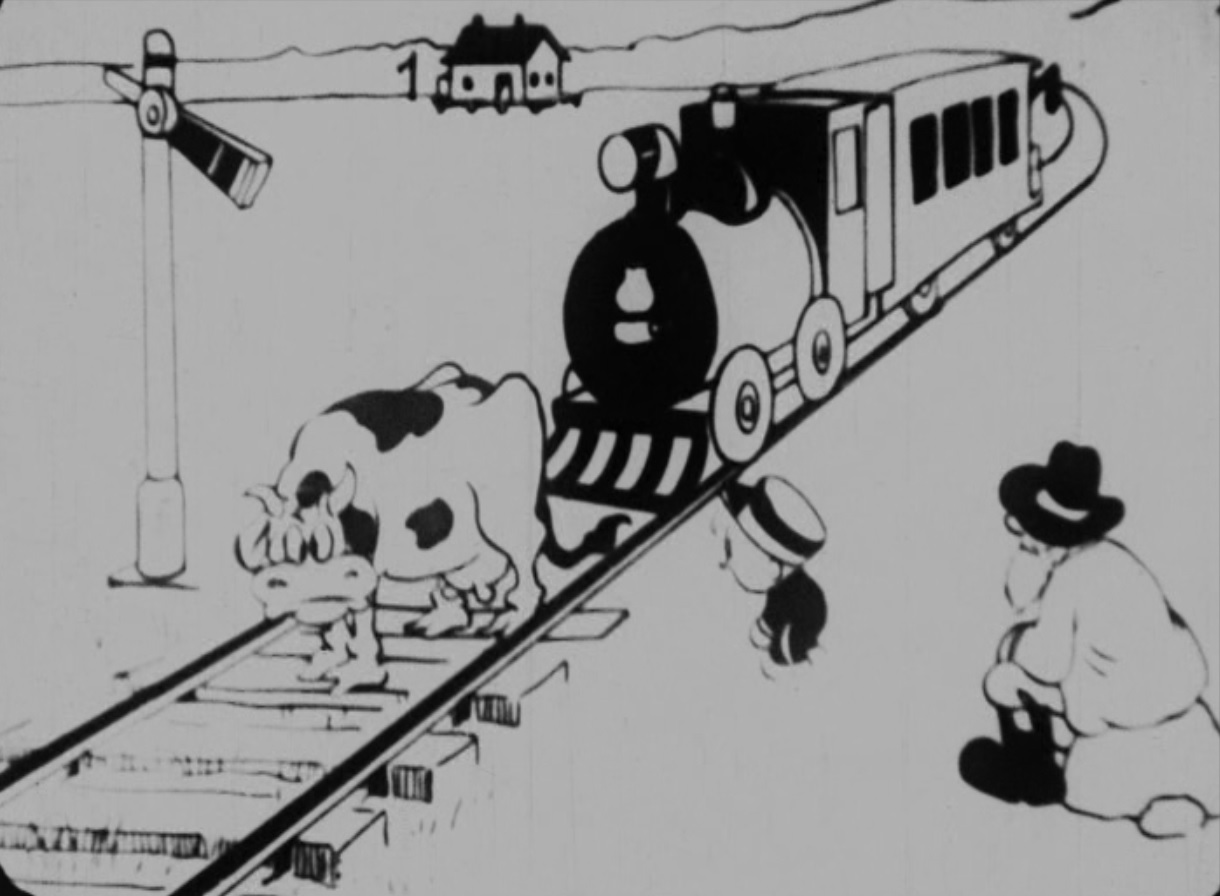
‘The Wrong Track’ is a short gag cartoon featuring ‘Jerry on the Job’, apparently a little kid doing all kinds of jobs.
In this short he’s a train engineer, who’s scolded by his boss of killing too many animals on the train track. And indeed, only a few seconds after leaving the train station Jerry encounters a cow, which after some action is killed.
The short features quite some funny gags and ends with a great punchline. The designs are simple, but pleasant and Walter Lantz’s animation is fair and effective. ‘The Wrong Track’ may not be a masterpiece, it’s a fun bit of early animation, and certainly one of the better shorts from this era.
The Wrong Track’ is available on the Thunderbean Blu-Ray/DVD-combo ‘Technicolor Dreams an Black & White Nightmares’
Director: Wallace Carlson
Release Date: January 9, 1919
Stars: Us Fellers
Rating: ★★★
 Wallace Carlson (1894-1967) was a comic strip artist, who had a brief career as an animator from 1914 to 1921. Carlson joined the Bray studio in 1917, for which he created the ‘Us Fellers’ series. The series stars a boy character called Dreamy Dud, whom Carlson had conceived earlier.
Dud is a boy who breaks his bank (and unfortunately the one coin therein) to buy his girlfriend Mamie some ice cream. But instead he’s punished and sent to bed without supper. At night Dud sneaks out and first imagines how his mother gets filled with remorse, while he finds a treasure. But then the figments of his imagination turn into scary monsters, and he runs home, only to get spanked.
‘Dud Leaves Home’ is a well-told film, with great attention to the child’s world and imagination. The night scenes show some pretty background art. The animation, on the other hand, is rather stiff and robotic, especially when compared to Earl Hurd’s or Raoul Barré’s animation from the same era.
Carlson left animation in 1921 to concentrate on comic strips again, creating the highly successful comic strip series ‘The Nebbs’ in 1923.
Watch ‘Dud Leaves Home’ yourself and tell me what you think:
‘Dud Leaves Home’ is available on the DVD ‘Before Walt’
Director: Earl Hurd
Release Date: November 20, 1918
Stars: Bobby Bumps
Rating: ★★★★
 In ‘Before and After’ Bobby Bumps tricks his father into buying a hair restoring lotion, with the help of his pooch Fido and two other dogs.
Bobby spends his father’s dollar on ice cream, but gets spanked in the end by father’s scalp massage machine.
This is a charming short cartoon, full of elegant designs and fine animation, even if it remains as stiff and repetitive as that of contemporary cartoons. But at least the poses look lifelike.
‘Before and After’ is available on the DVD ‘Before Walt’
Director: Paul Terry
Release Date: August 25, 1916
Stars: Farmer Al Falfa
Rating: ★
 In this very short animated cartoon a near-sighted British hunter called Sir Henry Bonehead comes poaching at farmer Al Falfa’s game reserve.
The hunter even shoots at Al Falfa, thinking the bearded man is a goat. In the end the farmer disposes of both hunter and his black servant.
This short shows that quality never has been in Paul Terry’s vocabulary. The story makes no sense, there’s no plot to speak of, the gags are lame, and the animation stiff as hell. Others at the Bray studio could do better, much better.
Watch ‘Farmer Al Falfa’s Revenge’ yourself and tell me what you think:
‘Farmer Al Falfa’s Revenge’ is available on the DVD ‘Before Walt’
Director: Earl Hurd
Release Date: September 17, 1917
Stars: Bobby Bumps
Rating: ★★½
 The Bobby Bumps series was conceived and drawn by Earl Hurd, the inventor of cel animation, and his series is the first to employ this new technique.
‘Bobby Bumps starts for School’ is the 23rd entry in the series, and this film transcends the tiresome dullness of the limited animation dominating the cartoons of the 1910s with the charm of the drawings.
Bobby Bumps has to go to school. First he’s washed by his ma, then we watch him walking to school, carrying ridiculously large books on his back. At school he imagines himself playing ball with his dog Fido (visualized on his desk). The body of the film involves some antics with the school bell and the headmaster. The film ends with a little mouse writing ‘Earl Hurd’.
‘Bobby Bumps Starts for School’ is full of clever ideas and elegant, if very limited animation. Especially the animation on Fido’s walk is very well done. Throughout it’s clear that Earl Hurd knows how to draw and his perspective drawing is excellent.
Watch ‘Bobby Bumps Starts for School’ yourself and tell me what you think:
‘Bobby Bumps Starts for School’ is available on the Blu-Ray-DVD-combo ‘Cartoon Roots’
Director: Leon Searl
Release Date: February 29, 1916
Stars: Krazy Kat
Rating: ★★★
 ‘Krazy Kat’ was the very first animal cartoon star featured in a cartoon series of her own.
‘Krazy Kat’, of course, was taken from George Herriman’s celebrated comic strip, which had started in 1913. The film series started three years later, and lasted until 1940. By then the character had become a far cry from Herriman’s creation.
But the earliest Krazy Kat cartoons still had a lot in common with George Herriman’s comic strip, on which they were based. ‘Krazy Kat Goes a-Wooing’, the fourth Krazy Kat cartoon, is a good example. This short animation film lasts only three minutes and seemingly re-tells one Sunday Page, using a lot of text balloons. Both the designs, backgrounds and characters are still in tune with Herriman’s creations.
Krazy Kat goes serenading her love Ignatz Mouse, but he rushes off to fetch some bricks to throw at her. Leon Searl’s drawings are appealing, but his animation is very stiff. For example, when we watch Krazy serenading, only two drawings are used.
Watch ‘Krazy Kat Goes a-Wooing’ yourself and tell me what you think:
‘Krazy Kat Goes a-Wooing’ is available on the DVD-set ‘Popeye the Sailor 1933-1938’
Director: George Vernon Stallings
Release Date: September 4, 1915
Stars: Colonel Heeza Liar
Rating: ★★★
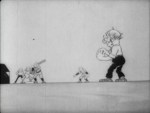 ‘Colonel Heeza Liar at the Bat’ is a Colonel Heeza Liar cartoon directed by George Vernon Stallings, who would later join Van Beuren and Disney.
Stallings’s approach to animation is very comic strip-like in this short: the scenes are very flat, and although the drawing and posing are very good, the animation is extremely limited and stiff, relying heavily on repeated drawings and on poses instead of movement.
In this short the colonel joins a ball game, winning it with ease, e.g. by pitching curve balls that defy all laws of nature, and by running a home-run three times in a row. The film uses titles in rhyme, but text balloons are reserved for the umpire only.
Watch ‘Colonel Heeza Liar at the Bat’ yourself and tell me what you think:
‘Colonel Heeza Liar at the Bat’ is available on the DVD-set ‘Popeye the Sailor 1933-1938’ and on the DVD ‘Before Walt’
Director: Paul Terry
Release Date: October 18, 1916
Stars: Farmer Al Falfa
Rating: ★★
 In 1915 Paul Terry joined the Bray studio and introduced a character of his own called farmer Al Falfa.
Farmer Al Falfa never amounted to something of an interesting character, like for example a Bobby Bumps or Felix the Cat, and I doubt whether he ever had many fans. Yet, the animated farmer lasted until 1937, and even didn’t completely disappear after that.
‘Farmer Al Falfa Sees New York’ is Farmer Al Falfa’s ninth film, and has the farmer visiting the big city, where he’s seduced by a remarkably realistically drawn woman. Later he plays cards with some cheating criminals, only to win after all.
Unlike J.R. Bray, Paul Terry was a rather poor draftsman, as this film clearly shows. The animation is weak and formulaic, and the farmer and the woman don’t inhabit the same cartoon universe. The result is a rather inferior cartoon that nevertheless foreshadows the quality of most animation of the silent era, unlike Bray’s own early high quality films.
Indeed, most of the secret of Terry’s success did not lie in the quality of his work, but in his working speed. Yet, his stay at Bray’s studio was not a happy one, and at the end of 1916 he left, only to get inducted in the army. A few years after World War I, in 1921, Terry would return to the animation business, co-founding a studio with Amedee J. van Beuren, reviving his character Al Falfa, and becoming one of the biggest players in the field.
Watch ‘Farmer Al Falfa Sees New York’ yourself and tell me what you think:
‘Farmer Al Falfa Sees New York’ is available on the DVD & Blu-Ray-set ‘Cartoon Roots: The Bray Studios Animation Pioneers’
Director: Carl Anderson
Release Date: January 27, 1916
Stars: Police Dog
Rating: ★
 Soon the Bray studio employed more and more animators, becoming the most important studio of the 1910s, greatly helped by some patents, most importantly the Bray-Hurd patent for cel animation, which copyrighted an animation technique that would be the major technique in drawn animation until the late 1980s.
In the 1910s the young studio kept attracting some names that would become some of the most important animators and producers of the future, like Max Fleischer, Walter Lantz and Paul Terry. These new animators were allowed to start their own series, thus the Bray studio produced such diverse series as Earl Hurd’s Bobby Bumps, Paul Terry’s Farmer Al Falfa, and Max Fleischer’s Out of the Inkwell.
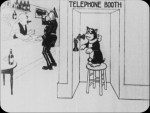
One of J.R. Bray’s new animators was Carl Anderson, who made ca. a dozen ‘Police Dog’ films between 1914 and 1918, of which ‘The Police Dog on the Wire’ is one. When judged by this film Anderson emerges as one of the less inspired artists of the Bray studio. The film is remarkably plotless, with a female dog phoning ‘police dog’, while a cop called Piffles gets drunk. The animation, too, is poor and formulaic, never reaching the heights of that of J.R. Bray himself, let alone a Winsor McCay. Moreover, the frames are cramped with objects, giving the characters scarcely space to move in. Many scenes are appallingly slow and static, resulting in a film that is best forgotten.
Watch ‘The Police Dog on the Wire’ yourself and tell me what you think:
‘The Police Dog on the Wire’ is available on the DVD & Blu-Ray-set ‘Cartoon Roots: The Bray Studios Animation Pioneers’
Director: J.R. Bray
Release Date: 1915
Rating: ★★★½
 ‘Diplodocus’ is J.R. Bray’s own version of Winsor McCay’s ‘Gertie the Dinosaur‘ (1914), being so similar to the McCay’s success film that it’s plain plagiarism.
The film stars a Diplodocus instead of a Brontosaur and shows the differences between Bray’s and McCay’s drawing styles, with McCay showing more art nouveau elegance, and Bray displaying more comic strip like clarity.
Bray’s film reuses much of McCay’s material: like Gertie the Diplodocus lifts one foot, shifts from side to side, he gets startled by a flying dragon, interacts with a mastodon, eats a pumpkin etc. Like McCay’s film it’s clear that the film had to be shown together with a live narrator, who interacts with the drawn prehistoric animal.
The only new elements are the Diplodocus tying its neck in a knot, the arrival of a small monkey, and a sea serpent pulling at the mastodon’s trunk.
Bray’s animation is of a high quality, but his Diplodocus lacks Gertie’s personality. Thus this weak rip off only manages to show what great film ‘Gertie the Dinosaur’ was, and still is.
Watch ‘Diplodocus’ yourself and tell me what you think:
‘Diplodocus’ is available on the DVD & Blu-Ray-set ‘Cartoon Roots: The Bray Studios Animation Pioneers’


 Dr. Grob's Animation Review