
You are currently browsing the category archive for the ‘Max Fleischer films’ category.
Director: Dave Fleischer
Release Date: March 25, 1932
Stars: Betty Boop, Bimbo
Rating: ★★½
Review:
 In ‘Crazy Town’ Betty Boop and Bimbo take a streetcar to Crazy Town, where everything is the other way round.
Unfortunately, this great idea doesn’t really lead to a funny cartoon. We’re watching e.g. fish in the sky and birds in the water, an elephant with a real trunk and a fish fishing for a person. In a lengthy sequence Bimbo is a barber adding hair to his customers. None of these scenes even raise a chuckle. In fact, the cartoon’s only interesting part is it’s opening, because the story unfolds like a real book.
It’s weird to realize that as soon as the Fleischers deliberately tried to show a surreal world, they failed, while their ‘normal’ shorts were full of mesmerizing surrealism (e.g. the earlier ‘Mask-a-raid‘ and ‘Chess Nuts‘ or ‘Betty Boop’s Bamboo Isle‘ from later that year). The theme song of this cartoon is the 1931 hit ‘Foolish Facts’.
Watch ‘Crazy Town’ yourself and tell me what you think:
This is Talkartoon No. 35
To the previous Talkartoon: S.O.S.
To the next Talkartoon: The Dancing Fool
‘Crazy Town’ is available on the French DVD Box Set ‘Betty Boop Coffret Collector’
Director: Dave Fleischer
Release Date: February 5, 1932
Stars: Bimbo, Betty Boop
Rating: ★
Review:
 Even though ‘The Robot’ was released half a year after ‘The Herring Murder Case’ (1931) it features Bimbo in his design before his make-over in that film.
In this film Bimbo is courting a female character, who only wants to marry him, when he can lick ‘One Round Mike’ in a boxing match. Bimbo accepts, but when it’s his turn he builds a robot out of his car to win the game.
Betty Boop has a small cameo in this cartoon when she rushes outside to revive Bimbo’s car-robot (or is she Bimbo’s girlfriend but in a different design? The Fleischers were inconsistent enough to be unclear on this). Apart from this short scene, there’s little to enjoy in ‘The Robot’. The most interesting part maybe Bimbo’s way of courting his sweetheart, which he does by ‘television’, a sort of Skype avant la lettre.
Strangely enough, the idea of a boxing robot was reused in ‘Mickey’s Mechanical Man‘ from 1933, with equally weak results. There was something going on in 1932 with boxing robots anyway, for also Popeye socks a robot in the ring in the Popeye Sunday comic strip of April, 24 and May 1, 1932. In any case, to most people in the Great Depression robots were the ultimate terror, as unemployment already was a major problem. Luckily, no robot would be used in any factory until the 1960s. And boxing robots still haven’t seen the light of day, yet.

Spread from the April 1934 issue of Modern Mechanix and Inventions
More on the robot craze of the early 1930s can be found here and here.
Watch ‘The Robot’ yourself and tell me what you think:
This is Talkartoon No. 32
To the previous Talkartoon: Boop-Oop-a-Doop
To the next Talkartoon: Minnie the Moocher
‘The Robot’ is available on the French DVD Box Set ‘Betty Boop Coffret Collector’
Director: Dave Fleischer
Release Date: January 16, 1932
Stars: Betty Boop, Koko, Bimbo
Rating: ★★★★½
Review:
 In ‘Boop-Oop-a-Doop’ Betty Boop works at the circus as a lion-tamer and as a rope-dancer.
We watch her in a sexy performance on the slack-rope. During this performance we can see the circus-master growing with lust, and back in her dressing room he tries to harass her. Luckily, Koko saves here, so he “couldn’t take her boop-oop-a-doop away“.
This is the first short to co-star Koko and Betty. Koko had returned to the animated screen in ‘The Herring Murder Case’, and he’s clearly comfortable in the circus setting of this short. Interestingly, it’s Koko who is Betty’s lover in this cartoon, not Bimbo. Bimbo’s role is reduced to being a peanut seller in a running gag. Koko’s career in the sound era was short-lived, however, and was to end already two years later with ‘Ha! Ha! Ha!‘ (1934).
‘Boop-oop-a-doop’ is an entertaining short, full of catchy music. For example, on the slack-rope Betty sings ‘Do Something’, a song associated by the singer who inspired her character, Helen Kane, who had recorded it in 1929. The two versions are indeed surprisingly similar, and it is not hard to see why Kane, whose own career had been in a steady decline, sued the Fleischer company on May 4, 1932.
It may very well be that this cartoon alone triggered that event. It at least should have been quite some evidence for Fleischer’s piracy, but after a case of two years, judge McGoldrick saw it otherwise. It’s rather difficult to understand now how the Fleischers could have won. Not only does Betty Boop sound like Kane, her looks are also strikingly similar. Indeed, according to her animator and creator Gram Natwick she was modeled after Helen Kane when conceived for ‘Dizzy Dishes‘ (1930). However, Betty’s grotesque, and rather ugly appearance in her earliest cartoons must hardly have given that fact away. Moreover, in her following films both Betty’s voice and looks were both subject to change. Only by the time of ‘Boop-Oop-a-Doop’ Betty really started to look like her source of inspiration…
Anyway, for a detailed account of the trial, see Trafalz’s excellent blog post on the subject.
Watch ‘Boop-Oop-a-Doop’ yourself and tell me what you think:
‘Boop-Oop-a-Doop’ is available on the French DVD Box Set ‘Betty Boop Coffret Collector’
This is Talkartoon No. 31
To the previous Talkartoon: Any Rags
To the next Talkartoon: The Robot
Director: Dave Fleischer
Release Date: November 14, 1931
Stars: Betty Boop, Bimbo
Rating: ★★★★
Review:
 In ‘Mask-A-Raid’ a very sexy Betty is queen of a masked ball.
The king, a dirty old man, fancies her, but she prefers Bimbo. Nevertheless, she makes Bimbo and the old guy fighting each other. Suddenly knights pop up from nowhere and everybody is fighting.
In ‘Mask-a-raid’ some of the random surrealism of ‘Barnacle Bill‘ and ‘Mysterious Mose‘ (both 1930) returns to the screen. The cartoon is full of weird images and odd gags, and at times should be seen to be believed. It ends with some great scatting by Bimbo himself.
This is Betty’s first cartoon as a human being (apart from the Screen Song ‘Kitty from Kansas City‘ from only one week before), with her dog ears having changed into large earrings. It’s also the first to give her starring credits. It introduces the new story idea of old men fancying Betty, and harassing her against her will. This story element would also be featured in e.g. ‘Boop-oop-a-Doop‘ (1932) and ‘Betty Boop’s Big Boss‘ (1933).
Watch ‘Mask-A-Raid’ yourself and tell me what you think:
This is Talkartoon No. 27
To the previous Talkartoon: In the Shade of the Old Apple Sauce
To the next Talkartoon: Jack and the Beanstalk
‘Mask-A-Raid’ is available on the French DVD Box Set ‘Betty Boop Coffret Collector’
Director: Dave Fleischer
Release Date: November 7, 1931
Stars: Betty Boop, Rudy Vallee
Rating: ★★★
Review:
 ‘Kitty from Kansas City’ is a Screen Song in which Rudy Valley sings his famous hit from 1930 about his dumb girlfriend Kitty.
This short starts with Kitty (whom we can recognize as Betty Boop) waiting for the train, until she’s picked up by a mail hook. Enter Rudy Vallee in bowler hat and with old-fashioned mustache, singing the title tune, accompanied by the bouncing ball. The cartoon ends with a particular fat Kitty involved in random events.
‘Kitty from Kansas City’ is important for two reasons: it’s the first cartoon in which Betty Boop is completely human, and second, it introduces a new story element, which was to be used frequently in the years to come: that of an old man fancying her. This time it’s an old station master.
Watch ‘Kitty from Kansas City’ yourself and tell me what you think:
‘Kitty from Kansas City’ is available on the French DVD Box Set ‘Betty Boop Coffret Collector’
Director: Dave Fleischer
Release Date: October 10, 1931
Stars: Betty Boop, Bimbo
Rating: ★★½
Review:
 Betty Boop, who lives in an apartment across the street, invites Bimbo over, but he can’t come, because he has to attend his little baby brother Aloysius.
Nevertheless, he does abandon the mischievous little brat and goes to Betty’s house to skip rope. However, Aloysius sucks them back into his own house, using a particularly powerful vacuum cleaner.
Aloysius is seen smoking a cigar and reading the paper, not unlike Baby Herman in ‘Who Framed Roger Rabbit‘ (1988). The cartoon establishes Bimbo and Betty as lovers, but it doesn’t make much sense, and its gags feel random and misguided.
‘Minding the Baby’ was the last cartoon featuring Betty with dog ears. in her next cartoon ‘Mask-A-Raid‘ she became fully human.
Watch ‘Minding the Baby’ yourself and tell me what you think:
This is Talkartoon No. 25
To the previous Talkartoon: Bimbo’s Express
To the next Talkartoon: In the Shade of the Old Apple Sauce
‘Minding the Baby’ is available on the French DVD Box Set ‘Betty Boop Coffret Collector’
Director: Dave Fleischer
Release Date: August 22, 1931
Stars: Betty Boop, Bimbo
Rating: ★★
Review:
 In this Talkartoon Bimbo is a moving man, moving Betty Boop’s household together with a horse, a cat and a hippo.
The short features ca. no story and consists of a string of unrelated throwaway gags. The animation, too, is at times completely random. For example, there’s some totally unnecessary and incomprehensible flexible animation on Bimbo’s van in the opening scene. This total lack of direction hampers ‘Bimbo’s Express’, and it fails to fulfil any promise.
The cartoon’s most stunning scene is that of Betty Boop cutting her toenails. But even more striking is Sammy Timberg’s music, which is loosely jointed from numerous familiar tunes, and which anticipates Carl Stalling’s techniques by several years.
This cartoon is billed ‘Bimbo & Betty’, indicating Betty’s rising star. In the next cartoon, ‘Minding the Baby‘, it would be ‘Betty Boop and Bimbo’, and in ‘Mask-A-Raid‘, it’s already “Betty Boop in ‘Mask-A-Raid’ with Bimbo’…
Watch ‘Bimbo’s Express’ yourself and tell me what you think:
This is Talkartoon No. 24
To the previous Talkartoon: Bimbo’s Initiation
To the next Talkartoon: Minding the Baby
‘Bimbo’s Express’ is available on the French DVD Box Set ‘Betty Boop Coffret Collector’
Director: Dave Fleischer
Release Date: July 24, 1931
Stars: Bimbo, Betty Boop
Rating: ★★★★★ ♕
Review:
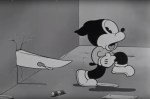 ‘Bimbo’s Initiation’ is probably the most famous Betty Boop cartoon, apart from ‘Snow-White‘ (1933).
Nevertheless, Betty only plays a small part in the cartoon, which is really about Bimbo. In his previous cartoon, ‘The Herring Murder Case’, Bimbo had been redesigned. He’s now more clearly a dog character, with a predominant black coloring instead of the earlier white. This redesigned Bimbo has some character in his rather original looks, but he’s still far from a character, remaining only a foil for the things happening around him.
In no cartoon this is so clear as in ‘Bimbo’s Initiation’. In the first scene we watch him walking on the street, when he suddenly falls into a well and is being caught in a scary underworld beneath the street. There bearded guys repeatedly ask him whether he wants to be a member of their secret order. Bimbo keeps saying no, and he tries to flee, but he cannot escape the nightmarish world, in which every deadly room leads to another one. These scenes are accompanied by a hot jazz version of ‘Tiger Rag’. Luckily, the last room features Betty, and when she asks him whether he wants to be a member, Bimbo gives in. Then all the bearded figures appear to be duplicates of her!
Betty Boop is completely blank in this cartoon and she still has dog ears here. But the nightmarish world is absolutely inspired. It’s both claustrophobic and funny, and we feel with Bimbo, who’s now victim of a world, in which no law, whether human or natural, applies. No other cartoon was so far removed from the happy world of Walt Disney, and arguably no other cartoon before Tex Avery’s ‘Northwest Hounded Police‘ (1946) and Chuck Jones’s ‘Duck Amuck‘ (1953) would be so compelling in portraying the anguish of a trapped cartoon character. Despite its primitive looks, the cartoon hasn’t aged at all, and it’s an undisputed classic within the complete cartoon canon.
‘Bimbo’s initiation’ undoubtedly has been the inspiration of the scary cartoon sequence in which a girl is caught in Joe Dante’s episode in the theatrical version of ‘The Twilight zone’ (1983).
Watch ‘Bimbo’s initiation’ yourself and tell me what you think:
This is Talkartoon No. 23
To the previous Talkartoon: The Herring Murder Case
To the next Talkartoon: Bimbo’s Express
‘Bimbo’s initiation’ is available on the French DVD Box Set ‘Betty Boop Coffret Collector’ and on Betty Boop: Essential Collection 2′
Director: Dave Fleischer
Release Date: April 16, 1931
Rating: ★★★½
Review:
 ‘Any Little Girl That’s A Nice Little Girl’ is a Screen Song about a cat who’s dating several girls at the same time.
First we watch him dating his girls through the telephone, then he goes through a bunch of photographs and chooses to visits hot Lulu Belle. When he tries to sneak out, Lulu Belle hits him with the couch. Enter the Screen Song, which is accompanied with images of e.g. a naked woman in a bath(!) and a picture of Betty Boop, who otherwise does not appear in this cartoon.
Only the first scene features lip-synch, and the scene with Lulu Belle also features an excerpt from the 1929 hit song ‘What Wouldn’t I Do for That Man’, popularized by Annette Hanshaw and Ruth Etting. This excerpt is much more interesting than the 1910 vaudeville title song. The last chorus features some nice interplay between the words and the animated characters, typical for the Screen Songs of this era.
Watch ‘Any Little Girl That’s A Nice Little Girl’ yourself and tell me what you think:
‘Any Little Girl That’s A Nice Little Girl’ is available on the French DVD Box Set ‘Betty Boop Coffret Collector’
Director: Dave Fleischer
Release Date: March 21, 1931
Rating: ★★★
Review:
 ‘In My Merry Oldsmobile’ is a rather odd commercial for Oldsmobile, done in Screen Song fashion. The cartoon will be familiar of readers of Leonard Maltin’s ‘Of Mice and Magic’, for his book features several stills from this film.
The film starts weird to begin with. We watch an evil male character sneak upon a woman undressing(!). Luckily she reveals countless dresses under each other. The creepy guy sneaks into her home and asks the terrified woman for a ride, which she unsurprisingly refuses. Then suddenly a little guy arrives offering her a ride in his Oldsmobile outside. This section uses a lot of dialogue, but no lip synch whatsoever.
The little guy’s invitation for a ride prompts the barbershop title song (a hit song from 1905) and the bouncing ball, so typical of Fleischer’s Screen Songs. The song is accompanied by images of a couple riding an Oldsmobile Curved Dash from 1904, the car celebrated in the song. Then we watch the cartoon characters riding this car, and suddenly there’s a lot of metamorphosis of words into the car etc. The film ends as oddly as it started: when the couple gets married, they’re immediately in a boxing match, indicating that marriage is one long fight.
One wonders how such a story would help Oldsmobile selling more cars. Moreover, none of their latest models is featured in the cartoon, only their first model, which by 1931 was of course extremely outdated.
Watch ‘In My Merry Oldsmobile’ yourself and tell me what you think:
‘In My Merry Oldsmobile’ is available on the DVD ‘Fleischer Classics featuring Gulliver’s Travels’
Director: Dave Fleischer
Release Date: May 23, 1931
Stars: Bimbo, Betty Boop
Rating: ★★★
Review:
 In ‘Silly Scandals’ Bimbo wants to visit a theater, where Betty Boop performs.
Unfortunately he’s broke, but he finally succeeds in sneaking into the theater by walking backwards along the leaving crowd. Inside we watch Betty singing the 1930 hit song ‘You’re driving me crazy’. Like in ‘Mysterious Mose‘ her sexiness is well explored, as her dress falls off during the performance, revealing her bra.
After Betty’s performance, Bimbo ends up being hypnotized by a magician, who makes our unfortunate hero dance against his will. The cartoon ends in a short, but zany and nightmarish dream sequence.
‘Silly Scandals’ is a transitional cartoon that shows the potential of Fleischer’s fledgling cartoon star Betty Boop, but failing to explore it to the max, still focusing on the rather bland Bimbo. We hear her name for the very first time. Yet, Bimbo is still the only billed star of the cartoon. But the Fleischers were quick learners, and with almost every subsequent Talkartoon Betty’s star would rise, and her screen time increase.
Watch ‘Silly Scandals’ yourself and tell me what you think:
This is Talkartoon No. 21
To the previous Talkartoon: Twenty Legs under the Sea
To the next Talkartoon: The Herring Murder Case
‘Silly Scandals’ is available on the French DVD Box Set ‘Betty Boop Coffret Collector’
Director: Dave Fleischer
Release Date: April 3, 1931
Stars: Bimbo, Betty Boop
Rating: ★★½
Review:
 Bimbo is a train robber who holds up a train. Unfortunately for him, his stout wife, Betty Boop (called Nan McGrew in this cartoon), is also on this train.
She confronts him and in the end Bimbo unwillingly reunites with his wife, fleeing with her into the distance on the locomotive.
‘The Bum Bandit’ lacks the wild surrealism of earlier Talkartoons, like ‘Barnacle Bill‘ and ‘Mysterious Mose‘ (both 1930), and is thus less interesting to watch. The best scene is when Bimbo practices shooting, e.g. shooting a cow from the sky. There is also some nice and flexible animation on the riding train. Betty Boop has a distinctly different voice here, which was not repeated after this cartoon.
Watch ‘The Bum Bandit’ yourself and tell me what you think:
This is Talkartoon No. 18
To the previous Talkartoon: The Cow’s Husband
To the next Talkartoon: The Male Man
‘The Bum Bandit’ is available on the French DVD Box Set ‘Betty Boop Coffret Collector’
Director: Dave Fleischer
Release Date: September 24, 1930
Stars: Bimbo?
Rating: ★★★★★ ♕
Review:
 ‘Swing You Sinners!’ is an early Talkartoon, and a wildly imaginative one, too.
We watch a thief (probably Bimbo, but his appearance in the early Talkartoons is so inconsistent, one can’t be sure). The thief tries to steal a chicken, but runs into a cop. The thief then flees into a graveyard, where he has a particularly nightmarish experience. First the gate locks itself, then turns into a stone wall, and then the graves start to sing…
Soon all kinds of inanimate objects start to haunt him. And although the soundtrack is very jazzy, ‘Swing You Sinners!’ remains a bad trip throughout. At one time the walls close into him, at another a ghost promises him to give him a ‘permanent shave’.
The animation is extremely rubbery, and even insane. For example, when we watch a chicken do some scatting, both the chicken and the background are very wobbly, to a hallucinating effect. In the end we watch countless ghosts marching, followed by even more ghostly images when the thief starts to descend into hell. The cartoon ends with a giant skull swallowing the thief, a surprisingly grim ending for a cartoon with such swinging music*.
In any case ‘Swing You Sinners!’ is a testimony of the sheer creativity, which was the Max Fleischer Studio in the early 1930s, and should be placed among the greatest cartoons of all time.
Watch ‘Swing You Sinners!’ yourself and tell me what you think:
This is Talkartoon No. 10
To the previous Talkartoon: Barnacle Bill
To the next Talkartoon: Grand Uproar
‘Swing You Sinners’ is available on the French DVD Box Set ‘Betty Boop Coffret Collector’
*It may be interesting to note that this is one of the earliest mentions of swing, predating for example Duke Ellington’s song ‘It Don’t Mean A Thing (If It Ain’t Got That Swing)’ by two years, and being miles ahead of the swing craze of the second half of the 1930s.
Director: Dave Fleischer
Release Date: July 18, 1930
Rating: ★★★★
Review:

The Fleischer studio had already experimented with synchronized sound in 1924, four years before ‘Steamboat Willie‘, so of all cartoon studios they made the transition to sound the most easily.
The Fleischers’ first sound series were the Screen Songs, the first of which was released in February 5, 1929. Eight months later they were followed by the aptly titled Talkartoons. These Talkartoons didn’t have a single star, but like Disney’s Silly Symphonies explored a wide range of subjects.
These Talkartoons show the Fleischers’ disregard of lip synchronization. This feat was reserved for special scenes, like song sequences. Unlike Disney, the Fleischers recorded all dialogue after animation, inviting the voice actors to ad-lib at will. Thus the Fleischer cartoons were the most talkative of all 1930s shorts. This technique reached its peak when Jack Mercer became Popeye’s voice in 1935, but already peppers their earliest output.
The improvised dialogue suits the studio’s free spirited, and equally improvised animation style perfectly. Add a multitude of zany gags, strikingly jazzy soundtracks and remarkably adult subject material, and it’s clear why the Max Fleischer cartoons from 1930-1933 are among the most delightful of all studio cartoons from the golden age.
‘Wise Flies’, the seventh Talkartoon, is a perfect example. It uses the theme of ‘the spider and the fly’, a theme Walt Disney would also use one year later in ‘The Spider and the Fly‘ (1931). However, the Disney version lacks the sexual overtones present in this Fleischer’s version. In it a six-legged spider spots some flies on a hobo’s head. He tries to catch one, but returns home to his wife empty-handed.
However, later he seduces a female fly, playing ‘Some of These Days’ on his web (a delightfully fast piece of guitar jazz). He then starts singing this tune, popularized by Sophie Tucker in 1926, and a hit for Louis Armstrong in 1929. His song leads to a dance sequence much akin to Disney’s Silly Symphonies from the same era. The film ends when the spider’s wife gets jealous, and interrupts the spider’s courting.
The animation by Willard Bowsky and Ted Sears is crude and simple, but the swinging soundtrack is delightful. The end result is an enjoyable piece of rubberhose animation.
Watch ‘Wise Flies’ yourself and tell me what you think:
This is Talkartoon No. 7
To the previous Talkartoon: Fire Bugs
To the next Talkartoon: Dizzy Dishes
Directors: Max Fleischer & F. Lyle Goldman
Production Date: June 21, 1929
Rating: ★★★
Review:
 Well, here’s a real treat: an educational/promotional film directed by Max Fleischer & F. Lyle Goldman to explain sound film, right from the era in which this new feat. was introduced.
The film starts with a sound film role changing into a cartoon figure. The sound film takes a silent film to a professor, who explains how sound film works. The film is most interesting, for it clearly shows the tremendous amount of changes that had to be made to make sound film work.
For example, in live action films the camera was now placed inside a box to prevent the primitive sound recording microphone from catching up the sound of the camera itself. And theaters, too, had to invest in the change. The screen had to be porous to let the sound through produced by giant loudspeakers behind the screen.
The designs and animation of this little film is still firmly rooted in the 1920s, and the animation is remarkably stiff, especially when compared to contemporary Disney cartoons. And although the characters talk a lot, lip synchronization is only suggested, but not really there. In fact, Fleischer would mostly neglect lip synchronization way until the end of the 1930s, only using it minimally. The voice over, too, is a little bit dull and hesitating in explaining the processes, but in the end this film is too unique a document of its time not to enjoy.
Watch ‘Finding his Voice’ yourself and tell me what you think:
‘Finding his Voice’ is available on the DVD ‘Cultoons! Rare, Lost and Strange Cartoons! Volume 2: Animated Education’ and on the DVD box set ‘Popeye the Sailor 1941-1943’
Director: Seymour Kneitel
Release Date: September 18, 1942
Stars: Superman
Rating: ★★★
Review:
 No sooner were the Fleischer brothers removed from their own studio, or their stars Superman and Popeye were fully put to the war effort.
No other American cartoon stars featured in as many propaganda shorts fighting the foe. Superman stars in five, of which ‘Japoteurs’ is the first.
In this entry three Japanese spies try to steal the world’s largest bomber on its test flight. Of course, Lois flies along, and both she and the plane have to be rescued by Superman.
‘Japoteurs’ is an unfortunate cartoon, which adds to the idea of a fifth column of Japanese within The United States, making every Japanese person suspicious. Indeed, due to this type of paranoia, during the war no less than 110,000 Japanese Americans, including women and children, were put into internment camps.
This is Superman film No. 10
To the previous Superman film: Terror on the Midway
To the next Superman film: Showdown
Director: Dave Fleischer
Release Date: July 3, 1942
Stars: Popeye, Olive Oyl, Li’l Swee’Pea
Rating: ★★★★½
Review:
 ‘Baby Wants a Bottleship’ opens with Olive visiting Popeye, whose battleship is stationed at the harbor.
Olive has brought li’l Swee’Pea with her. The baby wants to have a battleship en climbs aboard the cruiser. Popeye has a hard time catching him again.
The result is a cartoon of great comedy and excellent timing. The action includes a musical number in which Popeye is clobbered by a canon. Like in the previous Popeye cartoon, ‘Many Tanks’, Popeye’s design switches between old and new.
Watch ‘Baby wants a Bottleship’ yourself and tell me what you think:
This Popeye film No. 108
To the previous Popeye film: Many Tanks
To the next Popeye film: You’re a Sap, Mr. Jap
Director: Dave Fleischer
Release Date: May 15, 1942
Stars: Popeye, Bluto, Olive Oyl
Rating: ★★★
Review:
 In this World War II cartoon Bluto is a soldier who tries to sneak away to date Olive Oyl.
When Popeye passes by Bluto tricks him into his army uniform. Popeye unwillingly has to join a tank squad, which leads to hilarious antics. Only when he has eaten some spinach Popeye directs his tank out of the camp straight to Bluto, who is wooing Olive.
Jack Mercer’s ad libbing during Popeye’s tank ride is fantastic and a highlight of the cartoon, as is the extremely flexible animation on Popeye’s tank. Popeye’s design changes back and forth from the old Fleischer design to the later, more streamlined Famous design, which makes its debut in this cartoon.
Watch ‘Many Tanks’ yourself and tell me what you think:
This Popeye film No. 107
To the previous Popeye film: Olive Oyl and Water Don’t Mix
To the next Popeye film: Baby Wants a Bottleship
Director: Dave Fleischer
Release Date: March 13, 1942
Stars: Popeye
Rating: ★★★
Review:
 ‘Fleets of Stren’th’ is the third in a series of cartoons in which Popeye has joined the American navy.
In this cartoon Popeye still is a lousy sailor, but when the battle cruiser is under attack, he once again shows what he’s able to do (see also ‘Blunder Below‘). This time the battle cruiser is attacked by a squad of Japanese dive bombers. It takes some time before Popeye is able to eat his spinach, but when he does, he turns into a plane himself, defeating the complete enemy fleet.
In this process we see only one pilot, the other planes are subtly dehumanized. In this way we’ll never think of the fate of the Japanese pilots, at all. This was a clever device used in many war propaganda films of the time.
Watch ‘Fleets of Stren’th’ yourself and tell me what you think:
This Popeye film No. 104
To the previous Popeye film: Blunder Below
To the next Popeye film: Pip-Eye, Pup-eye, Poop-eye and Peep-eye
Director: Dave Fleischer
Release Date: February 13, 1942
Stars: Popeye
Rating: ★★★★
Review:
 Popeye had joined the navy before the United States entered the war, in ‘The Mighty Navy‘ (November 1941), so in ‘Blunder Below’ he’s ready to fight the enemy, the first major cartoon star to do so on the movie screen.
In the first part of this cartoon Popeye tries to be a normal sailor, among Superman-like sailors, trying to learn gunning. He is no talent, however, blundering away and almost shooting down the captain by accident.
But when a submarine approaches, Popeye shows his real worth: he beats the submarine single-handedly, saving the battle cruiser. It’s this great combination of clumsiness and superhuman powers which make Popeye such an appealing character.
The approaching submarine is accompanied by the music of Franz Schubert’s Erlkönig, indicating a German origin. However, it soon turns out to be Japanese. The submarine is anthropomorphic itself and completely dehumanized, as if it were not manned by people at all. When in August 1942 Popeye changed hands from the Fleischers to Paramount, this would radically change…
Watch ‘Blunder Below’ yourself and tell me what you think:
This Popeye film No. 103
To the previous Popeye film: Kickin’ the Conga ‘Round
To the next Popeye film: Fleets of Stren’th


 Dr. Grob's Animation Review