You are currently browsing the category archive for the ‘★★★★★ ♕’ category.
Director: Walt Disney
Release Date: May 15, 1928
Stars: Mickey Mouse, Minnie Mouse
Rating: ★★★★★ ♕
Review:
 April 1928. Disney has just returned from an ill-fated journey to New York. There he had learned that he had lost his star character Oswald the Lucky Rabbit, and all his crew – all hired away by his distributor, Charles Mintz.
All, save one – only his friend and star animator Ub Iwerks has remained loyal*. And while the rest of the studio is working on the last Disney-produced Oswald cartoons, Iwerks is set to work in a separate office, secretly working on a cartoon, not for Mintz, but for Disney.
Iwerks works at an astonishing speed, and he finishes the animation on the cartoon after two weeks. This is a stunning effort by all standards. But what is even more extraordinary is that the finished product, ‘Plane Crazy’, turns out to be such a fine cartoon!
‘Plane Crazy’ is more consistent than most of the preceding Oswalds. It’s fast, it’s simply packed with gags and very funny. Moreover, it’s full of visual tricks. For example, the film opens with the behind of a cow (!), walking away from the camera. Later there are some great perspective scenes with Mickey’s plane flying under a cow’s udders, and almost crashing into two cars.
The film draws inspiration from the same event as the earlier Oswald cartoon ‘The Ocean Hop‘ (1927): Charles Lindbergh’s flight from New York to Paris on May 20-21 1927, the first non-stop flight across the Atlantic Ocean. A goggle-eyed Mickey Mouse (without shoes or gloves) wants to imitate ‘Lindy’ and builds a plane himself, helped by the other farm animals.
Unfortunately his plane crashes against a tree. Then Mickey transforms a car into a plane, and asks Minnie to fly along. After a breath taking take-off, the plane flies, and up in the air Mickey forces a kiss from Minnie, with disastrous results.
‘Plane Crazy’ is, of course, Mickey’s first cartoon and it hasn’t aged a bit. Yes, it’s a silent cartoon with sound added later. Yes, Mickey looks and behaves rather differently than he would do later, and yes, some of the gags are rather crude. Yet, Plane Crazy is outstanding for its fast-paced gags, its extraordinarily rubbery animation, its awesome use of perspectives and its effective pantomime character animation (its only piece of dialogue is Minnie asking “who, me?”).
The film is a testimony of Ub Iwerks’s extraordinary skill. Not only was he an incredibly fast animator, as this short shows he was also an original artist, with a distinct style and an excellent sense of comic timing.
Unfortunately, in 1928, the distributors didn’t see anything distinctive in Mickey. True, he was not too different from Oswald. Both characters were of more or less the same size (with Mickey being outrageously big for a mouse from the outset). Both characters were kinda likable, had a joyful, adventurous spirit, and were seen courting a love interest. Nevertheless, Disney produced a second cartoon with his new character, ‘Gallopin’ Gaucho‘.
Watch ‘Plane Crazy’ yourself and tell me what you think:
This is Mickey Mouse cartoon No. 1
To the next Mickey Mouse cartoon: Gallopin’ Gaucho
* and, to be fair, animator Johnny Cannon, and the recently hired Les Clark (one of the future Nine Old Men – who was not even approached by Mintz), and some ink and paint girls, and the janitor.
Director: Burt Gillett
Release Date: August 11, 1934
Stars: Clara Cluck, Clarabelle Cow, Donald Duck, Goofy, Horace Horsecollar, Mickey Mouse, the Orphan Mice
Rating: ★★★★★ ♕
Review:
 In ‘Orphan’s Benefit’ Mickey and the gang are giving a theatrical performance for the orphan mice we know from ‘Mickey’s Nightmare’ (1932) and other cartoons.
We watch Donald Duck reciting ‘Little Boy Blue’, Horace Horsecollar, Clarabelle Cow and Goofy as acrobats and Mickey and Clara Cluck giving a recital.
‘Orphan’s Benefit’ marks Donald Duck’s second appearance, after his debut in ‘The Wise Little Hen‘ from two months earlier, and his looks are still a bit awkward: he has black feet (because of his transition from color to black and white), an elongated bill and he is very small compared to the rest of the gang. Nevertheless, ‘Orphan’s Benefit’ marks the real birth of Donald Duck: he’s cast outside the Silly Symphonies along Mickey and his co-stars, and he’s really stealing the show. Moreover, for the first time he’s showing his temper and his typical ‘dance of anger’ (created and animated by Dick Lundy).
Besides Donald Duck this cartoon also introduces Clara Cluck, the opera-singing hen. Her career was way less successful than Donald’s: in total she would star in only seven cartoons, and she retired in 1942. Mickey’s role is reduced to a scarcely visible and embarrassingly unfunny straight man. Therefore Orphan’s Benefit marks as much the start of Donald’s career as the beginning of Mickey’s demise.
‘Orphan’s Benefit’ was the only Disney cartoon to be remade. In 1941 it appeared again, now in color and with new designs (especially of Donald Duck).
Watch ‘Orphan’s Benefit’ yourself and tell me what you think:
This is Mickey Mouse cartoon No. 68
To the previous Mickey Mouse cartoon: Mickey’s Steamroller
To the next Mickey Mouse cartoon: Mickey Plays Papa
Director: Wilfred Jackson
Release Date: February 10, 1934
Rating: ★★★★★ ♕
Review:
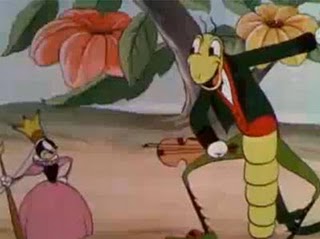 ‘The Grasshopper and the Ants’ is easily one of the best Silly Symphonies: it has a catchy song, great use of color and beautiful effect animation. Notice, for instance, the realism of the leaves blowing away during the autumn scene. One can even recognize which trees they’re from!
The grasshopper, too, is a wonderfully designed character, based on concept art by the great Albert Hurter. In contrast, the design of the ants looks a little primitive, still belonging to the black and white era. But, by now, the Disney staff has fully mastered the idea of character animation. This is best shown in the final dance scene: even in a crowd of lookalikes one easily recognizes the joyful ant the Grasshopper had tempted earlier.
Note that morality notwithstanding, the grasshopper is allowed to do what he does best: singing and playing. An encouragement to view art as an important contribution to society. Even so, the way the queen finally invites him is a real cliff-hanger.
This cartoon’s theme song, ‘the world owes me a living’ was composed by Leigh Harline, who would also compose the catchy songs of ‘Pinocchio‘. the grasshopper’s catchy song would become Goofy’s theme song. No wonder, for he and the Grasshopper share the same voice, by Pinto Colvig.
Watch ‘The Grasshopper and the Ants’ yourself and tell me what you think:
This is Silly Symphony No. 42
To the previous Silly Symphony: The China Shop
To the next Silly Symphony: Funny Little Bunnies
Director: Walt Disney
Release Date: May 10, 1929
Rating: ★★★★★ ♕
Review:
 ‘Skeleton Dance’ is the first of the Silly Symphonies and easily one of the best. It deservedly even ranks among the best cartoons of all time.
It starts spectacularly to begin with: we first watch lightning crack, immediately followed by an extreme close up of huge eyes, which only after the camera zooms out appear to belong to an owl.
The complete film is simple, yet perfect in its timing and its peculiar mix of eerie atmosphere and silly gags. The animation (which includes a remarkable quantity of repetition) is extraordinary fluent and the skeletons are convincing throughout the picture.
More than in any earlier cartoon the animation and music are a perfect match. This cartoon single-handedly puts Walt Disney, animator Ub Iwerks and composer Carl Stalling to the eternal hall of fame. A masterpiece.
‘The Skeleton Dance’ clearly shows Disney’s ambition. From now on Disney would use the Silly Symphony series to propel the art of animation forward, until the series ended 1939, after becoming a little obsolete, because their role had been taken over by the animated features.
Watch ‘The Skeleton Dance’ yourself and tell me what you think:
This is Silly Symphony No. 1
To the next Silly Symphony: El Terrible Toreador
Director: Jack Cutting
Release Date: April 7, 1939
Rating: ★★★★★ ♕
Review:
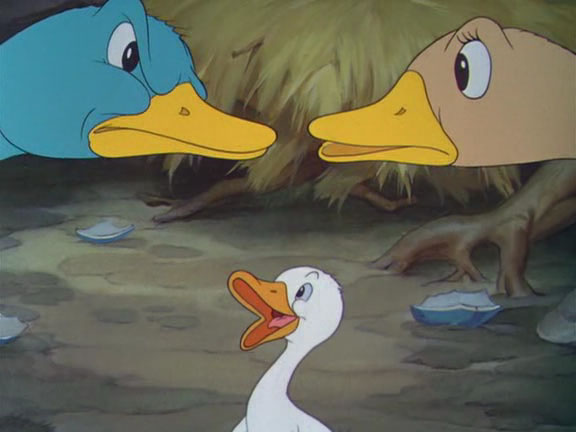 The remake of ‘The Ugly Duckling‘ (1931) is the last of the Silly Symphonies and, like the very first (The Skeleton Dance, 1929) one of the best.
Following Hans Christian Andersen’s tale much closer than the original ‘Ugly Duckling’, the 1939 version reaches the apex in animated storytelling. One can even watch it silent and understand the cartoon perfectly, and even more significant, remain emotionally involved, as well.
The Duckling is an instantly likeable character whose emotions are totally convincing and moving. Even the colors of the backgrounds add to the drama, changing from bright greens to blues when the Duckling is expelled. The 1931 version was a milestone in its time, yet it looks crude and primitive today. This 1939 version of The Ugly Duckling, however, is an all time animation masterpiece, and it will doubtless never date.
Watch ‘The Ugly Duckling’ yourself and tell me what you think:
This is Silly Symphony No. 75 (the last in the series)
To the previous Silly Symphony: The Practical Pig
Director: Jack Kinney
Release Date: January 1, 1943
Stars: Donald Duck
Rating: ★★★★★ ♕
Review:
 In ‘Der Fuehrer’s Face’ Donald is apparently a citizen of ‘Nutziland’, a fascist country where even trees and clouds are swastika-shaped.
Donald is awoken by a silly march band singing the sarcastic title song (penned by Disney composer Oliver Wallace and sung with gusto by Spike Jones). Then he has breakfast that consists of only one coffee bean, ‘aroma de bacon & eggs’ and a slice of wooden bread. All too soon he has to work at the assembly line, making shells and saluting to images of Adolf Hitler.
In the end, it appears that it was all just a dream, and Donald, in his Stars and Striped-colored room, sighs, embracing a golden copy of the statue of liberty: “Am I glad to be a citizen of the United States of America”. This closing scene is rather corny and the satire of the film misses some points: most of the (German) citizens of Nazi Germany were not poor and did not have to work like slaves, as is suggested here. Instead, the Nazis used forced labor forces from their occupied territories.
Nevertheless, ‘Der Fuehrer’s Face’ was both artistically and commercially the most successful of the Disney war time propaganda films. It even won an academy award for being the best animated short of 1943. It’s so successful, because, unlike most other propaganda shorts, it’s outrageously funny: its satire is so zany, its depiction of ‘Nutzi land’ so wacky, and the scene at the assembly line so out-to-lunch, that one cannot stop laughing. When Donald goes mad, these segments are even topped by a brightly colored, rather avantgardistic and very surrealistic stream-of-consciousness-like scene, which resembles similar dream sequences in ‘Dumbo‘ (1941) and ‘The three Caballeros‘ (1944).
This short was not directed by any of the two regular Donald Duck directors of the time, Dick Lundy and Jack King, who both preferred a more unassuming type of humor, but by Jack Kinney, who is most famous for directing Goofy, and who was undoubtedly the wackiest of the Disney directors, of which this film certainly is proof.
Watch ‘Der Fuehrer’s Face’ yourself and tell me what you think:
This is Donald Duck cartoon No. 38
To the previous Donald Duck cartoon: Bellboy Donald
To the next Donald Duck cartoon: Donald’s Tire Trouble


