
You are currently browsing the category archive for the ‘★★★★★’ category.
Director: Chuck Jones
Release Date: November 17, 1951
Stars: Daffy Duck, Porky Pig
Rating: ★★★★★
Review:
 Following the premise of ‘The Scarlet Pumpernickel’ (1950), Chuck Jones launched a series of cartoons starring Daffy as a misguided hero and Porky as his calm side-kick. ‘Drip-along Daffy’ is the first of this excellent series, with the others being ‘Duck Dodgers in the 24 1/2th Century‘ (1953), ‘My Little Duckaroo’ (1954), ‘Rocket Squad’ (1956), ‘Deduce You Say’ (1956) and ‘Robin Hood Daffy‘ (1958).
In ‘Drip-along Daffy’ Daffy is a typical Western hero, clad in white, riding a well-groomed horse, with an unshaven (!) Porky as ‘comic relief’, riding a donkey. Daffy wants to clean up ‘Lawless Western Town’, which lawlessness is depicted in a series of Tex Averyan gags. However, Daffy finds a heavy adversary in the villain Nasty Canasta…
‘Drip-along Daffy’ is a delightful and gag-rich cartoon, highlight being the strong drink scene, an elaboration on a gag Avery had made in ‘The Shooting of Dan McGoo‘ (1945). Also noteworthy is the high noon scene, in which Jones and his team indulge in numerous camera angles depicting Daffy and Canasta approaching each other. Such original and devoted cinematography had rarely been seen since the Frank Tashlin days.
Nasty Canasta who would return in two more cartoons: ‘My Little Duckaroo’ from 1954 and ‘Barbary Coast Bunny’ from 1956.
Watch ‘Drip-along Daffy’ yourself and tell me what you think:
https://www.dailymotion.com/video/x6em0i8
This is Porky Pig cartoon no. 136
To the previous Porky Pig cartoon: The Wearing of the Grin
To the next Porky Pig cartoon: Dog Collared
This is Daffy Duck cartoon No. 56
To the previous Daffy Duck cartoon: Rabbit Fire
To the next Daffy Duck cartoon: The Prize Pest
‘Drip-along Daffy’ is available on the Blu-Ray ‘Looney Tunes Platinum Collection: Volume 2’ and on the DVD-set ‘Looney Tunes Golden Collection Volume One’
Director: Chuck Jones
Release Date: May 9, 1951
Stars: Bugs Bunny, Daffy Duck, Elmer Fudd
Rating: ★★★★★
Review:
 ‘Rabbit Fire’ is the first of three cartoons in which writer Michael Maltese and director Chuck Jones play Bugs Bunny, Daffy Duck and Elmer Fudd against each other.
The cartoon introduces a new incarnation of Daffy: as the jealous and treacherous miser who never wins. This transformation works, because Daffy the trickster was already present, as can be seen in films like ‘You Ought to be in Pictures‘ (1940) and ‘The Ducksters‘ (1950). As we could expect Daffy’s tricks, so successful against Porky Pig, fail when tried on Bugs Bunny, and Daffy’s repeated failures add to the duck’s frustration.
However, with this transformation, Daffy would lose his lunacy altogether, and it was this new frustrated, misguided, loser type of Daffy that would prevail to the present day, combined with Daffy-the-misguided-hero, championed in other Chuck Jones cartoons, like ‘Drip-along Daffy‘ (1951) and ‘Duck Dodgers in the 24 ½ Century‘(1953).
In ‘Rabbit Fire’ the contrast between Bugs and Daffy is played out very well: Bugs is the initial victim, but he remains über-cool and in total control, while Daffy is the treacherous actor, trying to harm Bugs, but biting the dust every time. In fact, this character trait makes Daffy rather similar to an earlier incarnation of that other famous duck, Donald, who, by the early 1950s had more or less evolved into the straight guy.
The team’s streak of genius is that Daffy never turns into rage, but remains cool, as well. When confronted with a string of defeats, he just walks up to Bugs and utters: ‘you’re despicable!’. Elmer Fudd, meanwhile, remains the confused instrument of the feud between the two animals.
‘Rabbit Fire’ is a dialogue-rich cartoon, but the dialogue never wears down the action. In fact, two of the film’s highlights involve a lot of talking: the gun-pointing scene, and a scene in which Bugs and Daffy read aloud several recipes (strangely enough Daffy pulls out a book on rabbit recipes out of Bugs’s rabbit hole…). Other highlights are a gag involving an elephant gun, and the short’s finale, in which it’s suddenly Elmer Season.
The success of ‘Rabbit Fire’ was repeated in ‘Rabbit Seasoning’ (1952) and ‘Duck! Rabbit! Duck! (1953). After this classic trio the studio paired Bugs and Daffy, and even Elmer in a bunch of other cartoons, and the antagonism between rabbit and duck remains intact to the present day, as can be seen in the feature film ”Looney Tunes: Back in Action’ (2003).
Watch ‘Rabbit Fire’ yourself and tell me what you think:
This is Daffy Duck cartoon No. 55
To the previous Daffy Duck cartoon: The Ducksters
To the next Daffy Duck cartoon: Drip-along Daffy
This is Bugs Bunny cartoon No. 82
To the previous Bugs Bunny cartoon: Fair-Hared Hare
To the next Bugs Bunny cartoon: French Rarebit
‘Rabbit Fire’ is available on the Blu-Ray ‘Looney Tunes Platinum Collection: Volume 2’ and on the DVD-set ‘Looney Tunes Golden Collection Volume One’
Director: Friz Freleng
Release Date: April 22, 1950
Stars: Bugs Bunny, Yosemite Sam
Rating: ★★★★★
Review:
 To escape some hunters, Bugs Bunny hides inside a prison, where Sam Schultz (Yosemite Sam) is a prison guard.
What follows is a great series of prison gags, including two morbid ones resulting in Sam hanging on the gallows and being electrified in an electric chair. Throughout the cartoon the warden keeps calling for Schultz, not unlike the Nazi officer in the Ernst Lubitsch feature ‘To Be Or Not To Be’ (1942).
‘Big House Bunny’ is full of excellent gags and Freleng’s timing is superb throughout, making ‘Big House Bunny’ one of those little known masterpieces.
Watch ‘Big House Bunny’ yourself and tell me what you think:
https://www.dailymotion.com/video/x2l293q
‘Big House Bunny’ is available on the DVD set ‘Looney Tunes Golden Collection, Vol. 1’
This is Bugs Bunny cartoon No. 71
To the previous Bugs Bunny cartoon: Homeless Hare
To the next Bugs Bunny cartoon: What’s Up, Doc?
Director: Charles Nichols
Release Date: May 18, 1951
Stars: Mickey Mouse, Pluto, Milton
Rating: ★★★★★
Review:
 In ‘Plutopia’ Mickey and Pluto reach a cabin in the mountains called Utopia.
The place turns out to be dog-unfriendly however: Pluto has to stay outside and even worse, has to be muzzled. Frustrated, Pluto falls asleep. He dreams he’s in Plutopia where Milton (one of the cats from ‘Puss-Cafe‘, and here the cabin’s cat) is his willing servant, serving him food every time Pluto bites him in his tail.
The dream sequence is a delight to watch: its backgrounds consists of no more than changing monochromes featuring ‘scribbled’ outlines of doors, stairs e.g. With this sequence Pluto enters the ‘cartoon modern’ era. Unfortunately, it would be his only cartoon featuring such modern designs.
‘Plutopia’ is the last of only three Pluto cartoons featuring Mickey Mouse (the other two being ‘Pluto’s Purchase’ from 1948 and ‘Pueblo Pluto‘ from 1949). Normally cartoons featuring Mickey would appear under his own name. Indeed, after ‘Plutopia’ the Pluto series had only one entry left, but Pluto would return in Mickey’s last four cartoons.
Remarkably, ‘Plutopia’ features animation by two of the greatest animators of Mickey and Pluto in the 1930s: Fred Moore and Norm Ferguson. Both animators had been eclipsed by Disney’s Nine Old Men, and ‘Plutopia’ is one of the last films they worked on before their premature deaths in 1952 and 1957, respectively.
Watch ‘Plutopia’ yourself and tell me what you think:
This is Pluto cartoon No. 42
To the previous Pluto cartoon: Cold Storage
To the next Pluto cartoon: Cold Turkey
Director: Jack Kinney
Release Date: February 9, 1951
Stars: Pluto
Rating: ★★★★★
Review:
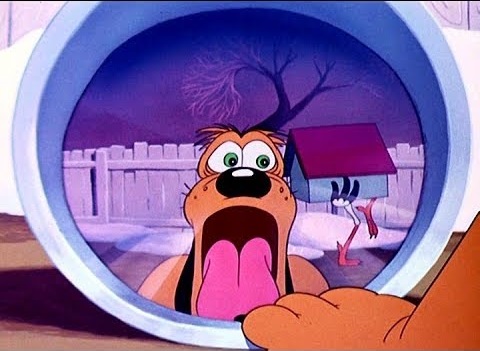 Cold Storage is the second of only two Pluto cartoons directed by Jack Kinney, the other being ‘Bone Trouble‘ from 1940.
Jack Kinney was Disney’s best gag cartoon director, and ‘Cold Storage’ is no exception. The story is set in wintertime. A freezing stork seeks shelter in Pluto’s dog house. When an equally cold Pluto returns home, a battle for the dog house begins.
Highlight of the film is when Pluto discovers his doghouse is moving and flying. Pluto’s facial expressions are priceless in this section. However, throughout the picture the animation of Pluto is expressive and flexible, full of great facial expressions and extreme poses. The interplay between the two characters is excellent and accounts for many gags. In the end the already zany cartoon turns absurd, when winter suddenly gives way to a hot summer day…
Watch ‘Cold Storage’ yourself and tell me what you think:
This is Pluto cartoon No. 41
To the previous Pluto cartoon: Camp Dog
To the next Pluto cartoon: Plutopia
Director: Charles Nichols
Release Date: August 11, 1950
Stars: Pluto, Chip ‘n’ Dale
Rating: ★★★★★
Review:
 Food for Feudin’ is the third of four cartoons coupling Chip ‘n’ Dale to Pluto. It’s also the only Chip ‘n’ Dale cartoon directed by Charles Nichols.
Nichols handles the characters of the two chipmunks very well. Their interplay is better than in many Donald Duck cartoons and a delight to watch. In the opening scene Dale even mocks Donald’s anger dance, and later we hear his version of the Goofy yell.
The story is set in autumn, in a park. Pluto tries to store his bone in Chip ‘n’ Dale’s nut tree. The result is that all Chip ‘n’ Dale’s nuts end up in Pluto’s dog house. In order to get them out they hide themselves in two gloves. This idea leads to some wonderfully comedy.
In all ‘Food for Feudin’ is a delightful cartoon, and one of Chip ‘n’ Dale’s best.
Watch ‘Food for Feudin’’ yourself and tell me what you think:
This is Pluto cartoon No. 39
To the previous Pluto cartoon: Pests of the West
To the next Pluto cartoon: Camp Dog
Director: Albert Barillé
Airing date: March 26?, 1983
Rating: ★★★★★
Review:
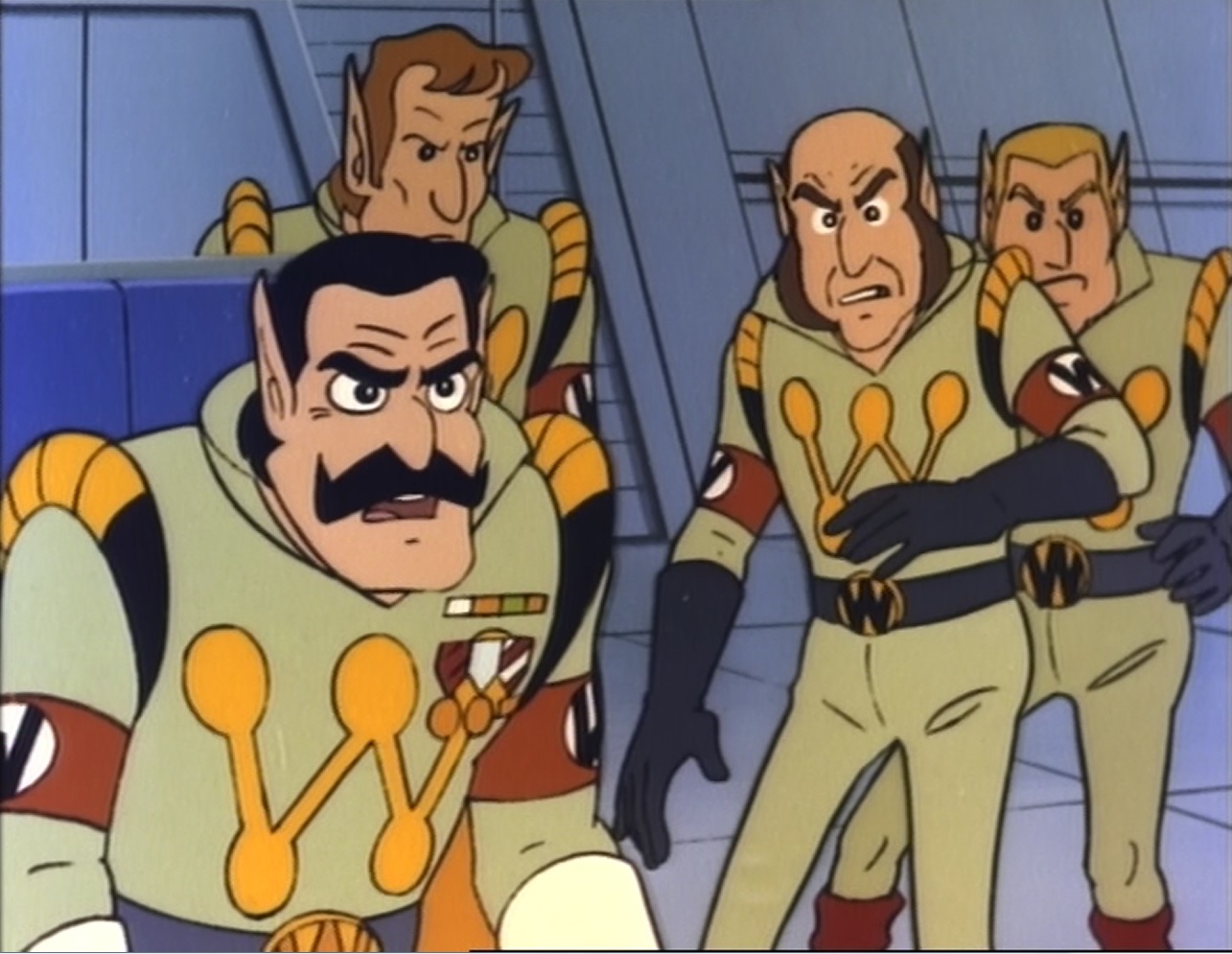 In the opening scene of this next to final episode, Cassiopeian general Teigneux (Pest) convinces his senate to give an ultimatum for unconditional surrender to Omega. But then he himself gets the same ultimatum from his former ally, Yama…
The general’s reaction is to arrest his senate, taking the final step to become a full dictator at last, and to declare war on Yama. Meanwhile on Omega Pierrot conceives a plan to harm the robot enemy from the inside, which he performs not only with the faithful Psi and Metro, but also Le Petit Gros and his girlfriend, Pierrot’s sister. By trickery, the five manage to be brought inside a Yama cruiser, where Pierrot places a bomb.
Some excitement is added, when after having placed the bomb the five are having difficulties leaving the ship, especially when Metro forgets an important code. Nevertheless, it’s the politics and the depressing battle scenes of Cassopeia’s ill-fated war that impress the most, not the antics of our heroes.
Yama’s might is shown by images literally flooded by space ships, and by battle scenes in which Cassiopeian cruisers are shot to pieces with a frightening ease. Nevertheless Le Teigneux persists almost to the very end, with his subordinates obeying with the motto of ‘Befehl ist Befehl‘. Thus Cassopeia heads to its own mass destruction, similar to Germany and Japan in World War II. Only when Yama threatens to blow up the entire planet of Cassiopeia itself, Le Teigneux gives in, and surrenders unconditionally. Now it will be Omega’s turn…
This episode’s images of war and mass destruction are very disturbing, and in no sense Barillé glorifies war, on the contrary. Although they had been the stock enemy in the past, the viewer is invited to sympathize with the Cassiopeians. Teigneux’s admiral is seen repeatedly in utter distress, torn between the general’s bullheadedness and the sheer hopelessness of his own duty, with his subordinates mourning the loss of human lives. Barillé raises the very question what cause would justify such loss, leaving the answer to the viewer. This is a very different take on war than the heroism of Star Wars, and a much more mature one, despite being aimed at children.
Watch ‘Combat de titans’ yourself and tell me what you think:
This is the 25th episode of ‘Il était une fois… l’espace’ (Once Upon a Time… Space)
To the 24th episode: Le grand ordinateur (The Great Computer)
To the 26th episode: L’infini de l’espace (The Infinity of Space)
Director: Albert Barillé
Airing date: March 19?, 1983
Rating: ★★★★★
Review:
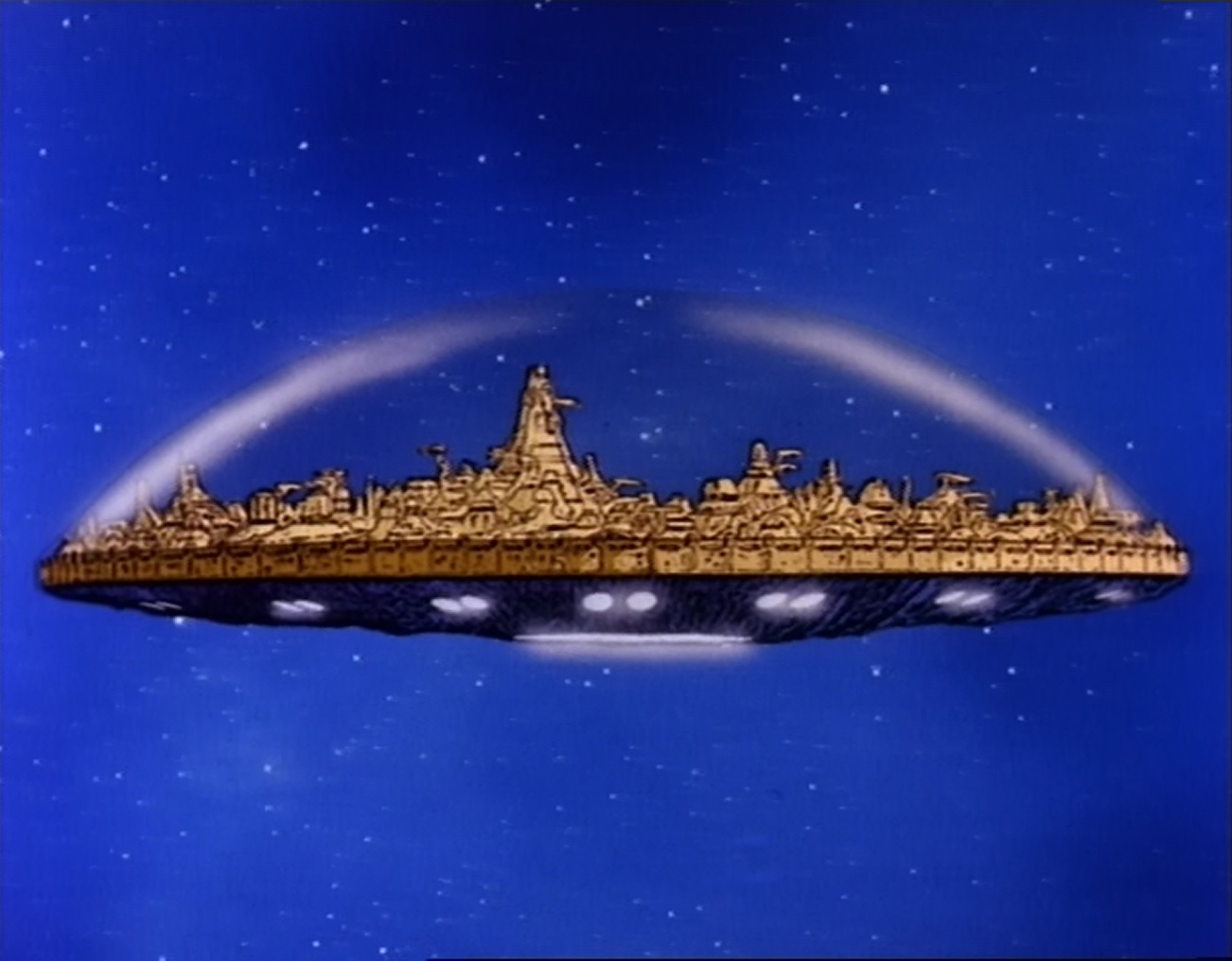 ‘La grand ordinateur’ completely takes place in the robot city that took flight in the previous episode, ‘Cité en vol‘.
First we watch Pierrot and Metro wandering endless corridors in search for Psi. Then the flying city invites Omega’s large space ship inside, which is dwarfed by the gigantic city. Inside, colonel Pierre and Maestro from the ship are soon reunited with Pierrot, Psi and Metro, and we meet the great computer itself at last, which is the robot city of Yama itself.
The great computer tells about its origin and how it has been behind every robot scheme in the series (e.g. the robot revolt in ‘La révolte des robots‘, and the doomsday rocket in ‘L’imparable menace‘). It reveals its ultimate plan, which is to stop man from its own inclination to violence. It does so by taking total control of humanity, so “no man will ever know any pain or sorrow again”. In the end the great computer shows its immense war fleet, and sends our heroes back to Omega with its message.
This episode is hampered by some odd staging, and at times terrible drawings of our heroes, but it’s also arguably Barillé’s most daring episode: a great deal of it is filled with a philosophical discussion on questions like what makes man human? Is it allowed to sacrifice lives for the greater good? And is violence to end all violence ethical? Bold subjects for a children’s series, indeed!
Both the great computer’s reasoning and action are very believable, and its consequences food for thought. It’s ironic how its destructive approach is fueled by a wish to end all violence. It makes it one of the most interesting villains ever put to the screen, especially because it’s not really visible.
Watch ‘Le grand ordinateur’ yourself and tell me what you think:
This is the 24th episode of ‘Il était une fois… l’espace’ (Once Upon a Time… Space)
To the 23rd episode: Cité en vol (City in Flight)
To the 25th episode: Combat de titans (The Battle of the Titans)
Director: Albert Barillé
Airing date: March 12?, 1983
Rating: ★★★★
Review:
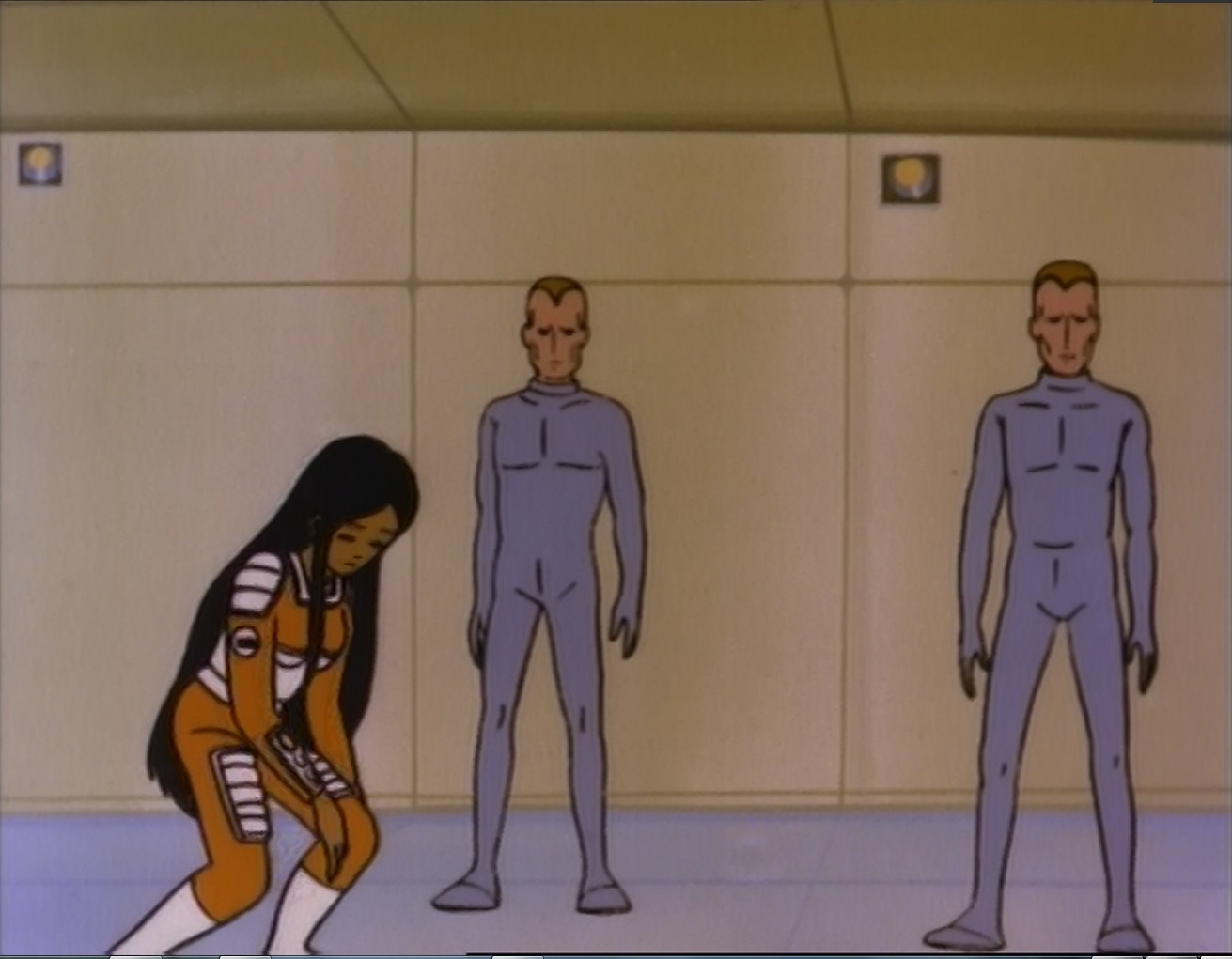 ‘Cité en vol’ is the third of six episodes, which form the finale of ‘Il était une fois… l’espace’.
This episode starts with Pierrot and Murdock flying to the hostile planet of Yama. Yama is overtly similar to Mos Eisley from ‘Star Wars’ (1977), and Pierrot and Murdock walk around like jedis. At Yama they ally with a rebel group, and together they try to enter the center of the city, which is pure robot territorium. Unfortunately, the robot city is well-guarded…
Meanwhile the humanoids try to get to the secrets of Psi’s psychic powers. As Pierrot reveals to Murdock, if they’ll succeed nothing will be able to stop them. At one point they get help from a Cassiopeian telepath, and he and Psi have a telepathic mind battle, which is a nightmarish variation on the battle between Merlin and Madam Mim in ‘The Sword in the Stone’ (1963). This scene, with its continuous metamorphosis, arguably is the most impressive piece of animation of the entire series, even if it’s still nowhere near the Disney animation that might have inspired it.
Although most of this episode is about Pierrot trying to get inside the robot city, it also hints at the real dangers the humanoids form. They call ambassador Le Nabot (Dwarf) a fool behind his back, and continuously refer to a secret plan. At the end of the episode the robot city takes flight, giving the episode its name. This concept Barillé undoubtedly borrowed from James Blish’s science fiction book series ‘Cities in flight’, which appeared between 1955 and 1962.
The importance of this event will only be revealed later, but it’s clear that Pierrot made it inside just in time. Unfortunately, it does kill Murdock, the only human being killed on screen in the entire series, a death that made a strong impression on me when I was a kid.
Watch ‘Cité en vol’ yourself and tell me what you think:
This is the 23rd episode of ‘Il était une fois… l’espace’ (Once Upon a Time… Space)
To the 22nd episode: Un monde hostile (A Hostile World)
To the 24th episode: Le grand ordinateur (The Great Computer)
Director: Albert Barillé
Airing date: February 26?, 1983
Rating: ★★★★★
Review:
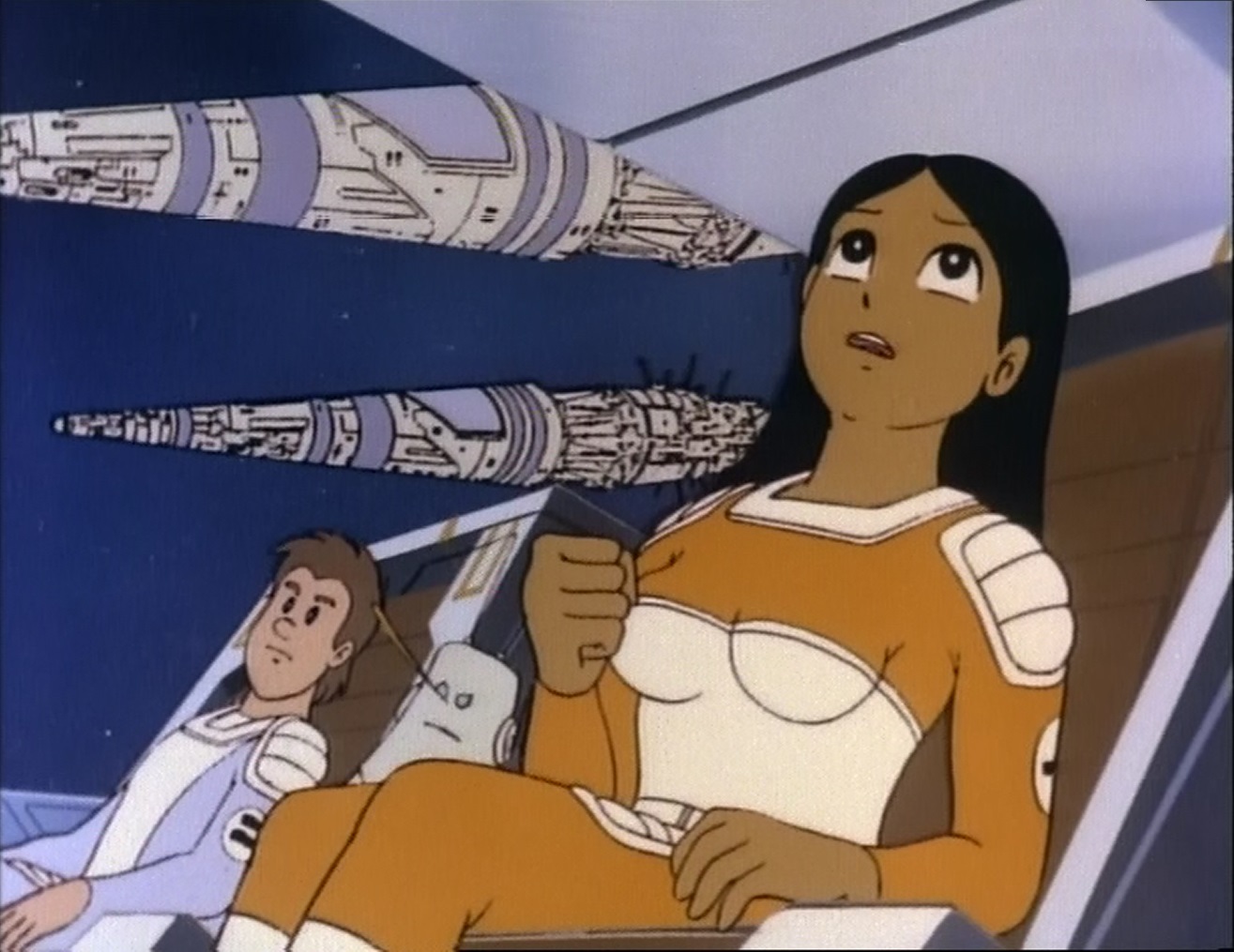 It’s the last ride of the Libellule, Pierrot’s and Psi’s little spaceship, and the last flight of our heroes as a team.
What should have been a routine flight, turns into disaster, when our heroes encounter enormous space vessels, which together are able to destroy complete planets (similar to the Death Star in ‘Star Wars’ from 1977). Composer Michel Legrand enhances the menace of these weapons of mass destruction by accompanying the images with a repeated, uncanny electronic riff.
When intercepted by space ships, the Libellule crashes on the planet Apis, where Psi is captured by the very humanoids she had encountered in ‘Les anneaux de Saturne‘. While she is taken to the neighbor planet Yama, Pierrot joins a rebel group of humans fighting the humanoids, and two of them, Sylva and Gillio, join him and Metro on a journey to find one captain Murdock, the only one on Apis that owns a spaceship.
In ‘Les humanoïdes’ the mysterious ally of Cassiopeia, Yama, reveals itself. It turns out to be a whole planet of humanoids, controlled by a supercomputer. In fact, Yama is behind every robot-involved scheme in the entire series, as they will reveal later.
‘Les humanoïdes” is the first episode of the six-part mini-series within the ‘Il était une fois… l’espace’ that constitutes its great finale. This finale in particular elevates the series above average, giving this series its extra grandeur. Barillé himself must have seen their potential, as these episodes were modified into a feature film called ‘la revanche des humanoïdes’ (Revenge of the Humanoids) and released later that year.
Watch ‘Les Humanoïdes’ yourself and tell me what you think:
This is the 21st episode of ‘Il était une fois… l’espace’ (Once Upon a Time… Space)
To the 20th episode: La revanche des robots (The Revenge of the Robots)
To the 22nd episode: Un monde hostile (An hostile world)
Director: Albert Barillé
Airing date: February 19?, 1983
Rating: ★★★★★
Review:
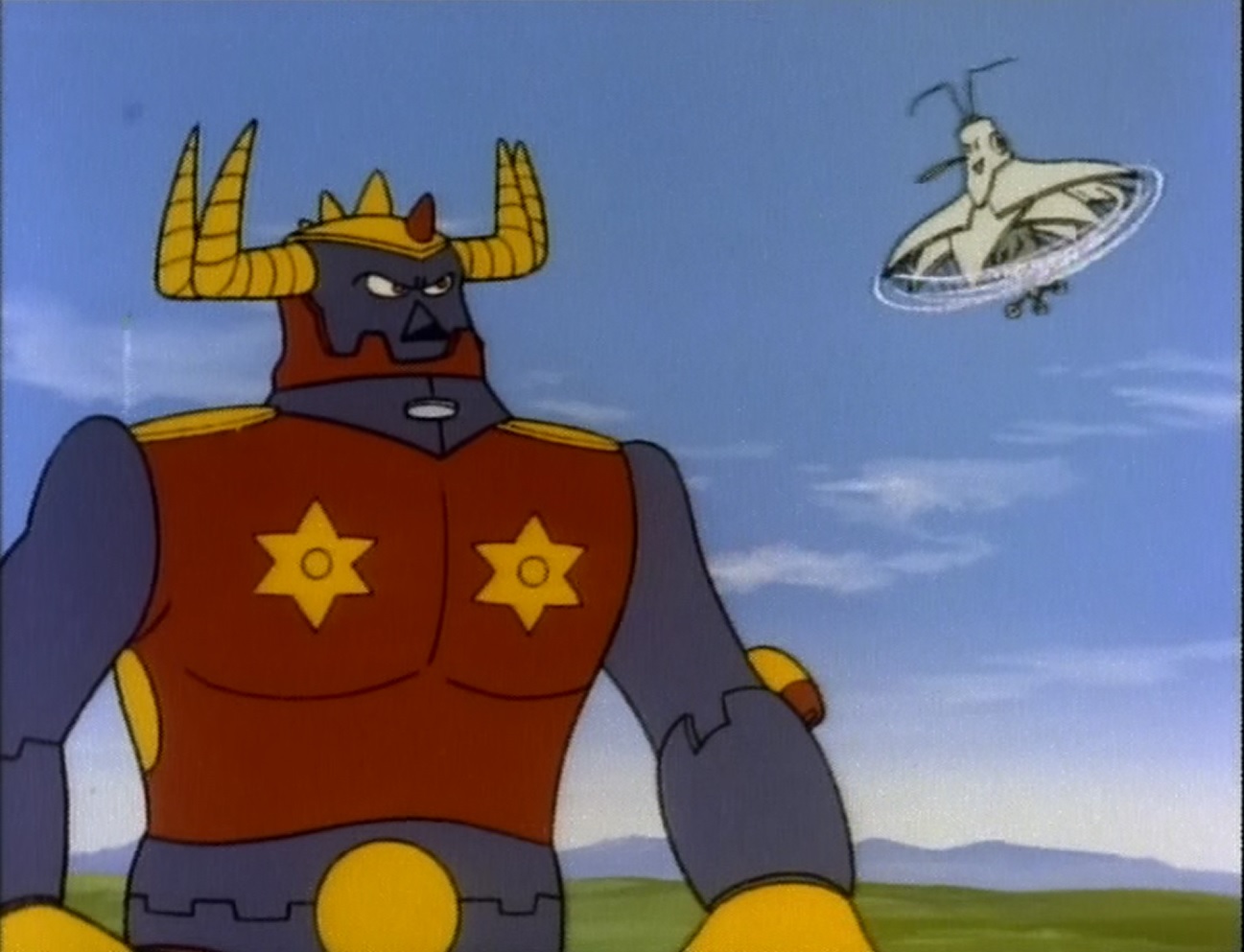 In the opening scene of this episode Pierrot, Psi, Petit Gros and Metro are honored for their heroic deeds in a.o. ‘L’imparable menace‘.
Adventure immediately announces itself, however, when the planet Leto (see ‘La révolte des robots‘) asks especially for Metro to mediate in a new conflict between robots and humans. This time, the robots want Metro to fight two of their battle robots, generals Goldenbar II and III, improved versions of the giant robot Metro defeated in ‘La révolte des robots’. Metro wins both fights, but surprisingly, the robots regard these losses only as temporary setbacks on the way to success. The last six episodes will show why…
Like ‘La révolte des robots’, ‘La revanche des robots’ is a highly enjoyable episode, with a star role for the matter-of-factly little robot Metro, battling two giant Grendizer (Goldorak)-like robots, with a rather improbable, but scary capability of duplication.
Watch ‘La revanche des robots’ yourself and tell me what you think:
This is the 20th episode of ‘Il était une fois… l’espace’ (Once Upon a Time… Space)
To the 19th episode: L’étrange retour vers Oméga (The Strange Return to Omega)
To the 21st episode: Les humanoïdes (The Humanoids)
Director: Albert Barillé
Airing date: February 12?, 1983
Rating: ★★★★★
Review:
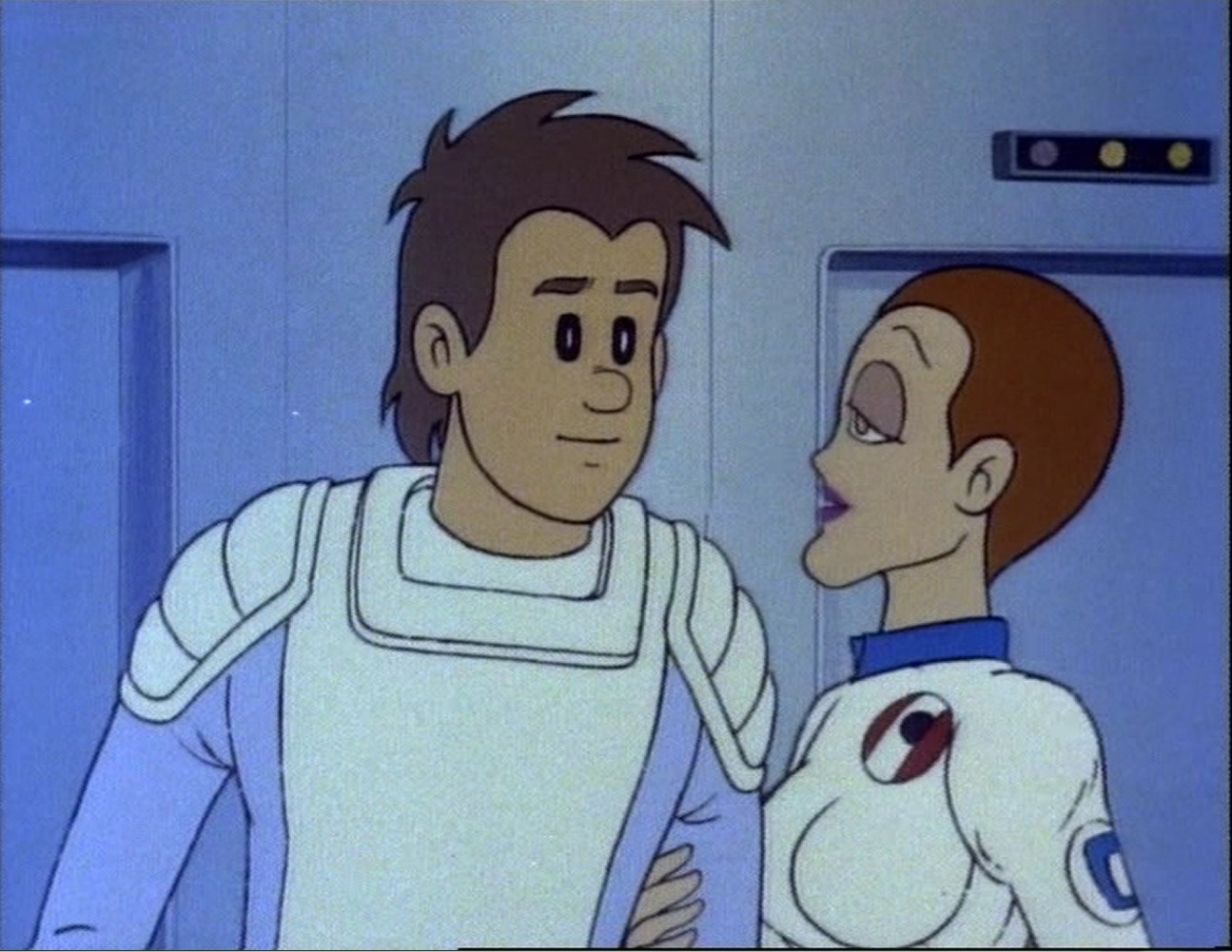 In the opening sequence of this episode the brave little robot Metro (who had been destroyed in ‘Les anneaux de Saturne) has been repaired and he joins Pierrot and Psi when they leave earth in a cruise ship called the Cosmopolitan.
Strange things are happening there, however, and our heroes are shadowed continuously. They discover that part of the crew has been replaced by robots…
‘L’étrange retour vers Oméga’ has a great mystery plot and together with ‘La revanche des robots‘ it forms a great prelude to the one-story-finale, which consists of the last six episodes.
Watch ‘L’étrange retour vers Oméga’ yourself and tell me what you think:
This is the 19th episode of ‘Il était une fois… l’espace’ (Once Upon a Time… Space)
To the 18th episode: L’Atlantide (Atlantis)
To the 20th episode: La revanche des robots (The Revenge of the Robots)
Director: Albert Barillé
Airing date: January 22?, 1983
Rating: ★★★★★
Review:
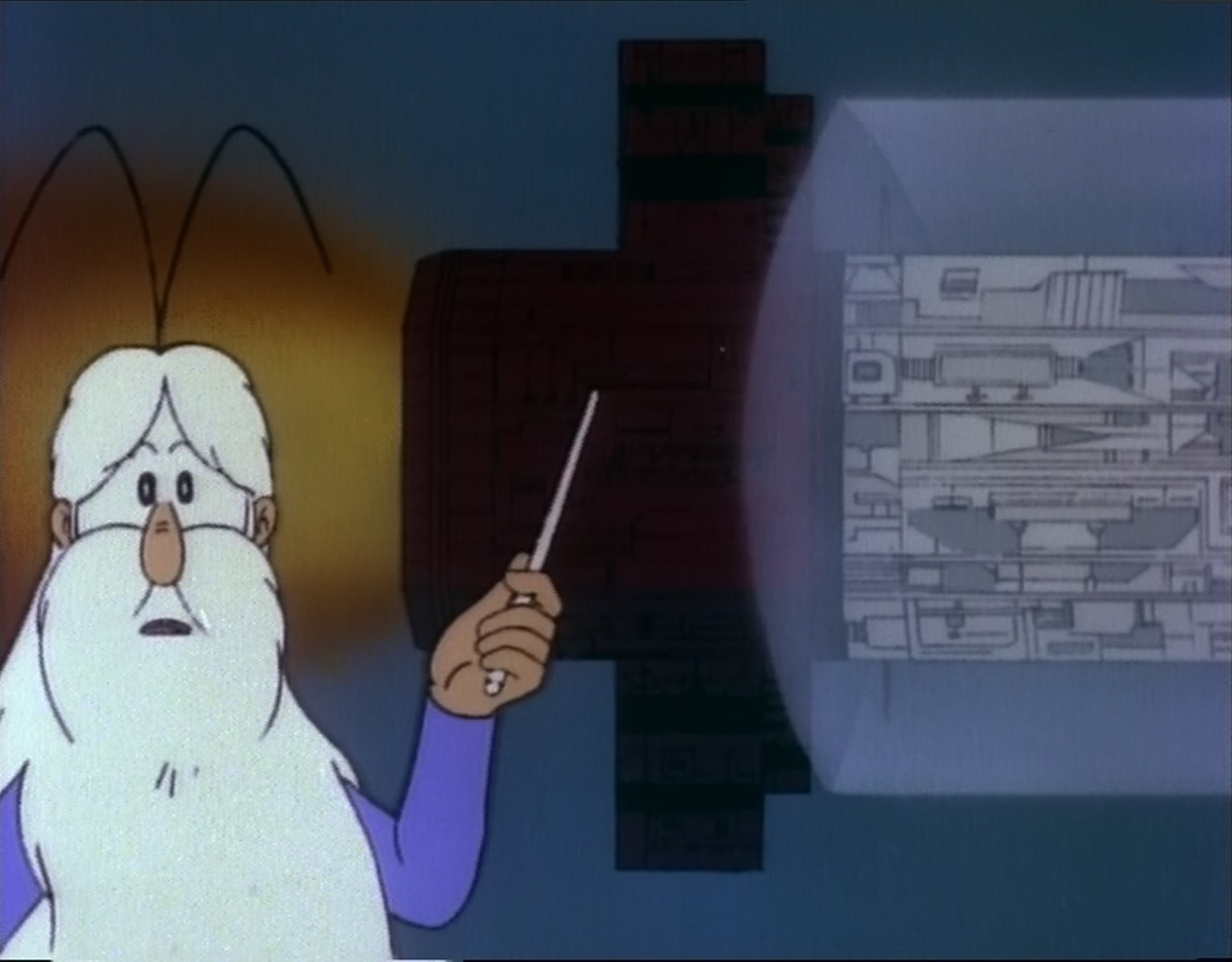 In ‘À Cassiopée‘ the hostile constellation of Cassiopeia had made plans to invade the earth. In ‘L’imparable menace’ it has become clear their plans have changed…
This episode starts with Cassiopeia firing a deadly rocket to Earth in order to make Omega surrender to Cassiopeia unconditionally. So now Omega itself is at stake, with Earth as a hapless pawn in interstellar politics.
Luckily for Omega, our heroes Pierrot, Petit Gros and Psi are still in the neighborhood of Jupiter, and they are the only ones who can stop the doomsday rocket in time. In fact, it’s the androids Psi encountered in ‘Les anneaux de Saturne‘ who had fired the rocket in the first place.
The whole episode is one race against time, which makes it one of the most exciting episodes of the entire series.
Watch ‘L’imparable menace’ yourself and tell me what you think:
This is the 16th episode of ‘Il était une fois… l’espace’ (Once Upon a Time… Space)
To the 15th episode: Les anneaux de Saturne (The Rings of Saturn)
To the 17th episode: Terre! (Earth)
Director: Albert Barillé
Airing date: January 15?, 1983
Rating: ★★★★★
Review:
 ‘Les anneaux de Saturne’ follows three boring episodes that rather stood on their own.
How different this episode is! Like ‘La révolte des robots‘, ‘Les anneaux de Saturne’ is no less than a key episode. With this episode starts the finale of ‘Il était une fois… l’espace’, the long continuous saga that makes the series such a remakable effort.
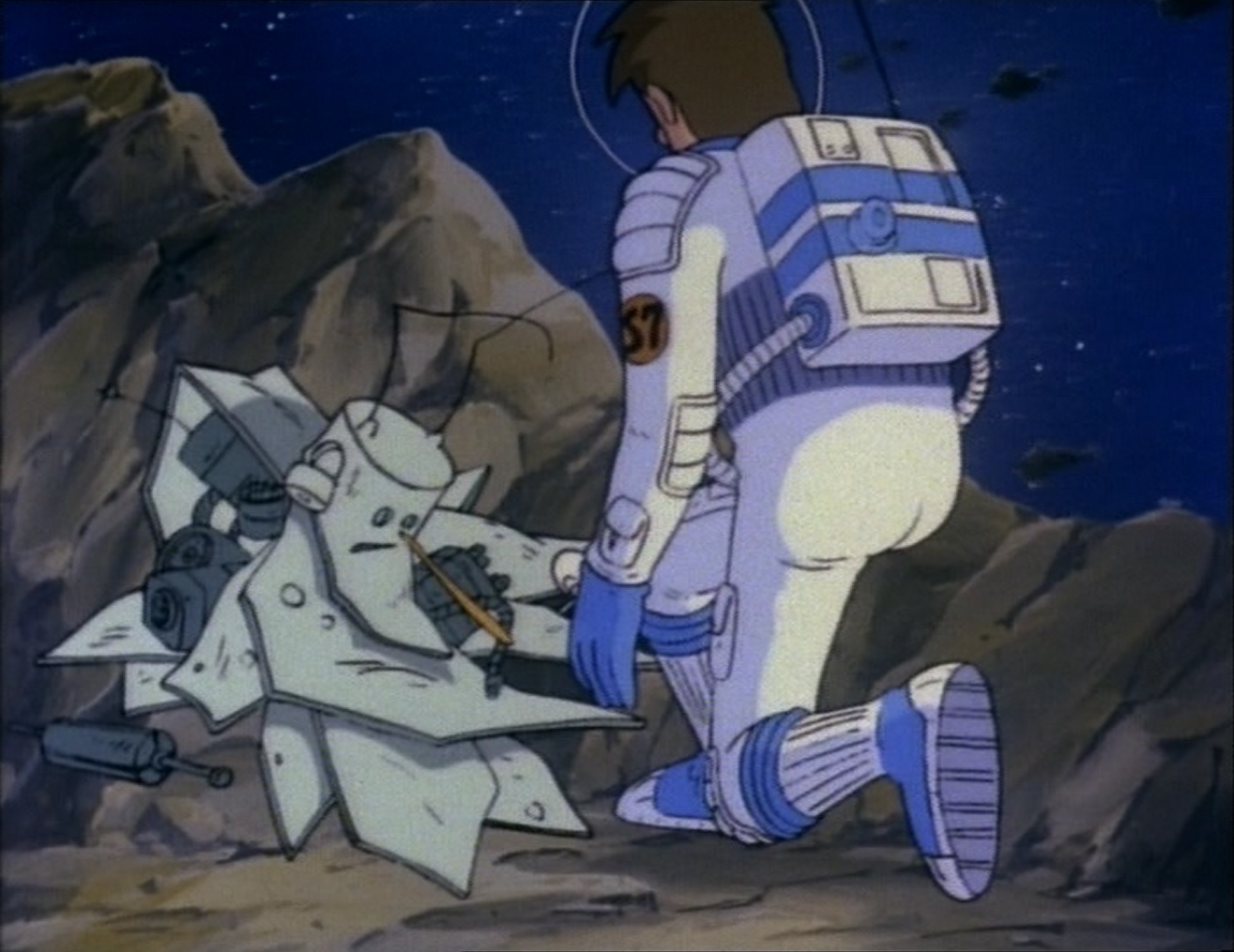
Because Pierrot has to recover from his injuries he got on the Jurassic planet in ‘Chez les dinosaures‘, Psi is allowed to go on a holiday – alone. Together with Metro she wants to explore the asteroid belt of our own solar system, but near Mimas, one of Saturn’s moons, she’s intercepted by unknown spaceships. These appear to be from a secret society of humanoid robots, and General Le Teigneux’s mysterious allies. Psi and Metro are thus the first to encounter this new threat, which will dominate the episodes 19 to 26. In an attempt to escape, Psi and Metro crash on an asteroid, leaving Metro in shambles. Luckily, Pierrot and Petit Gros come to the rescue…
This episode is not only mysterious and exciting, but also educational on Uranus, Saturn, Jupiter and the asteroid belt.
Watch ‘Les anneaux de Saturne’ yourself and tell me what you think:
This is the 15th episode of ‘Il était une fois… l’espace’ (Once Upon a Time… Space)
To the 14th episode: Chez les dinosaures (In the Land of the Dinosaurs)
To the 16th episode: L’imparable menace (The Unstoppable Menace)
Director: Albert Barillé
Airing date: December 11?, 1982
Rating: ★★★★★
Review:
 The exciting episode ‘La planète déchiquetée’ undoubtedly is one of the highlights of ‘Il était une fois… l’espace’.
It starts immediately where ‘À Cassiopée’ had left off. In this episode Cassiopeia leaves the galactic union, an act reminiscent of Japan’s resignation from The League of Nations in 1933. Like ‘À Cassiopée’ this episode starts with politics, with the absent-minded Maestro as a comic relief. Maestro also tells us how a sun explodes at the end of its life, thus adding a small educational touch to this episode.
A dying sun plays a major part in the political scheme of things, threatening a military base Cassiopeia is building nearby. When the sun does explode, Cassiopeia tries to save the material, leaving its own slave-like people behind, leaving them to be rescued by the allies.
Only after 20 minutes we meet our heroes, trying to save the last Cassiopeian people from the threatened planet. The time element and the contrasting goals of Cassopeia and Omega make this episode particularly thrilling. The suspense is supported by Michel Legrand’s exciting score.
At the end, the rescuing vessel The Ursus, with our heroes on board, crashes into another planet, leading to the first real cliffhanger in the series.
Watch ‘La planète déchiquetée’ yourself and tell me what you think:
This is the 10th episode of ‘Il était une fois… l’espace’ (Once Upon a Time… Space)
To the 9th episode: À Cassiopée (In Cassiopeia)
To the 10th episode: Les naufragés de l’espace (Shipwrecked in Space)
Director: Albert Barillé
Airing date: November 13?, 1982
Rating: ★★★★★
Review:
 La révolte de robots’ is the first highlight in the ‘Il était une fois… l’espace’ series.
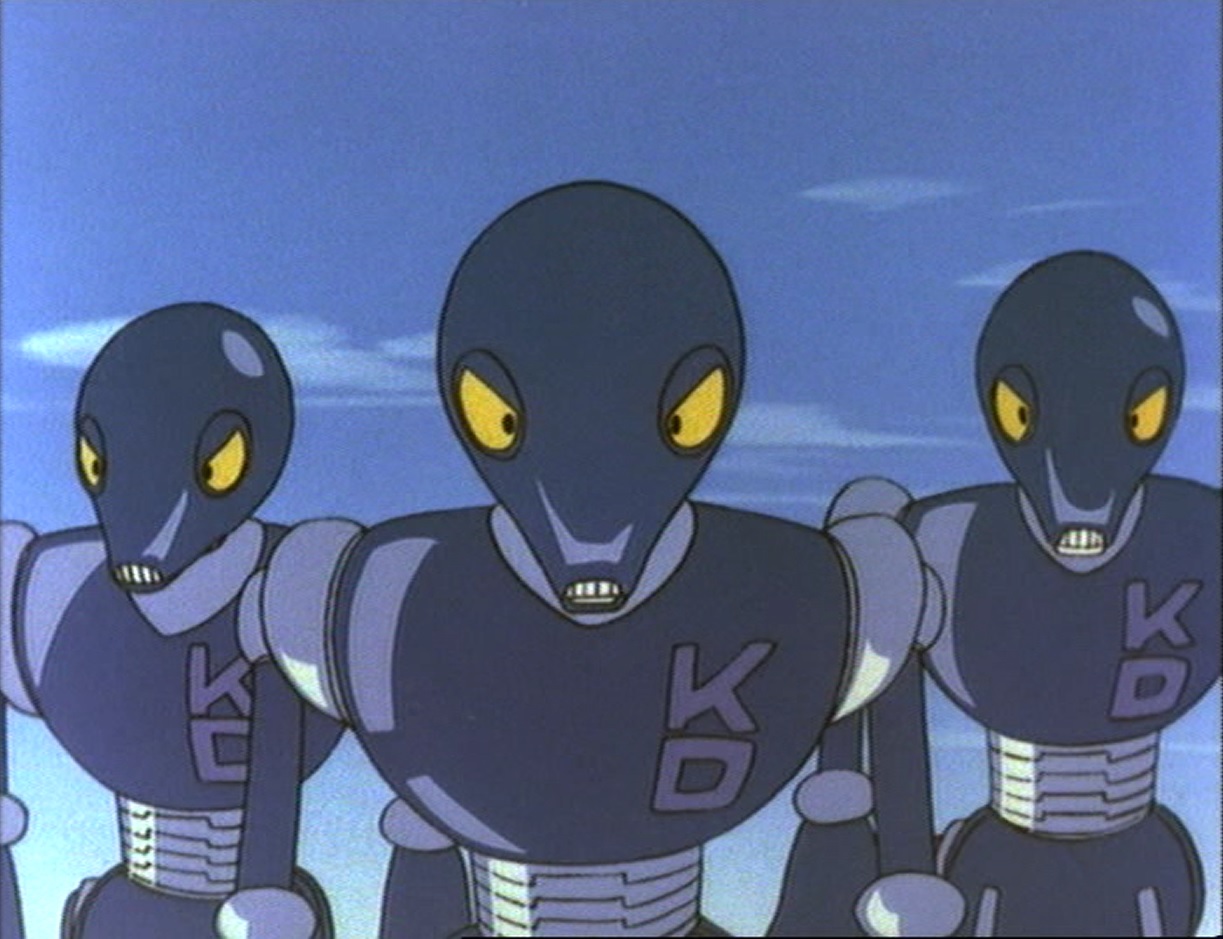
Unlike the earlier episodes the threat does not come from stock villain Cassiopeia, but from a rebelling robot planet called Leto. We’re introduced to this planet first, with our heroes only entering the scene after twelve minutes. Our heroes save the day, especially the little robot Metro, who battles a large robot, which looks like a copy from Grendizer (Goldorak), the famous robot from the Japanese 1970s series of the same name.
However, who is really responsible for the robots’ rebellion remains unknown. This would grow into the series’ most important story element, dominating its great last third. If anything, this episode shows the risks of man’s dependency on technology, but Barillé clearly states that humans are superior to robots, something he tries to illustrate rather unconvincingly in this episode. The whole argument of humans vs. machines would come back with a vengeance in the 23rd episode, ‘Le grand ordinateur‘.
Watch ‘La révolte des robots’ yourself and tell me what you think:
This is the 6th episode of ‘Il était une fois… l’espace’ (Once Upon a Time… Space)
To the 5th episode: Les Cro-Magnons (The Cro-Magnons)
To the 7th episode: La planète Mytho (The Planet Mytho)
Director: Michel Ocelot
Release date: 1979
Rating: ★★★★★
Review:
 With this animation film Michel Ocelot made his name in the world of animation.
In this film he uses elegant cut-out designs with a stunning virtuosity to evoke the gallant world of the late 18th century. The elaborate and graceful cut-outs recall the works by Lotte Reiniger from the 1920s, although Ocelot uses white laced paper on monochrome backgrounds, opposed to Reiniger’s black shapes.
The story is told with a little voice over, and a small amount of dialogue. The narrator introduces to us a family of inventors, a man, a woman and a little girl whose inventions (a balloon, a knitting machine and an automatic bird, respectively) are misunderstood and destroyed by the fearful, jealous and narrow-minded townspeople. When they try to show a steam engine to their neighbors, things go particularly awry.
True enough, the film suffers from bad sound designs and rather ugly harpsichord music. Yet, the film is not only beautiful to look at, Ocelot succeeds in evoking real emotions of disappointment, loss and fear. Its ending is disturbing enough, making it a true classic from the late 1970s. Indeed, the film won several prizes. Later, Ocelot would become an even greater voice in the animation world, especially with his feature film ‘Kirikou et la sorcière’ (1998).
Watch ‘Les trois inventeurs’ yourself and tell me what you think:
‘Les trois inventeurs’ is available on the DVD ‘Les trésors cachés de Michel Ocelot’
Director: Bill Meléndez
Release date: December 4, 1969
Stars: Charlie Brown, Snoopy, Lucy and Linus van Pelt, Schroeder, e.o.
Rating: ★★★★★
Review:
 Made after six television specials, ‘A Boy Named Charlie Brown’ is Meléndez’ first feature film about the Peanuts gang.
It is a film with a slow, but steady pace: unhurried, yet not too slow. Being totally relaxed, the film takes a long time to introduce the characters, citing a lot of Peanut comic strip gags, and showing Charlie Brown’s troubles in flying kites and playing baseball. Only after 30 minutes the head story kicks in, when Charlie Brown enters a spelling bee.
The laid-back feel of the film is further enhanced by two surprising musical numbers: Snoopy’s playing of the American National Anthem and Schroeder’s playing of the complete second movement of Ludwig van Beethoven’s Sonata pathétique, which is arguably the film’s highlight. Snoopy receives a fair deal of screen-time, and two of his fantasies are shown: him as a pilot in World War I and as a skater in Holland and in an ice-hockey game. Nevertheless, the story remains with Charlie Brown and his doomed attempt to gain respect. His frustrations and failure are funny, but remain genuine and heartfelt. This focus make the film a well-made tribute to Charles M. Schulz’s strip of the early 1960s, when Charlie Brown’s frustrations were the strip’s main focal point.
Overall, the designs are gorgeous, especially in the musical interludes, which feature bold, colorful images. The jazzy score, too, is a delight, and enhances the film’s unique atmosphere. In all, ‘A Boy Named Charlie Brown’ is a great film which has a typical 1960s feel without ever getting cheap.
Watch ‘A Boy Named Charlie Brown’ yourself and tell me what you think:
Directors: William Beaudine & Wilfred Jackson
Airing date: November 30, 1955
Stars: Walt Disney, Gertie the Dinosaur, Colonel Heeza Liar, Silas Bumpkin, Bobby Bumps, Felix the Cat, Koko the Clown
Rating: ★★★★★
Review:
 Walt Disney himself hosts a Disneyland television episode on the history of animation, from the humble attempts to capture movement in drawing in the caves of Lascaux to his own masterpiece ‘Fantasia’ (1940).
Disney demonstrates some early devices of animation like the thaumatrope, the phenakistoscope, the zoetrope and the praxinoscope, showing that animation in fact predates cinema. One of the highlights of the program is the complete showing of one of Charles-Émile Reynaud’s animated “films” for his own praxinoscope device. The other one is the reenactment of Winsor McCay’s vaudeville show with Gertie the Dinosaur (1914). This part alone makes the episode worthwhile watching, as McCay’s classic work becomes even stronger in its vaudeville context.
More animation from other early studios is shown, like Bray’s Colonel Heeza Liar, Raoul Barré’s Silas Bumpkin, Earl Hurd’s Bobby Bumps and Pat Sullivan’s Felix the Cat.
Disney also plays tribute to his old rival, Max Fleischer, by showing a Koko the Clown cartoon, accompanied by organ playing by his own cartoon composer, Oliver Wallace. The show ends with one of Walt Disney’s major achievements, the Nutcracker Suite from’Fantasia'(1940), which, unfortunately, is shown in black and white.
Watch ‘The Story of Animated Drawing’ yourself and tell me what you think:
‘The Story of Animated Drawing’ is available on the DVD ‘Walt Disney Treasures: Behind the Scenes at the Walt Disney Studio’
Director: Tex Avery
Release date: December 20, 1954
Stars: Chilly Willy
Rating: ★★★★★
Review:
 In 1954 Tex Avery left MGM to return to his first employer in the animation field, Walter Lantz, at whose studio he had been an animator in the early 1930s.
I’m Cold’ was the first of a mere four cartoons Tex Avery made at Walter Lantz’s studio. In this cartoon he sets his teeth on a character introduced in 1953 called Chilly Willy, a cute little penguin.
Like Pablo the cold-blooded penguin from ‘Three Caballeros‘ (1944), Chilly Willy finds it too cold in Antarctica. Avery, however, uses this premise with much funnier results. In an attempt to get warm, Chilly Willy sneaks into a fur coat store, guarded by a phlegmatic dog who shares a Daws Butler voice with the laid-back wolf from Tex Avery’s ‘Three Little Pups‘ from 1953. This phlegmatic dog was reused in at least four more Chilly Willy cartoons.
Avery is in excellent form here, delivering a perfectly timed cartoon. ‘I’m Cold’ demonstrates how genius can overcome small budgets and limited (animation) talent. Even Clarence Wheeler’s music sounds more inspired and certainly funnier than normal. Of course, the product was much cruder than Avery’s films at MGM had been, but at the same time it was much better than any earlier Lantz film from the 1950s. And, Avery’s second film featuring Chilly Willy, ‘The Legend of Rockabye Point‘ (1955) would even be better…
Watch ‘I’m Cold’ yourself and tell me what you think:


 Dr. Grob's Animation Review