You are currently browsing the category archive for the ‘★★★★’ category.
Director: ?
Release Date: May 27, 1948
Stars: Donald Duck, Joe Carioca, The Aracuan Bird
Rating: ★★★★
Review:
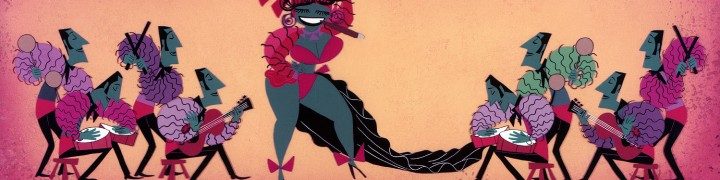
 Sung by Ethel Smith and the Dinning Sisters, ‘Blame it on the Samba’ looks like a lost sequence from ‘The Three Caballeros‘ (1944)
The short, the sixth segment from ‘Melody Time‘, reunites Donald Duck, Joe Carioca and the Aracuan bird. The latter serves as the cartoon’s surreal character, who can cross the three dimensions, not unlike the Do-Do in ‘Porky in Wacky Land’ (1938). It’s this feature that makes ‘Blame It On The Samba’ so enjoyable.
Again, the Mary Blair-inspired backgrounds are highly stylized, even almost abstract, and extremely colorful. It also features some live action footage of Ethel Smith dancing and playing the organ and a pair of conga’s. Unfortunately, the music seems to be more about samba than being it, and it never becomes really hot.
Nevertheless, ‘Blame It On The Samba’ is a welcome diversion after Melody Time’s three tiresome episodes ‘The Legend of Johnny Appleseed‘, ‘Little Toot‘ and ‘Trees‘.
Watch ‘Blame it on the Samba’ yourself and tell me what you think:
Director: ?
Release Date: May 27, 1948
Rating: ★★★★
Review:
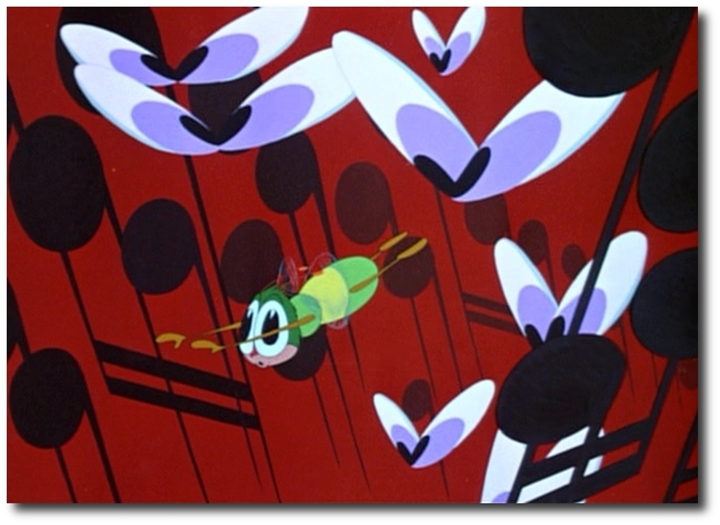 Freddy Martin and his orchestra play their jazzy variation of Nicolai Rimsky-Korsakov’s ‘Flight of the Bumblebee’ in this second segment from ‘Melody Time‘.
This music is accompanied by images of a little bumblebee fleeing from all kinds of things, in their designs loosely based on piano keys and music notes. The setting is semi-abstract and resembles the ‘After You’ve Gone’-sequence of ‘Make Mine Music’ (1946) a lot.
‘Bumble Boogie’ is far more colorful, however, with bright colors sometimes changing within semi-seconds. At one point, the little bumblebee is even rendered only in lines, anticipating the graphic style of the fifties, and of UPA in particular.
Watch ‘Bumble Boogie’ yourself and tell me what you think:
Directors: Jack Kinney, Hamilton Luske & Bill Roberts
Release Date: September 27, 1947
Stars: Jiminy Cricket, Mickey Mouse, Donald Duck, Goofy, Edgar Bergen, Luana Patton
Rating: ★★★★
Review:
 Fun and Fancy Free’ was the fourth of six package features Disney released in the 1940s.
It consists of two unrelated stories, which were both originally conceived as feature films in 1940/1941. The two stories, ‘Bongo’ and ‘Mickey and the Beanstalk’ are loosely linked by Jiminy Cricket, who sings the happy-go-lucky theme song.
He plays a record to a sad doll and a gloomy bear which features Dinah Shore telling the story of Bongo in rhyme and song. This cute, if unassuming and forgettable little film (after a story by Sinclair Lewis) tells about Bongo the circus bear, who breaks free from the circus, falls in love with a cute female bear called Lulubelle, and combats a large brutal bear called Lumpjack.
Immediately after this story has ended, we follow Jiminy Cricket to a live action setting: a private party with a little girl (Luana Patton), Edgar Bergen and his two ventriloquist sidekicks, the cynical Charlie and the dumb, but gentle Mortimer.
Bergen tells a version of ‘Jack and the Beanstalk’, starring ‘famished farmers’ Mickey, Donald and Goofy in their last classic trio outing. This part had a long genesis, the early drafts of this film go back to 1940. Apparently Pinto Colvig had returned to the Disney studio, because Goofy has his voice back after having been silenced for eight years. Pinto Colvig would do Goofy’s voice in two subsequent shorts, ‘Foul Hunting‘ (1947) and ‘The Big Wash‘ (1948), before leaving again, leaving Goofy voiceless, once more. This sequence is also the last theatrical film in which Walt Disney does Mickey’s voice. Halfway the production Jimmy MacDonald took over.
This second episode of ‘Fun and Fancy Free’ is a delight, if a little bit slow. Its humor derives mostly from Charlie’s sarcastic interruptions. Nevertheless, the animation of the growing beanstalk and of Willie the giant is stunning.
Willie would be the last giant Mickey defeated, after having done with giants in ‘Giantland‘ (1933) and ‘Brave Little Tailor’ (1938). Unlike the other giants, Willie is an instantly likeable character, and he was revived as the ghost of Christmas Present in ‘Mickey’s Christmas Carol‘ (1983).
‘Fun and Fancy Free’ is a lighthearted film. Like Disney’s other package features, it is not too bad, but it is certainly not among the ranks of masterpieces.
Watch the opening scene of ‘Fun and Fancy Free’ yourself and tell me what you think:
Director: Jack Hannah
Release Date: December 12, 1946
Stars: Goofy
Rating: ★★★★
 In ‘Double Dribble’ we’re watching a basketball game between home team U.U. and visiting team P.U. (which has only one fan).
‘Double Dribble’ is Jack Hannah’s second Goofy cartoon, and it uses the same format as his first, ‘A Knight for a Day‘ (1946) with equally fast and funny results. There’s a sports game with a lively narrator, typical for the Goofy shorts of the forties, but there’s also one underdog-like character, whom we can follow throughout the picture, and to whom we can relate. In ‘A Knight for a Day’ it was Cedric, this time it’s a tiny Goofy, called Marathu, who makes the final and deciding score, turning the game in favor of ‘old P.U.’.
Like in ‘Hockey Homicide‘ (1945) the team members share names with Disney employees.
Watch ‘Double Dribble’ yourself and tell me what you think:
This is Goofy cartoon No. 19
To the previous Goofy cartoon: A Knight for a Day
To the next Goofy cartoon: Foul Hunting
Director: Chuck Jones
Release Date: August 11, 1945
Stars: Bugs Bunny
Rating: ★★★★
Review:
 In ‘Hare Conditioned’ Bugs Bunny is working in a display at a department store. But the manager has other plans with him and wants our hero stuffed.
‘Hare Conditioned’ is full of director Chuck Jones’ typical sophisticated humor and extreme posing. For example, at the beginning of the chase scene we can see the manager looking for Bugs in three places. His move from one place to another is done in smears only one frame long, leading to extremely fast takes between the poses. Also, the final chase, involving elevators and stairs, is wonderfully timed. One of the short’s best gags, however, is set to a slower pace, and involves Bugs cross-dressing as a female customer and the manager courting him/her by tickling his/her feet.
Unfortunately, the cartoon ends abruptly with a rather trite ending: when the manager has Bugs Bunny cornered on the roof, Bugs convinces his adversary there’s a monster behind him, with himself posing as the monster, making the manager jump off the roof. But then he looks into the mirror himself…
‘Hare Conditioned’ is one of the great entries in the Bugs Bunny canon. The short clearly establishes Jones’s concept of the rabbit, as the director stated in his book ‘Chuck Amuck’:
“Golden Rule. Bugs must always be provoked. In every film, someone must have designs upon his person: gastronomic, as a trophy, as a good-luck piece (…..), as an unwilling participant in a scientific experiment (laboratory rabbit or outer-space creature). Without such threats Bugs is far too capable a rabbit to evoke the necessary sympathy”.
Indeed, Bugs only comes into action in this cartoon when threatened by death. First he tries to flee his foe, but when this proves impossible he takes control of the situation himself. Only then he does serious harm to his opponent. Nevertheless, Bugs remains calm throughout the cartoon.
Jones kept to his golden rule in the rest of his cartoons, giving Bugs other large or powerful adversaries like a giant red monster in ‘Hair-Rasing Hare’ (1946), a large boxer in ‘Rabbit Punch‘ (1948), or a Martian, capable of blowing up the earth, in ‘Haredevil Hare‘ (1948).
Watch ‘Hare Conditioned’ yourself and tell me what you think:
https://www.dailymotion.com/video/x5y67d2
This is Bugs Bunny cartoon No. 33
To the previous Bugs Bunny cartoon: Hare Trigger
To the next Bugs Bunny cartoon: Hare Tonic
‘Hare Conditioned’ is available on the DVD-set ‘Looney Tunes Golden Collection Volume Two’
Director: Jack Hannah
Release Date: September 20, 1946
Stars: Donald Duck
Rating: ★★★★
Review:
 In ‘Lightouse Keeping’ Donald works at a lighthouse. He nags a pelican by aiming the light on it. What follows is a fast and funny duel between the two birds in switching on/off the light.
This is a hilarious cartoon from the first scene, in which we watch Donald trying to read in the ever-circling lighthouse light, to the last one, where the feud has gotten so fanatical, the two birds even continue it after sunrise.
With his third Donald Duck short Jack Hannah really hit his stride. It’s faster and better timed than his first three shorts, ‘Donald’s Off Day’ (1944), ‘The Eyes Have It’ and ‘No Sail’ (1945). Maybe he was inspired by his work on a Goofy cartoon, ‘A Knight For A Day‘ earlier that year? In any case, while directing both Goofy and Donald (1946-1947), he made some of his best Donald Duck shorts: apart from ‘Lighthouse Keeping’, the 1947 shorts ‘Straight Shooters’, ‘Clown of the Jungle‘ and ‘Chip an’ Dale‘.
Watch an excerpt from ‘Lighthouse Keeping’ yourself and tell me what you think:
This is Donald Duck cartoon No. 59
To the previous Donald Duck cartoon: Dumb Bell of the Yukon
To the next Donald Duck cartoon: Straight Shooters
Director: Charles Nichols
Release Date: August 13, 1948
Stars: Pluto, Figaro
Rating: ★★★★
Review:
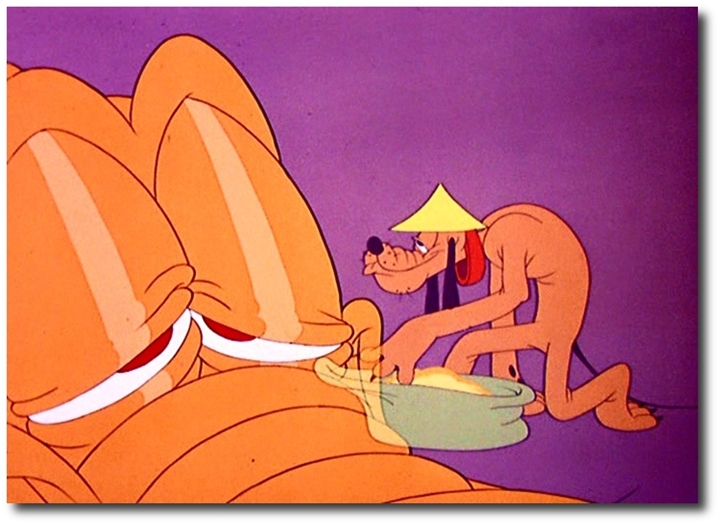
In ‘Cat Nap Pluto’ Pluto’s returning home in the morning from a very rough night, but he’s kept out of sleep by a very rise-and-shiny Figaro.
‘Cat Nap Pluto’ is an entertaining short. The funniest gags in this cartoon involve a very, very sleepy miniature Pluto sandman, who puts Pluto to sleep several times. Nevertheless, the cartoon pales when compared to the Tom & Jerry short ‘Sleepy Time Tom‘ (1951), which covers similar grounds.
‘Cat Nap Pluto’ is the second of three cartoons co-starring Pluto and Figaro, the other ones being ‘First Aiders’ from 1944 and ‘Pluto’s Sweater‘ from the next year.
Watch ‘Cat Nap Pluto’ yourself and tell me what you think:
This is Pluto cartoon No. 26
To the previous Pluto cartoon: Pluto’s Purchase
To the next Pluto cartoon: Pluto’s Fledgling
‘Cat Nap Pluto’ is available on the DVD-set ‘The Complete Pluto Volume Two’
Director: Charles Nichols
Release Date: May 10, 1946
Stars: Pluto, Dinah
Rating: ★★★★
Review:
 ‘In Dutch’ is one of those rare cartoons set in Holland.
In ‘in Dutch’ Pluto is a milk-bringing dog in a very awkward, almost fairy tale-like picture of The Netherlands. He and his love, Dinah the dachshund, accidentally ring the alarm bell in their love play, and they get expelled from the village.
However, our couple saves the day, when Dinah stops a leak in the dyke and Pluto warns the villagers, albeit in an unorthodox way. This story idea is a nice take on the children’s book ‘Hans Brinker, or the Silver Skates’ (1865) by Mary Mapes Dodge. The result is a charming little story in an exotic setting.
Like Mapes Dodge, the animators had probably never visited The Netherlands themselves, for the country is erroneously depicted as surrounded by a huge dyke, behind which the sea is splashing. Further couleur locale is provided by numerous windmills, tulips and wooden shoes. The people in the cartoon speak with a weird accent, which is supposed to sound like Dutch, but which is more reminiscent of German.
Nevertheless, it’s hard to blame the makers for the cliches, for even the George Pal’s cartoon about Holland, ‘Tulips Shall Grow’ (1942), is crowded with windmills, tulips and wooden shoes. And George Pal had lived in The Netherlands for several years…
Watch ‘In Dutch’ yourself and tell me what you think:
This is Pluto cartoon No. 18
To the previous Pluto cartoon: Pluto’s Kid Brother
To the next Pluto cartoon: The Purloined Pup
Director: Bob Clampett
Release Date: January 5, 1946
Stars: Daffy Duck
Rating: ★★★★
Review:
 ‘Book Revue’ is the last of the book-covers-come-to life cartoons, a series started by Harman and Ising in 1932, with ‘Three’s a Crowd’.
These cartoons, in which the book titles provide the gags, were mostly plotless, relying on puns and sight gags. ‘Book Revue’ is no exception, but it has the most swinging take on the formula one can wish for.
Set in ‘ye olden book shoppe’, ‘Book Revue’ contains caricatures of some famous (white) jazzmen of the era: Harry James, Frank Sinatra, Tommy Dorsey, Benny Goodman and Gene Krupa. There’s a scene resembling ‘The Swooner Crooner’ (1944), and foreshadowing ‘Little ‘Tinker’ (1948), in which several female characters swoon as soon as Sinatra starts singing. There’s a strong sense of sex here, as in an earlier scene involving ‘Indian strip’, affecting male characters. This places ‘Book Revue’ at the end of the World War II cartoon trends, for these allusions to sex would soon be discarded.
At a certain point Daffy Duck (jumping from a Merrie Melodies and Looney Tunes magazine cover) dresses himself as Danny Kaye (with a blonde wig). He interrupts the swing music to tell about a nonsensical tale of some Russian youth and a girl called Cucaracha. In this sequence Daffy imitates the Russian accent Kaye sometimes would explore. When ‘singing’ cucaracha the background suddenly changes into a startling monochrome red.
This absurd sequence is followed by Daffy singing ‘Carolina in the Morning’. Daffy immediately exchanges the song for some superb scat singing to warn Red Riding Hood for the Wolf. These two sequences form a highlight in Daffy’s career, and a real tour de force from voice actor Mel Blanc. The ‘story’, if there is any, involves Daffy being followed by the wolf from Red Riding Hood. In line with the book-covers-come-to-life tradition several personas from book covers come to help to get rid of the villain, sending the wolf to Dante’s inferno.
The animation of Daffy is extremely flexible in this cartoon, especially when animated by Rod Scribner and Manny Gould, who really push the limits here. At one point Daffy even converts into one big eye – probably the most extreme deformation of a major cartoon star ever put to screen.
‘Book Revue’ makes no sense at all, but it is a cartoon full of sheer joy, and a crowning achievement of the book series.
Watch an excerpt from ‘Book Revue’ yourself and tell me what you think:
This is Daffy Duck cartoon No. 31
To the previous Daffy Duck cartoon: Nasty Quacks
To the next Daffy Duck cartoon: Baby Bottleneck
‘Book Revue’ is available on the DVD-set ‘Looney Tunes Golden Collection Volume Two’ and on the Blu-Ray-set ‘Looney Tunes Platinum Collection: Volume 2’
Director: Wilfred Jackson & Ben Sharpsteen
Release Date: January 23, 1942
Stars: Donald Duck
Rating: ★★★★
Review:
 When the United States were forced into the war themselves, the government asked Disney to make a short to make the American citizens fill in their income tax forms in time. Disney gave them his biggest star of that time, Donald Duck, to play the everyman. The government was not impressed until the taxes came rolling in after the film was screened in cinemas.
In contrast to Disney’s earlier propaganda films for the Canadian government, this film uses entirely new animation, directed by Wilfred Jackson, and produced in the ridiculously short time period of a single month.
The short opens with Donald dancing to the energetic title song, which is sung by Cliff Edwards, the voice of Jiminy Cricket in ‘Pinocchio‘ (1940). The song is played on a slightly anthropomorphised radio. The radio then asks Donald if he wants to do his part for the country and Donald is growing more and more enthusiastic, until the radio reveals he has to pay his income tax. The radio has to persuade Donald once again, who grows enthusiastic again to the strong slogan ‘Taxes to beat the axis’ (with the axis referring to the Axis powers: Germany, Italy and Japan).
The film further explains the public how to fill in a new, simplified form, using an anthropomorphized pen, bottle of ink and blotter. Like the shorts Disney made earlier for the Canadian government (e.g. ‘The Thrifty Pig‘ and ‘7 Wise Dwarfs‘), the second half (directed by Ben Sharpsteen) consists of very limited and highly propagandistic animation with grim images of factories, guns, planes, war ships and tanks, while an intense narrator repeats the intoxicating mantra of ‘taxes to beat the axis’.
When he comes to the propagandist climax, the sentence “to beat to earth the evil destroyer of freedom and piece”, we watch a horrifying towering monster-like machine depicting the Nazi aggressor. This mechanical monster is defeated and makes place for a patriotic end shot with clouds resembling the American flag, tanks and guns rolling and planes flying accompanied by a heroic hymn, while the narrator tells us that “this is our fight”.
It’s important to note that the film goes at lengths to dehumanize the enemy. The average tax payer was not to help to kill people, but to destroy “the enemy”, in this case a vague mechanical monster. Succeeding propaganda films often eschewed the idea that making war is killing people, with the propaganda feature ‘Victory through Air Power’ (1943) being the prime example.
In case of “The New Spirit”, propaganda rarely was so obvious, but it works: after watching the picture I had its slogan in my head for days. Indeed, the film was so successful, that it got a follow-up the next year: ‘The Spirit of ’43‘.
Watch ‘The New Spirit’ yourself and tell me what you think:
Director: Ben Sharpsteen
Release Date: July 21, 1942
Stars: The Three Little Pigs (in a cameo)
Rating: ★★★★
Review:
 Arguably the most ridiculous of all war time propaganda cartoons, ‘Food Will Win the War’ tells us about the successes of American agriculture.
A bombastic narrator makes all kinds of outrageous comparisons to illustrate the farmer’s huge production. Examples are baking all fruits of America into one big pie or frying all America’s meat on four Vesuvius volcanoes. The result is so absurd and its message so out to lunch that the short is actually great fun to watch.
Throughout the cartoon the animation is very limited, almost absent. The limited animation gives the short a poster-like quality. Full animation is limited to four short sequences:
1) a bowling ball bowling down skittles which resemble Hitler, Mussolini and a Japanese general
2) a giant pie thrown at the earth
3) Chickens laying eggs
4) The three little pigs leading an army of pigs.
‘Food Will Win the War’ was the last animated short directed by Ben Sharpsteen. In the 1940s he had moved more and more towards production. He would supervise the production of a.o. ‘Fun and Fancy Free‘ (1947), ‘Cinderella‘ (1950) and ‘Alice in Wonderland‘ (1951) before moving to live action, working on Disney’s True-Life Adventures (1948-1960). He retired in 1962.
Watch ‘Food Will Win the War’ yourself and tell me what you think:
Director: Clyde Geronimi
Release Date: March 28, 1941
Stars: Mickey Mouse, Pluto
Rating: ★★★★
Review:
 Pluto serves Mickey breakfast on bed, then Mickey gives him a dime to get the morning paper.
Pluto loses the coin almost immediately down into a sewer, but he cleverly retrieves it using chewing gum. When Pluto gets the newspaper, he reads the funnies (a comic strip about… Pluto! – a rare cross reference to a Disney spin-off outside the cinema), before the wind starts to play with it, blowing the paper into the mud, leading to a blackface gag, which is a copy from the Pluto comic he has just read.
‘A Gentleman’s Gentleman’ is officially a Mickey Mouse cartoon, but most of the time is devoted to Pluto. In this cartoon his supreme silent character comedy is simply delightful, making ‘A Gentleman’s Gentleman’ one of the classic Pluto shorts.
Watch ‘A Gentleman’s Gentleman’ yourself and tell me what you think:
This is Mickey Mouse cartoon No. 110
To the previous Mickey Mouse cartoon: The Little Whirlwind
To the next Mickey Mouse cartoon: Canine Caddy
Director: Leonid Amalrik & Olga Khodataeva
Release Date: 1942
Rating: ★★★★
Review:
 ‘Kino-Circus’ (also called Cinema Circus) is the most inspired of the anti-fascist war propaganda cartoons made in the Soviet Union.
The short is called ‘a cartoon satire in three acts’ and features a Charlie Chaplin-like character, who introduces us to three staged satires, all featuring Adolf Hitler:
In the first, ‘Adolf the dog trainer and his pooches’, Hitler throws a bone at his three dogs, Benito Mussolini, Miklós Horthy and Ion Antonescu, the leaders of his allies Italy, Hungary and Romania, respectively.
In the second, ‘Hitler visits Napoleon’, Hitler asks Napoleon’s tomb for advice, but the deceased drags him into the tomb. It’s the most prophetic of the three, for indeed both Napoleon and Hitler were defeated in Russia.
In the third, ‘Adolf the juggler on powder kegs’, Hitler juggles with several burning torches on a pile of powder-barrels, representing the countries he has occupied. When he accidentally drops one of the torches, the barrels explode. The animation is particularly silly in this sequence and a delight to watch.
After the grim political posters from 1941, ‘Kino-Circus’ is more lighthearted. The film ridicules Hitler more than it makes him threatening. Quite surprising since in1942 Nazi Germany was still a serious threat to the Soviet Union: Leningrad suffered under a long siege, and the Soviet Union had only just begun its counter-attack.
Interestingly, both directors of ‘Kino-Circus’ later became famous for their sweet fairy tale films.
Watch ‘Kino-Circus’ yourself and tell me what you think:
‘Kino-Circus’ is available on the DVD box set ‘Animated Soviet Propaganda’
Director: Charles Nichols
Release Date: June 23, 1944
Stars: Pluto
Rating: ★★★★
Review:
 An updated version of Pan from ‘Fantasia’ (1940), now wearing a boiler hat, creates spring.
Pluto enjoys it for a while, e.g. discovering a caterpillar who transforms into a very sexy butterfly. The butterfly is designed as a miniature pin-up girl, who dances to a conga beat. After this encounter, Pluto juggles with a wasps’ nest, angering the wasps who sting him in the form of a Lockheed Lightning and a V2 rocket. These two sequences make ‘Springtime for Pluto’ a typical war era cartoon, even though it’s not about war, at all.
After Pluto gets stung, he’s caught in the rain, and even in a hailstorm. In the end he’s not enjoying spring anymore, and angrily he chases Pan into the distance.
‘Springtime for Pluto’ is the first cartoon directed by Charles Nichols, who would direct all Pluto and Mickey cartoons (save one) from now on until their retirement in 1953. Nichols is famous for his mild-mannered humor, but his debut consists of very enjoyable utter nonsense from the beginning to the end. It’s full of the exuberant spirit of the war time era.
Even the oil backgrounds, painted by Lenard Kester (1917-1997), have more vivid colors than before. These are flatter than in most Disney films, and during the butterfly sequence one can even see the paper texture. They form an early example of a more graphic style of backgrounds within a Disney film, and look forward to the fifties. Perhaps Kester had been inspired by similar experiments by Chuck Jones’ unit at Warner Brothers (e.g. ‘The Dover Boys‘ from 1942). In any case, the result contributes to the surreal atmosphere of the film.
Kester has been credited for backgrounds of only one other Disney cartoon, ‘How To Play Football’ from a few months later. In this short the backgrounds are effective, but unremarkable. Had he been toned down by the studio? Fact is that Kester soon moved on to devote his life to oil painting…
Watch ‘Springtime for Pluto’ yourself and tell me what you think:
This is Pluto cartoon No. 11
To the previous Pluto cartoon: Private Pluto
To the next Pluto cartoon: First Aiders
Director: Clyde Geronimi
Release Date: April 2, 1943
Stars: Pluto, Chip ‘n Dale
Rating: ★★★★
Review:

Pluto has joined the army, and wearing a helmet, he has to protect “the pillbox” (a canon) against saboteurs.
These appear to be two little chipmunks who use the canon to crack acorns. Pluto tries to fight them, but the two critters defeat him in an unexpected ending.
‘Private Pluto’ is the second of two World War II-themed Pluto cartoons (the first being ‘The Army Mascot‘ from 1942). It was also to be the last Pluto cartoon directed by Clyde Geronimi, who promoted to sequence director in Disney’s feature films. Geronimi was succeeded by Charles Nichols, who seemed to be more comfortable with the character and who would direct every Pluto cartoon save one from then on.
‘Private Pluto’ is an important cartoon, because it introduces those famous chipmunks, Chip ‘n Dale. They’re not named yet, nor are they two different characters here, but their mischievous behavior and their hardly comprehensible jabbering are already present, and they’re certainly instantly likeable.
Chip ‘n Dale would eventually become Donald’s adversaries, but Pluto, too, would re-encounter them in three cartoons: ‘Squatters Rights‘ (1946), ‘Food for Feudin’‘ (1950) and ‘Pluto’s Christmas Tree‘ (1952).
‘Private Pluto’ is interesting in its own right, for it shows the line of coastal defense the United States had placed at the Pacific Coast in the years preceding the war. After the attack on Pearl Harbor it had been placed on high alert (thus Pluto’s job), but luckily there was no need ever to use it.
Watch ‘Private Pluto’ yourself and tell me what you think:
This is Pluto cartoon No. 10
To the previous Pluto cartoon: Pluto at the Zoo
To the next Pluto cartoon: Springtime for Pluto
Director: Hawley Pratt
Release Date: April 26, 1967
Stars: The Pink Panther, The Little Guy
Rating: ★★★★
Review:
 ‘Pink Posies’ could be summarized as ‘The Pink Phink‘ set in a garden: this time the little guy is a gardener planting yellow flowers, while the Pink Panther replaces them for pink ones.
Most of the gags are variations on those in ‘The Pink Phink’, which make this cartoon a very enjoyable one, even though it’s not very original. The designs of this cartoon are also attractive, the very stylized trees in the background in particular.
Watch ‘Pink Posies’ yourself and tell me what you think:
https://www.dailymotion.com/video/x36nrng
‘Pink Posies’ is available on the DVD Box set ‘The Pink Panther Cartoon Collection’
Director: Hawley Pratt
Release Date: December 23, 1966
Stars: The Pink Panther, The Little Guy
Rating: ★★★
Review:
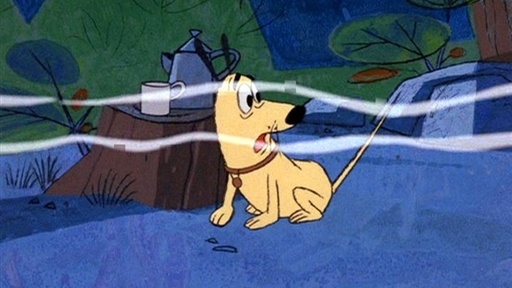 In ‘Rock-a-bye Pinky’ the little guy is camping out, but his snoring troubles the Pink Panther, who’s sleeping in the tree above.
The Pink Panther tries to get rid of the little guy, but it is the little guy’s dog who gets the blame. When finally man and dog discover that the Pink Panther is the real cause of their trouble, they chase him out of the park into the distance.
‘Rock-A-Bye Pinky’ is one of the better Pink Panther cartoons: it has a good story and some great gags. The dog would reappear in ‘Pink Paradise’, the following year.
Watch ‘Rock-A-Bye Pinky’ yourself and tell me what you think:
Director: Chuck Jones
Release Date: January 20, 1966
Stars: Tom & Jerry
Rating: ★★★★
Review:
 After another chase, Jerry challenges Tom for a duel.
What follows are rather Road Runner-like blackout gags in which the two try various weaponry. In the end it’s Tom who gets weary of their misguided attempts and goes back to the original chase.
‘Duel Personality’ is an original and entertaining film, in which the titles only arrive after 1 minute and 24 seconds. It’s also the first Tom and Jerry featuring music by composer Dean Elliott. Elliott replaced Eugene Poddany and his music is jazzier than Poddany’s, and his use of recurring themes make his music more like that of classic Tom & Jerry composer Scott Bradley. All in all a great improvement for the series.
Watch ‘Duel Personality’ yourself and tell me what you think:
This is Tom & Jerry cartoon No. 144
To the previous Tom & Jerry cartoon: The Cat’s Me-ouch
To the next Tom & Jerry cartoon: Jerry Jerry Quite Contrary
Director: Chuck Jones
Release Date: June 9, 1965
Stars: Tom & Jerry
Rating: ★★★★
Review:
 Director Chuck Jones and writer Michael Maltese reuse their story idea from their classic Warner Brothers cartoon ‘Mouse Wreckers‘ (1949), with Jerry and an anonymous mouse replacing Hubie and Bertie, and Tom replacing Claude Cat.
Like in the former cartoon, the two mice try to convince the unhappy cat he’s insane. The gags are different, though, as is the ending, for unlike Claude Cat, Tom gets his torturers and punishes them in the end.
Although ‘Mouse Wreckers‘ is much to be preferred above ‘The Year of the Mouse’, the inspired story works once again, and results in one of the better Tom & Jerry cartoons by Chuck Jones’s unit.
Watch ‘The Year of the Mouse’ yourself and tell me what you think:
This is Tom & Jerry cartoon No. 142
To the previous Tom & Jerry cartoon: Tom Thump
To the next Tom & Jerry cartoon: The Cat’s Me-ouch
http://www.supercartoons.net/cartoon/437/tom-jerry-the-year-of-the-mouse.html
Director: Chuck Jones
Release Date: February 25, 1964
Stars: Tom & Jerry
Rating: ★★★★
Review:
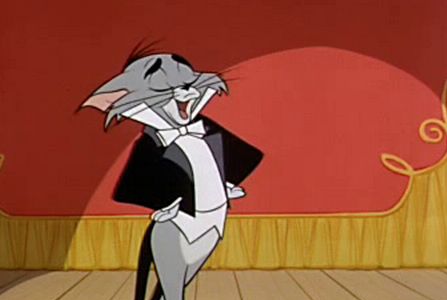 In ‘The Cat Above, The Mouse Below’ Tom is a successful opera singer performing Figaro’s famous aria ‘Largo el factotum’ from Gioachino Rossini’s ‘Il barbiere de Sevilla’ (what else?) at a grand theater, but awakening Jerry by doing so.
In this short Tom displays some fantastic facial expressions, director Chuck Jones’ trademark. It’s also probably the best of all Chuck Jones’s Tom & Jerry cartoons, albeit not as funny as Jones’ earlier ‘Long-haired Hare‘ (1949) or Tex Avery’s ‘Magical Maestro’ (1952), which both use the same theme.
Watch ‘The Cat Above, The Mouse Below’ yourself and tell me what you think:
https://www.dailymotion.com/video/x6eg8vi
This is Tom & Jerry cartoon No. 129
To the previous Tom & Jerry cartoon: Penthouse Mouse
To the next Tom & Jerry cartoon: Is There a Doctor in the Mouse?


 Dr. Grob's Animation Review