You are currently browsing the category archive for the ‘★★★’ category.
Director: David Hand
Release Date: November 14, 1936
Stars: Pluto
Rating: ★★★
Review:
 Pluto unwillingly starts a career as a mother to a number of chicks.
When he finally has learned to love them, their real mother returns and together with her husband, a violent rooster, tries to chase Pluto away.
Although introduced as such, ‘Mother Pluto’ is not really a Silly Symphony. It lacks both the obligate music and the fairy tale character typical of the series. It’s actually Pluto’s first solo outing. It seems that at the time Disney didn’t dare to introduce new series besides the Mickey Mouse cartoons and the Silly Symphonies. But with Mickey giving way more and more to his co-stars Goofy, Donald and Pluto, this step would soon be made.
At the end of 1937 Pluto would become the first Mickey Mouse co-star to start his own series with ‘Pluto’s Quin-Puplets’, immediately followed by Donald with ‘Donald’s Ostrich’. Goofy followed one-and-a-half year later, in 1939, with ‘Goofy and Wilbur’. These three stars would be heading most of the Disney shorts of the 1940s and 1950s when the Silly Symphony series had been dropped and the number of Mickey Mouse shorts diminished.
Watch ‘Mother Pluto’ yourself and tell me what you think:
This is Silly Symphony No. 64
To the previous Silly Symphony: The Country Cousin
To the next Silly Symphony: More Kittens
Director: Wilfred Jackson
Release Date: September 1, 1934
Rating: ★★★
Review:
 ‘Peculiar Penguins’ can be summarized as ‘love story in the Antarctic’: a penguin falls in love with a girl, blows it, but saves the day by rescuing her from a terrible shark.
Being one of the weaker entries in the Silly Symphonies, ‘Peculiar Penguins’ nevertheless contains some fine animation, especially in the under water chase, which is literally packed with special effects. Like in ‘Funny Little Bunnies‘, the setting is introduced by a sugary song, accompanying a complex opening shot, with lots of penguins moving and seagulls flying in it.
Ten years later Disney would return to the Antarctic to tell about a particularly peculiar penguin called Pablo in ‘The Three Caballeros‘ (1944).
Watch ‘Peculiar Penguins’ yourself and tell me what you think:
This is Silly Symphony No. 47
To the previous Silly Symphony: The Flying Mouse
To the next Silly Symphony: The Goddess of Spring
Director: Wilfred Jackson
Release Date: October 28, 1933
Stars: Mickey Mouse, Minnie Mouse
Rating: ★★★
Review:
 Mickey applies for a job at Tony’s pet store. Then Minnie drops by and together they perform their usual song-and-dance-routine.
‘The Pet Store’ was Mickey’s last cartoon to feature the half song-and-dance routine half story formula, a story structure that by 1933 had become old-fashioned.
This time Minnie’s quite tiresome lalala’s are interrupted by ‘Beppo, the movie monk’, an ape who has read about King Kong (that movie was released the same year) and who wants to imitate him, after he had imitated Stan Laurel. This leads to a nice spoof of King Kong, in which the ape climbs a pile of boxes with Minnie under his arm while being attacked by birds, mimicking the planes in the original feature. In the end Mickey and Minnie are fleeing the pet shop, just before the owner returns, leaving it in complete ruin.
Unfortunately, by 1933 such battle scenes had become as jaded as the song-and-dance routines, and the one in ‘The Pet Store’ is not really different from the ones in ‘The Bird Store‘, ‘King Neptune‘, or ‘Babes in the Woods‘ (all 1932). Nevertheless, the take on ‘King Kong’ is marvelous, and more original than Walter Lantz’s much more literal spoof ‘King Klunk‘ from one month earlier.
Tony is the first elaborate human to enter Mickey’s world, being on par with the human characters in the Silly Symphony ‘The Pied Piper‘ from one month earlier. He would be topped, however, by the giant in Mickey’s next cartoon, ‘Giantland‘. Part of the fun in this cartoon is provided by Tony’s pseudo-Italian labels (like “birda seed” and “biga da sale”), a type of pun that was later borrowed extensively by Chuck Jones in his Pepe le Pew-cartoons.
Watch ‘The Pet Store’ yourself and tell me what you think:
This is Mickey Mouse cartoon No. 61
To the previous Mickey Mouse cartoon: The Steeple Chase
To the next Mickey Mouse cartoon: Giantland
Director: Wilfred Jackson
Release Date: September 17, 1932
Stars: Mickey Mouse, Minnie Mouse, Goofy, Clarabelle Cow, Horace Horsecollar
Rating: ★★★
Review:
 After three years of musical cartoons, consistent story lines where reintroduced to the Mickey cartoons with a remarkable success in 1932 (good examples are ‘Barnyard Olympics‘ and ‘Touchdown Mickey’). In this era the musical cartoon ‘The Whoopee Party’ with its total lack of story seems to be quite old-fashioned.
The short contains numerous elements that were used many times earlier: a public dancing, Minnie singing behind the piano and alive inanimate objects (although the latter feature was much more common practice in the Fleischer and Iwerks cartoons of that time – yet no other Disney cartoon celebrates the secret dancing life of inanimate objects as much as ‘The Whoopee Party’ does). The short also contains some nice effect animation of confetti and flying feathers. Despite being anything but new, the sheer fun with which everything is executed, makes this cartoon a delight to watch.
‘The Whoopee Party’ marks Goofy’s second appearance after his debut in ‘Mickey’s Revue‘ earlier that year. It’s in this cartoon he gets the looks he would maintain until Art Babbitt redesigned him for ‘On Ice’ (1935). He’s more than just a silly laugh now; he now has a rudimentary character of being some kind of silly person, and we hear him speak for the first time. Clearly, he now is one of the gang, making sandwiches with Horace and Mickey, and showing to be a character here to stay. Yet, he’s still more weird than likable – and when he made his debut as ‘Dippy Dawg’ in Floyd Gottfredson’s comic strip in January, 1933, he’s introduced as a pest. In fact, Goofy’s character would remain rather vague until 1935. Only with ‘Mickey’s Service Station’ from that year he would become the likable Goof we know today.
It may be interesting to note that Goofy arguably is the first cartoon character built on a funny voice. His success is proof that, although a unique voice is not necessary (Tom and Jerry for instance could do perfectly without one), it certainly helps to build a character. This must have been an inspiration to later voice-based characters like Donald Duck, Porky Pig and Daffy Duck.
Ironically, Goofy himself would eventually lose his voice in the early forties when voice artist Pinto Colvig left Disney for Fleischer.
Watch ‘The Whoopee Party’ yourself and tell me what you think:
This is Mickey Mouse cartoon No. 46
To the previous Mickey Mouse cartoon: Trader Mickey
To the next Mickey Mouse cartoon: Touchdown Mickey
Director: Burt Gillett
Release Date: September 22, 1930
Stars: Mickey Mouse, Minnie Mouse
Rating: ★★★
Review:
 A gruesome gorilla has escaped. Mickey rings Minnie to warn her about it, but she’s not afraid and she plays Mickey a tune* through the telephone, until the gorilla enters and kidnaps her. Of course Mickey rushes to her house to save her.
This cartoon is interesting for the rather extensive dialogue in the beginning of the cartoon. By now the Disney animators had mastered lip-synch, and neither Mickey nor Minnie show any awkward faces anymore while talking.
Even more interesting is the cartoon’s quite elaborately drawn gorilla, which in several scenes is staged originally to show its huge size. The cartoon is a great improvement on Mickey’s earlier horror cartoon, ‘The Haunted House‘ (1929) and cleverly explores the possibilities of suspense by using some spectacular elements of horror: whispers, shadows, darkness and false alarms. It also contains a classic corridor-with-doors-scene, which may very well be the very first in its genre.
Watch ‘The Gorilla Mystery’ yourself and tell me what you think:
This is Mickey Mouse cartoon No. 22
To the previous Mickey Mouse cartoon: The Chain Gang
To the next Mickey Mouse cartoon: The Picnic
* The tune is “All Alone”, a hit song from 1924, which of course still was copyrighted in 1930. The use of a copyrighted tune marks a change in Disney’s musical policy. Apparently by 1930 he could afford it to pay rights. Disney’s use of well-known pop tunes remained sporadical, however. And Disney soon turned to producing hit songs of his own, most notably ‘Who’s Afraid of the Big Bad Wolf’ from ‘Three Little Pigs‘ (1933).
Director: Norm Ferguson
Release Date: December 21, 1944
Stars: Donald Duck, Joe Carioca, Panchito, The Aracuan Bird
Rating: ★★★
Review:
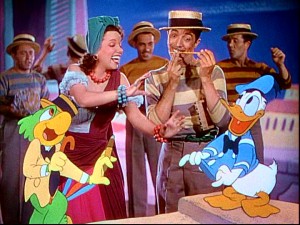 Donald stars in his first and only very own feature film.
In the opening scene he receives a large package full of presents. When he opens these presents, they lead him to the mild story of Pablo the cold-blooded penguin (narrated by the melancholy voice of Disney-favorite Sterling Holloway), and to the childish story of ‘Gauchito and his flying donkey Burrito’, before it reintroduces Joe Carioca from ‘Saludos Amigos‘ (1942). Joe takes Donald to Baía, where they dance the samba with Aurora Miranda, nicely blending animation with live action, something that occurs throughout the picture.
Another package introduces the Mexican rooster Panchito. Together the trio sings the intoxicating theme song, wonderfully animated by Ward Kimball, who regarded the scene as his best work. Panchito takes Donald and Joe on a magic serape ride over Mexico, visiting Mexico City, Veracruz en Acapulco Beach, where Donald plays blind man’s buff with a bunch of girls in bathing suits. Actually, Donald keeps hunting girls like a hungry wolf throughout the picture.
‘The Three Caballeros’ was the second of two ‘Good neighbor policy’ features, focusing on South America, and the second of six compilation features Disney made until returning to real features with ‘Cinderella‘ in 1950. When compared to ‘Saludos Amigos’, ‘The Three Caballeros’ is brighter, bolder and more nonsensical. It is noteworthy for its bold color design and for its beautiful color book artwork by Mary Blair, which in its modernity looks forward to the 1950s (especially in the opening titles, during the train ride and in the Mexican Christmas episode).
It is most interesting however, because of its zany surrealism, which invades many scenes with associative images, where metamorphosis and abstraction run haywire, not even sparing Donald himself. In this respect ‘The Three Caballeros’ is the boldest feature Disney ever made.
However, its lack of story, its strong touristic content, its outdated live action imagery, its sentimental songs and the two childish stories at the beginning of the feature all harm the picture. Thus watching the movie feels like being on a colorful journey full of beautiful images that nevertheless turns out to be unsatisfactory in the end.
Watch the title song from ‘The Three Caballeros’ below:
‘The Three Caballeros’ is available on DVD
Director: Wilfred Jackson
Release Date: August 19, 1931
Rating: ★★★
Review:
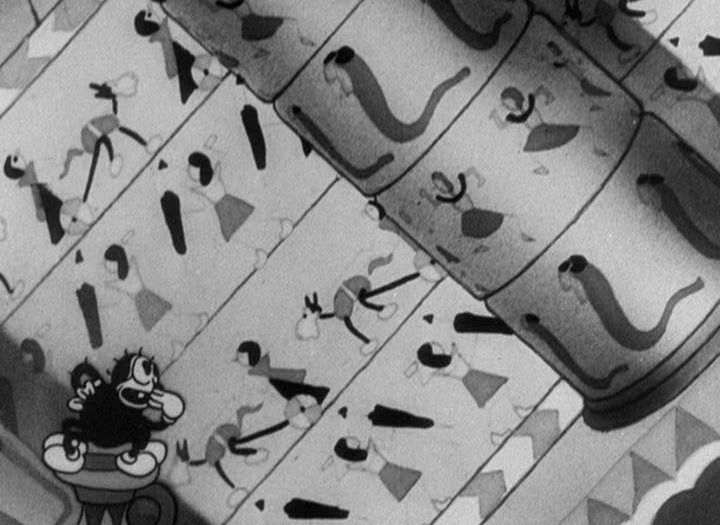
In ‘Egyptian Melodies’ the little six-legged spider from ‘Midnight in a Toy Shop‘ (1930) returns to the animated screen.
The short is one of those early Silly Symphonies that offers quite a dull dance routine only (and no story). Nevertheless, the introduction of the cartoon is well worth watching: when we follow the spider down into the pyramid, we experience some astonishing 3D-effect animation, creating the feeling that the camera wanders with the spider through corridors and staircases.
This unique exercise in perspective would not be repeated in animation until labyrinth computer games were introduced in the 1980s. The Disney Studio itself must have been impressed by this stunning piece of animation, for it was reused two years later in the Mickey Mouse cartoon ‘The Mad Doctor‘ (1933).
Once inside the pyramid, the spider watches four mummies dance, and the drawings on the walls coming to life. These last scenes feature 2-dimensional characters, which can be seen as very early and primitive forerunners of the cartoon modern style of the 1950s. Unfortunately, these scenes are a little bit dull, but they do lead to a great finale. This is one of the earliest nightmare-sequences, in which the montage of images is diffuse and increasingly sped up, in order to suggest the feeling of getting insane. This predates similar sequences in films like ‘Der Fuehrer’s Face‘ (1943) by many years.
The idea for ‘Egyptian Melodies’ may have come from the Van Beuren cartoon ‘Gypped in Egypt‘ (1930), which also features dancing hieroglyphs, nightmarish scenes, and even a corridor scene. Notice that the classic horror film ‘The mummy’ (1932) hadn’t been released, yet, at the time.
This is Silly Symphony No. 21
To the previous Silly Symphony: The Cat’s Out
To the next Silly Symphony: The Clock Store


 Dr. Grob's Animation Review