You are currently browsing the category archive for the ‘★★’ category.
Director: John Eng
Airing Date: January 27, 1996
Stars: Duckman
Rating: ★★
Review:
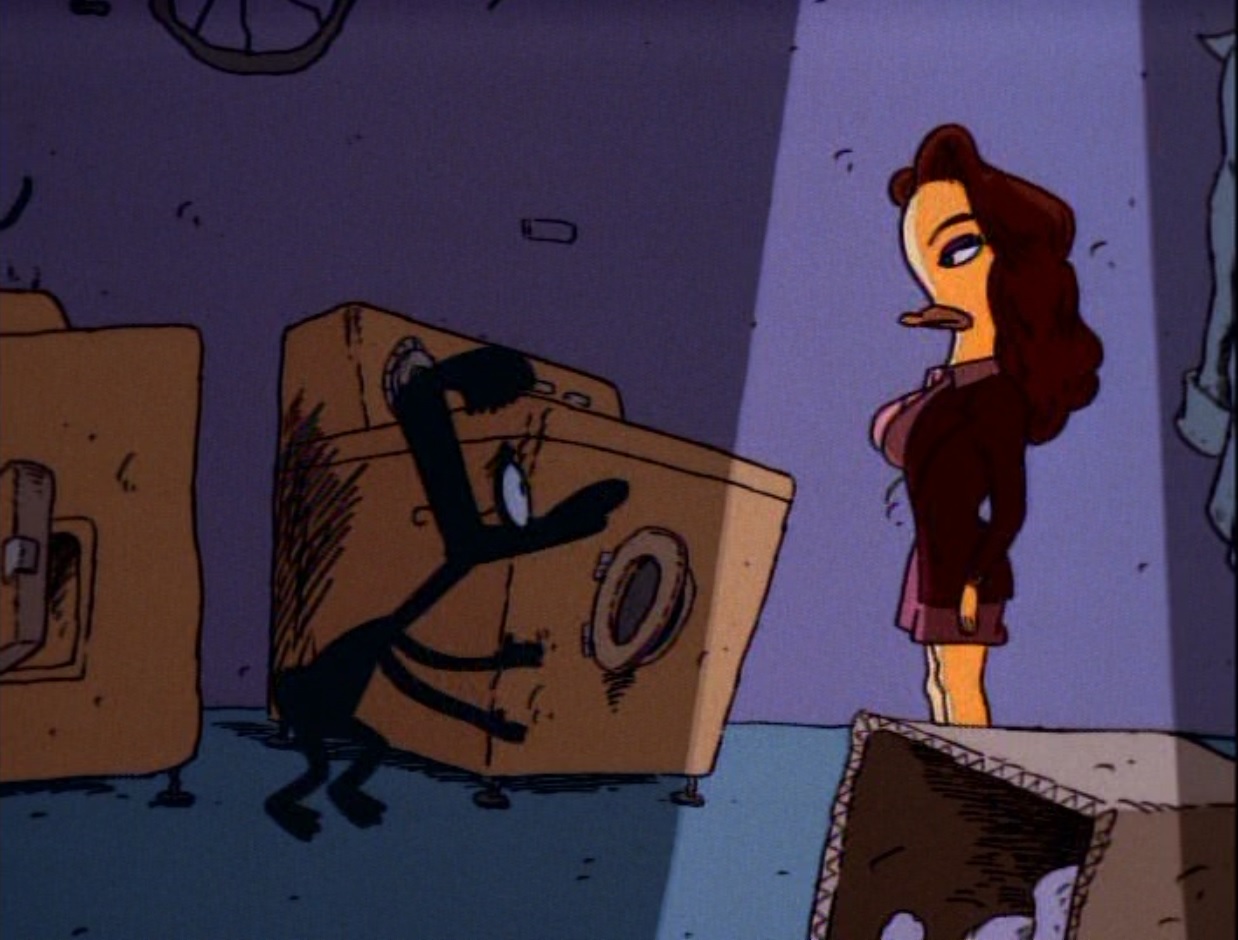
‘Color of Naught’ is one of those episodes revolving around an evil plot by Duckman’s arch nemesis King Chicken. These don’t belong to the series’ best, and ‘Color of Naught’ suffers from sloppy story telling, with its rather random plot twists, and obligatory finale.
Iggy Catalpa (from ‘Joking the Chicken‘) returns for a short cameo, but more interestingly is the return of Angela, Duckman’s love interest from ‘About Face‘. Her interactions with Duckman install some interesting moments in an otherwise disappointing episode. The cameo of three guys from the ‘Weird Sciene’ television show (1994-1998) has aged less well, as this series has fallen into oblivion.
‘Color of Naught’ is noteworthy for the outlandish animation on the Beautex Salesman, and for King Chicken’s rather original way of destroying Duckman’s world, reducing characters and background art to black and white sketches, before turning into nothingness.
Watch ‘Color of Naught’ yourself and tell me what you think:
This is Duckman episode no. 26
To the previous Duckman episode: Grandma-ma’s Flatulent Adventure
To the next Duckman episode: Sperms of Endearment
‘Color of Naught’ is available on the DVD-box ‘Duckman – The Complete Series’
Director: Brian Larsen
Release Date: November 13, 2012
Rating: ★★
Review:

In ‘The Legend of Mor’du’ the witch from ‘Brave‘ tells the viewer the background story of the feature film, and the origin of the bear Mor’du.
The witch is animated in 3D, just like the feature film, but her story is animated in 2D, featuring angular designs, strong color schemes, and very little animation. In fact, the story itself is little more than an animatic. Unfortunately, the story is of little interest, and the attempts of humor only disturb the narrative, instead of enhancing it. ‘Brave’ wasn’t a very strong film to begin with, and ‘The Legend of Mor’du’ only succeeds in proving that many of the feature’s story problems already start at its foundation.
Watch an excerpt from ‘The Legend of Mor’du’ yourself and tell me what you think:
‘The Legend of Mor’du’ is available on the Blu-Ray and DVD of ‘Brave’
Director: Pascale Hecquet
Release Date: June 9, 2012
Rating: ★★
Review:
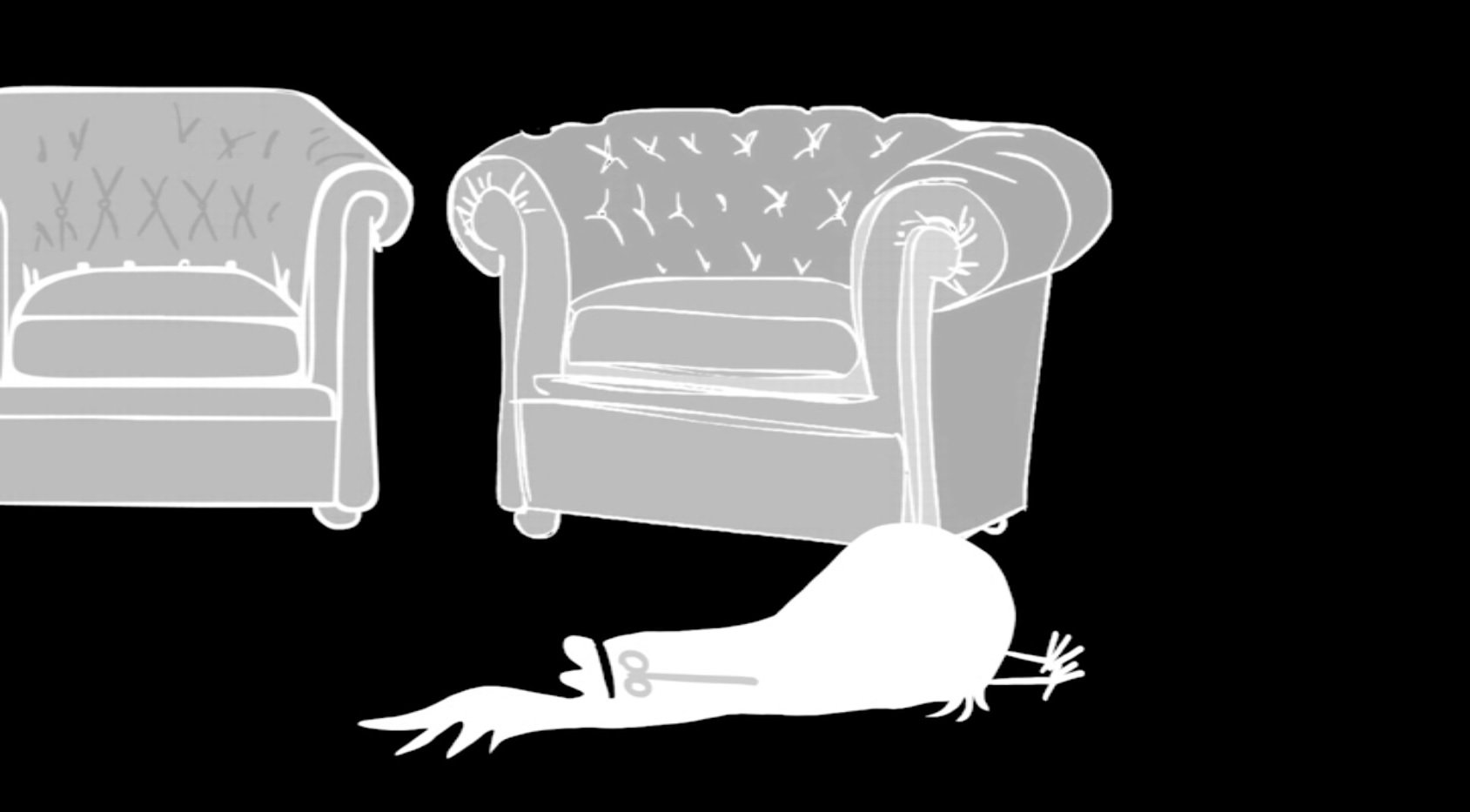
‘Duo de Volailles, Sauce Chasseur’ is a short comedy film in which a white and a black chicken are threatened by a fox in their own home.
The film is is black and white itself and tries to play with the idea that the white chicken is invisible in light and the black chicken invisible in the dark. Thus the film features a lot of on and off switching of lights.
Unfortunately, the film never succeeds in getting funny. Hecquet’s facial designs on the fox are more trite than funny, and his timing is sloppy. It certainly doesn’t help that at one point the two chickens start dancing a tango. How this deludes the fox is beyond me, because both thus remain visible to the fox throughout. Hecquet’s use of split screen is a rather petty try to make the action more exciting than it really is. The end result is a disappointingly tiresome film that never lives up to its clever premise.
Watch ‘Duo de Volailles, Sauce Chasseur’ yourself and tell me what you think:
‘Duo de Volailles, Sauce Chasseur’ is available on the Belgian DVD ‘Haas & Hert en andere verhaaltjes’
Director: Peter Sohn
Release Date: November 10, 2015
Rating: ★★
Review:

During the 2010s Pixar lost quite some of its brilliance. Not only saw the decade a multitude of sequels (seven out of eleven), two of the remaining stand-alone films, ‘Brave’ and ‘The Good Dinosaur’ were in fact strikingly disappointing. Particularly ‘The Good Dinosaur’ feels rather lackluster for a Pixar film. The general public apparently thought so, too, causing ‘The Good Dinosaur’ to become Pixar’s first financial disappointment.
For once, ‘The Good Dinosaur’ feels as if it had hit the theaters before its story problems were entirely solved. The film’s story had a troubled history, with two of its original writers (Bob Peterson and John Walker) being removed from the project halfway, and a release date being postponed two years. And yet, the final product still feels half-baked, and badly thought through.
The film’s premise is an alternate history in which the asteroid that hit Earth 66 million years ago only passed by, sparing the dinosaurs, and allowing them to evolve to the present day.
If you realize that this allows for a staggering 66 million years of extra evolution, surprisingly little is done with the concept. First, we hardly see any dinosaurs, at all. Only four species are depicted: Arlo’s family of Sauropods, a single Styracosaurus, a few hideously ugly Dromaeosaurids (who look like plucked chickens which makes them the most revolting looking Dromaeosaurids ever put to the screen) and three Tyrannosauruses. We can add some grisly Pterosaurs to the mix (another example of appalling design), but that’s it.
As you may have noticed, the species depicted are all recognizable as familiar species, as if nothing would have happened in 66 million years! Thus, the whole initial concept has been largely thrown away at the beginning. Instead, we are invited to believe Sauropods have invented agriculture, and Tyrannosaurids (who are very well-designed, but certainly not according to the latest scientific evidence of the time) have invented cattle breeding. Even worse, the film makers have allowed mammals to evolve beyond, as well, as if they wouldn’t have had competition from the well-established dinosaurs, depicting buffalo and, sadly, humans. How humans could ever have evolved in the shadow of dinosaurs baffles me, but here they are, and in the Americas, too. And yet, the story seems to take place during the Pleistocene, not extending the time period to the present, but why this may be so, will never be known. It unfortunately only adds to the age-old trope of co-existence of dinosaurs and early man, making ‘The Good Dinosaur’ strangely akin to the nonsense of e.g. The Flintstones.
The film focuses on Arlo, a small, weak and cowardly Sauropod, who loses his father and his home, but befriends a little human whom he calls Spot, and who overcomes his fears on his journey back home.
This story is already pretty uninteresting, but the execution is remarkably boring, and despite a modest length of 93 minutes, the film plods through its story following familiar tropes, and delivering no surprises. As too often in Disney movies there’s a strong focus on ‘family’ that feels tired and cliché. Moreover, Arlo’s development, given the traumatic loss of his father, feels obligate and is rather unconvincing, to say the least. Unlike Simba in ‘The Lion King’ (1994) there’s no sense of guilt or self-punishment, and Arlo’s dream encounter with his father is nothing like that of Simba in the former movie.
It doesn’t really help that for most of the time Arlo is a rather unpleasant character. His weakness and cowardice is not appealing, but annoying, and he behaves selfishly most of the time. To me it’s no less than a marvel that Arlo doesn’t die in the wild, so unbelievably unfit is our ‘hero’ for survival. I certainly believe the voice choice for Raymond Ochoa is part of the problem, for Arlo’s voice got on my nerves over time.
The other animals don’t help either. True, Spot is a well-established character, and surely forms the heart of the film, but Arlo’s family is quite bland, and almost all other creatures Arlo encounters seem rather lunatic, not to say insane. The only exceptions are the three Tyrannosaurs, and they form the highlight of the film. The animation of their walk, which looks like cowboys riding horses, belongs to the most original and best animation of movement ever put to the screen. Moreover, voice actor Sam Elliott is cast perfectly as the leader of the three. I don’t know why but somehow this Tyrannosaurus design is the perfect depiction of the mustached actor in Dinosaur form, as if Elliott had always been a Tyrannosaur deep inside, and the animators have brought his inner dinosaur to life.
Apart from story and personality issues, the film suffers from design flaws. The problems already start with the very first scene, which is a very, very unrealistic depiction of the asteroid belt. As said, the Dromaeosaurid and Pterosaur designs are atrocious, but also Arlo himself suffers. Compared to his co-stars he is way to cartoony, with oversized limbs, eyes and teeth, and essentially unappealing.
Spot is much, much better, but for some unknown reason Spot is shown as only partly bipedal and he’s given some dog-like behavior, while this is discarded in the depiction of other humans. One can argue that the orphan Spot is a feral child, like Mowgli, but as it’s never explained, I doubt whether this concept was even used in the background story.
No, the film’s real highlights are its landscapes. The film excels in impressive depictions of North American nature. The rivers, forests, mountains and plains depicted all look absolutely gorgeous, and are a giant move forward since ‘Cars’ (2005), which itself had been a milestone of landscape building in computer animation. The depiction of wet rocks and needle covered forest floors is no less than stunning and are still unparalleled in their realism and beauty. Indeed, it’s clear the film makers were most proud of their background art, for it’s the landscapes that ornament the end titles, not the characters. To me this says enough.
Watch the trailer for ‘The Good Dinosaur’ yourself and tell me what you think:
‘The Good Dinosaur’ is available on Blu-Ray and DVD
Director: Phil Mulloy
Release Date: 1995
Rating: ★★

‘Thou Shalt Not Bear False Witness’ tells about farmer Nathan and his wife Emmylou, who have been married since they were eighteen, but who are secretly dreaming of another life.
It’s a bit unclear what the subject of ‘Thou Shalt Not Bear False Witness’ has to do with this particular commandment, and the film feels rather pointless, resulting in possible the weakest of Mulloy’s The Ten Commandment films.
Like most of the other Ten Commandments episodes the short is narrated by Joel Cutrara and takes place in Joesville.
‘Thou Shalt Not Bear False Witness’ is available on the BFI DVD ‘Phil Mulloy – Extreme Animation’
Director: Phil Mulloy
Release Date: 1995
Rating: ★★

‘Honour Thy Father and Thy Mother’ is the fourth entry in Phil Mulloy’s puzzling Ten Commandments series.
This short tells the story of Little Tucker, who is forced by his parents to run a county race, only to arrive last. This film takes place full of oil fields, and Mulloy not only uses his characteristic stark black and whites, but also some bright reds and yellows for a fire.
The short, narrated by Joel Cutrara, is rather simple and straightforward, and doesn’t really deliver its promise. Nevertheless, it contains a nice jazzy score by Dave King.
‘Honour Thy Father and Thy Mother’ is available on the BFI DVD ‘Phil Mulloy – Extreme Animation’
Director: Philip Hunt
Release Date: 1994
Rating: ★★
Review:

‘Ah Pook is Here’ is a short but rather pretentious film using texts by avant-garde writer William S. Burroughs on the atomic bomb.
Read by William S. Burroughs himself from the book of the same name, the film mixes computer animation and stop motion to vaguely illustrate Burrough’s texts. The film is set on a small black planet, enircled by Gods, who look like satellites and bombs. Ah Pook is the destroyer, a.k.a. the atomic bomb. On the planet lives a red-headed alien who asks another flying alien about the nature of man, the nature of death and of democracy.
Unfortunately, the images are pretty irrelevant to the text: they neither illustrate nor counter it. Moreover, Burroughs’s text is pretty disjointed itself, making this short animation film remarkably aimless. For this reason ‘Ah Pook is Here’ must be regarded a cinematic failure, despite the virtuoso mix of computer animation and stop motion.
Watch ‘Ah Pook is Here’ yourself and tell me what you think:
‘Ah Pook is Here’ is available on the DVD ‘The Best of British Animation Awards 1’
Directors: Priit Pärn & Janno Põldma
Release Date: May 6, 1995
Rating: ★★
Review:

‘1895’ is Priit Pärn’s homage to hundred years of cinema. 1895 was the year the Lumière brothers invented the cinématographe, and Pärn, with his colleague Janno Põldma, tells their story in his own unique way. In fact, for 99% of the film we have absolutely no clue what it’s all about.
The film depicts the life of one Jean-Louis, born on November 26, 1863, whose life story takes him all across Europe. Jean-Louis’ biography is told with a voice over and in a rapid succession of short scenes, one more absurd than the other. Sometimes the narration switches to the life of his twin brother, which takes place underground, and which invariably is accompanied by a completely black screen. Little of it makes sense, and often the images are in sharp contrast with the voice over texts.
The film is chock-full of references to famous people of the 19th century, paintings, literature, and, of course, cinema. There’s even a Tom & Jerry parody, which is accompanied by the narrator naming all kinds of French artists. In another scene we can watch Jean-Louis crushing the penguin from Aardman’s ‘The Wrong Trousers‘ (1993).
The film is mostly shot in traditional cel animation, but Pärn and Põldma use a wide range of styles, including rotoscope done in pencil. Unfortunately, the film relies heavily on the narration, and is more absurd than satisfying. In fact, ‘1895’ should be regarded as Pärn’s least successful films, tickling one’s fantasy less than his other works.
‘1895’ is available on the DVD-set ‘Priit Pärn integral 1977-2010’
Director: Van Partible
Airing Date: March 26, 1995
Stars: Johnny Bravo
Rating: ★★
Review:

Johnny Bravo was one of the striking characters of the cartoon renaissance happening at Cartoon Network. Together with Dexter’s Laboratory, Cow and Chicken, The Powerpuff Girls, and Courage the Cowardly Dog he was the flagship of the creativity at the network in the second half of the nineties.
Yet, this isn’t immediately visible in the very first short starring the character, aptly titled ‘Johnny Bravo’. This very first Johnny Bravo episode first aired as part of Cartoon Network’s ‘World Premiere Toons’ (later renamed ‘What a Cartoon’), and was re-shown later as the first part of three shorts forming the first Johnny Bravo episode broadcasted on July 7, 1997.
The episode firmly establishes Johnny Bravo as a character obsessed by his own body and presumable attractiveness to women, who don’t care about him in a bit. The short starts at a zoo where Johnny Bravo hopelessly tries to impress passing girls. When a gorilla has escaped he offers the female zookeeper to retrieve the animal.
The gorilla is a badly designed, purple talking beast that is one of the least funny characters to hit the television screen, especially when Partible tries to make him Bugs Bunny-like funny when talking to Johnny Bravo. This is a painful attempt at humor, indeed. Much better are Johnny Bravo’s attempts to show off and to attract women.
The animation overall is limited and very jerky, with especially Bravo jumping from pose to pose, an animation style that was remarkably fresh at the time. The hands mostly are mere paws until the fingers have to be drawn. This style unfortunately gives the character an ugly and cheap look. The color design, too, is far from interesting and arguably non-existent. In all, this debut cartoon hasn’t aged very well. Yet, the character would last four seasons, being on television between 1997 and 2004.
‘Johnny Bravo’ is available on the DVD-set ‘Johnny Bravo Season One: All 13 Episodes’
Director: Phil Mulloy
Release Date: 1994
Rating: ★★
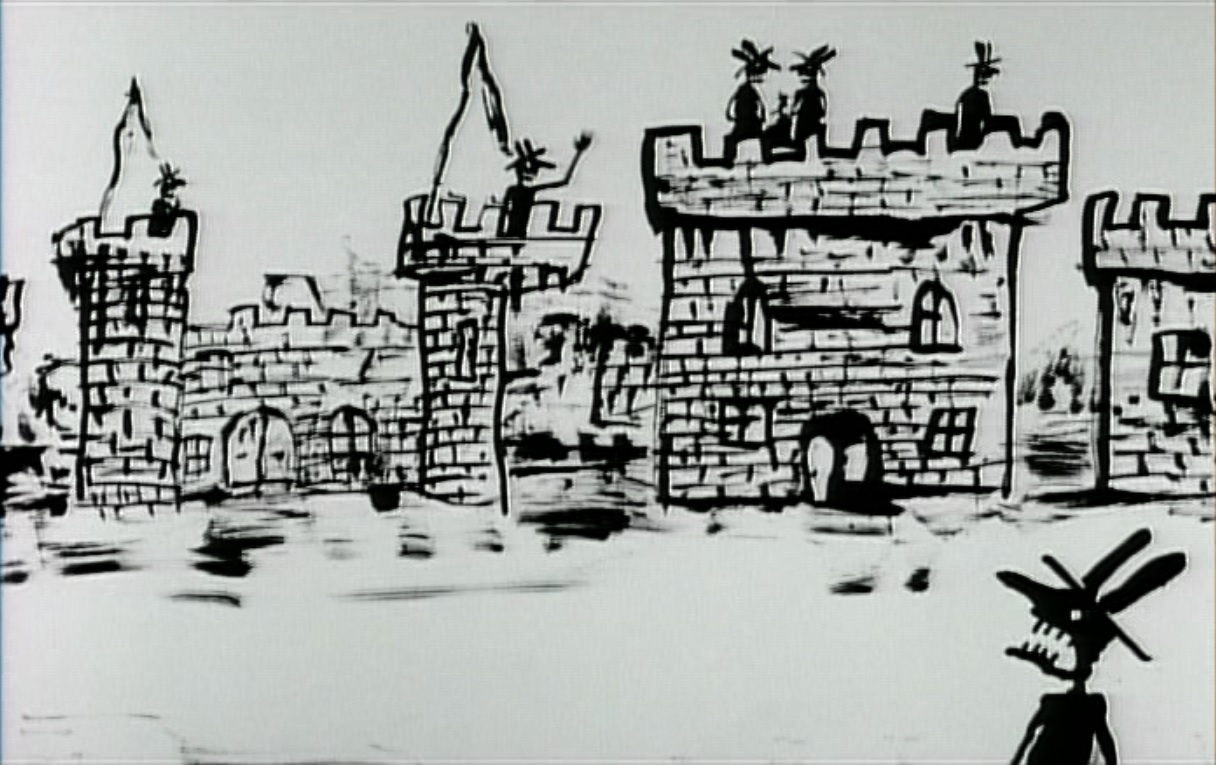
‘Thou Shalt Not Steal’ is the most critical of Mulloy’s ‘Ten Commandment’ films.
This short tells about Hank, an honest worker in ‘Joesville, at the wrong side of the Mississippi’. Hank works at a building site, and all his colleagues are stealing stuff (in a rather absurd sequence of images), but he won’t.
When crisis hits Joesville, Hank ends on the street, while all his colleagues mysteriously have built homes for themselves…
The town of Joesville would return in the episodes ‘Remember to Keep the Holy Sabbath Day‘ and ‘Thou Shalt Not Bear False Witness‘
‘Thou Shalt Not Steal’ is available on the BFI DVD ‘Phil Mulloy – Extreme Animation’
Director: Phil Mulloy
Release Date: 1993
Rating: ★★

After his absurd series ‘Cowboys’ (1991), which dealt with Western cliches, and the two-part ‘history of the world’, mostly devoted to sex, British indie animator Phil Mulloy embarked on a series on the ten commandments.
All stories are typically silent comedies, using a voice over by Joel Cutrara to tell the story. Unfortunately, Mulloy stays far from Krzysztof Kieślowski’s critical view on the ancient biblical laws. It seems he only uses the commandments as templates to build rather absurd stories on. Most attractive is Mulloy’s rough style, using broad black ink strokes on a white Canvas, with the occasional blood reds. His animation is very limited, but effective.
‘Thou Shalt Not Kill’ is a typical example of the series. The short tells about one Uncle Josh from Arkansas, who loses his family rapidly, in Job-like fashion. A a reaction he commits suicide, flies to heaven, where he’s kicked into hell by God himself.
It’s as if Mulloy tells a joke, helped by visuals. In no way the series approaches the misanthropic criticisms of his contemporary film ‘The Sound of Music‘ (1993).
‘Thou Shalt Not Kill’ is available on the BFI DVD ‘Phil Mulloy – Extreme Animation’
Director: Harry S. Palmer
Release Date: 1916
Rating: ★★
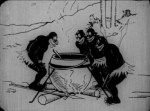 ‘Professor Bonehead Is Shipwrecked’ is a short animator Harry S. Palmer made for Mutual-Gaumont. Little can be found about this artist, except that his most well-known series was called ‘Keeping up with the Joneses’, which he had to quit in 1916 because J.R. Bray sued him for infringement of his cel patent.
It’s not even clear whether Professor Bonehead was the star of a series or not. In any case this film is the only one I can find. Perhaps it was a one-shot attempt. I wouldn’t be surprised, because so much is happening in this brief rather stream-of-consciousness-like film the result is hard to comprehend.
The film starts with a drawing of Professor Bonehead out of an inkwell. Then we watch him riding the waves, and being washed ashore carrying a huge egg, which hatches into a miniature duck-billed man. The duck-billed man chases Bonehead, who makes a jump to escape, right into the cook pot of a cannibal tribe, etc. and so on. The film ends with Bonehead and the duck-billed man making a car out of a log.
The film uses stop-motion, cut-out and full animation, but is completely devoid of timing. Some of the animation is remarkably good, however. Especially the rolling waves during the opening scene are very impressive. Nevertheless, the film is too random to be truly enjoyable, and it clearly didn’t secure Palmer’s position in the animation canon.
Watch ‘Professor Bonehead Is Shipwrecked’ yourself and tell me what you think:
‘Professor Bonehead Is Shipwrecked’ is available on the Thunderbean DVD ‘Uncensored Animation 2: Cannibals!’
Director: Paul Terry
Release Date: October 18, 1916
Stars: Farmer Al Falfa
Rating: ★★
 In 1915 Paul Terry joined the Bray studio and introduced a character of his own called farmer Al Falfa.
Farmer Al Falfa never amounted to something of an interesting character, like for example a Bobby Bumps or Felix the Cat, and I doubt whether he ever had many fans. Yet, the animated farmer lasted until 1937, and even didn’t completely disappear after that.
‘Farmer Al Falfa Sees New York’ is Farmer Al Falfa’s ninth film, and has the farmer visiting the big city, where he’s seduced by a remarkably realistically drawn woman. Later he plays cards with some cheating criminals, only to win after all.
Unlike J.R. Bray, Paul Terry was a rather poor draftsman, as this film clearly shows. The animation is weak and formulaic, and the farmer and the woman don’t inhabit the same cartoon universe. The result is a rather inferior cartoon that nevertheless foreshadows the quality of most animation of the silent era, unlike Bray’s own early high quality films.
Indeed, most of the secret of Terry’s success did not lie in the quality of his work, but in his working speed. Yet, his stay at Bray’s studio was not a happy one, and at the end of 1916 he left, only to get inducted in the army. A few years after World War I, in 1921, Terry would return to the animation business, co-founding a studio with Amedee J. van Beuren, reviving his character Al Falfa, and becoming one of the biggest players in the field.
Watch ‘Farmer Al Falfa Sees New York’ yourself and tell me what you think:
‘Farmer Al Falfa Sees New York’ is available on the DVD & Blu-Ray-set ‘Cartoon Roots: The Bray Studios Animation Pioneers’
Director: George Dunning
Release Date: 1962
Rating: ★★
 ‘The Flying Man’ is a very short absurdist film in which a man drops his coat to take a swim in mid air. Another man with a dog drops by, tries the same thing, but with his coat on, to no avail.
Dunning uses a single tableau and no perspective. On his white canvas he paints the three characters (two men and dog) with bold paint strokes. Dunning’s characters consist of loose joints, similar to characters by John Hubley. Unfortunately, this design makes it rather hard to decipher the action, especially when both men are on the ground.
The action is accompanied by short but effective clarinet music by Ron Goodwin.
Watch ‘The Flying Man’ yourself and tell me what you think:
‘The Flying Man’ is available on the DVD-box ‘Annecy – Le coffret du 50e Anniversaire’
Director: Jack Hannah
Release Date: April 25, 1961
Stars: Chilly Willy, Wally Walrus
Rating: ★★
 ‘Clash and Carry’ pairs Wally Walrus with Chilly Willy. The latter is hungry and tries to steal fish from Wally’s fish market.
To be frank, Wally clearly is no match for Chilly Willy, who easily empties the complete store before Wally’s eyes. The best gag is when Chilly Willy uses cardboard plaques attached to shopping carts to empty Wally’s market. The cardboard women all carry a sign telling Wally to ‘charge it’. Soon, more outlandish cardboard figures follow, like a picture of Napoleon. But Wally only sees his fish selling, and calls all ships out sea to catch more fish. This leads to live action footage of fishing boats, and even a whale hunt.
Unfortunately, neither story man Homer Brightman nor Jack Hannah apparently knew how to work this gag into the finale, and so, the cartoon dies out with the lame sight of Chilly Willy playing a vacuum cleaner like bagpipes, with marching fish behind him, apparently sucked by the vacuum cleaner.
Apart from the utterly disappointing finale, the short is hampered by Wally’s omnipresent vocalizations (by Paul Frees), which only become funny during the great scene mentioned above. Apart from that ‘Clash and Carry’ remains a very mediocre cartoon.
Watch ‘Clash and Carry’ yourself and tell me what you think:
‘Clash and Carry’ is available on the DVD-set ‘The Woody Woodpecker and Friends Classic Cartoon Collection Volume 2’
Directors: William Hanna & Joseph Barbera
Airing Date: March 31, 1961
Stars: The Flintstones
Rating: ★★
 ‘Rooms for Rent’ starts with Fred calculating his and Wilma’s expenses.
Because the couple is overspending, Wilma decides to take in some boarders. Promptly she and Betty (who has the same financial problems) are visited by two music students. Unfortunately, the two jazz cats don’t have any money, so Wilma and Betty let the two youngsters stay for two weeks in exchange of help with their own act they want to perform at the Loyal Order of Dinosaurs. Despite Fred and Barney wanting some boarders, too, these prove two very long weeks for the husbands, as the two students practice their modern jazz at home, and eat the lion’s share of their meals.
‘Rooms for Rent’ is a rather weak entry within the Flintstones series, offering inconsistent designs, mediocre animation and few laughs. The episode also is one of those Flintstones entries showing the inequality of man and woman in the early 1960s: when contemplating how to earn some money, Betty and Wilma never contemplate working themselves, as “the boys won’t let us go out and get a job” (Betty) and “A woman’s place is in the home” (as Wilma quotes Fred). This episode is typical for its many shots of people addressing the camera. Also featured is a prehistoric subway, the working of which is never explained…
Watch the subway scene from ‘Rooms for Rent’ yourself and tell me what you think:
This is Flintstones Season One Episode 25
To the previous Flintstones episode: In the Dough
To the next Flintstones episode: Fred Flintstone: Before and After
‘Rooms for Rent’ is available on the DVD-set ‘The Flintstones: The Complete First Season’
Directors: William Hanna & Joseph Barbera
Airing Date: March 3, 1961
Stars: The Flintstones
Rating: ★★
 When Betty gets an address wrong, Fred and Barney line up at the army recruitment office instead of the physical examination for an insurance company.
Before they realize it, the neighbors have joined the army, for three years… Inside the army Fred and Barney volunteer for a space program lead by a German-sounding professor without realizing it. After the professor has conducted some weird experiments on them, Fred and Barney are shot away in a wooden rocket by a giant slingshot, only to land some yards further, in an artillery range, which they think is the moon.
‘The Astra’ Nuts’ has one of the weakest plots of all Flintstones episodes. The whole series of events which lead to the boys joining the army for no less than three years is very unconvincing. One suspects all these plot twists are only introduced to get Fred and Barney inside a rocket.
When the four realize Fred and Barney have enlisted, we get a series of rather poorly drawn double-takes. Much better are the bizarre tests, but the best gag is when we’re set up to expect an enormous band only to see the conductor conduct just one trumpet player. This episode features a sergeant with the same voice as the Snorkasaurus had in ‘The Snorkasaurus Hunter‘.
Watch ‘The Astra’ Nuts’ yourself and tell me what you think:
https://www.topcartoons.tv/the-astra-nuts/
This is Flintstones Season One Episode 22
To the previous Flintstones episode: Love Letters on the Rocks
To the next Flintstones episode: The Long, Long Weekend
‘The Astra’ Nuts’ is available on the DVD-set ‘The Flintstones: The Complete First Season’
Directors: William Hanna & Joseph Barbera
Airing Date: February 10, 1961
Stars: The Flintstones
Rating: ★★
 ‘The Hypnotist’ is one of the silliest of the Flintstones episodes. The nonsense starts when Fred brags about being able to hypnotize himself after seeing one Mesmo on the television.
Betty and Wilma play along, but Fred really manages to hypnotize Barney, making him think he’s a dog. Unfortunately, Fred cannot make his friend snap out of it, and seeks the assistance of Mesmo. This leads to several slapstick gags, ending in a dog pound. In the end Mesmo turns Barney into human again, and two dogs, as well…
‘The Hypnotist’ is pretty gag rich, but few of the gags come off, due to poor timing and trite dialogue. Worse, in many scenes Fred’s designs are quite off, and the animation often is subpar. Most interesting may be the cash desk at the supermarket and the crazy veterinarian. This fellow is designed more stylistically than the other characters, recalling classic UPA modernism.
Watch an excerpt from ‘The Hypnotist’ yourself and tell me what you think:
This is Flintstones Season One Episode 20
To the previous Flintstones episode: The Hot Piano
To the next Flintstones episode: Love Letters on the Rocks
‘The Hypnotist’ is available on the DVD-set ‘The Flintstones: The Complete First Season’
Directors: William Hanna & Joseph Barbera
Airing Date: December 23, 1960
Stars: The Flintstones
Rating: ★★
 Tired of their jobs, Fred and Barney decide to open their own restaurant. So they quit their jobs to obtain a drive-in so lousy, they can even buy without the necessary cash.
Fred’s and Barney’s only mistake is not telling their wives, but of course, Wilma and Betty soon find out, thus ending the business. The running gag of this episode features two annoying waitresses who sing a particularly irritating drive-in song, which is also featured in the episode’s finale.
‘The Drive-in’ is one of the least inspired of all Flintstones episodes. The all too predictable story moves at a surprisingly slow speed, and even contains a completely superfluous scene with a bird stealing Barney’s flapjacks. The only prehistory gags in this episode are the giant ribs and eggs Barney and Fred serve at the drive in.
The designs of the characters are quite unsteady in this episode, especially Fred’s.
Watch an excerpt from ‘The Drive-in’ yourself and tell me what you think:
This is Flintstones Season One Episode 13
To the previous Flintstones episode: The Sweepstakes Ticket
To the next Flintstones episode: The Prowler
‘The Drive-in’ is available on the DVD-set ‘The Flintstones: The Complete First Season’
Directors: William Hanna & Joseph Barbera
Airing Date: December 9, 1960
Stars: The Flintstones
Rating: ★★
 This episode starts with a golf tournament, but turns out to be a story about a feud between Barney and Fred.
Part of the story is told as a flashback: Barney is chosen president of ‘The Loyal Order of Dinosaurs’ (first introduced in ‘Hot Lips Hannigan‘) and promises to collect overdue contributions. Because Fred is one of the late payers, this leads to a heavy and childish feud between the to neighbors, reminiscent of the one in ‘The Swimming Pool‘.
Barney even buys a vicious watchdog, with a laugh that sounds like that of Muttley from Hanna-Barbera’s future series ‘Wacky Races’ (1968). The low point is reached when Fred throws a party with people he doesn’t even like, only to provoke Barney (who turns out not to be home). In the end it’s up to the wives to settle the argument.
‘The Golf Champion’ is one of the duller Flintstones episodes. It contains some repetitive gags of Barney stealing his own stuff back from Fred’s yard. The sound of effect of Barney tiptoeing in these scenes, however, is a delight, as is the surprisingly inspired background music, which e.g. features a military version of the Flintstones theme music. Nevertheless, the opening scenes are arguably the best, with Fred having to deal with no less than two large dinosaurs occupying the golf course.
There are two stone age gags: a bird as a can opener, which informs us that he likes the food at the Rubble’s house better, and a record player, featuring a monkey and a bird.
Watch an excerpt from ‘The Golf Champion’ yourself and tell me what you think:
This is Flintstones Season One Episode 11
To the previous Flintstones episode: Hollyrock, Here I Come
To the next Flintstones episode: The Sweepstakes Ticket
‘The Golf Champion’ is available on the DVD-set ‘The Flintstones: The Complete First Season’


 Dr. Grob's Animation Review