
You are currently browsing the category archive for the ‘★’ category.
Director: Charles Nichols
Release Date: April 30, 1948
Stars: Pluto
Rating: ★
Review:
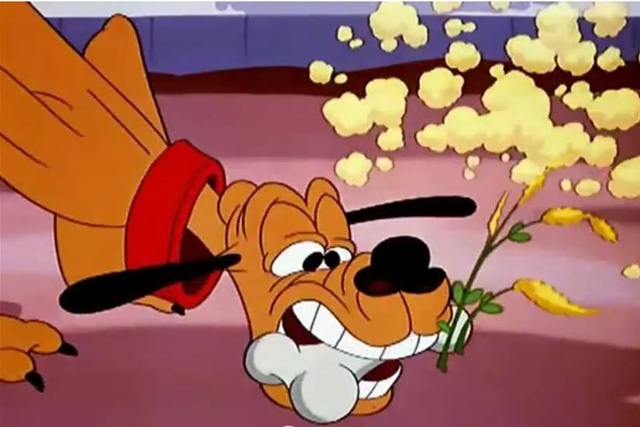 While looking for some bones he has buried, Pluto encounters a gopher who makes him sneeze, using mimosa ,all through this boring picture.
‘Bone Bandit’ is one of Pluto’s most forgettable entries, even though Pluto does not become friends with a little animal for once.
Pluto would encounter another gopher in ‘Pluto and the Gopher‘ (1950), which is only marginally better. Gophers apparently just aren’t funny, a fact also proven by ‘Donald’s Garden‘ (1942) and the Woody Woodpecker cartoon ‘Wicket Wacky‘ (1951).
Watch ‘Bone Bandit’ yourself and tell me what you think:
This is Pluto cartoon No. 24
To the previous Pluto cartoon: Pluto’s Blue Note
To the next Pluto cartoon: Pluto’s Purchase
Director: Charles Nichols
Release Date: November 14, 1947
Stars: Pluto
Rating: ★
Review:
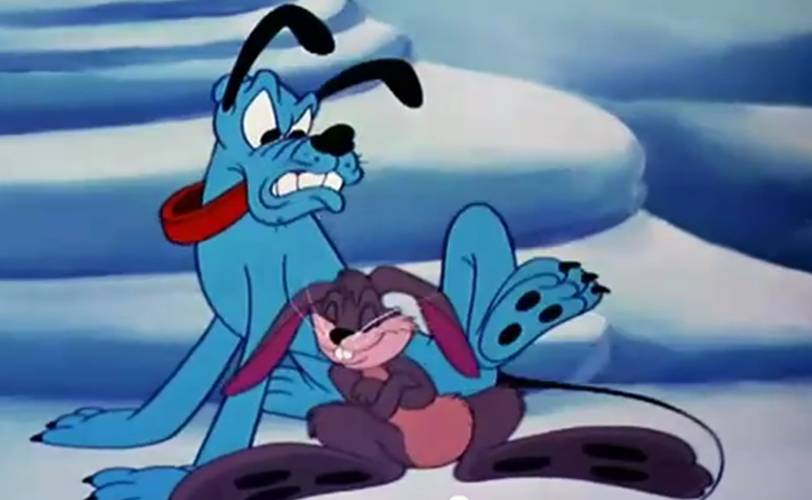 ‘Mail Dog’ is another arctic short featuring Pluto (see ‘Rescue Dog‘ from eight months earlier).
This time Pluto is a mail dog in Alaska. While delivering the mail he encounters a totem pole and a chilly rabbit. When he chases it, he accidentally delivers the mail in time, too.
This short follows the typical Pluto story, where Pluto befriends a little animal he dislikes at first. Unfortunately, there’s absolutely nothing special about this particular entry, making it one of Pluto’s most forgettable cartoons.
Watch ‘Mail Dog’ yourself and tell me what you think:
This is Pluto cartoon No. 22
To the previous Pluto cartoon: Rescue Dog
To the next Pluto cartoon: Pluto’s Blue Note
Director: Dick Lundy
Release Date: January 16, 1942
Stars: Donald Duck
Rating: ★
Review:
 In ‘The Village Smithy’ Donald is a blacksmith who has to fix a large cartwheel and to shoe a stubborn female donkey. He succeeds in neither in this remarkably unfunny cartoon, which is one of the weakest within the whole Donald Duck series.
Long situation gags became a common feature of Disney shorts during the rise of the character comedy, in cartoons like ‘Mickey Plays Papa‘ (1934) and ‘Moving Day‘ (1936). Arguably, this time of comedy reaches its nadir in ‘The Village Smithy’. In it only two situations are milked to the length of the complete cartoon, with tiresome results. The wheel scene is the most interesting of the two, if still far from funny, and tributary to the spiral spring scene in ‘Clock Cleaners’ (1937).
The most interesting feature of this otherwise boring cartoon are its backgrounds, which belong to the first oil backgrounds in a Disney short, and which give the film a distinct, gloomy look. Donald, too, has a unique yellowish tan throughout this picture, setting the cartoon apart from all other Donald Duck shorts.
Watch ‘The Village Smithy’ yourself and tell me what you think:
This is Donald Duck cartoon No. 30
To the previous Donald Duck cartoon: Chef Donald
To the next Donald Duck cartoon: Donald’s Snow Fight
Director: Gerry Chiniquy
Release Date: June 13, 1967
Stars: The Pink Panther
Rating: ★
Review:
 In ‘Jet Pink’ the Pink Panther enters a secret airport and climbs in test jet X13, which immediately goes astray.
This cartoon marks former Warner Brothers animator Gerry Chiniquy’s debut as a director. Unfortunately, it’s far from an overnight success: ‘Jet Pink’ is inconsistent, and rather unfunny.
The cartoon reuses the ‘count to ten and pull string’ gag from ‘Goofy’s Glider‘ (1940), but its execution is terrible when compared to the original.
Watch ‘Jet Pink’ yourself and tell me what you think:
Director: Abe Levitow
Release Date: August 4, 1966
Stars: Tom & Jerry
Rating: ★
Review:
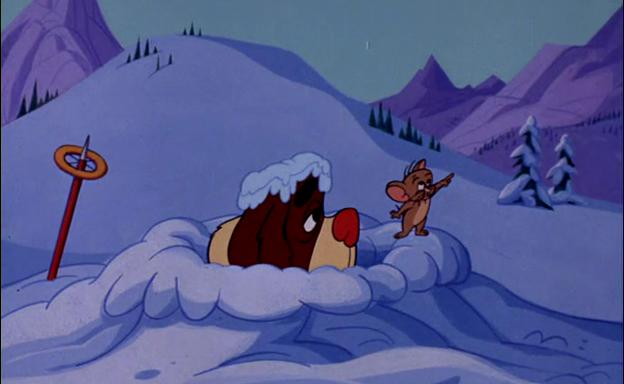 ‘The A-Tom-inable Snowman’ is as abominable as the snowman’s supposed to be: it’s painfully bad and unfunny.
The cartoon has nothing to do with yetis, however. It is set in the alps and involves a helpful St. Bernard. The only surprise is that the titles roll in after 1’22.
Watch ‘The A-Tom-inable Snowman’ yourself and tell me what you think:
This is Tom & Jerry cartoon No. 151
To the previous Tom & Jerry cartoon: Matinee Mouse
To the next Tom & Jerry cartoon: Catty Cornered
Director: Tom Ray
Release Date: July 14, 1966
Stars: Tom & Jerry
Rating: ★
Review:
 In ‘Matinee Mouse’ Tom and Jerry make peace and go watch their own cartoons together in a cinema. Of course, the truce doesn’t last long.
‘Matinee Mouse’ is a compilation cartoon, and a very cheap and terrible one, too. It uses footage of the classic Hanna/Barbera entries, but these are set to new sound effects and new music by Don Elliott. The gruesome result is easily one of the worst Tom and Jerry cartoons ever. Its director, Tom Ray (1919-2010), directed only one other Tom & Jerry cartoon, ‘Shutter Bugged Cat‘ (1967). That one is also a compilation cartoon, and arguably just as terrible.
Watch ‘Matinee Mouse’ yourself and tell me what you think:
This is Tom & Jerry cartoon No. 150
To the previous Tom & Jerry cartoon: Fillet Meow
To the next Tom & Jerry cartoon: A-Tom-inable Snowman
Director: Abe Levitow
Release Date: March 3, 1966
Stars: Tom & Jerry
Rating: ★
Review:
 ‘Jerry-Go-Round’ is staged at a circus: Jerry helps a circus elephant, who in turn protects Jerry from Tom.
This rather dull and unfunny cartoon marks the debut of animator Abe Levitow as a Tom & Jerry director. It is not a success. Levitow was an experienced director: in 1959 he had directed several Warner Brothers cartoons, and at UPA he had directed Mr. Magoo television specials, and the studio’s second feature, Gay-Purree (1962). Yet, this experience is hard to detect in ‘Jerry Go-Round’: both the designs, the timing and the animation are inferior to those in the cartoons directed by Chuck Jones himself.
Watch ‘Jerry-Go-Round’ yourself and tell me what you think:
This is Tom & Jerry cartoon No. 146
To the previous Tom & Jerry cartoon: Jerry, Jerry Quite Contrary
To the next Tom & Jerry cartoon: Love, Love My Mouse
Director: Jim Pabian
Release Date: March 3, 1965
Stars: Tom & Jerry
Rating: ★
Review:
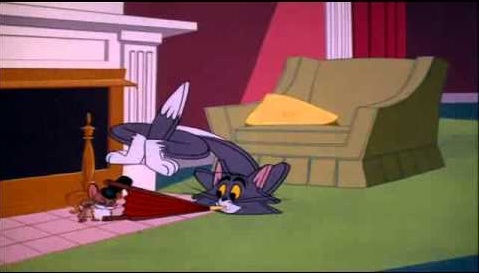 ‘The Brothers Carry-Mouse-Off’, its literary title notwithstanding, is Chuck Jones’ fourth Tom & Jerry chase cartoon using blackout gags, this time indoors.
This was the first of the Chuck Jones Tom & Jerries not directed by Chuck Jones himself, and it shows. The designs and the animation are worse than in other entries. Especially Jerry is badly designed here. The music is also particularly uninspired. All this results in one of the weakest entries in the series.
About its director, Jim Pabian, little is known. He co-wrote this cartoon and the next, ‘Haunted Mouse’,with Chuck Jones. ‘The Brothers Carry-Mouse-Off’ is the only cartoon he ever directed.
Watch ‘The Brothers Carry-Mouse-Off’ yourself and tell me what you think:
http://www.veoh.com/watch/v20008062MnN6BagS
This is Tom & Jerry cartoon No. 137
To the previous Tom & Jerry cartoon: Bad Day at Cat Rock
To the next Tom & Jerry cartoon: Haunted Mouse
Director: Gene Deitch
Release Date: December 1962
Stars: Tom & Jerry
Rating: ★
Review:

‘Carmen Get It’ opens with a busy New York street scene. From here Tom chases Jerry into the Metropolitian opera house, where a performance of Georges Bizet’s opera ‘Carmen’ is about to start.
The rest of the cartoon takes place within the opera setting, during the playing of the Carmen overture, and a little bit of the opera itself. Unfortunately, the whole cartoon is terribly tiresome and unfunny, making ‘Carmen Get It’ probably the worst of all concert cartoons. This is a sad irony, because Tom & Jerry are also responsible for one of the all time best: ‘The Cat Concerto‘ (1947).
Particularly annoying is the conductor, who is clearly modeled after Arturo Toscanini (1867-1957), but so badly designed and so awfully animated he gets on one’s nerves. Steven Konichek’s music, meanwhile, tries to get an American flavor by mixing ‘Yankee Doodle’, ‘Dixie’ and ‘There’ll Be a Hot Time in the Old Town Tonight’ into the music. The latter tune was most probably still under copyright at the time, but I wonder if anyone noticed.
‘Carmen get it’ was the last of the Gene Deitch Tom & Jerries, a poor and unfunny series of cartoons, which during their short existence never came even within a reasonable distance of the quality of the original ones by Hanna and Barbera. Gene Deitch had outlasted its welcome within one year and moved over to produce cartoons for Paramount, directing a.o. Popeye and Krazy Cat cartoons.
Tom & Jerry were already revived once again the next year, by Chuck Jones, whose Tom & Jerry cartoons were to be a great improvement on Gene Deitch’s ones, albeit nowhere near the classic Hanna-Barbera cartoons…
Watch an excerpt from ‘Carmen Get It’ yourself and tell me what you think:
This is Tom & Jerry cartoon No. 127
To the previous Tom & Jerry cartoon: Buddies Thicker than Water
To the next Tom & Jerry cartoon: Penthouse Mouse
‘Carmen Get It’ is available on the DVD-set ‘Tom and Jerry – The Gene Deitch Collection’ and the European DVD-Box ‘Tom and Jerry Collection’
Director: Gene Deitch
Release Date: October 1962
Stars: Tom & Jerry
Rating: ★
Review:

In ‘Sorry Safari’ we meet the fat man from ‘Down and outing‘ and ‘High Steaks‘ for the last time. In this cartoon he is on a safari in Kenya.
Tom and Jerry perform uninspired antics reminiscent of the former two cartoons. Never sympathetic in the Gene Deitch cartoons, Jerry is particularly nasty in this one. The whole affair is a tiresome watch and one has ample time to gaze at the charming cartoon modern background art of the jungle. The cartoon’s only highlight is its strangely designed elephant.
But notice the piece of animation when Tom tries to get Jerry out of one of the guns: suddenly he looks and moves like his old self again. This sequence does only last a second, but how did the marvel get in there? Did the animator trace a Hanna-Barbera cartoon for just these few frames? I guess we’ll never know.
Watch ‘Sorry Safari’ yourself and tell me what you think:
This is Tom & Jerry cartoon No. 125
To the previous Tom & Jerry cartoon: Tall in the Trap
To the next Tom & Jerry cartoon: Buddies Thicker than Water
‘Sorry Safari’ is available on the DVD-set ‘Tom and Jerry – The Gene Deitch Collection’ and the European DVD-Box ‘Tom and Jerry Collection’
Director: Gene Deitch
Release Date: July, 1962
Stars: Tom & Jerry
Rating: ★
Review:

Tom is involuntarily drafted on a whaling ship of an Ahab-like character in search of the whale ‘Dicky Moe’. On board Tom encounters Jerry, who makes life at sea extra hard for Tom.
Although ‘Dicky Moe’ could have been a nice take on ‘Moby Dick’ , the cartoon completely fails to deliver its promise. Most of the gags have nothing to do with Moby Dick, and the titular whale only arrives after six minutes. The best gag is the one in which a black Tom pretends to be the captain’s shadow, but I guess most viewers will remember this cartoon for the captain repeatedly exclaiming ‘Dicky Moe!’.
Nevertheless, the short is slightly more interesting to look at than most Gene Deitch Tom & Jerry cartoons, because of its nice etch-like backgrounds.
Watch an excerpt from ‘Dicky Moe’ yourself and tell me what you think:
This is Tom & Jerry cartoon No. 122
To the previous Tom & Jerry cartoon: Calypso Cat
To the next Tom & Jerry cartoon: The Tom and Jerry Cartoon Kit
‘Dicky Moe’ is available on the DVD-set ‘Tom and Jerry – The Gene Deitch Collection’
Director: Gene Deitch
Release Date: February, 1962
Stars: Tom & Jerry
Rating: ★
Review:
 In ‘Mouse Into Space’, the fifth of the Gene Deitch Tom & Jerry cartoons, Jerry becomes an “astro mouse”, because there are no cats in space.
By a strange accident, Tom ends up in the same rocket. He apparently has no problems with the void in this directionless, rather weird and unfunny cartoon.
Watch ‘Mouse Into Space’ yourself and tell me what you think:
This is Tom & Jerry cartoon No. 119
To the previous Tom & Jerry cartoon: High Steaks
To the next Tom & Jerry cartoon: Landing Stripling
Director: Gene Deitch
Release Date: December 12, 1961
Stars: Tom & Jerry
Rating: ★
Review:
 In ‘It’s Greek To Me-Ow!’ we see Tom and Jerry as citizens of ancient Greece.
Tom tries to enter a building (we don’t know why) and Jerry hinders him in doing that (why he does that we don’t know, either).
‘It’s Greek To Me-Ow!’ is the third Tom & Jerry-cartoon directed by Gene Deitch and animated by his Czech studio, and this time even the plot is terrible. This cartoon also painfully shows the complete lack of character in the Czech Tom and Jerry designs. The sad result is one of the worst Tom & Jerry cartoons ever made.
Watch ‘It’s Greek To Me-Ow!’ yourself and tell me what you think:
This is Tom & Jerry cartoon No. 117
To the previous Tom & Jerry cartoon: Down and Outing
To the next Tom & Jerry cartoon: High Steaks
Director: Friz Freleng
Release Date: June 10, 1965
Stars: The Pink Panther
Rating: ★
Review:
 In ‘Pink Ice’, the Pink Panther is reunited with what he was named after: diamonds. In this film the Pink Panther owns a diamond mine, which is stolen by two colonial Englishmen.
‘Pink Ice’ is a perfect example of how the DePatie-Freleng Studios struggled to hit the right mark in the early Pink Panther films. In ‘Pink Ice’ the Pink Panther behaves particularly unfamiliar. Not only does he wear a dressing-gown throughout the picture, but he talks, and a lot, too. As was to be expected, it’s not a success. The film is vaguely reminiscent of some of Friz Freleng’s Bugs Bunny-Yosemite Sam outings, but its abundant use of dialogue is annoying, resulting in a weak entry in the series. Luckily, this experiment with a talking Pink Panther was not to be repeated.
Watch ‘Pink Ice’ yourself and tell me what you think:
Director: David Hand
Release Date: January 19, 1935
Stars: Mickey Mouse
Rating: ★
Review:
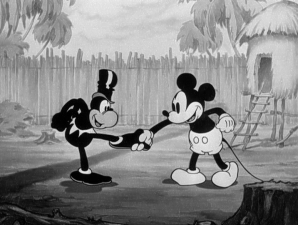 Like in ‘The Castaway‘ (1932), Mickey has been shipwrecked, and he’s washed ashore at a tropical island full of cannibals.
When the cannibals try to cook a young native, Mickey scares them away in order to rescue the poor fellow. He then adopts this young native and they build a fort together, which they finish just in time, before the cannibals return to attack them. These eventually manage to overrun Mickey’s defense, and Mickey and the native flee on a self made ‘ship’.
Even when compared to Disney’s two other embarrassing cartoons about cannibals (the Silly Symphony ‘Cannibal Capers‘ (1930) and ‘Trader Mickey‘ (1932, curiously also directed by David Hand), the depiction of natives in ‘Mickey’s Man Friday’ is backward and humiliating. Mickey’s man Friday uses his feet more than his hands and appears to be more closely related to apes than to man. This is so sickening to watch that this is one of the very rare cartoons of which I feel that they could have remained under the rug, despite the fast and clever ‘invention gags’ featured in this cartoon, which foreshadow comparable gags in ‘The Flintstones’.
Watch ‘Mickey’s Man Friday’ yourself and tell me what you think:
This is Mickey Mouse cartoon No. 72
To the previous Mickey Mouse cartoon: Two-Gun Mickey
To the next Mickey Mouse cartoon: The Band Concert
Director: Burt Gillett
Release Date: September 29, 1934
Stars: Mickey Mouse, Pluto
Rating: ★
Review:
 Mickey Plays Papa’ reuses the concept of Mickey receiving orphans from ‘Mickey’s Orphans‘ from 1931. But this time he has to deal with only one orphan mouse, called Elmer.
The film is particularly noteworthy for its scary opening: while Mickey’s reading a scary novel titled “the cry in the night” in bed, someone’s laying the orphan on his doorstep, whose cries startle Mickey and Pluto. When Mickey and Pluto discover that these cries are caused by a cute little baby, they both try to comfort him. These attempts include a nice Charlie Chaplin imitation by Mickey. This cartoon also contains a gag in which Mickey’s being attacked by numerous kitchen tools, which was copied in ‘Who Framed Roger Rabbit‘ (1988).
But most importantly, the cartoon contains long character-based solo sequences, like Mickey’s trouble with a rubber nipple and Pluto’s antics with a toy bunny and a fishbowl. This type of elongated solo scenes, alternating between the two characters, appear for the first time in this cartoon, but unfortunately they’re not very funny here. Nevertheless, they would become a dominant style element of the Mickey Mouse cartoons of the rest of the 1930s, especially in the Mickey, Donald and Goofy trio outings, luckily often with way more hilarious results.
‘Mickey Plays Papa’ ends when Mickey’s released from the rubber nipple and he finally succeeds in making the baby laugh, by doing a Jimmy Durante imitation with his elongated nose. It would be the last cartoon directed by Burt Gillett before he left Disney in March 1934 for the Van Beuren Studios, only to return in 1937 to direct two other cartoons, the excellent ‘Lonesome Ghosts’ (1937) and ‘The Moth and the Flame’ (1938).
Watch ‘Mickey Plays Papa’ yourself and tell me what you think:
This is Mickey Mouse cartoon No. 69
To the previous Mickey Mouse cartoon: Orphan’s Benefit
To the next Mickey Mouse cartoon: The Dognapper
Director: Wilfred Jackson
Release Date: June 17, 1933
Stars: Mickey Mouse, Minnie Mouse
Rating: ★
Review:
 Mickey has build a robot to fight a gorilla in a boxing match, which is called “the battle of the century: machine vs. beast”.
Mickey’s robot has one disadvantage: he runs wild when he hears Minnie’s car horn. Luckily, this fact helps him in the end: when he’s clobbered by the gorilla (on the tune of Franz Liszt’s second Hungarian rhapsody), he seems almost lost. But then Minnie fetches her car horn, revitalizing the robot. From that point he actually cheats, using multiple boxing gloves, a hammer and hits below the belt.
Despite its clear story and high quality animation, ‘Mickey’s Mechanical Man’ is a very weak short, and a low point in the otherwise outstanding Mickey Mouse year of 1933. The cartoon is surprisingly low on gags and it’s difficult to sympathize with the robot character, as it’s mechanical after all, while the gorilla is a living being. Moreover, Mickey’s motives remain unclear and we’re not invited to care about the match.
The cartoon most interesting feat. are the robot’s jerky movements, which are clearly mechanical and based on wind-up toys, but which become rather frantic and ridiculously elaborate when the robot goes wild. Nevertheless, there are some traces of Stan Laurel’s boxing moves from ‘Any Old Port’ (1932).
‘Mickey’s Mechanical Man’ is reminiscent of the Fleischer Studio’s equally weak ‘The Robot‘ (1932). Both films were inspired by rather hysterical stories about robots taking over jobs, which circulated in the early 1930s, and which struck a chord in an era of vast unemployment.
Watch ‘Mickey’s Mechanical Man’ yourself and tell me what you think:
This is Mickey Mouse cartoon No. 57
To the previous Mickey Mouse cartoon: The Mail Pilot
To the next Mickey Mouse cartoon: Mickey’s Gala Premier
Director: David Hand
Release Date: August 20, 1932
Stars: Mickey Mouse, Pluto
Rating: ★
Review:
 Mickey is a trader in Africa. He is captured by a bunch of hungry cannibals, whose king laughs with Goofy’s guffaw*.
The cannibals ruin Mickey’s trade, which consists mostly of musical instruments. When Mickey grabs a saxophone, he launches a long song-and-dance-routine, making the short old-fashioned when compared to contemporary Mickey Mouse cartoons like ‘Barnyard Olympics‘, ‘Mickey in Arabia‘ and ‘Mickey’s Nightmare’.
The cartoon is hampered further by severe and backward caricatures of African natives. They’re shown as extremely dumb, and halfway apes and humans. Among the offensive images are shots of cannibals playing instruments with their feet, and others of cannibals with gigantic duck-like lips. In any case practically all the gags originate in the cannibals’ ignorant use of Mickey’s trade, which make the film a tiresome watch today, despite its jolly atmosphere. The cannibals would also appear in Floyd Gottfredson’s contemporary Mickey Mouse strip, starting at August 17. The strip borrowed several images from the animated cartoon, including the fat king and his cook.
‘Trader Mickey’ was the first short directed by David Hand (1900-1986), who’d become Disney’s third director after Wilfred Jackson and Burt Gillett. Hand had joined the Disney studio as an animator in early 1930, just after the departure of Ub Iwerks. As a director he would create many wonderful shorts, like ‘The Mad Doctor‘ (1932) and ‘Who Killed Cock Robin‘ (1935). Then he advanced to features, directing ‘Snow White and the Seven Dwarfs’ (1937) and ‘Bambi‘ (1942). Hand would leave the Disney studio in July 1944 to set up his own studio in England.
Unfortunately, ‘Trader Mickey’ cannot be regarded a great start of Hand’s directing career. It’s a weak film, based on ingredients from the equally weak ‘Cannibal Capers‘ (1930) and ‘The Delivery Boy‘ (1931). Hand would nevertheless maintain a high standard in all his next films, the only other failures being ‘Mickey’s Man Friday‘ (unfortunately also starring cannibals) and ‘The Robber Kitten‘, both from 1935.
Watch ‘Trader Mickey’ yourself and tell me what you think:
This is Mickey Mouse cartoon No. 45
To the previous Mickey Mouse cartoon: Mickey’s Nightmare
To the next Mickey Mouse cartoon: The Whoopee Party
*Goofy himself had just made his first appearance in ‘Mickey’s Revue‘ from three months earlier and there was not yet an indication that this character was here to stay, or that this laugh was exclusively his.
Director: Burt Gillett
Release Date: September 1, 1931
Stars: Mickey Mouse, Pluto
Rating: ★
Review:
 Mickey and Pluto go fishing in a no fishing area, but the fish are making fun of them.
Pluto even gets under water, sniffing the bottom of the lake and meeting an enormous fish. This scene reuses quite some animation of Pluto sniffing from Pluto’s debut ‘The Picnic‘ (1930). Then a gamekeeper appears, but Mickey and Pluto escape him. The goat-like gamekeeper would return in Floyd Gottfredson’s Mickey Mouse comic ‘Dr. Oofgay’s Secret Serum’ (July 1934).
Like ‘Traffic Troubles‘, ‘The Moose Hunt‘ and ‘The Beach Party‘ from the same year, ‘Fishin’ Around’ is a genuine gag cartoon. It is the weakest of the lot, however, and can hardly be called a classic. The tricks the fish pull at Pluto and Mickey are amusing, but nothing more than that. Both the fish and Pluto steal a lot of screen time from Mickey, who is blander than ever before in this short.
Nevertheless, the film is a modest example of how the Disney studio tried to improve the quality of its animation. Notice, for example, the reflections and other water effects in this short. By now, they had become standard in Disney cartoons. Moreover, the cartoon starts with some quite convincing animation of Mickey rowing. There’s some clear sense of pulling weight here, even though these cycles are interspersed with less convincing animation.
Watch ‘Fishin’ Around’ yourself and tell me what you think:
This is Mickey Mouse cartoon No. 32
To the previous Mickey Mouse cartoon: Blue Rhythm
To the next Mickey Mouse cartoon: The Barnyard Broadcast
Director: Walt Disney
Release Date: May 3, 1929
Stars: Mickey Mouse, Minnie Mouse
Rating: ★
Review:
 Awkwardly, in this sixth Mickey Mouse cartoon Mickey and Minnie are portraited as real mice.
They are joined by several look-a-likes in a house party, while the owner, a drunk cat, is gone hunting. There’s still some silent comedy (and no dialogue), but there’s no real story, only an extended musical number. Therefore this cartoon can be regarded as the first of many ‘song-and-dance-routine’-cartoons that would dominate the early 1930s. It even predates the Silly Symphony series, which initial sole raison d’être seems to be song-and-dance-routines.
These cartoons no doubt delighted the audiences at the time. However, I regret their coming, because both story and surreal humor had to give way to the rise of them. ‘When the Cat’s Away’ is a prime example: despite some clever gags, it is easily the dullest of the earliest Mickey Mouse cartoons.
After ‘When the Cat’s Away’ Mickey would never been portrayed as a real mouse again. Like in his first five cartoons, he would just be a boy in the shape of a mouse. The idea of Mickey being a mouse would become negligible compared to the cartoon star he was. Mickey was seen as an actor, not as an animal. This would eventually lead to the awkward situation of Mickey dealing with ‘real’ and very different looking mice in ‘The Worm Turns‘ (1937).
Watch ‘When The Cat’s Away’ yourself and tell me what you think:
This is Mickey Mouse cartoon No. 6
To the previous Mickey Mouse cartoon: The Opry House
To the next Mickey Mouse cartoon: The Barnyard Battle


 Dr. Grob's Animation Review