You are currently browsing the category archive for the ‘Television programs’ category.
Directors: William Hanna & Joseph Barbera
Airing Date: November 11, 1960
Stars: The Flintstones
Rating: ★

This episode starts with Barney getting tickets to a big fight in town.
Meanwhile, their wives promise one Edna Boulder to make Fred and Barney babysit her little son Egbert, so they can go to the bridge tournament together. So, Fred and Barney stay home to watch the fight on television. Unfortunately, their area is blackened out (the replacement is a recital by Alice Blue Jean and her Magic Banjo), thus Fred decides to watch it at Joe Rockhead’s place, who lives outside the blackened era.
Yet, Joe is not home, and in the least convincing of the story twists, Fred busts in Joe’s door to watch the fight anyway. In another unlikely event little Egbert puts his clothes on Joe’s pooch (a little brontosaur), which promptly jumps out of the window, making Fred and Barney think it’s the baby.
The story of this episode rambles, to say the least, and contains an Irish policeman trope. Worse, the designs of the characters are pretty weird. Fred’s design in particular is very inconsistent and off model. On the upside, there’s a nice primitive elevator, and a bird functioning as a car horn. This bird is the first animal talking to the camera, a Flintstones trope that would occur throughout the series.
This is Flintstones Season One Episode 7
To the previous Flintstones episode: The Monster from the Tarpits
To the next Flintstones episode: At the Races
‘The Baby Sitters’ is available on the DVD-set ‘The Flintstones: The Complete First Season’
Directors: William Hanna & Joseph Barbera
Airing Date: November 4, 1960
Stars: The Flintstones
Rating: ★★★
 “Hollyrock” company ‘Miracle Pictures’ is going to shoot a low-budget one-day quicky monster movie called ‘The Monster of the Tar Pits’.
The producers randomly choose Bedrock as a location, because they cannot spend the money on a prop set. The whole town gets excited, because Hollyrock actors Gary Granite, Rock Pile and Tuesday Wednesday are in it.
Gary Granite is clearly a parody of Cary Grant, not really in looks, but certainly in voice. Wilma and Betty even go auditioning, but it’s Fred, who gets hired as Gary Granite’s stunt double. The look on Fred’s face when the director says he’d be perfect [as an actor] is priceless, and one of the best facial expressions in the entire series. Of course, Fred mainly gets hit by rocks and clubs, which are all too real, as the company cannot afford props for those, either.
The Movie Company’s slogan, “If it’s a good picture, it’s a miracle”, is a variation on similar slogans in ‘Daffy Duck in Hollywood‘ (1938), which uses the word Wonder, and the Popeye cartoon ‘Doing Impossikible Stunts‘ (1940) with the word Mystery.
The episode is only mildly funny, but contains a few stone age gags: Fred and Barney eating a huge brontosaur steak and pterodactyl drumstick, respectively, and Wilma doing the laundry using a pelican, and handling a little mastodon as a vacuum cleaner.
Watch ‘The Monster from the Tarpits’ yourself and tell me what you think:
https://www.dailymotion.com/video/x6ttko0
This is Flintstones Season One Episode 6
To the previous Flintstones episode: The Split Personality
To the next Flintstones episode: The Baby Sitters
‘The Monster from the Tarpits’ is available on the DVD-set ‘The Flintstones: The Complete First Season’
Directors: William Hanna & Joseph Barbera
Airing Date: October 28, 1960
Stars: The Flintstones
Rating: ★★½
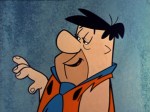 In this episode Fred accidently knocks himself out with a bottle. When he wakes up he has turned into a suave gentleman who loves opera and poetry.
Wilma, Barney and all other husbands soon get really fed up with this new ‘Frederick’ character, so Barney thinks up a scheme to get the old Fred back.
This is one of the more inspired Flintstones episodes, especially the scene in which Fred comes home, growling is a delight. Moreover, this episode finally features no less than three stone age gags: some birdlike creature is Wilma’s waste disposal, Betty’s shower is a mammoth, and Fred’s pick-up is a little bird with a will of his own.
Nevertheless, the episode’s message is rather dubious: one of Frederick’s new habits is his willingness to do some of the house cleaning himself. Such progressive, feminist ideas were clearly out of the question in this era…
Watch an excerpt from ‘The Split Personality’ yourself and tell me what you think:
This is Flintstones Season One Episode 5
To the previous Flintstones episode: No Help Wanted
To the next Flintstones episode: The Monster from the Tarpits
‘The Split Personality’ is available on the DVD-set ‘The Flintstones: The Complete First Season’
Directors: William Hanna & Joseph Barbera
Airing Date: October 21, 1960
Stars: The Flintstones
Rating: ★★½
 This episode starts with a conversation between Fred and Wilma providing the back story: due to a stupid action by Fred, Barney got fired. So, Fred helps his neighbor out by making him the caddie of his rich and influential golf partner, Mr. Boulder.
Barney’s authentic instructions makes the big shot win for once, so Barney gets a job as a debt collector, with his first victim happening to be Fred…
This episode is just one another example of Fred’s tendencies to deceive his wife, refusing to tell Wilma he has gambled the money away, necessary to pay the television bill. The story progresses at an even, rather slow speed, and is only moderately funny. The best scenes are the golf scene and the chase between Fred and Barney, with the latter looking like a television set with legs.
This episode is the first to feature Dino (although he has been in the titles since the beginning). Nevertheless, Dino’s appearance is restricted to the first scene, and no mentioning of him occurs during the rest of the episode.
Watch an excerpt from ‘No Help Wanted’ yourself and tell me what you think:
This is Flintstones Season One Episode 4
To the previous Flintstones episode: The Swimming Pool
To the next Flintstones episode: The Split Personality
‘No Help Wanted’ is available on the DVD-set ‘The Flintstones: The Complete First Season’
Directors: William Hanna & Joseph Barbera
Airing Date: October 14, 1960
Stars: The Flintstones
Rating: ★★★
 ‘The Swimming Pool’ was the very first Flintstones episode made, and it shows: Barney, Fred and Wilma all look different from later episodes, and Barney sounds quite different, too. Nevertheless, the episode introduces the visual style of the series: pleasant color schemes with olive skies, thick character lines, and limited animation.
This first episode of the Flintstones also establishes the Flintstones formula: although set in the stone age, it clearly portraits modern suburban neighbors, with telephones, television sets and such. Already in this episode Fred and Barney are portrayed as quarreling, but loving neighbors and friends, and there’s also a short shot of Fred working at the excavation.
In this episode Barney digs a swimming pool in his own backyard, and Fred talks him into sharing a pool with him, spanning both backyards. Nevertheless, it’s still Barney doing all the digging. Unfortunately the shared pool tests Fred’s neighborly attitude, and he even ends up in jail.
The humor in this episode is a little bit slow, with more room for slapstick than later episodes.
Watch an excerpt from ‘The Swimming Pool’ yourself and tell me what you think:
This is Flintstones Season One Episode 3
To the previous Flintstones episode: Hot Lips Hannigan
To the next Flintstones episode: No Help Wanted
‘The Swimming Pool’ is available on the DVD-set ‘The Flintstones: The Complete First Season’
Directors: William Hanna & Joseph Barbera
Airing Date: October 7, 1960
Stars: The Flintstones
Rating: ★★★½
Review:
 This episode opens with another feature borrowed from The Honeymooners, the series that served as the example for The Flintstones: the idea of the boys being member of an all-male society.
In this episode Fred and and Barney are members of The Loyal Order of Dinosaurs”. This club is also featured in the episode ‘The Golf Champion‘, but later the two neighbors would join the ‘Loyal Order of Water Buffaloes’.
The story starts with the two having to perform at the annual meeting. Barney practices a trampoline act, while Fred tries his luck at magic, with stuff borrowed from ‘Rockstone the Great’. In a demonstration he thinks he made the wives disappear and he and Barney take advantage of the situation to go to the Rockland Dance Hall to see Hot Lips Lannigan, an old acquaintance of Fred. Fred and Barney join in at his concert with Fred singing ‘When the Saints Go Marchin’ In’, bebop style, and Barney beating the drums. Their act impresses the young hep cats, much to Wilma’s and Betty’s bewilderment, who have dressed up like hep cats themselves to catch their husbands red-handed.
‘Hot Lips Hannigan’ is one of the more inspired Flintstone episodes, even though there’s absolutely no reference to prehistoric times, at all. Highlights are the intoxicating jazz number at the dance hall, and Betty’s and Wilma’s ‘hep’ alter egos. The name Hot Lips Hannigan is modeled on that of trumpeter Hot Lips Page, but the character looks more like a white version of Dizzy Gillespie, with his beret and goatee, and he plays the latter’s iconic upright trumpet.
Hot Lips Page had already died in 1954, and bebop arguably died with the death of Charlie Parker in 1955, making this episode strangely anachronistic. Moreover, Hannigan appears to be a square in disguise (for example ‘When the Saints Go Marchin’ was a staple of the conservative dixieland bands of the time), and it’s clear the writers’ sympathies are with the conservative middle-aged, not with the more advanced music-loving youngsters. This is a rather painful conclusion in an era in which even rock-‘n-roll was already past its prime, and hard bop (the follow-up to bebop) already started to make place for post-bop and free jazz…
Watch ‘Hot Lips Hannigan’ yourself and tell me what you think:
https://www.dailymotion.com/video/x6uouyo
This is Flintstones Season One Episode 2
To the previous Flintstones episode: The Flintstone Flyer
To the next Flintstones episode: The Swimming Pool
‘Hot Lips Hannigan’ is available on the DVD-set ‘The Flintstones: The Complete First Season’
Directors: William Hanna & Joseph Barbera
Airing Date: September 30, 1960
Stars: The Flintstones
Rating: ★★★½
Review:
 ‘The Flintstone Flyer’ was the very first Flintstone episode aired on television. The story was one of two already conceived before the series went to production and used to sell the series (the other one was ‘The Swimming Pool‘).
The episode establishes many aspects of the series: the setting may be in the stone age, this is a rather poor excuse for a suburban situation comedy depicting very a very standard family from mid-20th century indeed, complete with modern inventions like cars, telephone and television (how the latter two work is never revealed). This is little wonder, as the series was modeled after ‘The Honeymooners’ (aired 1955-1956), which features remarkably similar characters (for example, they love bowling, too).
Hanna and Barbera’s stone age is one of pure fantasy, and features dinosaurs coexisting with humans, despite the fact that dinosaurs had died out 65 million years before the dawn of man. In that respect ‘The Flintstones’ stand in a long tradition: dinosaurs co-existing with man could be seen in e.g. Willis O’Brien’s short ‘R.F.D. 10,000 B.C.’ (1916), in the Alley Oop comics (starting in 1932), in ‘Daffy Duck and the Dinosaur‘ (1939), in ‘Prehistoric Porky’ (1940), and Fleischer’s Stone Age cartoons from 1940.
The Flinstones tells about Fred Flintstone and Barney Rubble. The two are neighbors in some suburban area of ‘Bedrock’ (population 2500). They both love bowling, and are willing to lie to their wives (Wilma and Betty, respectively) to go out to play their favorite game. When bowling, Fred has a particular walk on his toes, and when excited he shouts ‘Yabba-dabba doo!’.
In this particular episode, the guys want to go bowling, while they have to go to the opera with their wives. So, Fred pretends to be ill and then the two literally fly off to the bowling alley, using a flying machine Barney has invented before. The opera itself is a typical mismatch of Wagnerian costume and bel canto singing, a trope frequently encountered in cartoons.
The complete cartoon moves at a steady pace, and by 2018 one can only conclude that the humor is rather dated. One cannot resist the thought what poor marriages these must be that one cannot be honest to each other. This sets the tone of many episodes to come: by now they only seem to demonstrate the inequality between men and women at the time.
Moreover, little to nothing is done with the stone age concept: we watch monkeys grabbing the pins, and a soda machine that’s operated by a man, but that’s about it.
No, despite Warner Bros. veterans Warren Foster and Michael Maltese working on the stories, the classic status of this very first animated series to be aired on prime time must come from its appealing designs by Ed Benedict (who had designed cavemen before, for Tex Avery’s ‘The First Bad Man’ from 1955), clever layouts by Dick Bickenbach and Walt Clinton, and great background artwork (e.g. featuring olive skies) by Art Lozzi, Fernando Montealegre, Robert Gentle and Dick Thomas. Even the limited animation (by the likes of top-animators Ken Muse, Carlo Vinci, Ed Love, Don Patterson and Dick Lundy) remains quite interesting throughout, even if the designs are rather off at times.
Watch an excerpt from ‘The Flintstone Flyer’ yourself and tell me what you think:
This is the first Flintstones Episode. To the demo episode: The Flagstones
To the next Flintstones episode: Hot Lips Hannigan
‘The Flintstone Flyer’ is available on the DVD-set ‘The Flintstones: The Complete First Season’
Directors: William Hanna & Joseph Barbera
Production Date: 1959
Rating: ★★½
Review:

‘The Flagstones’ is a demo reel lasting only 95 seconds, with which Hanna and Barbera tried to sell their product: a prime-time television animation series.
However, their title ‘The Flagstones’ resembled ‘The Flagstons’ too much, the surname of Hi and Lois from the comic strip of the same name by Mort Walker and Dick Browne. Thus the name was first changed into ‘The Gladstones’ and finally, into ‘The Flintstones’, the prehistoric family we all know today.
In this demo reel not only the names are different, Betty looks very different, too, and Barney doesn’t sound like himself. Wilma and Fred, on the other hand, are pretty much themselves already.
The demo depicts a short scene from the episode ‘The Swimming Pool’ (the final version can be seen from 10’40 to 12’03 in this episode). ‘The Swimming Pool’ was one of two stories Hanna and Barbera had already conceived before selling the series (the other one was ‘The Flintstone Flyer‘, the first episode to be made and aired).
The looks of the demo may be a little different from the real series, it does show that the Hanna-Barbera product has clear roots in the cartoon modern era, using appealing designs and layouts by Ed Benedict, and beautifully painted background art by Art Lozzi.
Watch ‘The Flagstones’ yourself and tell me what you think:
‘The Flagstones’ is a demo for ‘The Flintstones’.
To the first Flintstones Episode: The Flintstone Flyer
‘The Flagstones’ is available on the DVD-set ‘The Flintstones: The Complete First Season’
Director: unknown
Production Date: 1960
Stars: Tom Puss and Ollie Bungle
Rating: ★★½
Review:
 ‘The Eastern Treasure’ is based on the great Tom Poes comic strip ‘De achtgever’ (1957).
In this cartoon Ollie Bungle is visited by an Eastern treasurer and his obedient servant, called Kowtow. Ollie Bungle takes over the job as treasurer, and immediately the servant joins his side. In the end Tom Puss manages to get rid of him by making the servant into the treasurer.
The strong story of the comic strip is condensed to its bare essentials, and has lost most of its strengths. Moreover, the two Easterners hardly look that way. ‘The Eastern Treasure’ was the last of the Tom Puss shorts completed, before Toonder discovered he had been swindled. His Tom Puss television series was never aired, neither in the US, for which it had been made, nor anywhere else. A lot of money, effort and work had just been wasted on a scam.
‘The Eastern Treasure’ is available on the DVD inside the Dutch book ‘De Toonder Animatiefilms’
Director: unknown
Production Date: 1960
Stars: Tom Puss and Ollie Bungle
Rating: ★★
Review:
 During a stormy night Ollie Bungle brags he can teach everyone everything, and in one evening, too.
He’s overheard by a wizard, who immediately places his lazy son under Ollie Bungle’s tutelage. The little brat changes all kinds of objects into beds for him to sleep in, makes a pen write the writing lines he has to do, and makes objects taunting Ollie Bungle. Meanwhile Ollie Bungle doesn’t teach the boy a thing. Yet, the wizard is content, as his son has learned many new tricks during that one evening.
This short is one of the weakest of the eight surviving Tom Puss films. Tom Puss has hardly a role in it, and even behaves uncharacteristically fearful. In one scene he even looks like a real cat, instead of his normal rational self.
‘Little Faustus’ is available on the DVD inside the Dutch book ‘De Toonder Animatiefilms’
Director: unknown
Production Date: 1960
Stars: Tom Puss and Ollie Bungle
Rating: ★★★½
Review:
 At the start of this cartoon Ollie Bungle is out of gas. He and Tom Puss meet a bearded fellow with a large box, and when they ask him for gas, he makes the large box change into a fuel station.
The little bearded man demonstrates that the box can change into virtually anything, and Ollie Bungle buys the machine on the spot. Unfortunately, the all-purpose machine turns out difficult to handle, and only causes for trouble.
The story makes little sense and is highly forgettable. Nevertheless, this short is noteworthy for its very beautiful limited background art.
Watch ‘The All-Purpose Machine’ yourself and tell me what you think:
‘The All-Purpose Machine’ is available on the DVD inside the Dutch book ‘De Toonder Animatiefilms’
Director: unknown
Production Date: 1960
Stars: Tom Puss and Ollie Bungle
Rating: ★★★★
Review:
 ‘Vengeance Valley’ is based on the Tom Poes comic strip ‘De wraakgier’ (which can be translated as ‘the revenge vulture’) from 1956.
The comic strip is one of the best in the series, and features Tom Puss encountering an island of vengeance-loving vultures. In the film the vultures inhabit a hick town in the mountains called ‘Vengeance Valley’. The whole concept of avenge, revenge and counter-revenge is played out well, and this short makes particularly well use of the limited animation. This makes this episode arguably the best of the whole series, despite the lame ending, in which a female vulture blows up the whole town, wiping it off the map, literally.
‘Vengeance Valley’ is available on the DVD inside the Dutch book ‘De Toonder Animatiefilms’
Director: unknown
Production Date: 1959
Stars: Tom Puss and Ollie Bungle
Rating: ★★★½
Review:
 ‘The Wonder Shoes’ is one of the nine Tom Puss films the Toonder studios made in 1959-1960 for the American television market, which the series never reached.
This particular episode starts with Ollie Bungle capturing a large boot while fishing. Oddly enough he orders a shoe maker to make two shoes out of the boot. This is particularly puzzling as Ollie Bungle never wears shoes. The shoes possess a magic quality and fulfill Ollie Bungle’s wishes. So when he wishes them to walk to the moon, he is in serious trouble. Luckily, Tom Puss is there to save him.
‘The Wonder Shoes’ is a weak story that is saved by some slapstick comedy and silly situations, featuring criminal Bul Super and police officer Bulle Bas. Both characters are familiar to readers of the Tom Puss comics, but remain unnamed in the cartoon. Special mention should go to the minimal background art.
‘The Wonder Shoes’ is available on the DVD inside the Dutch book ‘De Toonder Animatiefilms’
Director: unknown
Production Date: 1959
Stars: Tom Puss and Ollie Bungle
Rating: ★
Review:
 ‘The Bungle Cure’ is based on the Tom Poes comic strip ‘De Bommelkuur’ (1953), one of the weakest of all Tom Poes comics. And indeed, the film based on this story, is equally weak.
The short starts with Tom Puss driving the sick Ollie Bungle to the mountains, because the doctor has advised the sick bear to get some mountain air. Unfortunately, in the mountains they end up in a feud between two mountain tribes, the Grimps and the Knarks. The two tribes are equally fanatical in helping Mr. Bungle to heal. Their zeal make Mr. Bungle flee to a deserted island in a mountain lake, where Tom Puss discovers that Mr. Bungle has been cured, after all.
‘The Bungle Cure’ may function as a nice story for children, but has little to offer otherwise. As with the other Tom Puss & Mr. Bungle films the animation is extremely limited and the short relies heavily on dialogue. Most interesting is the minimal background art, which has maintained some of the panache of Marten Toonder’s own comic strips.
‘The Bungle Cure’ is available on the DVD inside the Dutch book ‘De Toonder Animatiefilms’
Director: unknown
Production Date: 1959
Stars: Tom Puss and Ollie Bungle
Rating: ★★
Review:
 ‘The Weather Crystal’ is the second of nine Tom Puss films that were made for the American television market, but which were never released.
This short is based on a Tom Puss comic made for the Dutch Donald Duck magazine in 1959. In this film Tom Puss and Ollie find find a crystal that controls the weather. Ollie Bungle immediately conceives a plan to sell the weather, but as every client asks for something different, all goes wrong.
This is a very weak story, with both Tom Puss and Ollie Bungle behaving completely out of character (in Marten Toonder’s original comic strip none of the two would think of exploiting a commercial enterprise). Moreover, the short places the two in a human world, instead of the fable world they usually live in.
‘The Weather Crystal’ is available on the DVD inside the Dutch book ‘De Toonder Animatiefilms’
Director: unknown
Production Date: 1959
Stars: Tom Puss and Ollie Bungle
Rating: ★★★
Review:
 In 1959 an unknown American distribution company asked Marten Toonder to produce some animated shorts for the American television market starring Toonder’s comic strip stars Tom Poes (Tom Puss, a white cat) and Olivier B. Bommel (Ollie Bungle, a large bear).
Nine films were conceived, but the Americans were displeased with Ollie Bungle’s voice, which was provided by a black man. Even worse, the so-called distribution company turned out to be a fraud, and these films were never shown anywhere.
The DVD accompanying Jan-Willem de Vries’s Dutch language book ‘De Toonder Animatiefilms’ has included eight of these films. They are a strange mix of Toonder’s elaborate cartoon style and Hanna-Barbera-like cartoon modernism. For example, Tom Puss and Ollie Bungle look more angular than ever, and both suddenly wear bow-ties, an all too obvious Hanna-Barbera influence. The animation in these shorts is very limited, and unfortunately the films rely too heavily on rather tiring dialogue, but this is countered by some effective staging.
‘The Magic Hat’ is clearly based on the Tom Poes story ‘De kniphoed’ (1955), and apart of Tom Puss and Ollie Bungle, features Bungle’s butler, Joost, magician Hocus Pas and a rather unrecognizable chief constable Bulle Bas (all unnamed in the cartoon). As the 65 page comic strip has been squeezed into a five minute film, the story has been greatly simplified. The result is no masterpiece, but still makes a pleasant watch, and the film is a good example of the huge influence the Hanna-Barbera studio had on the rest of the world.
‘The Magic Hat’ is available on the DVD inside the Dutch book ‘De Toonder Animatiefilms’
Director: Keith Griffiths, Quay Brothers
Airing Date: 1984
Rating: ★★★★
Review:
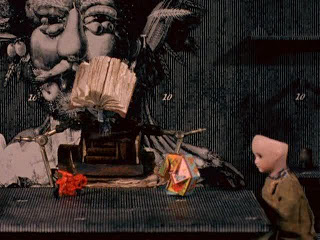 ‘The Cabinet of Jan Svankmajer’ is a documentary about the Czech master of surrealism.
It was made by the Quay Brothers with the sole purpose of being able to watch Švankmajer’s films themselves. Advertised to the BBC as a documentary on French and Czech surrealism, the film is rather highbrow, featuring artists and art historians, whose remarks are sometimes very difficult to grasp, indeed.
Unfortunately, the master himself refused to be interviewed and he is not shown at all. Luckily, Švankmajer’s strong images speak for themselves, and the documentary undoubtedly helped to raise interest in Švankmajer’s films in the West.
The documentary shows excerpts from Švankmajer’s films ‘Dimensions of a Dialogue‘ (which de facto is shown in its entirety), ‘The Last Trick‘, ‘The Flat’, ‘Et Cetera‘, ‘Jabberwocky‘, ‘Historia Naturae, Suita‘, ‘The Ossuary‘, ‘Games with Stones‘, ‘Punch and Judy’, ‘Don Juan‘ and ‘The Fall of the House of Usher‘.
However, ‘The Cabinet of Jan Svankmajer’ is also interesting for animation buffs, even for the one who have seen all Jan Švankmajer’s films, for its original interludes, which are animated by the Quay brothers. These interludes have a truly Švankmajer-like atmosphere, highlighted by the reuse of music from Švankmajer’s films. They feature a Švankmajer-like teacher, made of household objects, and his apprentice, a doll, whose head is emptied in order to let him experience the world anew.
These interludes are no less than wonderful and form an animation short in itself, which is both a great homage to the Czech master and a showcase of the Quay brothers’ own art. In fact, the Quay Brothers compiled the interludes and these are available and widely known under the same name as the complete documentary, which is, in fact, eclipsed by the animated short version.
Watch the animated interludes from ‘The Cabinet of Jan Svankmajer’ yourself and tell me what you think:
‘The Cabinet of Jan Svankmajer’ is available on the DVD ‘Jan Svankmajer – The Complete Short Films’
Director: Michel Ocelot
Airing Date: December 21, 1983 – ?
Rating: ★★★½
Review:
 After the artistic successes of ‘Les trois inventeurs‘ (1979) and ‘La légende du pauvre bossu‘ (1982) Ocelot turned his skills to a gentle and entertaining television series for children.
The series, called ‘La princesse insensible’ (the insensitive princess), consists of thirteen episodes and has a very simple story line: a princess is so bored that nothing can amuse her. The king declares that when a prince manages to amuse the princess nonetheless, he will win her. In the 4 minute long episodes we watch several young princes, sorcerers in fact, trying to amuse her in her own theater, all in vain.
‘La princesse insensible’ uses a mixture of traditional and cut-out animation. Ocelot’s animation may be simple, no doubt due to a limited budget, but it’s very effective in its pantomimed action. The series’ design is elegant in its recreation of an 18th century atmosphere. The framing story is told in silhouettes, reminiscent of the work by Lotte Reiniger, but the theater scenes are in bright colors. The atmosphere is fairy-like and surreal throughout, helped by Christian Maire’s otherworldly music. In all, ‘La princesse insensible’ is a little charming series, which shows Ocelot’s delicate and unique voice in the animation world.
The separate episodes of ‘La princesse insensible’ are listed below:
1. Le Prince dompteur (The Tamer Prince)
This episode tells the framing story and shows us the first prince. He has a menagerie of trained fairy tale animals: a unicorn, a three-headed dog, a Chinese dragon and a phoenix.
2. Le Prince jardinier (The Gardener Prince)
The second episode, like all following episodes of ‘La princesse insensible’, starts without the framing story. Instead the story is told in the title song. After the intro, we watch the second prince performing right away. He’s a garden prince, able to make plants and flowers grow on the bare floors and pillars of the princess’s theater. When he fails to impress the princess, he disappears on an ever-growing tree.
3. Le Prince à transformations (The Transforming Prince)
The third prince trying to impress the insensible princess is the most interesting to animation fans. Being called the metamorphosis prince, he’s able to transform himself into all kinds of people and things. Ocelot uses some beautiful metamorphosis animation in doing so. The prince’s performance builds up to a great finale, in which the prince transforms himself into seemingly hundreds of things, which is depicted by the rapid showing of random pictures. This simple device works because we’ve seen the process of transformation just before that. It also adds a humorous touch to the fairy-like atmosphere, because many of the objects are anachronisms in the 18th century setting.
4. Le Prince sourcier (The Dowser Prince)
The fourth prince, the ‘diviner prince’, is able to sprout water everywhere, using a divining-rod, turning the princess’s theater into a fountain. One of the more fairy-like episodes of ‘la princesse insensible’, ‘Le prince sourcier’ is less impressive than the first three episodes. After these three, the diviner prince even fails to impress we viewers.
5. Le Prince qui fait semblant (The Pretender Prince)
The fifth prince trying to impress the princess is almost typically french: he’s a mime artist, miming (among others) that he plays the piano, rides a bicycle and even a motorcycle inside the princess’s theater. When he fails to impress the princess he even mimes that he commits suicide. Like ‘le prince à transformation’ this episode has an extra touch because of the anachronisms.
6. Le Prince météorologue (The Meteorologist Prince)
The sixth prince is called the weather prince, and he’s able to make clouds dancing within the princess’s theater. He also makes rain, lightning and a rainbow. When he leaves the princess unimpressed, he covers himself in snow. One of the lesser episodes of ‘la princesse insensible’, ‘le prince météorologue’ nevertheless shows Ocelot’s fantasy. When one doesn’t expect any more meteorological wonders, the prince transforms the rainbow into numbers and patterns.
7. Le Prince sous-marin (The Underwater Prince)
The seventh prince arrives in a fish-like submarine inside an enormous fish-tank. Compared to the other princes, his antics are relatively believable, although he seems to have the ability to make fish forming patterns. This episode is one of the lesser entries in the series, despite the beautiful old-fashioned design of the princes’ submarine.
8. Le Prince volant (The Flying Prince)
The eight prince, the flying prince, looks like a Japanese superhero with wings. During his flight, we see more of the theater than in any other episode. Apparently there’s more public than the princess alone.
9. Le Prince décorateur (The Decorator Prince)
The decorator prince is able to turn the complete theater upside-down, to change its colors by clever lighting. When the princess is unimpressed as ever, he descends into the basements.
10. Le Prince magicien (The Magician Prince)
This prince is called the ‘magician prince’, even though many of the other princess were skilled magicians as well. The prince enters on a flying carpet and turns the pillars of the theater into palm trees, the chandelier into a beach ball and the stone ornaments into butterflies. Then he turns his own hat into a zeppelin and the furniture into a train. Enraged by the princess’s non-reaction, the prince makes everything disappear again, including the theater and himself.
11. Le Prince peintre (The Painter Prince)
The Painter prince episode, unlike the other episodes, has some false starts, as the prince repeatedly forgets something he needs to paint his enormous canvas. The painter exactly copies the theater on his canvas, then paints a happy portrait of the princess. But when she remains unimpressed, he violates his own drawings. It’s charming to see the shadows of Ocelot’s paper figure of the painter, while he’s painting the enormous canvas. It gives the series its handicraft appeal.
12. Le Prince artificier (The Artificer Prince)
The fireworks prince, like the painter prince, knows some false starts, when he has troubles preparing the fireworks in the dark. The fireworks effects are created nicely with kaleidoscope effects into beautiful abstract patterns. The prince also illuminates the theater with neon lights. In the end the prince disappears on a rocket, after which the complete theater explodes.
13. Le Prince écolier (The Schoolboy Prince)
The last prince, ‘the schoolboy prince’, is much less skilled than the other princes, but he immediately solves the princess’s problem: she appears to be terribly nearsighted, and he helps her with his glasses. They are married, and the other princes perform for the princess once again, which leads to a sequence with highlights from the previous episodes.
‘La princesse insensible’ is available on the DVD ‘Les trésors cachés de Michel Ocelot’
Directors: Tony Benedict, Gerry Chiniquy, Art Davis, David Detiege & Friz Freleng
Airing Date: April 1, 1980
Stars: Daffy Duck, Foghorn Leghorn, Miss Prissy, Sylvester, Speedy Gonzales
Rating: ★
Review:
 ‘Daffy Duck’s Easter Egg-Citement’ is an Easter-themed Looney Tunes television special produced by DePatie-Freleng.
Unlike Chuck Jones in ‘Bugs Bunny in King Arthur’s Court‘ Friz Freleng doesn’t attempt to tell one long story in the 25 minutes he’s got. Instead, we have three: the first evolves around Miss Prissy, who, in Foghorn Leghorn’s egg farm, lays a golden egg. Daffy and Sylvester find it, and fight eachother for it. This episode contains the only fine piece of animation of the whole special: the depiction of a paranoid Daffy in a car.
In the second episode Daffy is a guard at a chocolate bunny factory, protecting it against Speedy Gonzales, and in the third Daffy tries to go south, trying several options, including a horse. This part reuses the horse from the Pink Panther cartoon ‘Pinto Pink’ (1967) and some of its gags, too.
These stories are framed with Daffy in a very ‘Duck Amuck‘-like setting. Like ‘Bugs Bunny in King Arthur’s Court’ ‘Daffy Duck’s Easter Egg-citement’ suffers from bad designs (especially Foghorn Leghorn, who’s not a Freleng character, is badly drawn), can music, slow timing and excessive dialogue.
Director: Chuck Jones
Airing Date: February 23, 1978
Stars: Bugs Bunny, Daffy Duck, Porky Pig, Elmer Fudd, Yosemite Sam
Rating: ★
Review:
 The Looney Tunes Television Specials were a series of 25 minute long television programs running from 1976 to 1989 and revisiting the classic Warner Brothers characters in all new material. They were produced by either Chuck Jones’ studio or De Patie-Freleng.
‘Bugs Bunny in King Arthur’s Court’ is the fourth within the series, and produced and directed by Chuck Jones. The story is loosely based on Mark Twain’s ‘A Connecticut Yankee in King Arthur’s Court’ from 1889, as Jones readily admits in the opening titles. It features Bugs Bunny as himself, Elmer Fudd as a knight, Daffy Duck as a very unlikely King Arthur, Yosemite Sam as Merlin, and Porky Pig as an anonymous soldier.
Although Jones’s mastery shines through at times, the episode is a sad caricature of the old cartoons. Just nothing seems right. The designs are weak, especially that of Yosemite Sam (not a Jones character), who is too small compared to the others. Moreover, the timing is remarkably slow, and there’s way too much dialogue, slowing down the animation. The gags are further hampered by Dean Elliott’s terrible, partly electronic music. Even Mel Blanc’s voices are poor: his imitation of Arthur Q. Bryan’s voice of Elmer Fudd is nothing like the real thing, and Porky Pig simply stutters too much.
The episode’s trite story is expanded over 24 minutes, while, considering its flaws, it would already have been difficult to remain interesting within seven minutes. The result is a 24 minute long bore. The 1970s were the middle ages of animation, indeed…
Watch ‘Bugs Bunny in King Arthur’s Court’ yourself and tell me what you think:


 Dr. Grob's Animation Review