
You are currently browsing the category archive for the ‘Television programs’ category.
Director: Albert Barillé
Airing date: November 13?, 1982
Rating: ★★★★★
Review:
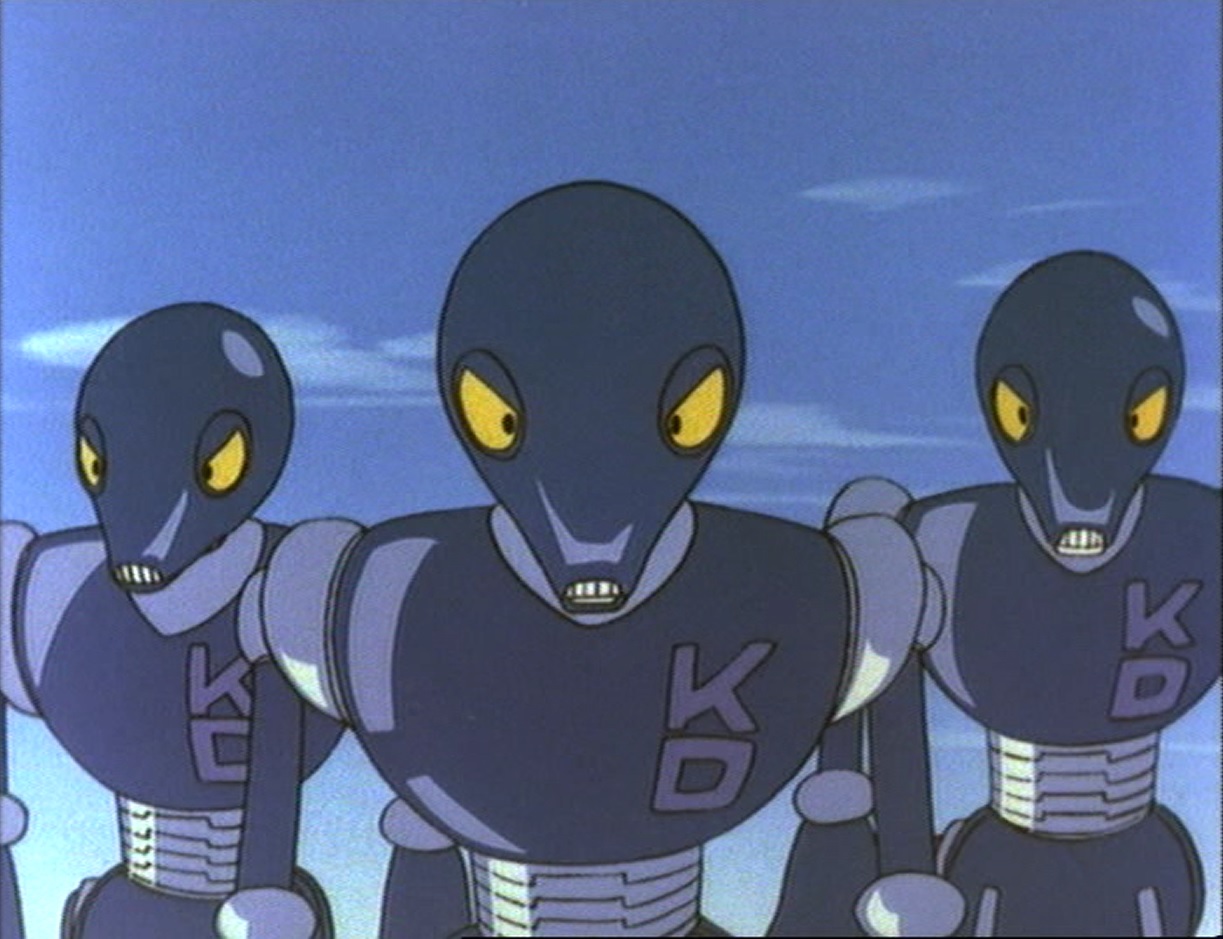 La révolte de robots’ is the first highlight in the ‘Il était une fois… l’espace’ series.
Unlike the earlier episodes the threat does not come from stock villain Cassiopeia, but from a rebelling robot planet called Leto. We’re introduced to this planet first, with our heroes only entering the scene after twelve minutes. Our heroes save the day, especially the little robot Metro, who battles a large robot, which looks like a copy from Grendizer (Goldorak), the famous robot from the Japanese 1970s series of the same name.
However, who is really responsible for the robots’ rebellion remains unknown. This would grow into the series’ most important story element, dominating its great last third. If anything, this episode shows the risks of man’s dependency on technology, but Barillé clearly states that humans are superior to robots, something he tries to illustrate rather unconvincingly in this episode. The whole argument of humans vs. machines would come back with a vengeance in the 23rd episode, ‘Le grand ordinateur‘.
Watch ‘La révolte des robots’ yourself and tell me what you think:
This is the 6th episode of ‘Il était une fois… l’espace’ (Once Upon a Time… Space)
To the 5th episode: Les Cro-Magnons (The Cro-Magnons)
To the 7th episode: La planète Mytho (The Planet Mytho)
Director: Albert Barillé
Airing date: November 6?, 1982
Rating: ★★★½
Review:
 This is the fourth episode of ‘Il était une fois… l’espace’ in which the evil constellation of Cassiopeia threatens a green and primitive planet in the Andromeda galaxy.
This time it’s the planet Diane, which is inhabited by humans, who apparently have descended from humans from earth. Against the regulations, Pierot and Psi visit the small population, who, like the title suggests, live like Cro-Magnons.
Like in ‘Il était une fois… l’homme’ this population knows its own versions of our main protagonists, so they have their own Pierrette, Maestro, le Teigneux and le Nabot. In the end, the visit by the people from Omega induces tales of Gods within the Cro-Magnon population, echoing the ideas of Erich von Däniken.
This episode opens in a neighborhood and a bar on Omega that is very similar to Mos Eisley in ‘Star Wars’ (1977), one of quite a few influences of that film on Barillé’s series. The most interesting part, however, is the computer search for the planet Cassiopeia probably wants to invade, showing several planets inhabited by weird alien creatures.
Watch ‘Les Cro-Magnons’ yourself and tell me what you think:
This is the 5th episode of ‘Il était une fois… l’espace’ (Once Upon a Time… Space)
To the 4th episode: Du côté d’Andromède (Towards Andromeda)
To the 5th episode: La révolte des robots (The Revolt of the Robots)
Director: Albert Barillé
Airing date: October 30?, 1982
Rating: ★★★
Review:
 ‘Du côte d’Andromède’ is the first episode of Il était une fois… l’espace in which Pierrot, his love Psi, and the little robot Metro are presented as a team.
Psi replaces Pierrot’s former co-pilot, Petit Gros, whose star would soon fade away. The trio’s routine inspection flight turns into a disaster when they crash into the planet Clarus, which orbits a dying star. In search of fresh air, our heroes meet a people called Terks, who are outcasts from Andromeda.
They also discover that the Terks are secretly armed by the evil constellation of Cassiopeia in order to invade Andromeda, making Clarus the third of four planets in the Andromeda Galaxy Cassiopeia is trying to use for an invasion. Naturally, the Terks aren’t fond of spies, and our heroes are about to get executed, when their friends from Omega come to the rescue.
Like ‘La planète verte‘, ‘Du côte d’Andromède’ shows Barillé’s love to show and explain political manipulations to children. This episode also introduces the vague, angel-like creature who visits Psi and tells her that evil will never win.
Watch ‘Du côté d’Andromède’ yourself and tell me what you think:
This is the 4th episode of ‘Il était une fois… l’espace’ (Once Upon a Time… Space)
To the 3rd episode: La planète verte (The Green Planet)
To the 5th episode: Les Cro-Magnons (The Cro-Magnons)
Director: Albert Barillé
Airing date: October 23?, 1982
Rating: ★★★
Review:
 Unlike the majority of the episodes of ‘Il était une fois… l’espace’, ‘La planète verte’ starts with politics: we witness a political conflict between Omega and Cassiopeia.
Like in ‘Les Sauriens‘, Cassiopeia tries to invade a green, primitive planet in the Andromeda section (something they would also try to do in the fifth episode). Only after more than eight minutes our heroes Pierrot and Petit Gros enter the stage. They check the planet, which turns out to be inhabited by intelligent plants, who have captured their invaders, including general Teigneux (The Pest) and ambassador Nabot (Dwarf) themselves.
This episode show us more of Cassiopeia than the two previous episodes. This society turns out to be very militaristic with Nazi-like characteristics. Because of Cassiopeia’s more prominent role, ‘La planète verte’ is more interesting than the previous two episodes, if not too exciting.
Watch ‘La planète verte’ yourself and tell me what you think:
This is the 3rd episode of ‘Il était une fois… l’espace’ (Once Upon a Time… Space)
To the 2nd episode: Les Sauriens (The Saurians)
To the 4th episode: Du côté d’Andromède (Towards Andromeda)
Director: Albert Barillé
Airing date: October 16?, 1982
Rating: ★
Review:
 In this second episode of ‘Il était une fois… l’espace’ the feisty little robot Metro gets his name.
Metro joins Pierrot and Petit Gros on their first mission. The trio explores a Jurassic planet inhabited by large iguana-like people who communicate by telepathy.
If anything, this episode shows how differences between cultures can lead to aversions and misunderstandings. Nevertheless, it is one of the slowest and weakest episodes of the series.
Watch ‘Les Sauriens’ yourself and tell me what you think:
This is the 2nd episode of ‘Il était une fois… l’espace’ (Once Upon a Time… Space)
To the 1st episode: La planète Omega (The Planet Omega)
To the 3rd episode: la planète verte (The Green Planet)
Director: Albert Barillé
Airing date: October 9, 1982
Rating: ★★½
Review:
 After the success of ‘Il était une fois… l’homme’ (Once upon a Time… Man) Albert Barillé returned with the boldest and most artistic children series of his entire career.
Largely abandoning education, the raison d’être of his last series, he embarked on a fictional and after a while remarkably integrated story, set in the far future, telling about a United Nations-like intergalactic union, and its problems.
Even more than the previous series, ‘Il était une fois… l’espace’ (Once upon a Time… Space) is a vehicle of Barillé’s highly personal views on the world and mankind. The series expresses a strong love for nature and mutual understanding, and an aversion to imperialism, war and, to a certain extent, technology.
New is a strong spirituality, embodied by the mild, and vaguely South American-looking girl Psi, who possesses psychic powers. Unlike the other main characters, she had not been in the original series, and she is less stereotypical than the rest of the cast. Her role in this first episode (in which she’s introduced as ‘Mercedes’, but everyone calls her ‘Psi’) is still minor, but soon she would become as important as Pierrot (Peter), the series’ main hero.
Pierrot, like all other good guys from ‘Il était une fois… l’homme’ has been redesigned and fixed into a single role. Pierrot now is a guy in his early twenties. Petit Gros (Jumbo), too, has changed. He is less dim, less strong and less obese than in the original series. In fact, he’s only recognizable by his red hair. His dad is equally slender and has grown a blonde mustache, while a stern-looking Pierre, head of the intergalactic police, is fixed at an older age (say 50).
The most surprising transformation may be that of Pierrette, who is head of the Union, and who has received a modern hairdo and some fancy glasses. By placing her as head of the union Barillé makes a strong feminist statement that was still pretty bold in the early 1980s. The only characters to remain the same are Maestro, and the two villains Le Nabot (The Dwarf) and Le Teigneux (The Pest). Remarkably, children are totally absent from the series.
In this first episode of ‘Il était une fois… l’espace’ Maestro conceives the little robot Metro, who would play a major part in the series, eclipsing his master, while Le Teigneux and le Nabot are introduced as the ambassador and general of Cassiopeia, a galaxy with militaristic ambitions, but which is part of the Union nonetheless. Taking time in introducing all these characters, there is very little action in ‘La planète Omega’. Nevertheless, the stage is set when the Union is confronted by an unknown spaceship of some supreme alien race…
Apart from Barillé’s original story and its classic characters, ‘Il était une fois… l’espace’ is a highlight of television animation because of its great music by Michel Legrand and its superb backgrounds by Philippe Bouchet, Manchu and Afrula Hadjiyanakis. This trio clearly draws inspiration from contemporary science fiction illustrators like Lukas Foss, Colin Hay, Angus McKie and Tony Roberts.
The animation itself, by the Japanese Eiken studio, is better than in ‘Il était une fois… l’homme’, but it’s still mediocre and uneven, and especially the designs of Psi are far from consistent. This would remain a problem throughout the series, together with a sometimes terribly slow narration. These drawbacks, however, do not overcome the series’ merits, and ‘Il était une fois… l’espace’ may be praised as Barillé’s masterpiece.
Watch an excerpt from ‘La planète Omega’ yourself and tell me what you think:
This is the 1st episode of ‘Il était une fois… l’espace’ (Once Upon a Time… Space)
To the 2nd episode: Les Sauriens (The Saurians)
Director: Ward Kimball
Airing date: December 28, 1955
Stars: Walt Disney, Ward Kimball, Wernher von Braun
Rating: ★★★
Review:
 After ‘Man in Space‘ (1955), ‘Man and the Moon’ is the second of three Disneyland broadcasts documenting man’s plans to conquest space.
‘Man of the Moon’ deals with the conquest of the moon, and consists of four parts. The first, largely animated, tells about man’s fascination for the moon, depicting the moon in mythology, in literature, in folklore, in nursery rhymes and in song. This sequence is a highlight of ‘cartoon modern’ style, and is full of director Ward Kimball’s trademark zany humor. It’s also the highlight of the documentary, despite the studio’s efforts to evoke the first mission to the moon in the fourth part. The folklore section is the most bold part featuring a highly stylized man, but even better are the charming animated children’s drawings in the nursery rhyme section. The sequence ends hilariously with a silly tin pan alley song about the moon, in which the writers throw in every obvious rhyme word (June, swoon, spoon, honeymoon, and even Daniel Boone).
After 18 minutes of great animation, the live action sections start, beginning with the second part. This is the shortest of the four, and features Ward Kimball in real person, telling us facts about the moon. The third part is hosted by German rocket scientist Wernher von Braun, who tells about a possible mission to the moon. Surprisingly, Von Braun does not try to land on the moon, but merely wants to fly around it. His plans involve the assembly of a giant wheel-like space station before even one vessel is flown to the moon.
His plans are shown in the fourth part as an “on the spot account of the first expedition to the moon”. Unfortunately, this is not as exciting a finale it possibly was in 1955, despite the dramatic music and the inclusion of an emergency scene in which a small meteor hits one of the fuel tanks. Nevertheless, the special effects are quite good, showing the space station rotating, and smaller reparation vessel leaving the moon rocket. Especially, weightlessness within the moon rocket is shown quite convincingly.
In 1957 Disney even showed more ambitious space plans, in ‘Mars and Beyond’.
Watch ‘Man and the Moon’ yourself and tell me what you think:
Directors: William Beaudine & Wilfred Jackson
Airing date: November 30, 1955
Stars: Walt Disney, Gertie the Dinosaur, Colonel Heeza Liar, Silas Bumpkin, Bobby Bumps, Felix the Cat, Koko the Clown
Rating: ★★★★★
Review:
 Walt Disney himself hosts a Disneyland television episode on the history of animation, from the humble attempts to capture movement in drawing in the caves of Lascaux to his own masterpiece ‘Fantasia’ (1940).
Disney demonstrates some early devices of animation like the thaumatrope, the phenakistoscope, the zoetrope and the praxinoscope, showing that animation in fact predates cinema. One of the highlights of the program is the complete showing of one of Charles-Émile Reynaud’s animated “films” for his own praxinoscope device. The other one is the reenactment of Winsor McCay’s vaudeville show with Gertie the Dinosaur (1914). This part alone makes the episode worthwhile watching, as McCay’s classic work becomes even stronger in its vaudeville context.
More animation from other early studios is shown, like Bray’s Colonel Heeza Liar, Raoul Barré’s Silas Bumpkin, Earl Hurd’s Bobby Bumps and Pat Sullivan’s Felix the Cat.
Disney also plays tribute to his old rival, Max Fleischer, by showing a Koko the Clown cartoon, accompanied by organ playing by his own cartoon composer, Oliver Wallace. The show ends with one of Walt Disney’s major achievements, the Nutcracker Suite from’Fantasia'(1940), which, unfortunately, is shown in black and white.
Watch ‘The Story of Animated Drawing’ yourself and tell me what you think:
‘The Story of Animated Drawing’ is available on the DVD ‘Walt Disney Treasures: Behind the Scenes at the Walt Disney Studio’
Director: Ward Kimball
Airing Date: March 9, 1955
Stars: Walt Disney, Ward Kimball, Wernher von Braun
Rating: ★★★★
Review:
 ‘Man in Space’ is a Disneyland special about man’s conquest of space, which, two years before the launching of Sputnik, was still a dream at that time.
The documentary includes information about rockets, weightlessness and concludes with an exciting account of man’s first space travel, based on the designs by rocket engineer Wernher von Braun. Von Braun is one of three German scientists featured in the program, the others being Willy Ley and Heinz Haber, demonstrating the enormous influence of German scientists on American science. Ley had fled Nazi Germany in 1935, but Haber stayed there till the end of the war, and Von Braun was even responsible for the deadly V2 rocket, a technical tour-de-force, but also the Nazi regime’s most fearful weapon.
‘Man in Space’ is shortly introduced by Walt Disney himself, quickly giving the presentation to director Ward Kimball, who remains the main host of the program. Kimball is clearly in his element here. His own wacky cartoon animation style is featured in a short history of man’s attempts to enter space, and in Haber’s accounts of ‘space medicine’. Indeed, he later called the space series, of which ‘Man in Space’ is the first entry, the creative high point of his career.
Throughout the movie, the use of animation is sparse, however, and the animation itself very limited. Nevertheless, its use is very effective, especially in the visionary concluding part, with its typical fifties science fiction designs.
‘Man in Space’ would be followed by ‘Man and the Moon‘ (1955) and ‘Mars and Beyond’ (1957), taking ideas on space travel even further.
Watch ‘Man in Space’ yourself and tell me what you think:
Director: Osvaldo Cavandoli
Release Date: 1974
Stars: La Linea
Rating: ★★★★
Review:
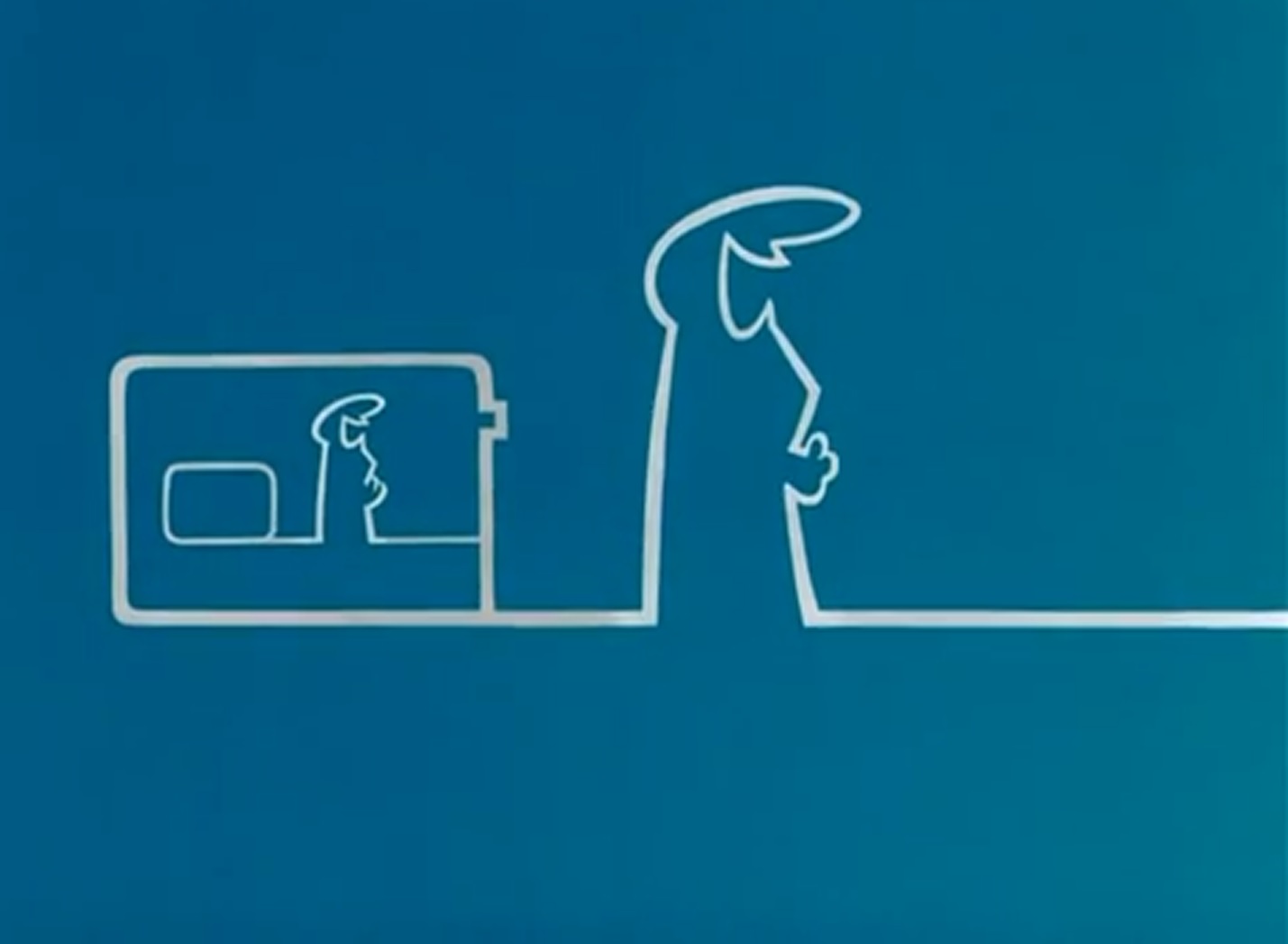 La Linea is an Italian television series, which takes graphic design, introduced by UPA to the animated screen, to the max.
The first of all La Linea shorts defines the complete series: it consists of numerous unrelated gags around the jabbering little man Linea, who lives in a 2-dimensional world, consisting of only one white line, of which he is part.
This cheerful, but temperamental guy has some characteristics that return in every single episode: First, he talks an Italian-sounding sort of gibberish, provided by voice actor Carlo Bonomi. Second, he always walks to the left of the screen. Third, he always encounters at least one interruption of the line during his walk. Fourth, he frequently argues with his off-screen creator, of whom we only see his hand drawing things for the little guy. And Fifth, our hero has also has an intoxicating laugh, which is heard at least once.
All designs are extremely stylized, yet perfectly recognizable, and beautifully animated. The backgrounds are monochromic, changing from green to red to blue etc. All these elements make this series such a classic, even though most of the episodes are completely plotless, and only last about 2 minutes.
In this particular episode La Linea encounters a turtle, a television set, a tap and a woman. He plays golf and takes a rollercoaster ride. It doesn’t make any sense, but it’s fun. Franco Godi’s music in this particular cartoon is more present than in the following ones, using a tune with voices instead of the instrumental background music of later cartoons.
Watch ‘La Linea episode 1’ yourself and tell me what you think:
‘La Linea episode 1’ is available on the DVD ‘La Linea 1’
Director: Chuck Jones
Airing Date: December 18, 1966
Rating: ★★★★★
Review:
 ‘How The Grinch Stole Christmas’ is a wonderful Christmas cartoon. The Christmas of a little town called the Whoville is threatened by a green character called the Grinch, who disapproves of Christmas, and particularly the noise involved. He decides to ‘steal’ Christmas from the little creatures, but then he discovers that Christmas is not restricted to objects.
This special, lasting 26 minutes, is one of Chuck Jones’s productions for MGM television. It’s a very faithful and beautiful reading of the classic Dr. Seuss children’s book, keeping Dr. Seuss’s rhymes and faithfully reproducing its designs, but extending those by long and beautiful silent comedy scenes and Jones’s wonderful facial expressions, to even better results.
Especially the Grinch himself is a wonderfully expressive character. In him Jones’ mastery of facial expression reaches its apex. Particularly amazing is the scene in which the Grinch thinks up his evil plan, making his face curl with wickedness.
The story is told by Boris Karloff’s grim voice, and it contains two songs: a rather annoying Christmas song sung by the Whos and an odd song describing the meanness of the Grinch. While we hear this song, we see the Grinch steal every Christmas item in Whoville.
All in all, it’s a classic. It’s arguably the best Dr. Seuss adaptation ever, and certainly one of the best Christmas cartoons ever made. It’s certainly better than the rather annoying live action remake from 2000.
Watch ‘How The Grinch Stole Christmas’ yourself and tell me what you think:
https://myspace.com/171601491/video/how-the-grinch-stole-christmas/47941731


 Dr. Grob's Animation Review